TL;DR — We gave Gamma and Divrite the same six briefs that an analyst or consultant might take on: GLP-1 market sizing, a three-country market entry, an Nvidia earnings breakdown, a tool selection, the EU AI Act’s rules for general-purpose models, and the research on remote work. Each tool made a 20-slide deck per brief, and we scored all twelve decks against the same 100-point scorecard. Divrite averaged 88 and Gamma 52, and Divrite came out ahead on all six briefs. The gap is not about looks. Gamma’s slides are clean and easy to read, but they leave out things a client will ask about, and two of them would lead a reader to the wrong conclusion. Slide by slide, the extra detail on Divrite’s decks is what a presenter needs when the questions start, and the same research can also come out as a reading version or a speech version with a script.
The result in one table
| Brief | Divrite | Gamma | What went wrong for Gamma |
|---|---|---|---|
| GLP-1 weight-loss drug market | 86 | 44 | Planning figure for 2030 built on forecasts the banks have since raised |
| US SaaS entering Germany, France and Japan | 88 | 54 | Missed Japan’s 2026 privacy-law amendment |
| Nvidia Q3 FY2027 results | 95 | 56 | Says Jensen Huang is out as CEO; Nvidia announced his return on Nov 23, 2026 |
| AI presentation tools for a 20-person sales team | 84 | 54 | Lists two tools as “confirm quote” although both publish prices |
| EU AI Act: duties for general-purpose AI providers | 90 | 52 | 10 slides delivered of the 20 asked for |
| Remote and hybrid work: the evidence since 2020 | 85 | 54 | Leaves out the studies that cut against its verdict |
| Average | 88 | 52 |
| Scorecard dimension (points) | Divrite | Gamma |
|---|---|---|
| Coverage of what the brief asks (25) | 23.8 | 14.6 |
| Depth of content per slide (20) | 18.1 | 8.6 |
| Charts and visuals that carry information (20) | 13.6 | 1.0 |
| Structure and conclusion-led titles (15) | 13.7 | 11.0 |
| Export: does the file open as it was built (10) | 9.7 | 9.3 |
| Accuracy of the numbers (10) | 9.1 | 7.6 |
Each brief had a neutral checklist of the points a correct answer has to cover. On average Divrite’s decks covered 95% of them and Gamma’s 58%. Across the six briefs Gamma left out 36 checklist points entirely.
Four ways a thin deck fails in front of a client
Missing content sounds abstract. Here is what it does to the person presenting.
1. The conclusion is wrong
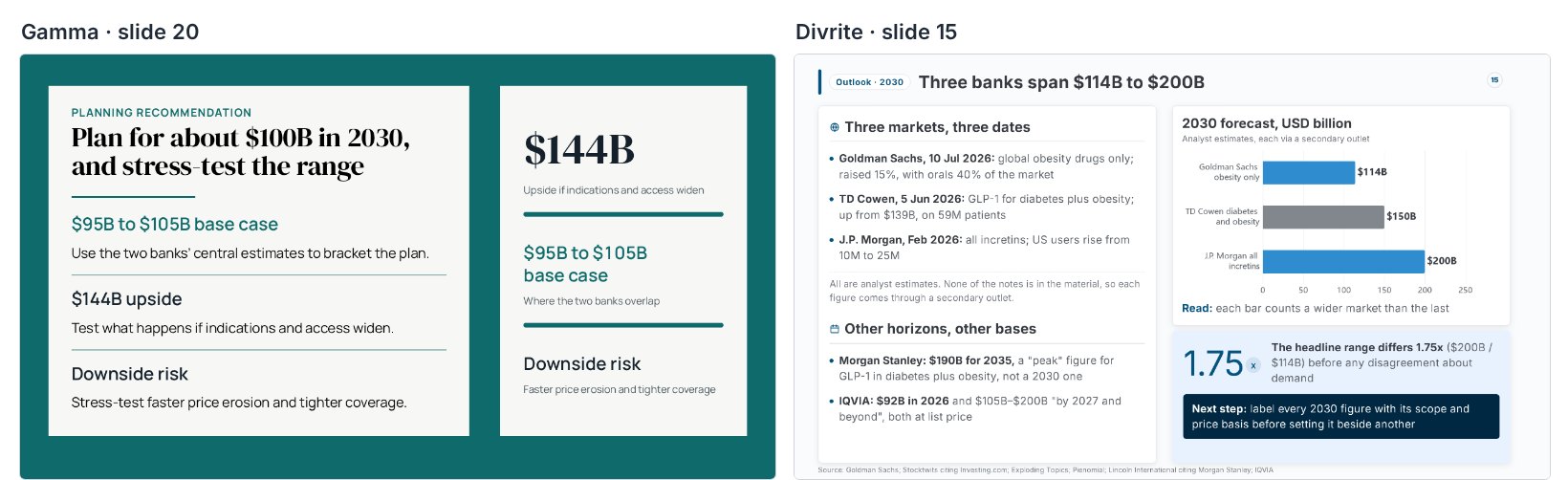
The GLP-1 brief asks for the 2030 outlook and where the forecasts disagree. Gamma’s closing slide tells the reader to “plan for about $100B in 2030”, using Goldman Sachs at $95B and Morgan Stanley at $105B. Both figures are out of date. Goldman raised its 2030 estimate to $114B in mid-2026, above Gamma’s whole planning range. Gamma’s deck also leaves out three things that move the forecast: the FDA ended the GLP-1 shortages in 2024 and 2025, compounded versions still compete for cash-paying patients, and semaglutide generics begin in Canada and other markets in 2026.
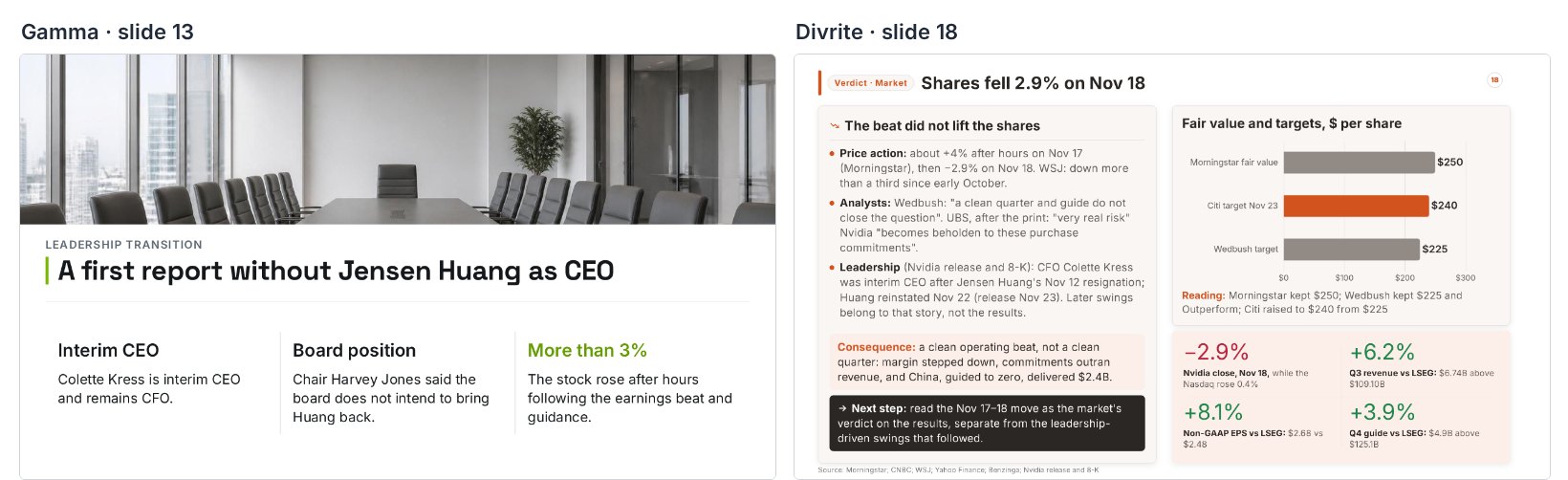
The Nvidia brief has the same problem with a newer fact. Gamma’s leadership slide says Colette Kress is interim CEO and that the board does not intend to bring Jensen Huang back. Nvidia announced Huang’s return as CEO on Nov 23, 2026, in an 8-K filing. Gamma’s deck also doesn’t say that Nvidia changed how it reports its business this fiscal year, or that its non-GAAP figures stopped excluding stock-based compensation. Comparing this quarter’s non-GAAP EPS with last year’s figures gives the wrong growth rate.
2. The presenter sees half the picture
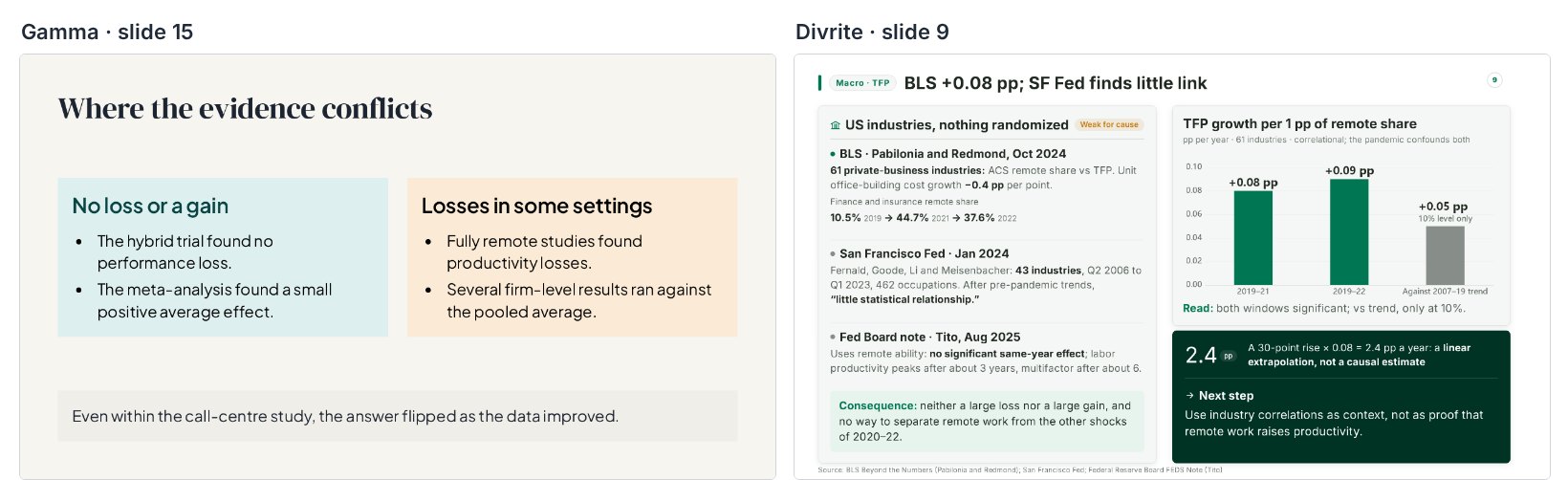
The remote-work brief asks how strong each study is and where the evidence conflicts. Gamma’s deck reaches a verdict (“hybrid is safe, fully remote is riskier”) from part of the evidence. It leaves out ten checklist points, including the US Patent and Trademark Office study where work-from-anywhere raised output, the research on what remote work costs junior engineers in training, and the conflict between the BLS (a positive link between remote work and productivity growth) and the San Francisco Fed (little link). A presenter who only saw Gamma’s deck would not know the other half exists.
3. No answer to “where is that number from?”
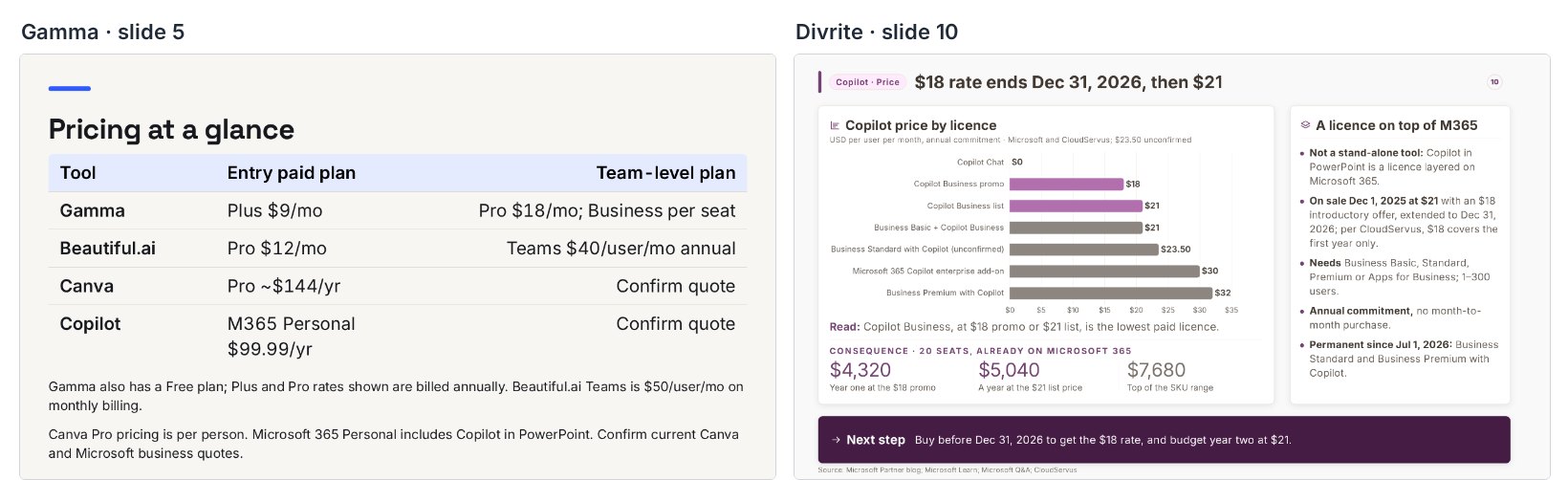
Four of Gamma’s six decks have no source line on any slide. In the tool-selection brief, Gamma lists Canva and Microsoft Copilot as “confirm quote”, although both publish business prices, and its recommendation then compares only the two tools it had prices for. When a sales leader asks what 20 seats of Copilot cost for a year, Gamma’s deck has no answer. Divrite’s slide gives $4,320 at the introductory rate and $5,040 at list price, with the date the rate ends.
Every Divrite content slide names its sources in the footer. In the app, each slide also carries a “sources for this page” note that points each fact to the page it came from. The research behind each of the six decks read between 151 and 290 web pages.
4. Rework before it can go to a client
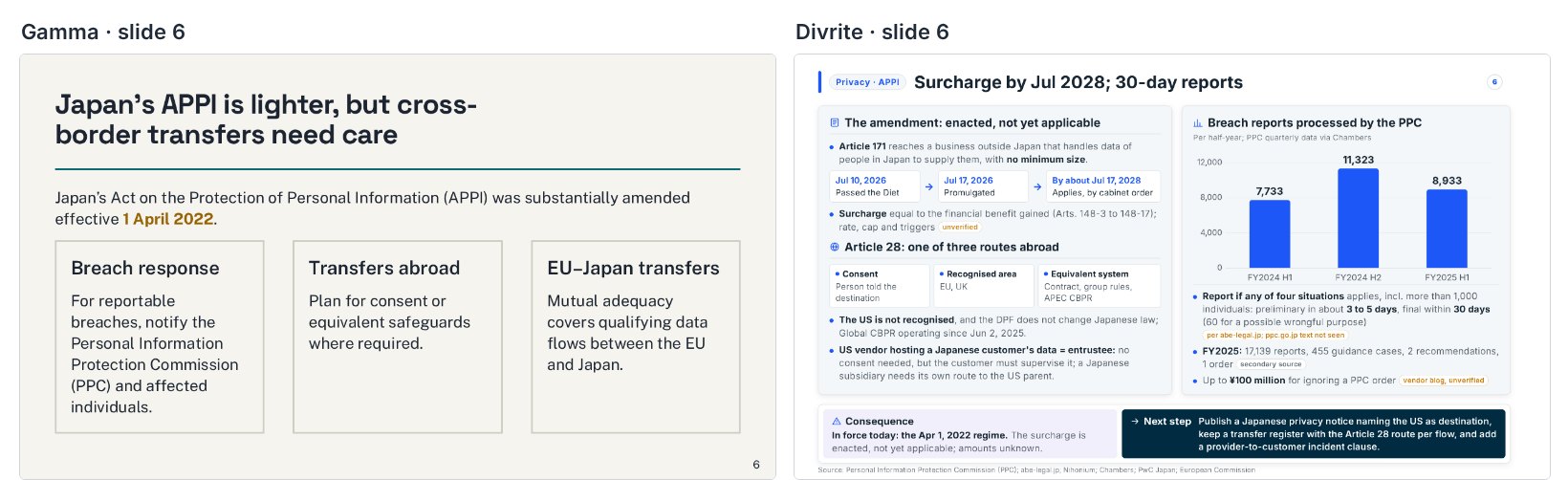
In the market-entry brief, Gamma describes Japan’s privacy law (APPI) as it stood after 2022. Japan amended it on July 10, 2026, adding administrative surcharges. Gamma also misses whether the German and French e-invoicing mandates apply to a company with no local entity, and Japan’s invoice rules for foreign digital-service providers. Those are the questions that decide the entry sequence.
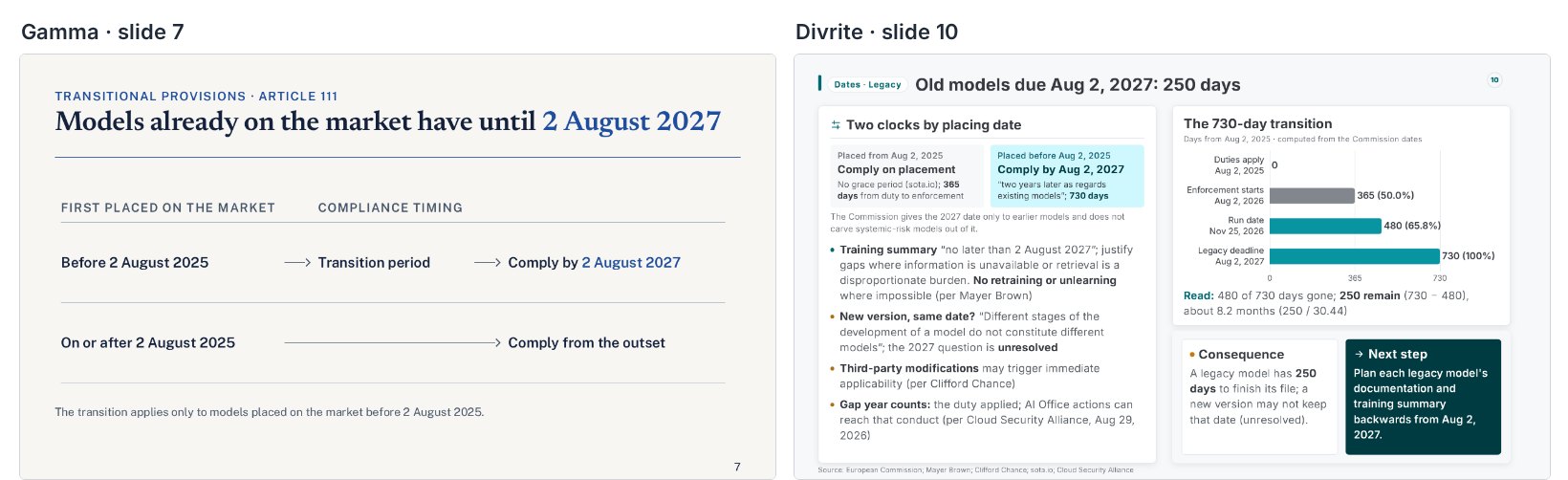
The EU AI Act deck shows a different gap. Gamma was set to 20 slides and delivered 10. Its numbers were right, but the deck leaves out which providers signed the code of practice, what the AI Office can do now that its enforcement powers apply, and the relief the Commission’s guidelines give models already on the market.
Taken together, a consultant who started from Gamma’s deck would have to redo most of the research before sending it. With the Divrite decks, the fixes before sending were one or two small corrections per deck.
Slide by slide: what the extra detail is for
A Divrite slide carries about three times the words of a Gamma slide. The fair question is whether those words earn their place. Here are the six pairs shown above, with each detail on Divrite’s slide that Gamma’s lacks and what it changes for the person presenting.
GLP-1, the 2030 outlook (Gamma slide 20, Divrite slide 15)
| Detail on Divrite’s slide | Why it matters |
|---|---|
| The date of each forecast: all three are 2026 figures | Shows which figures are current. Gamma’s $95B and $105B are from 2024 and 2025 |
| The direction of revisions: Goldman went from $101B to $114B | The forecasts are moving up, the opposite of a $100B plan |
| The market each figure measures: obesity only, diabetes plus obesity, all incretins | Most of the range is different scopes, not disagreement: 1.75× before anyone argues about demand |
| Figures that don’t belong in a 2030 range: Morgan Stanley’s $190B is a 2035 peak; IQVIA is at list price | Stops a presenter from mixing a 2035 peak or a list-price figure into a 2030 range |
Japan’s privacy law (Gamma slide 6, Divrite slide 6)
| Detail on Divrite’s slide | Why it matters |
|---|---|
| The 2026 amendment: passed Jul 10, promulgated Jul 17, applies by about Jul 2028, with a surcharge equal to the financial benefit gained | Sets the compliance timeline. Gamma stops at the 2022 regime |
| Article 171 covers a business outside Japan that serves people in Japan, with no minimum size | Answers the first question a US company asks: does this apply to us at all |
| The three routes for data leaving Japan (Article 28), and that the US is not a recognised country | Gamma says “consent or equivalent safeguards where required”; Divrite says which route fits which data flow |
| A US vendor hosting a Japanese customer’s data is an entrustee: no consent needed, but the customer must supervise it | Decides the contract terms with Japanese customers |
| Breach reporting: preliminary in about 3 to 5 days, final within 30 days (60 for a possible wrongful purpose) | Gamma says “notify the PPC” with no deadline |
Nvidia, the market’s verdict (Gamma slide 13, Divrite slide 18)
| Detail on Divrite’s slide | Why it matters |
|---|---|
| Huang’s resignation on Nov 12 and his reinstatement, announced on Nov 23 | Gamma still has him out |
| Shares rose about 4% after hours, then fell 2.9% the next day while the Nasdaq rose 0.4% | Gamma stops at “rose after hours”, which reverses the market’s verdict |
| The size of the beat against consensus: revenue +6.2%, EPS $2.68 vs $2.48, Q4 guide +3.9% | Gives the numbers an investor will ask for |
| Why the beat didn’t lift the shares: margins stepped down, purchase commitments outran revenue, China guided to zero delivered $2.4B | The part of the story a client will push on |
| Fair value and targets after the print: Morningstar $250, Citi $240, Wedbush $225 | Answers “what does the Street think” without another search |
Microsoft Copilot pricing (Gamma slide 5, Divrite slide 10)
| Detail on Divrite’s slide | Why it matters |
|---|---|
| Copilot Business at $18 a user a month (introductory) or $21 (list) | Gamma writes “confirm quote” and drops Copilot from its recommendation |
| The introductory rate ends Dec 31, 2026 | Year two costs more; the budget needs both years |
| 20 seats a year: $4,320 at the introductory rate, $5,040 at list | The number a sales leader actually asks for |
| It needs a Microsoft 365 business plan, 1 to 300 users, annual commitment only | Rules the option in or out before anyone buys |
Gamma’s slide also lists Microsoft 365 Personal at $99.99 a year, a one-person consumer plan rather than one a sales team would buy.
EU AI Act, models already on the market (Gamma slide 7, Divrite slide 10)
| Detail on Divrite’s slide | Why it matters |
|---|---|
| 250 days left until Aug 2, 2027, counted in late November 2026 | Turns a date into a work plan |
| The Commission does not exempt systemic-risk models from the 2027 date | Matters most to the largest providers |
| Relief in the guidelines: gaps in the training summary can be justified; no retraining or unlearning where impossible | The operational question for models trained before the rules |
| A new version may not keep the 2027 date, and changes by a third party may make the rules apply at once | The risk that breaks a legacy plan |
Remote work, where the evidence conflicts (Gamma slide 15, Divrite slide 9)
| Detail on Divrite’s slide | Why it matters |
|---|---|
| BLS (Oct 2024): across 61 industries, each point of remote share goes with 0.08 points faster growth in total factor productivity | The main official evidence on the “helps” side, absent from Gamma’s deck |
| San Francisco Fed (Jan 2024): “little statistical relationship” once pre-pandemic trends are removed | The direct conflict the brief asks about |
| Fed Board note (Aug 2025): effects show up after about 3 to 6 years | Explains why short studies and long data disagree |
| A strength label: industry data, nothing randomized, weak for cause | Tells the presenter how far the numbers can be pushed |
Two habits run through all of these. Each Divrite body slide ends with a “Consequence” and a “Next step”, while Gamma’s decks mostly keep the action for the last slide. And each Divrite slide names its sources, so every row above can be traced.
One research run, three decks
The decks in this test are Divrite’s report version, made for presenting at a meeting. The same research can also come out as two other versions, chosen before generation:
| Version | Made for | Words per body slide (GLP-1 deck) | What changes |
|---|---|---|---|
| Reading | Sending to a client to read alone | about 330 | Each point carries its method, scope and caveats, so it reads without a presenter |
| Report | Presenting in a meeting | about 180 | One chart and a column of findings per slide, with “What it means” and “Next step” |
| Speech | Presenting live | about 46 | A one-line conclusion and one large chart; the detail moves into a spoken script of about 150 words per slide |
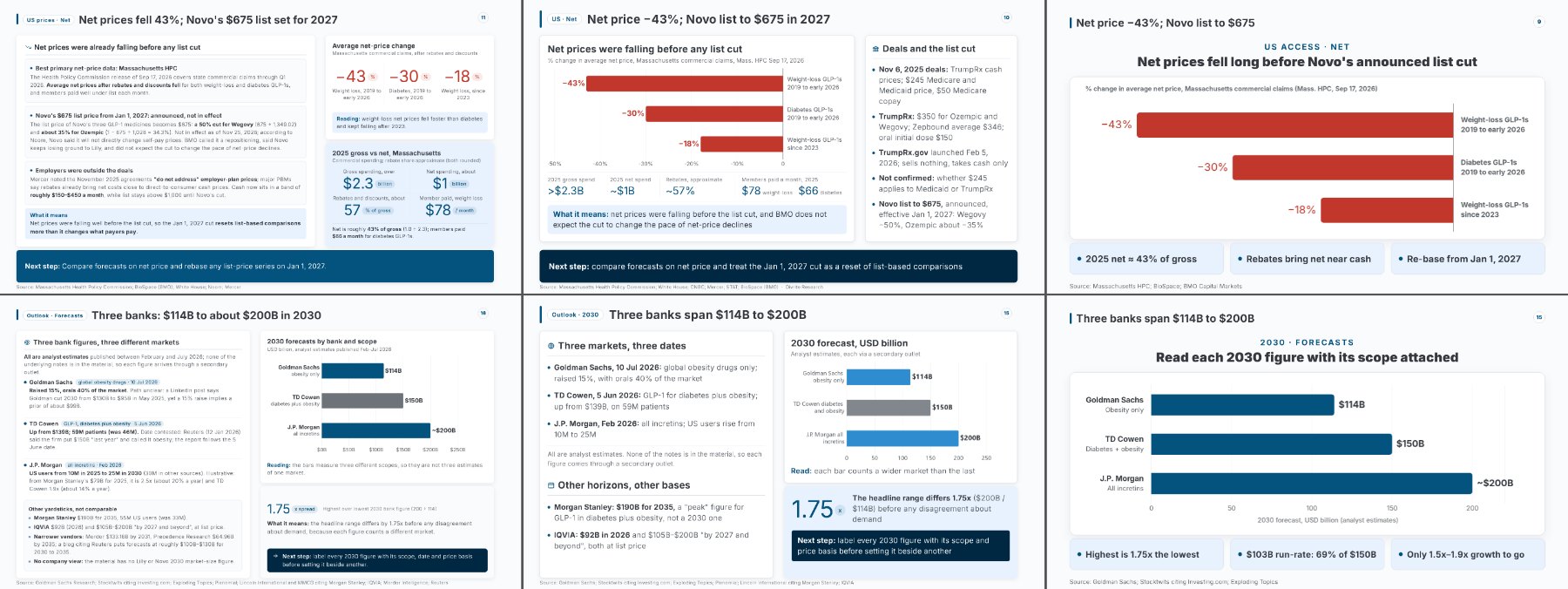
From left to right: reading, report and speech. The top row is US net prices and the bottom row the 2030 forecasts. The numbers are the same in all three; what changes is how much sits on the slide and how much moves to the notes. Gamma can set how much text each card holds, from brief to extensive. In this test it ran at its default.
Where Gamma did better
- Clean design. Larger type, more white space and one idea per slide, which reads well on a projector.
- Speed. Gamma drafts a deck while you watch. Divrite does the research first, which usually takes 10 to 30 minutes.
- Collaboration. Real-time co-editing, comments, and Manage, Edit, Comment or View permissions per workspace.
- Integrations. Gamma lists 38, including HubSpot, Slack and Zapier.
- Gamma Agent. Added in September 2025, it can restyle a deck, give design feedback and pull in cited research when you ask for it. Our test used Gamma’s standard generation.
For a short internal update or a pitch where the visuals matter more than the evidence, those are real advantages.
Divrite got things wrong too. In the sampled numbers our decks had four small errors and Gamma’s had four, besides the two that changed a conclusion. One of ours: the GLP-1 deck says it is not confirmed whether the $245 Medicare price also applies to Medicaid; the White House fact sheet says it does, and the same slide says so elsewhere. None of the errors in Divrite’s decks changed a conclusion, but a deck with 30 numbers per slide still needs a human read before it goes out.
What Divrite is built for
The briefs where Divrite pulled furthest ahead share one trait: the answer depends on many dated facts from many sources, and someone will check them. That is the work Divrite is made for.
Divrite is built for formal, serious work: decks and reports someone will make a decision from. Every deck comes with six things:
- Consulting-grade content, gathered widely and globally. Country questions are researched in each country’s own language, from official sources. In this test a Divrite slide carried about three times the words of a Gamma slide.
- Visuals that carry content. Charts built from the research data and diagrams of how things work; 13.6 of 20 for informative charts and visuals, against 1.0 for Gamma.
- A source behind every key figure. A source line on every content slide, and in the app each fact links to the page it came from.
- The report behind the deck. A full research report is written first, about 12,000 words per brief in this test, and you get it with the slides.
- Speaker notes for each slide, with the talk track and the sources.
- Three versions of the same research: reading, report and speech, shown above.
The briefs fall into six kinds of work:
- Investment and equity research. Earnings breakdowns, guidance against actuals, what changed from the prior quarter, and the market’s reaction. The Nvidia deck scored 95.
- Market sizing and industry outlooks. Current sales built bottom-up, analyst forecasts set side by side with their scope and date, and the assumptions that explain the spread. The GLP-1 deck shows each 2030 estimate with the market it measures.
- Trend and evidence reviews. What the research says, how strong each study is, and where the findings conflict, as in the remote-work deck.
- Policy and regulatory briefs. Obligations, deadlines and transition rules with their current status, as in the EU AI Act deck.
- Market entry and cross-border comparisons. The same questions answered country by country with dates.
- Competitive analysis and tool selection. Published prices turned into a cost for your team size, with the limits that decide the choice.
If the deck is a general, introductory one or a pitch where the look matters more than the evidence, Gamma is a fine choice. If someone will make a decision from it or ask where a number comes from, start with Divrite. For other tools, see Gamma alternatives: 10 AI presentation tools compared.
Features and pricing side by side
| Divrite | Gamma | |
|---|---|---|
| Built for | Research-heavy decks: investment research, market sizing, policy and trend analysis | Fast, polished decks from a prompt or your own notes |
| Sources on the slides | A source line on every content slide, plus a per-slide source note in the app | Source lines on 2 of 6 test decks; Gamma Agent can add cited research |
| Deck versions | Reading, report and speech versions of the same research; the speech version adds a spoken script for each slide | One deck; text per card set from brief to extensive |
| Layout | Dense, conclusion-led slides; layout and colours picked per deck, no template gallery | Cleaner layouts, larger type, templates |
| Collaboration | Share links; anyone can remix a shared work | Real-time co-editing, comments, workspace permissions |
| Export | PPTX and PDF for decks; DOCX and PDF for reports | PPTX, PDF and PNG; Google Slides through PPTX |
| Time to a finished deck | Usually 10 to 30 minutes, because the research runs first | Much faster; drafts while you watch |
| Price | One free trial, then from $9.90 a month | Free tier with 400 one-time credits; Business $40 per member a month, billed annually |
- Divrite pricing: no free plan, but a new account gets one free trial with no card: one research answer, one generation (a deck trial builds the first 4 slides) and one image. Paid plans start at $9.90 a month (Starter, 3,000 credits) and every plan includes deep research and every output type. See pricing.
- Gamma pricing: the Free tier gives 400 credits once, with up to 10 slides per prompt. Business is $40 per member a month, billed annually, according to Gamma’s help center in November 2026. Gamma’s pricing page lists Plus, Pro and Ultra but did not show their prices when we checked; third-party listings put Plus at about $8 to $9 and Pro at about $15 to $18 a month on annual billing.
A Divrite task runs a real multi-round web search, so it uses more credits than a prompt-only deck. What you pay for is the research and the sources, not just the slides.
Results by brief
| Brief | Slides asked / delivered (Gamma) | Checklist coverage, Divrite / Gamma | Information graphics, Divrite / Gamma | Decorative images, Divrite / Gamma |
|---|---|---|---|---|
| GLP-1 market | 20 / 20 | 93% / 48% | 19 / 8 | 3 / 7 |
| Germany, France, Japan | 20 / 20 | 92% / 58% | 21 / 12 | 2 / 6 |
| Nvidia Q3 FY2027 | 20 / 14 | 94% / 68% | 17 / 3 | 1 / 4 |
| Presentation tools | 20 / 18 | 98% / 65% | 20 / 3 | 3 / 8 |
| EU AI Act (GPAI) | 20 / 10 | 98% / 56% | 17 / 3 | 2 / 5 |
| Remote and hybrid work | 20 / 19 | 96% / 57% | 15 / 1 | 3 / 8 |
Information graphics are charts, tables and timelines built from the deck’s own data. Decorative images are photos or backgrounds that carry no information, such as server rooms, offices or pens.
Each brief in detail
Each brief has its own page with more slide pairs, the full checklist marked for both decks, and the questions a client is likely to ask:
- Market-sizing decks: the GLP-1 market
- Market-entry decks: a US SaaS in Germany, France and Japan
- Earnings-analysis decks: Nvidia Q3 FY2027
- Competitive-analysis decks: AI presentation tools for a sales team
- Regulatory-brief decks: the EU AI Act for general-purpose AI providers
- Evidence-review decks: remote and hybrid work
How we ran the test
- Who ran it. Divrite designed, ran and scored this test; we make one of the two tools, so read it as a vendor test. The work was done with AI assistance and checked by our team. The results reflect these six briefs and these settings only. The briefs, the checklists and the scoring rules are published here and on the per-brief pages, so anyone can rerun it.
- The briefs. Six briefs of the kind analysts and consultants get in the US, Europe and Japan. Each was written once in English and pasted unchanged into both tools, with the deck length set to 20 slides. The full briefs are listed in the FAQ below.
- The runs. Divrite’s decks were made on Nov 25, 2026 with Divrite’s research pipeline: the same search, prompts and slide rules as the app, run by our team. Gamma’s decks were made on Nov 26, 2026 on Gamma’s Plus plan with default settings and the length set to 20 slides; we kept the first result for each brief.
- The checklists. Before scoring, a separate review pass wrote a checklist for each brief from the brief and primary sources, without seeing either deck. Coverage counts a point as covered when it is backed by at least two specific facts, and as half-covered when it is only named.
- The accuracy check. For each deck we drew 20 numbers at random with a fixed seed, plus every number in a slide title, and checked each against a primary source such as a company filing, the regulation text, the paper or the vendor’s price page. Status counts: a deadline that has passed, written as upcoming, is an error. A deck fails if any error would change the reader’s conclusion.
- The reading lens. Layout and visuals were scored as a consulting deliverable: titles that state a conclusion, evidence behind each claim, data charts rather than decoration. Small type is not penalised; export is scored on whether the file opens as built, with nothing cut off.
- One thing we fixed on our side. The first export of Divrite’s decks had text cut off on 34 pages. The cause was a bug in Divrite’s PDF and PowerPoint export, which let one slide’s styles leak into the next. We fixed it for all users on Nov 26, 2026, re-exported the six decks, and scored the re-exported files. Gamma’s files were scored as delivered.
The scorecard comes from the method we use to test our own decks before release. Scores within 5 points count as a tie; no brief came close.
Frequently asked questions
Is Gamma accurate enough for research decks?
In this test, Gamma’s numbers were mostly right, but two of its six decks reached a conclusion that newer facts had overturned, and four had no source line on any slide. That is fine for an internal draft and risky for anything a client will question.
Can Gamma make a 20-slide deck?
Gamma was set to 20 slides for all six briefs. It delivered 20 for two of them, and 19, 18, 14 and 10 for the others.
Which tool is better for consultants and analysts?
For work where the client will ask where a number comes from, Divrite scored higher on every brief, mainly on coverage, depth and data charts. Gamma is the better choice when the deck is short and its look matters most.
Does Divrite cite its sources?
Yes. Every content slide names its sources in the footer, and each slide in the app has a note linking each fact to the page it came from. The research behind each deck in this test read between 151 and 290 web pages.
Does Gamma cite its sources?
Gamma Agent, added in September 2025, can pull in cited research when you ask it to. In our test of Gamma’s standard generation, four of six decks had no source line on any slide.
Can Divrite make a deck for presenting live?
Yes. Before generating, you choose the reading, report or speech version. The speech version puts a one-line conclusion and one chart on each slide and moves the detail into a spoken script of about 150 words per slide.
Which tool is faster?
Gamma. It drafts a deck in moments. Divrite usually takes 10 to 30 minutes because it researches the question before it writes a slide.
Can I use Divrite and Gamma together?
Yes. Divrite exports a standard PPTX, and Gamma can import a PowerPoint file, so you can research in Divrite and restyle in Gamma. Keep the source lines when you do; they are what lets the numbers be checked.
Isn’t a test run by Divrite biased?
It can be, which is why the checklists were written before anyone looked at the decks, the accuracy check uses a fixed random sample, and Divrite’s own errors are listed above alongside Gamma’s. The disclosures in “How we ran the test” cover the two places where the runs differed.
What were the six briefs?
- Size the global GLP-1 weight-loss drug market: current sales, the main players and their products, pricing and coverage in the US, supply, and the 2030 outlook. Where do analyst estimates disagree?
- We are a US B2B SaaS company expanding to Germany, France and Japan. Compare data-protection rules, e-invoicing mandates, payment and pricing norms, and hiring rules, with dates.
- Break down Nvidia’s latest quarterly results (Q3 FY2027): revenue by segment, margins, guidance, and what changed from the prior quarter.
- Competitive analysis of AI presentation tools for a 20-person sales team: Gamma, Beautiful.ai, Canva, Microsoft Copilot. Pricing, strengths, weaknesses, recommendation.
- What does the EU AI Act require from providers of general-purpose AI models, from which dates, and what transition applies to models already on the market?
- Does remote and hybrid work help or hurt productivity? Summarize the research since 2020, how strong each study is, and where the evidence conflicts.