TL;DR — On the market-entry brief, Divrite’s deck scored 88 of 100 and Gamma’s 54. Both tools delivered 20 slides; five of Gamma’s were a cover or section dividers, which left 15 slides of content. Three differences matter most for this kind of deck. First, whether the German and French e-invoicing rules reach a US company with no local entity: Divrite’s deck answers it on two slides, Gamma’s doesn’t raise it. Second, Japan’s 2026 changes: Gamma’s deck describes Japan’s privacy law as amended in 2022 and leaves out the cut to buyers’ tax credit on Oct 1, 2026. Third, the numbers behind each rule. A Divrite slide carried about 225 words and 36 figures, a Gamma slide about 50 words and 4, so fines, payment-law penalties and the cost of a hire appear only in Divrite’s deck. Neither deck had a number error that changes a conclusion. This page is one part of the full six-brief test.
The brief
We are a US B2B SaaS company expanding to Germany, France and Japan. Compare data-protection rules, e-invoicing mandates, payment and pricing norms, and hiring rules, with dates. Make it a 20-slide deck.
A correct answer needs:
- Four areas across three countries, with dates in the cells. Germany and France share EU rules, but each adds its own, and Japan runs a separate system for privacy, invoicing and tax.
- The status of each rule as of late 2026. France’s e-invoicing reform started on Sep 1, 2026, Germany’s issuing duty starts on Jan 1, 2027, and Japan amended its privacy law in July 2026. A deck that describes the rules as they stood in 2022 or 2023 is out of date.
- Whether each rule applies to a seller with no local entity. This decides whether e-invoicing applies on day one or only once the company sets up a subsidiary.
- The figures a budget needs: payment-term caps and late-payment costs, minimum wages, and the employer’s cost on top of gross pay.
- A dated calendar and an action list per country, so the deck can become a work plan.
Scores for this brief
| Dimension (points) | Divrite | Gamma |
|---|---|---|
| Coverage of what the brief asks (25) | 23.1 | 14.4 |
| Depth of content per slide (20) | 17.2 | 8.5 |
| Charts and visuals that carry information (20) | 14.4 | 4.2 |
| Structure and conclusion-led titles (15) | 13.4 | 10.5 |
| Export: does the file open as it was built (10) | 10 | 6 |
| Accuracy of the numbers (10) | 10 | 10 |
| Total (100) | 88 | 54 |
Most of the gap comes from depth, charts and coverage. Gamma’s deck uses tables, date timelines and one flow chart but no data charts, and six of its slides carry photos that hold no information. It lost export points because the date labels on slides 10 and 11 are cut off at the edges.
Slide by slide
Japan’s privacy law: what is in force, and what is coming
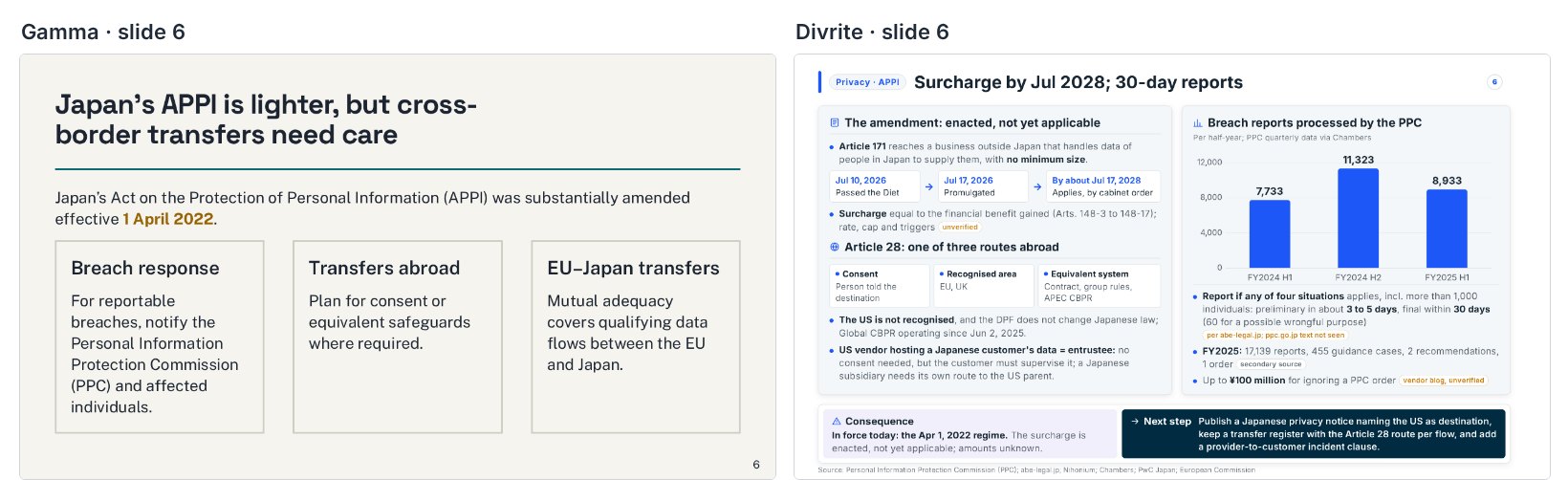
Gamma’s slide says the law “was substantially amended effective 1 April 2022” and tells the reader to “plan for consent or equivalent safeguards where required”. Divrite’s slide sets out the amendment passed on Jul 10, 2026, and says which rules apply now and which come later.
| Detail on Divrite’s slide | Why it matters |
|---|---|
| “In force today: the Apr 1, 2022 regime. The surcharge is enacted, not yet applicable; amounts unknown.” | Separates what a US seller must do now from what to plan for by about Jul 2028 |
| The surcharge equals the financial benefit gained (Arts. 148-3 to 148-17), with rate, cap and triggers marked unverified | Says what is known about the new penalty and what is not |
| The three routes for data leaving Japan, including APEC CBPR, with Global CBPR running since Jun 2, 2025 | Shows the routes other than consent |
| Next step: a Japanese privacy notice naming the US, a transfer register per data flow, and an incident clause with customers | Turns the rule into three tasks |
France’s e-invoicing reform: does it reach a US seller?
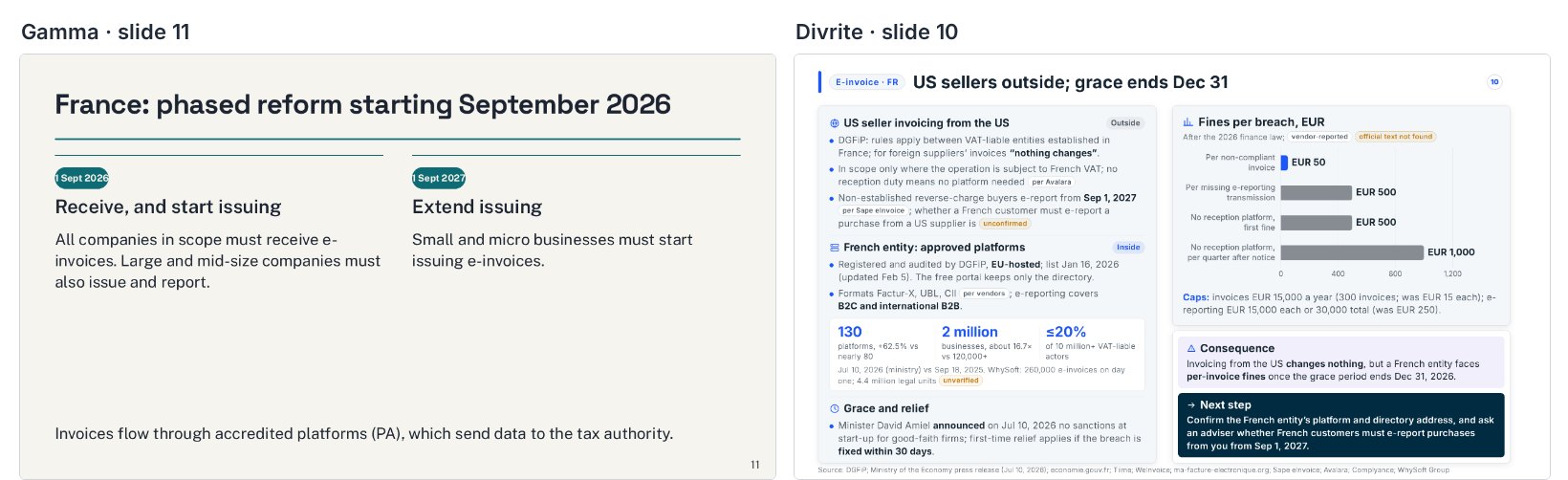
Gamma’s slide has the right dates: from Sep 1, 2026 all companies in scope must receive e-invoices, and small and micro businesses start issuing on Sep 1, 2027. It does not say who is “in scope”. Divrite’s slide starts with that question.
| Detail on Divrite’s slide | Why it matters |
|---|---|
| The tax authority (DGFiP) says that for foreign suppliers’ invoices “nothing changes”; a US seller invoicing from the US is outside | Answers the first question a US company asks |
| A French entity is inside and must use an approved platform; the ministry counted 130 platforms | Shows what changes once the company opens a French entity |
| Fines after the 2026 finance law: EUR 50 per non-compliant invoice, EUR 500 per missing e-reporting transmission, EUR 1,000 a quarter without a reception platform after notice (marked vendor-reported) | Puts a price on not being ready |
| Whether a French customer must e-report a purchase from a US supplier is marked unconfirmed | Tells the presenter what to ask an adviser |
Divrite’s slide 8 does the same for Germany: the duty needs both parties to be resident, so a US seller invoicing from the US is outside, and a German subsidiary (GmbH) is inside.
Payment terms: what the law allows and what late payment costs
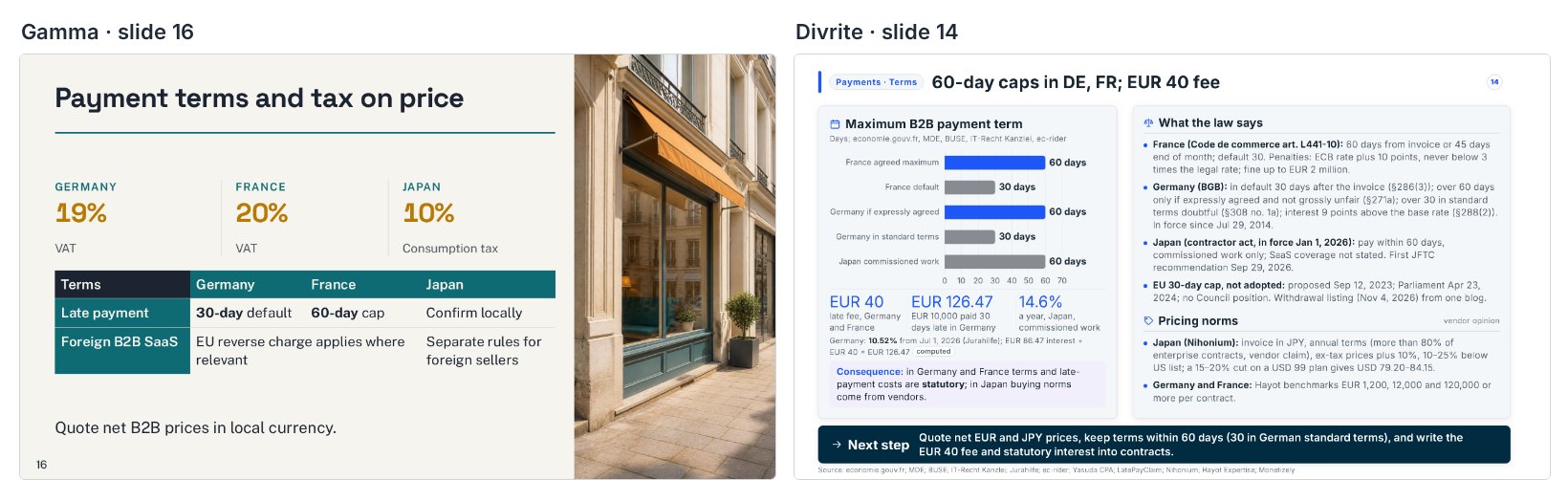
Gamma’s slide gives the three tax rates (19%, 20% and 10%) and one cell per country for late payment: “30-day default” in Germany, “60-day cap” in France and “Confirm locally” in Japan. A photo of a Paris shopfront fills the right third. Divrite’s slide gives the legal rules behind each cell and a worked cost.
| Detail on Divrite’s slide | Why it matters |
|---|---|
| France (L441-10): 60 days from invoice or 45 days end of month; penalties at the ECB rate plus 10 points; fines up to EUR 2 million | The French cap has a second form and a real fine behind it |
| Germany: over 60 days only if expressly agreed and not grossly unfair; over 30 days in standard terms is doubtful | Sets the terms to write into German contracts |
| A EUR 40 late fee in both countries; EUR 10,000 paid 30 days late in Germany costs EUR 126.47 | Shows what late payment costs in euros |
| Japan’s contractor act (in force Jan 1, 2026): pay within 60 days, for commissioned work only | Fills the cell Gamma leaves as “Confirm locally” |
First hires: employer of record or entity, and what each hire costs
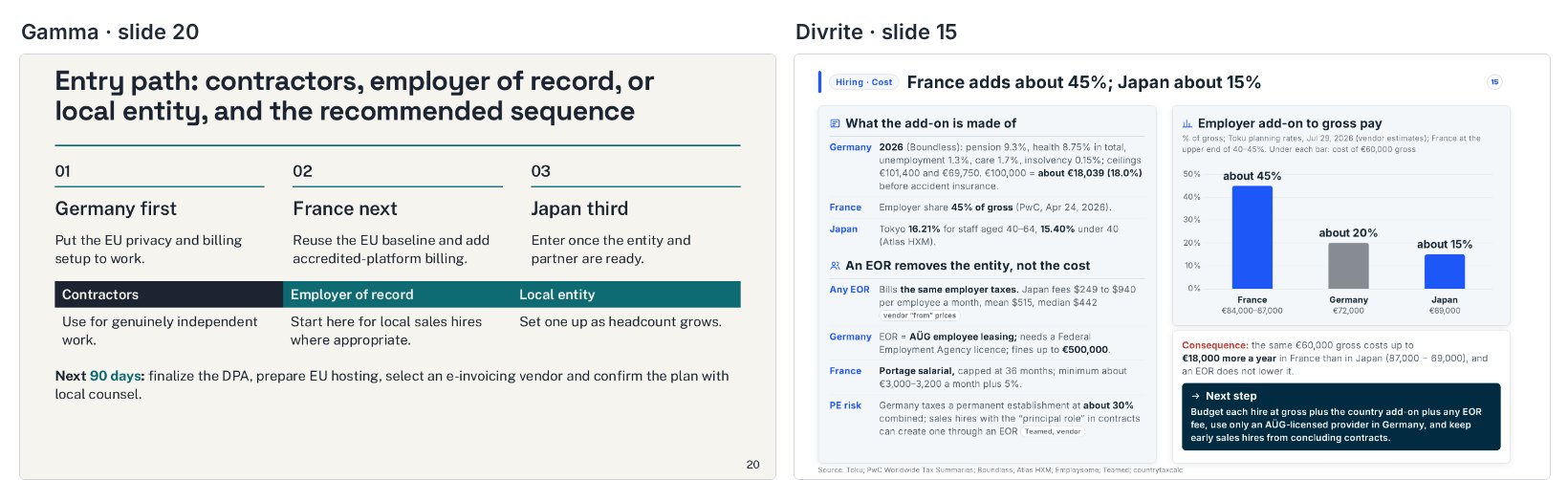
Gamma’s closing slide names three routes, with one line each: contractors “for genuinely independent work”, an employer of record (EOR) to “start here for local sales hires where appropriate”, and a local entity “as headcount grows”. Divrite’s slide puts a cost on each hire and gives the limits on using an EOR.
| Detail on Divrite’s slide | Why it matters |
|---|---|
| €60,000 gross costs about €84,000–87,000 in France, €72,000 in Germany and €69,000 in Japan (vendor planning rates) | The number the hiring budget needs |
| An EOR bills the same employer taxes; EOR fees in Japan run $249 to $940 per employee a month | An EOR saves setting up an entity, not the employer’s costs |
| In Germany an EOR is employee leasing under the AÜG and needs a licence; fines up to €500,000 | Rules out an unlicensed provider |
| A sales hire who concludes contracts can create a taxable permanent establishment through an EOR (marked vendor) | The risk in Gamma’s “start here for local sales hires” |
What each deck covers
| What the brief needs | Divrite | Gamma |
|---|---|---|
| GDPR baseline: fines, EU representative, processing agreements | ✓ | ✓ |
| EU-to-US transfers: the Data Privacy Framework, its court challenge, SCCs | ✓ | ◐ |
| Germany’s additions: BDSG, the officer threshold, cookie law | ◐ | ◐ |
| France’s additions: CNIL enforcement and cookie rules | ✓ | ◐ |
| Japan’s APPI: breach reports and transfers abroad | ✓ | ✓ |
| Japan’s 2026 APPI amendment | ✓ | ✗ |
| EU Data Act: cloud switching and portability | ✗ | ✗ |
| NIS2 cybersecurity duties | ✗ | ✗ |
| Germany: receiving e-invoices since Jan 1, 2025 | ✓ | ✓ |
| Germany: issuing from 2027 (above €800,000) and 2028 | ✓ | ✓ |
| France: Sep 2026 and Sep 2027 phases, approved platforms | ✓ | ✓ |
| France: e-reporting and penalties | ✓ | ◐ |
| Whether the mandates reach a seller with no local entity | ✓ | ✗ |
| Japan: qualified invoices and the T-number | ✓ | ✓ |
| Japan: the cut in buyers’ credit and rules for foreign sellers | ✓ | ✗ |
| Germany: invoice, transfer and direct debit; 19% VAT | ✓ | ✓ |
| Germany: legal payment terms and late-payment interest | ✓ | ◐ |
| France: payment-term caps, penalties, €40 fee | ✓ | ◐ |
| France: transfer and direct debit; 20% VAT | ✓ | ✓ |
| Japan: bank transfer against an invoice, JPY, 10% tax | ✓ | ✓ |
| Japan: fair-payment laws for contractors and small suppliers | ✓ | ✗ |
| Pricing: local currency, net prices, annual terms, price levels | ✓ | ◐ |
| Entity vs employer of record vs contractors, and their limits | ✓ | ◐ |
| Germany: minimum wage, dismissal protection, written terms | ✓ | ✓ |
| France: permanent contracts, staff committee threshold, minimum wage | ✓ | ✓ |
| Japan: Labor Standards Act, work rules, dismissal, minimum wage | ✓ | ◐ |
| EU Pay Transparency Directive | ✓ | ✗ |
| Employer social charges and visa routes | ◐ | ✗ |
| Deliverables | ||
| A four-by-three comparison with dates | ✓ | ◐ |
| A dated timeline of deadlines to 2028 | ✓ | ◐ |
| An action list or entry sequence | ✓ | ◐ |
Divrite’s deck covered 24 of the 28 points fully, Gamma’s 11. Both missed the EU Data Act and NIS2. Divrite’s matrix (slide 17) splits the rules into those that apply with no entity and those that start with one; Gamma’s snapshot (slide 3) has no dates, and its timeline (slide 13) covers e-invoicing only.
Accuracy
Conclusion-changing errors: none on either side.
In the sample of numbers we checked, Divrite’s deck had no errors in 39 checks (5 could not be verified, mostly figures the deck itself marks as vendor or unconfirmed) and Gamma’s none in 24. Gamma’s deck had far fewer numbers to check: 36 paragraphs with figures against 231 in Divrite’s. Neither side had a small error that changes a figure in the sample. Divrite’s deck had a few titles worded more firmly than their sources, and one figure outside the sample that was out of date; none of them changes a conclusion.
On Japan’s tax credit, Divrite’s deck was more current than the checklist: it gives the 2026 reform’s steps (70% from Oct 1, 2026, 50% from Oct 1, 2028), and the check confirmed them.
Questions a client will ask
“Do we have to issue e-invoices in Germany and France if we sell from the US?” Divrite’s slides 8 and 10 say no, citing the German finance ministry and the French tax authority, and say a local entity is inside the rules. Gamma’s deck doesn’t answer; slide 16 says “EU reverse charge applies where relevant”.
“What does a first hire in France cost compared with Japan?” Divrite’s slide 15: €60,000 gross comes to about €84,000–87,000 in France and €69,000 in Japan, and an EOR does not lower it. Gamma’s deck has no cost figures.
“What is due before Jan 1, 2027?” Divrite’s slide 18 lists two steps within 37 days, both only for a company with a local entity: France’s platform by Dec 31, 2026, and German issuing above €800,000 from Jan 1, 2027. It adds that Japanese buyers’ credit already fell to 70% on Oct 1, 2026. Gamma’s slide 10 has the German date; slide 20 lists four tasks for the “next 90 days” without dates.
“Which country first?” Both decks answer. Gamma’s slide 20 says Germany, then France, then Japan. Divrite’s slide 17 judges Germany the easiest first market, France the costliest to staff and Japan the most different, and says to decide on an entity in each country first.
Where Gamma’s deck was better
- Readable comparison tables. Slides 8 (data protection), 15 (payment methods) and 19 (employment law) set the three countries side by side in large type. Divrite’s body text runs at about 13–14 px in light grey, and its many unconfirmed and vendor labels make slides 6, 10 and 13 look busy.
- A simple transfer diagram. Slide 7 shows the two routes for moving data from the EU to the US, the Data Privacy Framework and SCCs, in one clear flow.
- A clear framing and a clear order. Slide 3 says Germany and France share the EU rulebook and Japan stands apart, which sizes the work in one line. Slide 2 says to use “regulatory deadlines, rather than market size, to set the launch order”, and slide 20 gives that order.
- Correct e-invoicing dates. Germany’s 2025, 2027 and 2028 dates and the €800,000 threshold, France’s Sep 2026 and Sep 2027 phases, and Japan’s Oct 2023 qualified invoices are all right.
Frequently asked questions
Can Gamma build a market-entry deck?
Yes, as an overview. In this test Gamma’s deck had the right e-invoicing dates and clear comparison tables, but it covered 11 of 28 checklist points fully, left out Japan’s 2026 changes, and gave no fines, hiring costs or source lines. It works as a first outline; a client deck needs more research on top.
Does a US SaaS company have to issue e-invoices in Germany and France?
According to Divrite’s deck, not while it invoices from the US. Slide 8 cites the German finance ministry: the duty needs both parties to be resident. Slide 10 quotes the French tax authority: for foreign suppliers’ invoices “nothing changes”. A German or French subsidiary is inside the rules: in France, receiving since Sep 1, 2026; in Germany, issuing from Jan 1, 2027 above €800,000 turnover.
Is either deck legal advice?
No. Gamma’s cover slide says “Confirm with local counsel before making commitments.”, and Divrite’s closing slide says “Information, not legal advice”. Divrite’s deck marks the points still open, such as whether French customers must e-report purchases from a US supplier, so a lawyer knows where to start.
See the full six-brief test for the other five briefs and how we ran the test.