ai deep research tool
The AI deep research tool that goes wider and deeper
Ask one question. Divrite splits it by country and sub-topic, searches government, regulator and industry sites in each local language, reads hundreds of pages in full, and keeps searching until every research point is settled. Then it turns the findings into a report, a deck or a web page.
- Local-language, first-hand sources
- Hundreds of pages read in full
- Searched until every point is settled
$ question
Which regulations apply to building EV plants in Brazil, Thailand and Germany?
plan · 5 tasks · 5 languages
- 01 Brazil — import tariffs, local-content rules PT ✓ base
- 02 Thailand — BOI incentives for EV makers TH ✓ base
- 03 Germany — investment screening (AWG / AWV) DE ● searching
- 04 Cross-country comparison of plant policy EN ✓ base
- 05 Analyst and trade-press coverage ZH ✓ round 1
[01] real outputs
One question in, professional output out
Every example below started as a single question and one research run. Open one to read it page by page.
138 sources · English Also as presentation and web page
Global Trade and Tariffs Monthly Brief · Sep 24–Oct 23, 2026
● Generated with Divrite
132 sources · English Also as presentation and web page
AI Regulation Watch Weekly Brief · Oct 17–23, 2026
● Generated with Divrite
99 sources · English Also as presentation and web page
Chinese EVs Going Global Monthly Brief · Sep 24–Oct 23, 2026
● Generated with Divrite
125 sources · English Also as presentation and web page
Semiconductor Export Controls Biweekly Brief · Oct 10–23, 2026
● Generated with Divrite
106 sources · English Also as presentation and web page
Geopolitical Conflicts and Supply Chains Weekly Brief · Oct 17–23, 2026
● Generated with Divrite
 Report
139 sources · English Also as presentation and web page
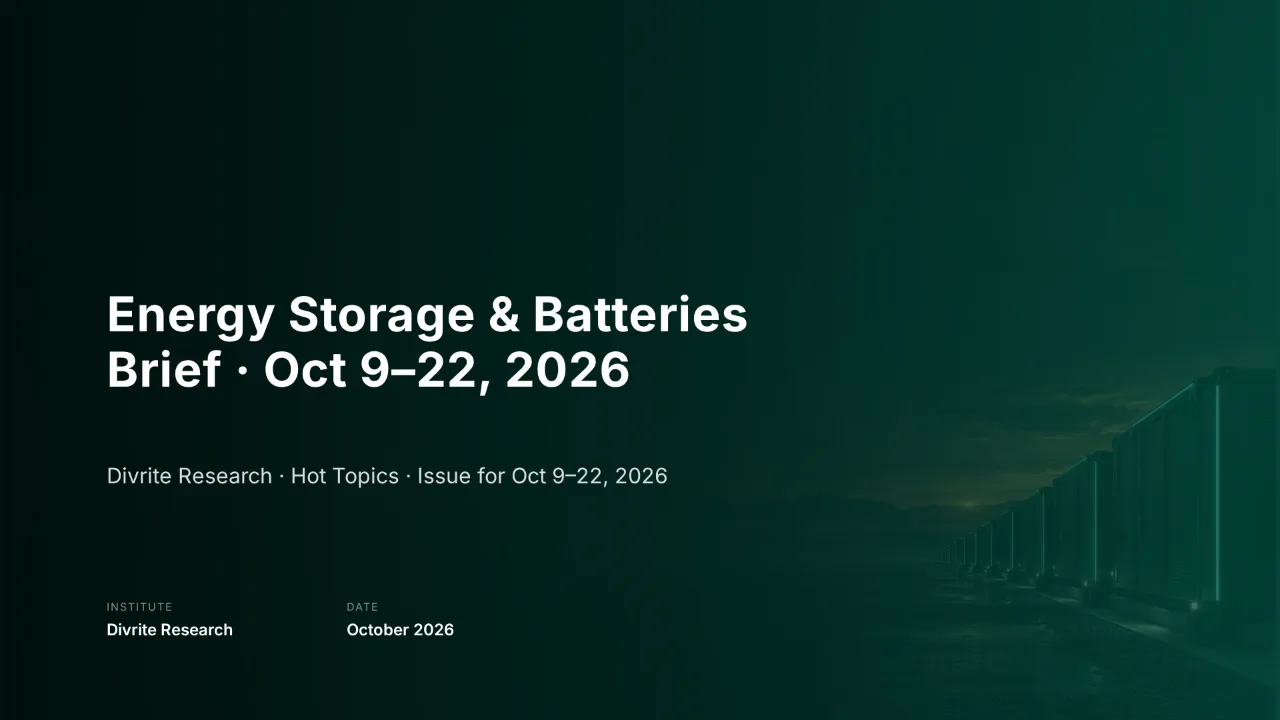
Energy Storage & Batteries Brief · Oct 9–22, 2026
● Generated with Divrite
Every example here is a real Hot topics issue generated with Divrite.
See all Hot topics →[02] how it works
How a deep research run works
A run takes minutes, not seconds. The time goes into planning, reading in full and going back for what’s missing — the work you would otherwise do across dozens of browser tabs, in languages you may not read.
-
step 01
Plan
Divrite splits your question into research tasks — by country where it matters, and by sub-topic — and sets a checklist of research points the answer has to cover. You can review the tasks before the run starts.
-
step 02
Search wider
Sub-topics are searched in parallel. Each country gets queries in its own language, aimed at government, regulator and industry sites, and hundreds of pages are read in full, along with the tables and images in them.
-
step 03
Dig deeper
After each round, Divrite checks the research points against the evidence so far and searches again for just the ones that are still thin. It stops when every point is settled, not after a fixed number of results.
-
step 04
Merge and write
The same page found in several languages is merged, reposts are traced back to the original, and sources are ranked by authority. The findings are written up in the language you asked in.
-
00 base search
5/10 covered
sub-topics searched in parallel · research points set
-
01 gap check 1
8/10 covered
5 thin points → follow-up searches
-
02 gap check 2
10/10 covered
2 thin points → follow-up searches → all points covered · search stops · report is written
- 01 Art. 53 duties
- 02 Art. 55 duties
- 03 Risk threshold
- 04 Key dates
- 05 Legacy models
- 06 Penalties
- 07 Code of practice
- 08 Open source
- 09 Transparency
- 10 Enforcement
[03] sources
Wider means first-hand, not just more links
The originals, in the original language, ranked by who published them — and read in full before anything is written.
- Local language
- Each country gets queries written in its own language, so national rules and data turn up in the original, not in someone’s summary of it.
- First-hand
- Searches go to government, regulator and industry sites, where rules and figures are first published.
- Merged
- The same page found in several languages counts once, and reposts are traced back to the original.
- Ranked
- Sources are ranked by authority, so an official notice outweighs a blog post about it.
- Read in full
- Hundreds of pages are read in full, not judged from search snippets.
- Checked
- Key figures in the write-up must be found in the pages read. A figure that can’t be found is flagged.
2.1 When the obligations apply
Obligations for providers of general-purpose AI models apply from 2 August 20251. Models placed on the market before that date have until 2 August 2027 to comply12. The Commission’s enforcement powers start on 2 August 20262.
- [1]eur-lex.europa.eu · Regulation (EU) 2024/1689, Art. 111 & 113
- [2]digital-strategy.ec.europa.eu · General-purpose AI models: Q&A
1 figure in this section has no source among the pages read — flagged for review
[04] vs. a chat assistant
Why not just ask a chat assistant?
Chat assistants are fine for quick answers. Deep research is for questions where a quick answer would miss most of what matters.
Planning
Chat ·Answers straight away, from memory or one search.
Divrite ·Splits the question by country and sub-topic, with a checklist of research points.
Languages
Chat ·Searches in the language you typed.
Divrite ·Searches each country in its own language, then writes in yours.
Sources
Chat ·Whatever ranks high in a quick search.
Divrite ·Government, regulator and industry sites first; reposts traced to the original; sources ranked by authority.
Reading
Chat ·A handful of search snippets.
Divrite ·Hundreds of pages read in full.
Depth
Chat ·One pass; whatever comes back is the answer.
Divrite ·Round after round on the points that still lack evidence, until each is settled.
Output
Chat ·Text in a chat window.
Divrite ·A report, a native PPTX deck, an interactive web page, an image or a scheduled briefing.
[05] deliver it as
One research run, five ways to deliver it
Choose the format before you start. Each one is built from the same research.
- AI presentations Decks in three densities, every key figure checked, exported as native PPTX with editable text. Learn more →
- Research reports Long-form reports with chapters, verified charts and numbered references, as DOCX or PDF. Learn more →
- Interactive web pages A page with section navigation and interactive charts, shared by link or as one HTML file. Learn more →
- AI images Infographics, roadmaps and covers; edit them by boxing the areas to change. Learn more →
- Topic subscriptions The same research on a schedule, as a briefing for each new period. Learn more →
[$] pricing
From $9.9/mo
Every plan includes deep research and all output formats — presentations, reports, web pages and images. You pay with monthly credits, and each task shows its credit estimate before it runs. Final prices are shown at checkout.
[06] faq
Frequently asked questions
How is deep research different from asking a chatbot?
How long does a deep research run take?
Which languages does it search in?
Which sources does it prefer?
Can I check where a number came from?
What can I do with the research?
Is deep research included in every plan?
Ask the question you’d normally spend a day on
Divrite searches wider, reads deeper and keeps going until every point is settled — then hands you a report, a deck or a web page.