TL;DR — We asked both tools for a 20-slide deck on the EU AI Act’s duties for providers of general-purpose AI models. Divrite’s deck scored 90 of 100 and Gamma’s 52. Divrite delivered 20 slides, Gamma 10. Neither deck had an error in the numbers we checked, so the gap is in what each leaves out. Gamma’s deck names most duties in one line each, while Divrite’s gives the deadline, the exception and the next step behind each. Gamma’s deck has nothing on the 2026 situation: who signed the Code of Practice, the AI Office’s first information requests, or the AI Omnibus. And it never gives the size of a fine. The overview is in the full six-brief test.
The brief
What does the EU AI Act require from providers of general-purpose AI models, from which dates, and what transition applies to models already on the market? Make it a 20-slide deck.
A separate reviewer wrote a 25-point checklist from the brief and primary sources before scoring. A correct answer needs:
- The duties by article: four Article 53 duties for every provider, the Article 54 representative for non-EU providers, and four more Article 55 duties for systemic-risk models, with a two-week notice under Article 52.
- Who counts as a provider: the 10²³ FLOP indicative test and the one-third compute line for modifiers. Fine-tuners need this to know whether the duties fall on them at all.
- “Applies” kept apart from “can be fined”: duties from Aug 2, 2025; enforcement powers, fines included, from Aug 2, 2026.
- The transition and its limits: models placed before Aug 2, 2025 have until Aug 2, 2027; later models comply at once.
- The status in late 2026: Code signatories, the AI Office’s first actions, and the AI Omnibus, which delayed the high-risk rules but not these.
Scores for this brief
| Dimension (points) | Divrite | Gamma |
|---|---|---|
| Coverage of what the brief asks (25) | 24.6 | 13.9 |
| Depth of content per slide (20) | 17.4 | 8.4 |
| Charts and visuals that carry information (20) | 14.4 | 0 |
| Structure and conclusion-led titles (15) | 13.4 | 9.5 |
| Export: does the file open as it was built (10) | 10 | 10 |
| Accuracy of the numbers (10) | 10 | 10 |
| Total | 89.8 | 51.9 |
Both files opened cleanly and both decks got their numbers right, so the gap comes from coverage, depth and charts. Gamma’s slides carry about 50 words and 3 numbers each, Divrite’s about 200 words and 28. Gamma’s deck has three information graphics (a duty table, a timeline and a transition table) and no data chart.
Slide by slide
When does a model have systemic risk?
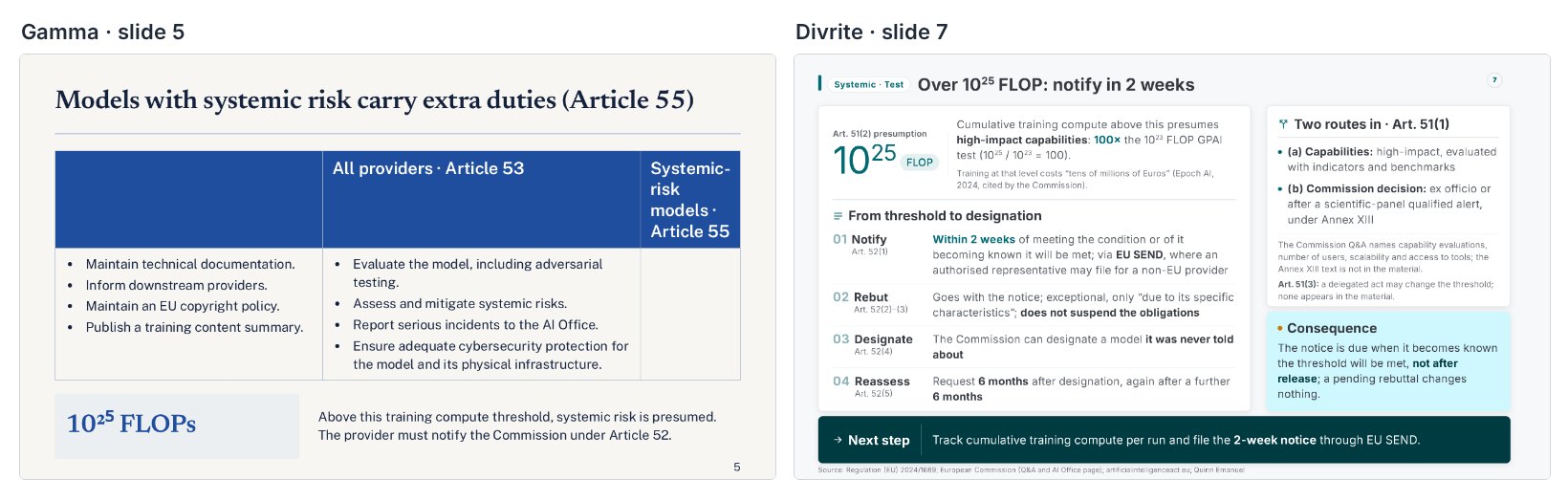
Gamma’s slide 5 lists the Article 53 and 55 duties and says that above 10²⁵ FLOPs “systemic risk is presumed. The provider must notify the Commission under Article 52.” Its table headers are shifted: the Article 55 duties sit under “All providers · Article 53”, and the Article 55 column is empty, so a reader can take them for duties on every provider. Divrite’s slide 7 covers the threshold and the steps from notice to designation.
| Detail on Divrite’s slide | Why it matters |
|---|---|
| Notify “within 2 weeks” of meeting the threshold or of knowing it will be met, through EU SEND | Gamma gives no deadline; a missed notice is a breach on its own |
| The notice is due “not after release” | Compute has to be tracked per training run |
| A rebuttal “does not suspend the obligations” | A provider can’t argue first and comply later |
| The Commission “can designate a model it was never told about” | Staying under 10²⁵ FLOP doesn’t rule out the extra duties |
What transition applies to models already on the market?
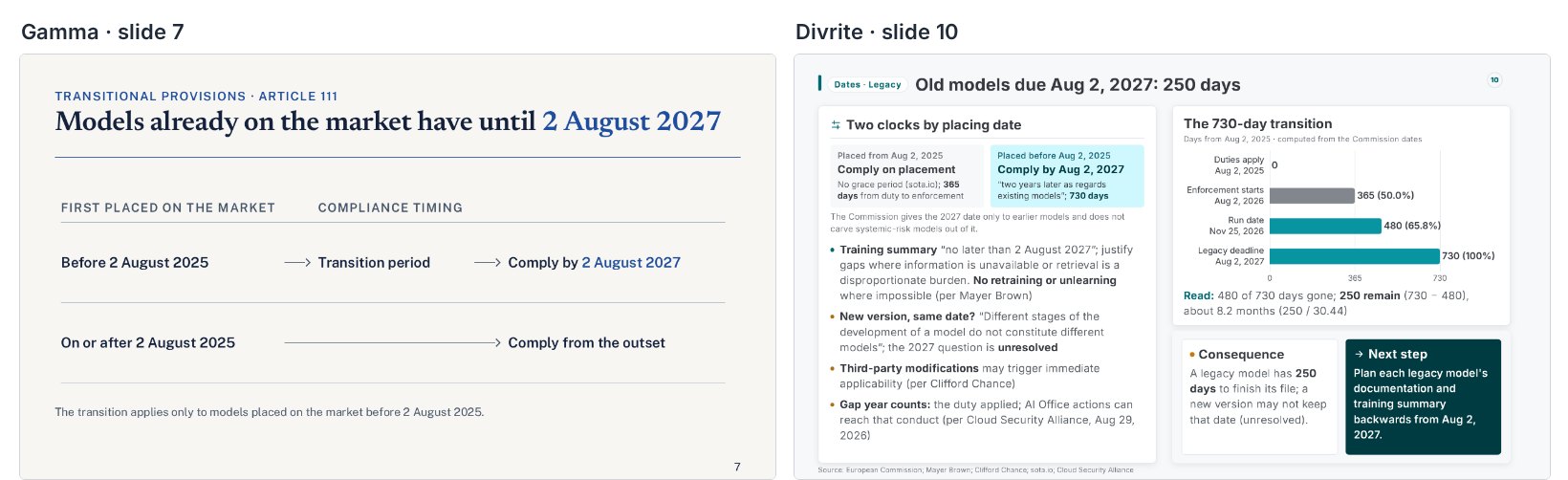
Gamma’s slide 7 answers in two rows: models placed before Aug 2, 2025 must comply by Aug 2, 2027; later ones comply from the outset. That is correct and easy to read. Divrite’s slide 10 gives the same two clocks, then what the relief covers and where it may not hold.
| Detail on Divrite’s slide | Why it matters |
|---|---|
| 480 of 730 days gone by Nov 25, 2026; 250 left, about 8 months | Turns the deadline into a work plan |
| The training summary is due “no later than 2 August 2027”; gaps can be justified; no retraining or unlearning where impossible (per Mayer Brown) | The practical question for a model trained years ago |
| A new version may not keep the 2027 date (“unresolved”); third-party changes may trigger immediate applicability | The two ways a legacy plan breaks |
| “Gap year counts”: AI Office actions can reach conduct from before its powers applied (per Cloud Security Alliance, Aug 29, 2026) | Waiting for the fines date was not a safe plan |
Should we sign the Code of Practice?
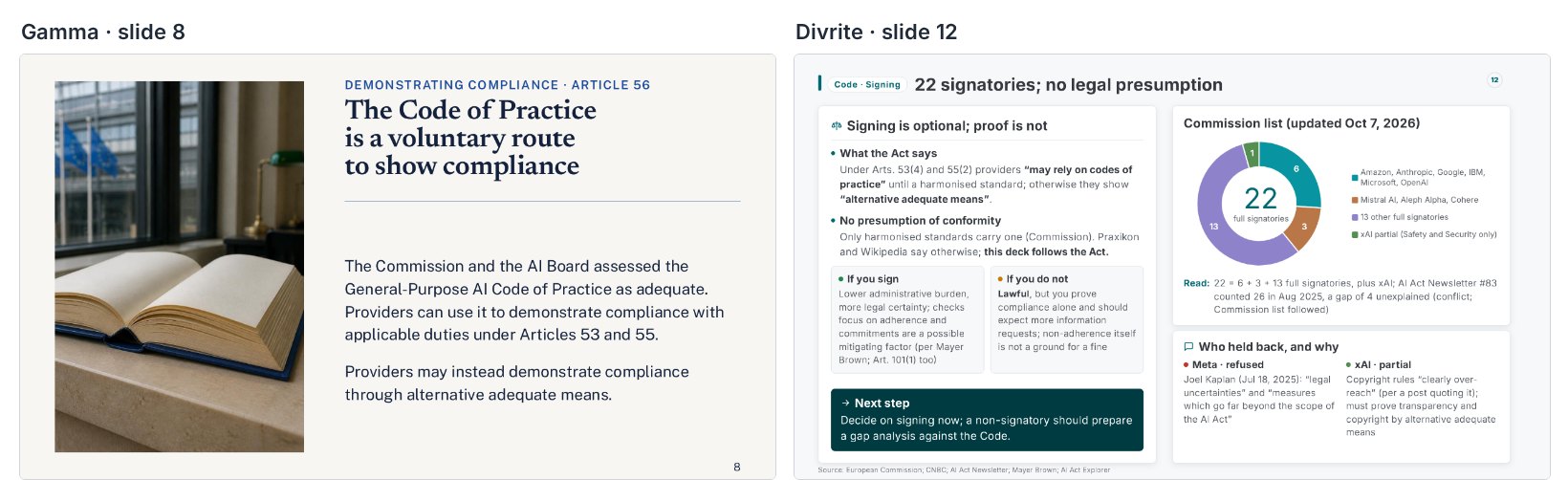
Gamma’s slide 8 says the Commission and the AI Board assessed the Code as adequate and that providers “may instead demonstrate compliance through alternative adequate means”. The left of the slide is a photo of a blank open book. Divrite’s slide 12 covers who signed, who refused, and what changes if you don’t sign.
| Detail on Divrite’s slide | Why it matters |
|---|---|
| 22 full signatories on the Commission list (updated Oct 7, 2026), including Amazon, Anthropic, Google, IBM, Microsoft, OpenAI, Mistral AI, Aleph Alpha and Cohere; xAI signed only the Safety and Security chapter | Lets a client compare itself with its peers |
| Meta refused, citing “legal uncertainties” (Joel Kaplan, Jul 18, 2025) | The main holdout and its reasons |
| No presumption of conformity: only harmonised standards carry one | Signing is not a safe harbour |
| Not signing is lawful, but expect “more information requests”; non-adherence “is not a ground for a fine” | The real trade-off |
When does a fine-tuner become a provider?
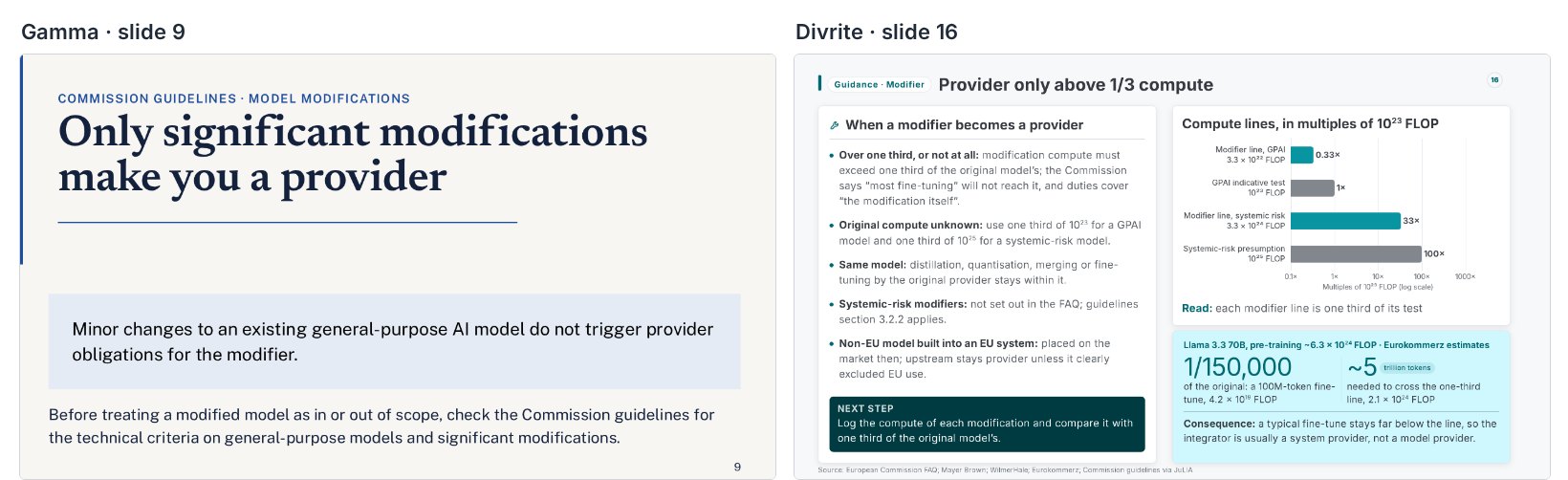
Gamma’s slide 9 says only significant modifications make you a provider, then tells the reader to “check the Commission guidelines for the technical criteria”. Divrite’s slide 16 gives the criterion and works an example.
| Detail on Divrite’s slide | Why it matters |
|---|---|
| A modifier is a provider only if its compute exceeds one third of the original model’s; “most fine-tuning” will not reach it | The rule Gamma points to but doesn’t state |
| If the original compute is unknown: one third of 10²³ or of 10²⁵ FLOP | The fallback when the base model’s figures aren’t public |
| Llama 3.3 70B (Eurokommerz estimates): a 100M-token fine-tune is 1/150,000 of the original; about 5 trillion tokens would cross the line | Shows how far a typical fine-tune sits from it |
| Duties cover “the modification itself” | Limits the work for a modifier that does cross |
What each deck covers
✓ covered with specifics, ◐ named or thin, ✗ missing.
| What the brief needs | Divrite | Gamma |
|---|---|---|
| Technical documentation for authorities | ✓ | ◐ |
| Information for downstream providers | ✓ | ◐ |
| Copyright policy honouring data-mining opt-outs | ✓ | ◐ |
| Public training summary on the official template | ✓ | ◐ |
| EU representative for non-EU providers | ✓ | ✓ |
| What the open-source exemption covers | ✓ | ✓ |
| Who is a provider; the 10²³ FLOP test | ✓ | ◐ |
| 10²⁵ FLOP presumption and designation | ✓ | ◐ |
| Two-week notice and rebuttal | ✓ | ◐ |
| Model evaluation and adversarial testing | ✓ | ◐ |
| Assessing and mitigating systemic risks | ✓ | ◐ |
| Reporting serious incidents | ✓ | ◐ |
| Cybersecurity for model and infrastructure | ◐ | ◐ |
| Code of Practice as a route to compliance | ✓ | ✓ |
| Who signed the Code and who did not | ✓ | ✗ |
| What the Commission’s guidelines settle | ✓ | ◐ |
| Duties apply from Aug 2, 2025 | ✓ | ✓ |
| Enforcement powers from Aug 2, 2026 | ✓ | ◐ |
| Fines: 3% of turnover or EUR 15 million | ✓ | ◐ |
| AI Office powers and first requests | ✓ | ✗ |
| Legacy models have until Aug 2, 2027 | ✓ | ✓ |
| Who gets no grace period | ✓ | ◐ |
| No retraining for legacy models where impossible | ✓ | ✗ |
| The 2026 AI Omnibus left these dates alone | ✓ | ✗ |
| Marking AI-generated content (Art. 50(2)) | ✓ | ✗ |
| Deliverables: duties table by article | ✓ | ◐ |
| Deliverables: timeline 2024 to 2027 | ✓ | ◐ |
| Deliverables: transition explainer | ✓ | ✓ |
| Deliverables: systemic-risk duties and threshold | ✓ | ✓ |
| Deliverables: enforcement and fines summary | ✓ | ◐ |
| Deliverables: compliance checklist | ✓ | ✓ |
Divrite’s deck covered 24 of 25 points fully and named the last. Gamma’s covered 5 fully, named 15 in a line each and left out 5. On the deliverables, Divrite’s deck had all six and Gamma’s three, with a shifted duty table, a timeline without the 2024 or Omnibus dates, and fines only as a timeline label.
Accuracy
Errors that change a conclusion: none on either side.
We checked 39 numbers and identifiers on Divrite’s deck and 16 on Gamma’s against primary sources. Neither deck had a small error either. Two items on Divrite’s deck could not be confirmed, both from a source the slide labels as secondary.
Questions a client will ask
“How large could a fine be?” Divrite’s slides 13 and 14: up to EUR 15 million or 3% of worldwide turnover, whichever is higher, with 3% setting the cap above EUR 500 million of turnover; a misleading reply to a request is itself fineable. Gamma’s slide 6 says only that enforcement powers “including fines” begin on Aug 2, 2026.
“Has the AI Office done anything yet?” Divrite’s slide 14: formal requests to more than 30 companies, confirmed on Aug 29, 2026, and no published fine by Nov 25, 2026; per Matheson, missing training summaries drew the first requests. Gamma’s deck can’t answer.
“Did the 2026 AI Omnibus move our dates?” Divrite’s slide 17: Regulation (EU) 2026/1744, in force Jul 27, 2026, kept the dates for these models, a view it marks as resting on secondary sources. Slides 9 and 19 separate the model deadline of Aug 2, 2027 from system dates such as Dec 2, 2026. Gamma’s deck can’t answer.
“We release open weights. What do we still owe?” Divrite’s slide 4: the copyright policy, the public summary and cooperation with authorities; paid dual licensing disqualifies, and systemic risk ends the relief. Gamma’s slides 3 and 4 give half: the first two duties and the representative may be waived unless the model has systemic risk.
Where Gamma’s deck was better
- Cleaner slides. Large type, even margins and a two-level title make every slide readable on a projector. Divrite’s source footers and side notes are small and light grey.
- The transition in two rows. Slide 7 answers the brief’s third question in a form anyone can remember.
- A simple duty grid. Slide 3 puts the four Article 53 duties in a two-by-two grid with icons, easier to take in than Divrite’s denser slide 5.
- Every date and article number right, and a checklist on slide 10 that can be used as it stands.
Divrite’s deck needs fixes too: its slide 5 chart writes 10²⁵ as “1025 FLOP”, three charts are images a client can’t edit, and the cover image has nothing to do with the content.
Frequently asked questions
Can Gamma build a regulatory-brief deck?
It can build a correct outline. On this brief every date and article number was right and the transition was clear. But most duties got one line, there were no fine amounts, and the Code signatories, the AI Office’s first requests and the AI Omnibus were missing. A client would still need the research.
How many slides did Gamma deliver for the EU AI Act brief?
10, with the length set to 20. Five of the ten carry a photo that holds no information. Divrite delivered 20 slides with 17 information graphics.
Does Divrite’s deck say which points are unsettled?
Yes. Slide 10 marks the date for a new version of a legacy model as “unresolved”, slide 12 flags a conflict between counts of 22 and 26 signatories, and slide 17 labels its Omnibus conclusion as a secondary-source view. The closing slide says the deck is information, not legal advice.
See the full six-brief test for the other five briefs and how we ran the test.