1. Highlights
Five weeks produced fewer launches than the same weeks of 2025. They also brought the first recovery of an orbital Starship upper stage, the first outright failure in ULA's history, and an FCC licence for up to one million satellites. Launch counts here come from Jonathan McDowell's GCAT launch log as updated at 01:28 UTC on Nov 27, 2026. Chapters 2–6 give the detail.

1.1 The period in numbers
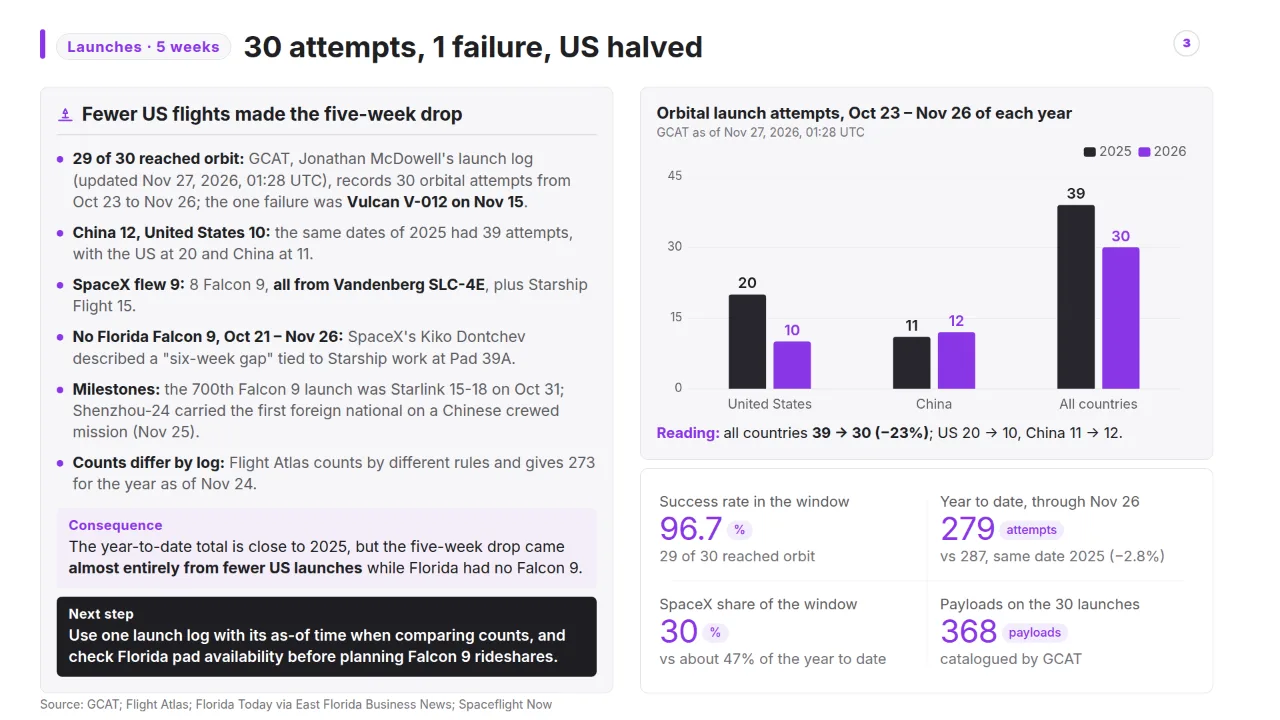
- 30 attempts, 29 successes, 1 failure (96.7%) between Oct 23 and Nov 26, 2026. In the same dates of 2025 there were 39. China flew 12 and the United States 10.
- SpaceX's share fell. It flew 9 of the 30 launches (30%), against about 47% of the year to date. All 8 Falcon 9 flights left from Vandenberg, and none flew from Florida between Oct 21 and Nov 26. SpaceX's Kiko Dontchev described a "six-week gap" in Florida tied to Starship work at Pad 39A.
- Year to date: 279 attempts through Nov 26, against 287 by the same date in 2025. Flight Atlas, which counts by different rules, gives 273 as of Nov 24.
1.2 What changed
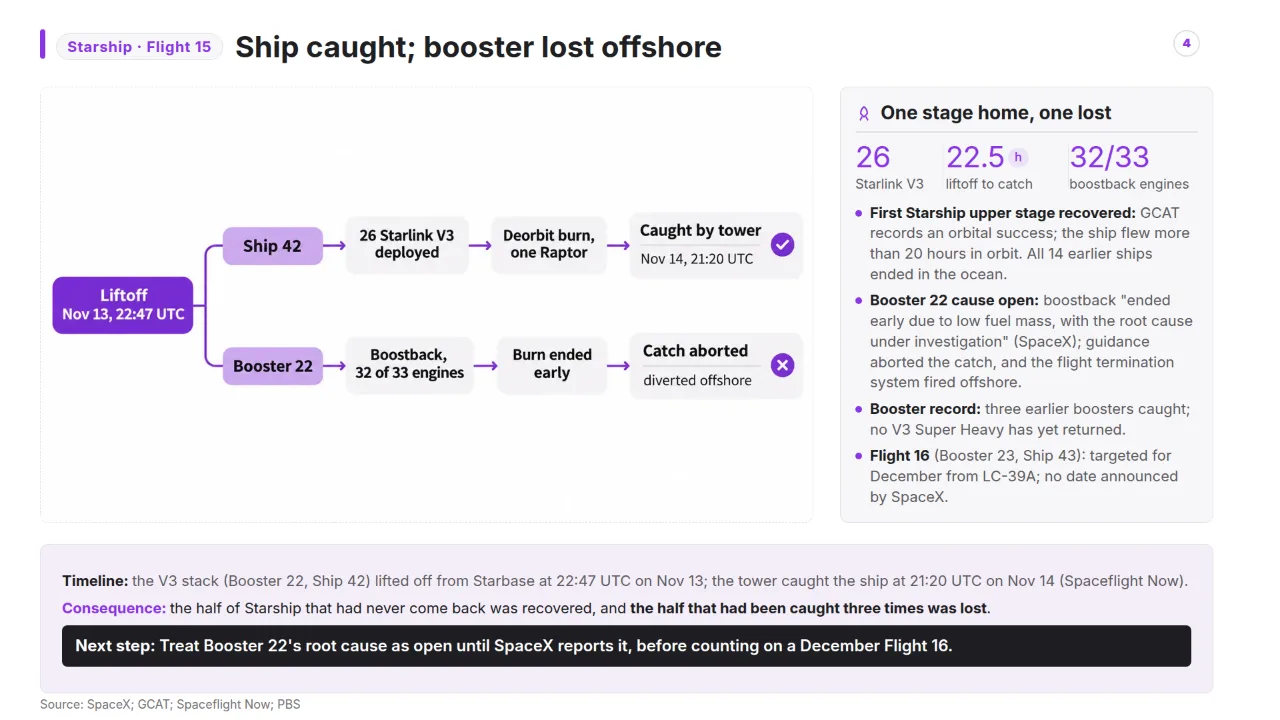
- Starship Flight 15 launched on Nov 13 with 26 Starlink V3 satellites. Ship 42 was caught by the Starbase tower on Nov 14, the first time a Starship upper stage has been recovered after an orbital flight. Booster 22's catch was aborted, and SpaceX says the root cause is under investigation.
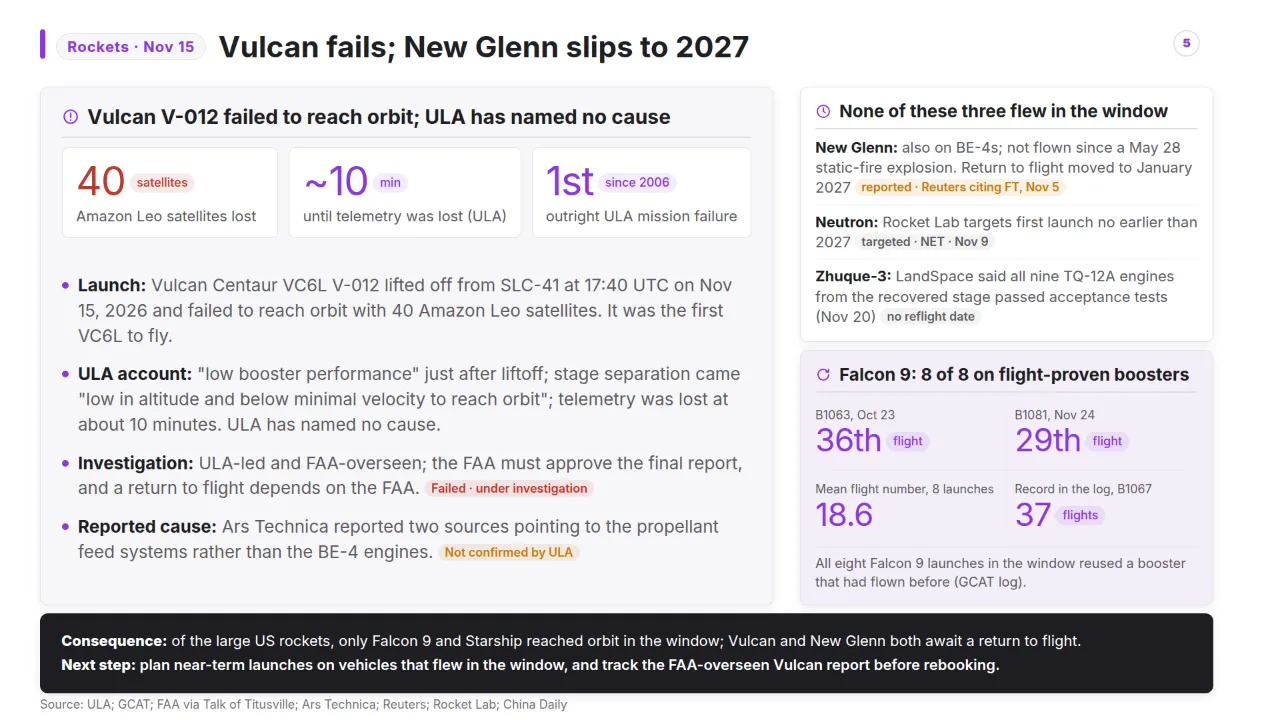
- Vulcan V-012 failed on Nov 15 and lost 40 Amazon Leo satellites. It is ULA's first mission failure, and the investigation is ULA-led and overseen by the FAA. Nine days later, Ariane 6 flight VA271 put 36 Amazon Leo satellites in orbit, bringing Arianespace's total for Amazon to 136.
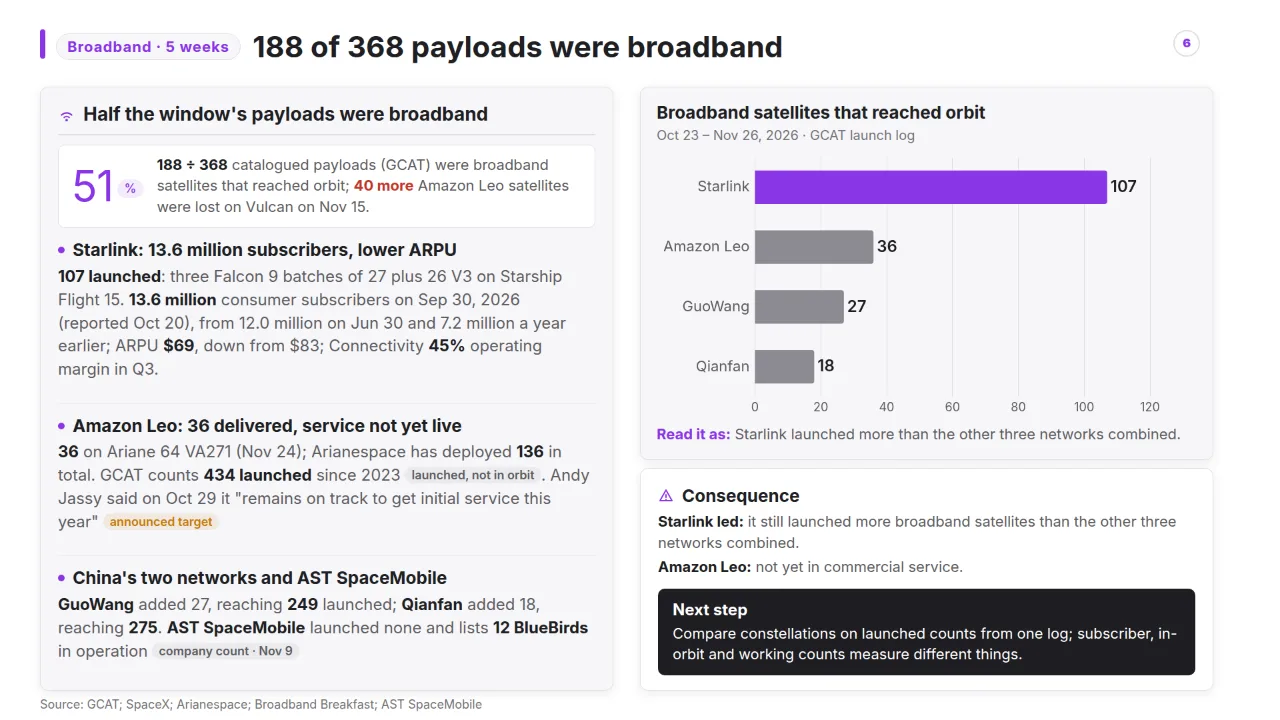
- Broadband satellites made up 188 of the period's 368 payloads: 107 Starlink, 36 Amazon Leo, 27 GuoWang and 18 Qianfan. The latest Starlink figure from SpaceX is 13.6 million consumer subscribers at Sep 30, reported Oct 20.
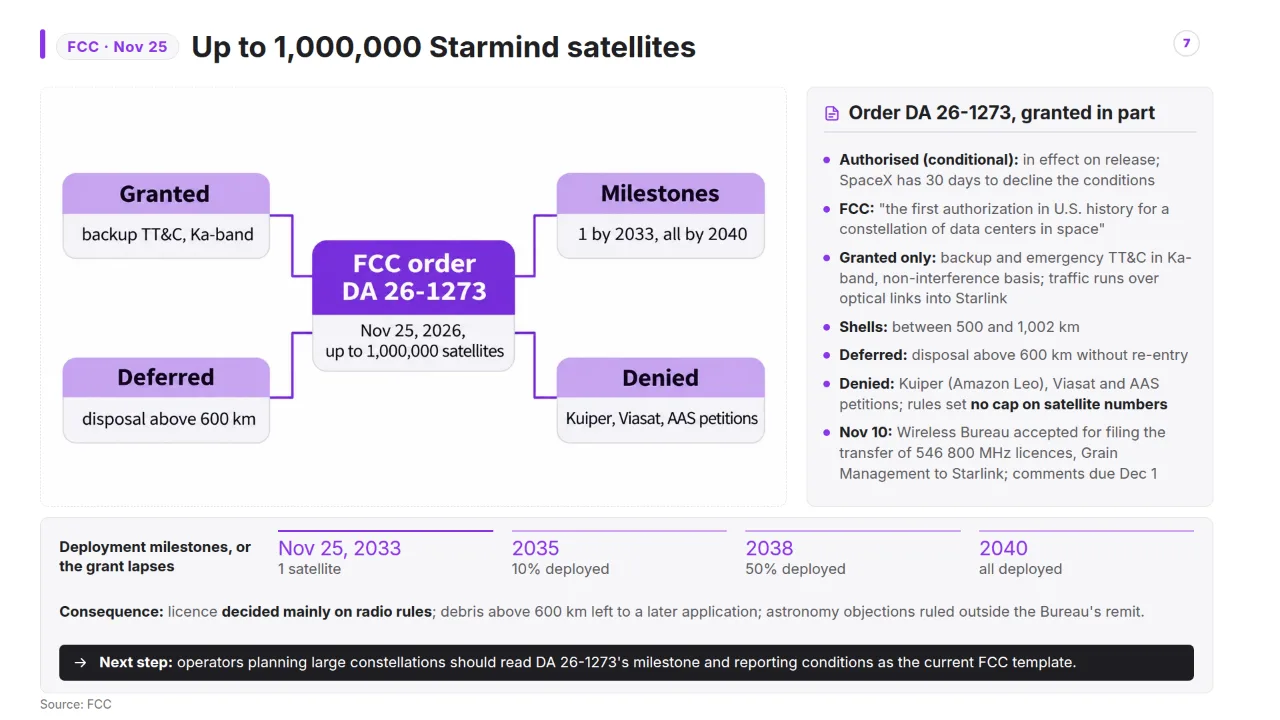
- The FCC authorised Starmind on Nov 25. SpaceX may deploy up to 1,000,000 orbital data-center satellites, provided one is in orbit by Nov 25, 2033 and all of them by 2040. Petitions to deny from Amazon's Kuiper, Viasat and the AAS were denied.
- Money and orders. Rocket Lab booked more than US$515M of Neutron launches and raised Neutron's base price to US$70M. It also says Neutron's first launch is now no earlier than 2027. CesiumAstro raised US$730M and Northwood Space US$375M. Blue Origin signed New Glenn deals with Google and EnduroSat, while New Glenn's own return to flight was reported moved to January 2027.
For December, the only launch with a day, time and operator announcement behind it is Ariane 6 VA272 with Metop-SGB1 on Dec 17, 2026 (Kourou time). SpaceX has given no date for Starship Flight 16.
| Item | Figure | Date | Status | Source |
|---|---|---|---|---|
| Orbital launch attempts (window) | 30 (29 success, 1 failure) | Oct 23 – Nov 26, 2026 | Launched; as of Nov 27, 01:28 UTC | GCAT |
| Starship Flight 15 | Ship caught; booster catch aborted | Nov 13–14, 2026 | Launched; booster cause under investigation | SpaceX |
| Vulcan V-012 | 40 Amazon Leo satellites lost | Nov 15, 2026 | Failed; FAA-overseen investigation | ULA |
| Ariane 6 VA271 | 36 Amazon Leo satellites | Nov 24, 2026 | Launched | Arianespace |
| Starlink subscribers | 13.6 million | Sep 30, 2026 (reported Oct 20) | Latest company figure | SpaceX |
| FCC Starmind | Up to 1,000,000 satellites | Nov 25, 2026 | Authorised (conditional) | FCC |
| Rocket Lab Neutron bookings | More than US$515M, 8 missions | Nov 9, 2026 | Signed | Rocket Lab |
| CesiumAstro / Northwood Space | US$730M / US$375M | Nov 5 / Nov 2, 2026 | Closed (rounds) | Dealroom; Hoodline |
| New Glenn return to flight | January 2027 | Reported Nov 5, 2026 | Moved | Reuters |
2. Launch statistics for the period
Chapter 1 gave the headlines; this chapter sets out the launch count behind them, taken from one database.
2.1 Thirty attempts, one failure
Between Oct 23 and Nov 26, 2026 (UTC), Jonathan McDowell's GCAT launch log records 30 orbital launch attempts: 29 reached orbit and 1 failed, a success rate of 29 / 30 = 96.7% (log updated Nov 27, 2026, 01:28 UTC). The only failure was ULA's Vulcan Centaur VC6L V-012 on Nov 15, 2026, which lost 40 Amazon Leo satellites; see Chapter 3. The 30 launches carried 368 catalogued payloads.
China flew 12 of the 30 launches and the United States 10. In the same window of 2025 the US had flown 20 and China 11.
| Country | Attempts in window | Failed | Vehicles in window | 2026 to Nov 26 | Source |
|---|---|---|---|---|---|
| China | 12 | 0 | Long March ×10, Lijian-2, Gushenxing-2 | 85 | GCAT |
| United States | 10 | 1 | Falcon 9 ×8, Starship V3, Vulcan Centaur | 142 | GCAT |
| New Zealand | 3 | 0 | Electron (Mahia) | 18 | GCAT |
| Russia | 3 | 0 | Soyuz-2-1B | 17 | GCAT |
| India | 1 | 0 | GSLV Mk II | 4 | GCAT |
| Europe | 1 | 0 | Ariane 64 (VA271) | 5 | GCAT |
| Japan, Italy, Germany, South Korea | 0 | 0 | – | 8 | GCAT |
| Total | 30 | 1 | 279 | GCAT |
| Provider | Vehicles in window | Launches | Sites | Source |
|---|---|---|---|---|
| SpaceX | Falcon 9 ×8, Starship V3 ×1 (Flight 15) | 9 | Vandenberg SLC-4E; Starbase | GCAT |
| CASC and affiliates | CZ-2C, CZ-2D ×3, CZ-2F, CZ-4B, CZ-6A, CZ-8A ×2, CZ-12 | 10 | Jiuquan, Taiyuan, Xichang, Hainan commercial site | GCAT |
| Rocket Lab | Electron ×3 | 3 | Mahia LC-1A | GCAT |
| Russia (Roscosmos) | Soyuz-2-1B ×3 | 3 | Plesetsk, Vostochny, Baikonur | GCAT |
| CAS Space | Lijian-2 (Kinetica-2) | 1 | Jiuquan | GCAT |
| Galactic Energy | Gushenxing-2 (Ceres-2) | 1 | Jiuquan | GCAT |
| ISRO | GSLV Mk II (F18) | 1 | Sriharikota | GCAT |
| Arianespace | Ariane 64 (VA271) | 1 | Kourou | GCAT |
| ULA | Vulcan Centaur VC6L (failed) | 1 | Cape Canaveral SLC-41 | GCAT |
Against the same dates in 2025, attempts fell from 39 to 30 (−23%), almost all on the US side (20 → 10). Year to date the gap is small: 279 attempts through Nov 26, 2026, against 287 by the same date in 2025 (−2.8%) and 329 in all of 2025; 270 of the 279 are coded successes (96.8%). SpaceX flew about 47% of the year's launches (130 / 279) but 30% of the window's (9 / 30).
2.2 SpaceX: every Falcon 9 from California
All 8 Falcon 9 launches in the window flew from Vandenberg SLC-4E; GCAT records no Florida Falcon 9 from Oct 21 to Nov 26, 2026, after Bandwagon-5 left SLC-40 on Oct 20. SpaceX had already stopped Falcon 9 Starlink flights from Florida, the last on Aug 25, 2026. On Oct 21, 2026, SpaceX Vice President of Launch Kiko Dontchev said "We have a six-week gap before the next Falcon 9" and tied it to Starship, calling the Pad 39A launch infrastructure "effectively complete" (Florida Today, via East Florida Business News and Space Launch Schedule). The next Florida Falcon 9, Cygnus NG-25, was scheduled for Nov 29, 2026, as of Nov 15.
The Orlando Sentinel counts 61 Space Coast orbital launches in 2026 as of Nov 15, including the failed Vulcan, against a record 109 in 2025; Florida Today counted one in September and four in October.
Starlink 15-18, launched at 04:04 UTC on Oct 31, 2026 (9:04 p.m. PDT, Oct 30) on booster B1093's 18th flight, was the 700th Falcon 9 launch. Spaceflight Now reports that SpaceX's 365-day total fell below 150 orbital launches on Oct 27 for the first time since July 2025, from a peak of 171 in December 2025. The five Falcon 9 flights after Oct 31 all carried US government ("USA") payloads, not Starlink.
2.3 China's twelve
China's 12 launches came from four sites; CASC's Long March family flew 10, including three Long March 2D and two Long March 8A. According to state-media reports, the Nov 9 (Beijing time) Long March 12 launch was the series' 676th flight and the Nov 19 Shijian-24 launch its 678th. Two commercial rockets flew from Jiuquan: CAS Space's Lijian-2 (Kinetica-2, vehicle Y2) with 18 Qianfan satellites on Nov 3, and Galactic Energy's Gushenxing-2 (Ceres-2, vehicle Y3) with 4 payloads on Nov 6. Year to date, Flight Atlas has China up from 74 to 83 and the US down from 180 to 159 against the same date in 2025 (as of Nov 23).
2.4 Data caveats
- Counting rules. GCAT counts Electron from Mahia for New Zealand; Flight Atlas counts by the rocket's country, so Electron counts for the US. That explains most of the US gap: GCAT US 142 + NZ 18 = 160 vs Flight Atlas 159.
- As-of dates. Flight Atlas: 273 attempts, 265 to orbit (7 failures, 1 partial) as of Nov 24; 277 as of Nov 26. GCAT: 279 through Nov 26, including one entry coded OF40 (New Glenn NG-3, Apr 19) and one coded NS (first Soyuz-5 test, Apr 30). Flight Atlas's "1 partial" matches the first; neither source itemises the remaining two-launch gap.
- Same-date comparisons. GCAT's 2025 figure runs to Nov 27, 2025, one day past the 2026 cutoff; Flight Atlas gives 283 by Nov 24, 2025.
- Time zones. In UTC, GCAT dates the Long March 12 and Shijian-24 launches Nov 8 and Nov 18, a day before the Beijing-time reports.
- Serials are not counts. GCAT tags the 700th Falcon 9 row F701; this chapter follows Spaceflight Now's launch count.
- Florida tallies are local newspaper counts with their own as-of dates, not GCAT figures.
3. Major missions and reusable rockets
Behind the 30 attempts counted in Chapter 2, two flights two days apart defined the period: a Starship upper stage caught by its tower, and a Vulcan that did not reach orbit.
3.1 Starship Flight 15: the ship came home, the booster did not
GCAT logs Starship Flight 15 (V3, Booster 22 and Ship 42) lifting off from Starbase at 22:47 UTC on Nov 13, 2026. It is recorded as an orbital success carrying 26 Starlink V3 satellites. SpaceX says contact was made with every satellite and all began raising their orbits.

After more than 20 hours in orbit, the ship relit one sea-level Raptor to deorbit. It returned to the site it had left 22.5 hours earlier, where Mechazilla's arms closed on it "for the very first time". Spaceflight Now timed the catch at 21:20 UTC on Nov 14. It called the flight the first return of an orbital launch vehicle's upper stage to Earth. All 14 earlier ships had ended in the ocean.
The booster half of the planned double catch failed. SpaceX says Booster 22 relit 32 of 33 engines for boostback, and the burn "ended early due to low fuel mass, with the root cause under investigation." Guidance then triggered an automated abort and diverted the booster offshore. It hovered over the Gulf, and its flight termination system fired when the landing burn shut down. Early coverage blamed a guidance fault. SpaceX commentator Dan Huot corrected this: "It was not a GNC issue that caused us not to come back". Three earlier boosters had been caught, but no V3 Super Heavy has yet returned.
Flight 15 recovered the half of Starship that had never come back before, the orbital ship. It lost the half that had already been caught three times.
3.2 Vulcan V-012: ULA's first mission failure
GCAT records Vulcan Centaur VC6L V-012 lifting off from SLC-41 at 17:40 UTC on Nov 15, 2026. It failed to reach orbit with 40 Amazon Leo satellites aboard. This was Vulcan's first flight since a solid-booster nozzle burned through on Feb 12. It was also the first VC6L, with six boosters and the shorter Centaur V. It is ULA's first outright mission failure since the company formed in 2006.
ULA's update blog says telemetry was lost at about 10 minutes. "Just after liftoff the launch vehicle experienced low booster performance," and stage separation came "low in altitude and below minimal velocity to reach orbit." ULA says the RL10 upper-stage engines and the repaired solid boosters were nominal. In a Nov 16 statement, the FAA said it requires a mishap investigation. ULA leads that investigation; the FAA oversees it and must approve the final report. A return to flight depends on an FAA finding that public safety is unaffected.
ULA has named no cause. Ars Technica reported, via MLQ.ai, that two sources pointed to the propellant feed systems rather than the BE-4 engines. ULA has not confirmed this. New Glenn also flies on BE-4s, and Blue Origin is working with ULA on the investigation, per CNBC. Status: failed, under investigation. For what the loss means for Amazon Leo, see Chapter 4.
3.3 Crew and cargo traffic
Russia launched Progress MS-36 on a Soyuz-2-1B from Baikonur at 10:17 UTC on Nov 24, 2026. A Long March 2F (Y24) carried Shenzhou-24 from Jiuquan at 00:18 UTC on Nov 25. The China Manned Space Agency called that launch a "complete success".
- Crew: commander Tang Hongbo on his third flight, flight engineer Wu Yi on his first, and payload specialist Muhammad Zeeshan Ali of Pakistan. Ali is the first foreign national on a Chinese crewed mission.
- Mission: China's 18th crewed flight and its 12th to Tiangong. Ali stays about a week and returns with Shenzhou-23's Zhang Zhiyuan and Lai Ka-ying. Zhu Yangzhu stays aboard for a year.
3.4 Reuse beyond Starship
Falcon 9. All eight Falcon 9 launches in the window flew flight-proven boosters. B1063 flew its 36th mission on Oct 23 and B1081 its 29th on Nov 24. The mean flight number was 18.6: (36+26+18+8+7+11+14+29)/8 = 149/8. The record in the log is B1067 at 37.
New Glenn. New Glenn's Apr 19 flight recovered its booster but left its payload too low. A vehicle then exploded in a static-fire test on May 28, and the rocket has not flown since. Reuters reported on Nov 5, 2026, citing the Financial Times, that Blue Origin had pushed the return to flight to January 2027; CEO Dave Limp called it a "small adjustment", according to a shattered.io roundup. Florida Today reported "early January 2027". Blue Origin also announced two pieces of new hardware on an undated newsroom page:
- GS3: a BE-7-powered third stage, rated at 8 t to GEO on New Glenn 7x2 and 14 t on 9x4. It is under contract for a government cislunar mission in 2028.
- Northstar: a LOX/LNG booster engine rated at 715,000 lbf.
Neutron. On Nov 9, 2026, Rocket Lab said Neutron's first launch is targeted for no earlier than 2027. For its contracts, see Chapter 5.
China. None of China's 12 launches in the window flew on Zhuque-3, Long March 12A or Long March 10B, so no Chinese booster recovery was attempted. LandSpace's Zhuque-3 Y2 first stage had landed on legs on Aug 19 and later tipped over. On Nov 20, LandSpace said all nine TQ-12A engines from that stage had passed acceptance tests, including a hot fire of about 185 seconds, and qualified for reflight. LandSpace has set no reflight date.
| Vehicle | Status | Latest milestone + date | Next stated step (who stated it) | Source |
|---|---|---|---|---|
| Starship V3 ship | Launched; ship recovered | First tower catch of Ship 42, Nov 14, 2026 | Starship launches from Florida "within a few months" (SpaceX plan, as reported by PBS) | SpaceX; Spaceflight Now; PBS |
| Super Heavy V3 | Not yet recovered | B22 diverted offshore and FTS fired, Nov 13, 2026 | Root cause under investigation (SpaceX) | SpaceX |
| Falcon 9 | In service | B1063 36th flight, Oct 23; B1081 29th, Nov 24, 2026 | None stated | GCAT |
| New Glenn | Grounded since May 28, 2026 | GS3 and Northstar announced (undated page) | Return to flight in January 2027 (Reuters citing FT, Nov 5; Florida Today) | Reuters; EFBN; Blue Origin |
| Neutron | In development | First-flight hardware delivered to LC-3 | First launch NET 2027 (Rocket Lab, Nov 9, 2026) | Rocket Lab |
| Zhuque-3 | Stage recovered Aug 19 | Nine engines requalified, Nov 20, 2026 | Reuse on future flights, no date (LandSpace) | China Daily; China in Space |
4. Satellite internet and constellations
Chapter 3 covered the rockets. This chapter covers what they carried, and broadband constellations made up about half of it.
4.1 What went up between Oct 23 and Nov 26, 2026
GCAT logs 368 payloads on the window's 30 launch attempts. 188 were broadband satellites that reached orbit: 107 Starlink, 36 Amazon Leo, 27 GuoWang and 18 Qianfan. That is 188 ÷ 368 = 51%. The 368 also includes the 40 Amazon Leo satellites lost on Nov 15, 2026.
188 of 368 payloads in the window were broadband satellites that reached orbit, and 40 more Amazon Leo satellites were lost on Vulcan V-012.
| Constellation | Launched in window | Cumulative figure (as of · what it measures) | Service status | Source |
|---|---|---|---|---|
| Starlink (SpaceX) | 107 (3×27 on Falcon 9, 26 V3 on Starship) | 13.6 million consumer subscribers (Sep 30, 2026 · service lines; reported Oct 20, 2026); "over 11,100" satellites in orbit (Sep 30, 2026 · 10-Q, includes ~400 approved for de-orbit, according to Axis Intelligence) | In service | GCAT; SpaceX; Axis Intelligence |
| Amazon Leo | 36 (Nov 24); 40 lost (Nov 15) | 434 launched successfully since 2023, incl. 2 prototypes (Nov 26, 2026 · launched, per GCAT, not in orbit); 136 deployed by Arianespace (Nov 24, 2026) | Not in commercial service; Amazon targets initial service in 2026 (Oct 29, 2026) | GCAT; Arianespace; Broadband Breakfast |
| GuoWang (China SatNet) | 27 (3×9) | 249 launched (GCAT); 249 in orbit, 249 working (Nov 24, 2026 · Flight Atlas catalogue count) | Domestic trials, according to Friends of NASA (Nov 9, 2026) | GCAT; Flight Atlas; Friends of NASA |
| Qianfan (Spacesail) | 18 (Nov 3) | 275 launched (Nov 26, 2026 · launched, per GCAT) | Not stated in sources reviewed | GCAT |
| AST SpaceMobile BlueBird | 0 | 12 BlueBirds in operation (Nov 9, 2026 · company count) | Initial intermittent coverage targeted by end-2026 | GCAT; AST via StockTitan |
These figures measure different things: launched, in orbit, working, or subscribers. Only GCAT's launch counts can be compared line by line across operators.
4.2 Starlink: 13.6 million lines and a second V3 batch
The latest company figure was reported on Oct 20, 2026. Starlink had 13.6 million consumer subscribers on Sep 30, 2026, up from 12.0 million on Jun 30, 2026 and 7.2 million a year earlier. Consumer ARPU fell to $69 a month from $83. Connectivity earned $2,367M of operating income on $5,248M of Q3 revenue, a 45% margin (2,367 ÷ 5,248). That was most of SpaceX's $2,791M total operating income.
The satellite counts come from secondary sources. According to Axis Intelligence, the Q3 10-Q reports "over 11,100" Starlink satellites in orbit. HighSpeedInternet.com put the count at about 11,190 in orbit, from 13,096 launched, on Nov 13, 2026.
In the window, Falcon 9 carried 27 Starlink satellites from Vandenberg on each of Oct 23, Oct 27 and Oct 31. SpaceX says Starship Flight 14, in Q3, was its first orbital Starship flight. It delivered 26 Starlink V3 satellites with "approximately 10x the downlink capacity added by a Falcon 9 Starlink launch". Flight 15 on Nov 13, 2026 carried another 26 V3; see Chapter 3 for the flight. Using SpaceX's own ratio, that one flight added about three times the downlink capacity of the window's three Falcon 9 Starlink launches combined (10 ÷ 3; estimate).
4.3 Amazon Leo: 40 lost, then 36 delivered
On Nov 15, 2026, Vulcan V-012 (Amazon's LV-01) failed with 40 Amazon Leo satellites on board. Gizmodo (via NeoTeo) reported an anomaly about ten minutes after liftoff. Chapter 3 covers the vehicle and the investigation.
On Nov 24, 2026, Ariane 64 flight VA271 (LE-04) launched 36 satellites to about 460 km after a ground-system problem stopped the Nov 23 count. Arianespace says it has now deployed 136 Amazon Leo satellites in under 10 months. VA271 was its fourth Amazon mission of 2026, out of 24 under contract.
The totals line up. GCAT counts 434 Amazon Leo satellites launched successfully since 2023, including two prototypes. That is a launched figure, not an in-orbit one. Before VA271 the GCAT count was 434 − 36 = 398, which matches Gizmodo's report of 398. Broadband Breakfast reported 396 in orbit on Nov 2, 2026 and no launches since early July.
On service, Andy Jassy said on Oct 29, 2026 that Amazon Leo "remains on track to get initial service this year". That is an announced target. On Nov 24, Amazon's Steve Metayer still described the team as preparing "to roll out Amazon Leo to customers".
4.4 China's two networks and AST SpaceMobile
GuoWang launched on the steadiest schedule: nine satellites on each of Oct 25, Nov 8 and Nov 20 (groups 28–30). That brings it to 113 in 2026 and 249 overall. Flight Atlas lists eight launches of nine satellites each between Aug 4 and Nov 20, 2026. Qianfan added 18 on Nov 3, 2026, on CAS Space's Lijian-2 (Kinetica-2) from Jiuquan, for 275 launched in total. Together the two Chinese networks added 45 satellites, more than Amazon's 36.
AST SpaceMobile launched no satellites in the window. On Nov 6, 2026 it announced Blacklift, a 20-ton rocket using Firefly Miranda engines. The first flight is targeted for late 2028, and AST is buying 36 engines for the first three vehicles under a $1.3B contract. Its Q3 update on Nov 9, 2026 listed 12 BlueBirds in operation and a target of about 45 by mid-2027. It also targets initial, intermittent coverage in the US, Canada, Japan, Saudi Arabia and the UK by end-2026. BlueBirds 14–16 were waiting at Cape Canaveral for a SpaceX launch date.
The FCC's Nov 25, 2026 authorisation of SpaceX's Starmind constellation is covered in Chapter 5.
5. Funding, contracts and regulation
Behind the launches and constellations of Chapters 2–4, the window's money and paperwork pointed the same way: a million-satellite compute licence, launches booked years ahead, and over a billion dollars for satellite and ground companies.
5.1 Regulation: the FCC authorises Starmind
On Nov 25, 2026 the FCC Space Bureau adopted and released order DA 26-1273, granting SpaceX's application for the "Starmind" orbital data-center system in part, deferring it in part, with conditions. The FCC called it "the first authorization in U.S. history for a constellation of data centers in space", covering up to 1,000,000 satellites, and said other orbital data-center proposals are under review. Status: authorised (conditional), in effect on release; SpaceX has 30 days from release to decline the conditions.

The grant itself is narrow: only backup and emergency telemetry, tracking and command in 18.8–19.3 GHz (down) and 28.6–29.1 GHz (up), on an unprotected, non-interference basis, because Starmind carries its traffic over optical links into Starlink. The authorised shells lie between 500 and 1,002 km, at 30° and sun-synchronous inclinations. The main conditions:
- Deployment milestones (new Part 100 schedule, replacing the Part 25 rules SpaceX asked to waive): one satellite by Nov 25, 2033, 10% by Nov 25, 2035, 50% by Nov 25, 2038, the rest by Nov 25, 2040, or the authorisation lapses.
- Debris: the plan below 600 km complies; disposal of higher satellites without re-entry is deferred pending a modification application.
- Reporting and waivers: semi-annual reports on conjunctions, re-entries and deployed numbers; processing-round and surety-bond rules waived.
Kuiper Systems (Amazon Leo), Viasat and the American Astronomical Society (AAS) each filed a petition to deny on Mar 6, 2026; all three were denied. Viasat cited aggregate Ka-band interference, debris and SpaceX's capacity to run yet another constellation; Amazon cited debris and planning uncertainty from waived milestones; AAS argued the satellites' waste heat would raise the infrared sky background and asked for environmental review. The Bureau replied that the non-interference condition answers interference, that applying milestones made that objection moot, that its rules set no cap on satellite numbers and it "declines to invent a de facto rule", and that environmental and infrared effects fall outside its authority; SpaceX's commitment to coordinate with the NSF was deemed enough for optical astronomy. Filippo Marchetti (University of Westminster) told BBC Sky at Night Magazine the scale raises Outer Space Treaty Article IX consultation questions.
The FCC licensed a million satellites mainly through radio rules: it treated debris, astronomy and environmental objections as either answered by conditions or outside its remit.
Other actions were procedural. On Nov 10, 2026 the Wireless Bureau accepted for filing (DA 26-1218) the transfer of 546 paired 800 MHz licences from Grain Management to Starlink Spectrum Holdings, with comments due Dec 1. On Oct 30, Globalstar urged scrutiny of Iridium in the review of Rocket Lab's pending Iridium acquisition. After the Nov 15 Vulcan failure, the FAA required a ULA-led mishap investigation that it oversees (see Chapter 3).
| Date | Regulator | Decision | Status | Source |
|---|---|---|---|---|
| Nov 25, 2026 | FCC Space Bureau | DA 26-1273: Starmind, up to 1,000,000 satellites, backup TT&C in Ka-band | Authorised (conditional); in effect on release | FCC |
| Nov 25, 2026 | FCC Space Bureau | Petitions to deny by Kuiper, Viasat, AAS | Denied | FCC |
| Nov 25, 2026 | FCC Space Bureau | Disposal waiver for Starmind satellites above 600 km | Deferred | FCC |
| Nov 10, 2026 | FCC Wireless Bureau | DA 26-1218: Grain → Starlink, 546 800 MHz licences | Accepted for filing; comments due Dec 1, 2026 | FCC |
| Oct 27, 2026 | FCC Space Bureau / WTB | SpaceX request to add 800 MHz supplemental coverage from space | Pending | FCC |
| Oct 30, 2026 | FCC (GN Docket 26-257) | Globalstar filing on Rocket Lab–Iridium transfer | Filed; transaction under review | Globalstar letter |
| Nov 15–16, 2026 | FAA | Vulcan mishap investigation, FAA-overseen | In effect (open) | ULA |
5.2 Contracts and orders
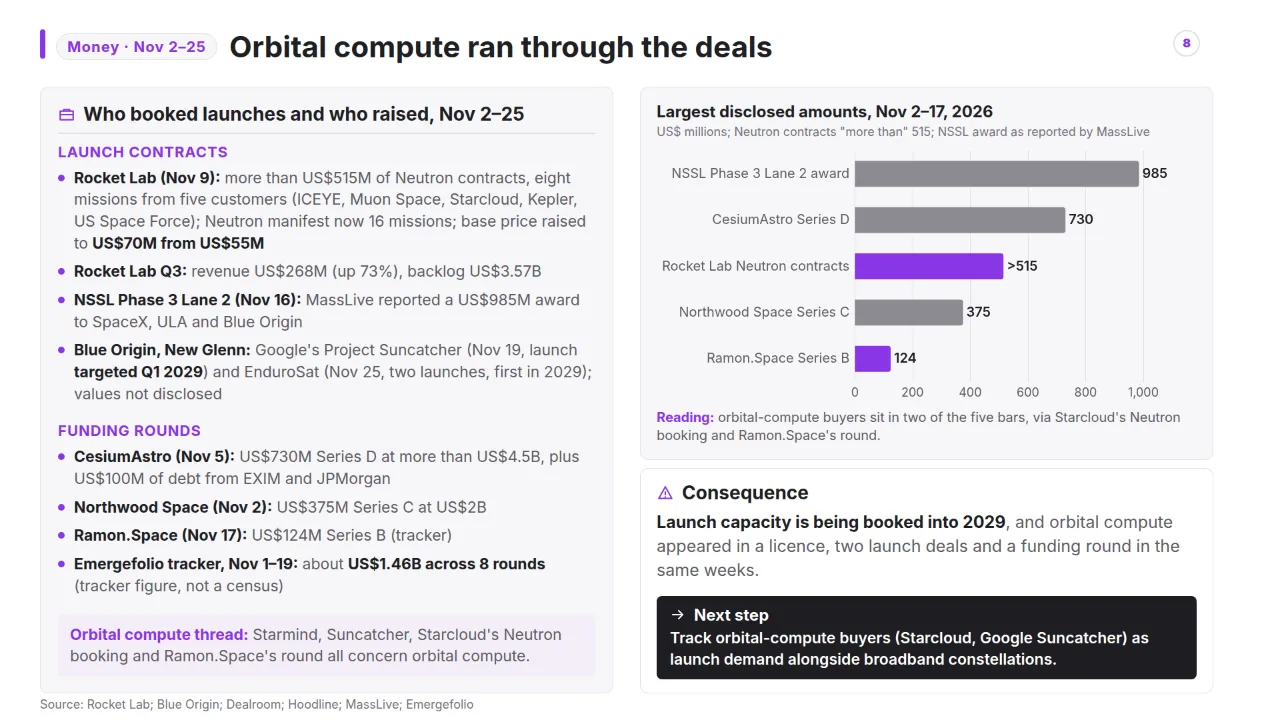
Rocket Lab reported Q3 2026 results on Nov 9, 2026: record revenue of 268 million dollars (up 73% year on year), backlog of 3.57 billion dollars (up 52% since the end of Q2) and a launch backlog of 117 launches. It signed more than 515 million dollars of Neutron contracts for eight missions from five customers (ICEYE three, Muon Space two, Starcloud, Kepler Communications and the US Space Force one each), taking the Neutron manifest to 16 missions and the base price to 70 million dollars from 55 million. Rocket Lab targets a first Neutron launch no earlier than 2027 (see Chapter 3).
Blue Origin signed two New Glenn agreements, values undisclosed: Google's Project Suncatcher on Nov 19, with a sun-synchronous launch targeted for Q1 2029, and EnduroSat on Nov 25, for two dedicated New Glenn 7x2 launches from Cape Canaveral, the first scheduled for 2029. In defence, MassLive reported a 985 million-dollar NSSL Phase 3 Lane 2 award to SpaceX, ULA and Blue Origin in a Pentagon notice of Nov 16. According to a Space FrontPage Facebook post of Nov 6, Viasat won a Space Force contract worth up to 450 million dollars; no primary source here confirms it.
5.3 Funding rounds
The two largest rounds went to communications infrastructure. Northwood Space announced a 375 million-dollar Series C at a 2 billion-dollar valuation on Nov 2, 2026, co-led by Andreessen Horowitz and DFJ Growth. CesiumAstro announced a 730 million-dollar Series D at more than 4.5 billion dollars on Nov 5, 2026, led by Janus Henderson, with a further 100 million dollars of debt from EXIM and JPMorgan, to fund its planned 737-satellite Synchronicity constellation. SatNews splits the 730 million into 630 million equity plus 100 million debt; this report follows Dealroom and Emergefolio, which list the debt separately.
Tracker figures (Emergefolio, Nov 1–19, 2026) add Ramon.Space (124 million, Series B, Nov 17), EOS-X Space (120 million, Nov 6) and Reflect Orbital (73.5 million, Nov 10). Its eight US-dollar rounds sum to 730 + 375 + 124 + 120 + 73.5 + 30 + 6 + 1.5 = about 1.46 billion dollars (tracker figure, not a census). The common thread is orbital compute: Starmind, Suncatcher, Starcloud's Neutron booking and Ramon.Space's round all fall in the window.
| Date | Company | Type | Amount | Counterparty / lead | Status | Source |
|---|---|---|---|---|---|---|
| Nov 2, 2026 | Northwood Space | Series C | 375M USD at 2B valuation | a16z, DFJ Growth (co-leads) | Closed (round) | Hoodline |
| Nov 5, 2026 | CesiumAstro | Series D + debt | 730M USD equity at >4.5B; +100M debt | Janus Henderson; EXIM, JPMorgan | Closed (round) | Dealroom |
| Nov 9, 2026 | Rocket Lab | Neutron launch contracts (Q3) | >515M USD, 8 missions | ICEYE, Muon, Starcloud, Kepler, USSF | Signed | Rocket Lab |
| Nov 16, 2026 | SpaceX, ULA, Blue Origin | NSSL Phase 3 Lane 2 award | 985M USD | Space Systems Command | Awarded | MassLive |
| Nov 17, 2026 | Ramon.Space | Series B | 124M USD | PSG (lead) | Reported (tracker) | Emergefolio |
| Nov 19, 2026 | New Glenn launch agreement | Not disclosed | Blue Origin | Signed; launch targeted Q1 2029 | Blue Origin | |
| Nov 25, 2026 | EnduroSat | Two New Glenn 7x2 launches | Not disclosed | Blue Origin | Signed; first launch scheduled 2029 | Blue Origin |
6. Launch calendar for December 2026
The contracts and licences in Chapter 5 only matter once hardware reaches a pad, so this chapter lists what the sources had on the December 2026 calendar as of Nov 27, 2026. Every entry is a schedule claim, not a result, and each carries the date of the source that made it.
6.1 Dated launches, sorted by date
| Date (NET; UTC where given) | Vehicle | Mission | Site | Status as of source date | Source |
|---|---|---|---|---|---|
| Dec 1, 01:45 | Kinetica-1 (CAS Space) | Not named | Haiyang Oriental Spaceport | NET, slipped from Nov 29 (listing as of Nov 26) | nextlaunch.today; Flight Atlas |
| Dec 1, 08:00 | ExPace rocket (not named) | Not named | Jiuquan | NET, slipped from Nov 13 (as of Nov 26) | nextlaunch.today |
| NET Dec 10 (social posts); "December" (media) | Starship (Booster 23, Ship 43) | Flight 16 | LC-39A, Kennedy (planned) | Targeted; no date announced by SpaceX | Orbit Alpha; Starlust; Facebook posts Nov 5 and Nov 16 |
| Dec 18, 00:36 (Dec 17, 21:36 Kourou) | Ariane 62 | VA272, Metop-SGB1 | CSG, ELA-4 | Scheduled, per Arianespace on Nov 25, 2026 | Arianespace; ESA |
| NET Dec 30 | Falcon 9 | AST SpaceMobile BlueBirds 14–16 | Not stated | NET per launch trackers; AST awaiting SpaceX date confirmation (Nov 9) | Orbit Alpha |
| Dec 31 (date not set) | Gravity-2 (Orienspace) | First test flight | Haiyang Oriental Spaceport | Planned, date not set | nextlaunch.today |
| December (no day) | Vega C | VV31, IRIDE satellites | CSG, ELA-1 | Planned, per European Spaceflight on Nov 10, 2026 | European Spaceflight |
| December (no day) | Falcon 9 | Amazon Leo | Not stated | Planned; moved forward from 2027, per Amazon after Nov 24 | Ars Technica |
| December 2026 or January 2027 | Atlas V | Starliner-1 (uncrewed) | CCSFS, SLC-41 | TBD, per Orlando Sentinel (updated Nov 15) | Orlando Sentinel; Scientific American |
6.2 What stands behind each date
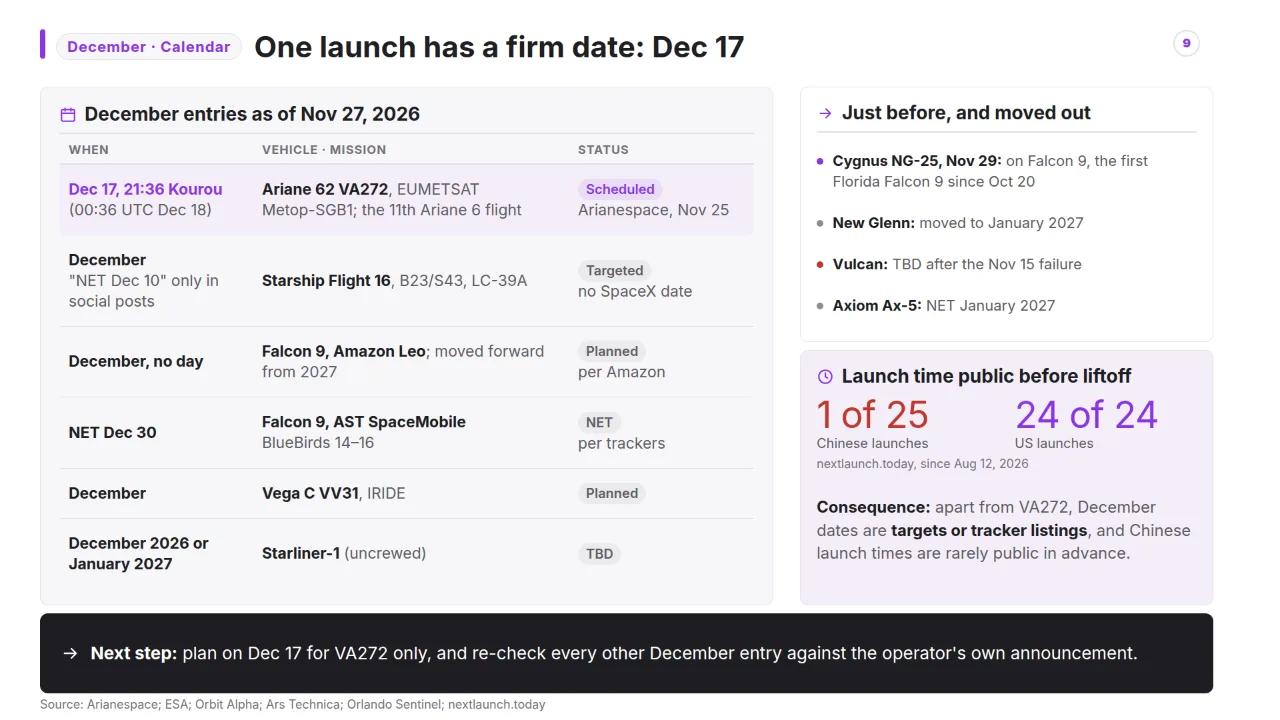
Only one December launch has a day, a time and an operator announcement behind it: Ariane 6 VA272 with Metop-SGB1, set for 00:36 UTC on Dec 18, 2026.
Ariane 6 VA272. Arianespace said on Nov 25, 2026 that it will launch EUMETSAT's Metop-SGB1 on an Ariane 62 on Dec 17, 2026 at 21:36 Kourou time, into a sun-synchronous orbit of about 800 km. It would be the 11th Ariane 6 flight and Arianespace's 6th launch of 2026. ESA repeated the date on Nov 26, 2026.
Starship Flight 16. SpaceX has given no date. Orbit Alpha, citing NASASpaceflight, lists a December 2026 target from LC-39A with Booster 23 and Ship 43, and says NASASpaceflight reported that a significant amount of first-time work at 39A remains. Starlust says the flight still awaits FAA approval. "NET Dec 10" appears only in Facebook posts of Nov 5 and Nov 16, 2026. An earlier Space Launch Schedule report put the first Florida Starship in 2027, so the sources disagree.
Station traffic. The Orlando Sentinel lists Starliner-1 as uncrewed and "TBD December '26 or January '27"; Scientific American reported on Nov 4, 2026 that NASA and Boeing plan the flight "as early as this December". Just before the month, Cygnus NG-25 on Falcon 9 was set for Nov 29, 2026 from SLC-40. It would be the first Florida Falcon 9 since Oct 20, 2026 in GCAT.
Constellation flights. After the Ariane 6 launch on Nov 24, 2026, Amazon told Ars Technica that its next Falcon 9 launch for Amazon Leo is planned for December, moved forward from 2027, with several more Falcon 9 flights to follow. Amazon gave no day. AST SpaceMobile said on Nov 9, 2026 that it was still waiting for SpaceX to confirm a date for BlueBirds 14–16. According to Orbit Alpha, launch trackers list that flight for no earlier than Dec 30 (see Chapter 4). European Spaceflight's schedule of Nov 10, 2026 lists Vega C VV31 with the IRIDE satellites for December, also with no day.
China. Chinese dates are rough. nextlaunch.today, which has tracked listings since Aug 12, 2026, found the exact time was public before liftoff for 1 of 25 Chinese launches, against 24 of 24 US ones. The same site also has an unidentified listing at NET Dec 10.
6.3 Moved out of December or undated
| Item | Status as of source date | Source |
|---|---|---|
| New Glenn return to flight | Moved to January 2027, reported Nov 5, 2026; grounded since the May pad explosion | Reuters; Ars Technica |
| Vulcan (Amazon Leo LV-02) | TBD; grounded after the Nov 15 failure, return subject to the FAA (statement of Nov 16) | Orlando Sentinel; Talk of Titusville |
| Isar Spectrum Flight 3 | Avinor window Nov 26, 2026 – Feb 17, 2027 (20:00–21:30 UTC); no date announced by Isar | European Spaceflight; Tech Times |
| Axiom Ax-5 | NET January 2027 | Orlando Sentinel |
| Long March 10A / Mengzhou test | Planned late 2026, reported slipping to early 2027 | KeepTrack |
On Spectrum: Tech Times found no confirmation by Nov 26, 2026 that the rocket had shipped to Norway. Orbitalradar now shows the flight as "no longer scheduled", and GCAT has no Spectrum launch through Nov 26, 2026. Chapter 3 covers the Vulcan investigation and the New Glenn changes.
7. References
This document draws on the following 71 sources, listed in the order they are first cited.
- GCAT orbital launch log (Jonathan McDowell, General Catalog of Artificial Space Objects), updated 2026 Nov 27 01:28 UTC — planet4589.org · 2026-11-27
- Space Coast Launch Count Falls Sharply in 2026 – East Florida Business News.com — eastfloridabusinessnews.com
- SpaceX Florida Launch Pause: 6-Week Space Coast Gap — spacelaunchschedule.com
- Rocket Launch Statistics 2026: 273 Launches So Far (24 November 2026) | Flight Atlas — flightatlas.org
- SpaceX — spacex.com
- Starship returns to Starbase and a successful tower catch — Spaceflight Now — spaceflightnow.com
- Vulcan Rocket Fails on Amazon Leo Satellite Launch — talkoftitusville.com
- Vulcan Leo 1 updates — blog.ulalaunch.com
- Arianespace successfully launches another 36 Amazon Leo satellites on Ariane 6’s 10th flight | Newsroom Arianespace — newsroom.arianespace.com
- Space Exploration Technologies - Live Earnings Release — sec.gov
- FCC Authorizes 1 Million Satellites for Data Centers in Space — docs.fcc.gov
- <u>Federal Communications Commission DA 26-1273</u> — docs.fcc.gov
- Rocket Lab Lands Over $515M in Neutron Launch Deals from Constellation Operators in Q3 | Mon, 11/09/2026 - 16:06 — investors.rocketlabcorp.com
- Rocket Lab Announces Third Quarter 2026 Financial Results: Posts Record Revenue, $1.2 Billion or 52% Sequential Quarterly Backlog Growth, Positive GAAP Operating Cash Flow, and Guides to Record Revenue and Gross Margin Expansion in Q4 2026 | Mon, 11/09/2026 - 16:05 — investors.rocketlabcorp.com
- CesiumAstro raises $730M Series D at more than $4.5B to build a 737-satellite constellation | Dealroom News — dealroom.co
- Northwood Space Raises $375M, Hits $2B Valuation in Torrance — hoodline.com
- Google Selects Blue Origin’s New Glenn for Project Suncatcher | Blue Origin — blueorigin.com
- EnduroSat Signs Multi-Launch Agreement with Blue Origin for Dedicated New Glenn Missions for Its Customers | Blue Origin — blueorigin.com
- Blue Origin pushes New Glenn rocket launch to January, sources say — reuters.com · 2026-11-05
- Arianespace to launch Europe’s Metop-SGB1 weather satellite aboard Ariane 6 on 17 December 2026 | Newsroom Arianespace — newsroom.arianespace.com
- SpaceX Starship Flight 16: Date and What It Means for SPCX Stock — orbitalpha.cloud
- SpaceX closes out October with 700th Falcon 9 launch to date — Spaceflight Now — spaceflightnow.com
- 2 rocket launches from Florida likely in November. Here's when, where — floridatoday.com
- Space Coast launch schedule: — orlandosentinel.com
- Pictures: 61 Space Coast launches and counting in 2026 – Orlando Sentinel — orlandosentinel.com
- China launches satellites aboard homegrown Long March-12 carrier rocket - Defensehere — defensehere.com
- China Launches Shijian-24 Satellite Using Long March-2D Rocket | China News — china-news.net
- Rocket launches by country in 2026: US 159, China 83 | Flight Atlas — flightatlas.org
- How many rocket launches? 277 in 2026, 7,441 since 1957 | Flight Atlas — flightatlas.org
- SpaceX’s Starship soars into orbit after booster malfunction thwarts double catch attempt — pbs.org
- Space.com on Facebook: "SpaceX’s Super Heavy booster exploded just before splashing down in the Gulf of Mexico following the…" — facebook.com
- ULA's Vulcan fails 10 minutes into return-to-flight launch, losing 40 Amazon Leo satellites | MLQ.ai — mlq.ai
- China launches Shenzhou-24 to Tiangong station — dw.com
- China launching 1st international astronaut to Tiangong space station today: Watch it live | Space — space.com
- Blue Origin New Glenn Slips to Jan 2027 2026 — shattered.io
- New Glenn Expands Its Reach with GS3: Heavy-Lift Performance Direct to GEO and Beyond | Blue Origin — blueorigin.com
- All 9 recovered engines from China's Zhuque-3 reusable rocket pass acceptance tests, qualifying for reflight — regional.chinadaily.com.cn
- The Space Road on Instagram: "LandSpace says the nine engines from its recovered Zhuque-3 first stage now meet the conditions for …" — instagram.com
- LandSpace Fires Up Flight-Proven Zhuque-3 Engines Ahead of Reuse — china-in-space.com
- Starlink Statistics 2026–2027: Satellites & Subscribers — axis-intelligence.com
- Amazon Leo to Launch 40 More Broadband Satellites Nov. 13 — broadbandbreakfast.com
- How many Guowang satellites are there? 249 in orbit | Flight Atlas — flightatlas.org
- Friends of NASA on Facebook: "China Long March 12 Rocket Launches Nine GuoWang Internet Satellites in Hainan FriendsofNASA.org: Ch…" — facebook.com
- AST SpaceMobile (ASTS) Earnings Show Plan for Phone Service From Space by Year End — stocktitan.net
- Starlink Reaches 13.6 Million Subscribers Globally as SpaceX Revenue Jumps 161% — broadbandbreakfast.com
- How Many Starlink Satellites Are in Orbit as of November 13? | HighSpeedInternet.com — highspeedinternet.com
- Amazon Leo satellite loss: 40 satellites missed orbit | NeoTeo — neoteo.com
- Mission VA271/LE-04: Launch Update | Newsroom Arianespace — newsroom.arianespace.com
- AST SpaceMobile, Inc. - current report (8-K) for fiscal year 2026 — sec.gov
- AST SpaceMobile To Build New Blacklift Rocket — payloadspace.com
- Starlink approved for launch of one million satellites into Earth orbit to create data centres in space | BBC Sky at Night Magazine — skyatnightmagazine.com
- DA 26-1218 - Federal Communications Commission — docs.fcc.gov
- October 30, 2026 Via Electronic Filing Marlene H. Dortch, Secretary ... — fcc.gov
- 3 space giants win nearly $1 billion to launch the military's most critical satellites — finance.yahoo.com
- Space FrontPage on Facebook: "🚀 VIASAT WINS $450 MILLION U.S. SPACE FORCE CONTRACT! 🇺🇸 A major step forward for America's military…" — facebook.com
- CesiumAstro Secures $730M Series D at $4.5B Valuation to Deploy Synchronicity Constellation – SatNews — satnews.com
- Space Tech Funding Tracker: November 2026 (Top Deals) — emergefolio.com
- China Rocket Launches: Latest Launches, Chinese Rockets & Who Flies Them | Next Rocket Launch — nextlaunch.today
- Starship Flight 16 - Latest News, Stories & Details — starlust.org
- Space FrontPage on Facebook: "🚀 STARSHIP FLIGHT 16: A NEW LAUNCH SITE, A NEW MILESTONE! SpaceX is now targeting December 10, 2026 …" — facebook.com
- David Rogers on Facebook: "SpaceX Starship Flight 16 is scheduled to launch no earlier than December 10, 2026, from Launch Comp…" — facebook.com
- Arianespace on Instagram: "🚀 Save the date: Ariane 6’s 11th flight is scheduled for 17 December 2026! For mission VA272, Ariane…" — instagram.com
- ESA Space Transport on X: "Next launch coming up 🚀 On 17 December, Ariane 6 will be launching MetOp-SG-B1 from Europe's Spacepo…" — x.com
- When will AST SpaceMobile start commercial service? | Orbit Alpha — orbitalpha.cloud
- European Rocket Launches in 2026: Ariane 6, Vega C & New Launchers — europeanspaceflight.com
- Amazon discovers Falcon 9 and Ariane 6 can deliver when nobody else can - Ars Technica — arstechnica.com
- Could SpaceX’s retirement of Falcon 9 spark a launch crisis? — scientificamerican.com
- Isar Aerospace Could Launch Third Spectrum Rocket as Early as 26 November — europeanspaceflight.com
- Isar Aerospace Launch Window Opens November 26: AT-Astra Tests Debris-Spotting Star Tracker — techtimes.com
- Long March 10 Family Guide - China Moon Rocket Already Flying - KeepTrack — keeptrack.space
- Spectrum AT-Astra and Others (Spectrum Flight 3) launch: live countdown — orbitalradar.com