Commercial Space Monthly · Sep 23 – Oct 22, 2026
Contents
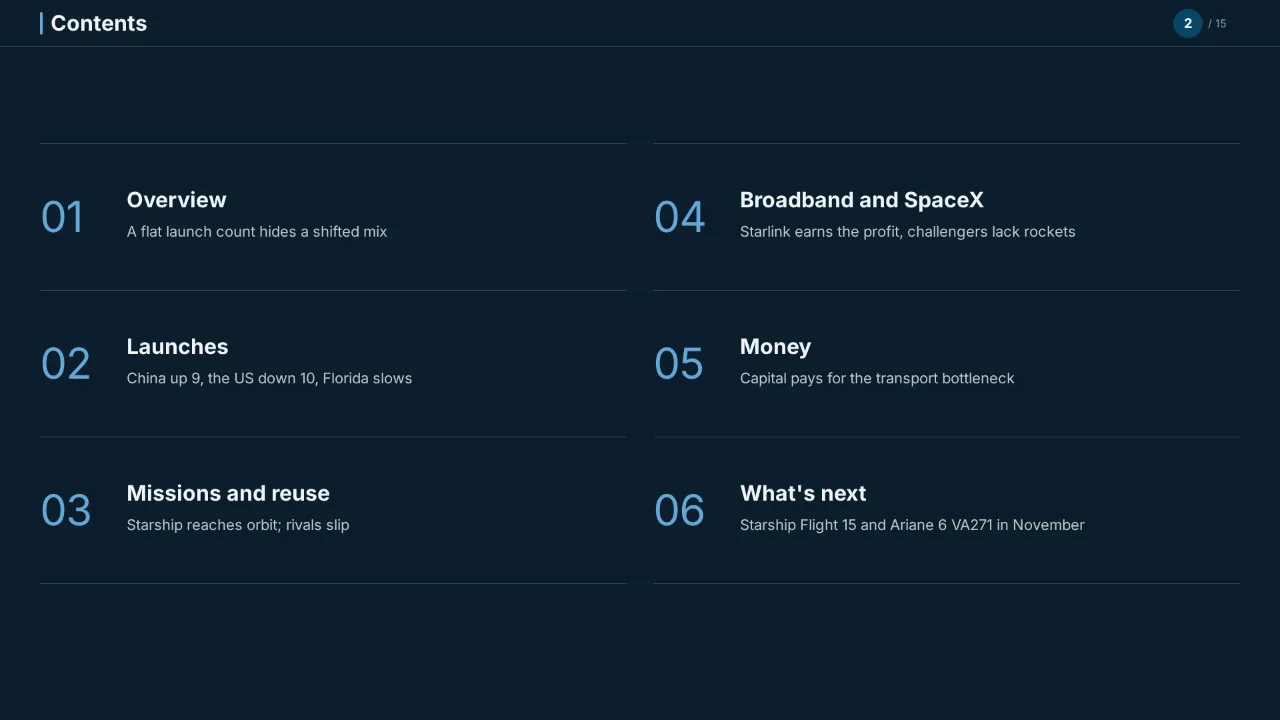
- Key takeaways from the month
- Launch statistics for the month
- Major missions
- Reusable rockets
- Satellite internet
- SpaceX as a listed company — Q3 2026 results
- Funding and contracts
- Next month's launch calendar
- What to watch and implications
1. Key takeaways from the month
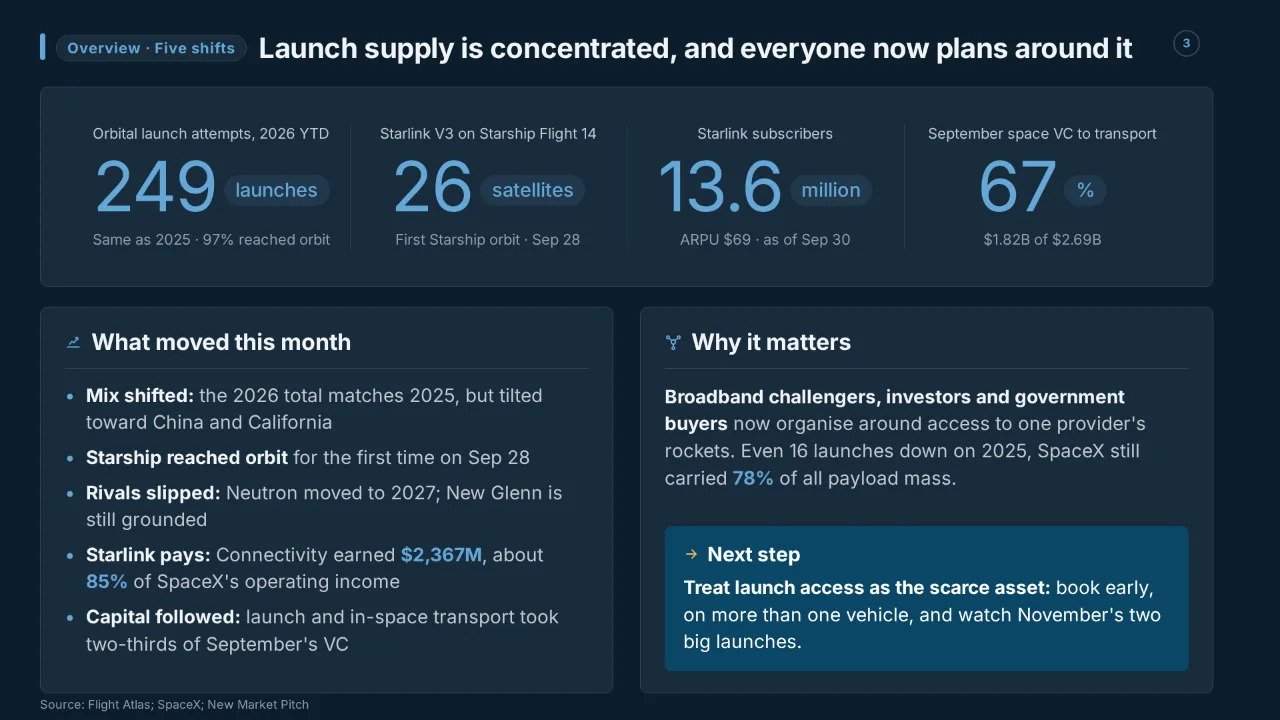
The month from 23 September to 22 October 2026 had fewer launches than usual. It mattered more than its count suggests: Starship reached orbit for the first time, SpaceX published the first full set of numbers showing where its money is made, and every challenger's schedule slipped further. Five conclusions follow, each drawn from the chapters that follow.
1.1 Five conclusions
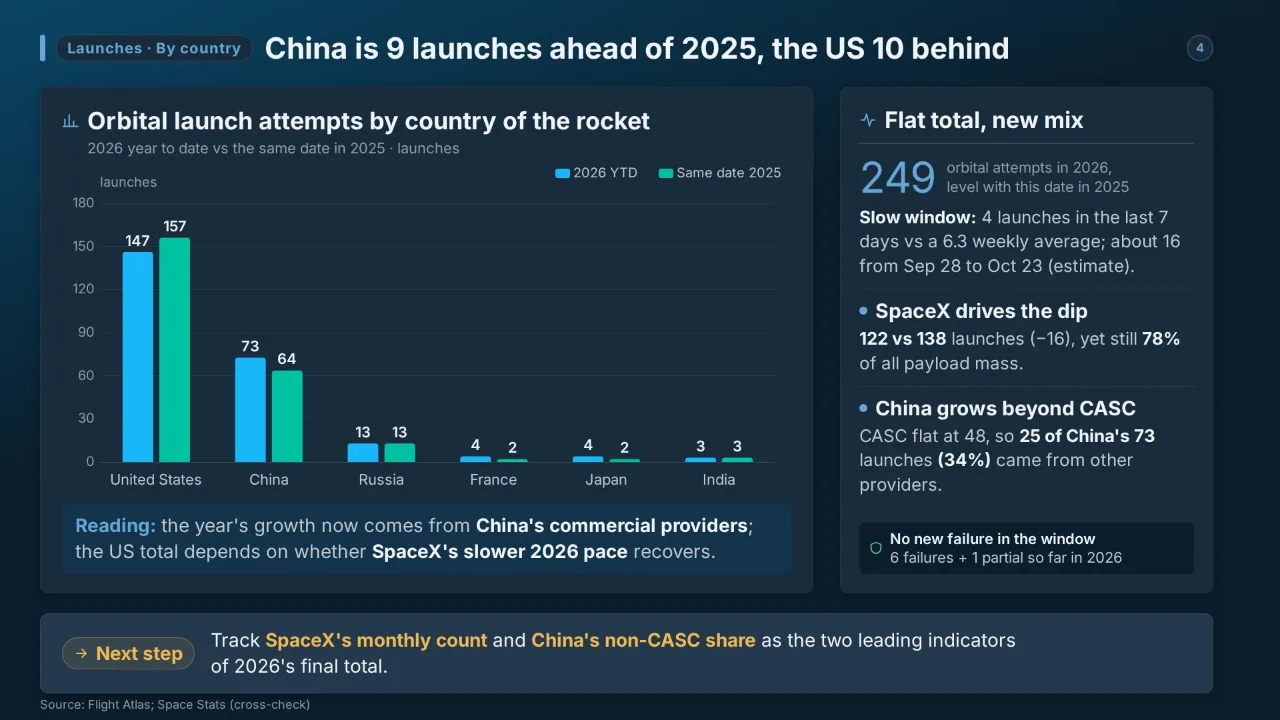
1. The global launch total is flat, but the mix has shifted from Florida and SpaceX toward China and California. As of 23 October, Flight Atlas counts 249 orbital launch attempts in 2026, exactly the same as by this date in 2025, with 97% reaching orbit. Underneath, the United States is 10 launches behind its 2025 pace (147 vs 157) and China 9 ahead (73 vs 64). SpaceX alone is down 16 launches (122 vs 138) yet still carried 78% of all payload mass. The window itself ran slow: 4 launches in the last 7 days against a 6.3 weekly average, and roughly 16 between 28 September and 23 October by a mixed-database estimate. Vandenberg, at 70 launches by 15 October, is one short of California's annual record, while the Space Coast stands at 60 against 109 in 2025.
2. Starship reaching orbit was the month's one industry-changing event, but it flew 3 of a planned 10 hours. Flight 14 lifted off on 28 September, made the first Starship orbit, deorbit burn and controlled splashdown, and released 26 Starlink V3 satellites, about 10x the downlink capacity of one Falcon 9 Starlink launch by SpaceX's own figure. An early Raptor vacuum shutdown cut the flight to about three hours. Flight 15, which will attempt to catch both the booster and the ship, is announced for November; Musk's "four to six weeks" from 20 October points to the second half of the month (estimate).
3. Reuse is still a one-company capability, and launch prices have not fallen. Rocket Lab moved Neutron's debut to 2027 on 14 October; New Glenn has been grounded since its 28 May pad explosion, and its return slid from December toward early 2027 in Reuters' reporting; China's two recovered first stages (Long March 10B in July, Zhuque-3 in August) have not flown again. Without a rival, SpaceX keeps the savings: Falcon 9's list price works out at about $3,246/kg, 19% above its 2018 level, and rideshare rose to $7,000/kg (according to SpaceNexus).
4. Starlink, not launch, is where SpaceX's profit comes from, and challengers are short of rockets, not satellites. SpaceX's Q3 2026 results, released on 20 October, show 13.6 million Starlink subscribers, ARPU of $69, and Connectivity operating income of $2,367M, a 45.1% margin and about 85% of group operating income; the Space segment lost $7M on Starship R&D. Amazon Leo has more than 1,000 satellites built but only 396 in orbit, has missed its 1,618-satellite FCC milestone, and relies on Ariane 6 VA271 (NET 23 November, 36 satellites) as its next heavy launch.
5. Capital is paying for the bottleneck: transport. In New Market Pitch's September cohort, launch and in-space transport took $1.82B of $2.69B (67%). The window caught the tail: Hanwha joined Impulse Space's $308M Series D extension (total $808M), Infinite Orbits announced €52M and booked four Impulse flights, and in-window disclosed rounds sum to about $521M across sources. On the government side, the Space Force reset SCAR as a commercial-services buy, with awards due in early 2027.
One month, one pattern: launch supply is concentrated in one company, and every other part of the industry — broadband challengers, investors, government buyers — is now organised around getting access to it.
1.2 Month at a glance
| Item | Number / event | Date | Status | Source |
|---|---|---|---|---|
| Orbital launch attempts 2026 YTD | 249 (same as 2025), 97% reached orbit | as of 23 Oct | In effect | Flight Atlas |
| US vs China YTD | 147 vs 73 (2025 same date: 157 vs 64) | as of 21 Oct | In effect | Flight Atlas |
| Starship Flight 14 | first orbit; 26 Starlink V3; ~3 h of ~10 h planned | 28 Sep | Done | SpaceX; ABC News |
| CRS-35 | >6,300 lb to ISS, final iROSA pair | 13 Oct | Done | NASA; Spaceflight Now |
| Neutron first launch | moved to 2027 | 14 Oct | Announced | Rocket Lab |
| Blue Origin Florida plan | $330M factory expansion; LC-36 rate 12 → 50 requested | 16 Oct | Announced; FAA review | Blue Origin; Spaceflight Now |
| SpaceX Q3 2026 | revenue $14,575M (+161%); Connectivity $5,248M | 20 Oct | Reported | SpaceX |
| Starlink | 13.6M subscribers, ARPU $69 | 30 Sep | In effect | SpaceX |
| Amazon Leo | 396 in orbit, >1,000 built | 9 Oct | In effect | Amazon via How-To Geek |
| Impulse Space Series D | $808M total; Hanwha joins | 22 Oct | Announced | The Korea Herald |
| Starship Flight 15 | booster + ship catch attempt | NET Nov | Upcoming | Space.com |
| Ariane 6 VA271 | 36 Amazon Leo satellites | NET 23 Nov | Upcoming | Arianespace |
2. Launch statistics for the month
Chapter 1 drew the month's conclusions; this chapter supplies the counting beneath them. The backbone is Flight Atlas, which compiles Launch Library 2 (The Space Devs) data checked against Jonathan McDowell's GCAT and credits each launch to the country of the rocket, not the launch site; other databases are used only for cross-checks.
2.1 Year to date: a flat total with a shifted mix
As of 23 October 2026, Flight Atlas counts 249 orbital launch attempts in 2026, exactly as many as by the same date in 2025, and 241 of them reached orbit. 2025 ended at 329, the most of any year. Payload mass tells a slightly weaker story: 2,163 t to orbit versus 2,248 t by the same date in 2025, i.e. (2,163 − 2,248) ÷ 2,248 ≈ −3.8%. On a trailing basis the 365 days to 20 October still logged 329 launches, +4% on the year before.
Table 2.1 — Orbital launch attempts by country of the rocket. Source: Flight Atlas (Launch Library 2 checked against GCAT), data as of 21 October 2026.
| Country | 2026 YTD | Share | Same date 2025 | All of 2025 | Source |
|---|---|---|---|---|---|
| United States | 147 | 59% | 157 | 198 | Flight Atlas |
| China | 73 | 29% | 64 | 92 | Flight Atlas |
| Russia | 13 | 5% | 13 | 17 | Flight Atlas |
| France | 4 | 2% | 2 | 4 | Flight Atlas |
| Japan | 4 | 2% | 2 | 4 | Flight Atlas |
| India | 3 | 1% | 3 | 5 | Flight Atlas |
| Italy | 2 | 1% | 2 | 3 | Flight Atlas |
| Germany | 1 | <1% | 1 | 1 | Flight Atlas |
| South Korea | 1 | <1% | 0 | 2 | Flight Atlas |
| World | 248 | 100% | 247 (headline) | 329 | Flight Atlas |
The global total is flat, but the mix is not: the United States is 10 launches behind its 2025 pace (147 vs 157) while China is 9 ahead (73 vs 64).
China already has 73 ÷ 92 ≈ 79% of its 2025 total, the United States 147 ÷ 198 ≈ 74%. A straight-line projection (73 ÷ 294 days × 365 ≈ 91, estimate) puts China level with, not clearly above, its 2025 record of 92.
Table 2.2 — Launches by provider, 2026 vs same date 2025, and payload delivered in 2026. Source: Flight Atlas, as of 23 October 2026.
| Provider | 2026 YTD | Same date 2025 | Change | Payload to orbit 2026 | Source |
|---|---|---|---|---|---|
| SpaceX | 122 | 138 | −16 | 1,683 t (78%) | Flight Atlas |
| CASC | 48 | 48 | 0 | 200 t (9%) | Flight Atlas |
| Rocket Lab | 16 | 13 | +3 | 2 t | Flight Atlas |
| Progress RSC | 11 | 10 | +1 | 63 t (3%) | Flight Atlas |
| CAS Space | 6 | 3 | +3 | 10 t | Flight Atlas |
| ULA | 5 | 4 | +1 | 70 t (3%) | Flight Atlas |
| World | 249 | 249 | 0 | 2,163 t | Flight Atlas |
The decline is almost entirely SpaceX: 122 launches (49%) versus 138 a year earlier, while it still carried 78% of all payload mass. CASC is flat at 48, so China's gain comes from other providers: CAS Space 6, LandSpace 5, China Rocket 4, Galactic Energy 4, ExPace 3, Orienspace 2 and Space Pioneer 1 add up, with CASC, to China's 73, meaning 25 of 73 (34%) Chinese launches came from providers other than CASC. By vehicle, Falcon 9 Block 5 led with 115 launches and one failure, ahead of Electron (16) and Long March 6A (8), as of 20 October.
2.2 The month in the window (23 Sept – 22 Oct)
The material has no Flight Atlas snapshot at 22 September, so an exact window count cannot be read off one database. Two indicators bracket it. Bridging Space Stats' 28 September total of 233 to Flight Atlas' 249 on 23 October gives roughly 16 launches in 25 days (estimate, mixed databases), of which about 11 were American and 3 Chinese by the country splits on the two pages. Flight Atlas' pace gauge agrees: 4 launches in the last 7 days versus a 6.3 weekly average over 365 days, and 36 t of payload versus 53.5 t. At 6.3 per week a typical 30 days would hold about 27 launches (6.3 ÷ 7 × 30), so this was a below-average month.
Launches in the window that the material names, all recorded as successes, were Starship Flight 14 on 28 September, the first Starship to reach orbit; Crew-13 on Falcon 9 and the NROL-97 Falcon Heavy on 1 October; Starlink 15-25 from Vandenberg on 12 October PT (13 October 00:28 UTC); CRS-35 on 13 October; the classified USSF-481 on 15 October; and Bandwagon-5 on 20 October. Chapter 3 covers them.
Reliability held. Flight Atlas records 6 failures and 1 partial failure in 2026 as of 23 October and a 97% reach-orbit rate, against 96% (316 of 329; 12 failures, 1 partial) for all of 2025. Space Stats showed 7 failures and no partials on 28 September; both databases therefore hold seven non-successful attempts, which suggests no new failure in the window (inference). The failures visible in Space Stats' log, including PSLV on 12 January and Long March 3B on 16 January, are background. Friction showed up as slips rather than losses: Starlink 15-25 slipped three times, 11 days in all, and Crew-13 moved from 12 September to 1 October after a propulsion leak on Dragon Grace.
2.3 Records and cadence: the West Coast overtakes Florida
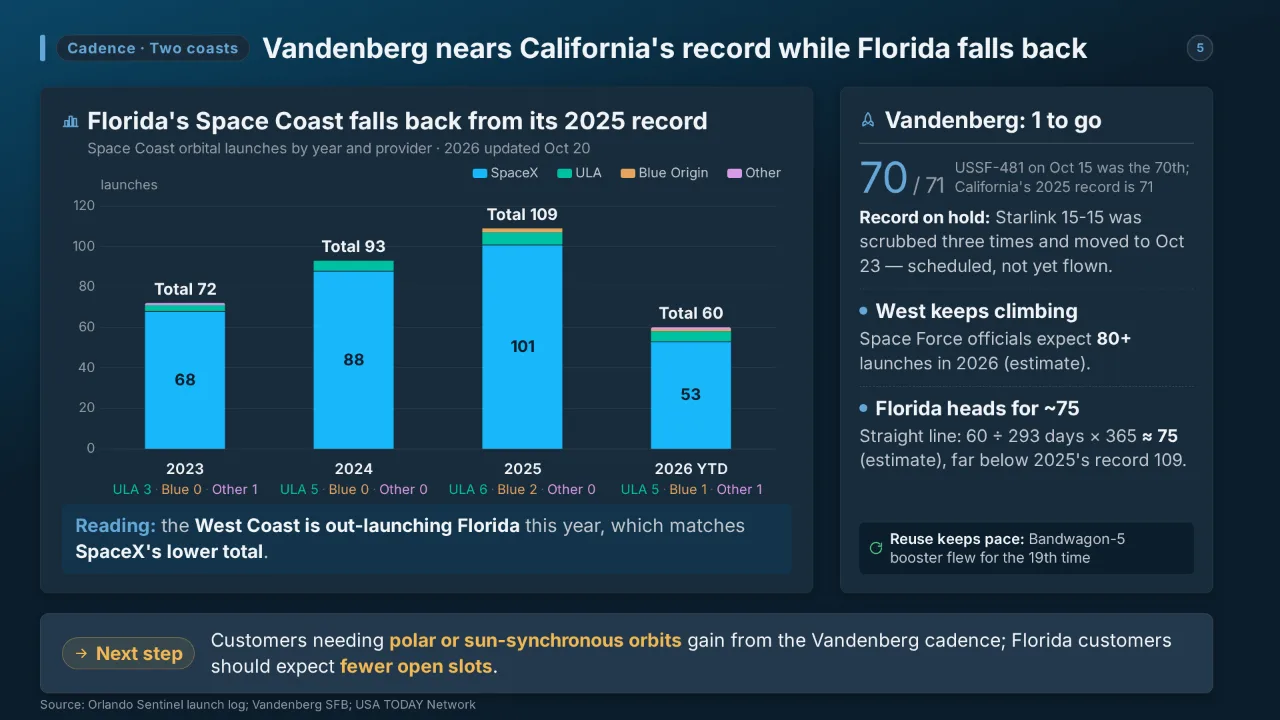
Vandenberg Space Force Base logged its 69th launch of 2026 on 12 October, and USSF-481 on 15 October was the 70th, one short of California's 2025 record of 71. The record-tying Starlink 15-15, first targeted for 20 October, was scrubbed for a third time for "unfavorable weather" and moved to 23 October, 2:30–6:30 p.m. PT; SpaceX lists a Starlink mission from 21:30 UTC on 23 October. Status on the run date: scheduled — the record is not yet tied. The record-breaking 72nd launch had been planned as Starlink 15-16 on 23 October. Space Force officials expect 80 or more Vandenberg launches in 2026 (estimate); a straight line gives 70 ÷ 288 days × 365 ≈ 89 (estimate).
Table 2.3 — Space Coast orbital launches by year and provider. Source: Orlando Sentinel launch log, 2026 updated 20 October 2026.
| Year | Total | Cape Canaveral | KSC | SpaceX | ULA | Blue Origin | Other | Source |
|---|---|---|---|---|---|---|---|---|
| 2023 | 72 | 59 | 13 | 68 | 3 | 0 | 1 (Relativity) | Orlando Sentinel |
| 2024 | 93 | 67 | 26 | 88 | 5 | 0 | 0 | Orlando Sentinel |
| 2025 | 109 | 83 | 26 | 101 | 6 | 2 | 0 | Orlando Sentinel |
| 2026 YTD | 60 | 56 | 4 | 53 | 5 | 1 | 1 (NASA SLS) | Orlando Sentinel |
Florida is the weak spot. The Space Coast stood at 60 on 20 October against the record 109 of 2025; a straight line (60 ÷ 293 days × 365 ≈ 75, estimate) ends the year near 2024 levels, not 2025's. With Vandenberg at 70 by 15 October, the West Coast is out-launching Florida this year, which is consistent with SpaceX's lower total in Table 2.2. Reuse records continue: according to shattered.io, the Falcon 9 fleet leader reached 37 flights on 25 August (background) and B1063 was set for its 36th flight on Starlink 15-15, which Flight Atlas also describes as a 36th flight; Bandwagon-5's booster flew for the 19th time. Chapter 4 covers reuse.
2.4 Data caveats
Flight Atlas' own snapshots read 247 (20 October), 248 (21 October) and 249 (23 October). Its breakdown of 241 reached orbit, 6 failures and 1 partial sums to 248, one short of 249. In Table 2.1 the same-date-2025 column sums to 244 against a 247 headline, and the all-2025 column to 326 against 329; the gap is countries that flew in 2025 but not yet in 2026 (9 countries versus 11). For Vandenberg, the base calls the 12 October launch its 69th, while SpaceNexus' Launch Library 2 record calls it the 65th and SpaceX's 113th of 2026; this chapter follows the base. Falcon 9 totals also diverge: 108 by 28 September at Space Stats, "107th" on 13 October at SpaceNexus, and 115 by 20 October at Flight Atlas, which is the figure used here. Orbital Radar shows 246 for the year without a date; Gunter's Space Page was last updated 15 September and adds megaconstellation launches only after they fly; McDowell's Starlink statistics page was last updated 20 August.
3. Major missions
Chapter 2 counted the launches; this chapter asks which of them changed what the industry can do. One flight, Starship's first orbital mission, outweighs the rest; the others show routine government logistics on reused Falcon hardware and a Chinese commercial sector now given launch priority over state rockets.
3.1 Mission timeline
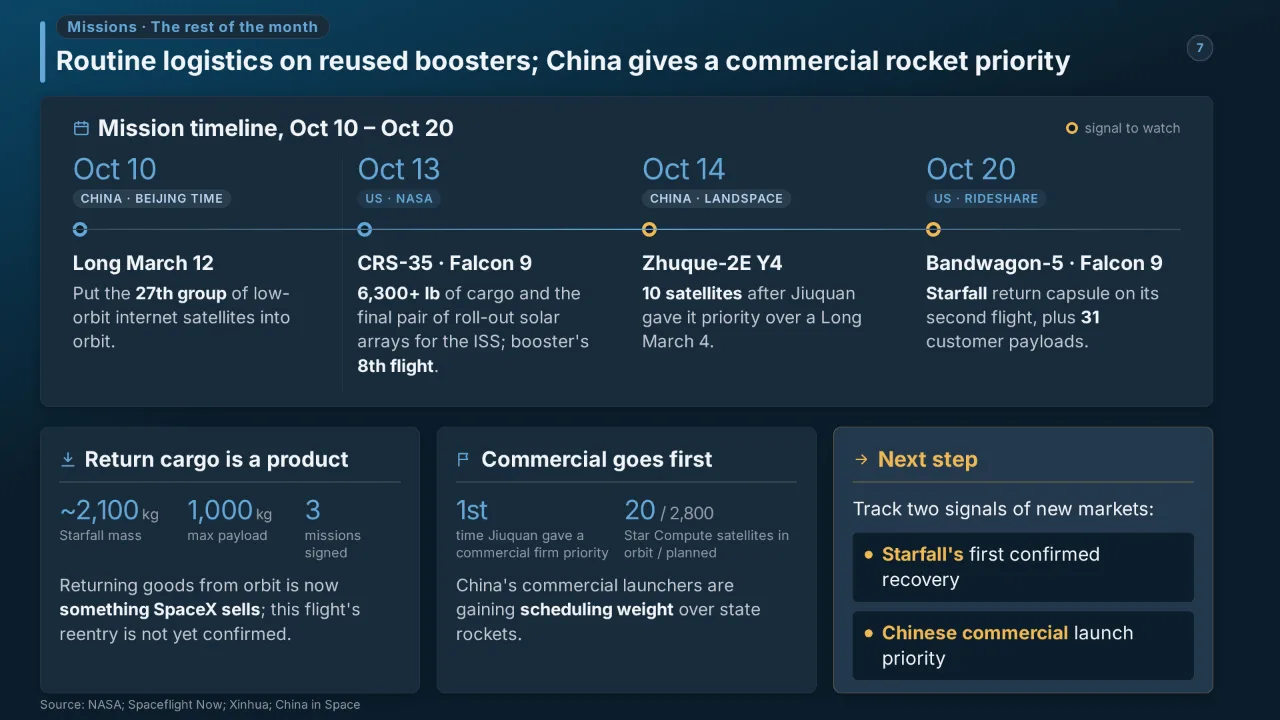
Missions that mattered, 2026-09-23 to 2026-10-22 (times converted to UTC from the local times each source gives; status as of 2026-10-23):
| Date (UTC) | Vehicle | Mission | Operator / customer | Outcome | Source |
|---|---|---|---|---|---|
| Sep 28, 12:48 | Starship (Super Heavy B21 / Ship 41) | Flight 14 "Starlink 31-1", 26 Starlink V3 | SpaceX | Success: first orbit, all 26 deployed; flight cut from ~10 h to ~3 h | SpaceX; Spaceflight Now |
| Oct 9 (headline date) | Falcon 9 | 21 data-transport satellites | Space Development Agency | Launched after an Oct 4 scrub | Spaceflight Now |
| Oct 9, 19:27 (Oct 10, 03:27 Beijing) | Long March 12 | 27th group of low-orbit internet satellites | China | Success, preset orbit | Xinhua via People's Daily |
| Oct 13, 10:33 | Falcon 9 (B1096) + Cargo Dragon C211 | CRS-35 | NASA | Success; booster landed at LZ-40; docking scheduled Oct 15 | Spaceflight Now; NASA |
| Oct 14, 11:40 | Zhuque-2E Y4 | 10 satellites (8 ADAspace compute + 2 Guangchuan) | LandSpace | "Complete success" | Xinhua via People's Daily; SpaceNexus |
| Oct 15 | Falcon 9 | Classified payload | U.S. Space Force | Launched (headline only) | Spaceflight Now |
| Oct 20, 11:04 | Falcon 9 (B1085) | Bandwagon-5: Starfall + 31 payloads | SpaceX / rideshare customers | All customer payloads deployed; Starfall reentry not confirmed | Spaceflight Now; SpaceNews via AIAA |
The material has nothing on the October Vulcan flight, and the SDA mission appears only as a Spaceflight Now headline, so its Tranche 1 designation and UTC time are unconfirmed. Crew rotation also fell in the window: Crew-13 arrived at the ISS on Oct 1 and Crew-12 splashed down on Oct 8.
3.2 Starship Flight 14 in depth
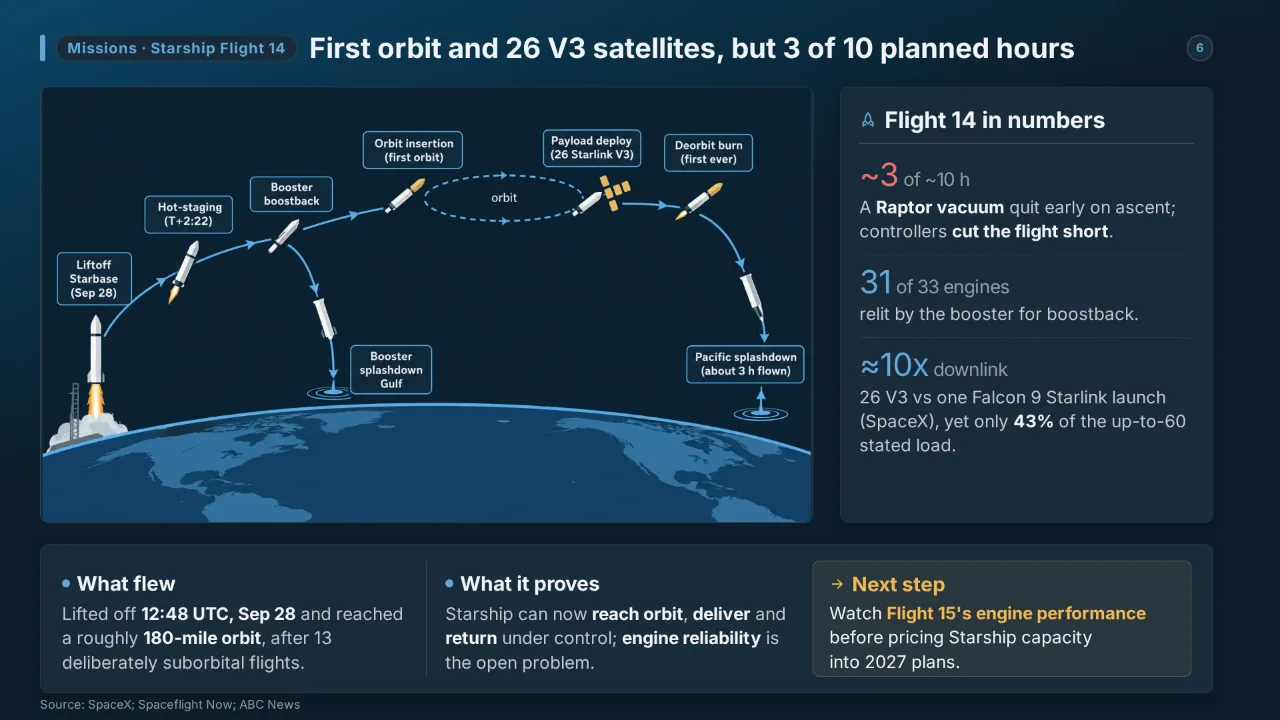
Starship lifted off from Starbase, Texas, at 7:48 a.m. CT on Sept 28 (12:48 UTC). Spaceflight Now logged 8:49 a.m. EDT and ABC News 8:50 a.m. ET; the one-to-two-minute gap is minor and this report follows SpaceX. The stack was Super Heavy B21 and Ship 41, and SpaceX did not try to recover either stage. All 13 earlier flights had been deliberately suborbital. This time the ship reached a roughly 180-mile-high orbit with two burns, released all 26 Starlink V3 satellites and made contact with every one of them. SpaceX's Q3 results call it the first revenue-generating Starship mission.
Engine performance by phase — SpaceX Flight 14 summary, as of 2026-09-28:
| Phase | Engines planned | Engines that ran | Result |
|---|---|---|---|
| Booster ascent | 33 Raptor 3 | 33 lit; 1 shut down in climb | Ascent and hot-staging completed |
| Boostback burn | 33 | 31 | Burn designed to use up remaining LOX and test performance limits |
| Booster landing burn | 13 | 11, then 5, then 3 | Gulf splashdown; flight termination system fired as a demonstration |
| Ship ascent | 6 | 6 lit; 1 Raptor vacuum shut down early | Other 5 burned longer to compensate |
| Orbit insertion | 1 sea-level Raptor | 1 | First orbit |
| Deorbit burn | 1 sea-level Raptor | 1 | First-ever Starship deorbit |
| Landing burn and flip | 3 sea-level Raptors | 3 | On-target Pacific splashdown |
Engines were the weak point, and the ship's early shutdown cut the mission short: "out of an abundance of caution", controllers cut the time in orbit and sent Starship to a splashdown in the northern Pacific, one of two landing zones agreed in advance. The flight lasted about three hours instead of the planned "just under 10 hours" and roughly six orbits, and the ship came down north of Hawaii rather than off Chile as planned. CNN reported a harder touchdown than Flight 13's in July (background).
Planned flight timeline — SpaceX pre-flight timeline, "all times approximate" (milestones after payload deploy were brought forward when the flight was shortened):
| Milestone | Planned T+ (h:mm:ss) |
|---|---|
| Max Q | 0:00:58 |
| Hot-staging | 0:02:22 |
| Boostback burn | 0:02:27 – 0:03:07 |
| Booster landing burn | 0:06:36 – 0:07:01 |
| Ship engine cutoff | 0:08:11 |
| Orbit insertion burn | 0:25:17 – 0:25:36 |
| Payload deploy | 0:34:07 – 1:04:39 |
| Deorbit burn | 8:52:37 – 8:52:48 |
| Entry | 9:28:56 |
| Splashdown | 9:50:30 |
On bandwidth, SpaceX's Q3 release credits the 26 satellites with about 10x the downlink capacity of one Falcon 9 Starlink launch, while spokesperson Dan Huot told CNN the flight "was like 20 Falcon 9 flights"; this report uses the filed 10x. SpaceX has said V3 flights could later carry up to 60 satellites, so Flight 14 used about 43% of that stated load (26 ÷ 60 ≈ 0.43). Three of the satellites carried cameras to film the ship's heat-shield tiles.
Starship Flight 14 put 26 Starlink V3 satellites in orbit, worth about 10x a Falcon 9 Starlink launch in downlink capacity according to SpaceX, but flew only ~3 of a planned ~10 hours after one of the ship's six engines quit during ascent.

What it proves: Starship can now relight in space, reach orbit, release a payload and bring itself back down under control. Engine reliability is the open problem, and it matters for NASA's plan to land astronauts with a Starship variant in 2028. Plans to catch the ship on Flight 15 are covered in Chapter 4.
3.3 Government, science and rideshare missions
CRS-35 lifted off from SLC-40 at 6:33 a.m. EDT (10:33 UTC) on Oct 13. (Space.com gives 6:35 a.m.; this report follows NASA and Spaceflight Now.) Dragon carried more than 6,300 lb of cargo and equipment for more than 40 studies. Its trunk held the fourth and final pair of Redwire roll-out solar arrays, each rated at more than 20 kW for over 10 years. Booster B1096 flew for the eighth time and landed at LZ-40; capsule C211 was on its fourth flight. NASA's revised advisory set docking for about 10:30 a.m. EDT on Oct 15, while Spaceflight Now and Space.com gave 11 a.m. EDT. Post-docking confirmation is not in the material. Dragon is due to leave in mid-November and splash down off California (upcoming). According to TechTimes, CRS-35 completes the delivery phase of an array campaign that began with CRS-22 in June 2021; installation still needs spacewalks.
The SDA (Oct 9) and classified Space Force (Oct 15) launches exist in the material only as Spaceflight Now headlines.
Bandwagon-5 was scrubbed on Oct 19 because of weather in the booster recovery zone. It launched on Oct 20 at 7:04 a.m. EDT (11:04 UTC), as SpaceNews (via AIAA) confirms. Spaceflight Now counts 32 payloads: Starfall plus 31 others. Exolaunch arranged 20 of the 31, including four HawkEye 360, four Iceye and six Xona Space Systems satellites. Shattered.io gives 23 for Exolaunch, but this report follows Spaceflight Now. Booster B1085 was on its 19th flight, and SpaceX confirmed that all customer payloads were deployed.
The more important passenger was Starfall, SpaceX's uncrewed return capsule, on its second flight after a June 23 debut (background). According to the FAA, it is about 0.75 m tall and 3.1 m wide, has a mass of about 2,100 kg and can carry up to 1,000 kg. According to shattered.io, reentry and recovery were not publicly confirmed. Yet SpaceX has already signed three commercial Starfall missions, which makes returning goods from orbit something it sells, not just a test.
3.4 China's month
A Long March 12 lifted off from Hainan's commercial launch site at 3:27 a.m. Beijing time on Oct 10 (19:27 UTC Oct 9) and placed the "27th group of low-orbit internet satellites" into orbit. Xinhua named neither the operator nor the number of satellites; constellation counts are in Chapter 5.
The more telling flight was LandSpace's Zhuque-2E Y4, which lifted off from Jiuquan Launch Area 96A at 7:40 p.m. Beijing time on Oct 14 (11:40 UTC). China in Space gives 12:40 UTC, which does not match its own Beijing time, so this report uses 11:40. The rocket put 10 satellites into sun-synchronous orbit. Eight were ADAspace "Star Compute" Group-02 satellites, testing 10,000-watt liquid-cooling loops, large deployable radiators, laser links and in-orbit training of foundation models. The other two were the Guangchuan-03 and -04 laser-communication testbeds. The plan targets 2,800 computing satellites; the constellation now has 20 in orbit.
The launch-site decision matters more than the payload. Jiuquan settled a conflict with a Long March 4 launch in LandSpace's favour, the first time a commercial company was allowed to go first. It was Zhuque-2E's fourth flight of 2026 and China's 72nd launch of the year. LandSpace has been building Zhuque-2E in batches since June and says it is now verifying reuse on Zhuque-3 (see Chapter 4).
Zhuque-2E vehicle data — China in Space, as of 2026-10-14:
| Parameter | Value |
|---|---|
| Payload to 500 km SSO | 4,000 kg |
| Height / liftoff mass | 55.9 m / 267,000 kg |
| First stage | 4 × TQ-12A, 338 t thrust |
| Second stage | 1 × TQ-15A, 85 t thrust |
| Stage / fairing diameter | 3.35 m / 4.2 m |
Our judgement: no Chinese mission this month matched Flight 14. The signals that matter are steadier commercial launch rates and launch priority over a state rocket.
4. Reusable rockets
The cadence and missions in Chapters 2 and 3 rest on reuse, and this month showed how unevenly it is spreading: SpaceX pushed toward full reuse while US challengers slipped or rebuilt, and China's two recovered boosters had yet to refly.
4.1 Reuse scoreboard
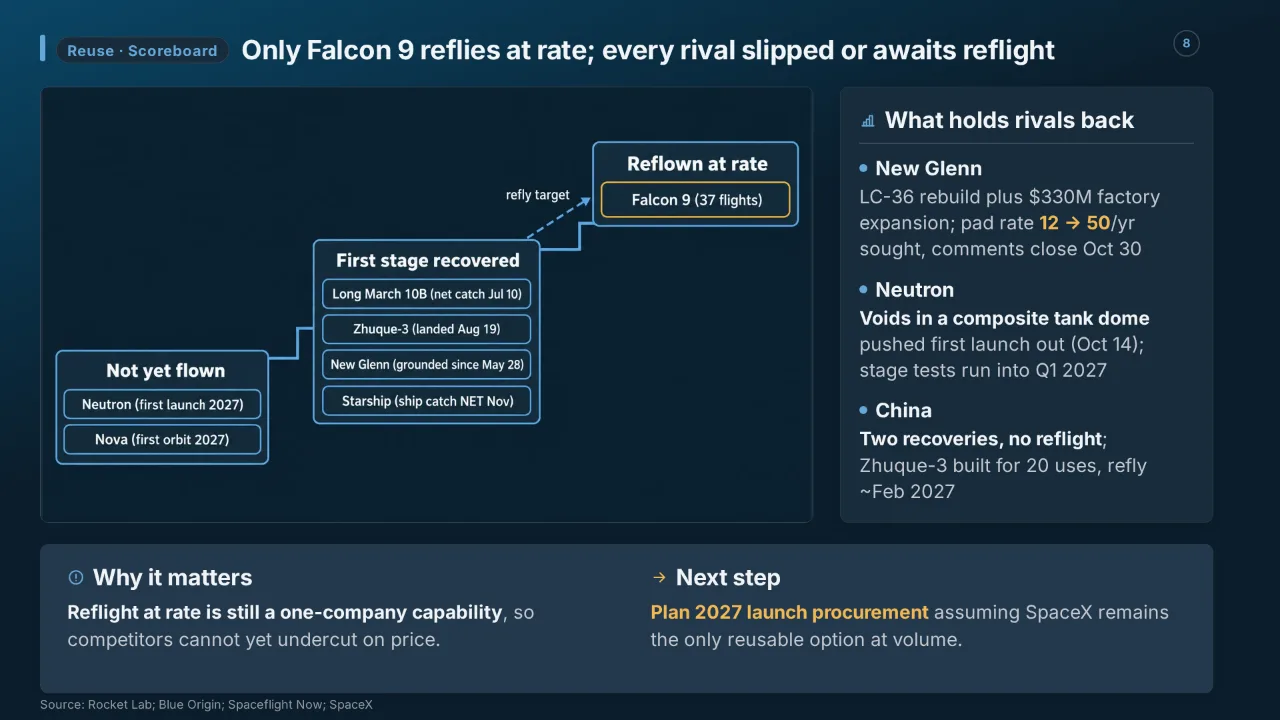
As of 2026-10-23, Falcon 9 is still the only booster reused routinely. Starship's first attempt to catch both stages is targeted for November 2026, Rocket Lab's Neutron has slipped to 2027, and New Glenn has been grounded since its May 28 pad explosion.
| Vehicle | Reuse status (as of 2026-10-23) | Latest milestone + date | Next step | Source |
|---|---|---|---|---|
| Falcon 9 (SpaceX) | Operational booster reuse; designed for up to 40 flights | Fleet leader flew its 37th mission, Aug 25, 2026 (background) | Continued reflights | SpaceNexus |
| Starship V3 (SpaceX) | Booster caught on Flights 5, 7, 8 (V1/V2); no V3 catch, no ship catch yet | Flight 14 reached orbit, Sep 28, 2026; both stages splashed down, no catch planned | Flight 15 (Booster 22 / Ship 42): booster + ship catch, NET November 2026 | KeepTrack; Shattered; SpaceNexus |
| New Glenn 7×2 (Blue Origin) | Booster landed on ship Jacklyn on its last two flights (background); grounded after May 28 test explosion | Florida pads, landing ships and factory plan, Oct 16, 2026 | Return to flight targeted before end-2026 (company target) | Orlando Sentinel; Spaceflight Now |
| Neutron (Rocket Lab) | Not yet flown; reusable first stage with captive fairing | First launch moved to 2027, Oct 14, 2026 | Stage-1 tank tests through Q1 2027 | Rocket Lab release; Space.com |
| Long March 10B (CASC) | First stage caught by cable-net system at sea on maiden flight | Jul 10, 2026 (background) | No reflight in material | Universe Today |
| Zhuque-3 (LandSpace) | First stage landed on legs, on land | Aug 19, 2026 Beijing time (background) | Refly the recovered booster within six months (company target) | science.report; India Today |
| Nova (Stoke Space) | Not yet flown | Nova Pathfinder first orbital launch targeted for 2027 | Nova Block 2 (15 t to LEO) maiden flight possibly 2029 | Florida Today |
The shape is clear: three non-SpaceX vehicles have now recovered orbital-class first stages, but reflight at rate is still a one-company capability.

4.2 US moves: SpaceX accelerates, challengers slip
Starship. Flight 14 on Sep 28 was the first Starship to reach orbit, but neither stage was caught; Booster 21 splashed down in the Gulf of Mexico and the ship was lost on water impact (see Chapter 3). SpaceX calls Starship "designed to be fully reusable". On the Oct 20 earnings call, Elon Musk said Flight 15 would try to catch both the Super Heavy booster and the ship, calling it potentially "the first time that an orbital launch vehicle has been fully recovered". Status: Announced / upcoming, NET November 2026; according to Shattered, a widely reported Nov 8 date is not official. Gwynne Shotwell said SpaceX expects the Flight 15 licence to cover return-to-launch-site operations and tower catches for both stages; the material does not show it issued.
The timing is tighter than the headlines suggest. Musk's "hopefully four to six weeks away" on Oct 20 points to Nov 17 – Dec 1. Pad 2's fastest turnaround is 63 days (Flight 12 on May 22 to Flight 13 on Jul 24). Sep 28 + 63 days = Nov 30, while a Nov 8 launch would need 41 days. The catch itself is the harder risk. Every ship so far has ended in the ocean, and all three V3 boosters had engine-relight problems on descent. Musk's odds have stayed hedged, from "at least 50 or 60 percent" in mid-September to "more likely than not" in October. SpaceX is also seeking FAA permission for up to 456 Starship launches and 912 landings per year at Starbase.
Blue Origin. In an Oct 16 company post, Blue Origin said it has invested more than $3 billion in Florida. It is building a $330 million upper-stage factory expansion that will make up to 150 upper stages a year when complete in summer 2027. It plans two more landing platforms to join Jacklyn and additional New Glenn pads beyond the two at LC-36, all aimed at "multiple flights per week by the end of the decade". The FAA is reviewing a request to raise LC-36's permitted rate from 12 to 50 launches a year. Its virtual hearing was scheduled for Oct 22, now past, and public comment closes on Oct 30. The present is less ambitious: LC-36A is still being rebuilt by more than 1,000 workers, and Jeff Bezos said on Oct 7 that Blue Origin aims to fly New Glenn 7×2 again before year-end. The New Glenn booster is designed for up to 25 launches.
Rocket Lab. On Oct 14, Rocket Lab said Neutron's first launch "is now expected to occur in 2027" (status: Announced / upcoming, no month given). CEO Peter Beck said inspectors found voids in the carbon-fibre layers of a newly cured forward propellant dome. He said a process fix had produced the company's "highest quality" aft dome, with stage tests running into Q1 2027. It is the fourth public slip: from 2024 to 2025, early 2026, late 2026 (after a January tank rupture) and now 2027.
Stoke Space. Nova Pathfinder is targeted for its first orbital launch in 2027 from LC-14, and the larger Nova Block 2 (15 t to LEO) may debut in 2029.
4.3 China moves: two recoveries, no reflight yet
Both Chinese milestones predate the window (background). On Jul 10, 2026, CASC's Long March 10B caught its first stage at sea with a cable-and-net system on its maiden flight. The 70.2 m rocket can carry up to 16 t. On Aug 19, 2026 (Beijing time), LandSpace's Zhuque-3 Y2 landed its first stage on legs at the Dongfeng site after placing Honghu-03 in orbit. It was China's first land landing of an orbital-class stage and came after the December 2025 attempt was lost to abnormal combustion. Zhuque-3 burns methane and liquid oxygen and can lift up to 18,300 kg to LEO.
The next proof point is reflight. LandSpace says the stage is designed for up to 20 uses and aims to refly the recovered booster within six months. Aug 19 + 6 months is roughly Feb 19, 2027, and the material reports no Chinese booster reflight as of Oct 23. At least six other Chinese firms, from Galactic Energy to Space Pioneer, are pursuing recoverable stages. Our judgement: China now has as many recovered orbital boosters as Blue Origin (two), but has not yet shown the "fly it again" step that drives cost.
4.4 What reuse does to price per kg
Table 4-A — Published/reported launch prices, one source (SpaceNexus, prices as of 2026-10-11; list prices, not negotiated contract values)
| Vehicle | Price | Payload to LEO | $/kg to LEO | Flights in 2026 (tracker) | Source |
|---|---|---|---|---|---|
| Falcon 9 Block 5 | ~$74M | 22,800 kg | ~$3,246 | 113 | SpaceNexus |
| Falcon Heavy | ~$97M (2022 listing) | — | ~$1,520 | 3 | SpaceNexus |
| Electron | ~$9.2M (avg. revenue per launch) | 300 kg | ~$30,667 | 18 | SpaceNexus |
| Falcon 9 rideshare | $350k for 50 kg | — | $7,000 | — | SpaceNexus |
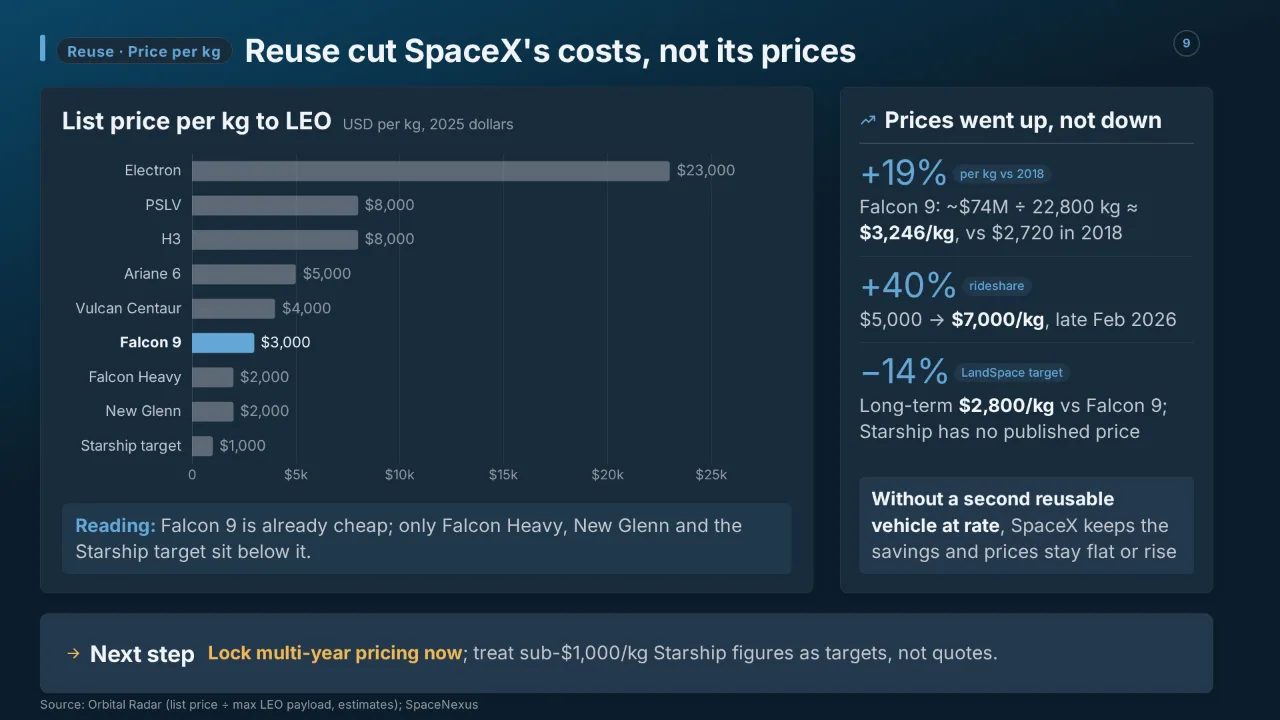
Table 4-B — List price ÷ maximum LEO payload, one source (according to Orbital Radar; 2025 USD; "~" marks its estimates; Starship is a design target)
| Vehicle | $/kg to LEO | Source |
|---|---|---|
| Electron | $23k | Orbital Radar |
| PSLV / H3 | ~$8k each | Orbital Radar |
| LVM3 / Soyuz-2 | ~$6k each | Orbital Radar |
| Ariane 6 | $5k | Orbital Radar |
| Vulcan Centaur | $4k | Orbital Radar |
| Falcon 9 / Long March 5 | $3k / ~$3k | Orbital Radar |
| Falcon Heavy / New Glenn | $2k / ~$2k | Orbital Radar |
| Starship (target) | ~$1k | Orbital Radar |
Table 4-C — Payload to LEO and estimated $/kg, one source (according to orbital-intel.com, updated May 2026; all $/kg are approximate, "est." and "target" rows are unflown or unpriced)
| Vehicle | Payload to LEO | $/kg to LEO | Source |
|---|---|---|---|
| Starship (target) | 150,000 kg | $100–200 | orbital-intel |
| Falcon Heavy (reusable) | 63,800 kg | $1,500 | orbital-intel |
| New Glenn | 45,000 kg | $5,000 (est.) | orbital-intel |
| Vulcan Centaur | 27,200 kg | $9,000 | orbital-intel |
| Terran R (target) | 23,500 kg | $3,500 (est.) | orbital-intel |
| Falcon 9 (expendable / reusable) | 22,800 / 15,600 kg | $2,700 / $1,500 | orbital-intel |
| Ariane 6 | 21,650 kg | $7,500 | orbital-intel |
| Neutron (target) | 13,000 kg | $3,000 (est.) | orbital-intel |
| Electron | 300 kg | $25,000 | orbital-intel |
The arithmetic gives an uncomfortable answer: reuse has lowered SpaceX's costs, but not its prices. Falcon 9's list price of $74M ÷ 22,800 kg = $3,246/kg compares with $62M ÷ 22,800 kg ≈ $2,720/kg in 2018 (NASA Ames via SpaceNexus). That is a 19% rise per kg ($3,246 ÷ $2,720 − 1 ≈ 0.19), even as the fleet leader reached 37 flights. Rideshare rose from $5,000/kg (2019–21) to $7,000/kg (late Feb 2026), a 40% rise. Sources disagree on the reused Falcon 9 figure: orbital-intel puts it at $1,500/kg and Orbital Radar at about $2,700/kg. We follow SpaceNexus's dated, reproducible list-price arithmetic; SpaceX does not publish its internal cost.
Without competition, SpaceX keeps the savings, and Neutron's slip and New Glenn's grounding extend that window. According to CNBC (via Quartz), SpaceX has stopped selling commercial Falcon 9 launches so it can focus on Starship; we treat that claim as unconfirmed.
Two numbers show where price could go next. LandSpace's long-term target of 20,000 yuan ($2,800)/kg is about 14% below Falcon 9's list price per kg ($2,800 ÷ $3,246 ≈ 0.86). At Zhuque-3's 18,300 kg, that implies about $51M per full flight (estimate: 18,300 × $2,800). Starship has no published price. If it sold at Falcon 9's $74M and carried 100,000 kg (Next Spaceflight's V3 figure), the price would be $740/kg, a hypothetical. Reported V3 payloads range from 100 t to about 200 t reusable. Third-party analysts put Starship's internal cost near $500/kg for expendable V1 and roughly half that for V3 (Payload Research via Ex Terra, estimate). Price per kg falls only when a second vehicle offers reflown capacity at rate; Flight 15's ship catch and a Zhuque-3 reflight are the events that would start that.
5. Satellite internet
Cheap, frequent launch (Chapter 4) pays off most in broadband constellations, and this month's numbers show one operator turning that advantage into profit while every challenger is still limited by how fast it can get satellites into orbit.
5.1 Constellation scoreboard
| Constellation | Satellites in orbit | As of | Subscribers / service status | Source |
|---|---|---|---|---|
| Starlink (SpaceX) | ~10,074 operational | Live tracker, retrieved Oct 2026 | 13.6M consumer subscribers at Sep 30, 2026; 174 markets — GA / in service | Orbital Radar; SpaceX Q3 release; SpaceX call via MarketBeat |
| Amazon Leo | 396 | Reported Oct 9, 2026 | No service yet; initial service planned for 2026 — Announced (Amazon) | Amazon VP Chris Weber via How-To Geek; Broadband Breakfast |
| Guowang (China SatNet) | 222 catalogued, ~258 incl. unsorted batches | Oct 2026 | No commercial service described in the material | KeepTrack |
| Qianfan (Shanghai Spacecom / Spacesail) | 251 objects, 233 working | Oct 2026 | Trial agreements in Brazil, Malaysia, Kazakhstan, Turkey | KeepTrack; Orbital Radar |
| AST SpaceMobile (BlueBird) | 13 launched | Oct 20, 2026 | Carrier beta in preparation (AT&T, Verizon); commercial D2D targeted for 1H 2027 — Announced | findcheapbroadband; MarketBeat via TradingView |
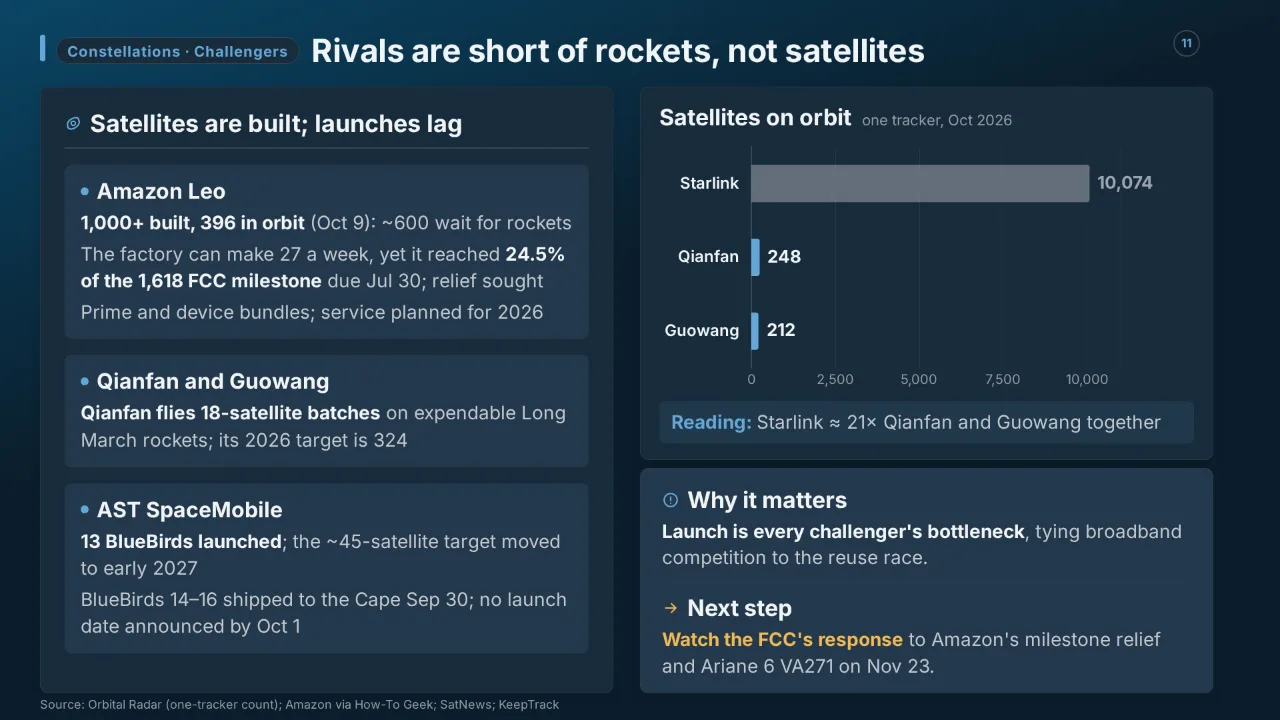
Chart set — satellites on orbit from one tracker: Orbital Radar live catalogue, page retrieved October 2026, exact timestamp not shown.
| Constellation | Satellites on orbit | Source |
|---|---|---|
| Starlink (operational fleet) | 10,074 | Orbital Radar |
| Qianfan | 248 | Orbital Radar |
| Guowang | 212 | Orbital Radar |
Tracker counts disagree. For Starlink, Orbital Radar counts 10,074 operational satellites on one page and 10,081 in orbit on another, while How-To Geek writes "more than 11,000 satellites in space". SpaceX gives no fleet total, so this chapter follows Orbital Radar, which states its counting basis. For Guowang, KeepTrack's catalogue shows 222, but it notes that four launches between August 4 and September 23, 2026 carried 36 satellites not yet sorted under the operator code, putting the real figure "closer to 258" (222 + 36); this chapter uses KeepTrack for China because it is dated October 2026. China's two networks together hold about 480 satellites against roughly 10,074 Starlinks — 10,074 ÷ 480 ≈ 21 times fewer.
5.2 Starlink economics: more users, lower prices, higher margin
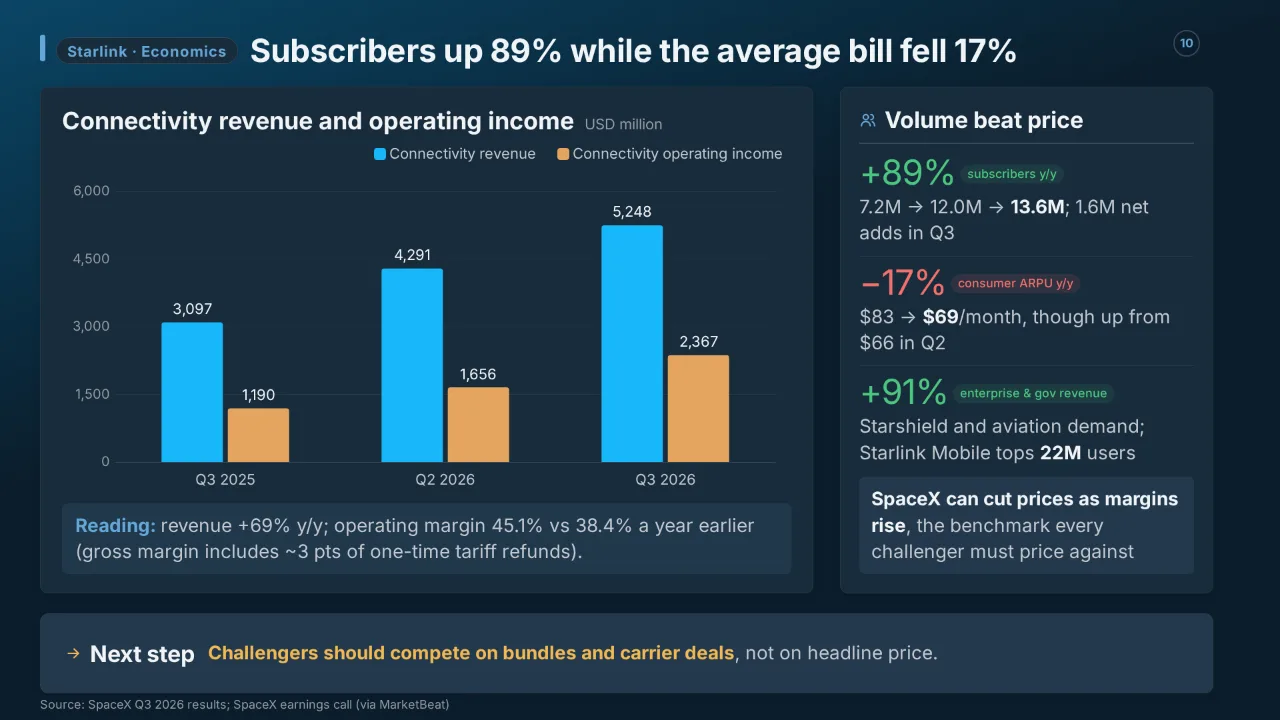
Chart set — Starlink and Connectivity KPIs, SpaceX Q3 2026 results release (quarter ended Sep 30, 2026; published Oct 20, 2026); % changes computed.
| Metric | Q3 2025 | Q2 2026 | Q3 2026 | QoQ | YoY | Source |
|---|---|---|---|---|---|---|
| Consumer subscribers (M, period end) | 7.2 | 12.0 | 13.6 | +13.3% | +88.9% | SpaceX |
| Consumer ARPU ($/month) | 83 | 66 | 69 | +4.5% | −16.9% | SpaceX |
| Consumer revenue ($M) | 1,986 | 2,485 | 3,121 | +25.6% | +57.2% | SpaceX |
| Enterprise & government revenue ($M) | 1,111 | 1,806 | 2,127 | +17.8% | +91.4% | SpaceX |
| Connectivity revenue ($M) | 3,097 | 4,291 | 5,248 | +22.3% | +69.5% | SpaceX |
| Connectivity operating income ($M) | 1,190 | 1,656 | 2,367 | +42.9% | +98.9% | SpaceX |
| Operating margin | 38.4% | 38.6% | 45.1% | — | — | computed from |
| Connectivity Adjusted EBITDA ($M) | 1,923 | 2,597 | 3,499 | — | — | SpaceX |
| Connectivity capex ($M) | 1,007 | 1,367 | 1,543 | — | — | SpaceX |
Chart set — Connectivity revenue by quarter ($M). Q3 2025, Q2 2026, Q3 2026 from SpaceX's release; Q1 2026 derived as nine-month 12,796 − 4,291 − 5,248; Q4 2025 derived by Stock Titan from the June 2026 prospectus.
| Quarter | Q3 2025 | Q4 2025 (derived) | Q1 2026 (derived) | Q2 2026 | Q3 2026 |
|---|---|---|---|---|---|
| Connectivity revenue | 3,097 | 3,228 | 3,257 | 4,291 | 5,248 |
Starlink ended September with 13.6 million consumer subscribers, up from 12.0 million in June and 7.2 million a year earlier. That is 13.6 − 12.0 = 1.6 million net additions in one quarter, which management said came mainly from developed markets; year on year, 13.6 ÷ 7.2 = 1.89, or +89%. Price moved the other way: consumer ARPU rose to $69 a month from $66 in Q2 (+4.5%, which the CFO rounded to 5% and put down to customer mix) but is down from $83 a year ago (69 ÷ 83 − 1 = −17%). The base nearly doubled while the average bill fell by about a sixth.
Revenue still grew because volume beat price. Consumer revenue rose 57% year on year to $3,121M, enterprise and government revenue rose 91% to $2,127M on Starshield and aviation demand, and Connectivity revenue reached $5,248M (+69%), above the $4.84B StreetAccount consensus cited by CNBC. A rough check: 12.8M average subscribers × $69 × 3 months ≈ $2.65B, about $0.47B below the reported consumer line (estimate). The release does not break that difference out. The quarterly series also shows a step change: revenue was flat from Q4 2025 to Q1 2026 (+0.9%), then jumped 31.7% in Q2 2026.
Starlink added 1.6 million consumer subscribers in Q3 2026 to reach 13.6 million, and Connectivity earned $2.37 billion of operating income — a 45.1% margin, up from 38.4% a year earlier.
Part of the margin gain will not repeat: the 55% gross margin includes a one-time benefit of about 3 percentage points, mainly from tariff refunds. Starlink Mobile, the direct-to-cell service, passed 22 million monthly users, up 37% quarter on quarter. About 12,000 aircraft are under contract and more than 3,800 were equipped at September 30. On capacity, Starship Flight 14 put 26 Starlink V3 satellites into orbit, about 10x the downlink capacity of one Falcon 9 Starlink launch, or 26 Tbps according to the call summary. Even so, Shotwell said "a few hundred" V3 satellites are needed before users in high-demand areas see a lasting improvement, which SpaceX expects by mid-2027 (company target). Starlink Mobile V2 plans — 15,000 satellites approved by the FCC, flights on Starship from 2027 and service in early 2028 — are company targets covered in Chapter 6.
5.3 Challengers: Amazon Leo, China, AST SpaceMobile
Amazon Leo is limited by launches, not factory output. Interviewed by Ars Technica (reported October 9), Chris Weber said Amazon has 396 satellites in orbit and that "the plan is to launch the initial service in 2026". More than 1,000 satellites have been built in Kirkland, and the factory can make 27 a week. That leaves roughly 1,000 − 396 ≈ 600 finished satellites waiting for rockets. The Gen1 design is quoted as 3,236, 3,232 or about 3,200. This chapter uses 3,236 because it is exactly twice the FCC milestone of 1,618 satellites. That milestone fell due on July 30, 2026 and has passed: 396 ÷ 1,618 = 24.5% deployed, and Amazon is seeking regulatory relief. Its commercial answer is bundling with Prime Video, eero, Fire TV and Ring, aiming for "the best value by far". Beta service in the US, Canada, the UK, Germany and France is expected in late 2026 or early 2027, according to BGR.
China: Qianfan launched 54 satellites in 2024, 54 in 2025 and 143 so far in 2026, according to KeepTrack. The 2026 targets are 310 for Guowang and 324 for Qianfan. Measured against KeepTrack's October counts, that means about 52 more for Guowang (310 − 258) and about 73 more for Qianfan (324 − 251) in roughly ten weeks. Orbital Radar estimates that Qianfan added only 10 satellites in the last 90 days, about 18% of Starlink's pace at the same age, and that it would finish its 1,296-satellite Phase 1 "beyond 2035" at that rate. Each Qianfan batch carries 18 satellites on expendable Long March rockets, against up to 60 per Falcon 9. No Xinhua or CASC figures were available; China counts come from trackers.
AST SpaceMobile has 13 BlueBirds in orbit. BlueBirds 11–13, launched August 5 (background), are all performing nominally, according to AST via Advanced Television on October 3. BlueBirds 14–16 left Midland for Cape Canaveral on September 30, and no launch date had been announced as of October 1. Advanced Television puts the batch about a month behind AST's August schedule. A July 2026 filing moved the target of about 45 satellites from end-2026 to early 2027, which requires 45 − 16 = 29 more in four to five months. Commercial direct-to-device service is targeted for 1H 2027 (company target). On October 19, Deutsche Telekom, Orange, Telefónica and Vodafone signed a Letter of Intent with AST to explore a joint European spectrum bid through "Satellite Connect Europe", according to Tech Insider citing AST's announcement.
5.4 What it means
Starlink now leads financially as well as in orbit: a 45% margin while ARPU falls 17% year on year lets SpaceX keep cutting prices, and every challenger must price against that. Amazon's Prime bundle moves the contest to customer-acquisition cost, where Amazon is strongest. It cannot fix the 600-satellite launch backlog. China is constrained by expendable launch and AST by its batch cadence — in every case the bottleneck is getting satellites up, which links this chapter to the reuse race in Chapter 4. In direct-to-device, Starlink Mobile's 22 million monthly users are already in service while AST is still preparing its carrier beta, so AST's best argument is carrier alignment, as the European LoI shows. Sovereignty also works in the challengers' favour: Musk reportedly ordered Starlink capability over Ukraine limited on October 14, according to the Wall Street Journal via Advanced Television. Such episodes give governments reason to back alternatives.
6. SpaceX as a listed company — Q3 2026 results
Chapter 5 looked at Starlink as a network; this chapter reads the same business through SpaceX's second quarterly report as a listed company (Nasdaq: SPCX), released just after 3 p.m. Texas time on 2026-10-20 and discussed on a webcast the same afternoon. The core finding: in the published accounts, launch is roughly break-even, Starlink earns most of the profit, and the AI unit, now called "Super Intelligence" (SI), is both the largest revenue line and the main user of capital.
6.1 Results at a glance
Status: reported 2026-10-20 for the quarter ended 2026-09-30. Revenue was $14.6 billion, up 161% from $5.6 billion. Net income was $4.4 billion, compared with a net loss of $1.1 billion a year earlier, and Adjusted EBITDA (non-GAAP) was $8.8 billion, up 306%. Revenue beat the LSEG consensus of $12.72 billion, and adjusted EPS was 45 cents against 13 cents expected. Quarter on quarter, revenue rose 14,575 / 7,814 − 1 = +86.5%.
Table 6.1 — Group results, $ million. Source: SpaceX Q3 2026 results release, three months ended each date; published 2026-10-20.
| Metric | Q3 2025 | Q2 2026 | Q3 2026 | YoY | Source |
|---|---|---|---|---|---|
| Revenue | 5,576 | 7,814 | 14,575 | +161% | SpaceX release |
| Income (loss) from operations | (273) | (143) | 2,791 | +3,064 swing | SpaceX release |
| Adjusted EBITDA (non-GAAP) | 2,169 | 3,538 | 8,809 | +306% | SpaceX release |
| Capex | 6,880 | 18,369 | 19,593 | +185% (19,593 / 6,880 − 1) | SpaceX release |
Table 6.2 — Revenue by segment, $ million. Source: SpaceX Q3 2026 results release, as of 2026-09-30.
| Segment | Q3 2025 | Q2 2026 | Q3 2026 | Share of Q3 2026 | YoY | Source |
|---|---|---|---|---|---|---|
| Space | 1,666 | 962 | 1,767 | 12.1% | +6% | SpaceX release |
| Connectivity | 3,097 | 4,291 | 5,248 | 36.0% | +69% | SpaceX release |
| SI | 813 | 2,561 | 7,560 | 51.9% | +830% | SpaceX release |
| Total | 5,576 | 7,814 | 14,575 | 100% | +161% | SpaceX release |
Share = segment / 14,575 (SI: 7,560 / 14,575 = 51.9%).
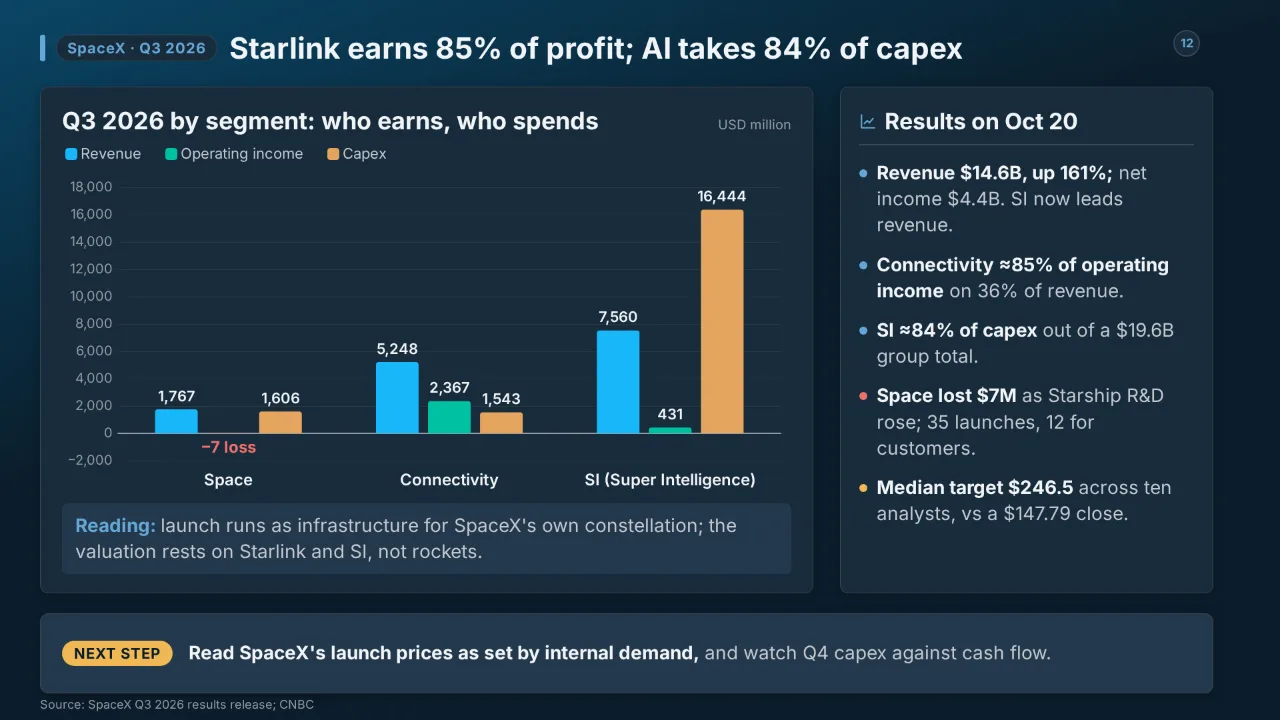
Table 6.3 — Q3 2026 profit and capex by segment, $ million. Source: SpaceX Q3 2026 results release.
| Segment | Income from operations | Segment Adj. EBITDA | Capex | Operating margin | Source |
|---|---|---|---|---|---|
| Space | (7) | 357 | 1,606 | −0.4% | SpaceX release |
| Connectivity | 2,367 | 3,499 | 1,543 | 45.1% | SpaceX release |
| SI | 431 | 4,953 | 16,444 | 5.7% | SpaceX release |
| Total | 2,791 | 8,809 | 19,593 | 19.1% | SpaceX release |
Net income was higher than operating income. According to a Yahoo Finance analysis built on TIKR data, the gap came from $1.03 billion of other income, a $390 million tax benefit and $198 million of net interest income. These add up: 2,791 + 1,030 + 390 + 198 ≈ $4.41 billion.
Connectivity earned $2,367M of $2,791M in group operating income (≈85%) on 36% of revenue, while SI took $16,444M of $19,593M in capex (≈84%).
6.2 Segments: who earns and who spends
Space. Revenue was $1.77 billion, up 6% year on year and 84% from a weak Q2. The segment posted a $7 million operating loss. Before R&D, the launch business is clearly profitable, with a gross margin of (1,767 − 435) / 1,767 = 75.4%. The loss comes from R&D, which rose to $1,225 million from $849 million (+44%) as Starship spending increased. SpaceX flew fewer launches than a year earlier (35 against 44), and customer launches fell from 15 to 12. Even so, launch services revenue rose from $1,000 million to $1,130 million. That works out to about $94 million per customer launch (1,130 / 12), up from about $67 million (1,000 / 15). This is an estimate, because the line may not map one-to-one to individual launches. Management credited a favourable customer mix. The 35 launches included 21 Starlink Falcon 9 missions, two Starship flights, one Falcon Heavy and six national-security missions. Flight 14 (see Chapter 3) was SpaceX's first revenue-generating Starship mission, carrying 26 Starlink V3 satellites with about 10x the downlink capacity of a Falcon 9 Starlink launch. New contracts in the quarter included three NASA crew missions, 18 national-security launches, three Starfall missions and a Starship lunar-payload contract.
Table 6.4 — Space segment operating data. Source: SpaceX Q3 2026 results release.
| Metric | Q3 2025 | Q2 2026 | Q3 2026 | Source |
|---|---|---|---|---|
| Customer launches | 15 | 10 | 12 | SpaceX release |
| Internal launches | 29 | 28 | 23 | SpaceX release |
| Mass to orbit (t) | 525 | 485 | 476 | SpaceX release |
| Launch services revenue ($M) | 1,000 | 648 | 1,130 | SpaceX release |
| Space R&D ($M) | 849 | 1,076 | 1,225 | SpaceX release |
Connectivity. Revenue was $5.25 billion, up 69% year on year. Consumer revenue rose 57% to $3,121 million, and enterprise and government revenue rose 91% to $2,127 million. Operating income nearly doubled, from $1,190 million to $2,367 million (+99%). Gross margin was (5,248 − 2,368) / 5,248 = 54.9%, which matches the CFO's 55%. That figure includes a one-time benefit of about 3 points from tariff refunds. Starlink ended the quarter with 13.6 million consumer subscribers at an ARPU of $69 (detail in Chapter 5).
SI. Revenue grew 830% to $7.56 billion. That includes $608 million from Cursor, consolidated from August 14. Excluding $1.2 billion of Cursor stock compensation, SI's operating profit would have been $1.6 billion.
The comparison favours broadband. Launch and Starlink share the same rockets, but Starlink turns them into a 45% operating margin, while launch's 75% gross margin is used up by Starship R&D. For now, SpaceX runs launch as infrastructure for its own constellation.
6.3 Guidance and cadence targets (company targets)
All items are forward-looking, stated 2026-10-20; none had fallen due by 2026-10-23.
Table 6.5 — Company targets from the Q3 2026 release and call.
| Target | Timing | Status | Source |
|---|---|---|---|
| Starship Flight 15: attempt to catch both booster and ship | "Next month" (November 2026) | Announced / upcoming | SpaceX webcast |
| Starship weekly cadence; twice weekly or more | H1 2027; by end-2027 | Company target | SpaceX webcast |
| Starbase Louisiana first launch | 2029 (release); internal target 2028 | Company target | SpaceX; MarketBeat |
| Starlink Mobile V2 satellites on Starship; service activation | 2027; early 2028 | Company target | MarketBeat |
| Q4 2026 capex | $35–40B | Guidance | MarketBeat |
| Q1 2027 revenue | $33–37B | Guidance | CNBC |
| Annualized revenue (December basis) | $100B by end-2026 | Reaffirmed target | MarketBeat |
The Starship targets matter for launch economics. Musk said Flight 14, only about half loaded, delivered 26 Tbps of bandwidth, equal to about 10 Falcon 9 launches. According to MarketBeat's call summary, Shotwell said a few hundred V3 satellites are needed before high-demand areas see sustained improvement, and SpaceX expects to reach that level by mid-2027. The FCC has approved 15,000 Mobile V2 satellites.
The financial guidance depends mainly on SI. The Q1 2027 midpoint of $35 billion is 35 / 14.575 ≈ 2.4x Q3 revenue and 35 / 22.2 − 1 ≈ 58% above LSEG's $22.2 billion consensus. Q4 capex guidance implies full-year 2026 capex of $48.1B + $35–40B = $83–88 billion. Before the release, Axios cited an S&P Visible Alpha estimate of $69.9 billion. Q3 capex was 19,593 / 8,809 ≈ 2.2x Adjusted EBITDA. According to the Yahoo/TIKR analysis, nine-month operating cash flow of $13.1 billion fell about $35 billion short of capex. Backlog was $63 billion, including $17.5 billion of deferred revenue, with about $42 billion expected to be recognised within a year.
6.4 Market reaction and valuation
Background (before the window). SpaceX listed on 2026-06-12 at about a $1.77 trillion valuation. Accounts of the IPO differ. VenQuest gives a $135 offer price, while Yahoo Finance describes a "$150 market debut." Forge reports $75 billion raised, while Exploding Topics reports $85.7 billion net.
Pre-results. According to KeepTrack, the stock closed at $162.57 on 2026-10-09, about $2.2 trillion. Through the 2026-10-19 close, it was about 9% below its IPO level. It closed at $147.79 on 2026-10-20, roughly $2.0 trillion. As a check, 13.58 billion shares × $147.79 ≈ $2.01 trillion.
Reaction. Reported after-hours gains ranged from 2% (Axios, early) and about 4% (Yahoo/TIKR) to about 8% (CNBC). The differences reflect when each snapshot was taken. Investing.com's quote page is undated and shows a later close of $144.75, down 9.14% on the day, with a $1.97 trillion market cap. Evercore ISI had flagged lock-up releases of 1.30 billion shares two days after earnings and 329 million on 2026-10-24. No causal link is established.
Table 6.6 — Analyst price targets after Q3 2026 ($/share). Source: CNBC, 2026-10-21.
| Firm | Rating | New target | Prior | Source |
|---|---|---|---|---|
| JPMorgan | Overweight | 500 | 240 | CNBC |
| Barclays | Overweight | 300 | 254 | CNBC |
| Morgan Stanley | Overweight | 300 | maintained | CNBC |
| Wells Fargo | Overweight | 274 | 214 | CNBC |
| Bernstein | Outperform | 248 | — | CNBC |
| Goldman Sachs | Buy | 245 | — | CNBC |
| Citi | Buy | 240 | 200 | CNBC |
| Bank of America | Buy | 235 | reiterated | CNBC |
| UBS | Buy | 230 | 210 | CNBC |
| HSBC | Hold | 150 | — | CNBC |
The median of the ten targets is (245 + 248) / 2 = $246.5, which is 246.5 / 147.79 − 1 ≈ +67% above the 2026-10-20 close. One figure in the coverage does not add up. Morgan Stanley's note cites 15.7x P/E on 2028 EPS of $9.45 at $160, but $160 / $9.45 ≈ 16.9x. The 15.7x figure fits the $147.79 close instead.
Annualizing Q3 revenue gives 14.575 × 4 = $58.3 billion. At ~$2.0 trillion, that is about 34x annualized revenue. That multiple rests on SI's compute guidance, not on launch or Starlink. HSBC pointed to the lack of historical data, and Morgan Stanley called financing needs "the biggest risk" to its model. Musk said SpaceX and Tesla have formed special committees to discuss a merger; no terms have been agreed.
7. Funding and contracts
Chapter 6 showed how SpaceX now finances itself as a listed company; this chapter follows the money through the rest of the sector, where the window between 2026-09-23 and 2026-10-22 was a quieter coda to a record September rather than a new wave.
7.1 Deals in the window
The month's headline private financing was not new money but a follow-on. On 2026-10-22 Hanwha Asset Management said it had joined Impulse Space's $308 million Series D extension through a project fund backed by four Korean institutional investors, bringing the Series D total to $808 million (Hanwha Asset Management via The Korea Herald). The extension itself was announced on 2026-09-16 and is background to this window. The Series D arithmetic holds: the roughly $500 million raised in June plus the $308 million extension gives $500M + $308M = $808M, and Seoul Economic Daily reports the June raise pushed Impulse's cumulative funding past $1 billion. Hanwha says it is the only Asian investor to have backed Impulse since its 2024 Series B and has now joined four consecutive rounds.
The other closed round with a clear in-window announcement was Infinite Orbits. On 2026-10-19 the Toulouse-based servicing company said it had secured €52 million ($58.4 million) across two financing rounds, completed in two tranches backed by the EIC Fund, Matterwave Ventures, Wind Capital, Balnord, IRDI Capital Investissement and Newfund Capital, and reported a firm order backlog above €150 million. Timing is uncertain: Tracxn records $59.4 million over two rounds, dated 2024-05-13 and 2025-11-17, so the October release may disclose capital that closed earlier.
| Date (2026) | Company | Type | Amount | Lead / customer | Status vs 2026-10-23 | Source |
|---|---|---|---|---|---|---|
| Sept 16 (background) | Impulse Space | Series D extension | $308M | 137 Ventures, BANNER VC, Linse Capital (key investors) | Announced, before window | New Market Pitch |
| Sept 23 | Hubble Network | Series C | $200M | n/d | Announced | New Market Pitch |
| Sept 24 | GalaxEye | Optionally convertible debentures | ₹63.84 crore (~$6.7M) | n/d | Announced | New Market Pitch |
| Sept 28–Oct 4 (Tracxn: Sept 30) | Varda Space Industries | Series D | $251M | Lux Capital | Tracker-reported | StartupTalky; Tracxn |
| Sept 28–Oct 4 (Tracxn: Sept 30) | Charter | Seed | $5M | Crystal Venture Partners | Tracker-reported | StartupTalky; Tracxn |
| Oct 19 | Infinite Orbits | Two equity rounds | €52M ($58.4M) | EIC Fund, Matterwave and others | Closed (two tranches); timing unclear | SatNews; Space Intel Report |
| Oct 22 | Impulse Space | Follow-on within Series D extension | Part of $308M | Hanwha Asset Management project fund | Participation completed (per Hanwha) | The Korea Herald; Seoul Economic Daily |
According to Tracxn, ULOOK (2026-09-28, Peak XV Partners) and Blackswan Space (2026-09-30, Iron Wolf Capital) also closed seed rounds, but the page does not give readable amounts. None of the in-window announcements in our sources disclosed a valuation.
7.2 Where capital concentrated
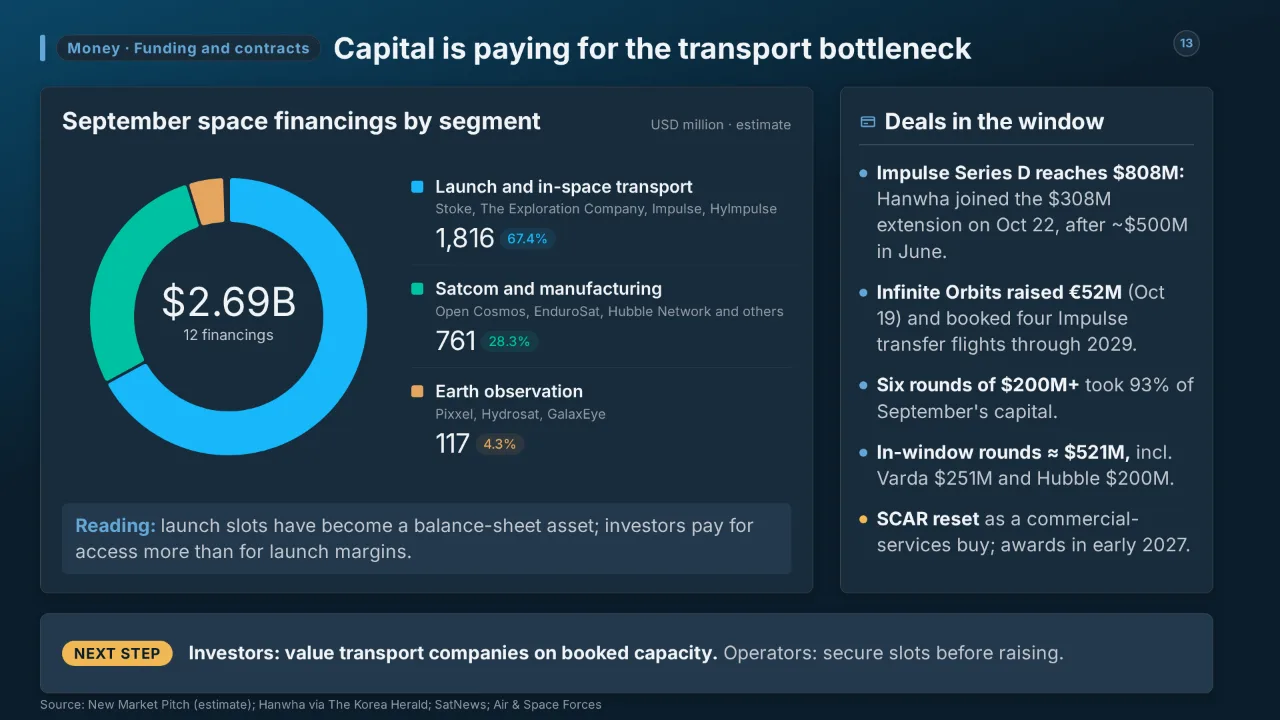
The best single-source view is New Market Pitch's September 2026 roundup (last updated 2026-10-05). It counts 12 financings totalling about $2.69 billion of announced capital and labels its aggregates as its own reconstruction, so they are treated here as estimates.
Chart data: September 2026 space financings by segment. Source: New Market Pitch, last updated 2026-10-05; segment sums computed from its deal table.
| Segment | Companies | Amount ($M) | Share of $2,694M |
|---|---|---|---|
| Launch and in-space transport | Stoke Space 1,000; The Exploration Company 450; Impulse Space 308; HyImpulse ~58 | 1,816 | 67.4% |
| Satcom, satellite manufacturing, lunar, orbital compute | Open Cosmos ~348; EnduroSat 205; Hubble Network 200; Interlune 5; Galaxia ~3.25 | 761 | 28.3% |
| Pure Earth observation | Pixxel 100; Hydrosat 10; GalaxEye ~6.7 | 117 | 4.3% |
Arithmetic: 1,816 + 761 + 117 = 2,694 ($M), consistent with the source's "about $2.69B"; 1,816 / 2,694 = 67.4%, matching its "roughly two-thirds". The six rounds of $200 million or more sum to 1,000 + 450 + 348 + 308 + 205 + 200 = 2,511, or 2,511 / 2,694 = 93%.
In New Market Pitch's September cohort, launch and in-space transport took $1.82 billion of $2.69 billion (67%), while pure Earth-observation companies raised $117 million (4%).
The window caught only the tail of that cohort. Hubble Network ($200M) and GalaxEye (~$6.7M) are the only listed deals dated on or after 2026-09-23, so (200 + 6.7) / 2,694 = 7.7% of September's capital fell inside this report's period. Adding the other disclosed in-window amounts (Varda $251M, Charter $5M, Infinite Orbits $58.4M) gives 200 + 6.7 + 251 + 5 + 58.4 ≈ $521 million across sources, a lower bound because seed amounts are missing.
At annual scale, Tracxn's tracker estimate puts 2026 space-tech funding at $23.6 billion to date, against $9.28 billion for all of 2025 (23.6 / 9.28 ≈ 2.5×). Definitions differ widely: Tracxn lists SpaceX's private funding at $11.9 billion, while New Market Pitch counts SpaceX's June 2026 IPO at $85.7 billion.
Chart data: space-tech funding by year (estimate). Source: Tracxn, page undated, latest listed round 2026-09-30.
| Year | 2021 | 2022 | 2023 | 2024 | 2025 | 2026 YTD |
|---|---|---|---|---|---|---|
| Total funding ($B) | 11.5 | 6.54 | 4.76 | 4.13 | 9.28 | 23.6 |
7.3 Government and commercial contracts
The government side moved more on procurement design than on dollar awards. On 2026-09-24 the Space Force and the Missile Defense Agency reset the Satellite Communications Augmentation Resource (SCAR) programme as a Commercial Solutions Opening. They asked for three models: government-owned contractor-operated commercial systems, long-term exclusive leases, and "Antenna as a Service". White papers were due 2026-10-15, so that deadline has now passed. Space Systems Command plans to evaluate submissions through late 2026 and make prototype and installation awards in early 2027 (announced, upcoming). The reset follows the cancellation of the original SCAR contract. Air & Space Forces Magazine puts it at $1.4 billion for 12 phased-array antennas from BlueHalo, now part of AeroVironment, cancelled in March; SatNews says $1.7 billion. This report follows the more detailed Air & Space Forces figure.
On 2026-10-15 BAE Systems announced an SSC contract to design and demonstrate ultra-compact RF terminals for a space-based data layer. The material gives no value, and the company is preparing for later high-rate production. Execution of older awards continued. The SDA's Tranche 1 Transport Layer A mission, with 21 Northrop Grumman satellites, is one of 23 missions awarded to SpaceX under the August 2020 NSSL Phase 2 contract. Before it, 63 of 126 planned Transport Layer satellites were in orbit (63 / 126 = 50%). Chapter 3 covers the launch.
Commercially, the most telling booking was Infinite Orbits' purchase of four firm launch slots through 2029 on Impulse Space orbital transfer vehicles flying on Falcon 9. Its first Endurance servicer deployment is planned for late 2027. The deal makes Impulse a seller of capacity in the same month it raised money. Among corporate moves, Iridium shareholders approved the Rocket Lab acquisition on 2026-09-24 with 99.6% of votes cast; closing is expected by mid-2027, pending regulatory approvals. Blue Origin said it has invested over $3 billion in Florida and added a $330 million expansion targeted for summer 2027 (Reuters via Central Oregon Daily); Chapter 4 covers the pads.
7.4 Signals for investors
First, launch access is now a balance-sheet asset. Infinite Orbits' chief executive called the four slots "the company's most precious asset". Reuters describes a global launch squeeze that has left dozens of satellite companies desperate for rides. This supports New Market Pitch's finding that transport absorbed two-thirds of September capital: investors are paying for the bottleneck.
Second, round sizes have reset upward. In New Market Pitch's ranking, recent single rounds of roughly half a billion dollars are common, and a $100 million round "no longer automatically" marks a company as exceptional. The median September financing was about $150 million.
Chart data: largest 2026 last-round sizes among private space companies. Source: New Market Pitch ranking, last updated 2026-09-23.
| Company | Last round (2026) | Amount ($M) |
|---|---|---|
| Stoke Space | Series E, Sept | 1,000 |
| Sierra Space | Series C, Mar | 550 |
| ICEYE | Series F, Jun | 520 |
| K2 Space | Series D, Jul | 500 |
| Isar Aerospace | Series D, Jun | 318 |
| Impulse Space | Series D extension, Sept | 308 |
| Astranis | Series E, May | 300 |
Third, government demand is shifting toward buying commercial services rather than bespoke systems. The SCAR reset is the clearest case, but award values were thin this month, so the investable signal will come in early 2027. Finally, the in-window total (~$521 million) is far below September's $2.69 billion. Unless large rounds land in November, the tracker that showed a 2026 surge is likely to show a softer fourth-quarter start.
8. Next month's launch calendar
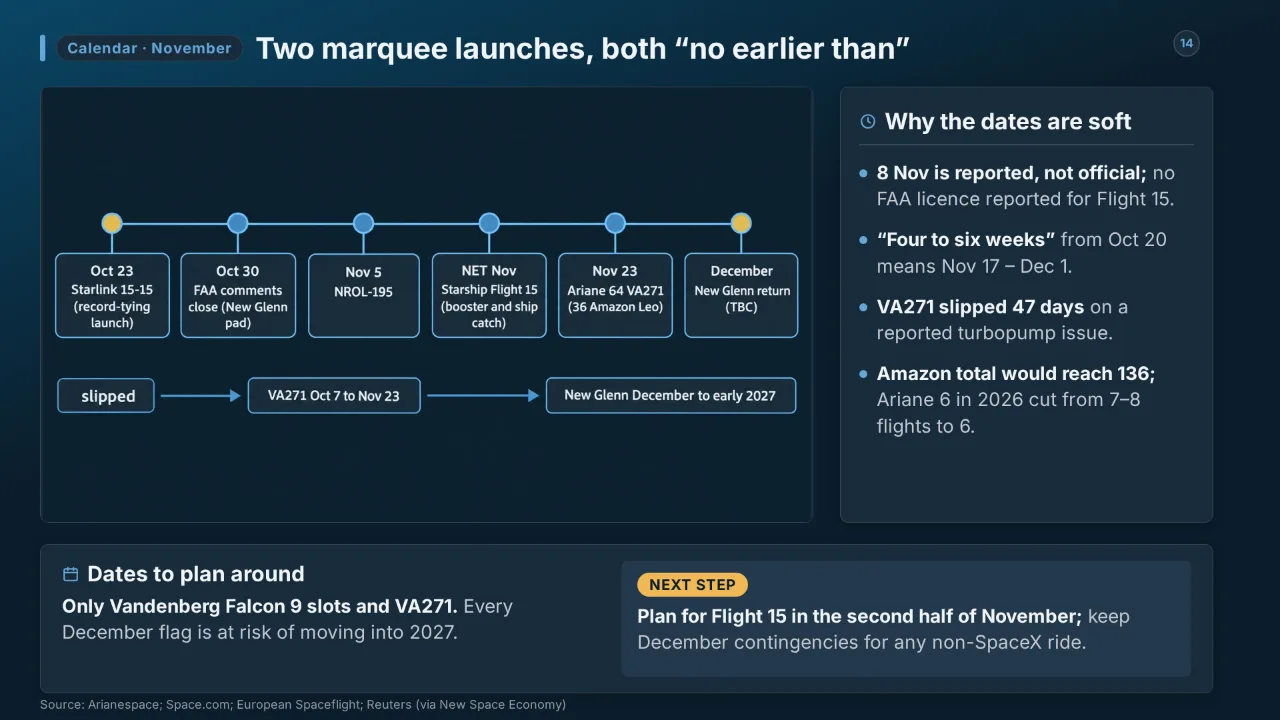
After the capital and contract flows of Chapter 7, this chapter looks forward: what is dated to fly between 23 October and 30 November 2026, what has already been pushed into December or beyond, and which dates are firm enough to plan around. The short answer is that almost nothing outside SpaceX's Vandenberg cadence carries a hard date. The two marquee events of November, Starship Flight 15 and Ariane 6 flight VA271, are both "no earlier than" targets, and two heavy-lift returns have already slipped out of the year.
8.1 Calendar: 23 October – 30 November 2026, with December flags
| Date (NET) | Vehicle | Mission | Site | Status (as of 23 Oct) | Source |
|---|---|---|---|---|---|
| 21 Oct, 03:35 UTC | Galactic Energy Ceres-1S | Unknown payload | China (pad not given) | Date passed; outcome not reported in material | KeepTrack |
| 22 Oct | — | FAA virtual public hearing on New Glenn LC-36A cadence (12 → 50 flights) | — | Done | Spaceflight Now |
| 23 Oct, 21:30 UTC | Falcon 9 (B1063, 36th flight) | Starlink 15-15, 27 satellites | Vandenberg SLC-4E | NET; scrubbed 20, 21 and 22 Oct | Spaceflight Now |
| 23–24 Oct (window opens 22:29 PT) | Falcon 9 | Starlink 15-16, 27 satellites | Vandenberg SLC-4E | TBC; listed before the 15-15 scrubs | USA TODAY Network |
| 30 Oct | — | FAA public comment closes on LC-36A cadence request | — | Scheduled | Spaceflight Now |
| 5 Nov, 22:34 UTC | Falcon 9 | NROL-195 (NRO) | Vandenberg | TBC | According to SpaceNexus, as of 21 Oct |
| NET Nov (8 Nov reported, unofficial) | Starship V3, Booster 22 / Ship 42 | Flight 15: first Ship catch + first V3 booster catch | Starbase, Pad 2 | NET; FAA licence not reported issued | Next Spaceflight; Space.com; shattered.io |
| 10 Nov | Falcon 9 | Starlink Group 15-21 | Vandenberg | Date TBD | According to SpaceNexus |
| NET Nov | Falcon 9 | Cygnus NG-25, ISS cargo | Cape Canaveral SLC-40 | NET, day TBD | Orlando Sentinel |
| NET 23 Nov | Ariane 64 | VA271 / LE-04, 36 Amazon Leo satellites | Guiana Space Centre, ELA-4 | NET; window to be set | Arianespace; European Spaceflight |
| NET Dec (flag) | Ariane 62 | MetOp-SG-B1 (EUMETSAT) | Guiana, ELA-4 | Planned | European Spaceflight |
| Dec (flag) | Vega C | VV31, IRIDE satellites (ASI) | Guiana, ELA-1 | Planned | European Spaceflight |
| Dec (flag) | Falcon Heavy | Astrobotic Griffin lunar lander (CLPS) | Space Coast | TBD | Orlando Sentinel |
| Dec 2026 or early 2027 (flag) | New Glenn 7×2 | Return to flight, Blue Ring | Cape Canaveral LC-36 | TBC | New Space Economy (Bezos; Reuters) |
| Dec 2026 or Jan 2027 (flag) | Atlas V | Starliner-1, uncrewed | Cape Canaveral SLC-41 | TBC | Orlando Sentinel |
| Late 2026, reported slipping to early 2027 | Long March 10A | Mengzhou-1, uncrewed | China | TBC | KeepTrack |
| TBD | Vulcan Centaur (six boosters) | Vulcan Leo 1, 44 Amazon Leo satellites | Cape Canaveral | TBD | Orlando Sentinel |
Caption: compiled 23 October 2026; times UTC unless marked PT. Entries from aggregators (SpaceNexus, KeepTrack, shattered.io) are "according to" listings, not operator commitments.
The calendar is thinner than the launch rate suggests. According to SpaceNexus, only 2 Vandenberg launches were on the November manifest as of 21 October, yet SpaceX flew 6 Falcon 9 missions from Vandenberg in September alone. Starlink missions are added a week or two out, so November's Falcon 9 count will fill in late. Starship dates likewise firm up about a week before flight, when SpaceX posts a mission page and airspace closures appear. Chinese dates surface only days ahead through closure notices, which is why the material contains no dated Shenzhou, Tianzhou or Long March 12 flight for November. The near-term test of cadence is Starlink 15-15. Booster B1063 would become the second Falcon booster to reach 36 flights, and its landing would be the 673rd Falcon booster landing. USA TODAY counts the Starlink 15-15/15-16 pair as California's 71st and 72nd launches of 2026, one of which would set a new state annual record.
8.2 The three launches that matter most
Starship Flight 15 (NET November, Starbase). On SpaceX's 20 October Q3 earnings call, Elon Musk said the next flight is targeted for "next month" and will try to catch both Super Heavy and Ship. He called a first-try success "more likely than not". Next Spaceflight lists it as NET November 2026 with Booster 22 and Ship 42. According to shattered.io, several outlets report a working target of 8 November, but SpaceX has not made that date official. Musk's "hopefully four to six weeks away" framing points later: 20 Oct + 4 weeks = 17 Nov; + 6 weeks = 1 Dec. This report therefore uses NET November, more likely the second half (estimate). Before the call, KeepTrack still carried only a 31 December placeholder (as of 11 October), and Starbase Events listed "Q4 2026". The flight matters because no Starship upper stage has ever been caught. Success would make Starship the first orbital launch vehicle to be fully recovered, and it would pace the V3 Starlink deployments covered in Chapter 6. A miss would not empty the December calendar. Musk said a failed catch would be followed by "a steady stream of Starship flight attempts through the end of this year," with flights accelerating in 2027. Watchers should therefore expect at least one more Starship date to appear before year-end, whatever happens on Flight 15.
Starship Flight 15 is the only November launch whose outcome changes the industry's cost curve. Every date attached to it depends on an FAA licence that, as of 20 October, had not been reported as issued.

Ariane 6 VA271 / LE-04 (NET 23 November, Kourou). Arianespace's primary announcement sets the tenth Ariane 6 flight for no earlier than 23 November. It is an Ariane 64 with P160C boosters carrying 36 Amazon Leo satellites, and liftoff to final deployment should take about two hours and four minutes. A successful flight would bring Arianespace's Amazon Leo total to 136, its 4th mission for Amazon in 2026 under a 24-launch agreement. VA271 is both Europe's return to flight and Amazon's main deployment event of the month.
| Ariane 6 flight (2026) | Date | Config | Payload | Amazon Leo satellites | Cumulative Amazon |
|---|---|---|---|---|---|
| VA267 | 12 Feb | Ariane 64 | Amazon Leo | 32 | 32 |
| VA268 | 30 Apr | Ariane 64 | Amazon Leo | 32 | 64 |
| VA269 | 17 Jun | Ariane 64 | Amazon Leo | 36 | 100 |
| VA270 | 27 Aug | Ariane 62 | MTG-I2 / Meteosat-14 | 0 | 100 |
| VA271 | NET 23 Nov | Ariane 64 | Amazon Leo | 36 | 136 |
| TBC | NET Dec | Ariane 62 | MetOp-SG-B1 | 0 | 136 |
Caption: European Spaceflight 2026 European launch schedule, crawled October 2026; cumulative column computed (32 + 32 + 36 + 36 = 136), matching Arianespace's 136.
New Glenn return to flight (December 2026 or early 2027, flagged). New Glenn falls outside the November window, but it decides whether Amazon gets a third heavy launcher this year. Jeff Bezos targeted December 2026 with Blue Ring on 7 October. Reuters reported on 16 October that the return is now expected in early 2027. Blue Origin's own 16 October announcement gives no flight date. This report follows the later, independent Reuters timing and marks December as TBC. The regulatory track runs in parallel: the FAA is reviewing Blue Origin's request to raise LC-36A from 12 to 50 permitted flights, with comments closing on 30 October. Without New Glenn, and with Vulcan Leo 1 still undated, VA271 is the only heavy non-SpaceX Amazon Leo launch with a date before year-end.
8.3 Slip risk: what has already moved, and why
| Mission | Earlier target | Latest target | Cause | Source |
|---|---|---|---|---|
| Ariane 6 VA271 | NET 7 Oct (CNES) | NET 23 Nov | Reported LH2 turbopump anomaly in acceptance testing | European Spaceflight |
| New Glenn RTF | Before end-2026; Dec 2026 (Bezos, 7 Oct) | Early 2027 (Reuters, 16 Oct) | 28 May pad explosion; BE-4 main oxygen valve | New Space Economy; Florida Today |
| Starship Flight 15 | Late Oct, then early Nov (airspace planning) | NET Nov | FAA licence pending; hardware readiness | KeepTrack; shattered.io |
| Starliner-1 | NET April 2026 | Dec 2026 or Jan 2027, uncrewed | Contract changed to uncrewed flight | Orlando Sentinel |
| Mengzhou-1 (LM-10A) | Late 2026 | Reported early 2027 | Not stated | KeepTrack |
| Starlink 15-15 | 20 Oct | NET 23 Oct | Technical issue, then weather twice | Spaceflight Now |
The Ariane slip is the best documented. CNES's provisional schedule had VA271 at NET 7 October. The new date adds 24 days left in October plus 23 in November, 47 days, which matches European Spaceflight's "almost seven weeks". The cause, a liquid-hydrogen turbopump anomaly found in an engine acceptance test before the summer, comes from La Tribune's reporting. ArianeGroup declined to confirm it and pointed only to the new date. The knock-on effect is annual: Arianespace had been expected to fly seven or eight Ariane 6 missions in 2026 and now looks likely to manage six, while still targeting nine to ten in 2027.
New Glenn's slip has a hardware root. Blue Origin traced the 28 May explosion to the main oxygen valve on a BE-4 engine, and the company is rebuilding LC-36 with a horizontal-integration-plus-crane approach. CEO Dave Limp still saw "a path to launch this year" on 28 September. Less than three weeks later, reporting moved that to early 2027, which shows how quickly year-end targets erode.
Elsewhere, risk is spread across the manifest. ULA's Dream Chaser Demo-1 flight is held by Sierra Space's own schedule risk, and next2space lists every pending Vulcan mission only as "2026", with no day. China postponed Chang'e-7 from the pad in September, and People's Daily now places it next year. For planners, the rule is simple. Treat 23 November (VA271) and the Vandenberg Falcon 9 slots as the only dates likely to hold within a few days. Treat Starship Flight 15 as a November-to-early-December window, and treat every December flag as at risk of moving into 2027.
9. What to watch and implications
Chapter 8 listed what is on the pad; this chapter asks what the month means for the people who buy launches, run constellations, fund companies and write the rules, and which signals will show next month whether the pattern from Chapter 1 is holding or breaking. Every fact here was established in Chapters 2–8.
9.1 What the month means, by stakeholder
The common thread is scarcity. One provider flew 78% of the year's payload mass and still sells at list prices above its 2018 level per kilogram, while each alternative — Neutron, New Glenn, Ariane 6, China's reusable boosters — slipped or has yet to refly. Every group below has to plan around that.
| Stakeholder | What changed this month | Implication | Basis |
|---|---|---|---|
| Satellite operators buying launch | Neutron to 2027; New Glenn return now December at best; VA271 slipped ~7 weeks; rideshare at $7,000/kg | Book capacity early and on more than one vehicle; launch slots are now an asset worth financing, as Infinite Orbits' four Impulse slots show | Ch. 4, 7, 8 |
| Broadband challengers (Amazon Leo, Qianfan, Guowang, AST) | Starlink's ARPU fell 17% y/y while its margin rose to 45%; Starship adds ~10x Falcon 9 capacity per flight | Price competition will intensify just as challengers are short of satellites in orbit; bundling (Prime) and carrier alignment (AST's European LoI) are their real levers | Ch. 5 |
| Investors | Transport took 67% of September capital; SpaceX's launch segment is break-even, Connectivity earns ~85% of operating income | Value in launch now depends on owning or reselling access (Impulse, Stoke), not on launch margins alone; SpaceX's valuation rests on SI and Starlink, not rockets | Ch. 6, 7 |
| Government buyers | SCAR reset as a commercial-services buy; SDA Transport Layer half deployed; 18 new national-security launches on SpaceX's manifest | Commercial-as-a-service procurement is spreading, but dependency on one launcher deepens with every award | Ch. 6, 7 |
| Regulators | FAA weighing LC-36A at 50 flights a year and Starbase at up to 456 Starship launches; Amazon missed its FCC milestone | Licensing and spectrum milestones, not only rockets, now pace the industry; milestone relief for Amazon is a test case | Ch. 4, 5 |
| China watchers | China +9 launches y/y, 34% of them from non-CASC providers; a commercial launch got priority over a state rocket at Jiuquan | China's commercial sector is maturing in cadence before it matures in reuse; the Zhuque-3 reflight is the step to watch | Ch. 2, 3, 4 |
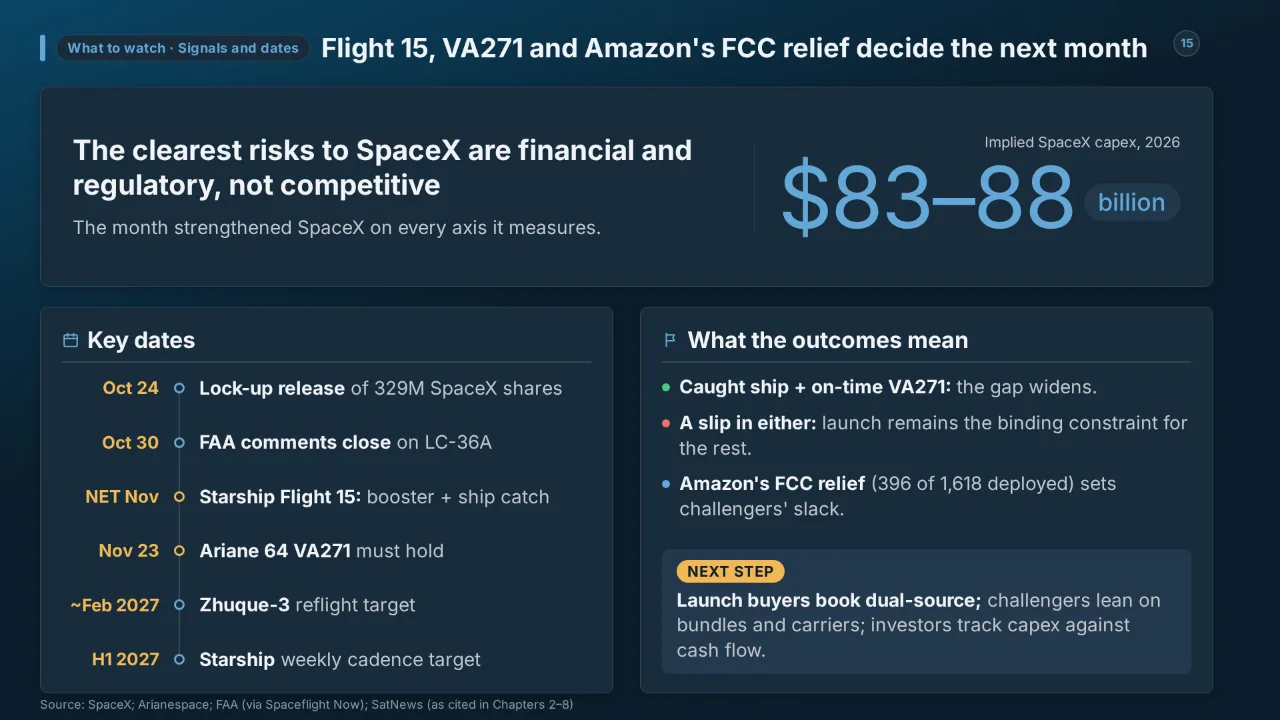
Our judgement: the month strengthened SpaceX's position on every axis it measures — mass to orbit, broadband economics, Starship progress — while the clearest risks to it are financial (capex of $83–88B implied for 2026) and regulatory, not competitive.
9.2 Signals to watch, with thresholds
- Starship Flight 15 outcome. A caught ship would make Starship the first fully recovered orbital vehicle and open the path to the weekly cadence SpaceX targets for H1 2027. Threshold: a launch before 1 December keeps the turnaround inside Musk's "four to six weeks"; a date after 30 November means it is slower than Pad 2's 63-day record.
- SpaceX's year-end launch count. SpaceX stands 16 launches behind 2025. Watch whether Vandenberg ends the year near the 80+ Space Force officials expect (estimate), and whether the Space Coast recovers from its pace toward roughly 75.
- Ariane 6 VA271 on 23 November. If it holds, Arianespace's Amazon total reaches 136; another slip would leave Amazon Leo with no dated heavy launch before year-end.
- Amazon's FCC milestone relief. With 396 of 1,618 satellites deployed (24.5%), the FCC's response sets how much schedule slack challengers can expect.
- New Glenn's licence and date. The FAA comment period on LC-36A closes on 30 October; a December flight would need a dated announcement soon, while Reuters already points to early 2027.
- The first Chinese booster reflight. LandSpace targets a Zhuque-3 reflight within six months of the 19 August landing, i.e. by about mid-February 2027. A reflight before then would be the first non-SpaceX evidence that reuse can lower prices.
- Q4 funding pace. In-window rounds totalled about $521M against September's $2.69B; a November with no $200M+ round would confirm a softer quarter.
- Starlink subscriber adds. Q3 added 1.6M; at that pace the Q4 report would show about 15.2M (estimate: 13.6 + 1.6).
9.3 Key dates
Dates on or before 23 October are marked as done or in effect.
| Date | Event | State (as of 23 Oct 2026) | Source |
|---|---|---|---|
| 15 Oct | SCAR white papers due | In effect (deadline passed) | Air & Space Forces |
| 20 Oct | SpaceX Q3 2026 results | Done | SpaceX |
| 22 Oct | FAA public hearing on LC-36A cadence | Done | Spaceflight Now |
| 23 Oct | Starlink 15-15 (record-tying California launch) | Upcoming (NET) | Spaceflight Now |
| 24 Oct | Lock-up release of 329M SpaceX shares | Upcoming | Evercore ISI via report |
| 30 Oct | FAA comments close on LC-36A 12 → 50 | Upcoming | Spaceflight Now |
| 5 Nov | NROL-195, Falcon 9, Vandenberg | Upcoming (TBC) | according to SpaceNexus |
| NET Nov | Starship Flight 15, booster + ship catch | Upcoming (NET) | Space.com; Next Spaceflight |
| Mid-Nov | CRS-35 Dragon departs ISS | Upcoming | NASA |
| NET 23 Nov | Ariane 64 VA271, 36 Amazon Leo satellites | Upcoming (NET) | Arianespace |
| Dec 2026 – early 2027 | New Glenn return to flight | Upcoming (TBC) | New Space Economy |
| Dec 2026 – Jan 2027 | Starliner-1, uncrewed | Upcoming (TBC) | Orlando Sentinel |
| Early 2027 | SCAR prototype awards; AST's ~45-satellite target | Upcoming (target) | SatNews; findcheapbroadband |
| ~Feb 2027 | Zhuque-3 reflight target | Upcoming (company target) | India Today |
| H1 2027 | Starship weekly cadence | Company target | SpaceX webcast |
| 2027 | Neutron first launch | Announced | Rocket Lab |
| Mid-2027 | Iridium–Rocket Lab deal close; Blue Origin factory expansion complete | Upcoming | Space Watch Africa; Blue Origin |
10. References
This document draws on the following 124 sources, listed in the order they are first cited.
- Rocket Launch Statistics 2026: 249 Launches So Far (23 October 2026) | Flight Atlas — flightatlas.org
- Rocket launches by country in 2026: United States 147, China 73, Russia 13 | Flight Atlas — flightatlas.org
- Orbital launches in 2026 | Space Stats — spacestatsonline.com
- California to break Vandenberg rocket launch record in October — redding.com
- Space Coast launch schedule — orlandosentinel.com
- SpaceX — spacex.com
- SpaceX Reports Third Quarter 2026 Results — ir.spacex.com
- SpaceX Starship splashes down after successful 1st orbital flight test - ABC News — abcnews.com
- SpaceX will attempt 1st-ever double Starship rocket catch on next test launch, Elon Musk says | Space — space.com
- Starship Flight 15: Nov. 8 Target, First Dual Catch — shattered.io
- Rocket Lab expects Neutron's first launch in 2027 | RKLB Stock News — stocktitan.net
- Why Is Blue Origin’s New Glenn Rocket Now Expected to Return to Flight in 2027? | New Space Economy — newspaceeconomy.ca
- China Successfully Tests Reusable Long March-10B - Universe Today — universetoday.com
- Private Chinese Rocket Zhuque-3 Achieves First Landed Booster Recovery — science.report
- How Much Does a Rocket Launch Cost? Falcon 9: $74M (2026) — spacenexus.us
- SpaceX Raises Falcon 9 Launch Price to $74M, Rideshare Now $7,000/kg (2026 Update) | SatBase — satbase.com
- SpaceX Reports Third Quarter 2026 Results — s21.q4cdn.com
- Amazon Leo is on track to launch its satellite internet service in 2026 — howtogeek.com
- Amazon Leo Plans Prime Subscription Bundling to Challenge Starlink in Consumer Satellite Broadband Market – SatNews — satnews.com
- Arianespace to launch 36 Amazon Leo satellites on November 23 at the earliest, for 10th Ariane 6 flight | Newsroom Arianespace — newsroom.arianespace.com
- Space Economy Funding News (October 2026) – New Market Pitch — newmarketpitch.com
- Hanwha Asset raises bet on US startup Impulse Space - The Korea Herald — koreaherald.com
- Infinite Orbits Raises €52 Million and Books Four Impulse Space OTV Flights to 2029 – SatNews — satnews.com
- Space Force Eyes Commercial Antennas to Control Satellites — airandspaceforces.com
- U.S. Space Force Solicits Commercial Proposals for Restructured SCAR Ground Antenna Network – SatNews — satnews.com
- NASA Sets Coverage for SpaceX 35th Station Resupply Launch, Arrival - NASA — nasa.gov
- SpaceX launches NASA science and cargo to the International Space Station – Spaceflight Now — spaceflightnow.com
- Building the Infrastructure for More Frequent Launches in Florida | Blue Origin — blueorigin.com
- Blue Origin to add new Florida launch pads, seeks aggressive increase in New Glenn flight rate – Spaceflight Now — spaceflightnow.com
- Rocket launches in 2026: 247 so far (20 October 2026) | Flight Atlas — flightatlas.org
- Next Starship Launch 2026, Flight 15 Date and Flight Log - KeepTrack — keeptrack.space
- Pictures: 60 Space Coast launches and counting in 2026 – Orlando Sentinel — orlandosentinel.com
- Vandenberg Supports 69th Launch of 2026 > Vandenberg Space Force Base > Article Display — vandenberg.spaceforce.mil
- Falcon 9 · Starlink Group 15-25: Launched Oct 13, 2026 | SpaceNexus — spacenexus.us
- Space Coast launch schedule: — orlandosentinel.com
- SpaceX is ‘go’ to launch NASA’s Crew-13 astronaut mission to the ISS on Oct. 1 | Space — space.com
- Record-tying rocket launch today at Vandenberg. How to watch SpaceX liftoff — desertsun.com
- SpaceX — spacex.com
- SpaceX plans 2 California rocket launches. See Vandenberg schedule — recordnet.com
- Falcon 9 Booster B1063 Flies 36th Time 2026 — shattered.io
- Flight Atlas - Every Rocket Launch Ever | Rocket Comparison & Statistics — flightatlas.org
- Titan Launches — 216 on Record | Orbital Radar — orbitalradar.com
- Orbital Launches of 2026 — space.skyrocket.de
- Jonathan's Space Report | Space Statistics — planet4589.org
- Launch preview: SpaceX to launch first Starlink V3 satellites to orbit on Starship – Spaceflight Now — spaceflightnow.com
- Starship returns to Earth; rocket splashes down north of Hawaii after three-hour flight – Spaceflight Now — spaceflightnow.com
- NASA, SpaceX to launch new solar arrays, 6,300 pounds of cargo to the space station – Spaceflight Now — spaceflightnow.com
- China's Long March-12 rocket launches new internet satellite group - People's Daily Online — en.people.cn
- China's Zhuque-2E rocket launches 10 satellites into space - People's Daily Online — en.people.cn
- Zhuque-2E Block 2 · 10 satellites: Launched Oct 14, 2026 | SpaceNexus — spacenexus.us
- SpaceX launches Starfall reentry capsule, 31 customer payloads on Bandwagon-5 rideshare mission – Spaceflight Now — spaceflightnow.com
- SpaceX Sends Second Starfall Reentry Vehicle Into Orbit | AIAA — aiaa.org
- Watch SpaceX deliver more than 6,000 pounds of cargo to the ISS today | Space — space.com
- Highlights: SpaceX reaches orbit in unprecedented Starship test flight | CNN — cnn.com
- SpaceX CRS-35 Delivers Final Solar Arrays, Completing ISS Power Upgrade — techtimes.com
- SpaceX Bandwagon-5 Payloads: 32 on 1 Rocket 2026 — shattered.io
- SpaceX Flies Starfall Capsule 2nd Time 2026 — shattered.io
- Three-Body Computing Constellation Expands with LandSpace Launch Zhuque-2E Y4 — china-in-space.com
- LandSpace Launches Zhuque-2E Carrying Eight ADAspace Orbital Data Center Satellites – SatNews — satnews.com
- Blue Origin rebuild aims for multiple weekly rocket launches by decade's end — floridatoday.com
- Starship Program Tracker: Live Flight History & News | SpaceNexus — spacenexus.us
- Blue Origin expansion plans aim for multiple Space Coast launches a week – Orlando Sentinel — orlandosentinel.com
- Rocket Lab pushes 1st launch of next-gen Neutron rocket to 2027 | Space — space.com
- China joins global reusable rocket push, lands Zhuque-3 rocket on second attempt SpaceX falcon 9 Blue Origin ISRO rocket - India Today — indiatoday.in
- SpaceX Starship Flight 15: November Dual Catch Plan — tech-insider.org
- Starship Flight 15 | Starship-Super Heavy v3 | Next Spaceflight — nextspaceflight.com
- Why Has Rocket Lab Delayed Neutron’s First Orbital Launch Until 2027? | New Space Economy — newspaceeconomy.ca
- China’s Zhuque-3 Reusable Rocket Achieves First Land-Based Recovery — defensemirror.com
- Rocket Launch Cost: $54,000 → $3,000 per Kg (2026) — orbitalradar.com
- Launch Cost Per Kg: From $54,500 to $1,500 (Complete History) | orbital-intel.com — orbital-intel.com
- Blue Origin plans $330 million Florida expansion for New Glenn — qz.com
- LandSpace Targets Zhuque-3 Rocket Reuse Milestone in 2026 - Khabar Asia — khabarasia.com
- Starship V3’s First Flight Rewrites the Commercial Launch Cost Equation — exterrajsc.com
- Qianfan vs Starlink: The Deployment Race in Numbers 2026 — orbitalradar.com
- What SpaceX (SPCX) Said on Its Q3 Earnings Call — marketbeat.com
- Amazon Leo Aiming to Sway Consumers From Starlink With Prime, Other Bundles — broadbandbreakfast.com
- How Many Chinese Satellites Are in Orbit? 1,650 (Oct 2026) - KeepTrack — keeptrack.space
- Guowang & Qianfan: China's Satellite Internet 2026 — orbitalradar.com
- AST SpaceMobile Availability: U.S. Launch & 2027 Timeline — findcheapbroadband.com
- AST SpaceMobile’s BlueBird Progress Comes With Several Risks Still Unresolved — Noticias de TradingView — es.tradingview.com
- SpaceX Q3 Earnings: AI Brings In More Money Than Starlink — stocktitan.net
- SpaceX (SPCX) Q3 2026 Earnings Call Transcript | The Motley Fool — fool.com
- SpaceX: Impressive Q3 results | Advanced Television — advanced-television.com
- Musk says Tesla and SpaceX formed special committees to discuss merger: Live updates — cnbc.com
- Amazon Considers Challenging Starlink With A New Streaming Bundle Deal For Subscribers — bgr.com
- China's Satellite Constellations: Guowang and Qianfan | OrbitalIntel — orbitalintel.org
- BlueBird’s 11,12,13 OK; 14,15,16 en route | Advanced Television — advanced-television.com
- AST SpaceMobile’s BlueBird Progress Comes With Several Risks Still Unresolved — finance.yahoo.com
- AST SpaceMobile Satellites Target 500M Europeans 2026 — tech-insider.org
- SpaceX Third Quarter 2026 Webcast Transcript — s21.q4cdn.com
- SpaceX Q3 Earnings: AI Now Brings in Half the Revenue, Starlink Still Earns Most of the Profit — finance.yahoo.com
- SpaceX says big AI growth fueled revenue jump | The Verge — theverge.com
- SpaceX earnings soar past expectations as AI business surges — axios.com
- SpaceX Valuation History 2002 to 2026, Every Round - KeepTrack — keeptrack.space
- The SpaceX IPO: A $1.77 Trillion Bet on Space — venquestgroup.com
- SpaceX earnings: Live updates — finance.yahoo.com
- SpaceX IPO Timeline and Financing Details - Forge — forgeglobal.com
- SpaceX Revenue and Valuation Statistics (October 2026) — explodingtopics.com
- SpaceX Stock: IPO Date, Share Price & News - Investing.com — investing.com
- SpaceX stock rises after Q3 earnings beat. What analysts say — cnbc.com
- Hanwha Asset Management Backs U.S. Space Firm Impulse Space Again - Seoul Economic Daily — en.sedaily.com
- Infinite Orbits' precious asset: Four firm launch contracts with Impulse Space OTV on Falcon 9 rockets to 2029 - Space Intel Report — spaceintelreport.com
- Infinite Orbits - 2026 Company Profile, Team, Funding, Competitors & Financials - Tracxn — tracxn.com
- Top Space Economy Startups by Fundraising (2026) – New Market Pitch — newmarketpitch.com
- US Funding and Investors Data for 2026 (Updated Weekly) — startuptalky.com
- Space Tech - 2026 Market & Investments Trends - Tracxn — tracxn.com
- BAE Systems Secures U.S. Space Force Contract for Ultra-Compact Resilient Space Terminals – SatNews — satnews.com
- SpaceX scrubs launch attempt for 21 data transport satellites for the Space Development Agency – Spaceflight Now — spaceflightnow.com
- Iridium Announces Third Quarter 2026 Results - Space Watch Africa — spacewatchafrica.com
- Blue Origin targets multiple New Glenn launches weekly by end of decade | Consumer | centraloregondaily.com — centraloregondaily.com
- Ariane 6 Slips to Nov 23 After Turbopump Fix - KeepTrack — keeptrack.space
- Bad weather scrubs launch of 27 Starlink satellites on Falcon 9 rocket from Vandenberg SFB – Spaceflight Now — spaceflightnow.com
- SpaceX plans 2 California rocket launches. See Vandenberg schedule — siskiyoudaily.com
- Vandenberg Launch Schedule November 2026: Next NROL-195, Nov 5 — spacenexus.us
- European Rocket Launches in 2026: Ariane 6, Vega C & New Launchers — europeanspaceflight.com
- Long March 10 Family Guide - China Moon Rocket Already Flying - KeepTrack — keeptrack.space
- SpaceX Falcon 9 launches classified mission for U.S. Space Force from West Coast – Spaceflight Now — spaceflightnow.com
- How to Watch a Rocket Launch in China: The Wenchang Beach Guide — Outer Space Trip — outerspacetrip.com
- Starship Flight 15: Launch Date, Time & How to Watch from Starbase | Starbase Events — starbaseevents.com
- Arianespace Targets 23 Nov Ariane 6 Return Following Reported Turbopump Fix — europeanspaceflight.com
- Blue Origin CEO sees path to return to launch in 2026 post-rocket explosion — floridatoday.com
- Blue Origin upcoming launches, livestreams, events & recent videos — next2space.com
- The Moon Is the Next Strait: America and China Collide in Orbit — Foreign Affairs Forum — faf.ae
- From Earth orbit to deep space - People's Daily Online — en.people.cn