1. What happened
| Date (ET) | Step | Legal basis | Source |
|---|---|---|---|
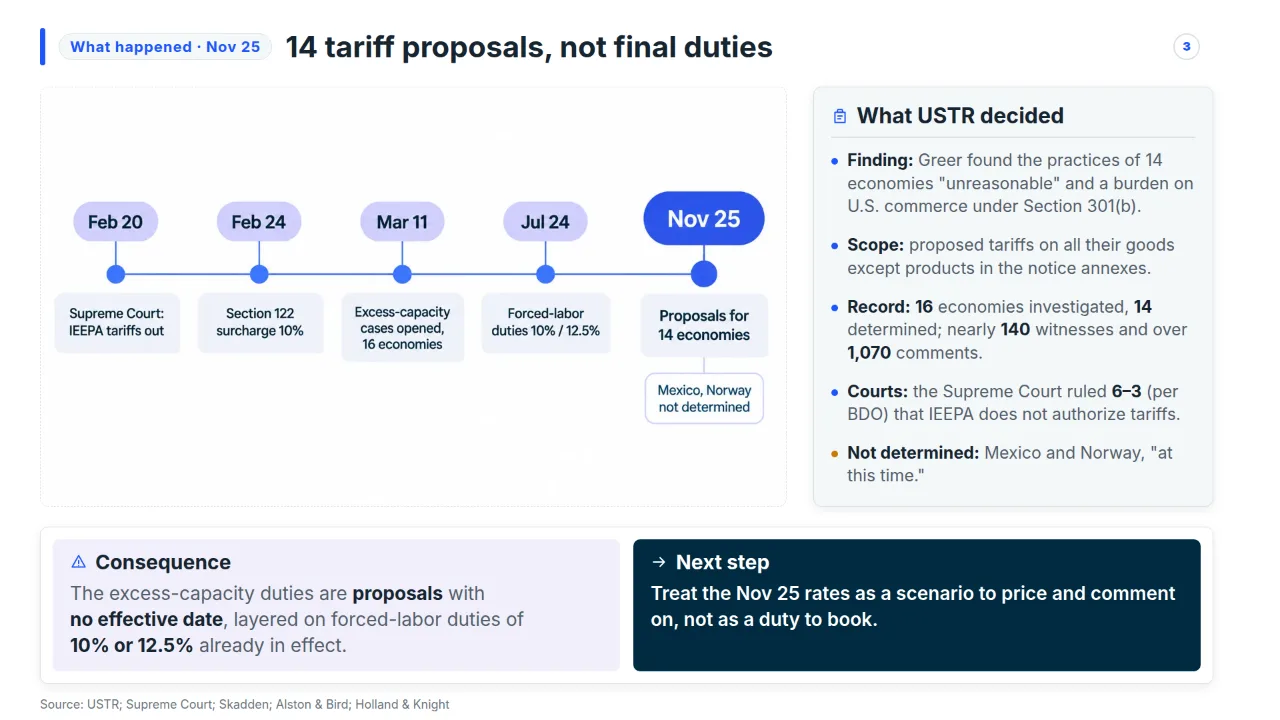
| Feb 20, 2026 | Supreme Court decides Learning Resources, Inc. v. Trump (with Trump v. V.O.S. Selections), 6–3: IEEPA does not authorize tariffs | IEEPA (struck down as a tariff basis) | Supreme Court; BDO |
| Feb 20 → Feb 24, 2026 | Proclamation 11012: 10% surcharge on most imports, effective Feb 24; statute caps it at 15% for 150 days | Section 122, Trade Act of 1974 | Skadden; Ward and Smith |
| Mar 11, 2026 | USTR opens excess-capacity investigations of 16 economies; requests consultations with China | Sections 301(b), 302(b)(1)(A) | USTR; China notice |
| Mar 12, 2026 | USTR opens forced-labor investigations of 60 economies | Section 301 | Holland & Knight; Thompson Coburn |
| May 5–8, 2026 | Excess-capacity hearings: nearly 140 witnesses; over 1,070 written comments in total | Section 304(b)(1)(A) | China notice; USTR |
| May 7, 2026 | Court of International Trade holds Proclamation 11012 invalid; relief limited to three plaintiffs; on appeal | Section 122 | Skadden |
| Jul 23 → Jul 24, 2026 | Forced-labor final action: 10% or 12.5% on 60 economies, in effect 12:01 a.m. Jul 24 as the Section 122 surcharge expired | Section 301 | Alston & Bird; Holland & Knight |
| Nov 25, 2026 | Determinations for 14 of 16 economies; proposed tariffs published for comment; Mexico and Norway not determined | Section 301(b) | USTR; China notice |
| Jan 5 / Jan 25, 2027 | Comments and requests to appear due; hearings begin (scheduled) | Section 301 procedure | USTR; China notice |
Times are US Eastern; statuses as of Nov 26, 2026. The Mar 12 forced-labor date comes from the two law-firm notes cited.
1.1 Nov 25: fourteen determinations, fourteen proposals
USTR documents. On Nov 25, U.S. Trade Representative Jamieson Greer determined that the "acts, policies, and practices" of 14 economies "relating to structural excess capacity and production in manufacturing sectors are unreasonable and burden or restrict U.S. commerce," and so are actionable under Section 301(b). The 14 are China, the European Union, Singapore, Switzerland, Indonesia, Malaysia, Cambodia, Thailand, Korea, Vietnam, Taiwan, Bangladesh, Japan and India. USTR "has not made determinations with respect to Mexico or Norway at this time".

Every action is a proposal. In most notices USTR would "consider applying" tariffs on all goods of the economy, except products in the notice annexes:
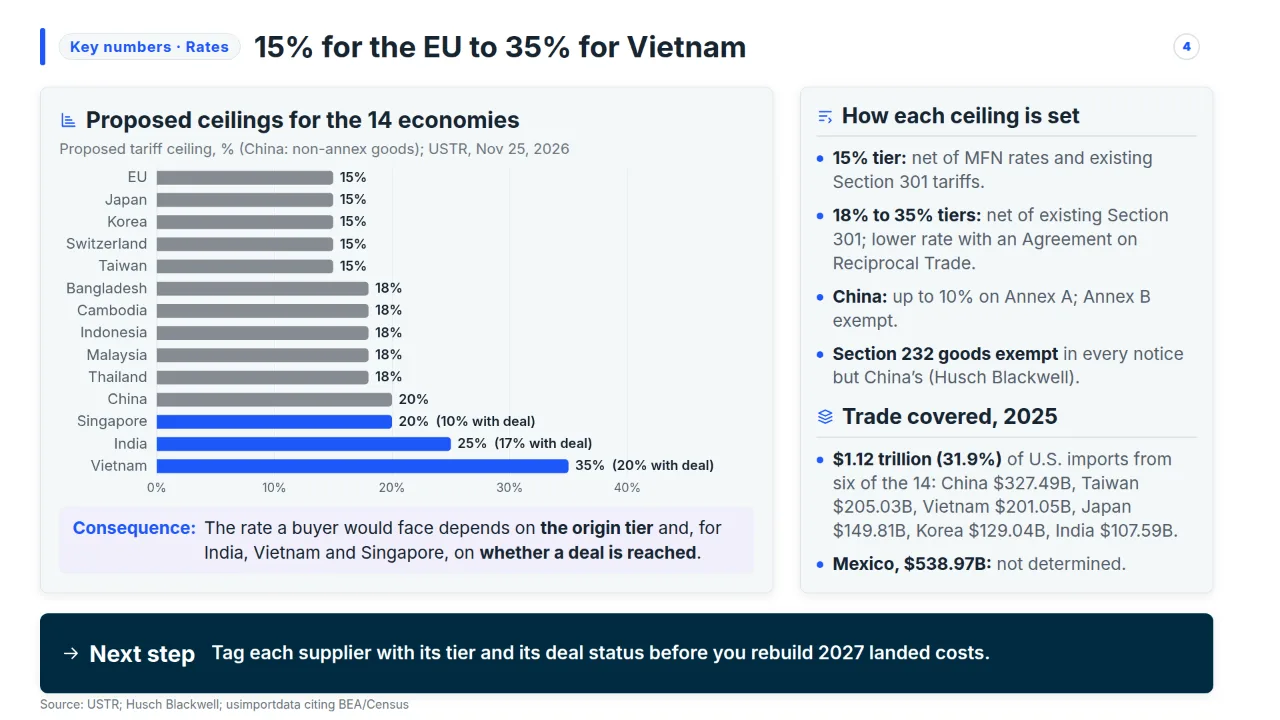
- 15% for the EU, and up to 15% for Japan, Korea, Switzerland and Taiwan, net of MFN rates and existing Section 301 tariffs.
- Up to 18% for Bangladesh, Cambodia, Indonesia, Malaysia and Thailand.
- Up to 20% for Singapore, 25% for India and 35% for Vietnam, with 10%, 17% and 20% named if each reaches an Agreement on Reciprocal Trade.
- For China, up to 20% on goods not in the annexes, net of the forced-labor Section 301 rate. Annex A goods would face up to 10%, and Annex B goods would be exempt. USTR says this accounts for the 20% rate in the Kuala Lumpur Joint Arrangement of Oct 30, 2025.
Written comments and requests to appear are due Jan 5, 2027. Hearings start Jan 25, 2027, "continuing as appropriate". The China notice records that Beijing "did not accept USTR's request for consultations" made on Mar 11.
On Nov 25, USTR proposed tariffs on 14 economies. It did not impose them. Comments are due Jan 5, 2027 and hearings start Jan 25, 2027.
Press reports. BBC gave China "up to 40%". CNBC reported 20% on top of the 25% imposed in 2018, rising to 40% if China does not keep to the 2025 truce. According to Alvarez & Marsal, the China notice proposes a fallback of up to 40%. This brief uses the USTR figure of up to 20%; Chapter 2 shows how the higher figures are built.
1.2 How the case got here
Court rulings. On Feb 20, 2026, the Supreme Court decided "whether the International Emergency Economic Powers Act (IEEPA) authorizes the President to impose tariffs". The syllabus states: "When Congress has delegated its tariff powers, it has done so in explicit terms and subject to strict limits". According to BDO, it held 6–3 that IEEPA does not. The same day, Proclamation 11012 invoked Section 122 for a 10% surcharge from Feb 24. On May 7, the Court of International Trade held it invalid but granted relief only to three importer plaintiffs, leaving all other importers subject to the duty.

The two Section 301 tracks. On Mar 11, USTR opened the excess-capacity cases. Greer said: "The United States will no longer sacrifice its industrial base to other countries that may be exporting their problems with excess capacity and production to us". The forced-labor track moved faster. Determinations came on Jun 2 and the proposal was published on Jun 5. Final action followed on Jul 23 and took effect at 12:01 a.m. ET on Jul 24, "precisely when global tariffs under Section 122 ... expired," according to Holland & Knight. Those duties are 10% or 12.5%, and goods already under Section 232 are exempt. They are in effect. The Nov 25 China proposal is netted against them.
1.3 Statements on the record
United States. Greer said trading partners "have adopted industrial strategies built on targeting manufacturing, wage and labor suppression, financial and other support, non-market economy inputs, and other market distorting practices." He said "President Trump is proposing to take action to bring about the elimination of these unfair acts, policies, and practices". On China, a senior U.S. official said: "We know that they don't like these actions, but we are seeking stability with the Chinese" (via The Nation, Thailand).
Governments named.
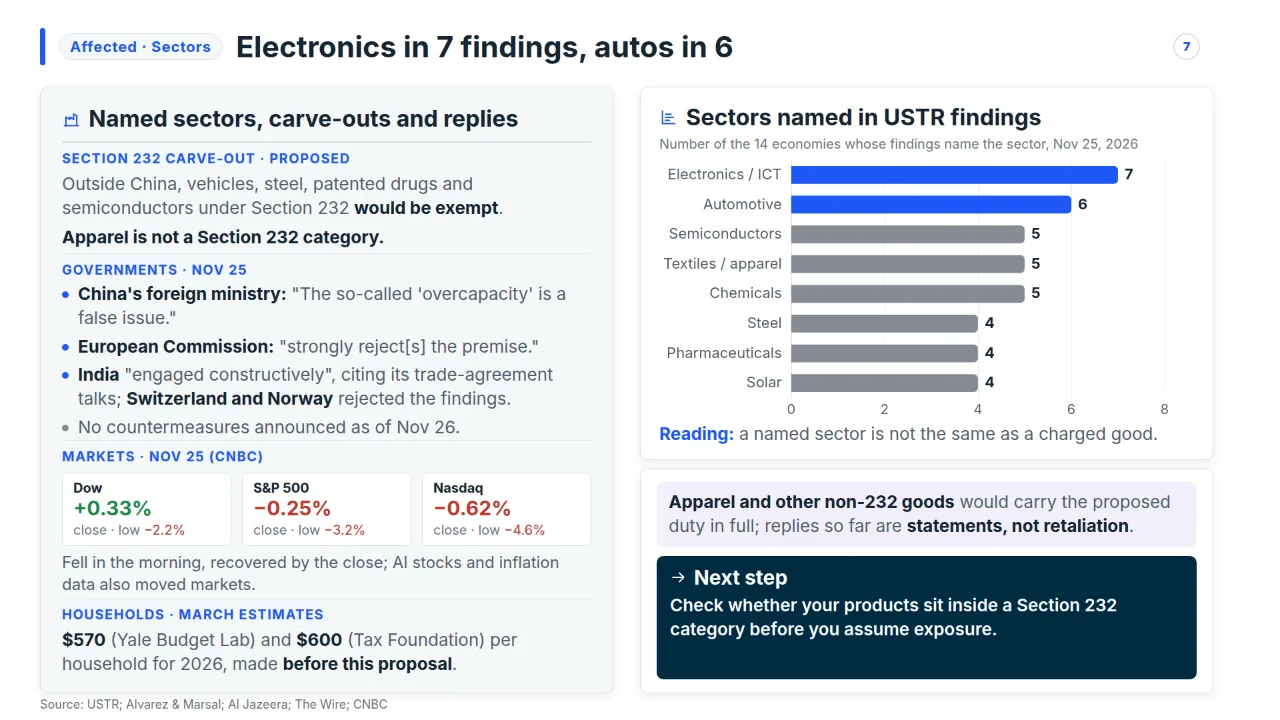
- China. Foreign Ministry spokesman Guo Jiakun said: "The so-called 'overcapacity' is a false issue, and China opposes using it as an excuse for political manipulation" (via Al Jazeera).
- EU. Commission spokesperson Olof Gill said: "We will study the findings. At the same time we strongly reject the premise that Europe is a source of structural overcapacity" (via Al Jazeera).
- India. The commerce ministry said: "India engaged constructively throughout this investigation." It added that it "remains committed to working closely with the United States towards the early conclusion of the India-US Bilateral Trade Agreement" (via The Wire).
- Switzerland. The government said it rejects the allegations, according to Al Jazeera.
- Norway (not determined). Foreign Minister Espen Barth Eide said: "Norway does not have policies that contribute to overcapacity".
As of Nov 26, this brief found no statement from Japan, Korea, Taiwan, Vietnam or the other governments; Chapter 3 covers reactions.
2. Key numbers
Chapter 1 traced the path to the Nov 25, 2026 determinations; this chapter sets out the proposed rates, how each is calculated and how much trade is involved. All are proposals open for comment until Jan 5, 2027.
| Economy | Proposed rate | Basis | Lower rate named | 2025 U.S. goods imports | Source |
|---|---|---|---|---|---|
| China | up to 20% (goods not in annexes); up to 10% (Annex A); Annex B exempt | Net of the forced-labor Section 301 rate | None; "accounts for" the 20% rate of the Kuala Lumpur Joint Arrangement (Oct 30, 2025) | $327.49B | USTR; usimportdata |
| European Union | 15% | Net of MFN rates and existing Section 301 tariffs | None | Not in material (Germany $159.17B, Ireland $133.89B) | USTR; usimportdata |
| Japan | up to 15% | Net of MFN and existing Section 301 | None | $149.81B | USTR; usimportdata |
| Korea | up to 15% | Net of MFN and existing Section 301 | None | $129.04B | USTR; usimportdata |
| Switzerland | up to 15% | Net of MFN and existing Section 301 | None | Not in material | USTR |
| Taiwan | up to 15% | Net of MFN and existing Section 301 | None | $205.03B | USTR; usimportdata |
| Bangladesh | up to 18% | Net of existing Section 301 | None | Not in material | USTR |
| Cambodia | up to 18% | Net of existing Section 301 | None | Not in material | USTR |
| Indonesia | up to 18% | Net of existing Section 301 | None | Not in material | USTR |
| Malaysia | up to 18% | Net of existing Section 301 | None | Not in material | USTR |
| Thailand | up to 18% | Net of existing Section 301 | None | Not in material | USTR |
| Singapore | up to 20% | Net of existing Section 301 | 10% with an Agreement on Reciprocal Trade | Not in material | USTR |
| India | up to 25% | Net of existing Section 301 | 17% with an Agreement on Reciprocal Trade | $107.59B | USTR; usimportdata |
| Vietnam | up to 35% | Net of existing Section 301 | 20% with an Agreement on Reciprocal Trade | $201.05B | USTR; usimportdata |
All rates are proposed (Nov 25, 2026) and would apply to all goods of each economy except products in the notice annexes. Import values are 2025 merchandise imports as given by usimportdata.com, which cites BEA and Census. The material has no Census country table for the blank rows.
2.1 What "net of" does to each rate
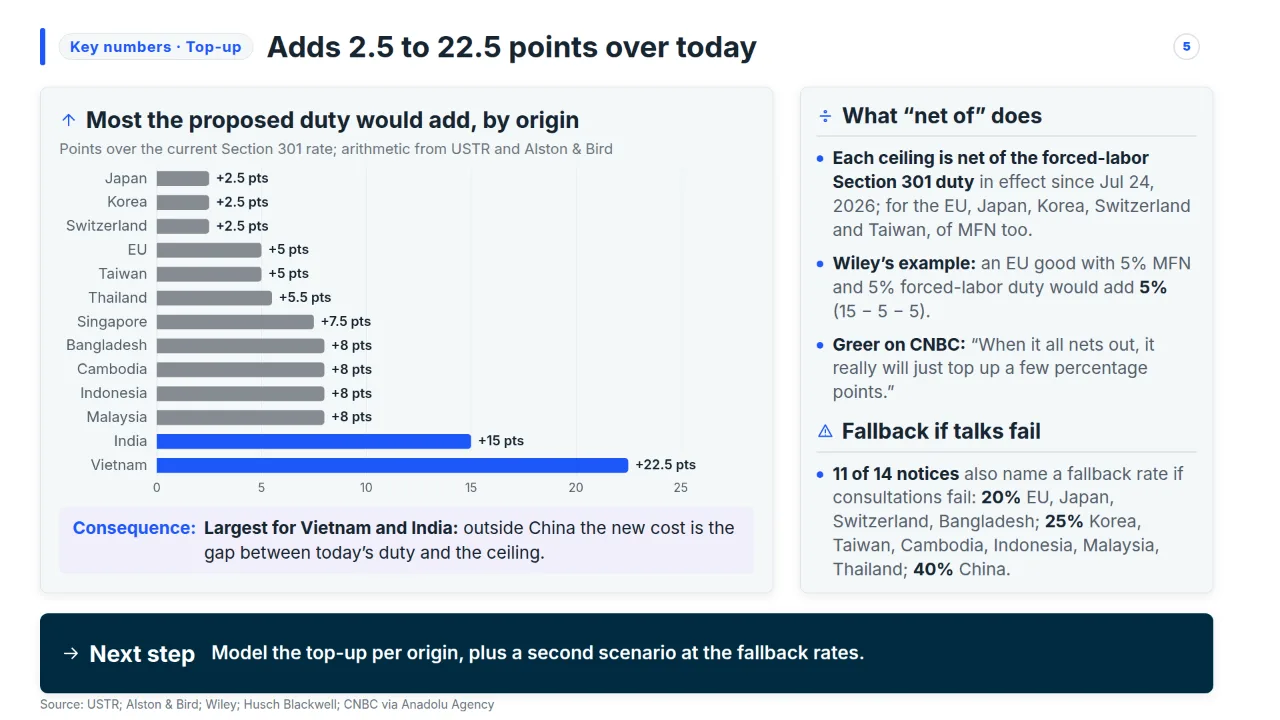
The proposed rates are ceilings. USTR offsets each by the Section 301 forced-labor tariff in effect since Jul 24, 2026. For the EU, Japan, Korea, Switzerland and Taiwan it also counts the ordinary MFN duty inside the 15%. Wiley's example: an EU good with a 5% MFN duty and a 5% forced-labor tariff would pay an extra 5%, for 15% across the three measures (5 + 5 + 5). A Bangladeshi good paying 10% today would pay 8% more, for 18% plus its ordinary duty. The table subtracts today's rate from each ceiling:
| Economy | Section 301 rate since Jul 24 | Proposed ceiling | Most the new duty adds |
|---|---|---|---|
| EU, Taiwan | 10%, MFN included | 15%, MFN included | 5 pts (15 − 10) |
| Japan, Korea, Switzerland | 12.5%, MFN included | 15%, MFN included | 2.5 pts (15 − 12.5) |
| Bangladesh, Cambodia, Indonesia, Malaysia | 10% | 18% | 8 pts (18 − 10) |
| Thailand | 12.5% | 18% | 5.5 pts (18 − 12.5) |
| Singapore | 12.5% | 20% (10% with deal) | 7.5 pts (20 − 12.5); none at 10% |
| India | 10% | 25% (17% with deal) | 15 pts (25 − 10); 7 pts at 17% |
| Vietnam | 12.5% | 35% (20% with deal) | 22.5 pts (35 − 12.5); 7.5 pts at 20% |
Source: rates since Jul 24, Alston & Bird reading the final forced-labor notice; ceilings, USTR; arithmetic by this brief.
Greer described the result on CNBC: "When it all nets out, it really will just top up a few percentage points" (via Anadolu Agency). According to Global Trade & Sanctions Law, the 18% tier sits one point below the 19% rate in the Bangladesh, Cambodia, Indonesia and Malaysia agreements and the Thailand framework. Husch Blackwell reports that every notice except China's would exempt goods under Section 232 tariffs: steel, aluminum and copper articles, vehicles and parts, wood products, patented pharmaceuticals and semiconductors.
2.2 China, and where the 40 percent figure comes from
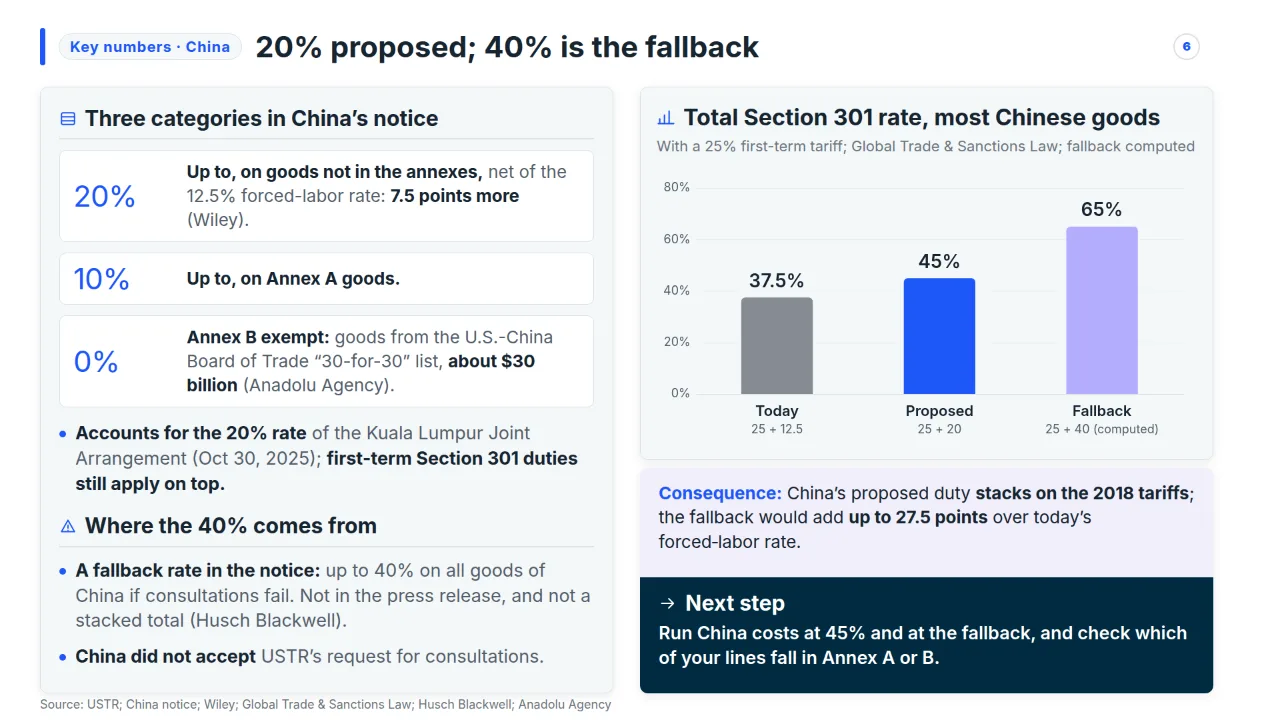
China's notice sets three categories. Goods not in either annex would face up to 20%, net of the forced-labor rate. Annex A goods would face up to 10%. Annex B goods, drawn from the U.S.-China Board of Trade "30-for-30" U.S. Imports List, would be exempt. Chinese goods already pay 12.5% under the forced-labor action, so the 20% would add 7.5 points (20 − 12.5), according to Wiley. First-term Section 301 tariffs still apply on top. Global Trade & Sanctions Law puts most Chinese goods at 37.5% today (25 + 12.5) and 45% under the proposal (25 + 20), counting all three Section 301 actions. Annex B covers about $30 billion of Chinese goods, Anadolu Agency reported.
The "up to 40%" in BBC and CNBC reports is not a stacked total. Law firms reading the China notice say it is a fallback rate: up to 40% on all goods of China, net of the forced-labor rate. USTR could apply it if consultations and commitments prove unsatisfactory. The press release omits it. CNBC ties it to China's compliance with the trade truce. If it were applied, it would add up to 27.5 points over today's 12.5% (40 − 12.5), per StockTitan's reading. On a good also under a 25% first-term tariff, the total would be 65% (25 + 40, computed here; in no USTR document).
The fallback is not limited to China. Alvarez & Marsal counts 11 of 14 notices with a higher alternative rate. Husch Blackwell lists 20% for the EU, Japan, Switzerland and Bangladesh and 25% for Korea, Taiwan, Cambodia, Indonesia, Malaysia and Thailand. India, Singapore and Vietnam have none.
2.3 Trade covered and the record
The six economies with 2025 figures in the material come to $1.12 trillion (327.49 + 205.03 + 201.05 + 149.81 + 129.04 + 107.59 = $1,120.01B). The source puts their combined share at 31.9% of U.S. imports (9.3 + 5.8 + 5.7 + 4.3 + 3.7 + 3.1). The other eight, including the EU, come on top; the material has no official total. USAFacts gives different values (China $331.8B) on an unstated basis; this brief follows the merchandise series. Mexico, the largest single source at $538.97B (15.4%), has no determination. Imports from China fell 29% from 2024.
USTR's record: nearly 140 witnesses and 1,070 comments across all 16 economies. The China notice dates the hearings to May 5–8, 2026. Of the sectors named, China has the most, 22, from aluminum to wind; for the EU, automotive, chemicals and pharmaceuticals; for Vietnam, textiles, apparel, footwear, shipbuilding, cement and ICT; for Bangladesh, ready-made garments.
For the 13 economies other than China, the proposed ceilings would add 2.5 to 22.5 points over today's Section 301 rate. China's 20% stacks on first-term tariffs, and the 40% in headlines is the notice's fallback rate, not the proposed one.
Source notes: some outlets give the China truce as "Busan"; this brief follows USTR's "Kuala Lumpur Joint Arrangement". Taxise lists China, Vietnam, Singapore and Thailand at 5% under the forced-labor action; this brief follows Alston & Bird's 12.5%.
3. Who is affected and how
Chapter 2 set out the proposed rates. This chapter covers who would pay them, what each group has said and where costs would fall. As of Nov 26, 2026, all of it is proposed.
| Group | What changes if adopted | Who said it / document | Date | Source |
|---|---|---|---|---|
| U.S. importers, 13 non-China origins | New duty fills the gap up to the proposed rate; goods now under Section 232 exempt; AD/CVD still stack | USTR notices; Wiley, Alvarez & Marsal | Nov 25 | USTR; Wiley; A&M |
| U.S. importers, China origin | Up to 20% net of the 12.5% forced-labor rate, stacked on 2018 Section 301 duties; Annex B goods (about $30bn) exempt; no Section 232 carve-out | China notice; Wiley; Al Jazeera | Nov 25 | USTR; Wiley; A&M; Al Jazeera |
| U.S. business groups | No Nov 25 statement found; earlier, 17 groups called Section 301 tariffs "counterproductive" | Forced Labor Working Group letter | Apr 2026 | FLWG |
| China | "False issue"; did not accept consultations | Foreign ministry (Guo Jiakun); China notice | Nov 25 | Al Jazeera; USTR |
| EU, Switzerland | "Strongly reject the premise"; Swiss government rejects the allegations | Commission spokesperson Olof Gill; Swiss government | Nov 25 | Al Jazeera |
| India | Up to 25%, or 17% with a deal; says it has no structural excess capacity | Commerce and industry ministry | Nov 25 | The Wire |
| Taiwan | Up to 15% net of MFN | Executive Yuan | Nov 25 | CNA |
| Households | 2026 tariff cost estimates of $570–$600 per household, made before this proposal | Yale Budget Lab; Tax Foundation | Mar 2026 | CNBC |
| Markets | Close: Dow +0.33%, S&P 500 −0.25%, Nasdaq −0.62%, after intraday lows of −2.2%, −3.2% and −4.6% | CNBC | Nov 25 | CNBC |
3.1 U.S. importers and manufacturers
Each notice covers "all goods" of the economy except annexed products. Outside China, much of each rate is already being paid. According to Wiley, the new duty is reduced by the forced-labor Section 301 duty, which has been in effect since Jul 24, 2026. A Bangladeshi good paying 10% would add 8 points (18 − 10). An EU good with 5% MFN and 5% forced-labor duty would add 5 points (15 − 5 − 5). Antidumping and countervailing duties would still stack. Greer told CNBC: "When it all nets out, it really will just top up a few percentage points".
Section 232 decides much of the exposure. According to Alvarez & Marsal, the 13 non-China notices exempt goods now under Section 232: metals, vehicles and parts, wood products, patented pharmaceuticals and semiconductors. The China notice has no such carve-out, and its duty would stack on the 2018 Section 301 tariffs. In an example by Baker Tilly's Pete Mento (via Manufacturing Dive), on $1 million of Chinese goods, duty would rise from $125,000 at 12.5% to $200,000 at 20%, an extra $75,000. Annex B "30-for-30" goods would be exempt, about $30bn of Chinese imports according to Al Jazeera. Kelley Drye notes that four notices (Bangladesh, Cambodia, India, Malaysia) seek comment on a textile mechanism that would admit a set volume of apparel at a reduced rate.
The sources reviewed contain no Nov 25 statement from the U.S. Chamber, NAM, NRF or CPA. In the related forced-labor probe, a 17-group coalition led by NRF, AAFA, RILA and USFIA, and including the U.S. Chamber, filed comments in April 2026. It said tariffs "would be counterproductive, legally unwarranted, and harmful to the very U.S. commerce that Section 301 is designed to protect".
3.2 Exporters and governments
The governments that responded rejected the findings. No countermeasures had been announced in the sources reviewed through Nov 26. China's foreign ministry spokesman Guo Jiakun said: "The so-called 'overcapacity' is a false issue, and China opposes using it as an excuse for political manipulation". The China notice records that Beijing "did not accept USTR's request for consultations". A senior U.S. official said: "We know that they don't like these actions, but we are seeking stability with the Chinese".
For the EU, Commission spokesperson Olof Gill said: "We will study the findings. At the same time we strongly reject the premise that Europe is a source of structural overcapacity". Switzerland also rejected the allegations. India's commerce ministry said India "engaged constructively throughout this investigation". It added that concerns "should be addressed within the framework of these negotiations" on a bilateral trade agreement. According to CNA, Taiwan's Executive Yuan called its 15% the lowest level without stacking. Norway, with no determination yet, said it "does not have policies that contribute to overcapacity". No official statement from Japan, Korea, Vietnam or the five 18% economies appears in the sources reviewed.
According to a senior official, the rates respect deal ceilings, and Malaysia's 18% sits below its 19% ceiling. According to Holland & Knight, 11 of the 14 notices also name a higher alternative rate of 20% to 40% if consultations fail. That is the source of the media figure of "up to 40%" for China (see Chapter 2).
Outside China, the proposals would mostly top up forced-labor duties to deal caps and leave Section 232 goods out. Comments on all 14 are due Jan 5, 2027.
3.3 Sectors, consumers and markets
USTR's findings name sectors for each economy:
| Sector named in USTR findings | Economies | Count |
|---|---|---|
| Electronics, ICT, telecom | China, India, Malaysia, Singapore, Taiwan, Thailand, Vietnam | 7 |
| Automotive | China, EU, Japan, Korea, Malaysia, Thailand | 6 |
| Semiconductors | China, Japan, Korea, Singapore, Taiwan | 5 |
| Textiles, apparel, garments | Bangladesh, Cambodia, China, Indonesia, Vietnam | 5 |
| Chemicals, petrochemicals | China, EU, Korea, Singapore, Switzerland | 5 |
| Steel | China, India, Japan, Switzerland | 4 |
| Pharmaceuticals, health | EU, India, Singapore, Switzerland | 4 |
| Solar, renewables | Cambodia, China, India, Indonesia | 4 |
Source: USTR press release, Nov 25, 2026.
The sectors named in the findings are not the same as the goods that would be charged. Outside China, vehicles, steel, patented drugs and semiconductors under Section 232 would be exempt. Apparel is not among the Section 232 categories, and textiles or apparel are named for Bangladesh, Cambodia, Indonesia and Vietnam.
The sources reviewed contain no household-cost estimate for this proposal. In March, CNBC reported estimates for the tariffs then in force: $570 per household in 2026 (Yale Budget Lab) and $600 (Tax Foundation). Budget Lab put the cost at $315 (0.8% of after-tax income) for the bottom 10% and $1,325 (0.3%) for the top 10%. Economists cited by AP said the new duties "largely replace" earlier tariffs and "should have a modest impact on inflation and growth".
On Nov 25, U.S. stocks fell sharply in the morning and recovered by the close. At their lows the Dow was down 2.2%, the S&P 500 3.2% and the Nasdaq 4.6%; they closed at +0.33%, −0.25% and −0.62%. Al Jazeera tied the early fall to the tariff news. CNBC reported that AI-linked stocks led the decline, with Nvidia down almost 4%, on a day that also brought October inflation data. The move cannot be put down to the tariffs alone.
4. Timeline and next dates
Chapter 3 covered who would pay the proposed duties. This chapter lists the dates already passed and those fixed by a notice or announced, as of Nov 26, 2026.
| Date | Event | Status | What is fixed | Source |
|---|---|---|---|---|
| Mar 11, 2026 | Excess-capacity investigations of 16 economies opened | Done | Initiation notice, 91 FR 12886 (Mar 17) | USTR; China notice |
| May 5–8, 2026 | Section 301 Committee hearings | Done | Nearly 140 witnesses, over 1,070 comments | China notice |
| Jul 24, 2026 | Forced-labor Section 301 duties (10% or 12.5%, 60 economies) start; Section 122 surcharge expires | In effect / expired | 12:01 a.m. ET | Alston & Bird |
| Nov 18–19, 2026 | APEC leaders' meeting, Shenzhen, with Trump–Xi talks | Done | — | Brookings; CFR |
| Nov 25, 2026 | Determinations for 14 economies; proposed actions; pre-publication notices | Done (proposals only) | Rates "up to", no effective date | USTR |
| December 2026 | G20 summit, Doral, Florida; Trump–Xi meeting expected | Announced | Day not in material | Brookings; Fortune |
| Jan 5, 2027 | Written comments and requests to appear (with testimony summary) due | Scheduled | Set in each notice | USTR; China notice |
| Jan 9, 2027 | Extended exclusions from 2018 China Section 301 tariffs end, 11:59 p.m. ET | Scheduled, per FreightFigures | Unless USTR extends again | FreightFigures |
| Jan 10, 2027 | U.S.–China truce expires | Announced | Extended from Nov 10, 2026 | Fortune; Feedstuffs |
| Jan 25, 2027 | Public hearings begin, 10:00 a.m., U.S. International Trade Commission | Scheduled | "continuing, as appropriate" | China notice |
| Mar 11, 2027 | 12-month statutory deadline for determinations, per EcoVadis | Deadline, not a scheduled decision | Relevant to Mexico and Norway | EcoVadis |
| Not set | Final action and effective date | Not fixed | Notices state none | GT&S Law; Thompson Coburn |
4.1 The window the notices fix
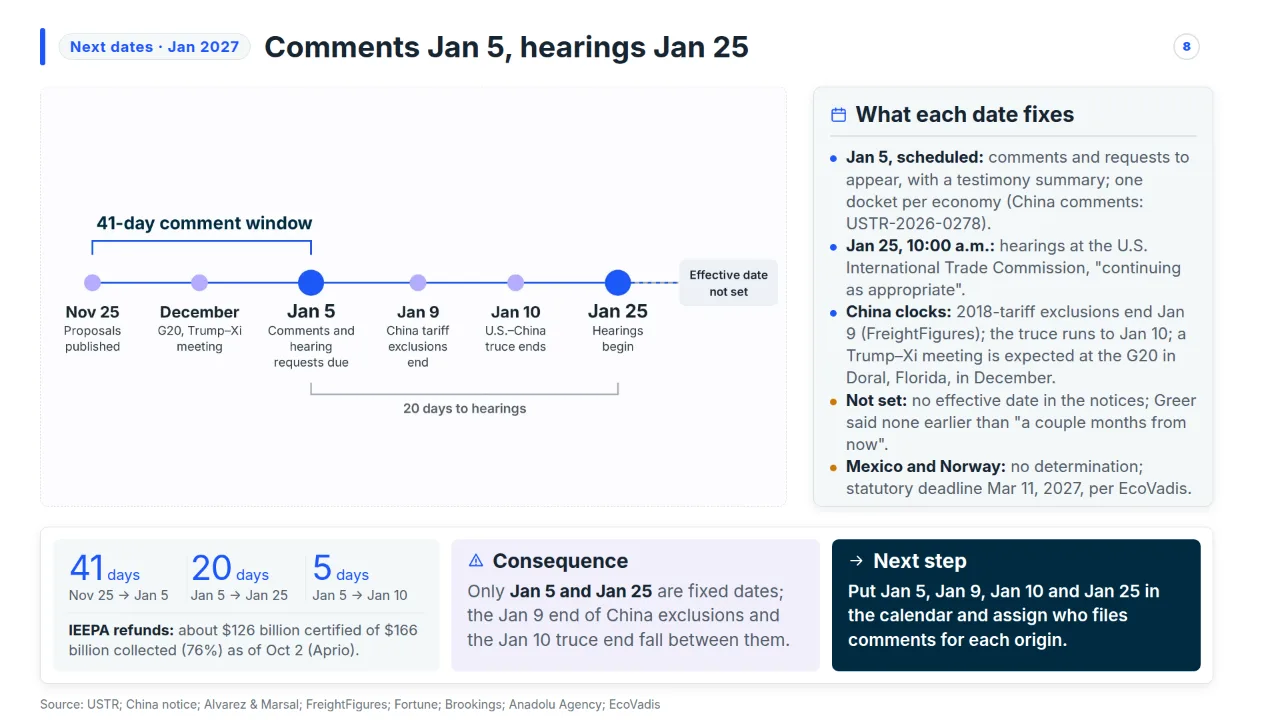
USTR's Nov 25 release says that "to be assured of consideration," written comments and requests to appear, with a summary of testimony, are due by Jan 5, 2027. Hearings start on Jan 25, 2027, "continuing as appropriate". The China notice names the venue: the U.S. International Trade Commission, 500 E Street SW, Washington, from 10:00 a.m.. From the release, the window is 41 days (5 remaining November days + 31 + 5). The hearings open 20 days after the deadline (25 − 5).

Filings go through comments.ustr.gov. The China notice uses docket USTR-2026-0278 for written and rebuttal comments and USTR-2026-0741 for requests to appear. According to Alvarez & Marsal, each economy has its own comment docket (India's is USTR-2026-0731), and the Japan notice names two request-to-appear dockets, so it advises confirming on the portal.
USTR posted "pre-publication" versions of the 14 notices. The material shows no Federal Register citations, so this brief cites those texts; Alvarez & Marsal notes that the published notices control.
No effective date is fixed. The notices "do not state an effective date," according to Global Trade & Sanctions Law; Thompson Coburn lists it as "TBD" until USTR publishes a final determination. Greer told CNBC that none of the duties is likely to take effect earlier than "a couple months from now," according to Anadolu Agency. That is a statement, not a date.
4.2 Clocks already running
The forced-labor duties of 10% or 12.5% on 60 economies have been in effect since 12:01 a.m. ET on Jul 24, 2026, when the Section 122 surcharge expired. Global Trade & Sanctions Law notes a pending court challenge to them. The Section 122 surcharge itself was struck down for three plaintiffs on May 7, 2026, and the government appealed, according to Skadden.
IEEPA refunds carry no new fixed date. According to Aprio, CBP's CAPE system opened in three phases (Apr 20, Jun 29 and Oct 6, 2026), the last limited to importers with their own court case, and CBP had certified about $126 billion of roughly $166 billion collected as of Oct 2: 126 ÷ 166 ≈ 76%. The government's appeal on finally liquidated entries is pending.
Two China dates fall inside the comment window. FreightFigures reports that exclusions from the 2018 China tariffs were extended through 11:59 p.m. ET on Jan 9, 2027. The U.S.–China truce, first set to end Nov 10, 2026, now runs through Jan 10, 2027. USTR says the China proposal "accounts for" the 20% rate in the Kuala Lumpur Joint Arrangement of Oct 30, 2025. The truce end falls 5 days after the comment deadline and 15 days before the hearings.
4.3 Diplomacy and the two open cases
Brookings wrote that Trump and Xi "are supposed to meet one more time in December on the margins of the G20 summit in Doral, Florida, but after that, no meetings are scheduled". The material gives no exact day. The proposal's Annex B comes from the U.S.-China Board of Trade's "30-For-30" lists. Greer also told CNBC that Washington plans broader plurilateral talks on excess capacity, with no date.
The lower rates for India (17%), Vietnam (20%) and Singapore (10%) depend on an agreement "responsive to the determinations". India's commerce ministry said it "remains committed to working closely with the United States towards the early conclusion of the India-US Bilateral Trade Agreement". The material has no date for that agreement or for talks with Vietnam or Singapore.
USTR "has not made determinations with respect to Mexico or Norway at this time". Greer gave no timeline and told CNBC that talks with Mexico continue, according to Anadolu Agency. EcoVadis wrote on Nov 3 that the statute sets a determination deadline of Mar 11, 2027.
Only two dates are fixed: Jan 5, 2027 for comments and requests to appear, and Jan 25, 2027 for hearings. No final rate and no effective date has been set for any of the 14 economies.
5. What it means for decision-makers
Chapters 1–4 give the proposed rates, who would pay them and the dates; this chapter turns them into checks a company can run before Jan 5, 2027. None of it is a forecast of the final rates.
5.1 Importers: price the top-up, not the headline
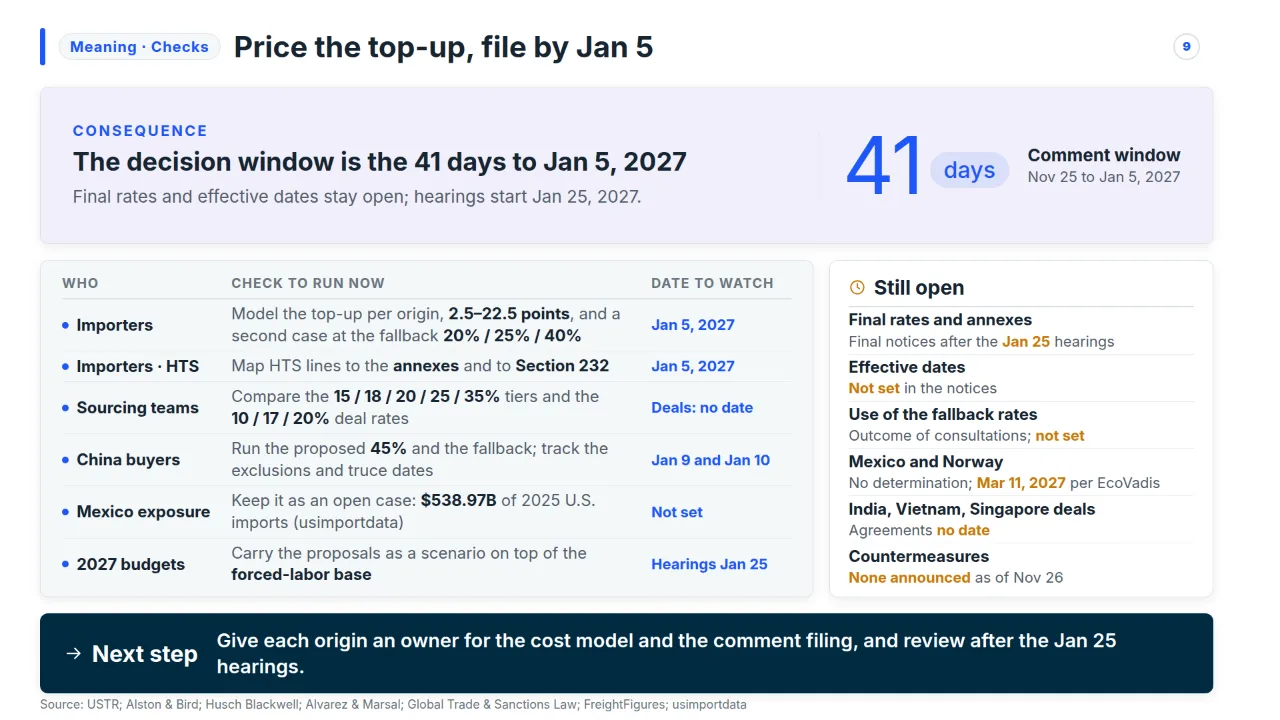
For the 13 economies other than China, each ceiling is net of the forced-labor Section 301 duty already in effect since Jul 24, 2026, and for the EU, Japan, Korea, Switzerland and Taiwan also of the MFN duty. The new duty would add 2.5 to 22.5 points: 5 for the EU and Taiwan, 2.5 for Japan, Korea and Switzerland, 8 for most of the 18% tier, and 22.5 for Vietnam (35 − 12.5). Goods under Section 232 would be exempt in all but the China notice. China is different: up to 20% net of the 12.5% forced-labor rate, stacked on the 2018 Section 301 duties, so 37.5% would become 45% on most goods, according to Global Trade & Sanctions Law.
- Landed-cost model: add one column per origin for the proposed top-up, and a second for the fallback rates (20% or 25%; 40% for China) that 11 of the 14 notices name if consultations fail.
- Annex check: map your HTS lines against the annexes. Section 232 goods are out outside China; China's Annex A goods would face up to 10% and Annex B goods, about $30 billion, none.
- China exclusions: the extended exclusions from the 2018 tariffs end at 11:59 p.m. ET on Jan 9, 2027, according to FreightFigures.
5.2 Exporters and sourcing teams: the gaps between origins
The tiers create rate differences between supplier countries for the same product: 15% for the EU group, 18% for five Southeast and South Asian economies, 20% for Singapore, 25% for India and 35% for Vietnam. For India, Vietnam and Singapore, an Agreement on Reciprocal Trade would bring the ceiling to 17%, 20% and 10%. India's commerce ministry said it remains committed to "the early conclusion of the India-US Bilateral Trade Agreement"; no date for that agreement, or for talks with Vietnam or Singapore, is in the record.
- Dual sourcing: compare Vietnam (up to 35%, 20% with a deal) with the 18% tier for apparel and electronics; textiles and apparel are named for Bangladesh, Cambodia, Indonesia and Vietnam and are not Section 232 goods.
- Mexico: USTR made no determination for Mexico or Norway. Mexico was the largest source of U.S. imports in 2025 at $538.97 billion, according to usimportdata. Keep it as an open case, not as a zero.
5.3 Comment, budget and watch
The window is 41 days: comments and requests to appear by Jan 5, 2027, hearings from Jan 25, 2027. Each economy has its own docket on comments.ustr.gov (China: USTR-2026-0278 for comments). The notices state no effective date; Greer said none would come earlier than "a couple months from now".
- File by Jan 5: comments can ask for products to be added to an annex or argue the rate; companies with a stake in China should also track the truce, which runs to Jan 10, 2027.
- 2027 budgets: carry the proposals as a scenario, not as the base case; the forced-labor duties are the in-effect base.
The duties are proposals with no effective date. The fixed date is Jan 5, 2027, the last day to put a product, a rate or an exemption in front of USTR before the Jan 25 hearings.
| Check | Why (fact) | Date to watch |
|---|---|---|
| Model top-up per origin | Ceilings net of forced-labor and MFN; adds 2.5–22.5 points | Jan 5, 2027 |
| Model fallback rates | 11 of 14 notices name 20%/25% (China 40%) | Hearings from Jan 25, 2027 |
| Map HTS lines to annexes | Section 232 goods exempt outside China; China Annex A 10%, Annex B exempt | Jan 5, 2027 |
| Compare supplier origins | 15% / 18% / 20% / 25% / 35% tiers; deal rates 10% / 17% / 20% | Agreements with India, Vietnam, Singapore (no date) |
| Track China clocks | Exclusions end Jan 9; truce ends Jan 10 | Jan 9–10, 2027 |
| File comments | Separate dockets per economy | Jan 5, 2027 |
| Keep Mexico open | No determination; largest 2025 import source | Not set |
6. What we don't know yet
The rates and dates in Chapters 1–4 leave several questions open as of Nov 26, 2026. Each one below has a known way to be settled and, where the record gives one, a date.
6.1 The final rates
- Will the final rates match the proposals? Every rate is "up to" and open for comment until Jan 5, 2027; hearings start Jan 25, 2027. The final notices will settle it.
- Will the fallback rates be used? Eleven of the 14 notices name a higher rate (20% or 25%; 40% for China) if consultations fail, according to Holland & Knight and Husch Blackwell. The press release does not mention them.
- Which products end up in the annexes? Comments can ask for changes; the published Federal Register notices control over the pre-publication texts.
6.2 When, and for whom
- When would duties take effect? The notices state no effective date. Greer said not earlier than "a couple months from now"; that is a statement, not a date.
- What happens with Mexico and Norway? USTR has made no determination. EcoVadis puts the statutory deadline at Mar 11, 2027.
- Will India, Vietnam or Singapore reach agreements? These would bring the ceilings to 17%, 20% and 10%. India says it is working toward "early conclusion" of a bilateral agreement; no date is set.
6.3 How others respond
- Will trading partners take countermeasures? China called overcapacity "a false issue" and the EU said it "strongly reject[s] the premise"; no countermeasures had been announced as of Nov 26.
- How does the China rate fit the truce? USTR says the proposal accounts for the 20% rate in the Kuala Lumpur Joint Arrangement; the truce runs to Jan 10, 2027, and Trump and Xi are expected to meet at the G20 in Doral, Florida, in December.
- What would it cost households? No estimate for this proposal is in the record; the March estimates of $570–$600 per household cover the tariffs then in force.
The comment and hearing dates are fixed (Jan 5 and Jan 25, 2027); the final rates, the effective dates, Mexico and Norway, and any countermeasures are not.
| Question | What would settle it | Expected date or source |
|---|---|---|
| Final rates vs proposed ceilings | Final notices after hearings | After Jan 25, 2027 |
| Use of fallback rates (20–40%) | Outcome of consultations; final notices | Not set |
| Annex contents | Comments; published Federal Register notices | Jan 5, 2027 (comments) |
| Effective dates | Final determination | Not set; Greer: "a couple months" |
| Mexico and Norway | USTR determinations | Statutory deadline Mar 11, 2027 per EcoVadis |
| Lower deal rates (India, Vietnam, Singapore) | Agreements on Reciprocal Trade | No date |
| Countermeasures | Official announcements by trading partners | None as of Nov 26 |
| China rate and the truce | Trump–Xi meeting; truce expiry | December G20; Jan 10, 2027 |
7. References
This document draws on the following 43 sources, listed in the order they are first cited.
- 24-1287 Learning Resources, Inc. v. Trump (02/20/2026) — supremecourt.gov
- Section 122 Import Surcharge Replaces IEEPA Tariffs | BDO — bdo.com
- US Trade Court Strikes Down Section 122 Tariffs, but Ruling’s Fate Is Uncertain and Practical Impact Is Limited | Insights | Skadden, Arps, Slate, Meagher & Flom LLP — skadden.com
- Court of International Trade Rejects 10% Section 122 Tariff: What Businesses Should Know While the Appeal Proceeds | Ward and Smith, P.A. — wardandsmith.com
- USTR Initiates Section 301 Investigations Relating to Structural Excess Capacity and Production in Manufacturing Sectors | United States Trade Representative — ustr.gov
- USTR Makes Determinations and Proposes Actions in 14 Section 301 Investigations Relating to Structural Excess Capacity and Production in Manufacturing Sectors | United States Trade Representative — ustr.gov
- China%20FRN.pdf — ustr.gov
- And the (Tariff) Beat Goes On: New Section 301 Forced-Labor Tariffs Imposed on 60 Countries | Insights | Holland & Knight — hklaw.com
- 83. July 27, 2026 | Administration Implements Section 301 Tariffs on 60 Economies | Thompson Coburn LLP — thompsoncoburn.com
- USTR Finalizes and Imposes 10 to 12.5 Percent Section 301 Forced Labor Duties - Alston & Bird | Washington Trade Watch — alstontrade.com
- US announces new tariff proposals on EU, China, and other trade partners — bbc.com
- U.S. proposes new tariffs on 14 trading partners, including China and the EU — cnbc.com
- USTR’s Excess Capacity Determinations: Section 301 Moves to the Center of U.S. Tariff Policy | Alvarez & Marsal | Management Consulting | Professional Services — alvarezandmarsal.com
- Trump proposes import duties of up to 18% on goods from Thailand — nationthailand.com
- World reacts to Trump’s new tariffs as US stocks tumble | Trade War News | Al Jazeera — aljazeera.com
- US Proposes Up to 25% Tariff on India Citing ‘Excess Manufacturing Capacity’ - The Wire — m.thewire.in
- US Import Database 2025-26: US Imports by Country & Top Imports in America — usimportdata.com
- USTR Announces Affirmative Section 301 Determinations and Proposes New Tariffs on 14 Trading Partners to Address Structural Excess Capacity: Wiley — wiley.law
- UPDATE 2 - US proposes tariffs of up to 35% on 14 economies, including China, EU, citing excess manufacturing capacity — usmuslims.com
- USTR Proposes Section 301 Tariffs on 14 Economies in Structural Excess Capacity Investigations — Global Trade & Sanctions Law — November 25, 2026 — globaltradeandsanctionslaw.com
- USTR Announces Proposed Section 301 Excess Capacity Tariffs on Fourteen Economies | Husch Blackwell LLP - JDSupra — jdsupra.com
- USTR Proposes Section 301 Overcapacity… | Kelley Drye & Warren LLP — kelleydrye.com
- New Tariffs List by Country, From Up to 35% for Vietnam to 15% for the EU — stocktitan.net
- Who does the US trade with? | USAFacts — usafacts.org
- Client Alert: The New US Section 301 Tariff - Taxise Asia LLC — taxiseasia.com
- Ambassador Jamieson Greer United States Trade Representative ... — fdra.org
- U.S. Section 301 Investigation Results Released! Taiwan Faces 15% Tariff, Tied with Japan, South ... — youtube.com
- Household tariff costs: Why some families will pay more than others — cnbc.com
- Stock market news for Nov. 25, 2026 — cnbc.com
- US to impose new tariffs on China, 13 other trading partners — signalscv.com
- US agency mulls tariffs on China, EU — mobileworldlive.com
- US readies tariffs over manufacturing capacity, production concerns | Manufacturing Dive — manufacturingdive.com
- USTR Proposes Tariffs Following 14 Section 301 Manufacturing Excess Capacity Investigations | Insights | Holland & Knight — hklaw.com
- Trump, Xi, and Putin: What to expect from the APEC summit | Brookings — brookings.edu
- Six Experts on the Significance of Trump, Xi, and Putin’s First Trilateral Meeting | Council on Foreign Relations — cfr.org
- What's at stake for Trump and Xi in Shenzhen: A trade truce deadline, new export controls, and Iran | Fortune — fortune.com
- Section 301 Excess-Capacity Tariff Delay | FreightFigures — freightfigures.com
- U.S. and China extend trade truce, activate Board of Trade — feedstuffs.com
- Section 301 Excess Capacity: Countries, Sectors, and Status — ecovadis.com
- 90. November 25, 2026 | USTR finds “Structural Excess Capacity” Practices in 14 Economies, Proposes New Section 301 Tariffs from 15-25% | Thompson Coburn LLP — thompsoncoburn.com
- IEEPA tariff refunds: How to claim through CAPE – Aprio — aprio.com
- IEEPA Tariff Refunds in 2026: Status and Next Steps for Importers — opscaleexchange.com
- IEEPA Tariff Refunds: CAPE Phase 3 Guide 2026 | Intoglo Blog — intoglo.com