1. Highlights
One interim final rule, published on Nov 19, 2026, changes who can use U.S. advanced chips overseas: it ties a license to the user of the compute, not only to the place a chip ships. Chapters 2–6 give the detail; these are the facts a reader needs first.
1.1 What the rule does
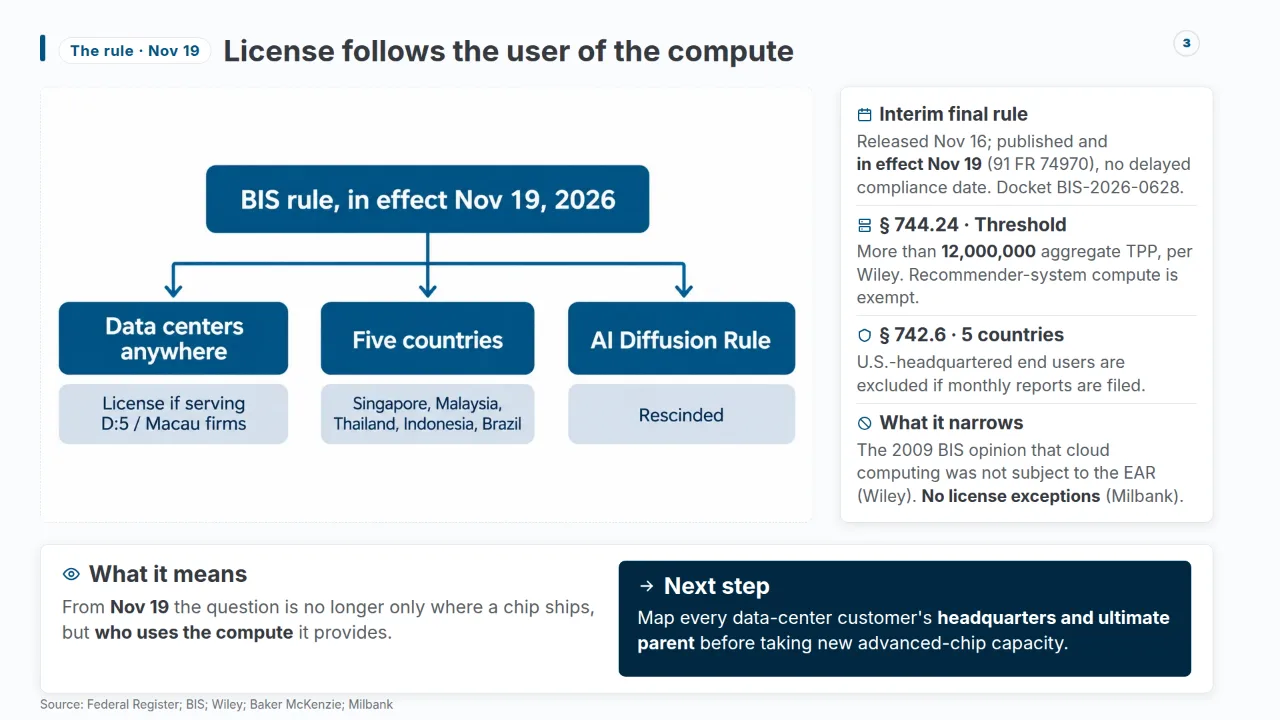
- Released Nov 16, in effect Nov 19. BIS released "Addressing Remote Access to Advanced Semiconductors" on Nov 16 and it took effect on publication on Nov 19, 2026 (91 FR 74970), with no delayed compliance date.
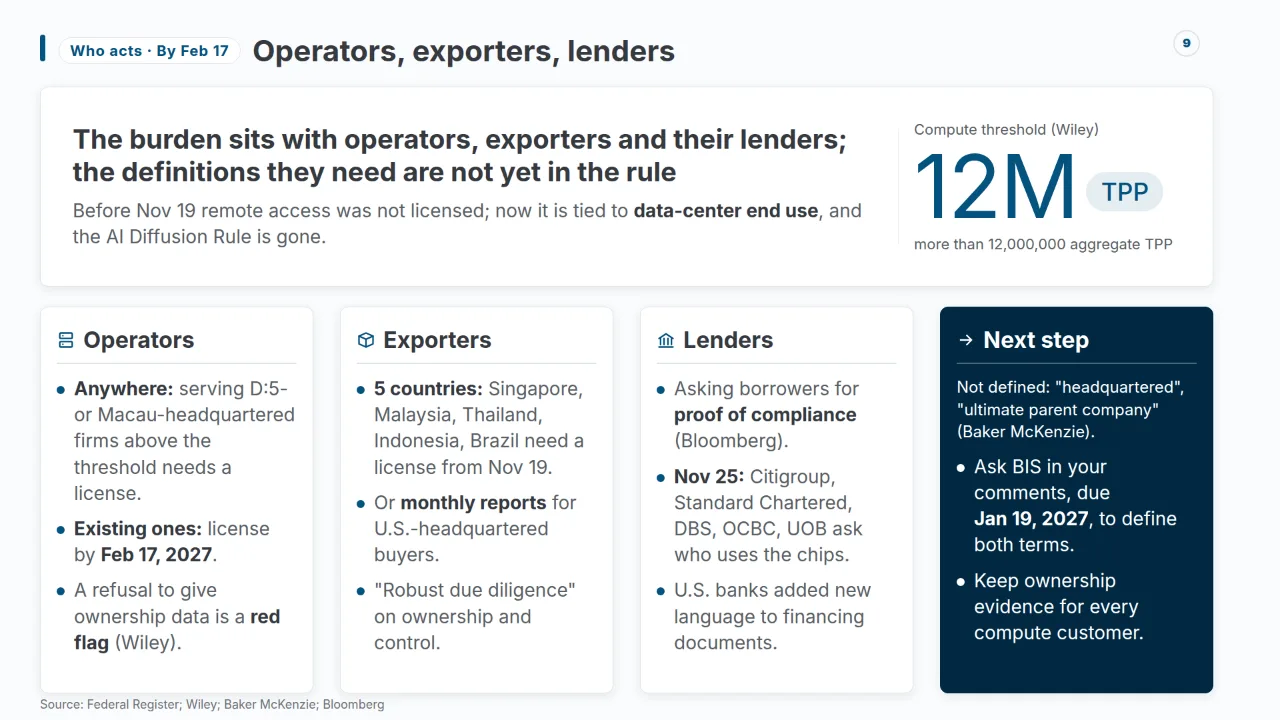
- Data centers anywhere. A license is now required when advanced computing items will be used in a data center, wherever located, that gives a significant volume of compute to companies headquartered in Country Group D:5 or Macau; Wiley puts the threshold at more than 12,000,000 aggregate TPP. Data centers already serving such companies have 90 days, to Feb 17, 2027, to obtain one.
- Five countries. Covered shipments to Singapore, Malaysia, Thailand, Indonesia and Brazil need a license from Nov 19, with a 30-day savings clause only for items already en route.
- AI Diffusion Rule removed. The never-enforced January 2025 regulations are formally rescinded.
1.2 What happened next
- China said on Nov 17 that it has "strong dissatisfaction and firm opposition" and would take countermeasures "if the US persists"; as of Nov 26 no measure had been named.
- The five governments split between compliance and review: Malaysia said operators must "follow U.S. regulations", Singapore's prime minister said the country will not be "a conduit", Thailand said it would check chip importers, Indonesia is reviewing the rule, and Brazil had not commented.
- Lenders paused or re-priced deals tied to Chinese tenants. Bloomberg reported a frozen US$480M loan for chips used by ByteDance (Nov 17) and four facilities worth about US$7.75B slowed or partly abandoned (Nov 25).
- Markets and prices: Malaysian data-center stocks fell up to about 20% on Nov 17, and the B300 GPU rental index was 7% below late October by Nov 24.
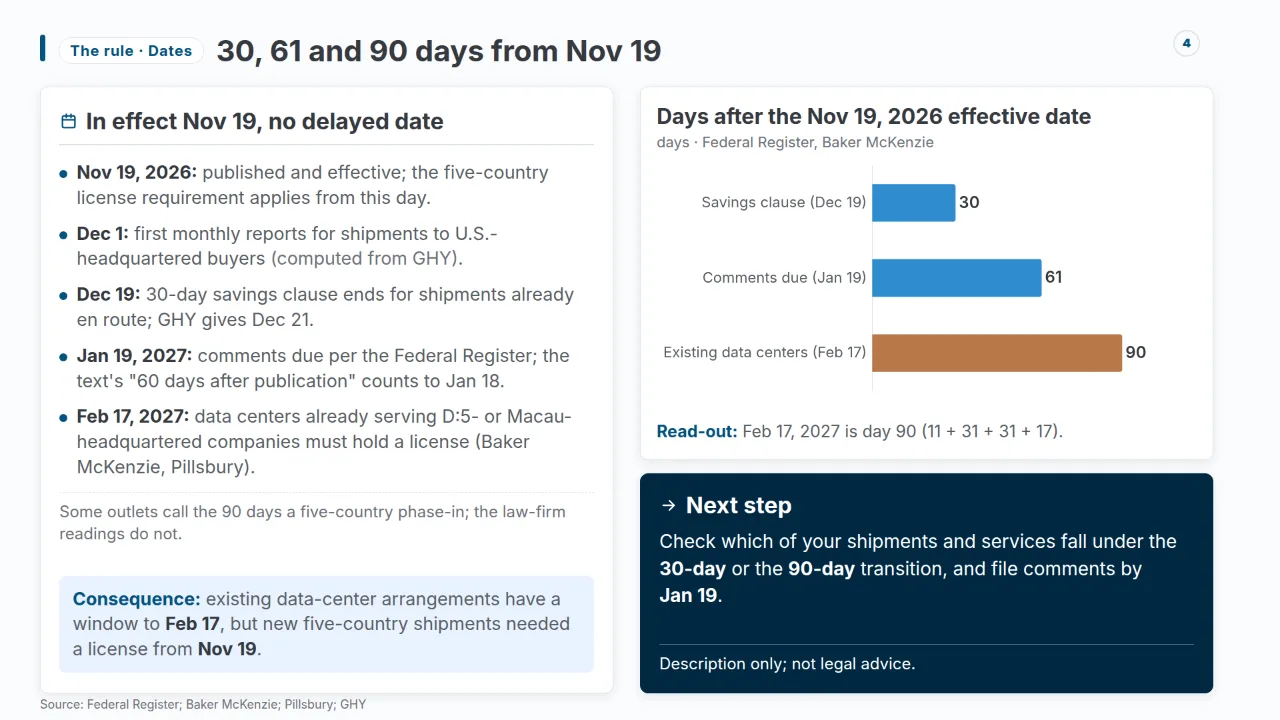
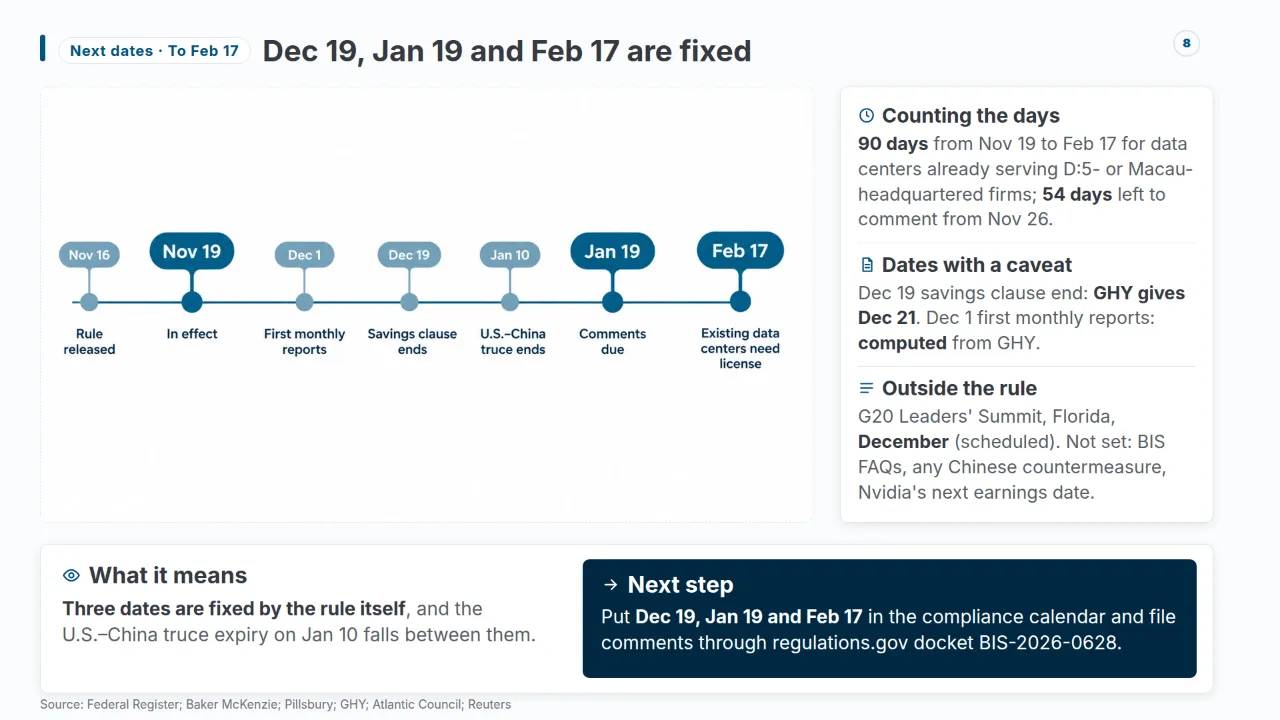
The fixed dates are Dec 19, 2026 (shipments en route), Jan 19, 2027 (comments) and Feb 17, 2027 (existing data centers must hold a license).
| What changed | Before Nov 19 | From Nov 19, 2026 | Source |
|---|---|---|---|
| Remote access by D:5/Macau-headquartered firms | Cloud access to overseas chips not licensed (2009 BIS opinion) | License tied to data-center end use above a compute threshold | Wiley; FR text |
| Shipments to the five countries | No country-wide license for these items | License required; U.S.-headquartered users excluded with monthly reports | FR text; Baker McKenzie |
| AI Diffusion Rule | In the EAR, not enforced since May 2025 | Rescinded | FR text |
| Existing data-center services | Running | License needed by Feb 17, 2027 | Baker McKenzie; Pillsbury |
2. The rule and what changed
Behind the highlights sits one Federal Register document; this chapter sets out what its text requires, from which date, and what it replaces.
| Provision | What it requires | Effective | Source |
|---|---|---|---|
| Data-center end-use control, new § 744.24 | License for advanced computing items when there is "knowledge" they will be used in a data center, wherever located, giving a "significant volume" of compute to an entity headquartered (or with an ultimate parent headquartered) in Macau or Country Group D:5; Wiley puts the threshold at more than 12,000,000 aggregate TPP | In effect Nov 19, 2026; existing providers have 90 days to get a license | FR text; Wiley |
| Five-country license, amended § 742.6 | License for 3A090 (except 3A090.c), 4A090 and .z items to or within Indonesia, Malaysia, Singapore, Thailand and Brazil; U.S.-headquartered end users excluded if monthly reports are filed | In effect Nov 19, 2026; 30-day savings clause for shipments en route | FR text; Baker McKenzie |
| Foundry and packager presumptions | Fewer pathways to overcome the presumption for designers in destinations that need a license for these chips | In effect Nov 19, 2026 | FR text |
| AI Diffusion Rule | Regulations formally rescinded | Rescinded Nov 19, 2026 | FR text |
| Comments | regulations.gov docket BIS-2026-0628, RIN 0694-AK50 | Interim final, comments open to Jan 19, 2027 | Federal Register; FR text |
2.1 Dates, docket and transition periods
BIS released the interim final rule on Monday, Nov 16, 2026. Its press release says the rule was "written by and at the direction of the Department of Treasury and the National Security Council" and "is designed to ensure that existing restrictions on access to sensitive American technology cannot be circumvented through remote computing arrangements involving data centers in third countries". It was filed for public inspection as document 2026-23529 under docket number 261116-0005, then published and made effective on Nov 19, 2026 at 91 FR 74970. Baker McKenzie notes there is "no delayed compliance date".

The text sets comments at "60 days after date of publication". The Federal Register page gives Jan 19, 2027. Counting 60 days from Nov 19 lands on Jan 18 (11 days left in November + 31 + 18), the date one secondary summary prints. This report uses the Federal Register date, which is 61 days after Nov 19 (11 + 31 + 19).
Two transition periods apply, and neither delays the five-country requirement:
- Savings clause, 30 days, for shipments already en route aboard a carrier under actual orders. Nov 19 + 30 days = Dec 19, 2026 (11 + 19); GHY gives the completion date as Dec 21, 2026.
- 90 days for existing data-center arrangements. Data centers already supplying significant compute to D:5 or Macau-headquartered companies must get a license within 90 days to keep serving them. Nov 19 + 90 days = Feb 17, 2027 (11 + 31 + 31 + 17).
Some outlets present the 90 days as a five-country phase-in. The law-firm readings link it only to existing data-center services. See Chapter 6 for the full calendar.
2.2 The data-center control and the five countries
The new § 744.24(a)(1) covers advanced items "destined for use in data centers, wherever located, that will provide direct or indirect access to a significant volume of computing power". Applications are reviewed case by case. According to Wiley, the 12,000,000 aggregate TPP threshold counts "linked" data centers as one, so capacity cannot be split across sites. Wiley adds that de minimis rules give no relief. Milbank says no license exceptions are available. It also reads the rule as treating a change to a restricted end use as an in-country transfer, so chips installed before Nov 19 are caught when such service begins.

The text puts the diligence burden on the whole chain: "Data centers, foreign foundries, and chip exporters are required to perform robust due diligence on their customers, including any direct or indirect ownership or control by persons in Country Group D:5 or Macau". Wiley reports that a data center's refusal to provide that information counts as a "red flag". Compute used only for "commercial recommender systems" is exempt; Milbank notes the carve-out excludes generative AI. Baker McKenzie says "headquartered" and "ultimate parent company" are not defined.
The text calls the five countries "countries which present a higher-than-normal risk of diversion" and lets Commerce designate more. U.S.-headquartered end users are excluded if the exporter files a monthly report under new § 743.10, due by the first business day of the following month. Commerce says it "will consider a range of consequences" for countries that tolerate evasion, including "import restrictions" and "downgrading the country's status in the U.S. export control regime".
The rule does not redefine "export" to cover pure remote access, according to Baker McKenzie. Instead it attaches a license to the chip by its end use. From Nov 19, 2026, the question is no longer only where a chip ships, but who uses the compute it provides.
2.3 What it builds on and what it removes
| Date | Measure | Source |
|---|---|---|
| Jan 2009 | BIS advisory opinion: grid or cloud computing not subject to the EAR (reaffirmed 2014) | Wiley |
| Oct 7, 2022 | First BIS advanced-computing controls (background) | Federal Register |
| Oct 2023 | License for these items to entities headquartered in D:5 or Macau, wherever located | Lexology note |
| Dec 5, 2024 | IFR adding foreign direct product rules and refining advanced-computing controls | Federal Register |
| Jan 2025 | AI Diffusion Rule (issued Jan 13, published Jan 15) | Baker McKenzie; Lexology note |
| May 13, 2025 | BIS announces rescission and non-enforcement; the text stays in the EAR | Lexology note |
| May 31, 2026 | BIS guidance confirming the D:5/Macau headquarters requirement | Baker McKenzie |
BIS describes the new control as an extension of the headquarters requirement to remote access, according to Baker McKenzie. Wiley says the rule "materially narrows" the 2009 cloud carve-out. The rescission, which the text says "has never been enforced", removes ECCN 4E091 (model weights), License Exceptions AIA and LPP, the country tiers and the Data Center VEU. License Exceptions ACM, NAC and ACA remain, as do licenses for D:1, D:4, D:5 and the UAE.
3. Responses: China and the five countries
Chapter 2 set out what the rule requires. This chapter records what governments, companies and U.S. officials said about it between Nov 16 and Nov 26, 2026, quoted as they said it.
| Party | Statement or action | Date (2026) | Source |
|---|---|---|---|
| U.S. Commerce Department / BIS | Rule meant to stop restrictions being "circumvented through remote computing arrangements"; "written by and at the direction" of Treasury and the NSC | Nov 16 | Commerce release via Lexology; Bloomberg via The Star |
| Semiconductor Industry Association | Welcomes rescission of the AI Diffusion Rule; "still evaluating the impact" | Nov 16 | SIA |
| China, Ministry of Commerce | "Strong dissatisfaction and firm opposition"; countermeasures "if the US persists"; no measure named | Nov 17 | Bloomberg via The Business Times; TECHi |
| China, Foreign Ministry (Guo Jiakun) | "Economic coercion and long-arm jurisdiction"; "necessary measures" | Nov 17 | AI Chat Daily; BBC via Quartz |
| Singapore, trade and digital ministries | Studying the rule, engaging companies and U.S. authorities, exploring "trusted access" | Nov 17 | The Online Citizen; Certified Strategic |
| Malaysia, Minister Johari Abdul Ghani | No plan to negotiate; operators to follow U.S. rules | Nov 17 | Reuters via Quartz; CNBC |
| Thailand, Vice Minister for Commerce Kirida Bhaopichitr | Checks on chip importers; "crack down" on re-exporters | Published Nov 18 | CNBC |
| Indonesia, government | Reviewing the rule with industry | Reported; undated in source | Certified Strategic citing Bloomberg; Certified Strategic |
| Singapore, PM Lawrence Wong | "We do not enforce America's export controls…" | Nov 24 | Bloomberg via The Edge |
| Malaysia, MITI | MIDA to advise all operators not to serve seven newly listed entities | Nov 24 | The Star and Malay Mail via CASRAI |
| Brazil, government | No statement in the material; did not immediately respond to Bloomberg | Nov 16–17 | Bloomberg via The Star |
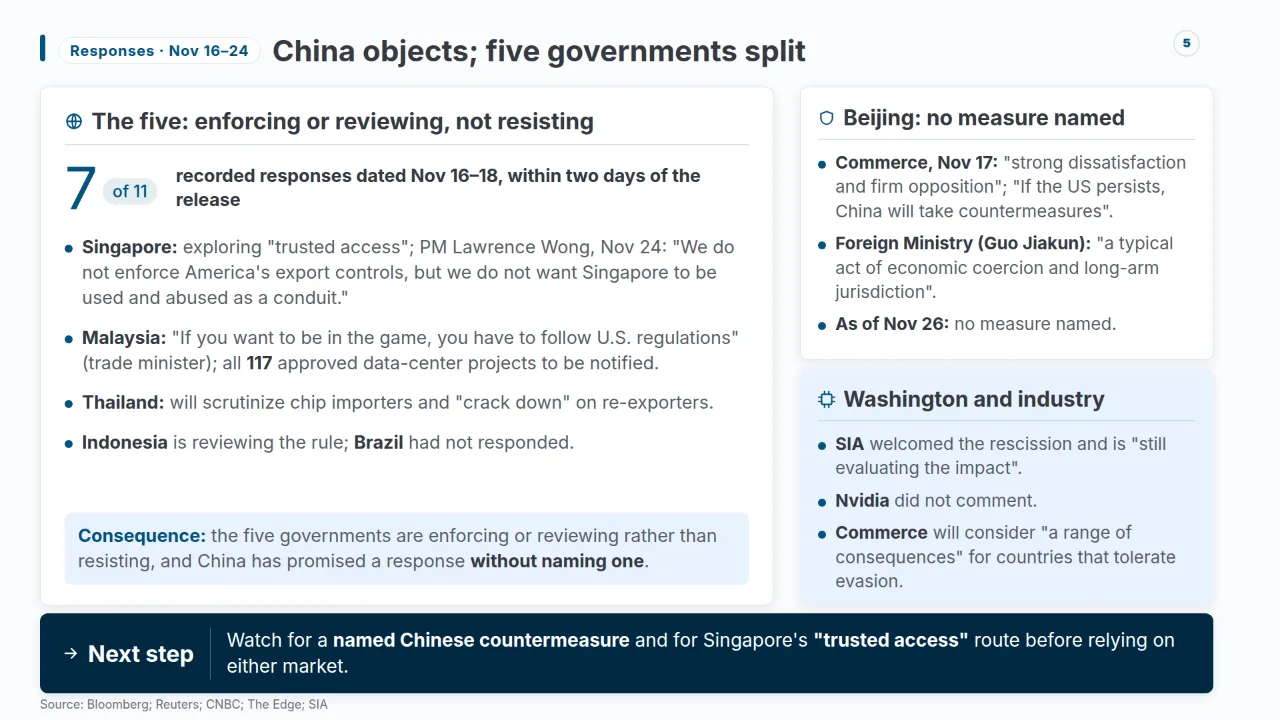
Seven of the eleven entries are dated Nov 16–18, within two days of the release. Brazil is the only named country with no government statement on record as of Nov 26.
3.1 Beijing: two ministries, no named measure
China's Ministry of Commerce issued its statement at 8:27 p.m. Beijing time on Nov 17. It expressed "strong dissatisfaction and firm opposition" and said: "China hopes the US will work with us in the same direction and return to the right track of resolving differences through consultation and cooperation. If the US persists, China will take countermeasures to firmly safeguard its sovereignty, security and development interests". The ministry said the rule runs counter to understandings between the two presidents and threatens global semiconductor supply chains. No measure, company or date was named.
The same day, Foreign Ministry spokesperson Guo Jiakun called the rule "a typical act of economic coercion and long-arm jurisdiction". His pledge appears in three translations: China would "take necessary measures to resolutely safeguard its legitimate rights and interests" (Bloomberg via AI Weekly), "firmly safeguard its own legitimate rights and interests" (BBC via Quartz), or take "necessary steps to steadfastly safeguard" them (Lexology).
Both Chinese ministries promised a response on Nov 17, the day after the release. As of Nov 26, neither had named a specific countermeasure.
3.2 The five governments: compliance, review, silence
Singapore. On Nov 17 the trade and digital ministries said they were studying the measure, engaging companies and U.S. authorities, and exploring "trusted access" for Singapore companies. Minister Josephine Teo discussed the rule with U.S. Deputy Secretary of State Christopher Landau. On Nov 24, Prime Minister Lawrence Wong said: "We do not enforce America's export controls, but we do not want Singapore to be used and abused as a conduit by companies to circumvent America's export controls." Singapore would take "very firm enforcement actions" against companies that break local law, he said.
Malaysia. On Nov 17 trade minister Johari Abdul Ghani said Kuala Lumpur does not intend to negotiate with Washington over the rule, according to Reuters. He also said: "If you want to be in the game, you have to follow U.S. regulations". On Nov 18 he said all 117 approved data-center projects would be notified and that Malaysia "remains open to investment". On Nov 24, MITI said MIDA would advise every operator not to serve the seven entities newly added to the Entity List (a separate measure; see Chapter 4), adding that Malaysia "will not allow itself to be used as a channel to circumvent export controls".
Thailand. Vice Minister for Commerce Kirida Bhaopichitr told CNBC in Manila that Thailand would scrutinize data centers importing high-end chips and "crack down" on those that re-export them. She said new projects without U.S. approval may "not be able to complete construction", and added: "We will have to discuss with the U.S. to make sure that the chips are coming".
Indonesia said it is reviewing the rule with industry, and it is developing a strategic trade management framework. Brazil's government did not immediately respond to Bloomberg, and the material contains no later statement.
3.3 Washington and industry
The Commerce Department said the rule "is designed to ensure that existing restrictions on access to sensitive American technology cannot be circumvented through remote computing arrangements involving data centers in third countries". It added: "Commerce will be actively monitoring for countries that tolerate evasion of this IFR … and will consider a range of consequences for such countries". Its release said the rule was "written by and at the direction of the Department of Treasury and the National Security Council". On Nov 16 President Trump described two views, not insulting China or going "down and dirty", and said: "Can't say either is wrong or right. We'll let you know".
SIA chief executive Michael Robbins said on Nov 16: "We welcome the formal rescission of the Biden-era AI Diffusion Rule. While we are still evaluating the impact of the new interim final rule, we appreciate the Trump Administration's more targeted approach". Nvidia did not respond to requests for comment from Bloomberg or CNBC. People cited by CNBC on Nov 17 said Nvidia had told buyers in recent months that, for now, it would not sell to customers renting over 50% of their GPUs to Chinese companies. The material has no AMD statement on the rule.
Source note: CNBC dates the Thai remarks only to "Sunday"; this chapter uses the Nov 18 publication date.
4. Affected companies, data centers and financing
Chapter 3 set out how governments answered the rule; this chapter follows the money: the data centers, GPU clouds and lenders whose deals depend on Chinese tenants, as Bloomberg reported them on Nov 17 and Nov 25, 2026.
| Company | Exposure | What was reported | Date | Source |
|---|---|---|---|---|
| Aolani Cloud (Singapore neocloud) | US$480M loan to buy Nvidia GPUs for a Malaysian data center used by ByteDance; DBS mandated lead arranger | Bankers at five lenders discussed pulling out; work frozen. On Nov 25, "multiple banks" reassessing | Nov 17; Nov 25 | Bloomberg Law; Bloomberg via The Edge Singapore; Bloomberg via AI Weekly |
| Bridge Data Centres (Bain Capital) | Upsized US$6.6B loan; Malaysian facilities used by ByteDance | Some lenders delayed for more due diligence | Nov 25 | Bloomberg via AI Weekly |
| Digital Halo (Partners Group-backed) | Fully underwritten US$372M loan; Malaysian facility serves Alibaba | One bank passed | Nov 25 | Bloomberg via AI Weekly |
| GMI Cloud (Nvidia cloud partner) | US$300M loan for chips for a Thai data center used by Tencent | Proposed covenant: full early repayment if Tencent is added to a U.S. restricted list; at least one fund will not take part | Nov 17; Nov 25 | Bloomberg via TrendForce; Bloomberg via AI Weekly |
| PaleBlueDot AI (U.S. neocloud) | US$255M loan for chips used by Xiaohongshu, data center in Japan | A lender is seeking legal opinions on whether the change could trigger mandatory prepayment | Nov 17 | Bloomberg via BigGo Finance |
| United Overseas Bank | Planned significant risk transfer of about US$1B, including data-center loans | Slowed | Nov 25 | Bloomberg via MLQ.ai |
| Citigroup, Standard Chartered, DBS, OCBC, UOB | Data-center and neocloud clients in Singapore, Malaysia and the region | Sweeping client reviews; requests for proof of compliance | Nov 25 | Bloomberg via The Edge Malaysia |
| Tencent | Compute in Thailand via GMI Cloud; own cloud unit | Says next-model development could slow; cloud revenue not expected to be substantially harmed | Nov 18 | NeoTeo |
| Alibaba | Rented compute in Malaysia from Megaspeed; Digital Halo tenant | Assessing whether the rules affect some global data-center expansion plans | Nov 19 | AP via NeoTeo |
All loan figures and statuses are reported by Bloomberg, citing people familiar with the matter; none has been confirmed by the borrowers' filings.
4.1 The loans on hold
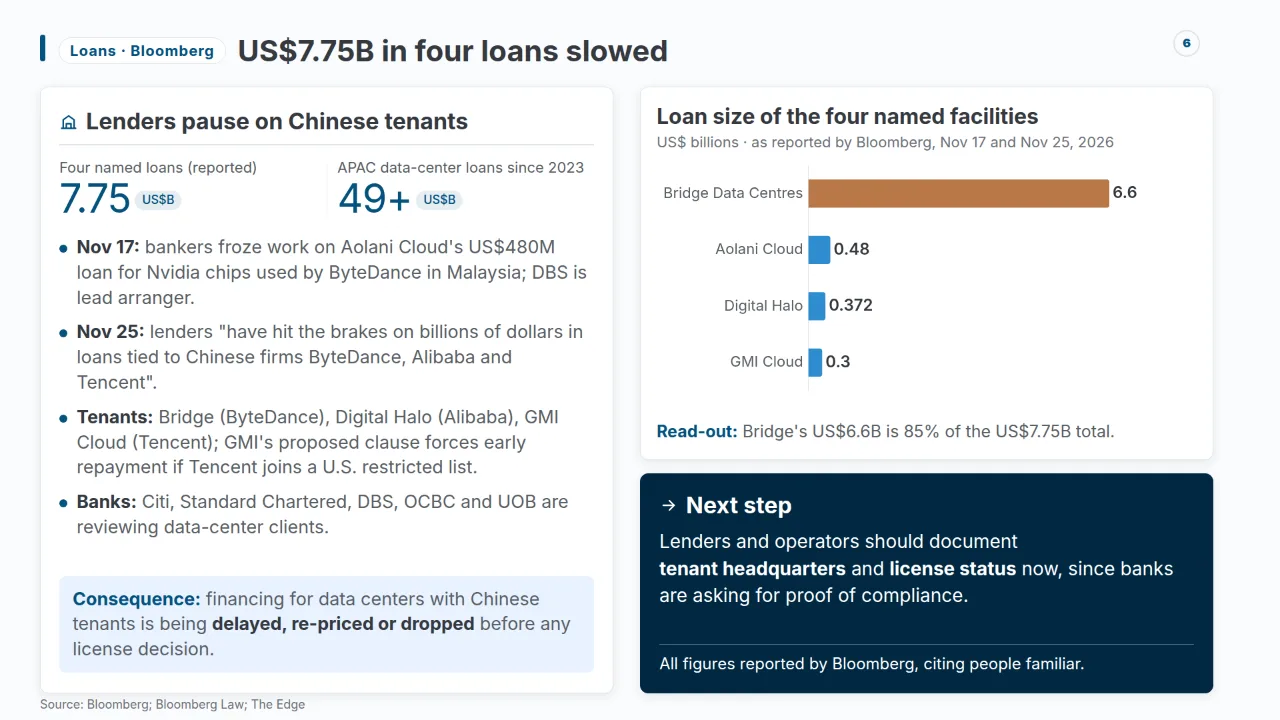
The first deal named was Aolani's. On Nov 17 (U.S. Eastern), Bloomberg reported that "bankers have frozen work on a $480 million loan that would have funded advanced Nvidia Corp. chips for use by China's ByteDance," and that bankers at five lenders "have had internal discussions about pulling out or not joining the loan". Aolani had recently begun inviting banks to join the loan; DBS, the mandated lead arranger, declined to comment, and some bankers internally "described the facility as dead," according to the same report.
A second Bloomberg report the same day set the scale. Data-center companies in Asia Pacific have raised about US$49B in loans since 2023, often secured on customer contracts and sometimes on the chips themselves. ByteDance rents compute from DayOne Data Centers and Bridge Data Centres, two of the region's largest borrowers. Alibaba rented compute in Malaysia from Megaspeed International.
On Nov 25 Bloomberg wrote that "lenders have hit the brakes on billions of dollars in loans tied to Chinese firms ByteDance, Alibaba and Tencent," and that lenders "trying to sell down their exposure are struggling to find interested buyers". It named four facilities totalling US$7.75B (6.6 + 0.48 + 0.372 + 0.3 = 7.752). Bridge's US$6.6B loan alone is 85% of that sum (6.6 ÷ 7.752). A consortium including BlackRock is weighing a lower offer for a portfolio of Asia Pacific data centers, the report said.
Bloomberg's Nov 25 report names four loans worth about US$7.75B slowed or partly abandoned because their end tenants are ByteDance, Alibaba or Tencent, in a regional market that grew from virtually zero in 2023 to more than US$49B.
4.2 How lenders are re-pricing the risk
The change shows up in loan terms. According to Bloomberg's Nov 17 report, loans for chips used by Chinese customers had already sought "hefty termination fees, higher upfront payments and early repayment" in the months before the rule. GMI Cloud's proposed covenant would force full early repayment if Tencent were added to a U.S. restricted-party list. After the rule, U.S. banks "added new language to financing documents" for deals in the works.
Banks then widened the review. On Nov 25 Bloomberg reported that Citigroup and Standard Chartered, with DBS, OCBC and UOB, are "pressing clients for further details on who uses their chips," with neoclouds and private equity owners a focus. OCBC's Pauline Ho said: "we do not anticipate material concerns at this juncture, given that the vast majority of our data centre exposure is to US hyperscalers". DBS said it "continues to work on data centre financing transactions, subject to applicable regulatory requirements". The Monetary Authority of Singapore said it "expects financial institutions to remain vigilant". Data-center loans are a low-single-digit share of each Singapore bank's book. Hogan Lovells Cadwalader's Ben Kostrzewa told Bloomberg the curbs "won't stop the market, but it will slow it all down".
4.3 What the companies say, and the licensing clock
Aolani told Bloomberg: "We are pro-actively working with regulators and our financing partners to ensure the project delivery goes ahead in full compliance with the new ruling". At Tencent's third-quarter results call on Nov 18, President Martin Lau said constrained access to advanced compute could slow development of its next AI model. Executives said they did not expect the controls to substantially harm cloud revenue, which mainly serves inference. Alibaba said it was assessing whether the rules could affect some of its global data-center expansion plans, the AP reported on Nov 19. Bain, Partners Group, GMI Cloud, Citigroup and Standard Chartered declined to comment or did not respond to Bloomberg.
The rule also reaches operators outside Southeast Asia. UK neocloud Nscale, which serves ByteDance, now needs a license, according to MLQ.ai. ByteDance and Alibaba applied for 1.12 million H200s for their own data centers in Malaysia, Indonesia and Thailand, and BIS returned all applications without action, according to ChinaTalk citing a Nov 19 House disclosure.
For data centers already serving companies headquartered in China, Macau or other Country Group D:5 destinations, the rule gives 90 days from the Nov 19 effective date to obtain a license, according to Kharon. That is Feb 17, 2027 (11 days left in November + 31 + 31 = 73 by Jan 31; + 17 = 90), the "mid-February" date in ISMG's report. Chapter 6 covers this date.
5. Supply-chain and market adjustments
Chapter 4 named the companies and loans caught by the rule; this chapter follows how share prices, compute prices, lenders and Chinese buyers moved after the Nov 16 release.
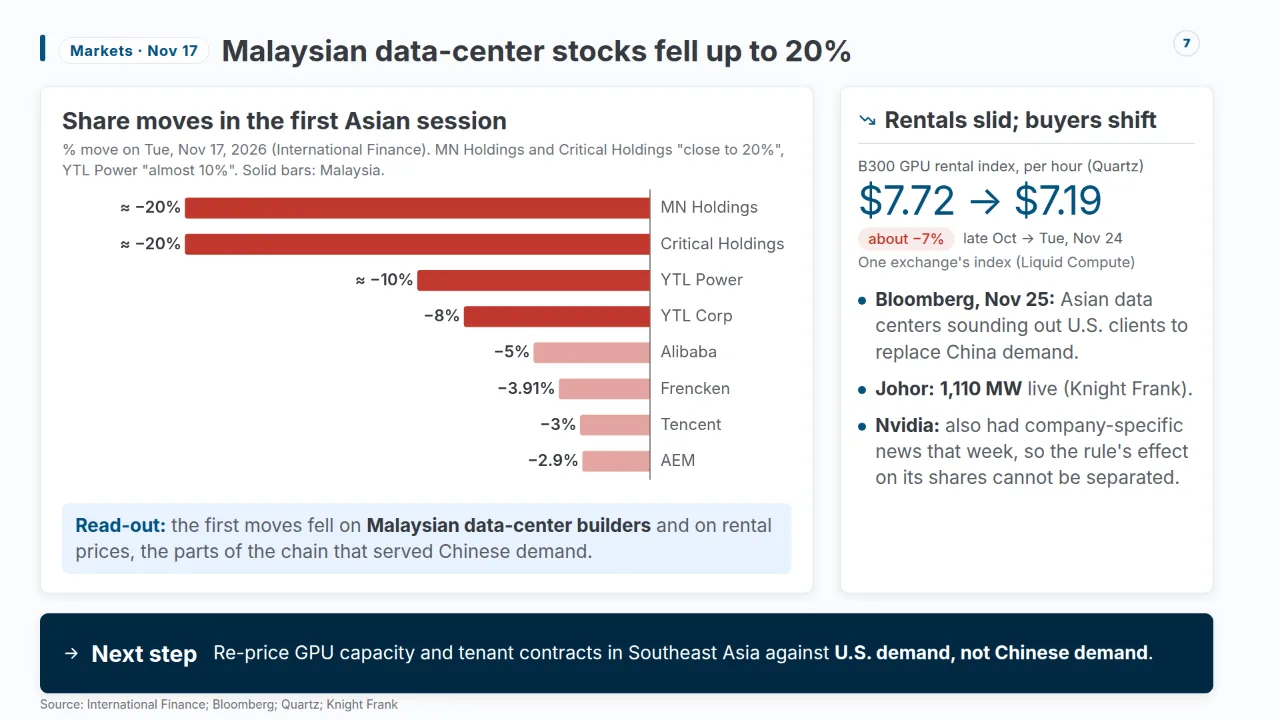
| Company | Market | Business | Move on Tue, Nov 17, 2026 | Source |
|---|---|---|---|---|
| MN Holdings | Malaysia | Data-center infrastructure | fell close to 20% | International Finance |
| Critical Holdings | Malaysia | Data-center infrastructure | fell close to 20% | International Finance |
| YTL Power | Malaysia | Nvidia partner on AI infrastructure | lost almost 10% | International Finance |
| YTL Corp | Malaysia | Parent of YTL Power | shed 8% | International Finance |
| Frencken | Singapore | ASML supplier | −3.91% | International Finance |
| AEM | Singapore | Chip testing | −2.9% | International Finance |
| Alibaba | China tech | Cloud and AI | −5% | International Finance |
| Tencent | China tech | Cloud and AI | −3% | International Finance |
Nov 17 was the first Asian session after the Monday release. In New York, Alibaba's American depositary receipts fell nearly 4% on Monday, Bloomberg (via The Star) reported.
5.1 Share prices and the investment at stake
In its report on the rule, Bloomberg (via The Star) put Nvidia down more than 4% and the Philadelphia Semiconductor Index down 5.3%. Nvidia also had company-specific news that week, so the material does not separate the rule's effect from other causes.
Malaysia's approval figures show what was at stake. The Malaysian Investment Development Authority (MIDA) counted RM95.8 billion of approved data-center and cloud investment in the first half of 2026, out of RM218.5 billion in total (95.8 ÷ 218.5 = 43.8%) (MIDA via International Finance). On Nov 17 MIDA put the nine-month figure at RM123.5 billion ($38.9 billion) across 86 projects, 35.2% of all approved investment (via The Straits Times). That implies RM27.7 billion approved in the third quarter (123.5 − 95.8, computed here). These are approvals, not money spent.
Johor had 1,110 MW of live IT capacity and an 8,542 MW incoming pipeline, according to Knight Frank. Cushman & Wakefield gives the same 1,110 MW, up from 94 MW in 2023, but counts 3,088 MW under construction or planned; the two pipeline figures use different definitions. As of November 2026 Johor had approved 51 projects (17 operational, 11 under construction, 23 approved) worth MYR 182.96 billion. Singapore hosts more than 70 data centers with about 1.4 GW. CNBC counts more than 60 operating in Thailand and about 30 under construction; Thai officials counted 35 operating in September. "Capital has not fled the market, but has become more selective," Samuel Tan of Olive Tree Property Consultants told The Straits Times.
5.2 Asian capacity looks for U.S. buyers
On Nov 25 Bloomberg reported that data centers across Asia are "racing to offload excess computing power to US buyers", according to Ronit Jain, chief executive of Liquid Compute, a New York startup building an exchange for AI computing capacity. He said the rule is hitting providers that were counting on renting to Chinese customers.
Liquid Compute's index showed hourly Nvidia B300 rental falling from $7.72 in late October to $7.19 on Tuesday, Nov 24, as holders listed large volumes for sale, according to Quartz. That is a 6.9% drop ((7.72 − 7.19) ÷ 7.72), reported as 7%; Bloomberg Law's excerpt opens with the same $7.72. It is one exchange's index.
Contract terms were already shifting. Nvidia told buyers it would not, for now, sell chips to customers renting more than 50% of their GPUs to Chinese companies, CNBC reported on Nov 17, citing two people. Lenders are also asking who uses the chips. Citigroup and Standard Chartered have launched reviews of data-center clients, joining DBS, OCBC and UOB in pressing for disclosures on chip users and proof of compliance, with neoclouds a key focus, Bloomberg reported on Nov 25. OCBC's Pauline Ho said: "we do not anticipate material concerns at this juncture, given that the vast majority of our data centre exposure is to US hyperscalers". Data-center loans are a low-single-digit percentage of each Singapore bank's loan book. Paused loans are covered in Chapter 4.
Within a week of the Nov 19 effective date, Bloomberg reported Asian data centers sounding out U.S. buyers, and the B300 rental index was down 7% from late October ($7.72 → $7.19).
5.3 Chinese buyers and domestic chips
The Institute for Progress estimated in October that about 75% of China's overseas AI compute would be in Southeast Asia by end-2026 (via CNBC), and that remote access could be a quarter of China's total AI compute by then (via Nikkei Asia and Business Standard).
Tencent President Martin Lau said the measures could slow development of the company's next-generation models in the short term, and that he expects them to speed up China's domestic chips and supply chains (Reuters via TrendForce). DeepSeek plans to train its next-generation V5 model mainly on Huawei's Ascend 950, with the project targeted for 2027, Nikkei Asia reported; other large Chinese firms still depend on Nvidia's CUDA software. An Ascend 950DT cluster at Shantou began serving overseas AI users in November 2026, according to The Threshold Report citing the South China Morning Post. On the supply side, interim Nvidia chief executive Colette Kress said on Nov 17 that Nvidia would no longer sell H200 chips in China, according to IBTimes.
6. Upcoming dates
After the rule, the responses and the market moves in Chapters 2 to 5, this chapter lists the fixed dates, from what is done to the deadlines the rule sets.
| Date | Event | Status (as of Nov 26, 2026) | What is fixed | Source |
|---|---|---|---|---|
| Dec 1, 2026 | First monthly reports for shipments to U.S.-headquartered buyers in the five countries | Scheduled (recurring) | Reports are due by the first business day of the month after the transaction; for Nov 19–30 shipments that is Tuesday, Dec 1 (computed) | GHY |
| Dec 19, 2026 (GHY: Dec 21) | End of the 30-day savings clause for items already en route on Nov 19 | Scheduled | Nov 19 + 30 days = Dec 19 (11 + 19); GHY gives Dec 21 | Baker McKenzie; CellCog; GHY |
| December 2026 | G20 Leaders' Summit in Florida | Scheduled | Month and state per Atlantic Council; Dec 14–15 according to MindCast AI | Atlantic Council; MindCast AI |
| Jan 10, 2027 | U.S.–China truce suspensions expire | Scheduled | Extended on Nov 9 from Nov 10, 2026 | CEO Economy citing Reuters; CommonWealth |
| Jan 19, 2027 | Comments due on the interim final rule | Comments open | Federal Register date; 60 days from Nov 19 gives Jan 18 | Federal Register |
| Feb 17, 2027 | Data centers already serving D:5- or Macau-headquartered companies must hold a license | Scheduled | Nov 19 + 90 days = Feb 17 (11 + 31 + 31 + 17) | Pillsbury; Baker McKenzie; CellCog |
6.1 Done before Nov 26

BIS filed the rule "Addressing Remote Access to Advanced Semiconductors" for public inspection on Nov 16, 2026 at 4:15 p.m. Eastern, according to CellCog. Wiley puts the release on the same day. Done.
On Nov 17, China's commerce ministry expressed "strong dissatisfaction and firm opposition" and said: "If the US persists, China will take countermeasures to firmly safeguard its sovereignty, security and development interests" (The Business Times). TECHi reports that the ministry named no specific measure. The same day, Singapore's Ministry of Energy, Trade and Industry and its Ministry of Digital Development and Information said they were studying the details. Nvidia also reported third-quarter fiscal 2027 results on Nov 17. Its fourth-quarter outlook says it "is not assuming any Data Center compute revenue from China". Done (see Chapter 3 for the statements).
On Nov 19, the rule was published in the Federal Register and took effect. That Thursday, Trump, Xi and Putin met in Shenzhen at APEC. Done. On Nov 25, Bloomberg reported that lenders had "hit the brakes on billions of dollars in loans" tied to ByteDance, Alibaba and Tencent. Reported (see Chapter 4).
6.2 Deadlines the rule sets
Comments, Jan 19, 2027. The Federal Register page gives 01/19/2027. The BIS text of the rule sets the deadline at 60 days after Federal Register publication. Sixty days from Nov 19 lands on Monday, Jan 18 (11 days left in November + 31 + 18 = 60). Greenberg Traurig and CellCog give Jan 18. International Trade & Supply Chain Insights gives Jan 19. This brief follows the Federal Register. Jan 18, 2027 is the Martin Luther King Jr. Day holiday; no source gives that as the reason. From Nov 26, 54 days remain (4 + 31 + 19).
Savings clause, Dec 19 or Dec 21, 2026. The five-country license requirement has applied since Nov 19, with "no delayed compliance date," according to Baker McKenzie, which says the rule grandfathers shipments "already en route aboard a carrier pursuant to actual orders" under a 30-day savings clause. Nov 19 + 30 days is Saturday, Dec 19, which matches CellCog's date. GHY says such shipments may proceed "if completed by December 21, 2026," the following Monday. The clause text is not in the material, so both dates are given.
Existing data centers, Feb 17, 2027. The 90 days apply only to data centers already providing more than 12,000,000 aggregate TPP to companies headquartered in Country Group D:5 or Macau. These data centers must obtain a license within 90 days of the effective date or face "future export restrictions" (JD Supra). Nov 19 + 90 days is Wednesday, Feb 17, 2027. According to CellCog, the preamble also says that data centers serving commercial recommender systems "may continue providing these services for 90 days." CellCog notes this sits uneasily with the recommender exemption.
Three dates are fixed by the rule itself: Dec 19, 2026 for shipments already en route (GHY: Dec 21), Jan 19, 2027 for comments, and Feb 17, 2027 for existing data centers to hold a license.
6.3 Dates outside the rule, and what has no date
Truce, Jan 10, 2027. China confirmed on Nov 9 that its 24% additional tariff on U.S. goods stays suspended to Jan 10. Its measures against 11 U.S. firms on the unreliable entity list and 16 on its export control list also stay on hold (CEO Economy citing Reuters). The U.S. suspended its expanded restrictions on affiliates of listed entities to the same date. CommonWealth lists broad U.S. controls on advanced AI chips as "not generally removed by the trade truce". Atlantic Council links the two, writing that tighter U.S. chip restrictions "could invite Beijing’s retaliation" through reinstating measures suspended to that date.
G20, December. Atlantic Council writes that both leaders head toward "the December Group of Twenty (G20) Leaders' Summit in Florida, where these conversations will continue". The material gives a day only from MindCast AI (Dec 14–15) and does not name the venue.
No date set. The material has no Nvidia announcement of its next earnings date. Public.com and AlphaQuery list Feb 24, 2027. BIS has announced no FAQ or guidance date. Milbank says only that "guidance could be forthcoming", and Baker McKenzie notes that "headquartered" is not defined. China has set no countermeasure date. In Congress, the House passed the Remote Access Security Act 369–22 on Jan 12, 2026. It sits with the Senate Banking Committee, undated.
7. References
This document draws on the following 69 sources, listed in the order they are first cited.
- Bureau of Industry and Security — bis.gov
- Federal Register :: Addressing Remote Access to Advanced Semiconductors — federalregister.gov
- BIS Restricts Remote Access to Advanced AI Chips and Formally Rescinds the AI Diffusion Rule — sanctionsnews.bakermckenzie.com
- 2026-23529.pdf — public-inspection.federalregister.gov
- BIS Issues Interim Final Rule on Remote Access to Supercomputing Capabilities: Wiley — wiley.law
- Commerce Issues Interim Final Rule Restricting Remote Access to Advanced Chips — pillsburylaw.com
- China warns US of retaliation over new AI chip restrictions - The Business Times — businesstimes.com.sg
- China vows countermeasures to US chip rule; Qualcomm gets 42% of sales there, Nvidia 9% — techi.com
- New U.S. chip curbs put Southeast Asia's data center boom at risk — cnbc.com
- Banks put data centre clients under microscope on AI chips — Bloomberg — theedgemalaysia.com
- US acts to stop China renting AI chips in Asian data centres | Certified Strategic — certifiedstrategic.com
- US to curb China’s remote access to Nvidia chips | The Star — thestar.com.my
- Banks Pause $480 Million Chip Loan Tied to China’s ByteDance (1) — news.bloomberglaw.com
- Banks Pause Bain's $6.6B Bridge Loan on New Asia Chip Curbs | AI Weekly — aiweekly.co
- Nvidia fallout: US chip curbs turn Southeast Asia's AI boom into a compliance test - International Finance — internationalfinance.com
- Quartz on Facebook: "Nvidia chip holders rush to sell as new U.S. rule bars Chinese access: Holders of Nvidia GPUs are li…" — facebook.com
- FOR IMMEDIATE RELEASE BUREAU OF INDUSTRY AND SECURITY — bis.gov
- Federal Register :: Addressing Remote Access to Advanced Semiconductors — federalregister.gov
- Federal Register :: Addressing Remote Access to Advanced Semiconductors — federalregister.gov
- AI Chip Remote Access Rule: What Commerce Filed | CellCog — cellcog.ai
- U.S. to Tighten Export Controls on Advanced Semiconductors - GHY International — ghy.com
- BIS targets remote access to advanced chips through overseas data centers | Nixon Peabody Export Controls Alert | Nixon Peabody LLP — nixonpeabody.com
- The United States will require licenses to re-export AI chips to Brazil, Singapore, Indonesia, Malaysia, and Thailand within 90 days. — en.hwlibre.com
- BIS Issues New Rule Restricting Remote Access to Advanced Chips (Nov 2026) — milbank.com
- Document Search Results for 'Addressing Remote Access to Advanced Semiconductors' — federalregister.gov
- BIS closes the remote-access gap with interim final rule - Lexology — lexology.com
- SIA Statement on New Export Control Rule to Address Remote Access to Advanced Semiconductors - Semiconductor Industry Association — semiconductors.org
- China vows 'necessary measures' over US remote-access AI chip rule — AI Chat Daily — aichatdaily.com
- U.S. requires AI chip export licenses for Southeast Asia data centers — qz.com
- The Online Citizen on Facebook: "https://tocasia.link/fwttwi The United States Commerce Department’s Bureau of Industry and Security …" — facebook.com
- Southeast Asia steps up data centre oversight under US curbs | Certified Strategic — certifiedstrategic.com
- Malaysia warns data centres on US Entity List — CASRAI — casrai.org
- China Vows Countermeasures as US Chip Rule Hits Five Nations | AI Weekly — aiweekly.co
- Beijing Threatens Countermeasures as Washington Tightens Grip on AI Chip Access — BigGo Finance — finance.biggo.com
- US chip curbs cloud Malaysia data centre ambitions | The Straits Times — straitstimes.com
- New US export controls on Malaysia, Singapore for advanced chips to take effect Nov 19 — theedgemalaysia.com
- Nvidia warns chip buyers of legal risks tied to China AI access, sources tell CNBC — cnbc.com
- Banks pause US$480 mil chip loan tied to China’s ByteDance — theedgesingapore.com
- News U.S. Chip Curbs Hit Southeast Asia GPU Rental Financing; ByteDance-Linked US$480M Loan Reportedly Paused — trendforce.com
- Trump Closes Southeast Asia Compute Loophole; Banks Hit the Brakes as $49 Billion in AI Loans Sound Alarm — BigGo Finance — finance.biggo.com
- Lenders stall billions in Asian data center loans after US chip curbs | MLQ.ai — mlq.ai
- Tencent and U.S. AI-chip restrictions: scope and impact | NeoTeo — neoteo.com
- U.S. chip restrictions target remote AI access | NeoTeo — neoteo.com
- Byron Wan on X: "Banks and private credit funds that lent billions to fund data centers and AI chip purchases in Sout…" — x.com
- US AI Chip Curbs Stall Billions in Asia Data Center Loans and Deals — bloomberg.com
- Remote Access Buys Six Months of AI Lead — chinatalk.media
- AI Remote Access Rule & RASA: Export Compliance Guide | Kharon — kharon.com
- US Chip Rule Puts Data Center Tenants Under Ownership Checks — bankinfosecurity.asia
- Jensen Huang's Nvidia Exit Could Hand China's AI Chip Market to Huawei, Analyst Warns as Ban Talk Grows — ibtimes.com.au
- Southeast Asia Rethinks Its Data Center Boom as Resource Pressures Grow - Telecom Review Asia — telecomreviewasia.com
- Asia-Pacific Data Center Market Size, Share, and Industry Analysis - Forecast to 2036 — researchandmarkets.com
- Asia Data Centers Sound Out US Clients to Replace China Demand — bloomberg.com
- Asia Data Centers Sound Out US Clients to Replace China Demand — news.bloomberglaw.com
- Citi, StanChart Put Data Center Clients Under the Microscope on AI Chips - Bloomberg — bloomberg.com
- US moves to restrict China's remote access to AI chips after Nvidia row | World News - Business Standard — business-standard.com
- Huawei chip cluster begins operating for overseas AI customers | The Threshold Report — thethreshold.report
- As the Nvidia scandal threatens to reignite trade tensions at Trump-Xi talks, Beijing still holds the rare earths - Atlantic Council — atlanticcouncil.org
- MCAI National Innovation Vision: Trump-Xi Shenzhen Summit and the AI Chip Remote-Access Rule — The Trade Truce Meets a Chip Control It Never Covered, Beijing's August Template Shows Its Likely Reply — mindcast-ai.com
- US and China extend trade truce to January 10, buying importers two more months | CEO Economy — ceoeconomy.com
- Is the U.S.–China Trade Truce Changing Taiwan's Chip Strategy?|Industry|2026-11-16|web only — english.cw.com.tw
- US requires chip export licences for Singapore, Malaysia, Thailand, Indonesia and Brazil over diversion risk — news.theonlinecitizen.com
- NVIDIA Announces Financial Results for Third Quarter Fiscal 2027 — investor.nvidia.com
- Six Experts on the Significance of Trump, Xi, and Putin’s First Trilateral Meeting | Council on Foreign Relations — cfr.org
- rin-0694-ak50.pdf — media.bis.gov
- BIS Interim Final Rule Targets Remote Access to Advanced Semiconductors, Rescinds AI Diffusion Rule | Insights | Greenberg Traurig LLP — gtlaw.com
- BIS Issues Interim Final Rule Addressing Remote Access to Semiconductors | International Trade & Supply Chain Insights — internationaltradeinsights.com
- BIS Announces New Export Controls on Remote Access, AI Chips | JD Supra — jdsupra.com
- NVIDIA (NVDA) Earnings: Latest Report, Earnings Call & Financials — public.com
- NVIDIA Corporation (NVDA) - Earnings History — alphaquery.com