1. Key takeaways from the window
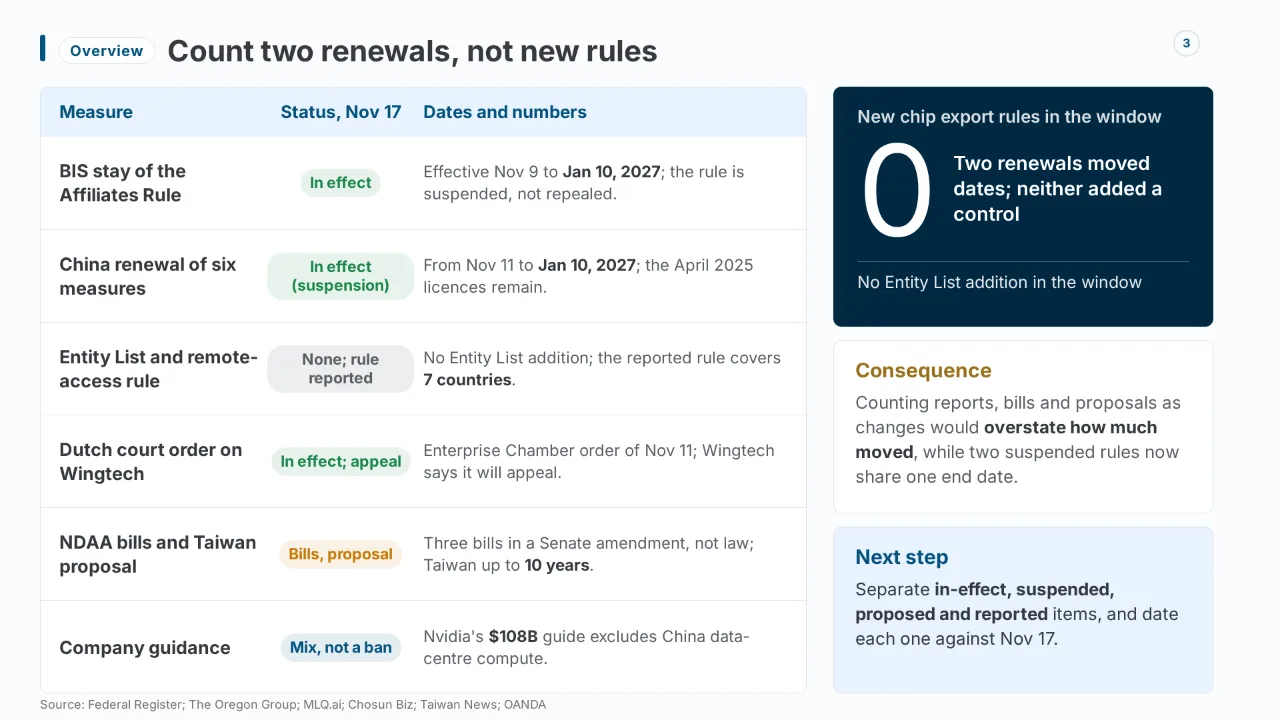
Between Nov 3 and Nov 16, 2026, the window produced one US final rule that only moved a date, one Chinese renewal that did the same, one Dutch court order, and a wave of political pressure after the Nvidia leadership crisis. No Entity List addition and no new export-control rule on chips was issued. Five conclusions follow; each points to the chapter that supports it, with statuses judged against Nov 17.

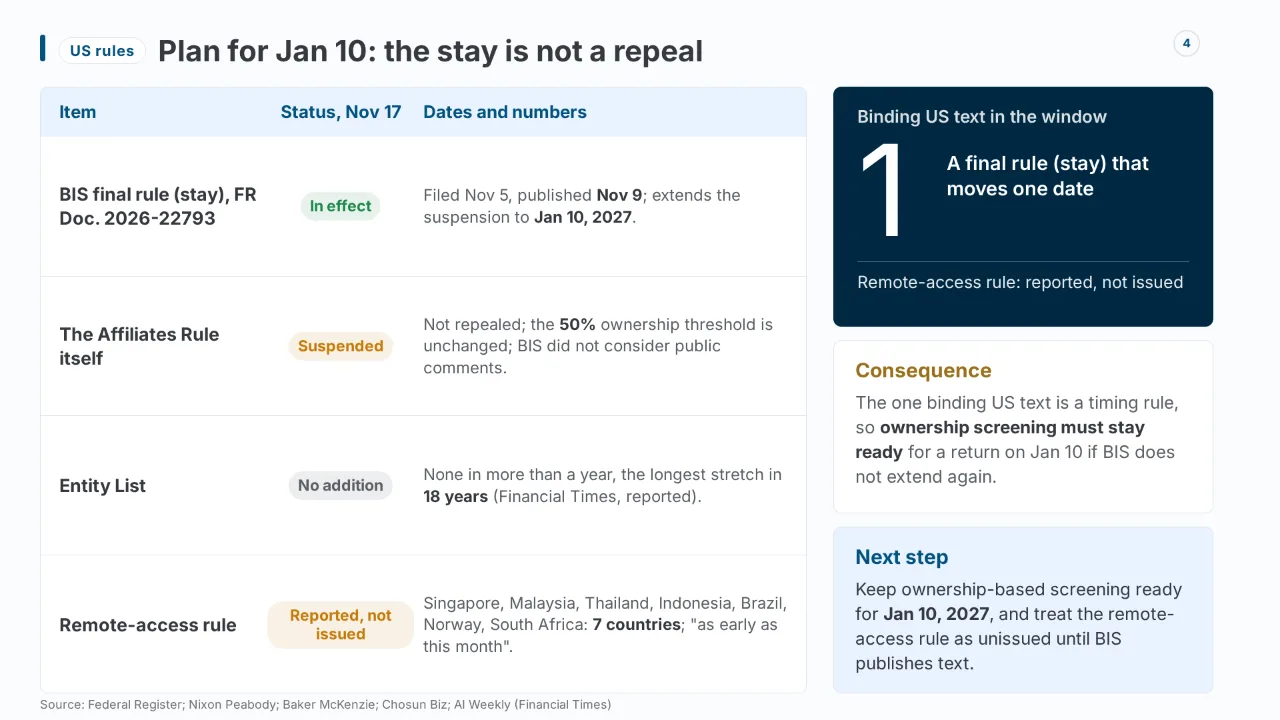
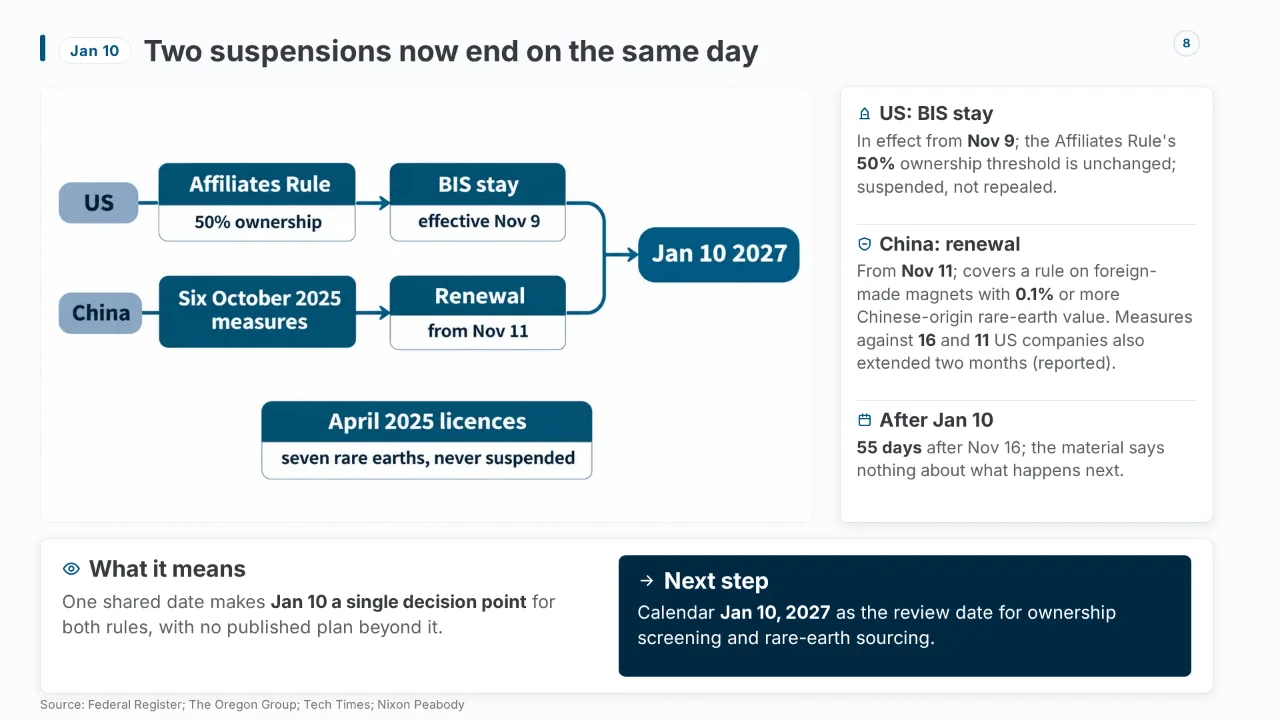
1. Washington's only binding text is a timing rule. BIS filed a final rule (stay) on Nov 5, published it in the Federal Register on Nov 9 (FR Doc. 2026-22793), and extended the suspension of the Affiliates Rule to Jan 10, 2027; the rule is suspended, not repealed. The Financial Times reported that Commerce has added no company to the Entity List in more than a year, the longest stretch in 18 years. A remote-access rule for seven more countries is reported as being finalised, not issued. [Chapter 2]
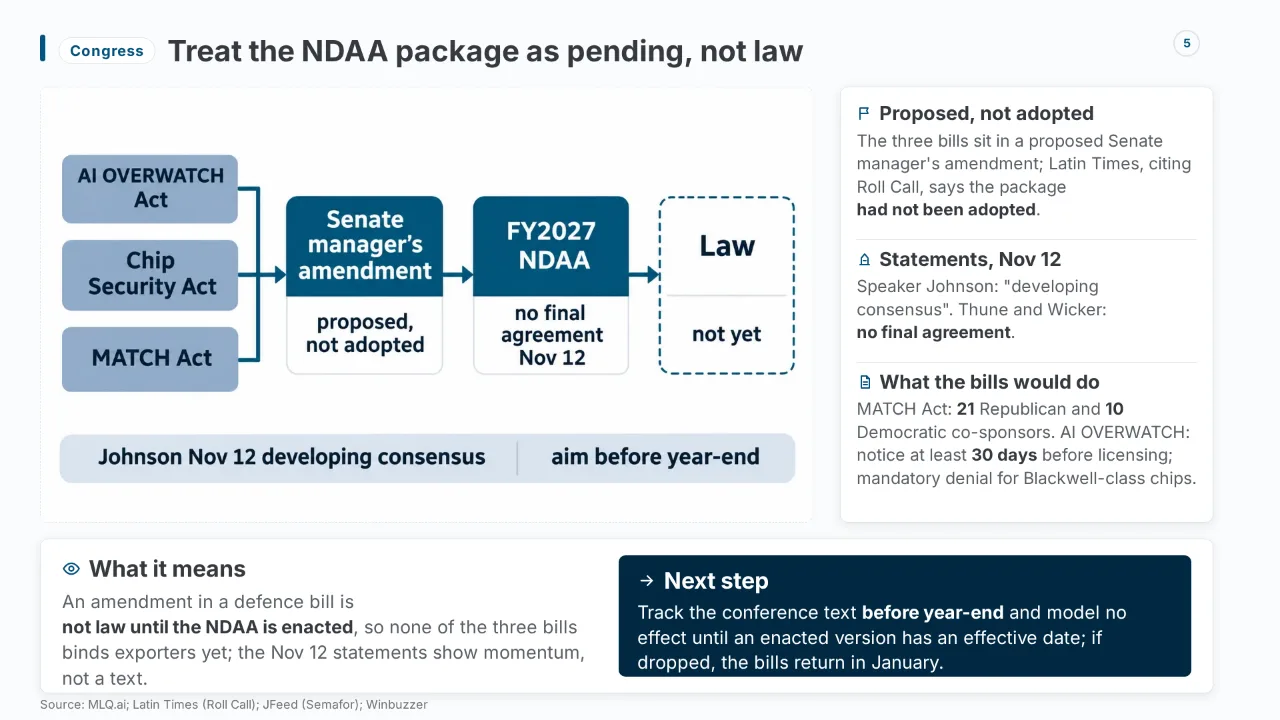
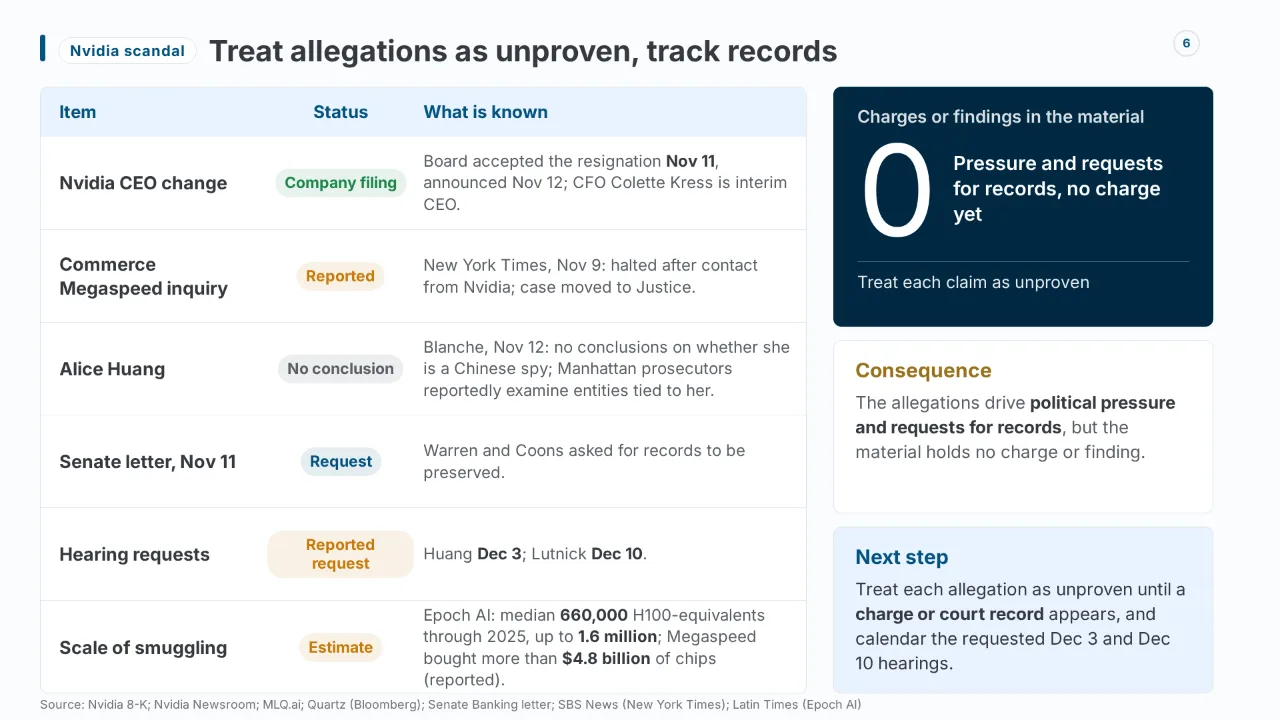
2. The Nvidia scandal moved Congress, not the law. Nvidia's board accepted Jensen Huang's resignation on Nov 11 and announced it on Nov 12, with CFO Colette Kress as interim CEO. House Speaker Mike Johnson said there is a "developing consensus" on limiting chip exports; the AI OVERWATCH, Chip Security and MATCH Acts sit in a proposed Senate NDAA amendment and are bills, not law, with no final agreement on Nov 12. The New York Times reported that Commerce halted a Megaspeed inquiry after contact from Nvidia, and the Justice Department is reported to be examining entities tied to a former Megaspeed executive; every allegation is attributed and unproven. [Chapter 3]
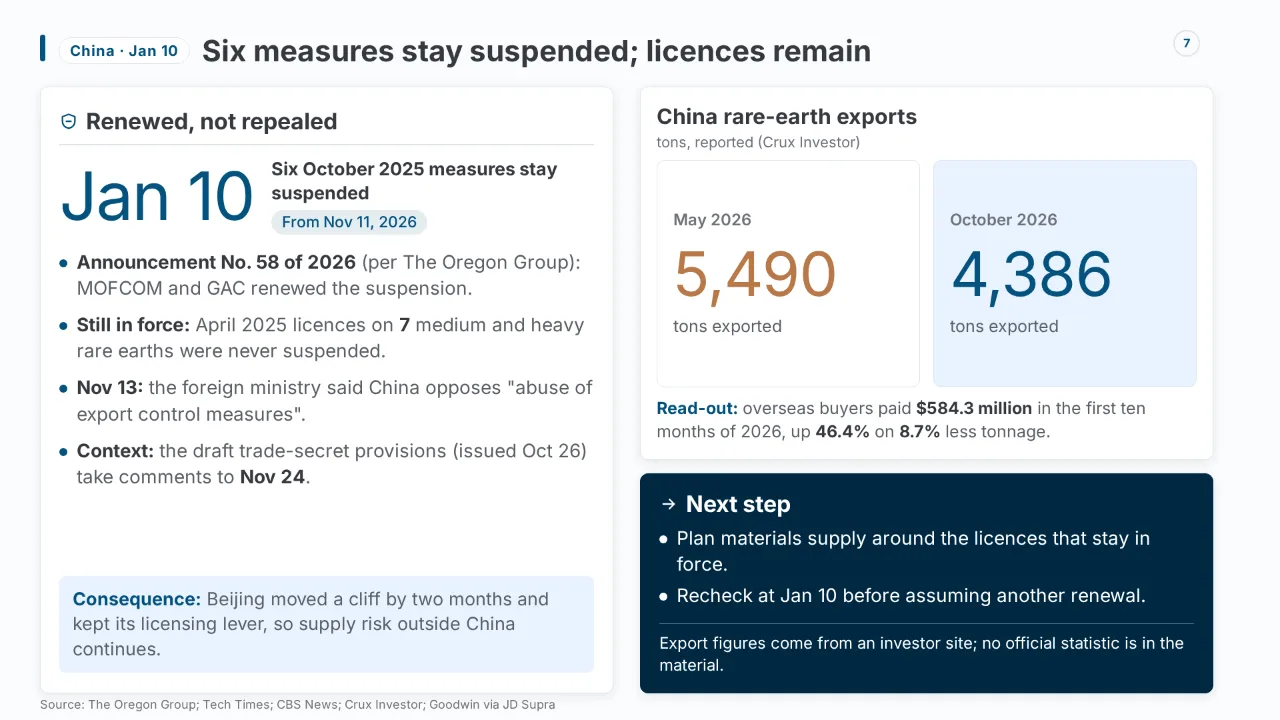
3. China renewed and warned; it did not escalate. MOFCOM and GAC kept six October 2025 measures suspended from Nov 11 to Jan 10, 2027, the same date the US chose; the April 2025 rare-earth licences stay in force. On Nov 13 the foreign ministry said China "has consistently opposed the abuse of export control measures". MOFCOM's draft trade-secret provisions (issued Oct 26, context) take comments to Nov 24. [Chapter 4]
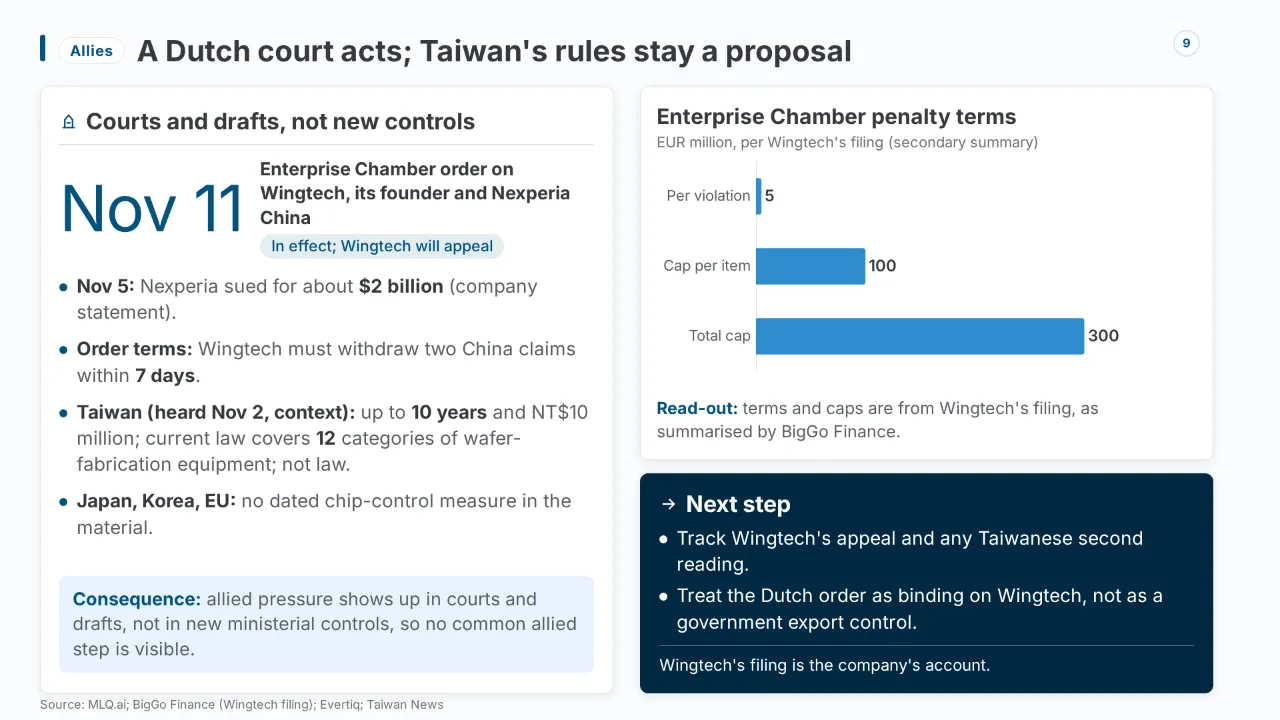
4. Allied action came from a court and a proposal. The Enterprise Chamber of the Amsterdam Court of Appeal ordered Wingtech and Nexperia China on Nov 11 not to interfere with Nexperia, and Wingtech said it will appeal. Taiwan's proposal of up to 10 years in prison for illicit chip exports had its hearing on Nov 2 and is not law. The material has no dated Japanese, Korean or EU measure. [Chapter 5]
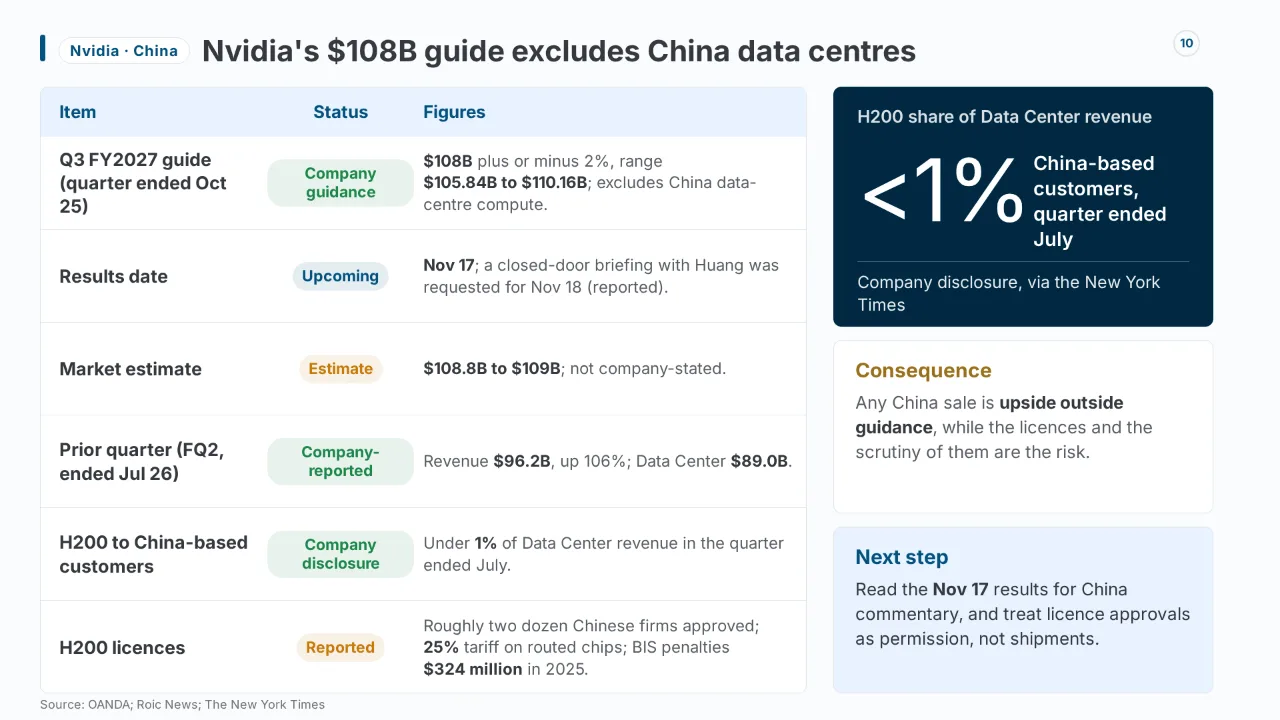
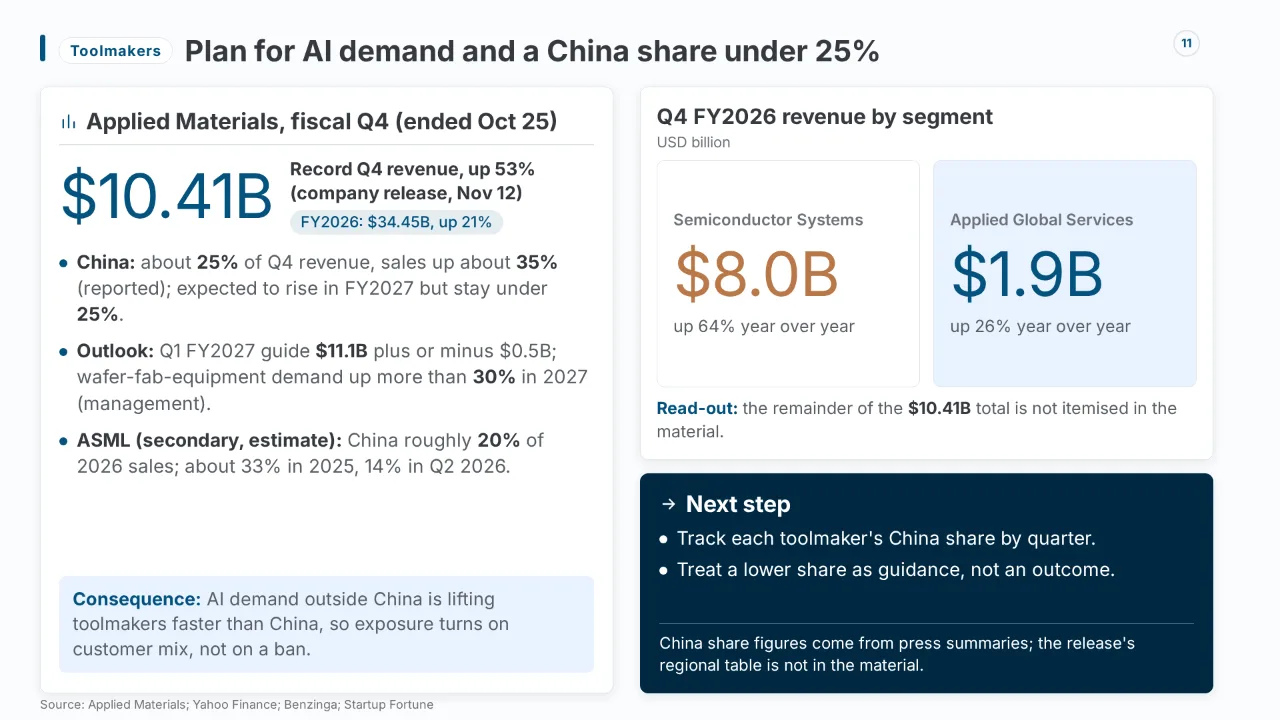
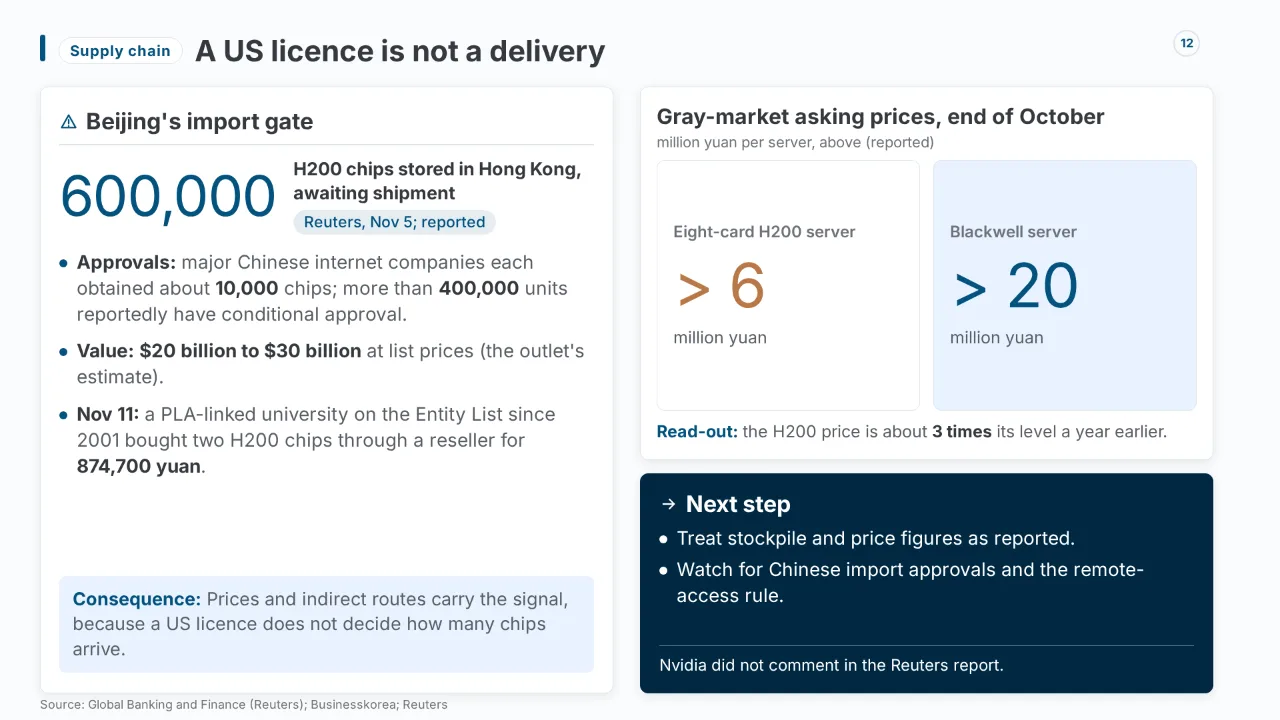
5. Companies and supply chains are adjusting around the gap. Applied Materials reported record fiscal Q4 revenue of $10.41 billion with China at about 25%; Nvidia's $108 billion guide excludes China data-centre compute. Reuters reports about 600,000 H200 chips waiting in Hong Kong while Beijing withholds large-scale imports, and The Information reports Korean HBM being smuggled in server packages. [Chapters 6, 7]
1.1 Measures at a glance
| Issuer | Measure | Instrument | Effective date | Status (Nov 17) | Source |
|---|---|---|---|---|---|
| BIS | Extension of the suspension of the Affiliates Rule | Final rule (stay), FR Doc. 2026-22793 | Nov 9, 2026 to Jan 10, 2027 | In effect; rule suspended, not repealed | Federal Register |
| BIS | Licensing for seven more countries, remote access limits | Rule being finalised | Not stated | Reported, not issued | Chosun Biz |
| MOFCOM, GAC | Suspension of six October 2025 measures | Announcement No. 58 of 2026 (number per The Oregon Group) | Nov 11, 2026 to Jan 10, 2027 | In effect as a suspension | The Oregon Group |
| Foreign ministry | Opposition to new US export controls | Spokesperson statement | Nov 13 | Statement | CBS News |
| Enterprise Chamber, Amsterdam | Order on Wingtech, founder and Nexperia China | Court order | Nov 11, 2026 | In effect; Wingtech to appeal | MLQ.ai |
| Taiwan Legislative Yuan | Penalties up to 10 years, wider scope | Proposed amendment; hearing Nov 2 | Not stated | Proposed (context) | Taiwan News |
| Congress | AI OVERWATCH, Chip Security and MATCH measures | Proposed Senate NDAA amendment | Not stated | Bills, not law | MLQ.ai |
| Treasury | COINS Act proposed rule | Proposed rule (released Oct 22) | After final rule; comments Dec 7 | Proposed (context) | Legal 500 |
| MOFCOM | Draft trade-secret provisions | Draft for comment (issued Oct 26) | On promulgation; comments Nov 24 | Draft (context) | Goodwin via JD Supra |
2. New US rules, lists and licences
Chapter 1 summarises the window; this chapter starts with what the US government actually issued between Nov 3 and Nov 16, 2026, and separates it from what was only reported. The record is short: one final rule, one rule reported as being finalised, and no Entity List addition.
2.1 Measures at a glance
| Date | Issuer | Measure | Instrument | Effective | Status |
|---|---|---|---|---|---|
| Nov 5 filed; Nov 9 published | BIS | Extension of the suspension of the Affiliates Rule | Final rule; stay (FR Doc. 2026-22793) | Nov 9, 2026 to Jan 10, 2027 | In effect; Affiliates Rule stays suspended, not repealed |
| Nov 11 to 12 (reported) | BIS (per The Information) | Licensing for advanced chips in seven more countries, with remote-access limits | Rule being finalised; no text in the material | Not stated; "could be announced this month" | Reported, not a measure |
| Window | BIS | Entity List additions | None found | None | The Financial Times reports none in over a year |
| Oct 22 (context) | Treasury | COINS Act proposed rule on outbound investment | Proposed rule | Comments due Dec 7, 2026 | Context; not in force; final rule sets the effective date |
Sources for the table: Federal Register; Nixon Peabody; Chosun Biz citing The Information; AI Weekly citing the Financial Times; Legal 500 on the Treasury proposal.
The only binding US export-control text in the window is a timing rule: BIS stayed the Affiliates Rule from Nov 9, 2026 to Jan 10, 2027 and changed nothing else in it.
2.2 The Affiliates Rule stay
The Federal Register text states the operative sentence: effective Nov 9, 2026, the amendments to 15 CFR parts 732, 734, 736, 744 and 748 in the interim final rule of Sept 30, 2025 (90 FR 47201), already stayed on Nov 10, 2025 (90 FR 50857), "are further stayed until January 10, 2027". The rule is a final rule in the form of a stay. It would have taken effect on Nov 10, 2026 had BIS done nothing.
Two dates appear in the sources and they describe different events. Nixon Peabody, Baker McKenzie and Thompson Hine say BIS released or announced the rule on Nov 5 (filed for public inspection) and that it was scheduled for Federal Register publication on Nov 9. Pillsbury's blog describes it as "published on November 5". We follow the Federal Register page, which carries the Nov 9 effective date. The suspension "was set to end November 9, 2026", so the stay arrived four days before the original rule would have resumed.
What the rule does and does not do, according to the law-firm summaries of the text:
- It is a pure timing measure. It leaves the 50% ownership threshold and the licence requirements untouched.
- BIS issued it under the Export Control Reform Act of 2018, exempt from notice-and-comment under section 1762, and says it "did not consider public comments received on the Affiliates Rule", which it will weigh in later rulemakings.
- The Affiliates Rule would extend Entity List, Military End-User List and certain sanctions-based licence requirements to foreign entities owned 50% or more, directly or indirectly, by listed parties.
- It follows the Sept 23, 2026 announcement by Treasury Secretary Scott Bessent that the US-China truce would run to Jan 10, 2027; that announcement did not mention the rule, which caused confusion until BIS published the stay.
The law firms agree on the practical reading: the rule is suspended rather than withdrawn, and companies "should continue to prepare ownership-based screening" for a possible return in January absent a further extension. Pillsbury adds that whether BIS lets the rule resume, extends again or modifies it "remains uncertain" and will likely follow US-China trade relations. This is a description of the filings, not legal advice.
2.3 Remote access, the Entity List and H200 licences
The remote-access rule is reported, not issued. On Nov 11 (US time) The Information reported, citing multiple sources, that BIS is finalising an expansion of existing controls to seven countries: Singapore, Malaysia, Thailand, Indonesia, Brazil, Norway and South Africa; Chosun Biz and SBS relayed the report on Nov 12. Under the reported design, buyers of Nvidia Blackwell-class and more advanced chips would need Commerce licences, would have to say who receives the chips and what they will run, and would face ongoing monitoring. Data centres operated by US companies would be exempt if they bar remote access from arms-embargoed countries and report their customers' countries and computing scale. The report says it "could be announced as early as this month", so it is an upcoming item, not a window measure. Saudi Arabia and Vietnam are already under comparable licensing, according to the same report. No Federal Register text or BIS statement is in the material.
No Entity List additions. The material contains no BIS Entity List addition in the window. The Financial Times, relayed by AI Weekly, reported that Commerce delayed new additions for two months and "has not added a company to the entity list in more than a year, the longest stretch without such a listing in 18 years". Per the same report, the Pentagon and the State, Energy and Treasury departments proposed adding Singapore-based Megaspeed, whose Malaysian subsidiary reportedly bought at least $4.8 billion of equipment containing Nvidia chips between June 2024 and February 2026; Megaspeed stays off the list. Bessent said on Nov 13 that Treasury and other agencies had backed listing Megaspeed for months but that "the Commerce Department has the final say", per a BigGo summary of his CNBC interview. The same summary says Commerce Secretary Howard Lutnick agreed to testify before the Senate Banking Committee, a secondary-source report whose dates differ between outlets; see Chapter 3 for the congressional side.
H200 licences exist but sales are small. The New York Times reported on Nov 7 that Commerce appears to have approved roughly two dozen Chinese firms to buy or handle Nvidia H200 chips, including Baidu, BYD and Tesla Shanghai, each for tens of thousands of chips but short of those quotas; it also reported that the chips must route through the US so the government can collect a 25% tariff on their value. It found that one approved assembler, New Matrix, listed an empty office and has owners tied to a fund that the US placed on a trade blacklist in 2024. Per the Times, H200 shipments to China-based customers were under 1% of Nvidia's data-centre revenue in the quarter that ended in July. A BIS spokesman said the agency reviews applications for national security risk, imposed $324 million of penalties in 2025 and hired more than 90 officers this year. These are newspaper findings; the licences themselves and the approval dates are not in the material.
3. Congress, the Nvidia scandal and enforcement
Chapter 2 found no new Entity List entry and one timing rule; this chapter covers where the window's pressure came from, a leadership crisis at Nvidia that moved Congress, the Department of Justice and the White House. Every claim about individuals below is attributed and unproven unless a court or agency says otherwise.
3.1 The bills: three measures, none law
| Bill | Status at Nov 16 | What it would do | Source |
|---|---|---|---|
| AI OVERWATCH Act | Bill (not law); in the proposed Senate NDAA manager's amendment | Commerce notifies House Foreign Affairs and Senate Banking at least 30 days before licensing chips such as H200 to adversary nations; Congress can block by joint resolution; Blackwell-class chips face mandatory denial | MLQ.ai |
| Chip Security Act | Bill (not law); same package | Advanced chips carry mechanisms that verify location; companies report credible diversion or tampering | MLQ.ai |
| MATCH Act | Bill (not law); same package | Pushes US allies to restrict chipmaking-equipment sales to China; 21 Republican and 10 Democratic co-sponsors (Sen. Ricketts is the Republican sponsor) | MLQ.ai |
All three are in a proposed manager's amendment to the Senate's fiscal 2027 National Defense Authorization Act; Latin Times, citing Roll Call, says the package "had not been adopted by the Senate". MLQ.ai, citing Reuters, says all three are "in the Senate's NDAA manager's package". We follow the narrower reading: the three bills sit in a proposed amendment, and an amendment to a defence bill is not law until the NDAA is enacted. The House Foreign Affairs Committee advanced the three bills earlier this year.

Momentum is political, not legal: House Speaker Mike Johnson said on Nov 12 "there's a developing consensus in Congress" on limiting chip exports to China, but he named no bill, and no text has passed both chambers.
On the same day Senate Majority Leader John Thune told Semafor there is a "high probability" of more restrictions, and Senate Democratic Leader Chuck Schumer wants all three bills passed, according to JFeed. The Hill reports the effort to ride the must-pass defence bill before year-end is months old and that the scandal added fuel. Incoming House Democratic leader Hakeem Jeffries said the provisions should make it into the final NDAA; if conference drops them they return in January, with Sen. Elizabeth Warren in line to chair Senate Banking. Senate Majority Leader Thune and Armed Services chair Roger Wicker said on Nov 12 that negotiators had no final agreement, per Winbuzzer. Conference dates are not in the material.
3.2 The Nvidia scandal and the congressional response
What the company confirmed. Nvidia's 8-K records that the board accepted Jen-Hsun (Jensen) Huang's resignation as president, chief executive and director on Nov 11, effective immediately, and appointed CFO Colette Kress interim CEO and Harvey C. Jones chair. The press release announcing it is dated Nov 12. The 8-K date is the board action; the release date is the public announcement. Nvidia's board had opened an independent review on Nov 8 and said it had "no reason to believe" national security or company secrets were compromised, per Roic News. The links to export policy are the reported allegations: Megaspeed, the Singapore data-centre firm where Alice Huang was an executive, bought more than $4.8 billion of Nvidia chips since June 2024 and is reportedly under investigation for diverting chips to China. Attorney General Todd Blanche said on Nov 12 the Justice Department has reached "no conclusions" on whether she is a Chinese spy; China's foreign ministry calls the claims "groundless speculation".
The reported Commerce episode. The New York Times reported on Nov 9 that Commerce halted its Megaspeed inquiry after contact from Nvidia and that the case moved to the Justice Department; Nvidia and Commerce did not respond to requests for comment, and the precise communications could not be independently verified.
Letters, hearings, pressure. All are reports or requests, not findings:
- Sens. Warren and Coons asked Commerce, State and the White House on Nov 11 to preserve records on Nvidia chip exports to China.
- Sen. Ron Wyden and Rep. Richard Neal opened an inquiry into the H200 approval arrangement.
- Sen. Tim Scott requested testimony from Huang on Dec 3 and Commerce Secretary Howard Lutnick on Dec 10; Lutnick's spokesperson said he would testify voluntarily, according to RUKUS.news, a secondary aggregator. House Republicans reportedly sought a closed-door briefing with Huang on Nov 18.
- Reuters, via Hindustan Times, reported senior White House officials discussing whether Lutnick should leave; the White House said President Trump "maintains complete confidence" in him.
- Treasury Secretary Bessent said agencies had long backed listing Megaspeed but that Commerce decides (see Chapter 2).
3.3 Enforcement and compliance
The Justice Department's Manhattan US attorney's office is examining whether entities tied to Alice Huang had a hand in attempts to smuggle Super Micro products into China, per Bloomberg on Nov 12 as relayed by Quartz. Quartz also says Jensen Huang is not a target of the probes, that Megaspeed is under a separate smuggling investigation and denies wrongdoing, and that investigations "sometimes wrap up without anyone being charged". Context, not window events: Super Micro co-founder Yih-Shyan "Wally" Liaw and two others were charged in March over diverting Nvidia-powered servers to China via a Southeast Asian intermediary, co-defendant Ting-Wei Sun pleaded guilty to four counts in October, and Super Micro is not a defendant. Super Micro said Megaspeed was never a customer, and Singapore's Home Affairs Ministry said it received limited cooperation from Super Micro, per the same aggregator.
For scale, Epoch AI estimates a median of 660,000 Nvidia H100-equivalent chips smuggled into China through 2025, with a possible upper range of 1.6 million (estimate, via Latin Times). For compliance teams the lesson is documentary: the legislative text under discussion centres on notification, location verification and customer disclosure, which depend on records. This is a description of reports, not legal advice.
4. China's countermeasures
Chapter 3 showed Washington debating new limits after the Nvidia scandal; Beijing's side of the window was one renewal, one warning and a set of rules that stayed on hold. Beijing issued no new chip-specific control in the window.
4.1 Measures at a glance
| Date | Issuer | Instrument | Scope | Effective | Status |
|---|---|---|---|---|---|
| Nov 9 | MOFCOM and GAC | Announcement No. 58 of 2026 (number per The Oregon Group; ministry text not in the material) renewing a suspension | Six October 2025 notices (Nos. 55, 56, 57, 58, 61, 62) covering rare earths, lithium batteries, graphite anode material, superhard materials | Nov 11, 2026 to Jan 10, 2027 | In effect as a suspension; the controls are suspended, not repealed |
| Nov 12 to 13 | Foreign ministry | Spokesperson statements | Opposes "abuse of export control measures"; calls US "spy" claims a pretext for a "technological blockade" | Not applicable | Statement, not a measure |
| Context: Oct 26 | MOFCOM | Draft "Special Provisions on Protecting China's Trade Secrets" | Penalties on foreign entities, including trade and investment limits | On promulgation; comments due Nov 24, 2026 | Draft (issued before the window) |
| Context: Apr 2025 | MOFCOM | Export licensing | Seven medium and heavy rare earths including dysprosium, terbium and yttrium | In force | In effect; untouched by the Nov 9 renewal |
Sources: The Oregon Group; Tech Times; Cyberverso; CBS News; Goodwin via JD Supra; Crux Investor.
China's only dated measure in the window moved a cliff: the October 2025 controls were due to return on Nov 10, 2026 and now stay suspended to Jan 10, 2027, the same date the US chose for the Affiliates Rule.
4.2 The Nov 9 renewal and what it covers
MOFCOM said on Monday, Nov 9 that it will keep suspending its October 2025 export controls until Jan 10, 2027; Tech Times, citing Reuters, notes the statement was brief and named rare earths, industrial diamonds and lithium-battery technology. The renewal takes effect Nov 11, according to the Epoch Times as cited by Tech Times. It replaces Announcement No. 70, issued by MOFCOM and the General Administration of Customs on Nov 7, 2025, which suspended the six notices until Nov 10, 2026. That earlier suspension was due to lapse on Nov 10 US time, which is Nov 11 in Beijing. Cyberverso says the notices cite the "consensus of the eighth round" of US-China trade talks, which has not been published. The Oregon Group gives the number as Announcement No. 58 of 2026, a one-line notice with no other details, published Monday. We rely on press and desk summaries; the ministry's own text is not in the material. The same source says the commerce ministry also extended by two months its suspension of measures against 16 US companies on its export control list and 11 on its unreliable entity list, and that China's tariff commission kept an extra 24% tariff on US goods suspended for two months from Nov 10.
One source disagrees on timing. Rare Earth Exchanges wrote that Announcement No. 70 "still expires November 10", creating a legal gap. A Radial Magnets note of Nov 3 likewise said the legal text still read Nov 10 until Beijing published a numbered notice. Both predate the Nov 9 renewal; we follow the later reports of the renewal.
What stays suspended, per Tech Times and Adamas Intelligence's reading of the October 2025 notices: licensing for lithium-ion cells and packs at or above 300 Wh/kg, LFP cathode material above stated density and capacity floors, graphite anode material and synthetic-diamond wire saws, plus the rare-earth rules, including the one that would require a Chinese licence for foreign-made magnets with Chinese-origin rare earths at 0.1% or more of their value. A suspended measure can return by notice, so the Jan 10 date matters to chipmakers' materials planning (see Chapter 7). Cyberverso expects, as an assessment, that Beijing will likely renew again for a short term in January.

4.3 Reactions, rare-earth licensing and the H200 gate
Warning on new US controls. On Friday, Nov 13, foreign ministry spokesperson Mao Ning said China "has consistently opposed the abuse of export control measures", and that the two countries "should work together to implement the important consensus reached by their respective heads of state". A day earlier Beijing called the Nvidia "spy" allegations a "pretext for imposing a technological blockade". The remarks answered calls from US lawmakers for more limits on chip exports; they are a warning, not a countermeasure. Asia Financial notes the remarks come ahead of a Trump-Xi meeting in Shenzhen expected the following week; the material contains no announced Chinese response to the US bills.
April 2025 licences remain. MOFCOM left the April 2025 licences on seven rare earths in place, including samarium, dysprosium, terbium and yttrium, according to Crux Investor, a secondary investor site. It reports China's rare-earth exports at 4,386 tons in October 2026 against 5,490 tons in May 2026, and overseas buyers paying $584.3 million in the first ten months of 2026, up 46.4% from a year earlier on 8.7% less tonnage (arithmetic: tonnage down, value up, so price per ton rose). The same source puts yttrium at about $1.15 million per ton in Europe against $9,144 in China (reported).
Trade-secret draft (context). MOFCOM issued the draft "Special Provisions on Protecting China's Trade Secrets" on Oct 26, 2026, before the window; comments are due Nov 24, 2026. The 10-article draft would let MOFCOM restrict a foreign entity's trade, new investment in China, personnel entry and work permits, and impose fines, where conduct infringing "Chinese trade secrets" endangers China's security or development interests; the term is undefined, and the text is published in Chinese only. It is a draft, not in force, and the material has no later step.
Beijing's gate on H200 imports. The US licenced H200 sales (see Chapter 2), but Reuters reported on Nov 5, via Businesskorea, that about 600,000 H200 chips are held in Hong Kong warehouses because Chinese authorities have not approved large-scale imports; more than 400,000 units reportedly have conditional purchase approval for Alibaba, ByteDance and Tencent, though the conditions are unclear. These are reported figures and Chapter 7 treats them as supply-chain facts.
5. Allied measures
Chapter 4 followed Beijing's renewal; allied governments moved less than in earlier issues. The window's dated allied action is a Dutch court order in the Nexperia dispute, while Taiwan's tougher export rules stayed at the proposal stage and the material holds no dated Japanese, Korean or EU chip-control measure.
5.1 Allies at a glance
| Country | Measure | Instrument | Date | Status |
|---|---|---|---|---|
| Netherlands | Additional immediate measures on Wingtech, its founder and Nexperia China | Order of the Enterprise Chamber, Amsterdam Court of Appeal | Nov 11; Wingtech said Nov 15 it will appeal | In effect ("effective immediately" per the order summary); under appeal |
| Netherlands | Nexperia's damages claim of about USD 2 billion against Wingtech, its founder and Nexperia China | Company lawsuit (not a government measure) | Nov 5 | Pending |
| Taiwan | Penalties of up to 10 years and NT$10 million, wider scope to ICs, wafer materials, parts and tools, anti-circumvention clause | Proposed amendment; public hearing in the legislature | Nov 2 (context, one day before the window) | Proposed; ministry supports; not law |
| Japan | No dated chip-control measure in the material | Not applicable | Not stated | None found |
| South Korea, EU | No dated measure in the material | Not applicable | Not stated | None found |
Sources: MLQ.ai; BigGo Finance; Evertiq; Taiwan News.
The only allied measure with force in the window came from a court, not a ministry: on Nov 11 the Enterprise Chamber told Wingtech and Nexperia China to stop interfering with Nexperia.
5.2 Taiwan: proposal, not yet law
At a public hearing on Monday, Nov 2, DPP legislator Chung Chia-pin proposed export rules that would restrict sales to China of integrated circuits and of key materials, parts and manufacturing equipment for wafer fabrication; current law covers only 12 categories of wafer-fabrication equipment, per Taiwan News on Nov 3. The material for violators is a prison term of up to 10 years, fines of up to NT$10 million (about US$304,511), confiscation of profits, and an anti-circumvention clause against transshipment through third countries, according to UDN as cited by Taiwan News. The Ministry of Economic Affairs backed the amendment, saying it would write into Taiwan's law restrictions similar to the US Foreign Direct Product Rule that already reaches Taiwan under its trade agreement with Washington.
The trigger was enforcement: in August, Keelung prosecutors indicted nine people for allegedly exporting 74 Supermicro servers with Nvidia GPUs to China. East Asia Brief describes the ministry as "advancing plans" on Nov 2 and gives a different penalty (up to five years for brokers); we follow Taiwan News, which cites the hearing and UDN for the 10-year figure. No passage, second reading or effective date appears in the material, so the proposal remains a proposal.
5.3 Netherlands: the Nexperia orders
The Enterprise Chamber of the Amsterdam Court of Appeal ruled on Nov 11 that Wingtech, founder Zhang Xuezheng, Nexperia China and others in Wingtech's leadership must "refrain from interfering with Nexperia's normal business activities" and respect the court-appointed officials, per MLQ.ai citing Nexperia's statement. Per Wingtech's own filing as summarised by BigGo, the ruling also bars Wingtech and Yucheng Holdings from executing parts of a Nov 2 Dongguan court preservation order on Nexperia's assets, and orders them to withdraw two claims at the Guangdong High People's Court within seven days. The penalty structure in that summary: EUR 5 million per violation on some clauses, caps of EUR 100 million per item, and a total cap of EUR 300 million (company-disclosed, via a secondary summary). The ruling was declared immediately enforceable.
Wingtech announced late on Nov 15 that it does not accept the ruling and will appeal, arguing that it interferes with Chinese proceedings and amounts to a cross-border anti-suit injunction. That is the company's position, not a finding.
What the court-appointed officials said on Nov 12, per Bloomberg and SCMP as relayed by MLQ.ai: they will sound out investors about a majority or minority stake, and no decision has been made to reduce Wingtech's ownership. They earlier proposed a "Two Circles" structure; Wingtech rejected it but said it remained open to talks. Dealroom adds that the officials are not currently preparing a majority sale or a split into Chinese and non-Chinese businesses.
On Nov 5 Nexperia announced a Dutch lawsuit against Wingtech, Nexperia China and Zhang, seeking damages it estimates at about USD 2 billion for operating outside the company's governance framework since October 2025. Context: the Hague court granted Nexperia an injunction on Nov 2 on the use in the EU of a Chinese judgment, and the dispute began when the Dutch government intervened at Nexperia under the Goods Availability Act in autumn 2025 (sources say September or October 2025). For automakers' supply exposure, see Chapter 7.
5.4 Japan, Korea, the EU and the MATCH Act
The material has no dated METI chip-equipment measure in the window; METI's own post in the material concerns China's rare-earth controls and US tariffs, not a new Japanese control. Nikkei Asia (via the EU-Japan Centre newsletter) reported on Nov 12 that yttrium prices in Europe rose ninefold in a year and Japan's import volumes fell by about 70%, with Japan diversifying supply. There is no dated Korean or EU export-control action in the material. The Dutch government's position on the MATCH Act is not in this window's material; the bill itself is covered in Chapter 3, where it remains a bill in a proposed Senate amendment.
6. Affected companies and products
Chapter 5 ended with a court fight over Nexperia; this chapter turns to the companies whose numbers show how much of their business the controls reach. Two results matter: Nvidia has written China data-centre compute out of its outlook, and Applied Materials reported record sales with China at about a quarter of revenue.
6.1 Company exposure at a glance
| Company | Exposure | What changed in the window | Figure and period | Status | Source |
|---|---|---|---|---|---|
| Nvidia | H200 licences for Chinese buyers; Q3 FY2027 outlook excludes China data-centre compute | CEO resigned Nov 12 (see Chapter 3); results due Nov 17 | Guide $108.0B plus or minus 2% for the quarter ended Oct 25 | Company guidance; results upcoming | OANDA |
| Applied Materials | China about 25% of Q4 FY2026 revenue | Reported Q4 and FY2026 results on Nov 12 | Revenue $10.41B (quarter ended Oct 25, 2026) | Company-stated | Applied Materials |
| ASML | China roughly 20% of 2026 sales; MATCH Act pending | No new rule; analyst coverage of China share | Q3 2026 sales EUR 11.7B (reported Oct 14, context) | Secondary reporting | DataFLOQ; Startup Fortune |
| Super Micro | Servers with Nvidia GPUs; Manhattan DOJ examination of entities tied to Alice Huang | Probe reported Nov 12; the company is not a defendant | None stated | Reported | Quartz |
Both big results already assume a smaller China: Nvidia guides without China data-centre compute, and Applied Materials expects fiscal 2027 China revenue to rise but stay under 25% of its business.
6.2 Nvidia and AI chips
Guidance and period. Nvidia will report third-quarter fiscal 2027 results on Tuesday, Nov 17, for the period ended Oct 25, 2026, which falls after this window; it has guided revenue to $108 billion plus or minus 2%, a range of $105.84 billion to $110.16 billion (arithmetic: $108.0B x 0.98 and x 1.02), and the guidance excludes Data Center compute sales to China. Market estimates cited by OANDA are $108.8 billion to $109 billion (estimate, not company-stated). The prior quarter, fiscal Q2 2027 ended July 26, was revenue of $96.2 billion, up 106%, with Data Center revenue of $89.0 billion.
China exposure is small and political. H200 shipments to China-based customers were under 1% of Data Center revenue in the quarter ended July, per Roic News and the New York Times; Nvidia has excluded China data-centre compute from its outlook because of geopolitical uncertainty. Nvidia spokesman John Rizzo said "it makes no sense for the Chinese military to depend on American technology" and that Nvidia sells the "first, best and most" of its technology in America. The licences themselves are covered in Chapter 2; in a policy sense the company's argument that it must keep Chinese customers on its stack is now being tested by Congress (Chapter 3).
Leadership risk, not a rule. Chapter 3 covers the resignation and the interim CEO. Roic News also reports that Republican committee leaders requested a closed-door briefing with Huang for Nov 18, the day after earnings, as an upcoming item. The material has no company guidance on whether the leadership change affects China licences.
6.3 Equipment makers and others
Applied Materials (company release, Nov 12). For the fiscal fourth quarter and the fiscal year ended Oct 25, 2026, Applied reported record quarterly revenue of $10.41 billion, up 53%, non-GAAP EPS of $4.16, and fiscal-year revenue of $34.45 billion, up 21%. Yahoo Finance's summary of the call adds Semiconductor Systems revenue of $8 billion, up 64%, Applied Global Services of $1.9 billion, up 26%, and first-quarter guidance of $11.1 billion plus or minus $0.5 billion. On China, Yahoo Finance's analysis says it was 25% of quarterly revenue with sales up about 35% year over year; the same piece says tightening restrictions "could limit which tools Applied can ship". Arithmetic: 25% of $10.41B is about $2.6B, an estimate from a rounded share. Benzinga reports management expects China revenue to increase in fiscal 2027 but to be less than 25% of the business. Management also expects wafer-fab-equipment demand to rise more than 30% in 2027, per Yahoo Finance. The China share in these figures comes from press summaries; the regional table of the release is not in the material.
ASML (context and secondary). ASML's Q3 2026 sales of EUR 11.7 billion were reported on Oct 14, before the window, with full-year guidance of EUR 44 billion to EUR 45 billion. Startup Fortune says China accounted for about 33% of ASML revenue in 2025, 14% in the second quarter of 2026, with the company expecting about 20% for 2026; MRKT3.0 says China has held at roughly 20% with the MATCH Act "hanging over" DUV exports and the order book not yet touched. Both are analyst-style pieces, not ASML filings. The company's own position on the MATCH Act is not in the material; see Chapter 3 for the bill.
Super Micro and Singapore's account. Super Micro is not a defendant in the Manhattan matter and said Megaspeed was never a customer (Chapter 3). Singapore's interior ministry said on Nov 12 that its police and customs opened an inquiry into Megaspeed in February 2025 over suspected misdeclarations on server imports and exports, that Alice Huang was never investigated for espionage, and that it sought US help, per BigGo Finance. That statement is an official account relayed by a secondary outlet; the US response is not in the material.
7. Supply-chain adjustments
Chapter 6 showed company exposure; this chapter follows what buyers, smugglers and suppliers did around the rules. The window's evidence points one way: where official channels are narrow, volumes, prices and routes adjust. Every figure here is reported unless the table says otherwise.
7.1 Adjustments at a glance
| Actor | Adjustment | Evidence | Date | Status |
|---|---|---|---|---|
| Chinese buyers and Beijing | About 600,000 Nvidia H200 chips stored in Hong Kong while Beijing withholds large-scale import approval | Reuters, two people familiar | Nov 5 | Reported |
| Smugglers | Korean HBM packed with low-end server processors, then stripped by melting solder in China | The Information via Businesskorea and Chosun Biz | Nov 2 (report), relayed Nov 3 | Reported |
| Chinese institutions | A blacklisted PLA-linked university bought two H200 chips through a reseller | Reuters, procurement records | Nov 11 | Reported |
| Nexperia China | Local 12-inch wafer platform covers all product categories | CEO statement via SCMP | Nov (day not stated) | Company-stated |
| Rare-earth buyers | Prices outside China far above Chinese prices | Oregon Group, Crux Investor | Nov 5 and Nov 9 | Reported |
The 600,000-chip stockpile shows a licence is not a shipment: US approval is necessary, but Beijing's import gate decides how many chips arrive.
7.2 Chips, smuggling and the import gate
Hong Kong stockpile. Reuters reported on Nov 5 that about 600,000 H200 chips are stored in Hong Kong awaiting shipment to mainland China, per two people familiar, as Beijing withholds approval for large-scale imports; the size had not been reported before. Several major Chinese internet companies have each obtained about 10,000 chips in recent months, one person said, and small quantities moved through intermediaries. An eight-card H200 server was offered for more than 6 million yuan (about $900,000) by the end of October, roughly three times its price a year earlier, and Blackwell servers for more than 20 million yuan. Businesskorea, relaying the same reports, estimates the stockpile at $20 billion to $30 billion at list prices; that range is the outlet's calculation, not Reuters'. It also says more than 400,000 units reportedly have conditional purchase approval for Alibaba, ByteDance and Tencent, with unclear conditions. Ownership, location and value of the stock are all reported, not confirmed by Nvidia, which did not comment in the Reuters piece.
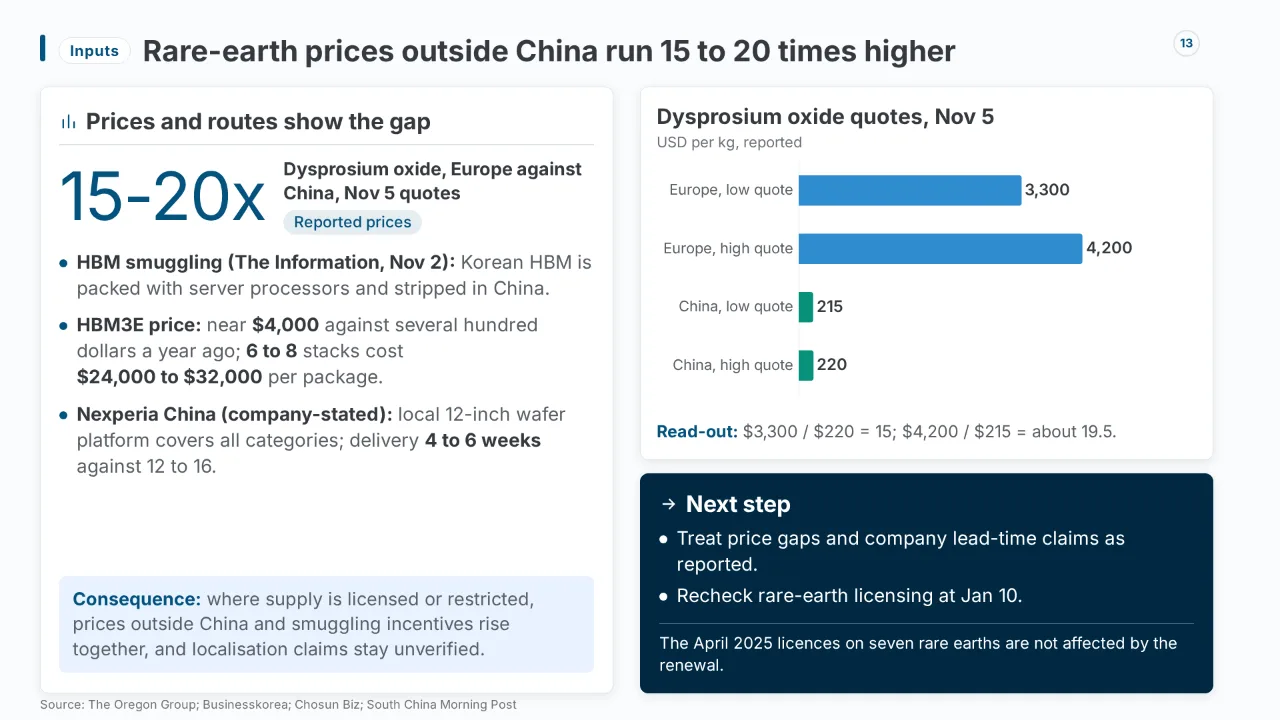
HBM smuggling. The Information reported on Nov 2 that smugglers export Samsung and SK hynix high-bandwidth memory packaged on a board with low-end server processors, because US rules judge a package's computing power by the processor rather than the memory; in China technicians heat the board to melt the solder and detach only the HBM. A broker told The Information a single HBM3E that cost several hundred dollars a year ago now trades near $4,000, and a chip package needs 6 to 8 stacks, so the memory alone costs $24,000 to $32,000 (arithmetic: $4,000 x 6 and x 8). Huawei reportedly told customers its next Ascend flagship will use Samsung and SK hynix HBM, per sources, and advised some customers to source memory themselves. These are single-source reports from an anonymous broker and unnamed supply-chain sources.
Blacklisted buyers and rented compute. Reuters reported on Nov 11 that Northwestern Polytechnical University, on the Entity List since 2001, bought two H200 chips for 874,700 yuan ($123,000) in an Oct 21 procurement record, from a reseller rather than Nvidia, and also bought rented H200 capacity through five contracts. Reuters says licences for such an institution are normally denied; Nvidia, the university and BIS did not respond. How the chips reached the reseller is not stated in the material. The reported US response, a remote-access licensing rule for seven more countries, is in Chapter 2.
7.3 Minerals, magnets and Nexperia's China unit
Rare earths: prices show the gap. The Oregon Group says spot dysprosium oxide in Europe was quoted at US$3,300 to US$4,200 per kilogram on Nov 5 against US$215 to US$220 in China, and that the April 2025 licences on seven medium and heavy rare earths are not affected by the renewal described in Chapter 4. Arithmetic on the quoted ranges: $3,300 / $220 = 15 and $4,200 / $215 = about 19.5, so the European price is about 15 to 20 times the Chinese one. Crux Investor puts yttrium at about $1.15 million per ton in Europe against $9,144 in China (a 125-fold gap), with the first new non-Chinese supply, Lynas's Malaysian plant, not due until 2028. Radial Magnets, citing the Financial Times, reports that Chinese rare-earth magnet exports to the US in August 2026 were 512 tonnes, down 20% from July and 13% from August 2025, and that a US procurement rule starting Jan 1, 2027 targets magnets with any Chinese supply-chain stage. These are trade-press and investor-site figures; none is a government statistic in the material.
Nexperia's split supply chain. Nexperia China's CEO John Chang said at the China International Semiconductor Expo in Beijing that its domestic 12-inch wafer platform now covers all product categories and cut delivery times for some components to four to six weeks from 12 to 16 weeks. The unit says it completed "localisation of the entire chain". That is a company claim, made more than a year after the Dutch parent halted direct shipments of European wafers; the Dutch court order and the parent's lawsuit are in Chapter 5, and the material has no independent check of the lead-time figures or of automaker supply.
What this means. The adjustments run in three directions: toward intermediaries and indirect routes (Hong Kong, resellers, packaged memory), toward domestic substitution where Western supply is cut (Nexperia China), and toward price premiums for suppliers outside China's licensing system (rare earths). None is a policy measure; each is a response to one. This is a description of reports, not legal or investment advice.
8. Upcoming dates
Chapter 7 showed supply chains adjusting around the controls; this chapter turns Chapters 2 to 7 into a calendar. All facts come from those chapters, and every status is judged against Nov 17, 2026, the run date. This is a description, not legal advice or investment advice.
8.1 What changed and what it means, by reader
| Reader | What changed | Implication | Evidence |
|---|---|---|---|
| Chipmakers and toolmakers | No Entity List addition; BIS stayed the Affiliates Rule to Jan 10, 2027; Applied Materials put China near 25% of Q4 revenue and expects a lower share in fiscal 2027; Nvidia's guide excludes China data-centre compute | Exposure turns on dated suspensions and customer mix, not on a new rule; the next company checkpoint is Nvidia's Nov 17 results | — |
| Chip buyers and cloud operators | The remote-access rule for seven more countries is reported, not issued; H200 licences exist but Beijing holds back large-scale imports | Southeast Asian hosting could need licences if the rule appears; a US licence does not equal delivery | — |
| Compliance and legal teams | Affiliates Rule stays suspended, not repealed; Treasury's proposal is open; MOFCOM's draft is open | Three texts, three statuses (suspended, proposed, draft) and three dates: Jan 10, Dec 7, Nov 24 | — |
| Policy watchers | Three bills sit in a proposed Senate NDAA amendment; leaders say consensus is growing; no final agreement on Nov 12 | Law-making is pending; no enacted text or effective date exists | — |
| Materials and automotive suppliers | China renewed its suspension to Jan 10; April 2025 rare-earth licences stay; the Dutch court curbed Wingtech; Nexperia China says it has localised | The pause moved a cliff by two months and did not lift licensing; Nexperia's split continues in court | — |
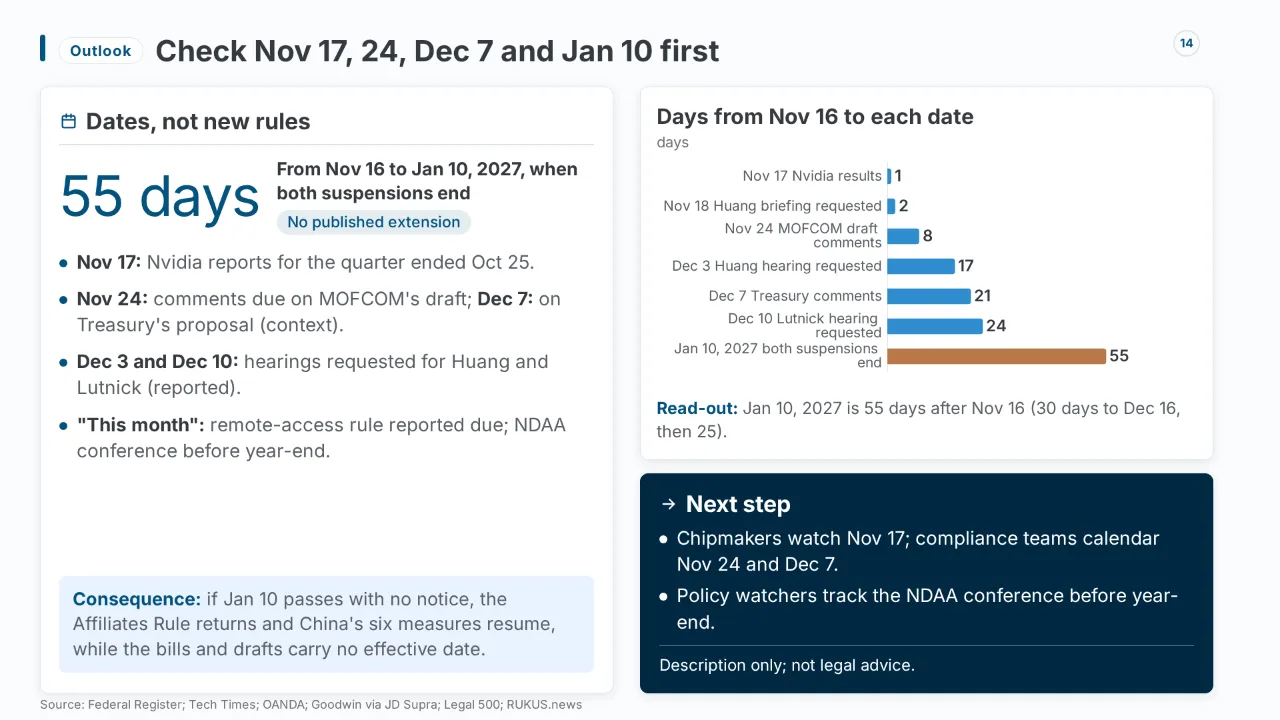
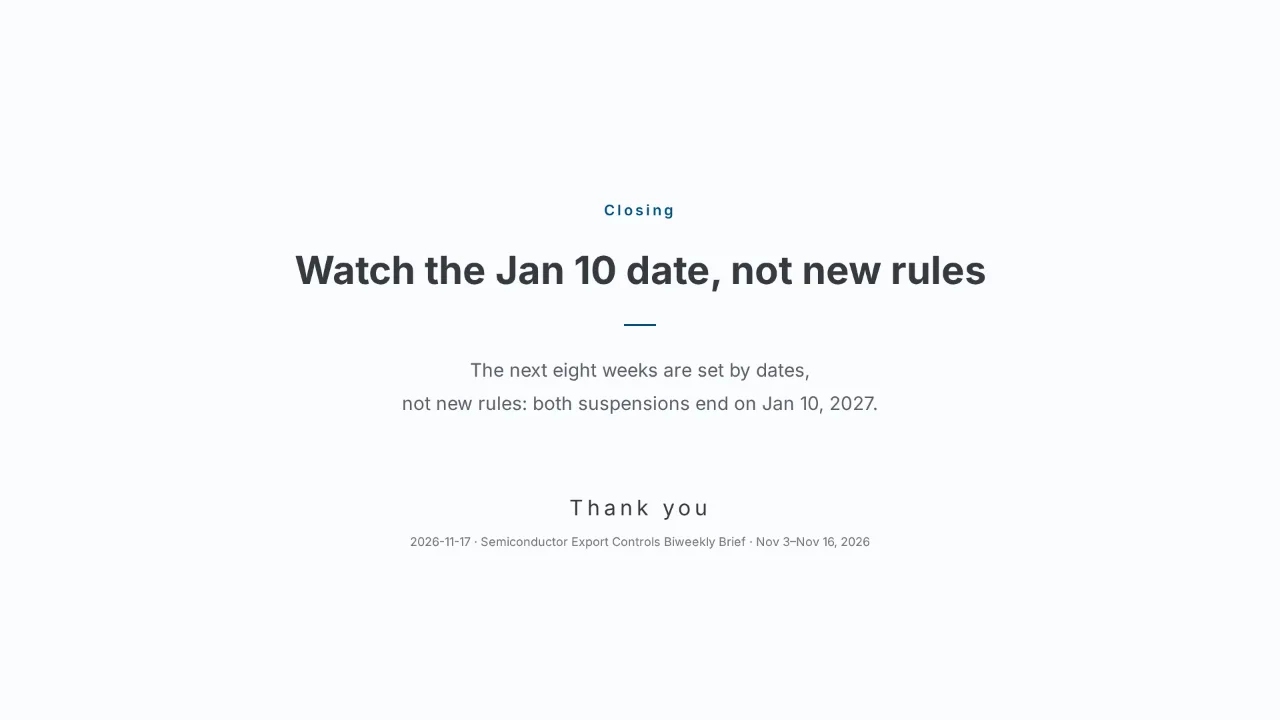
The next eight weeks are set by dates, not by new rules: the BIS stay and China's six suspended measures both end on Jan 10, 2027, and neither has a published further extension.
8.2 Measures at a glance
| Issuer | Instrument | Date | Status |
|---|---|---|---|
| BIS | Final rule (stay), FR Doc. 2026-22793 | Effective Nov 9, 2026; stay to Jan 10, 2027 | In effect; Affiliates Rule suspended, not repealed |
| MOFCOM and GAC | Announcement No. 58 of 2026 (number per The Oregon Group) | Suspension Nov 11, 2026 to Jan 10, 2027 | In effect as a suspension |
| Enterprise Chamber, Amsterdam | Order on Wingtech, its founder and Nexperia China | Nov 11, 2026 | In effect; Wingtech to appeal |
| BIS | Remote-access rule for seven countries | "As early as this month" (reported) | Reported, not issued |
| Treasury | COINS Act proposed rule | Comments due Dec 7, 2026 | Proposed; context |
| MOFCOM | Draft trade-secret provisions | Comments due Nov 24, 2026 | Draft; context |
| Congress | AI OVERWATCH, Chip Security, MATCH in the Senate NDAA package | Before year-end (stated aim) | Bills; not law |
8.3 Dated watch-list
| Date | Item | State |
|---|---|---|
| Nov 17 | Nvidia reports Q3 FY2027 results for the quarter ended Oct 25; guide $108B plus or minus 2%, excluding China data-centre compute | Upcoming at window end |
| Nov 18 | Requested closed-door briefing with Jensen Huang by House committee chairs; Wingtech's seven-day deadline to withdraw two China claims also falls about Nov 18 (arithmetic: Nov 11 + 7 days) | Upcoming (request; deadline) |
| Week of Nov 16 | Trump-Xi meeting in Shenzhen expected; date not fixed in the material | Upcoming |
| Nov 24 | Comments due on MOFCOM's draft trade-secret provisions | Upcoming |
| This month (reported) | BIS remote-access rule for Singapore, Malaysia, Thailand, Indonesia, Brazil, Norway and South Africa | Reported; upcoming |
| Dec 3 and Dec 10 | Requested Senate Banking testimony from Huang and Commerce Secretary Lutnick; Lutnick said he would testify voluntarily | Upcoming (reported request) |
| Dec 7 | Comments due on Treasury's COINS Act proposed rule | Upcoming |
| Before year-end | NDAA conference and the three export-control bills; Thune and Wicker said on Nov 12 there was no final agreement | Upcoming |
| Jan 1, 2027 | US procurement rule on magnets with any Chinese supply-chain stage | Upcoming (as reported) |
| Jan 10, 2027 | End of the BIS Affiliates Rule stay and of China's suspension of six measures | Upcoming |
8.4 Reading the dates
One boundary, two names. The BIS stay was filed on Nov 5 and effective on Nov 9, the day the earlier suspension would have ended; the Affiliates Rule would otherwise have returned on Nov 10. China's suspension replaced Announcement No. 70, whose own end date was Nov 10. The two renewals line up on Jan 10, 2027, the date of the truce extension announced by Treasury Secretary Bessent in September. We follow the primary Federal Register text for the US date and the press accounts for the Chinese one, because the Chinese ministry's text is not in the material.
Dates that depend on others. The NDAA timing depends on a Congress that, per MLQ.ai, returns in January with new leadership if the provisions are dropped in conference. The remote-access rule has no date beyond "this month" and no text. Hearing dates for Huang and Lutnick come from an aggregator and a request, not from a committee notice.
Counting days. Counted from Nov 16, the window's last day (arithmetic): Nov 17 is 1 day away, Nov 18 is 2, Nov 24 is 8, Dec 3 is 17, Dec 7 is 21, Dec 10 is 24, and Jan 10, 2027 is 55 days (Nov 16 to Dec 16 is 30 days, then 25 more).
What is not a date. A truce is not an instrument. Cyberverso assesses that Beijing will likely renew the suspensions again for a short term in January; that is an assessment, with a stated 60 to 90% likelihood, not a fact. Nothing in the material says what BIS or MOFCOM will do after Jan 10.
9. References
This document draws on the following 59 sources, listed in the order they are first cited.
- Federal Register :: Extension of the Suspension of Expansion of End-User Controls for Affiliates of Certain Listed Entities — federalregister.gov
- BIS formally suspends the Affiliates Rule until January 10, 2027 | Nixon Peabody LLP — nixonpeabody.com
- Commerce delays Entity List additions, Megaspeed stays off | AI Weekly — aiweekly.co
- US to widen AI chip export controls to seven nations, curb China remote access - CHOSUNBIZ — biz.chosun.com
- nvda-20261111 — sec.gov
- NVIDIA Announces CEO Transition | NVIDIA Newsroom — nvidianews.nvidia.com
- Speaker Johnson sees a 'developing consensus' in Congress on limiting chip exports to China: the bills and rules in play | MLQ.ai — mlq.ai
- OpenAI Reportedly Backs Tighter AI Chip Controls on China — winbuzzer.com
- US Commerce Dept Pauses Probe Into Firm Linked to Jensen Huang's Alleged Affair Amid Nvidia Intervention Claims — news.sbs.co.kr
- U.S. is probing Alice Huang's entities over Super Micro smuggling — qz.com
- Rare Earth export controls: China extends pause to January 10 ahead of Trump-Xi talks - The Oregon Group — theoregongroup.com
- China Extends Export Controls Pause on Batteries, Graphite, Diamond Saws, Rare Earths Into January — techtimes.com
- China’s Rare Earth Relief Lets Alternative Suppliers Sell at High Prices - Article | Crux Investor — cruxinvestor.com
- China warns against new U.S. export controls on chips in wake of Nvidia's Huang scandal — cbsnews.com
- China’s Ministry of Commerce Proposes Sanctions on Foreign Companies for Infringement of Chinese Trade Secrets | Goodwin - JDSupra — jdsupra.com
- Dutch court further curbs Wingtech's control of Nexperia as administrators sound out investors for a stake | MLQ.ai — mlq.ai
- Dutch court adds injunction with €300 million penalty cap; *ST Wingtech opens down over 5%, plans appeal — BigGo Finance — finance.biggo.com
- Taiwan pushes to tighten chip controls to China | Taiwan News | Nov. 3, 2026 14:57 — taiwannews.com.tw
- Applied Materials Announces Fourth Quarter and Fiscal Year 2026 Results | Applied Materials — ir.appliedmaterials.com
- Applied Materials Identifies Major Catalyst Heading into 2027 — finance.yahoo.com
- NVIDIA Q3 earnings preview: Record expectations, rising risk | OANDA EU — oanda.com
- Nvidia AI Chips Pile Up in Hong Kong Amid China Import Hold — globalbankingandfinance.com
- Smugglers Bypass U.S. Controls to Ship HBM to Huawei - Businesskorea — businesskorea.co.kr
- U.S. Treasury Department And China’s MOFCOM Propose Restrictions On Biotechnology Transactions | Legal 500 — legal500.com
- BIS Extends Suspension of the "Affiliates Rule" Through January 10, 2027 - Global Sanctions and Export Controls Blog — sanctionsnews.bakermckenzie.com
- BIS Extends “Affiliates Rule” Until January 2027 | SmarTrade — thompsonhinesmartrade.com
- BIS Extends Its Suspension of the “Affiliates Rule” Until January 2027 — Global Trade & Sanctions Law — November 10, 2026 — globaltradeandsanctionslaw.com
- US Department of Commerce Moves to Block China's AI Chip 'Southeast Asia Detour' — news.sbs.co.kr
- Bessent Takes Aim at Commerce Department for Stalling Megaspeed Sanctions, Calls Out Nvidia's Internal Controls — BigGo Finance — finance.biggo.com
- U.S. Cleared Nvidia Chips to Chinese Firms With Empty Offices and Troubling Ties - The New York Times — nytimes.com
- U.S. Congress Moves to Slash AI Chip Sales to China After Spy Scandal Forces Out Nvidia CEO — latintimes.com
- Congress Pushes Fast-Track Chip Ban on China | JFeed — jfeed.com
- Nvidia spy scandal could reshape fight over AI chips and China — thehill.com
- Nvidia's Washington Scrutiny Deepens as Commerce probe into Megaspeed halted after executive intervention | Roic News — roic.ai
- November 11, 2026 The Honorable Howard Lutnick ... — banking.senate.gov
- Justice Department has not concluded Alice Huang was a Chinese spy, Attorney General Blanche says | MLQ.ai — mlq.ai
- Howard Lutnick agrees to testify over Nvidia chip exports to China as pressure grows · RUKUS.news — welive.news
- White House weighs ousting Howard Lutnick as Commerce Secretary amid Nvidia controversy: Report | Hindustan Times — hindustantimes.com
- China / Desk — 9 Nov 2026 — cyberverso.net
- China Rare Earth Export Controls November 10 Deadline Explained — rareearthexchanges.com
- November 2026 Magnet Industry Update | Radial Magnets — radialmagnet.com
- China Fears New Export Curbs on Chips After Nvidia Scandal — asiafinancial.com
- China’s Ministry Of Commerce Proposes Sanctions On Foreign Companies For Infringement Of Chinese Trade Secrets | Legal 500 — legal500.com
- Nvidia H200 Chips Pile Up in Hong Kong as China Holds Back Import Approvals - Businesskorea — businesskorea.co.kr
- Nexperia sues Wingtech for $2 billion in damages — evertiq.com
- Taiwan expands chip export controls to block China rerouting — eastasiabrief.com
- Dutch Enterprise Chamber orders Wingtech not to interfere at Nexperia as officials sound out investors | Dealroom News — dealroom.co
- METI, Japan on X: "Q&A -China’s export controls on rare earths -Impact of the U.S. midterm election results on tariffs and investment in the United States -Background to the Vice-Minister for International Affairs’ visit to Russia and METI’s response to Japanese companies" / X — x.com
- JAPANESE ECONOMIC AND BUSINESS WEEKLY NEWSLETTER: 07 - 13 November ,2026 | EU-Japan Centre — eu-japan.eu
- ASML Has More Demand Than Machines. How It Allocates Them Is the Real Story | DataFLOQ — datafloq.com
- ASML posts record quarter as Washington keeps its China chip deadline alive - Startup Fortune — startupfortune.com
- Applied Materials Sees Another Record Year in 2027 - Applied Materials (NASDAQ:AMAT) — benzinga.com
- Jeffries: Congress Needs More Information on Nvidia Situation | Roic News — roic.ai
- What Applied Materials (AMAT) Said on Its Q4 Earnings Call — finance.yahoo.com
- What Do ASML's Q2 2026 Results Tell Us About the AI Boom? - MRKT3.0 — mrkt30.com
- Singapore Says Washington Stonewalled Megaspeed Probe as Supermicro Shares Plunge on DOJ Scrutiny — BigGo Finance — finance.biggo.com
- Smugglers funnel Korea’s HBM to China for Huawei via server chip loophole - CHOSUNBIZ — biz.chosun.com
- EXCLUSIVE: Chinese university bought Nvidia H200 chips despite US blacklist | Reuters — reuters.com
- Nexperia’s China unit claims supply chain ‘localisation’ as rift with Dutch parent deepens | South China Morning Post — scmp.com