Big Tech AI Strategy: Biweekly Brief, November 3 to 16, 2026
Contents
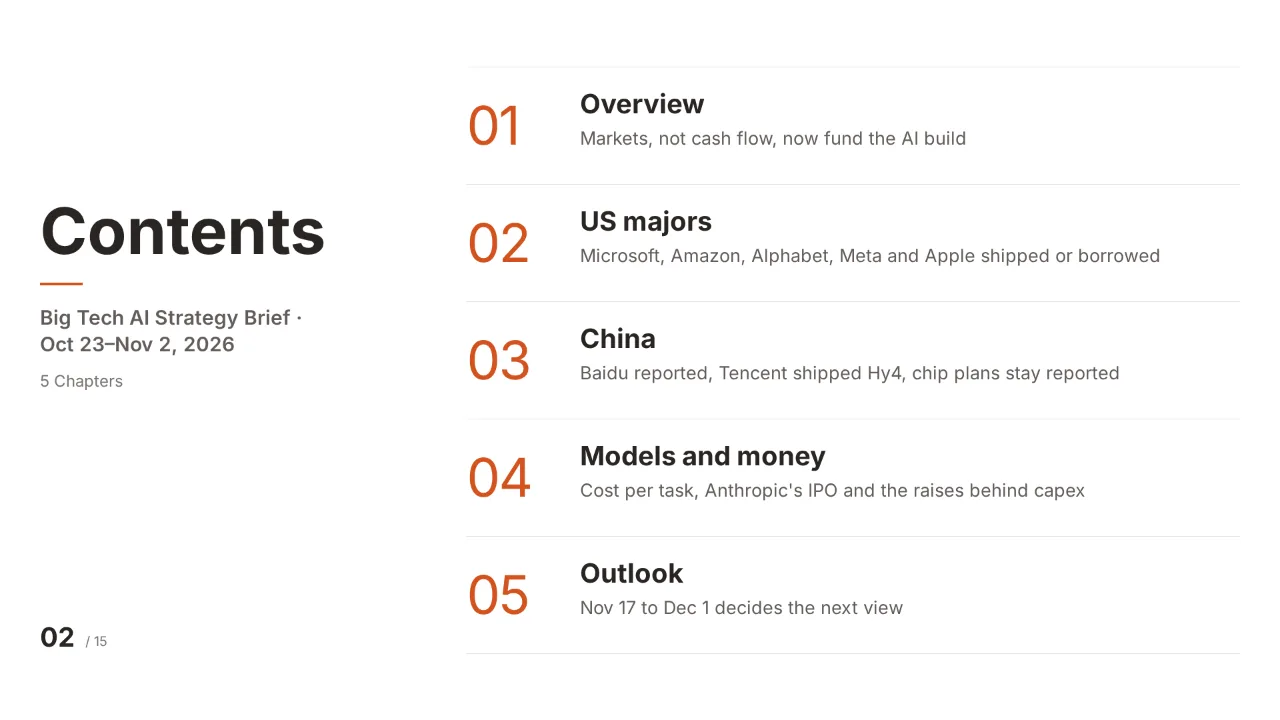
- Key takeaways from the two weeks
- Microsoft and Amazon: Copilot metering, Trainium access and the Anthropic exposure
- Alphabet and Google: Gemini 4 Carbon, Hydrogen and glasses
- Meta and Apple: borrowing to build, a cheaper Muse model and Siri's people risk
- China's majors: Baidu reports, Tencent ships Hy4, Alibaba and DeepSeek wait on dates and chips
- Products and model comparison: who leads, at what price and through whom
- Investments, partnerships and people: Anthropic's IPO, Nvidia's CEO exit and a reported national-champions list
- Capex, financing and the capital markets: debt, equity and off-balance-sheet commitments
- Competitive outlook and what to watch next
1. Key takeaways from the two weeks
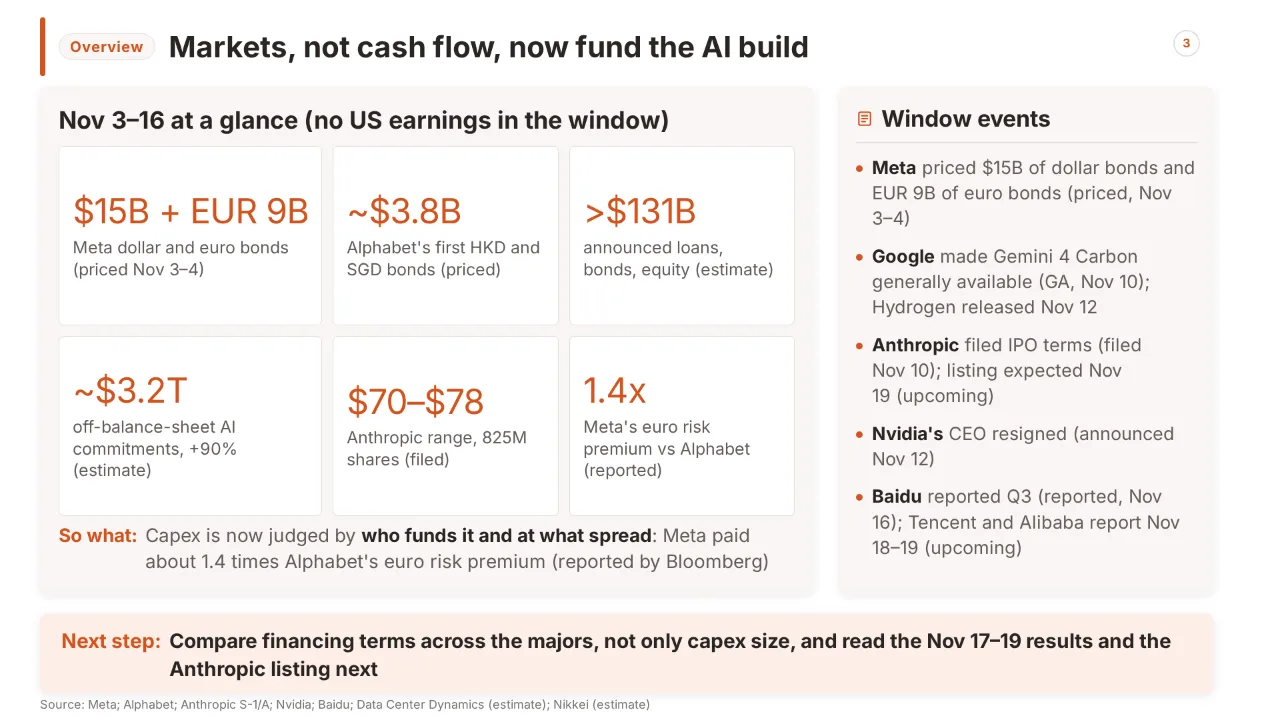
This window (November 3 to 16, 2026) had no earnings from the US majors; the earnings-week figures are in the previous issue and appear here only as context. What happened instead was shipping, borrowing and one very large listing. Five conclusions explain it.

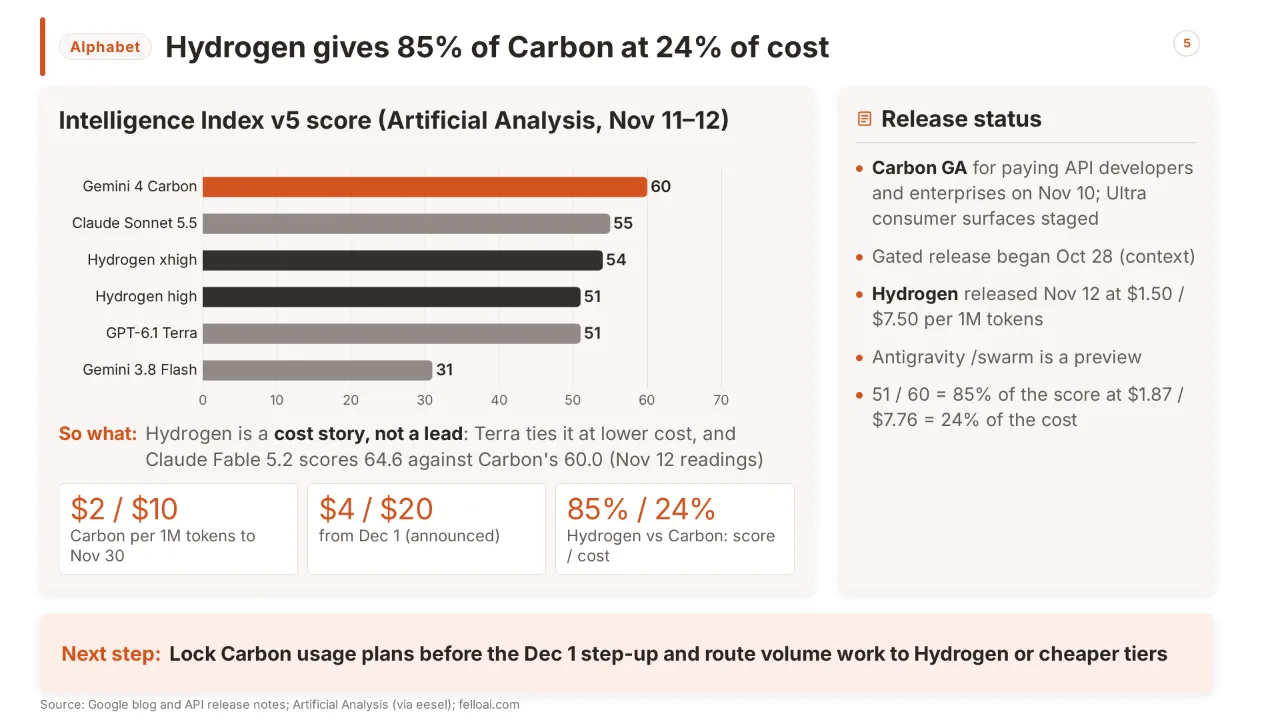
1. Google opened its frontier model to paying customers, but the independent scale still puts an Anthropic model on top. Gemini 4 Carbon became generally available in the paid Gemini API on November 10 at $2 / $10 per million tokens, doubling to $4 / $20 on December 1, and Gemini 4 Hydrogen followed on November 12 at $1.50 / $7.50. On Artificial Analysis Intelligence Index v5 (readings of November 12) Carbon scores 60.0 against 64.6 for Anthropic's Claude Fable 5.2 and 59.1 for Claude Opus 5.5, so no Big Tech in-house model leads. The gap between Hydrogen and the cheapest efficient models is large: Hydrogen's per-token prices are 15 times those of Muse Ember.
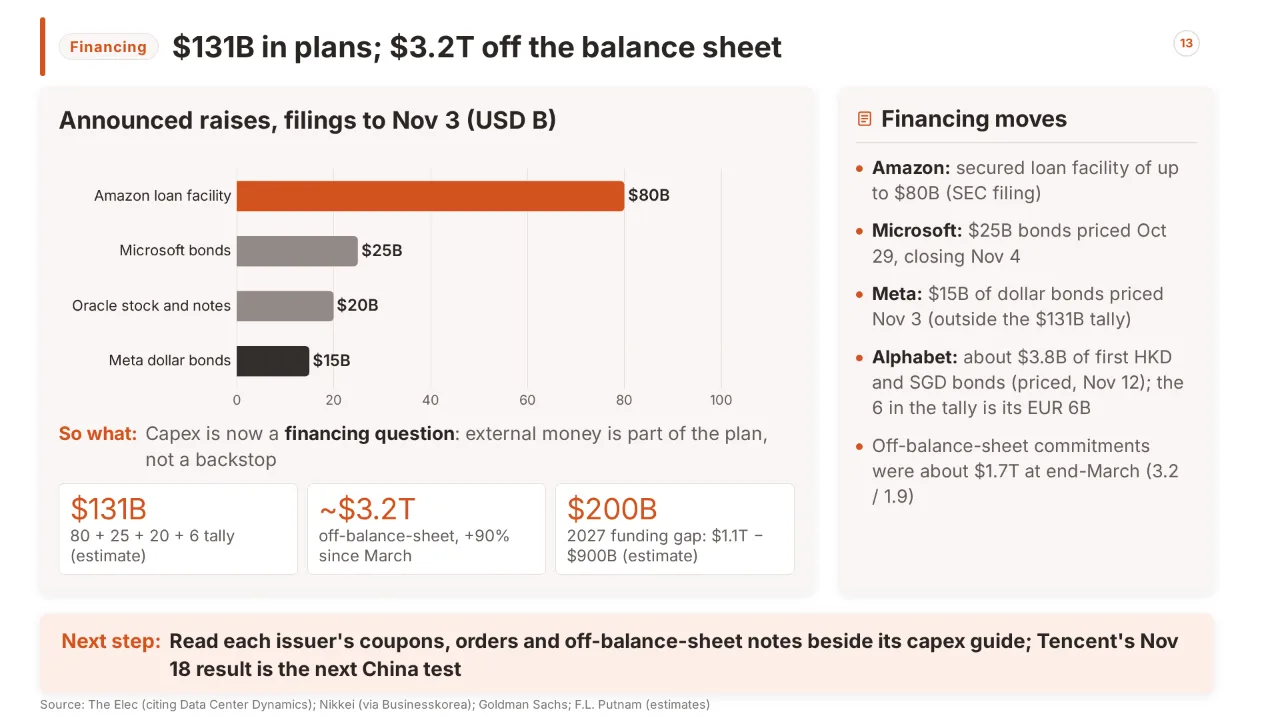
2. The AI build moved from cash flow to the bond and equity markets. Meta priced $15 billion of dollar bonds on November 3 (annual coupon interest $990.1 million) and its first euro bonds, EUR 9 billion, on November 4 at about 1.4 times Alphabet's risk premium. Alphabet raised about $3.8 billion in its first Hong Kong and Singapore dollar bonds. A third-party tally puts announced loans, bonds and equity at more than $131 billion, and off-balance-sheet AI commitments at about $3.2 trillion (estimates).
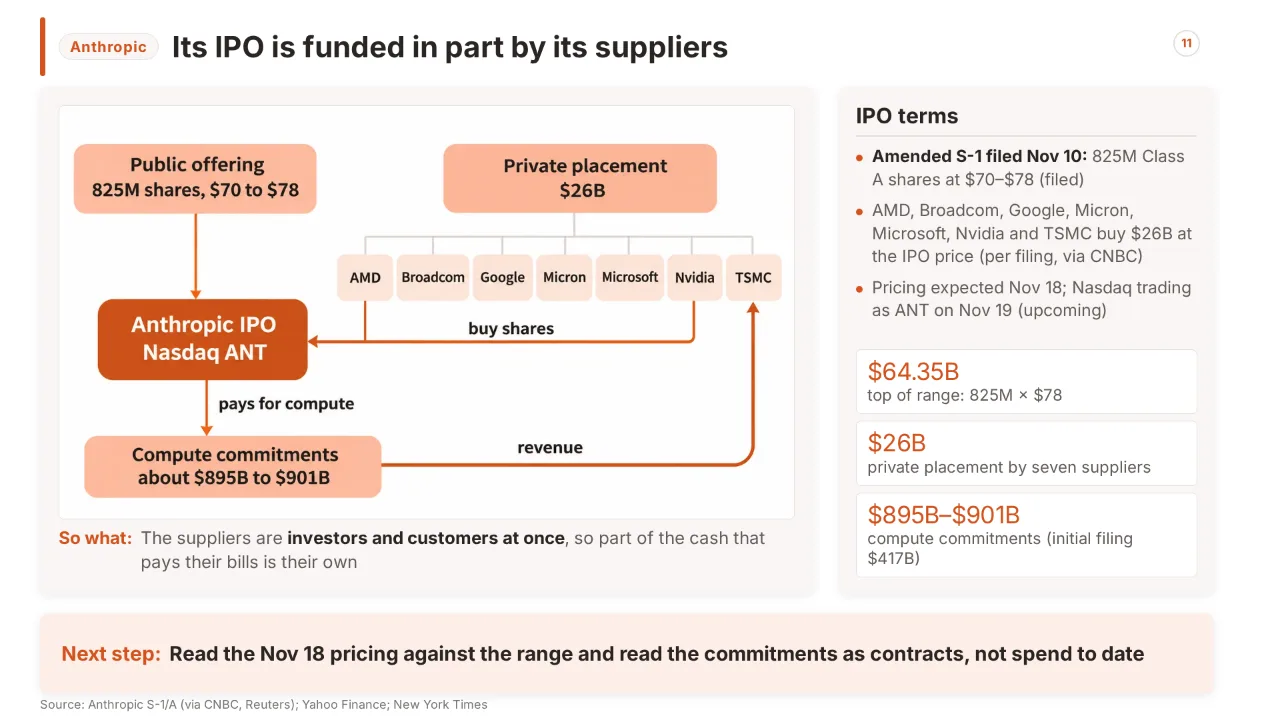
3. Anthropic's IPO turns suppliers into shareholders. The amended S-1 sets 825 million shares at $70 to $78, up to $64.35 billion, and a $26 billion private placement by AMD, Broadcom, Google, Micron, Microsoft, Nvidia and TSMC; trading is expected on November 19 (upcoming). Amazon and Google together own more than a quarter of Anthropic, per the New York Times, and Anthropic's compute commitments are about $895 billion to $901 billion.
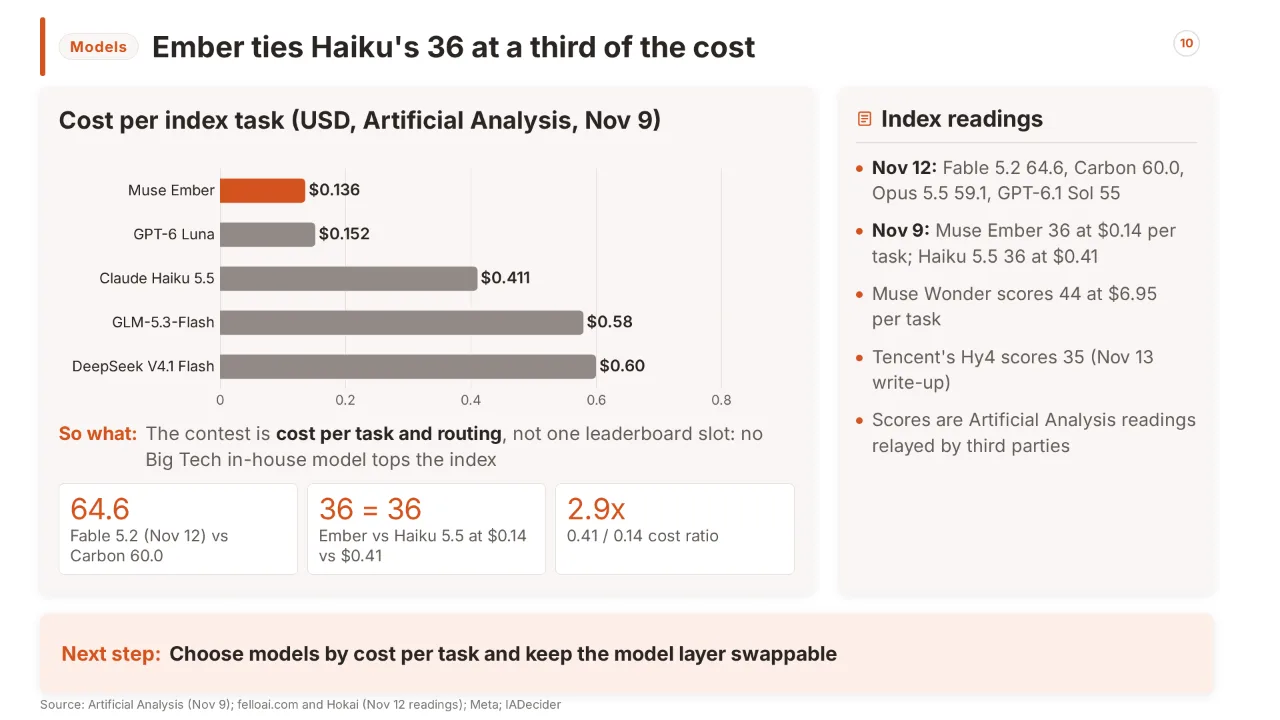
4. Monetisation is becoming metered. Microsoft extended unpublished fair-use limits on Copilot Chat to unlicensed users (November 2 and 9) with a $30-per-seat upgrade path; Amazon's Bedrock page lists a +75% Priority tier and a -50% Flex tier (secondary source); Meta's Ember scores 36 on the independent index at $0.14 per task against $0.41 for Haiku 5.5.
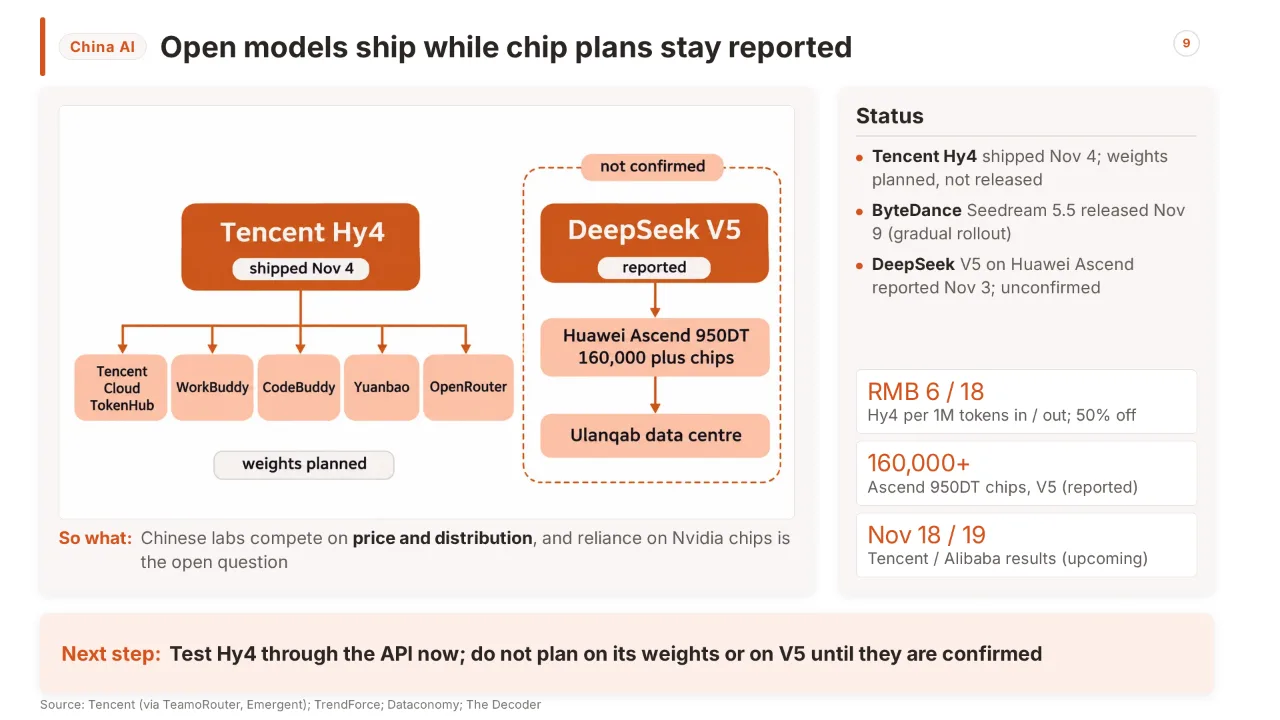
5. The Chinese majors reported or shipped, and the chip story is still press-reported. Baidu's November 16 results show AI Cloud Infra revenue up 94% to RMB 8.2 billion while AI-native marketing fell 15%; Tencent's full Hy4 shipped on November 4 with weights still planned; DeepSeek's V5 on 160,000-plus Huawei Ascend chips is reported, not confirmed. Tencent (November 18) and Alibaba (November 19) report after the window.
The window's pattern: models got cheaper and more widely available, while the money to run them came increasingly from markets, not cash flow.
What changed at a glance
| Company | Change | Date | Status |
|---|---|---|---|
| Alphabet | Gemini 4 Carbon open to paying developers and enterprises | Nov 10 | GA (API); staged for Ultra consumer surfaces |
| Alphabet | Gemini 4 Hydrogen; HKD/SGD bonds about $3.8B | Nov 12 | Released; priced |
| Meta | $15B dollar bonds; EUR 9B first euro bonds | Nov 3; Nov 4 | Priced |
| Meta | Muse Ember (36 on AA index at $0.14 per task) | Nov 9 | Available on Meta Model API |
| Microsoft | Copilot Chat fair-use limits for unlicensed users | Nov 2 / Nov 9 | In effect (rolled out) |
| Amazon | TorchNeuron for Trainium; Bedrock tiered pricing | Nov 9; page of Nov 3 | Announced; tiers per secondary source |
| Apple | Apple Intelligence China developer beta with Qwen; Siri chief reports | Nov 4; Nov 8 | Beta; reported by press |
| Baidu | Q3 results; ERNIE 5.5 Flash Preview | Nov 16 | Reported; preview |
| Tencent | Hy4 full version | Nov 4 | Shipped; weights planned |
| ByteDance | Seedream 5.5 | Nov 9 | Shipping, gradual rollout |
| DeepSeek / Huawei | V5 on Ascend 950DT report | Nov 3 | Reported, unconfirmed |
| Anthropic | IPO terms filed; $26B placement | Nov 10 | Filed; listing upcoming (Nov 19) |
| Nvidia | CEO Jensen Huang resigns; Colette Kress interim | Nov 12 | Announced |
| US government | AI "national champions" list | Nov 15 | Reported by press |
2. Microsoft and Amazon: Copilot metering, Trainium access and the Anthropic exposure
This window had no earnings from the two largest cloud platforms, so the news is about how each one meters and sells AI capacity: Microsoft by tightening what unlicensed Copilot users get, Amazon by making Trainium easier to adopt and pricing Bedrock by priority.
2.1 Microsoft: Copilot limits and billing, with Ignite still ahead
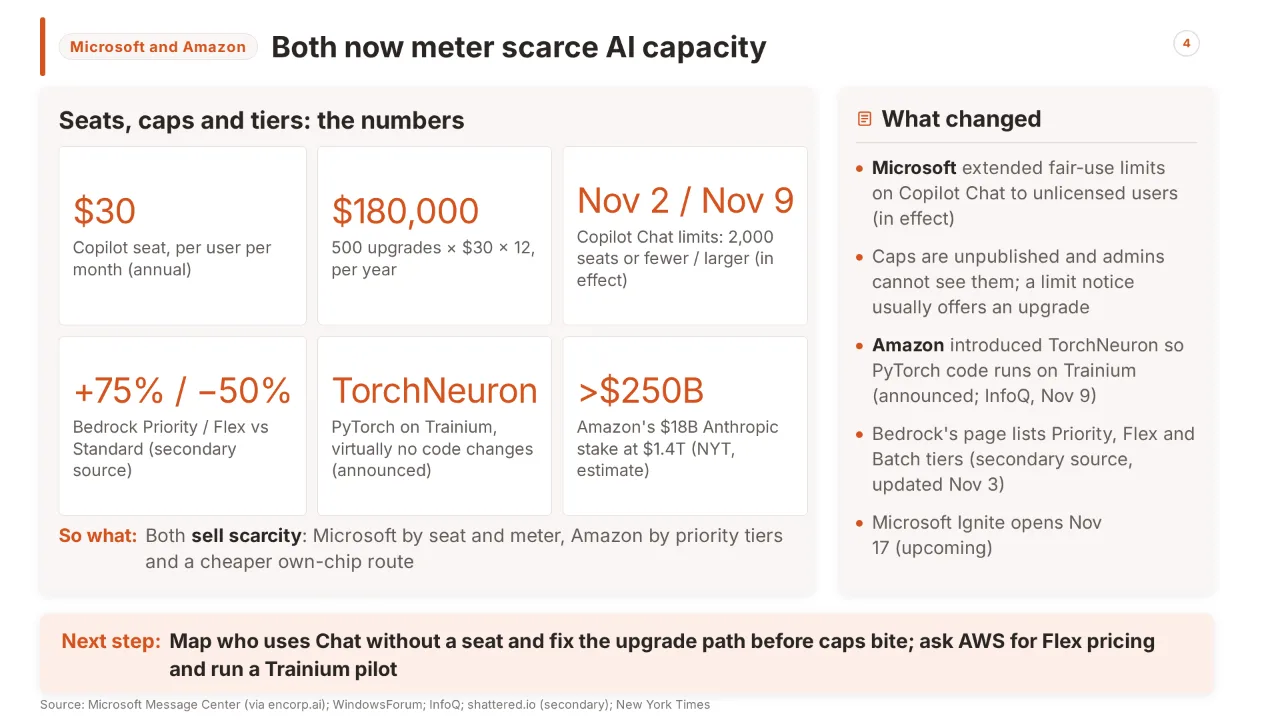
Microsoft's concrete window event is a change to who pays for Copilot Chat. Message Center items MC1536163 and MC1536158, both published on November 3, extend fair-use limits (already used for image generation) to more Copilot Chat features for commercial users who do not hold a Microsoft 365 Copilot licence. Per Microsoft's Partner Center announcement as relayed by The Register on November 5, the rollout began on November 2 for tenants with 2,000 or fewer seats and on November 9 for larger tenants. Microsoft does not publish the numeric caps, admins cannot see or change them, and the limit notice usually carries an upgrade prompt. Status: rolling out (in effect for all tenants since November 9).
The upgrade path is priced. A Microsoft 365 Copilot seat costs $30 per user per month on annual billing or $31.50 billed monthly with an annual commitment, according to WindowsForum's reading of Microsoft's pricing. Approving 500 upgrade requests at $30 is 500 x $30 x 12 = $180,000 a year, the same source's arithmetic. Agent features such as Copilot Cowork are usage-based and billed separately. In the partner channel, Microsoft moved the date on which usage-based billing becomes the default for new CSP Copilot Business subscriptions from November 2 to December 1, 2026, and the Partner Center sandbox date slipped without a new one being set, according to CRN as relayed by WindowsForum. Microsoft's own explanation was that it had heard partner feedback.
The window's Microsoft story is monetisation, not models: fair-use caps that cannot be seen by admins, a $30-per-seat upgrade, and agents billed by usage.
Two items are context, not window events. The redesigned Copilot app (Home, Code and Autopilot tabs, announced September 25) splits billing between per-user chat licences and pay-as-you-go agents, with Autopilot still in private preview, according to a training-firm explainer. The voluntary exit offer of October 26 covered about 60,000 eligible employees (roughly 27% of the reported workforce) in the US, Canada, UK and India; Microsoft expected 3,000 or fewer to accept, and employees reportedly have until early December, per secondary reports. The $25 billion bond that followed on October 29, Microsoft's first US investment-grade sale since 2017, is covered in Chapter 8.
Microsoft Ignite runs November 17 to 20 in San Francisco with Satya Nadella's opening keynote, so any announcement there is upcoming and outside this issue.
2.2 Amazon: TorchNeuron, tiered Bedrock prices and an Anthropic stake about to be marked
Amazon's window news is about lowering the switching cost to its own silicon. AWS introduced TorchNeuron, a native PyTorch backend for Trainium, at PyTorch Conference North America 2026; InfoQ reported it on November 9. It lets existing PyTorch code run on Trainium with virtually no changes (the device string changes from cuda to neuron), and early adopters named include Cartesia and the Lieber Institute for Brain Development. The stated rationale is that 85% of AI developers write PyTorch, so porting effort has been the main brake on non-Nvidia chips (InfoQ via a secondary summary).
On pricing, the Bedrock page, updated on November 3, lists a Priority tier at a 75% premium to Standard, a Flex tier at a 50% discount and Batch at half price for selected models, according to shattered.io. The same source quotes Andy Jassy saying on October 23 (before the window) that 2027 AWS capacity is "largely sold out". Treat the tier figures as secondary until confirmed on the AWS pricing page. On hardware, shattered.io describes Trainium3 as a 3 nm part already powering Trn3 UltraServers on EC2, while Microsoft's Maia 300 (announced October 12) has production deployments only from 2027.
Amazon's largest AI exposure is a shareholder one. Anthropic's amended S-1 (filed November 10) sets a price range of $70 to $78 and the NYT reports that Amazon and Google together own more than a quarter of the company. At the $74 midpoint, TradingKey estimates Amazon's stake at about $142.1 billion and Alphabet's at about $132.4 billion. The NYT instead says Amazon's $18 billion investment could exceed $250 billion if Anthropic reaches a $1.4 trillion valuation. The two figures rest on different valuation assumptions and both are estimates. Anthropic is also committed to spend at least $110 billion with Amazon over a decade, per CNBC. Anthropic's Nasdaq debut is expected on Thursday, November 19 (upcoming). Details of the IPO are in Chapter 7.
2.3 Two ways to sell the same scarcity
The contrast is useful. Microsoft sells access through seats and meters (a licence per user, usage-based agents, caps for the unlicensed), so its lever is price discrimination on a captive base. Amazon sells capacity and chips (tiers of priority, a cheaper alternative to Nvidia hardware), so its lever is utilisation of scarce compute. Both are exposed to the same two outside facts: the Copilot upgrade path depends on OpenAI and Anthropic models that Microsoft routes to, and Amazon's chip story depends on Anthropic continuing as a very large Trainium customer.
3. Alphabet and Google: Gemini 4 Carbon, Hydrogen and glasses
After Chapter 2's look at how Microsoft and Amazon meter and price capacity, Alphabet's window is about shipping models at both ends of the price ladder in three days: a gated frontier model opened to paying customers, then a cheap everyday model.
3.1 Gemini 4 Carbon: from gated preview to paid general availability
Carbon was announced on October 28 (context, previous issue) and went first to cyber defenders through Google's Fairwind Program. On November 10, 2026 Google made it available "to developers, enterprises, scientists, and consumers". The API in Google AI Studio and Gemini for business is open to all paying developers and enterprises, and Android Studio is included. Google AI Ultra subscribers are getting it in Antigravity, the Gemini app and AI Mode in Search, described as "rolling out". The API release notes label gemini-4-carbon generally available (GA) on November 10. Status: GA for the paid API; staged rollout on Ultra consumer surfaces.
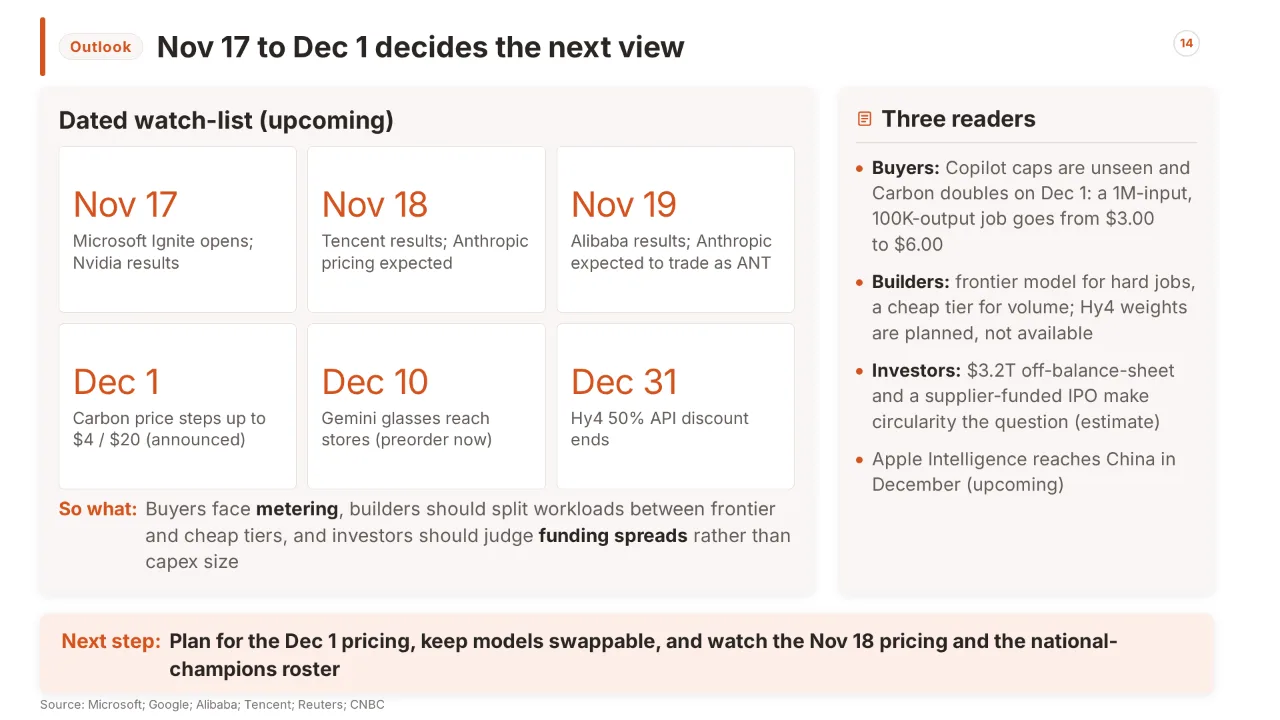
Price: $2 per 1M input and $10 per 1M output tokens through November 30, the same introductory price as Gemini 4 Argon, then $4 and $20 from December 1, with 95% off cached input. The model has a unified 1M-token window and low, medium (default) and high thinking levels. For a job of 1M input and 100K output tokens: now 1 x $2 + 0.1 x $10 = $3.00; from December 1, 1 x $4 + 0.1 x $20 = $6.00. The price exactly doubles, with about two weeks of intro pricing left on November 17.
Sources disagree on availability. A Shattered.io piece updated November 10 says worldwide access is "not confirmed" and calls Carbon "invitation-stage", but it describes only the October 28 announcement. Google's own November 10 posts and API release notes state GA for paying developers. This chapter follows Google. User posts on Google's developer forum (November 13-14) report Gemini 4 models "Unavailable" in Antigravity for some student, promotional and annual Pro accounts, which looks like an entitlement problem, not regional gating.
Benchmarks, kept apart. Vendor-reported (Google, November 10): Carbon ranks #1 on CursorBench 4.0, Perplexity's WANDR and Zapier's AutomationBench at "more than 2X lower cost per task" than the next best external model, and #2 on the Multimodal Knowledge Agent benchmark Google launched with Artificial Analysis, at more than 6X lower average cost per task than the top model. Independent (Artificial Analysis): see the table in 3.2. The /swarm multi-agent mode in Antigravity is a preview.
Google's window is a pricing story at both ends: Carbon at $2/$10 doubling on December 1, and Hydrogen at $1.50/$7.50 priced to run all day.
3.2 Gemini 4 Hydrogen and the consumer launches
Hydrogen (gemini-4-hydrogen), November 12. According to Shattered.io summarising Google's announcement, it has a 1M-token window, four thinking levels, $1.50 input and $7.50 output per 1M tokens, and Google claims 2.5x the speed of Gemini 3.8 Flash. NeuralTrust, citing VentureBeat, reports a rollout to the Gemini API, AI Studio, Gemini for business, the Gemini app, Search and Gemini in Sheets, with Google Cloud listing it as GA; Gemini 3.8 Flash costs $0.75/$3.75 through December 31 and $1.50/$7.50 after. Google's own table, vendor-reported, shows Hydrogen ahead of Claude Sonnet 5.5 and GPT-6.1 Terra on seven of ten rows but behind Sonnet 5.5 on Terminal-Bench 4.1 (57.0% vs 63.9%), OSWorld-2.1 and Terminal-Bench-Science.
Independent numbers, one source: Artificial Analysis Intelligence Index v5, Carbon run published November 11, other models checked November 12, as relayed by eesel.
| Model (effort) | Index score | Cost per task |
|---|---|---|
| Gemini 4 Carbon (high) | 60 | $7.76 |
| Claude Sonnet 5.5 | 55 | $10.02 |
| Gemini 4 Hydrogen (xhigh) | 54 | $3.16 |
| Gemini 4 Hydrogen (high, default) | 51 | $1.87 |
| GPT-6.1 Terra | 51 | $0.96 |
| Gemini 3.8 Flash (high) | 31 | $7.77 |
Hydrogen at default reaches 51/60 = 85% of Carbon's score at $1.87 / $7.76 = 24% of its cost per task; xhigh adds 3 points for $3.16 / $1.87 - 1 = 69% more. Hydrogen is a cost-efficiency story, not a leaderboard lead: Terra matches its score at $0.96. Chapter 6 compares all flagships.
Consumer launches (all dated in the window).
- Pixel Drop, from November 10: Gemini Intelligence, previously Pixel 11-only, comes to the Pixel 10 family; multi-step tasks run in the US, UK and India; Gemini phone calls are in public beta; rollout is phased over weeks.
- Gemini Live on Apple CarPlay, November 11: per Google's post, "rolling out globally starting today to all Gemini users on iOS" across supported Gemini Live languages.
- Gemini glasses, preorders from November 12, in stores December 10 (US, South Korea): Samsung-built, no display, 41 g, 12MP camera, up to nine hours of battery; Warby Parker from $395, Gentle Monster $449-489. Technology.org notes $395 undercuts Ray-Ban Meta Gen 3 ($449) by $54. Status: preorder.
3.3 TPU and capacity signals: confirmed, estimated and unsupported
On Monday November 9, Google unveiled the TPU 8tx (confidential computing) and TPU 8i Max (two 8i chips per package, doubling compute and memory bandwidth). They join the TPU 8t and 8i from April, and become available next year (2027). Google says nearly 100 customers use TPUs and Anthropic has committed to multiple gigawatts. Anthropic's Google-Broadcom arrangement gives it roughly 3.5 GW of TPU capacity from 2027. Anthropic's compute commitments are covered in Chapter 7.
Bloomberg Intelligence estimates TPU sales could rise from about $12 billion in 2026 to more than $135 billion in 2028, excluding cloud rentals. This is an estimate, not company revenue. $135B / $12B = 11.25x, or sqrt(11.25) - 1 = about 235% growth a year.
Meta. No dated report of TPU talks with Meta was found. The only related item is a Yahoo Finance line that Meta is "among companies using Google's AI computing technology". None is claimed here.
Market reaction (reported only). Alphabet shares rose more than 2% in premarket trading on November 9 and closed slightly higher, still about 30% below its $408.61 52-week high. As context, it fell 12.6% on October 29 after Q3 results. That is not investment advice.
4. Meta and Apple: borrowing to build, a cheaper Muse model and Siri's people risk
Meta spent the window paying for and packaging its AI push; Apple spent it on distribution (China) and on reports about who will run Siri. Both stories are about how a company without the largest cloud business competes.
4.1 Meta's bond sales: two currencies, one funding gap
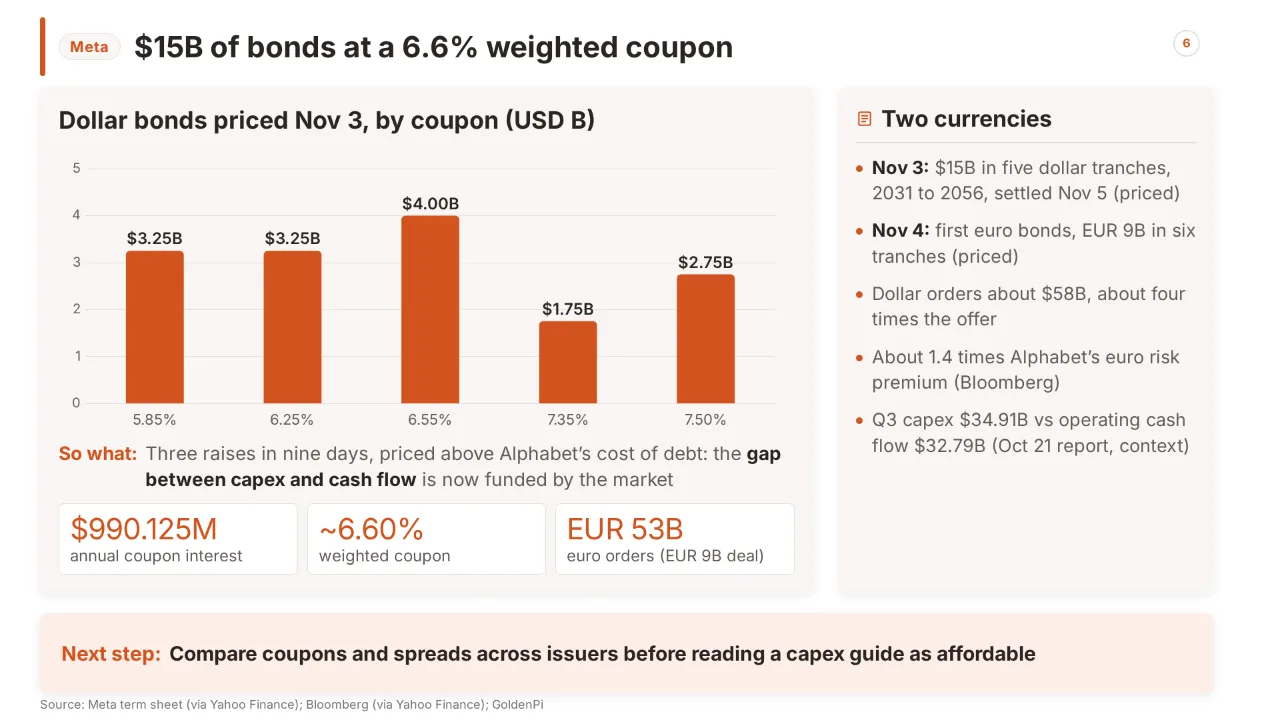
After the October 26 equity plan (context, Chapter 8), Meta went to the bond market. On November 3 it priced $15 billion of US-dollar bonds in five tranches running from 2031 to 2056, with settlement on November 5, according to its term sheet as read by Yahoo Finance. On November 4 it priced its first-ever euro sale, EUR 9 billion in six tranches, with record orders of EUR 53 billion, per Bloomberg via Yahoo Finance. Bloomberg had reported before pricing that Meta aimed to sell $20 billion to $25 billion, split roughly two-to-one between dollars and euros; the priced deals are what we follow.
| Tranche (USD, priced Nov 3) | Size | Coupon |
|---|---|---|
| 1 | $3.25B | 5.85% |
| 2 | $3.25B | 6.25% |
| 3 | $4.00B | 6.55% |
| 4 | $1.75B | 7.35% |
| 5 | $2.75B | 7.50% |
| Total | $15.00B | weighted about 6.60% |
Source: Meta term sheet via Yahoo Finance. The tranche sizes sum to $15.00 billion (3.25 + 3.25 + 4.00 + 1.75 + 2.75) and annual coupon interest is $990.125 million (the sum of each size times its coupon, which gives a weighted coupon of about 6.60%). Orders for the dollar deal were about $58 billion, roughly four times the amount offered, according to a LinkedIn summary. In euros, Meta paid about 1.4 times the risk premium that Alphabet paid on euro bonds priced November 2, in Bloomberg's spread ratio; Meta's reoffer yields were 1.07 to 1.14 times Alphabet's, or 0.27 to 0.77 percentage points higher. The drivers are Alphabet's higher ratings and Meta's capex running ahead of cash flow: Q3 capex of $34.91 billion against operating cash flow of $32.79 billion (Oct 21 report, context).
Meta sold shares on October 26, dollar bonds on November 3 and euro bonds on November 4: three raises in nine days, priced above Alphabet's cost of debt.
4.2 Muse: specialised models, then Muse Ember
Two Meta product moves fall in the window. On November 6 Meta said it was rolling out specialised versions of the models behind Muse and Meta AI, trained with Muse Wonder (the October 12 release, context), bringing Active Memory and Active Focus to all users; Muse Wonder itself is not part of the rollout. The figures are Meta's own: the Active Memory evaluation rose from 76% to 90%, completion of everyday tasks with unexpected problems improved 67%, and the Personal Superintelligence Index (an internal composite of eight evaluations) went from 38% to 47%; none has independent evaluation.
On November 9 Meta introduced Muse Ember, its smallest and most efficient model, aimed at repetitive agent work such as tool calls, coding subtasks, routing and extraction, available on the Meta Model API at $0.10 per million input tokens and $0.50 per million output tokens. Artificial Analysis Intelligence Index v5 data, as published on November 9 (the benchmark date for this table; cost per task at list pricing, with Ember's cost an estimate at proposed pricing), shows the position Meta claims:
| Model, max reasoning setting | Intelligence Index score | Cost per task |
|---|---|---|
| Muse Ember | 35.8 | $0.136 |
| Claude Haiku 5.5 | 36.2 | $0.411 |
| GPT-6 Luna | 27.8 | $0.152 |
Source: Artificial Analysis, November 9, 2026, as reproduced in Meta's Muse Ember post. Meta's reading is that Ember matches Haiku's best score at about a third of the cost: $0.136 / $0.411 is about 0.33, consistent with its claim, and it beats every GPT-6 Luna setting. Meta's own results table, which is vendor-reported, lists Ember's best result on AutomationBench-AA at 37.8% against 13.9% for Haiku and 20.2% for Luna. The Intelligence Index figures are independent; the benchmark selection and the framing are Meta's.
4.3 Apple: China distribution, Gemini inside Siri and a leadership question
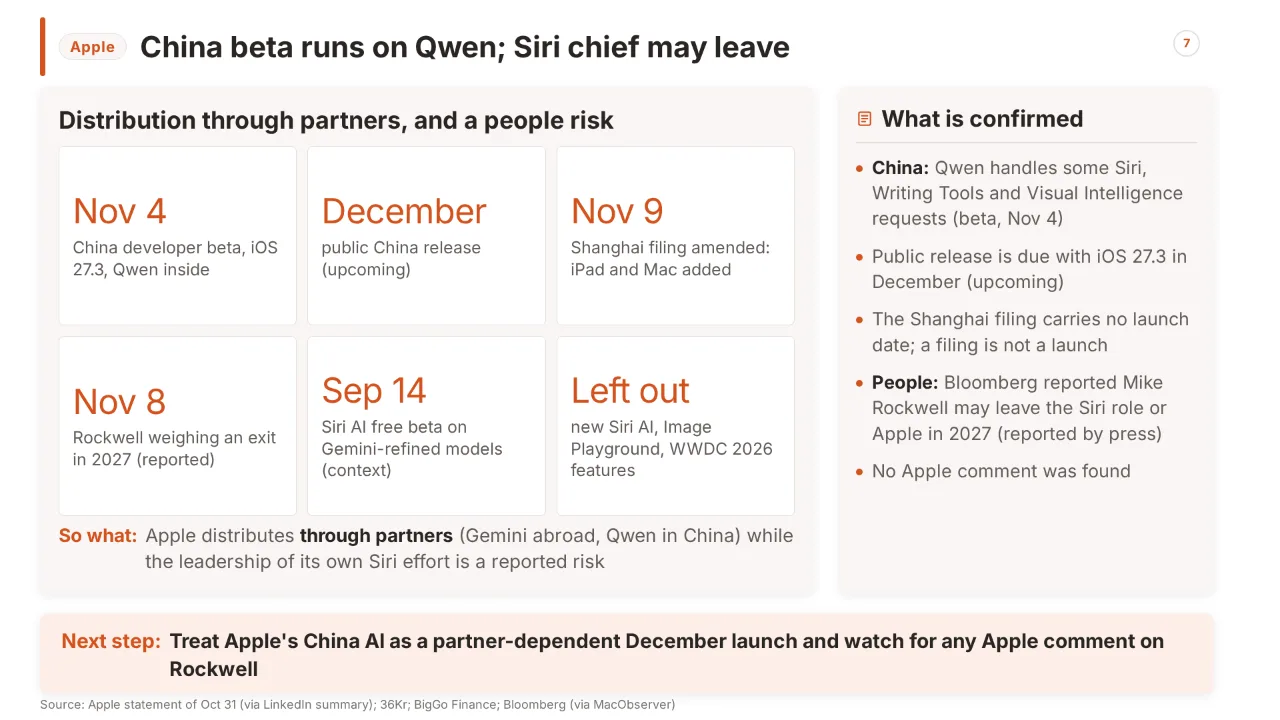
Apple's AI news this window is mostly about reach. Apple confirmed on October 31 that its first Apple Intelligence features for mainland China would open to developer testing on November 4 (iOS 27.3 developer beta), with a public release alongside iOS 27.3 in December (upcoming), and that Siri, Writing Tools and Visual Intelligence will hand some requests to Alibaba's Qwen. The China build does not include the new Siri AI, Image Playground or the WWDC 2026 features, and is iPhone-only for now, per a social-media summary. On November 9, Shanghai's Cyberspace Administration published that Apple's generative-AI filing had been amended to add iPad and Mac use cases, without a launch date; a filing is not a launch. Outside China, Siri AI shipped as a free beta with iOS 27 on September 14 (context) on Apple Foundation Models refined with Google Gemini.
The people story is reported, not announced. Bloomberg's Mark Gurman wrote on November 8 that Mike Rockwell, who leads Siri AI, is seriously considering stepping down from the role or leaving Apple in 2027; if he left, his duties would reportedly be shared by Amar Subramanya and Sebastien Marineau. Gurman also reported that CEO John Ternus has pressed software chief Craig Federighi to accelerate the AI roadmap beyond Siri. No Apple comment was found; treat both as reported by press.
5. China's majors: Baidu reports, Tencent ships Hy4, Alibaba and DeepSeek wait on dates and chips
Where the US majors in this window were financing and shipping, the Chinese groups split into three states: one that has reported (Baidu), two that have announced dates (Tencent on November 18, Alibaba on November 19) and a chip story that is still press-reported (DeepSeek and Huawei).
5.1 Baidu: the one Chinese result inside the window
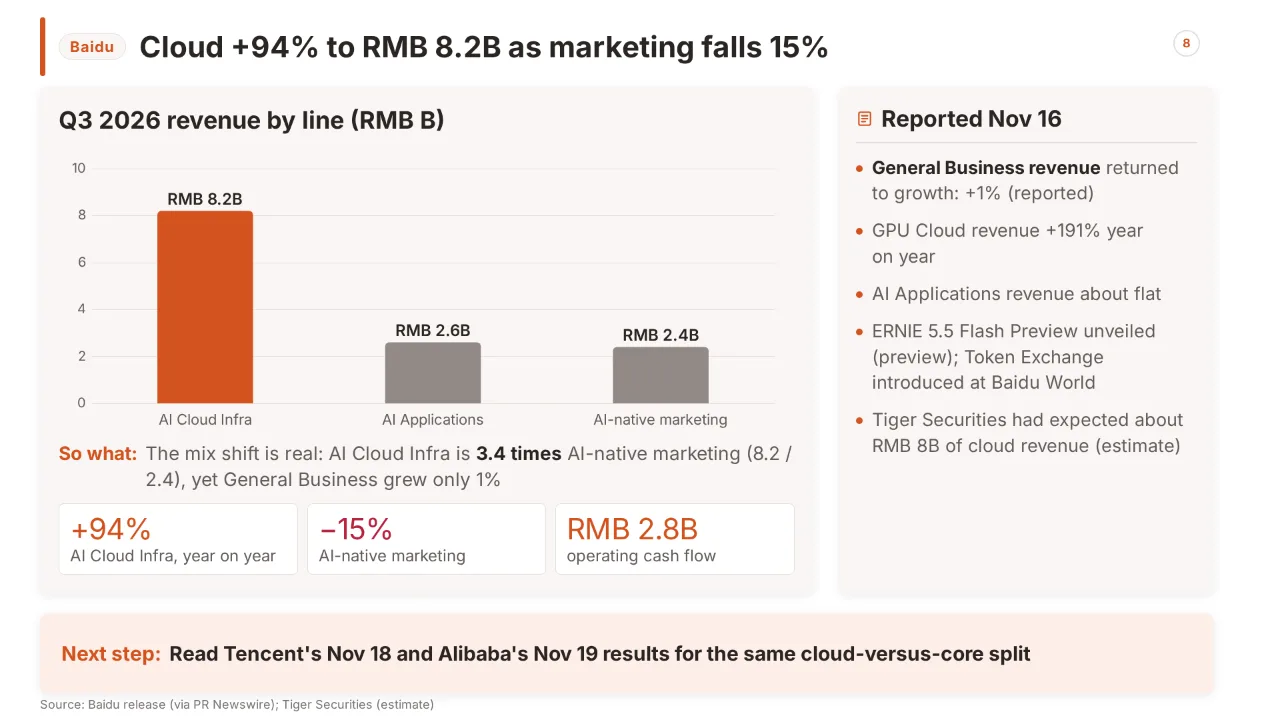
Baidu announced its third-quarter 2026 results on November 16 (quarter ended September 30), so this is a company statement, not an estimate. Its Baidu General Business revenue returned to year-over-year growth of 1%, with AI Cloud Infra revenue of RMB 8.2 billion, up 94% and GPU Cloud revenue up 191% year over year and 43% quarter over quarter. Revenue from external customers' token usage on its Qianfan platform rose 1,159% year over year; AI Applications revenue was RMB 2.6 billion, about flat; AI-native marketing services were RMB 2.4 billion, down 15%. Operating cash flow was RMB 2.8 billion and Baidu Core AI-powered Business was 53% of General Business revenue.
Against the pre-results picture, the shape matches what analysts expected: a Tiger Securities preview expected AI Cloud revenue near RMB 8 billion and growth near 91%, and a fall in the legacy ad business (estimate). The actual cloud figure of RMB 8.2 billion is slightly above that estimate. The base was Q2, when AI Cloud Infra revenue was RMB 7.3 billion, up 50% (context). The release excerpt reviewed gives no capex figure, so none is stated here; the preview recorded a Q2 peak of RMB 11.4 billion and management guidance to bring it lower (estimate, secondary).
Baidu's product news came with the results. In November it unveiled ERNIE 5.5 Flash Preview (status: preview), which Baidu says ranks second among open-source models on the Code Arena WebDev leaderboard (vendor-reported), and at Baidu World introduced Token Exchange, a marketplace connecting model providers and customers. Robin Li framed the intermediary problem: platforms that aggregate models do not take responsibility for performance, speed or whether a "Flash" model is passed off as "Pro".
Baidu's quarter is a mix shift (AI Cloud Infra is 3.4 times AI-native marketing: 8.2 / 2.4): cloud up 94% to RMB 8.2 billion while AI-native marketing fell 15% to RMB 2.4 billion.
5.2 Tencent and Alibaba: models shipped, results still ahead
Tencent Hy4. On November 4 Tencent released the full version of Hy4, which adds vision for the first time and can operate a computer on a user's behalf; the earlier preview (August 28) was a 770-billion-parameter model with 49 billion active parameters under Apache 2.0. A detail that matters for the "open" label: according to the TeamoRouter and Orca Router write-ups, Tencent says it plans to release the full model's weights, and as of November 4 only Hy4-preview was downloadable. It is live on Tencent Cloud TokenHub, WorkBuddy, CodeBuddy, Yuanbao and the WeChat Work assistant, with OpenRouter integration on launch day. API price is RMB 6 per million input tokens, RMB 0.3 cached input and RMB 18 output, unchanged from the preview, and Tencent offers a 50% discount through December 31, 2026 (in effect). Tencent's claim to rank among the world's leading open-source models is its own positioning; no benchmark table placing Hy4 was found.
Dates. Tencent's Q3 results are scheduled for November 18 (upcoming). Alibaba announced on November 6 that it will report September-quarter results on Thursday, November 19, before the US open, with a call at 7:00 a.m. Eastern (upcoming). Alibaba has no company-dated model or capex announcement inside the window in this material, and we do not reuse June-quarter figures as new; its Qwen role in Apple's China build is covered in Chapter 4. The Tencent capex estimate (Goldman) is in Chapter 8.
5.3 ByteDance and the DeepSeek-Huawei report
ByteDance Seedream 5.5 (November 9). ByteDance's Seed team released its image model, which it says holds a picture stable across up to 100 editing rounds with pixel-level preservation of unedited areas, outputs native transparent (RGBA) images and renders small text better than Seedream 5.0 Pro. It is rolling out gradually across Jimeng/Dreamina, Doubao and Doubao Work, with the API on Volcano Ark; a Pro version is planned. On November 10 Doubao said its image design features had been upgraded on top of it. ByteDance claims leads on text structure and realism over GPT Image 2.5 Sunburst but, per CellCog, published no head-to-head numbers and no independent test exists yet. BytePlus lists it from about $0.02 per image on a third-party API (WaveSpeed).
DeepSeek on Huawei (reported November 3). Cailian Press and STAR Market Daily, citing supply-chain sources, reported that DeepSeek plans to pre-train its next model, V5, mainly on Huawei Ascend 950 chips; other reports (TrendForce, Dataconomy) say at least 160,000 Ascend 950DT chips at a new data centre in Ulanqab, Inner Mongolia, with operations from late 2026 and V5 expected in 2027. DigitalCitizen adds an unverified parameter count of about eight trillion. Neither DeepSeek nor Huawei has confirmed it, and pre-training has not started. Status: reported by press.

5.4 Who is where, side by side
| Company | In the window | Status | Source |
|---|---|---|---|
| Baidu | Q3 results Nov 16; AI Cloud Infra RMB 8.2B (+94%); ERNIE 5.5 Flash Preview; Token Exchange | Reported results; preview model | Baidu release |
| Tencent | Hy4 full version Nov 4; Q3 results Nov 18 | Shipped (weights not yet released); results upcoming | Tencent via TeamoRouter, Moneyweb |
| Alibaba | Results date set for Nov 19 | Announced date; results upcoming | Business Wire |
| ByteDance | Seedream 5.5 Nov 9; Doubao image upgrade Nov 10 | Shipping, gradual rollout | Baidu Baike, Decoder |
| DeepSeek / Huawei | V5 on 160,000+ Ascend 950DT chips | Reported, unconfirmed | TrendForce, Dataconomy |
6. Products and model comparison: who leads, at what price and through whom
Chapters 3 to 5 described each company's launches; this chapter puts them on one scale. Two independent snapshots from Artificial Analysis (AA) Intelligence Index v5 are used, each in its own table, because they are dated differently and the index moved between them. Vendor-reported results are kept apart.
6.1 Frontier tier: AA Intelligence Index v5, readings of November 11-12
Version 5 of the index launched on October 27 on a new scale, so scores do not compare with earlier versions. The patch v5.0.1 regrades one evaluation (CritPt v2) and leaves the nine evaluations and weights unchanged. Readings from the model-ranking sites below are AA numbers relayed by third parties.
| Model | Company | Index score | Price / cost note | Source (reading date) |
|---|---|---|---|---|
| Claude Fable 5.2 | Anthropic | 64.6 | $26.54 per index task at max effort | felloai.com (Nov 12 snapshot) |
| Gemini 4 Carbon (High) | 60.0 | $2 / $10 per 1M tokens through Nov 30 | felloai.com | |
| Claude Opus 5.5 | Anthropic | 59.1 | n/a in source | felloai.com |
| GPT-6.1 Sol | OpenAI | 55 | $1.27 per index task | Hokai (Nov 12) |
| Gemini 4 Hydrogen (xhigh / high) | 54 / 51 | $3.16 / $1.87 per task | AA via eesel (Nov 11-12) | |
| GPT-6.1 Terra | OpenAI | 51 | $0.96 per task | AA via eesel |
Three readings follow. First, the top is held by a model outside the Big Tech groups: Fable 5.2 (released November 9) is ahead of Carbon by 4.6 points (64.6 - 60.0), so the lead Carbon held on the November 3 and 4 readings (59 to 59.4) ended when Fable 5.2 arrived on November 9. Second, the cost spread is large: Sol at 55 costs $1.27 per task against $26.54 for Fable at 64.6, so a 9.6-point gap (64.6 - 55) costs about 21 times as much (26.54 / 1.27 = 20.9). Third, Carbon's own cost per task is not stable across AA pages: $5.48 on AA's German model page (High), $6.59 for Medium on an AA comparison page, and $7.76 via eesel in Chapter 3. This chapter compares scores, not Carbon's cost.
On the independent scale, Google's Carbon (60.0) is second to Anthropic's Fable 5.2 (64.6) and 0.9 points ahead of Opus 5.5 (59.1) as of November 12; no Big Tech in-house model leads.
6.2 Efficiency tier: AA readings of November 9
This second table has one source and one date: Artificial Analysis, November 9, 2026, from AA's own article on Meta's Muse Ember.
| Model (max effort) | Company | Index score | Cost per task |
|---|---|---|---|
| Muse Wonder | Meta | 44 | $6.95 |
| Muse Ember | Meta | 36 | $0.14 |
| Claude Haiku 5.5 | Anthropic | 36 | $0.41 |
| DeepSeek V4.1 Flash 1017 | DeepSeek | 33 | $0.60 |
| GLM-5.3-Flash | Z.ai | 28 | $0.58 |
Ember scores the same as Haiku 5.5 at about a third of the cost ($0.41 / $0.14 is roughly 2.9 times), and Wonder is 8 points ahead for about 50 times the cost per task ($6.95 / $0.14 is about 50). AA's own page lists Ember at 36 (Max), time per task 2.6 minutes for Xhigh, and a cost per task of $0.12. For Chinese models, the Fello AI snapshot dated November 5 puts Moonshot's Kimi K3.1 Pro (released October 23) at 46 and ninth on the index, ahead of DeepSeek V4.1-Flash-1017 at 32.5 and GLM-5.3 at 31.7. AA's index score for Tencent's Hy4 is 35, "mid-field", per a November 13 write-up.
6.3 Vendor-reported against independent claims
- Google, Carbon (vendor-reported, Nov 10): #1 on CursorBench 4.0, WANDR and AutomationBench at more than 2x lower cost per task than the next external model (Chapter 3). Independent: 60.0 on AA, second.
- Tencent, Hy4 (vendor-reported): per an explainx summary of Tencent's own tests, Hy4 does not rank first on any of 12 benchmarks and sits 3rd to 4th of 7 compared models; BenchLM lists no public rank. Independent: AA's Cyber Index (published November 13) gives Hy4 58, second behind Kimi K3.1 Pro at 64 and one point above DeepSeek V4.1 Flash 1017 at 57, and Hy4 leads CWE-Bench-AA at 76% pass@1 against 69% for DeepSeek.
- Baidu, ERNIE 5.5 Flash Preview (vendor-reported): second among open-source models on Code Arena WebDev (Chapter 5); a third-party write-up says it beats Opus 5.5 and GPT-6.1 Sol on some document and tool tasks but trails them on complex reasoning.
- Meta, Muse (internal): the Personal Superintelligence Index and Active Memory results are Meta-internal (Chapter 4); the only independent Meta numbers are the AA points in 6.2.
6.4 Access and price, and who builds versus partners
| Model | Access and status | Price (per 1M tokens) |
|---|---|---|
| Gemini 4 Carbon | GA on API Nov 10; Ultra tiers staged | $2 / $10 through Nov 30, then $4 / $20 |
| Gemini 4 Hydrogen | Released Nov 12 | $1.50 / $7.50, flat; 15x the lowest rates of Haiku 5.5, GPT-6 Luna and Ember |
| Claude Fable 5.2 | Released Nov 9 (gated Mythos 5.2 alongside) | $8 / $40; fast mode $16 / $80 |
| Muse Ember | Meta Model API | $0.10 / $0.50 (Chapter 4) |
| Tencent Hy4 | Tencent Cloud and OpenRouter; weights planned | RMB 6 / RMB 18, 50% off to Dec 31 (Chapter 5) |
| Qwen4-Max Preview | Subscription only (Token Plan); Alibaba says retired after Nov 25 | per a secondary source |
The 15x check: $1.50 / $0.10 = 15 and $7.50 / $0.50 = 15, matching VentureBeat's statement. Build versus partner is the structural split: Google, Meta, Tencent and Baidu ship their own flagships and Google and Tencent also sell the model through cloud channels; Microsoft's Copilot routes to OpenAI and Anthropic models rather than leading with its own, and GitHub Copilot Fusion (October 28, context) orchestrates Anthropic and OpenAI models to balance cost and performance; Apple partners (Gemini-refined models in Siri, Qwen in China, Chapter 4).
7. Investments, partnerships and people: Anthropic's IPO, Nvidia's CEO exit and a reported national-champions list
The financing pressure in Chapter 8 meets three concrete events in this window: the terms of Anthropic's IPO, which turns three of the Big Tech groups into shareholders and suppliers at once; a sudden leadership change at Nvidia, the supplier behind most of the spending; and a reported US policy programme that would name favoured AI companies.
7.1 Anthropic's IPO terms: filed price range, reported valuation
On November 10 (Tuesday) Anthropic filed an amended S-1 that sets the price range at $70 to $78 per share for 825 million Class A shares, listing on Nasdaq under the symbol ANT. The prospectus splits the shares into 801,351,354 sold by the company and 23,648,646 by selling stockholders (801,351,354 + 23,648,646 = 825,000,000). At the top of the range the offering would raise $64.35 billion (825 million x $78) and at the bottom $57.75 billion (x $70). Reuters reports a valuation of up to about $1.4 trillion, which CNBC puts at $1.405 trillion fully diluted at the top of the range, against the $965 billion valuation of the May funding round. Pricing is expected on November 18 and first trading on Thursday, November 19 (upcoming).
A concurrent $26 billion private placement by seven suppliers means that part of the IPO money comes from the companies Anthropic pays.

The filing also records a concurrent private placement: AMD, Broadcom, Google, Micron, Microsoft, Nvidia and TSMC agreed to buy $26 billion of Class N stock at the IPO price, with no lock-up on those shares, per CNBC's reading of the filing. An earlier report on November 9 (before the filing) had said Anthropic had not confirmed the figure and that a distributed filing copy with about 867 million shares at $70 to $80 was "inaccurate"; follow the filed numbers. On revenue, TradingKey cites $33.242 billion for the first nine months of 2026, up 1,206%, a secondary figure to be checked in the S-1/A.
Compute commitments are the number that sources round differently. One summary says the amended S-1 puts commitments at $895.4 billion, up from $417 billion in the initial filing a week earlier; Yahoo Finance says $895 billion; shattered.io and TradingKey say about $900.9 billion; CNBC says "over $900 billion". The window supports "about $895 billion to $901 billion" and the S-1/A itself is the authority, and these are contractual commitments, not spend to date. Yahoo adds that Broadcom has the most at stake, with $161 billion of Anthropic's commitments against $63.9 billion of its fiscal 2025 revenue. Bloomberg reported on November 9 that both OpenAI and Anthropic were pursuing financings at lower-than-expected valuation targets after the market sell-off.
The implication for the Big Tech groups: Google (a $10 billion option on Class N stock is the one placement the amended S-1 documents, per Yahoo's reading), Microsoft and Amazon (see Chapter 2) are at once investor, supplier and landlord of Anthropic's demand.
7.2 Nvidia: a CEO resigns, and the partners' supply chain is reminded of key-person risk
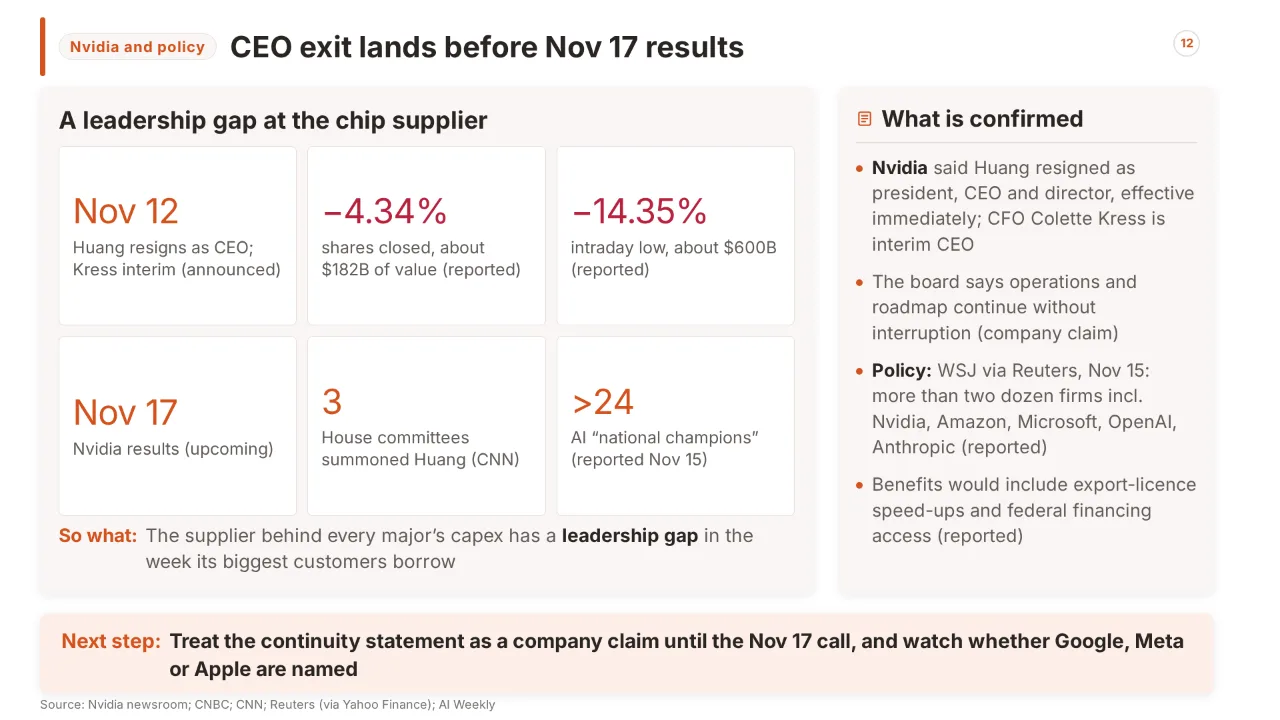
Nvidia is not a Big Tech platform in this issue's scope, but it is the supplier to every one of them, and its leadership change is the biggest people event of the window. Nvidia announced that Jensen Huang resigned as president, CEO and director, effective immediately, with CFO Colette Kress appointed interim CEO while the board searches internally and externally; board chair Harvey Jones said operations, customer commitments and the product roadmap would continue without interruption. CNBC dates the announcement to Thursday, November 12. It followed days of reporting about Huang's personal relationships, including one with a businesswoman linked to a Chinese company that is an Nvidia customer; Huang had apologised publicly on Sunday, November 8. We state only what the company release and major outlets confirm.
The market and political effects are reported, not Nvidia statements: shares closed down 4.34%, erasing roughly $182 billion of market value (after falling as much as 14.35%, about $600 billion, at the open), and three House committees summoned Huang while the Senate Banking chair asked for testimony on national-security concerns, per CNN. Nvidia's results are scheduled for November 17 (upcoming), with Kress expected to run the call. For partners the practical point is continuity: the 8-K under Item 5.02 and the company statement both stress an uninterrupted roadmap.
7.3 Policy: a reported national-champions programme
On November 15 Reuters relayed a Wall Street Journal report that the Trump administration plans to designate more than two dozen AI "national champions", including Nvidia, Amazon, Microsoft, OpenAI and Anthropic, to help them expand overseas and compete with Chinese rivals. According to AI Weekly's summary, benefits would include expedited chip export-licence approvals, support for overseas operations and access to federal financing, and Commerce Secretary Howard Lutnick is expected to unveil the programme within about a week; the roster and criteria are not public. Status: reported by press, not announced. Google, Meta and Apple are not named in the reports reviewed.
A caution on circular financing: claims circulating on social media that the IMF flagged $1.4 trillion of circular AI deals could not be traced to an IMF document in the sources reviewed and are left out.
8. Capex, financing and the capital markets: debt, equity and off-balance-sheet commitments
With product news concentrated at Google and Meta (Chapters 3 and 4) and the Anthropic listing dominating the deal calendar (Chapter 7), the thread that links every company in this window is how the spending is being paid for. This window had no US earnings, so the capex actuals below (Microsoft, Alphabet, Amazon, Meta) are context from the previous issue; the window events are bond and loan filings, third-party tallies and Chinese pre-earnings estimates.
8.1 Financing moves around the window
The table is built from one source (The Elec, citing Data Center Dynamics and SEC filings) except where marked, and the status column separates the window from context.
| Company | Instrument | Size | Date / status | Source |
|---|---|---|---|---|
| Meta | US-dollar bonds, five tranches | $15B | Priced Nov 3 (in window); the $97.5B equity plan of Oct 26 is context | The Elec, Yahoo Finance |
| Meta | First euro bonds, six tranches | EUR 9B | Priced Nov 4 (in window); orders EUR 53B | Bloomberg via Yahoo Finance |
| Alphabet | First HKD and SGD bonds, seven parts | $3.8B (HKD 16B = $2B; SGD 2.28B = $1.8B) | Term sheets seen by Reuters on Nov 12 (in window); orders above $7B | International Finance |
| Alphabet | Euro bond offering, 3.7% to 5.25% | EUR 6B | Reported as being prepared; Bloomberg says Alphabet priced euro bonds on Nov 2 (just before the window) | The Elec, Yahoo Finance |
| Microsoft | Fixed-rate bonds, 4.85% to 6.35% | $25B | Priced Oct 29 (context); expected to close Nov 4 (in window) | The Elec |
| Amazon | Secured vendor-financing loan facility | up to $80B | Disclosed in an SEC filing the week before Nov 3 (context); draws Q1 2027 to Q3 2028, floating rate, five-year maturity | The Elec |
| Oracle | $10B common stock plus $10B senior notes | $20B | Disclosed the same week (context) | The Elec |
The $131 billion headline (Data Center Dynamics) equals 80 + 25 + 20 + 6, so it adds the euro amount at face value; it is a third-party tally of plans, not of cash raised, it mixes loans, bonds and equity, and it names only Amazon, Alphabet, Microsoft and Oracle, so Meta's $15B dollar bond is outside it. What the window adds is the second wave: Meta's bond and Alphabet's first Hong Kong and Singapore dollar sales show issuers diversifying currencies and investor bases, which is a sign that the home market alone is not absorbing the volume.
Four of the largest AI spenders announced or closed more than $131 billion of loans, bonds and equity within roughly two weeks (third-party tally, plans not proceeds).
8.2 Cash flow, commitments and the cost of capital
The cash-flow gap is the reason for the borrowing. In the quarter just reported, Microsoft's capex including finance leases was $45.2 billion and it lowered its 2026 outlook from $175 billion to about $170 billion; Alphabet spent $51.36 billion, held its $195 billion to $205 billion 2026 range and reported free cash flow of negative $9.01 billion against an expected negative $2.7 billion (all from the Q3 reports, context, as relayed by The Elec). F.L. Putnam, an asset manager, estimates the big four will spend $1.1 trillion in 2027, 45% more than in 2026, against operating cash flow of about $900 billion, which leaves about $200 billion (1,100 - 900) to be funded by debt, equity or off-balance-sheet structures. Its "nearly $800 billion" for 2026 is a rounded figure: $1.1 trillion divided by 1.45 is about $760 billion. All of these are estimates.
Off-balance-sheet obligations are the larger number. Nikkei compiled about $3.2 trillion of AI-related commitments for Alphabet, Meta, Microsoft, Amazon and Oracle at the end of September, 90% above end-March (which implies about $1.7 trillion then: 3.2 / 1.9); about 60% are long-term purchase agreements for chips, servers and electricity and 40% are leases not yet commenced. Goldman Sachs credit analyst Amanda Lynam gives the same $3.2 trillion and says debt will remain a crucial funding source. These are disclosed in filing notes, not hidden, but they are not on the balance sheet. Goldman also projects hyperscaler debt supply of $296 billion in 2026 and $440 billion in 2027 (estimate).
The stress shows at the edges, not at the centre. According to The Elec, citing Fortune, CoreWeave's bonds originally issued at 9.67% now yield about 15%, and OpenAI cut its fundraising target from $30 billion to $20 billion. A Goldman trading-desk note after the US midterm vote argues spending may be pulled forward into 2027 because states likely to tighten data-centre rules hold about 45% of planned US capacity. Treat that as one desk's view.
8.3 China: capex is rising, results are still ahead
Of the Chinese majors, only Baidu reported inside the window (Chapter 5). Tencent's last reported figure is context: second-quarter 2026 capex of RMB 52.8 billion, up 176% year on year, reported on August 12. Its Q3 results are scheduled for November 18 (upcoming). Goldman Sachs estimates its Q3 capex at about RMB 66 billion (about $9.9 billion), an estimate to be checked on November 18; short-sold Tencent shares rose from 3.44 million to 6.41 million between November 6 and 13, an increase of 86%. Alibaba's results follow on November 19 (upcoming); its RMB 380 billion three-year cloud and AI plan dates from February 2025 and is context.
9. Competitive outlook and what to watch next
The preceding chapters show a window in which models became cheaper and more available, while financing moved to the markets and several of the biggest dates fall just after it. This chapter draws the implications for three readers and gives a dated watch-list as of the run date, November 17. It describes; it is not investment advice.
9.1 What the window means for three readers
| Reader | What changed | Implication |
|---|---|---|
| Enterprise buyers choosing a platform | Microsoft's unlicensed Copilot Chat limits are unpublished and admins cannot see them, with a $30-per-seat upgrade path; Bedrock lists Priority at +75% and Flex at -50% (secondary); Carbon's price doubles on December 1 | Budget for metering, not just seats: plan the Copilot upgrade list before users hit caps, and lock Carbon usage plans before the December 1 step-up (a 1M-input, 100K-output job goes from $3.00 to $6.00) |
| Builders choosing a model stack | Independent index: Fable 5.2 64.6, Carbon 60.0, Hydrogen 51 to 54, Terra 51; Ember 36 at $0.14 per task; TorchNeuron lowers the cost of trying Trainium | Split workloads: frontier model for hard jobs, a cheap tier (Terra at $0.96, Ember at $0.14 per task) for volume; treat Hy4's open weights as planned, not available |
| Investors and strategists judging financing durability | $3.2 trillion of off-balance-sheet commitments (estimate), a third-party $131 billion tally of announced raises, Meta paying about 1.4 times Alphabet's euro spread; Anthropic's suppliers are also its IPO buyers; Nvidia's CEO exit shows key-person risk | The question is no longer capex size but who funds it and at what spread; watch the circularity (supplier, investor and customer are the same firms) |
9.2 Company strategies side by side
| Company | Build / partner / buy | Chips | Flagship model in the window | Financing stance |
|---|---|---|---|---|
| Microsoft | Partner: Copilot routes to OpenAI and Anthropic models; monetises through licences and usage | Maia 300 announced Oct 12, production in 2027 (secondary) | No in-house flagship in the window | $25B bonds priced Oct 29 (context), closing Nov 4 |
| Alphabet | Build, and sell TPU capacity to Anthropic | TPU 8tx and 8i Max available 2027 | Carbon 60.0 and Hydrogen 51 to 54 | First HKD and SGD bonds, about $3.8B |
| Meta | Build (Muse) | Not covered in the window | Muse Ember 36 at $0.14 per task; Wonder 44 | Equity plan (context), $15B dollar and EUR 9B euro bonds |
| Amazon | Platform plus chips; large Anthropic stake | Trainium with TorchNeuron | None in the window | Secured facility up to $80B disclosed before the window |
| Apple | Partner: Gemini-refined models, Qwen in China | Not covered | None in the window | Not covered; Siri leadership reports |
| Baidu | Build, plus a marketplace (Token Exchange) | Kunlunxin M100 targeted for volume production by end-2026 | ERNIE 5.5 Flash Preview | Cash flow positive at RMB 2.8B operating cash flow |
| Tencent | Build and distribute (Hy4 in WeChat Work, WorkBuddy) | Not covered | Hy4: AA index 35, Cyber Index 58 | Results due Nov 18; capex estimate in Chapter 8 |
| ByteDance | Build (Seedream 5.5) | Not covered | Seedream 5.5, no independent test yet | Not covered |
9.3 Key dates, sorted
Status is judged on the run date, November 17: dates before it are in effect or past; dates from it onward are upcoming.
| Date | Event | Status | Source |
|---|---|---|---|
| Nov 3 to 4 | Meta bonds priced ($15B, EUR 9B) | In effect (priced) | — |
| Nov 9 | Copilot Chat limits reach tenants above 2,000 seats | In effect | — |
| Nov 10 | Carbon GA; Anthropic S-1/A with $70 to $78 range | In effect; filed | — |
| Nov 12 | Hydrogen released; Nvidia CEO resignation announced | In effect | — |
| Nov 16 | Baidu Q3 results | Reported | — |
| Nov 17 | Microsoft Ignite opens (to Nov 20); Nvidia results (Kress interim CEO) | Upcoming (run date) | — |
| Nov 18 | Tencent Q3 results; Anthropic pricing expected | Upcoming | — |
| Nov 19 | Alibaba September-quarter results; Anthropic expected to trade on Nasdaq as ANT | Upcoming | — |
| About Nov 22 | Commerce Secretary expected to unveil the national-champions programme | Reported expectation | — |
| Nov 25 | Qwen4-Max Preview retired, per Alibaba (secondary) | Upcoming | — |
| Nov 30 | Carbon introductory price ends | Upcoming | — |
| Dec 1 | Carbon $4 / $20; default usage-based billing for new CSP Copilot Business (reported delay) | Upcoming | — |
| Early Dec | Microsoft buyout decision deadline (reported) | Upcoming | — |
| Dec 10 | Gemini glasses in stores (US, South Korea) | Upcoming | — |
| December | Apple Intelligence China public release with iOS 27.3 | Upcoming | — |
| Dec 31 | Hy4 50% API discount ends | Upcoming | — |
The three bets to track are whether Anthropic prices inside its range on November 18 and trades on November 19, whether Tencent and Alibaba show capex and cloud numbers consistent with the estimates in Chapter 8, and whether the national-champions list names Google, Meta or Apple, which the reports reviewed do not.
10. References
This document draws on the following 126 sources, listed in the order they are first cited.
- Gemini 4 Carbon is now available — blog.google
- Google AI Studio — aistudio.google.com
- Gemini 4 Carbon: Developer Guide — aistudio.google.com
- Gemini 4 Hydrogen: $1.50 Input, 2.5x Faster 2026 — shattered.io
- Best AI Models in November 2026: Updated Rankings and Comparisons — felloai.com
- Google launches Gemini 4 Hydrogen — a faster, smarter, pricier Flash successor — venturebeat.com
- Meta Stocks Rise 1.77% While $15 Billion Bond Deal Adds a Cash Hurdle — finance.yahoo.com
- Meta Paid 1.4 Times What Alphabet Did to Borrow in Euros — finance.yahoo.com
- Alphabet raises USD 3.8 billion through Hong Kong, Singapore bond sales amid AI expansion - International Finance — internationalfinance.com
- Big four hyperscalers raising more that $131 billion in debt and equity for AI buildout — datacenterdynamics.com
- U.S. Big Tech’s AI Off-Balance-Sheet Commitments Surge 90% to $3.2 Trillion - Businesskorea — businesskorea.co.kr
- Anthropic sets price range of $70 to $78 in upcoming IPO as AI lab marches toward Nasdaq — cnbc.com
- Anthropic, PBC - S-1/A-2 — fidelity.com
- Amazon and Google Will See Big Paydays from Anthropic IPO - The New York Times — nytimes.com
- Google, Nvidia and Microsoft “Literally Feeding Themselves Money” with $26 Billion Anthropic IPO Buy — finance.yahoo.com
- Anthropic IPO: $900.9B Compute Dwarfs $26B Raise 2026 — shattered.io
- Copilot Chat Fair-Use Limits Before 9 Nov | encorp.ai — encorp.ai
- Microsoft Expands Copilot Chat Limits for Unlicensed Business Users in November 2026 — windowsforum.com
- Bedrock Pricing Tiers: Priority +75%, Flex -50% 2026 — shattered.io
- Meta's Muse Ember is the cheapest model scoring 36 on the Intelligence Index | Artificial Analysis — artificialanalysis.ai
- Baidu Announces Third Quarter 2026 Results - Kosmo Online — kosmo.com.my
- Tencent Hy4 API: Price, Specs and How to Call Hunyuan's New Model (2026) · TeamoRouter — teamorouter.com
- ⭐️Trades on X: "DEEPSEEK IS MOVING IN WITH HUAWEI. NVIDIA GETS THE COUCH. Reports (TrendForce, The Information): DeepSeek plans to pre-train its next model, V5, mainly on Huawei Ascend 950 chips, with 160,000+ Ascend 950DT chips at a new Ulanqab, Inner Mongolia data center. Founder Liang Wenfeng ha… / X — x.com
- DeepSeek Plans To Train V5 Using 160,000 Huawei Chips - Dataconomy — dataconomy.com
- Own Naspers? Watch the cash in Tencent’s next results - Moneyweb — moneyweb.co.za
- Alibaba Group Will Announce September Quarter 2026 Results on November 19, 2026 — finance.yahoo.com
- Your Unlicensed Copilot Chat Users May Hit Limits Admins Can't See | THE DAILY BRIEF — beri.net
- Microsoft Delays Default Copilot Business Usage-Based Billing for CSP Partners to Early 2027 — windowsforum.com
- Microsoft unveils a completely redesigned Copilot — aisisters.ai
- Microsoft Employee: What If I Say No to the Buyout? — youtube.com
- Microsoft Employee: Take the Buyout or Risk a Layoff? — thegrindhotlinedispatch.substack.com
- microsoft 25 billion bond sale: Why is Microsoft borrowing $25 billion after offering buyouts to 60,000 employees? - The Economic Times — m.economictimes.com
- Microsoft Ignite 2026 arrives Nov 17, keynote time and schedule — pasqualepillitteri.it
- Citi: Microsoft Ignite conference expected to reinforce AI growth narrative; maintains Buy rating with a target price of $680 — news.futunn.com
- AWS Launches TorchNeuron to Run PyTorch Models on AWS Trainium Without Modifications - InfoQ — infoq.com
- AWS launches TorchNeuron for PyTorch models on Trainium chips, TechGig — techgig.com
- AWS Launches TorchNeuron to Run PyTorch Models on AWS Trainium Without | Tech Bytes — techbytes.app
- Trainium3 vs Maia 300 2026: AWS Ships 1 Year Earlier — shattered.io
- Anthropic proposes IPO at $70–$78 per share | ANT IPO Registration (S-1) — stocktitan.net
- Anthropic IPO Investor List: Amazon, Alphabet Lead Holdings as Seven Tech Giants Including Nvidia, AMD Plan to Invest — tradingkey.com
- Anthropic IPO is make or break for the technology industry — cnbc.com
- Gemini 4 Carbon: New model for developer agents — blog.google
- Gemini 4 Carbon Availability 2026: $2 Price, Limited Regions — shattered.io
- Title: Student AI Pro (promotional), single subscription, no overlap — yet all Gemini 4 models show "Unavailable" - Google Antigravity - Google AI Developers Forum — discuss.ai.google.dev
- Gemini 4 Hydrogen: Benchmarks & Security | NeuralTrust — neuraltrust.ai
- Gemini 4 Hydrogen review: benchmarks, cost per task, and verdict | eesel AI — eesel.ai
- Google's November Pixel Drop Just Gave Pixel 10 the Pixel 11's AI — Free — youtube.com
- Google Releases November 2026 Pixel Drop with New Features, Also Announces Gemini on Apple CarPlay — themobileindian.com
- Gemini on Apple CarPlay: available to all iPhone users with Gemini Live — datastudios.org
- Gemini Live Comes to Apple CarPlay for iPhone Users — androidguys.com
- Samsung and Google AI Glasses Preorders Open at $395 — techrepublic.com
- Gemini Smart Glasses Go on Preorder From $395 — technology.org
- Google and Samsung's first Android XR smart glasses open for preorder from $395 with Warby Parker and Gentle Monster | MLQ.ai — mlq.ai
- Alphabet Escalates AI Chip Rivalry With NVIDIA — finance.yahoo.com
- Google Is Turning Its Secret AI Weapon Into an Nvidia Problem — finance.yahoo.com
- Google Makes Major New Move as Nvidia Faces New Challenge — finance.yahoo.com
- Google TPU Sales Eyed at $135B by 2028 2026 — shattered.io
- Meta Eyes $20B-$25B Bond Sale for AI — briefs.co
- Meta is reportedly seeking to raise up to $25B through a bond sale to fund its AI infrastructure expansion — linkedin.com
- Meta Bonds $15 Billion Bond Sale Shows AI Debt Is Getting Costlier — goldenpi.com
- Meta rolls out specialized AI models for better memory and task completion | Superpower Daily — superpowerdaily.com
- Current Muse Scores 47% on Meta’s Personal Superintelligence Index – Unite.AI — unite.ai
- Instagram — instagram.com
- Meta’s specialized AI models for Muse and Meta AI | NeoTeo — neoteo.com
- Introducing Our Smallest, Most Efficient Model: Muse Ember — research.meta.ai
- #apple #ai #china | Jared Van Valkengoed — linkedin.com
- Apple’s 2-Years-Overdue AI Rollout Leaves Users Deeply Disappointed — eu.36kr.com
- One iPhone. Two AI brains. | Facebook — facebook.com
- Apple Expands China AI Filing to Cover iPad and MacBook, But Launch Timeline Still Unannounced — BigGo Finance — finance.biggo.com
- Is Apple Intelligence Worth It? Siri AI Verdict 2026 — felloai.com
- Mark Gurman on X: "Also in Power On: Mike Rockwell, the Apple executive who helped rescue Siri AI, continues to seriously consider leaving his role as Siri chief — or Apple altogether — next year. His departure would be a major blow as Apple looks to accelerate. https://t.co/2LJdbFWkju" / X — x.com
- Siri AI chief may step down as more Apple departures are rumored - Dans Tutorials — danstutorials.com
- Apple's Siri AI Chief Mike Rockwell May Leave the Company Next Year — macobserver.com
- Ternus Reportedly Urges Federighi to Accelerate Apple's AI Plans - iClarified — iclarified.com
- Baidu's AI Cloud Is Booming While Ads Collapse — Can Cloud Carry It? — youtube.com
- Baidu aims to restructure the entry point for large language model scheduling. — news.futunn.com
- Tencent Hy4 Launch: 770B Vision Model With Computer Use — emergent.sh
- Tencent Hy4 Launches: New Flagship AI Model in 2026 - PowerfulAI.tools — powerfulai.tools
- Tencent Hy4 vs Hy4 Preview: Newer Model, Less Open — orcarouter.ai
- Tencent Hy4 Is a 770B Apache 2.0 Open Model 2026 — shattered.io
- Alibaba Group Will Announce September Quarter 2026 Results on November 19, 2026 | Morningstar — morningstar.com
- Seedream 5.5(Doubao Image Creation Model)_Baiduwiki — baike.baidu.com
- ByteDance Seed Introduces Seedream 5.5 for Multi-Round Image Editing – Unite.AI — unite.ai
- Bytedance's Seedream 5.5 promises pixel-stable image editing across 100 rounds without color drift — the-decoder.com
- Seedream 5.5: 100 Rounds of Editing, Native Transparency | CellCog — cellcog.ai
- The V5 War: DeepSeek Will Train Its Next AI on Huawei Chips — youtube.com
- DeepSeek Reportedly Plans to Train Its V5 AI Model Using 160,000 Huawei Ascend 950DT Chips — digitalcitizen.life
- Best LLM Right Now (Nov 2026): Latest Models Ranked | Hokai — hokai.io
- AA Intelligence Index v5.0.1 Leaderboard | LLMLearner — llmlearner.com
- Smartest AI models: November 2026 rankings | Requesty — requesty.ai
- What will be top Artificial Analysis Intelligence Index score on Dec 31, 2026? — metaculus.com
- Gemini 4 Carbon-Modelle – Vergleich von Intelligenz, Leistung und Preis | Artificial Analysis — artificialanalysis.ai
- Muse Ember vs Gemini 4 Carbon - Release Intelligence, Performance & Price Comparison | Artificial Analysis — artificialanalysis.ai
- Best Chinese AI Models in 2026: Ranked and Compared — felloai.com
- AI News Archive — November 2026 | IADecider — iadecider.com
- Tencent Hy4 Release: 770B, Computer Use, 12 Benchmarks | explainx.ai Blog | explainx.ai — explainx.ai
- Hy4 Benchmarks & Pricing (November 2026) | BenchLM.ai — benchlm.ai
- ERNIE 5.5 Flash Preview vs DeepSeek and GLM · GPTunneL — gptunnel.ru
- Gemini 4 Carbon Explained: Google's Model That Thinks Longer – Real Python — realpython.com
- New AI models, November 2026: cost per task compared — lindentech.de
- Copilot vs ChatGPT: $20 Plus vs $500 Pro 2026 — shattered.io
- Articles | Artificial Analysis — artificialanalysis.ai
- EXCLUSIVE: Anthropic eyes $1.4 trillion IPO valuation in test of Wall Street's AI fervor | Reuters — reuters.com
- Anthropic: Funding Rounds, Valuation, Investors and Compute Deals | Tokscale — tokscale.ai
- Anthropic IPO Nears: Claude Maker to Debut on Nasdaq Nov. 19, Key Watchpoints for ANT Listing — tradingkey.com
- Google, Nvidia and Microsoft Are Among 7 Tech Giants Putting $26 Billion Into Anthropic’s IPO — finance.yahoo.com
- The Hirsch Report: Issue #34 — linkedin.com
- OpenAI and Anthropic Valuations Fall as AI Market Rout Hits Fundraising - Bloomberg — bloomberg.com
- NVIDIA Announces CEO Transition | NVIDIA Newsroom — nvidianews.nvidia.com
- Nvidia CEO Jensen Huang resigns: Live updates — cnbc.com
- Jensen Huang summoned to testify before Congress after resigning as Nvidia CEO | CNN Business — cnn.com
- AI Hub for YOU | AI Agents, AI Tools & Super Intelligence | The Fed just named AI the top risk | Facebook — facebook.com
- nvda-20261111 — sec.gov
- Trump administration to name Nvidia, other AI firms as US ’national champions’, WSJ reports By Reuters — investing.com
- Trump administration to name Nvidia, other AI firms as US 'national champions', WSJ reports — finance.yahoo.com
- Trump to name Nvidia, OpenAI among AI 'national champions' | AI Weekly — aiweekly.co
- [98K views · 1.9K reactions | The IMF has warned about $1.4 trillion in circular AI deals, and the numbers are wild. Nvidia put $30 billion into OpenAI and backs up to $105 billion of its Ohio data center leases, a site that runs on Nvidia chips. Microsoft holds about 27% of OpenAI and has a $250 billion Azure contract with it.
Google is backing Anthropic with up to $40 billion while Anthropic has committed $121 billion to Google Cloud. People call this an AI bubble. Our view is that this is how big business has always worked. The dot-com bubble burst in 2000, yet the internet never went away. What do you think, AI bubble or just the beginning? #CryptoWala #AIBubble #Nvidia #OpenAI | CryptoWala](https://www.facebook.com/61565955700229/videos/the-imf-has-warned-about-14-trillion-in-circular-ai-deals-and-the-numbers-are-wi/2337990659938920) — facebook.com 118. [1.7K views · 19 reactions | 🚨NEW: The IMF is raising concerns over $1,400,000,000,000 in circular AI revenue commitments 👀
The IMF identified $300B in equity investments and $650B in debt supporting these arrangements.
Here's how the cycle works: ➡️ Big Tech invests billions into AI companies. ➡️ Those companies turn around and spend billions buying Big Tech's chips and cloud services.
This doesn't mean AI demand isn't real, but the IMF warns these financial loops could amplify losses if AI demand or profitability falls short of expectations. | Cryptos R Us](https://www.facebook.com/cryptosrus/videos/new-the-imf-is-raising-concerns-over-1400000000000-in-circular-ai-revenue-commit/29325986497037791) — facebook.com 119. Big Four Hyperscalers Seek $131 Billion for AI Infrastructure < IT·Gaming < 기사본문 - The Elec Inc. — thelec.net 120. AI’s Next Bottleneck: Capital - F.L.Putnam — flputnam.com 121. Big Tech has more than $3 trillion in AI commitments that don't show up on its balance sheets — finance.yahoo.com 122. AI Debt Risks Mount: Why Borrowing by Meta, Alphabet, Microsoft and Oracle Worries Investors — tradingkey.com 123. Goldman Says Tech Giants May Pull AI Capex Forward Into 2027 - FourWeekMBA — fourweekmba.com 124. AI Investment Returns: Why Revenue Lags Behind Spending — scommerce.com 125. Short Selling of Tencent Surges 86% Ahead of Q3 Results; Alibaba Shorting Sentiment Relatively Subdued — BigGo Finance — finance.biggo.com 126. Tencent Joins China's AI Spending Race With 2025 Capex Boost | I3investor — klse.i3investor.com