Robotics and Embodied AI Brief · Nov 3–Nov 16, 2026
Contents
- Key takeaways from the two weeks
- New products and demos
- Robot foundation models
- Production and deliveries
- Funding and partnerships
- Technical-route comparison
- Outlook and what to watch next
1. Key takeaways from the two weeks
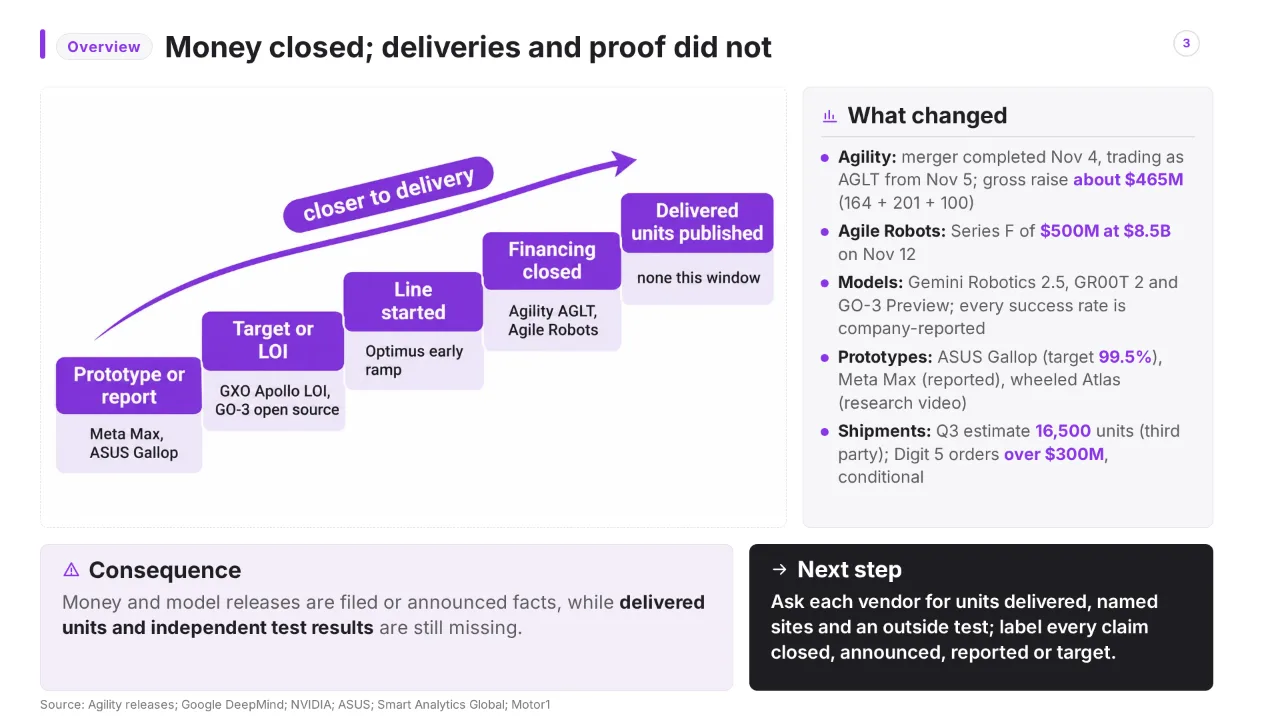
This brief covers 2026-11-03 to 2026-11-16 and continues the issue for Oct 23 – Nov 2. Items dated before Nov 3 appear only as context. The pattern of the window: one financing closed and listed, models got more open but stayed vendor-measured, and production claims again ran ahead of delivery evidence.

1.1 Five conclusions
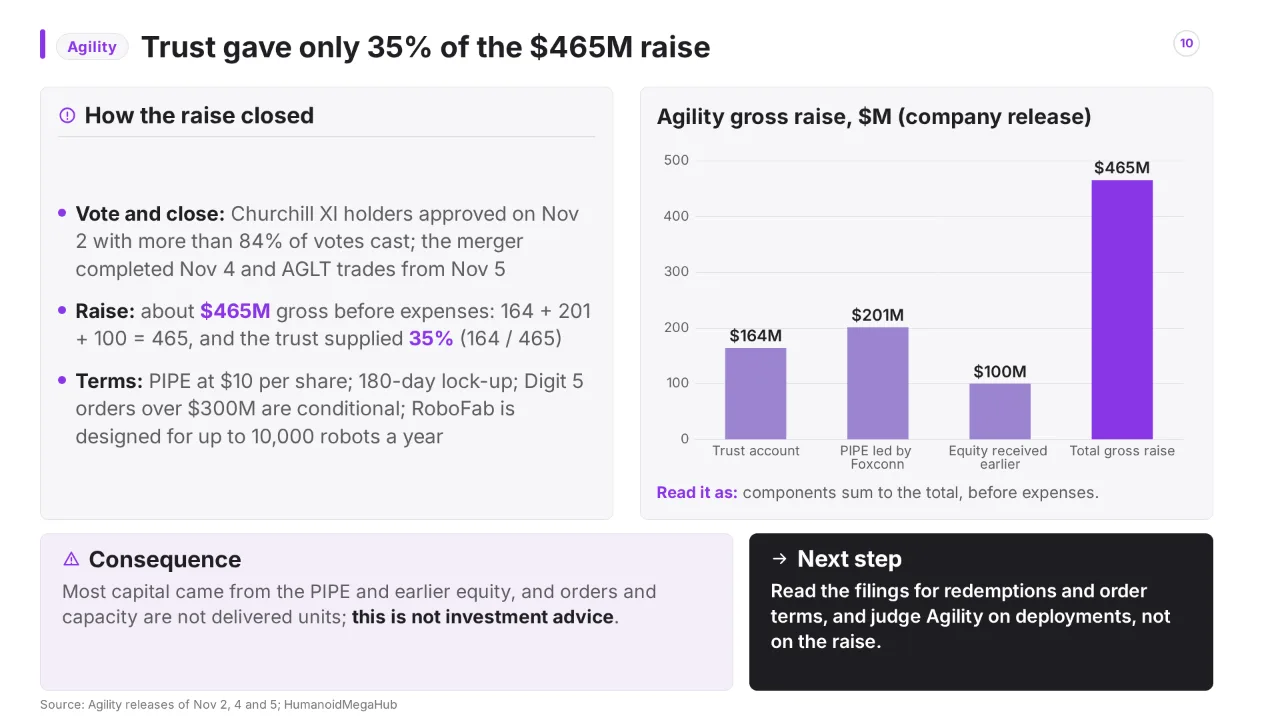
1. The US listing route for a humanoid maker is now open, and it was a financing, not a revenue story. Agility completed its merger with Churchill Capital Corp XI on Nov 4 and began trading on Nasdaq as AGLT on Nov 5. The company says about US$465 million gross was raised, made up of about US$164 million from the trust, about US$201 million from a Foxconn-led PIPE at US$10 per share and US$100 million of equity received earlier (164 + 201 + 100 = 465). The trust supplied only 35% of the total. The company also reports more than US$300 million of committed Digit 5 orders, but they are conditional on contractual milestones, and its factory is designed for up to 10,000 robots a year, which is capacity, not output. This is not investment advice.
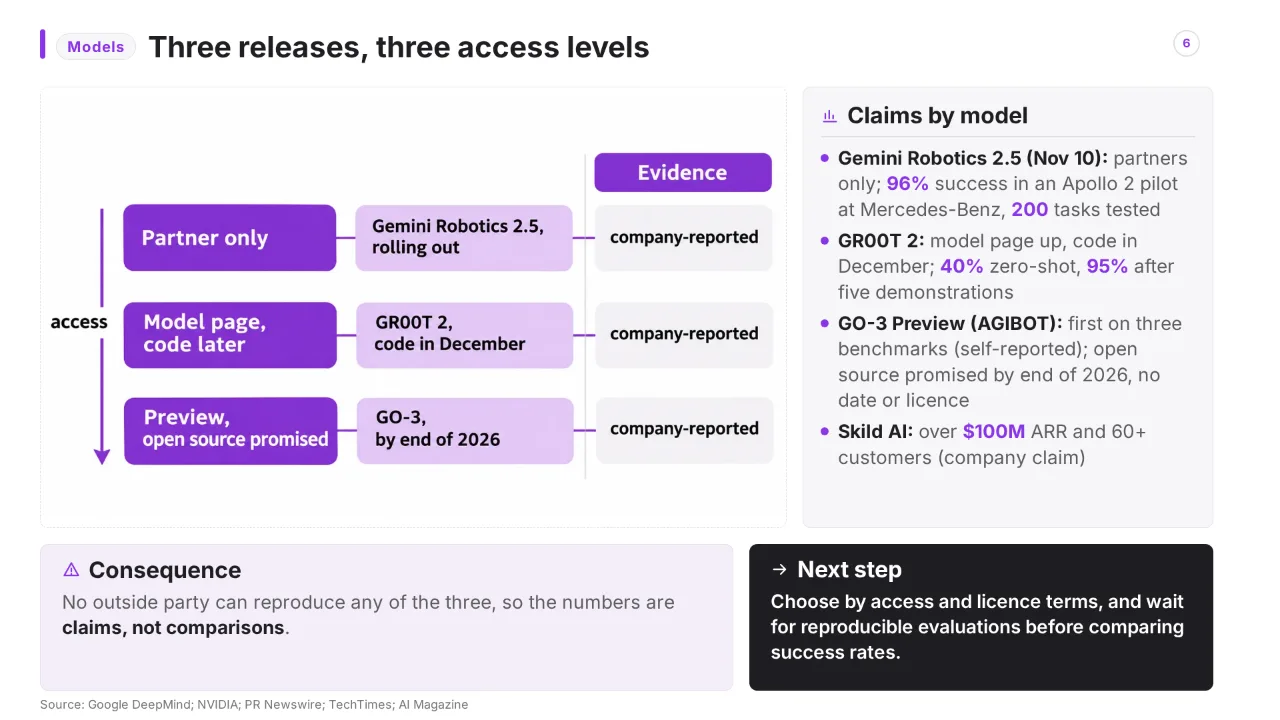
2. Robot models split into three access levels, and every headline number is company-reported. Google DeepMind's Gemini Robotics 2.5 (Nov 10) is rolling out to partners only, with a 96% success rate in an Apollo 2 pilot at Mercedes-Benz. NVIDIA's GR00T 2 has a public model page with code "available in December" and 95% success after five demonstrations per task. AGIBOT's GO-3 Preview claims first place on three benchmarks and promises open source by end of 2026, without a date or licence. No outside party has reproduced any of them. Chapter 3 shows why the blog and research-page numbers for GR00T 2 are different metrics.
3. Capital is moving toward platforms and robot "brains", not toward single robots. Agile Robots raised US$500 million at US$8.5 billion on Nov 12, led by SoftBank with Nvidia taking part. GXO and Apptronik signed only a letter of intent, with an intention of up to 1,000 Apollo robots over four years and initial deployment in late 2027, gated by KPIs. Skild AI says it has passed US$100 million in annual recurring revenue with more than 60 customers. Reported talks, such as Physical Intelligence at about US$20 billion, are unconfirmed and excluded from every total.
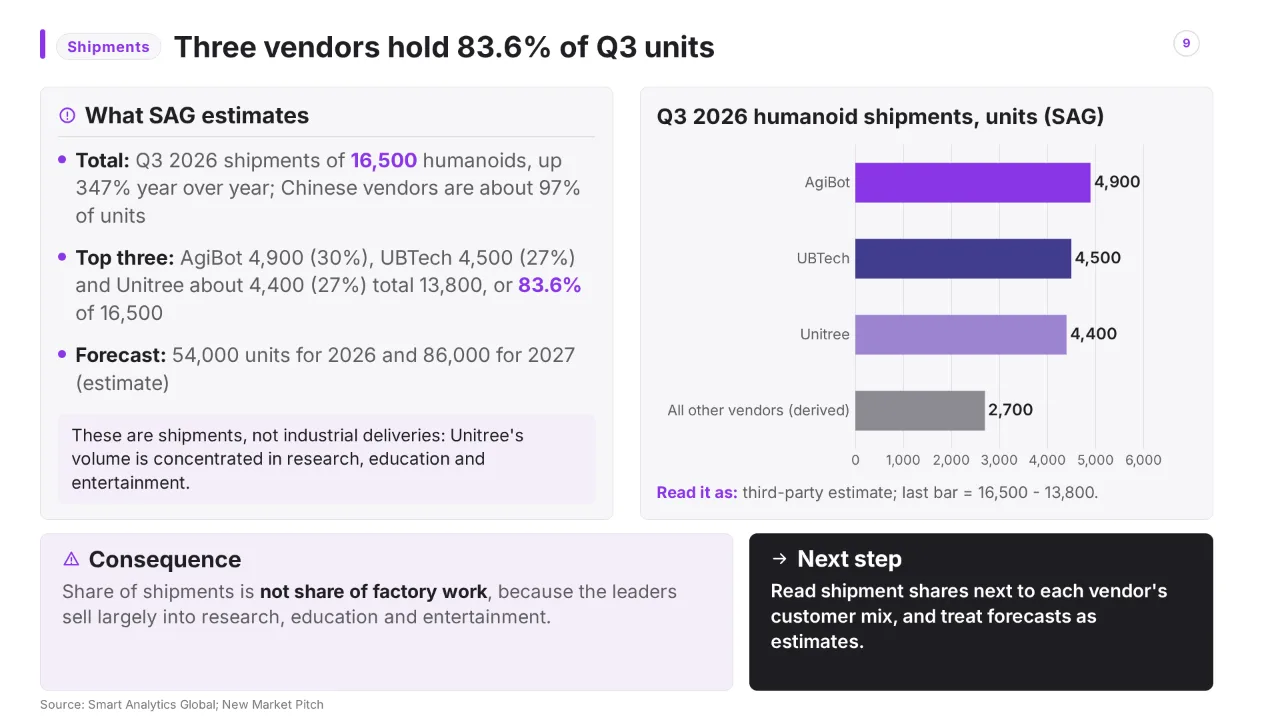
4. Production claims still outrun delivery evidence. Tesla's Fremont Optimus line is at "early ramp" with no unit count, V3 has not been shown, and Musk said "No" to December consumer orders on Nov 1. XPeng's CEO talked up IRON on the Nov 16 results call, but mass production is only targeted for end of 2026 and deliveries for 2027. The one delivery-like dataset is a third-party estimate: 16,500 humanoids shipped worldwide in Q3, with AgiBot, UBTech and Unitree together at 13,800 or 83.6% (4,900 + 4,500 + 4,400). Shipments to research and education are not the same as industrial deliveries.
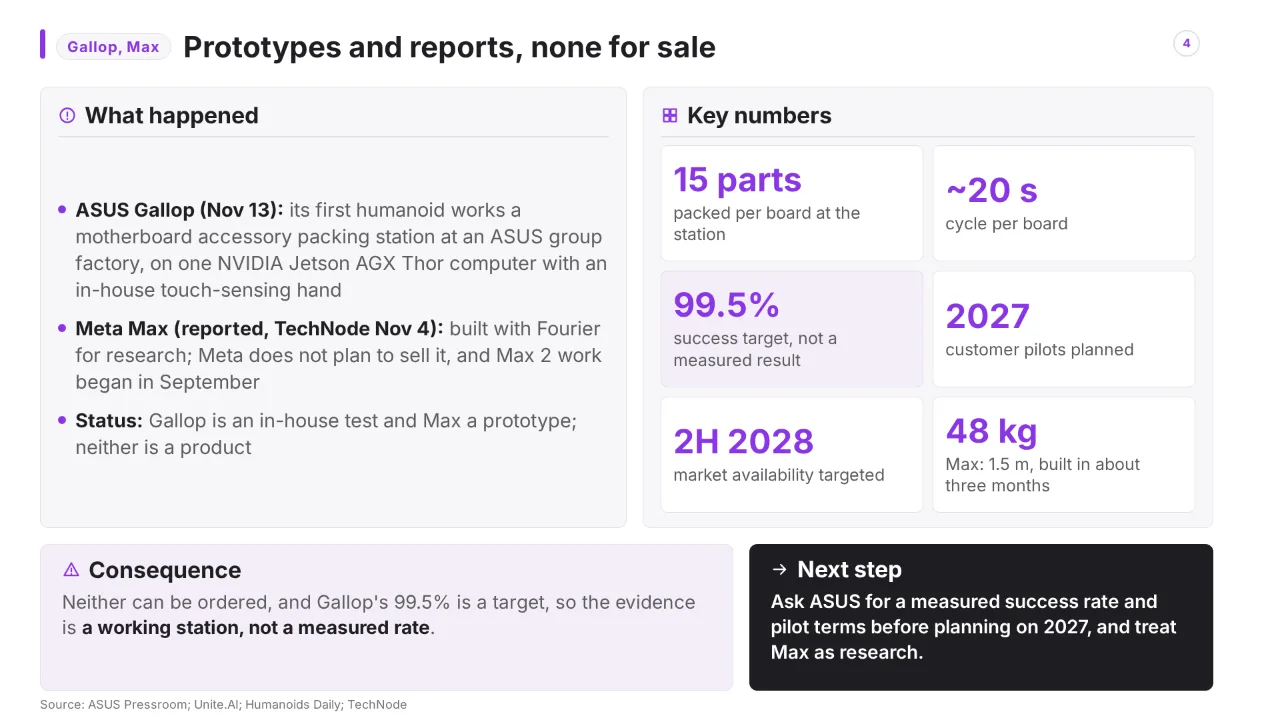
5. New builders arrived as prototypes and reports, not products. ASUS showed Gallop on Nov 13: a fixed-base two-arm robot packing motherboard accessories in its own factory against a 99.5% target, with customer pilots in 2027 and market availability targeted for 2H 2028. Meta's Max with Fourier remains a reported research prototype, not for sale. Xinhua and UBTech showed bionic news anchors on stage, and Boston Dynamics showed a wheeled Atlas as a research platform. None can be ordered today.

1.2 What changed at a glance
| Company · product | Change | Date | Status |
|---|---|---|---|
| Agility · Digit | Merger completed; Nasdaq trading as AGLT; about US$465M gross capital | Nov 4–5 | Closed |
| Agile Robots | US$500M Series F at US$8.5B, led by SoftBank | Nov 12 | Closed (company statement) |
| GXO · Apptronik | Letter of intent for up to 1,000 Apollo robots over four years | Nov 12 | LOI, KPI-gated |
| Google DeepMind · Gemini Robotics 2.5 | New VLA model rolling out to partners | Nov 10 | Released to partners |
| NVIDIA · GR00T 2 | Open world-action model; code due in December | Nov 9 | Model page up; code upcoming |
| AGIBOT · GO-3 Preview | Preview model with self-reported benchmark wins | Nov 3 (release) | Preview; open source promised |
| ASUS · Gallop | First humanoid, in-house factory test | Nov 13 | Prototype; pilots 2027 |
| Tesla · Optimus | No V3 reveal; "No" to December consumer orders | Nov 1 | Early ramp; no unit count |
| XPeng · IRON | Q3 results call; robot talked up | Nov 16 | Mass production targeted end-2026 |
| SAG estimate | Q3 global humanoid shipments of 16,500, up 347% | Nov 8 | Third-party estimate |
2. New products and demos
Chapter 1's pattern holds in the product news too: the window brought a factory-floor prototype from a hardware group, one state-media stage act, a research video from Boston Dynamics and follow-up reporting on a Meta prototype, but no new humanoid on sale.
2.1 Dated product table
The window's product news is almost entirely prototypes, videos and reports; the only robot with a stated commercial date is ASUS Gallop, and that date is 2H 2028.
| Date | Company · product | What was shown | Evidence type | Price / availability | Source |
|---|---|---|---|---|---|
| Nov 4 (report) | Meta · Max (built with Fourier) | Follow-up coverage of the 1.5 m, 48 kg prototype first reported around Oct 31 – Nov 2 (context) | Report; Meta statement relayed by media | Not for sale | TechNode |
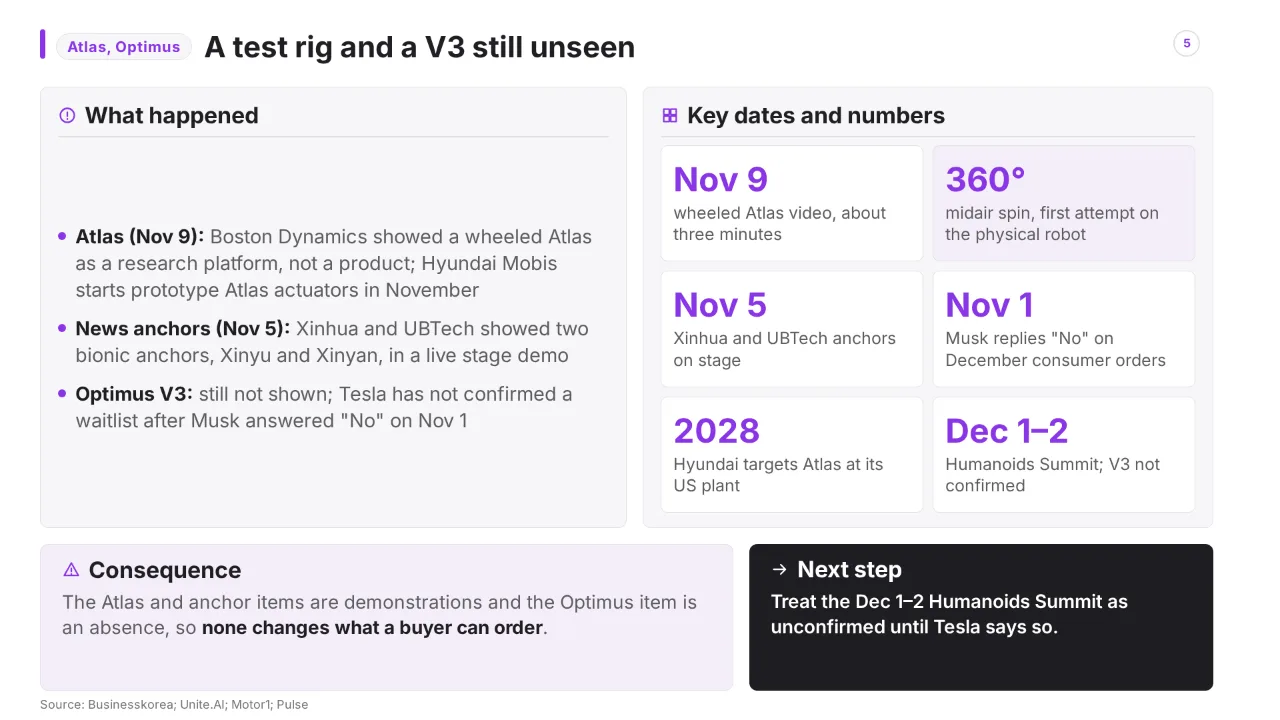
| Nov 5 | Xinhua · UBTech · bionic news anchors Xinyu and Xinyan | Two life-size robots at the World Media Summit, Beijing; one read the opening news on stage | Live stage demo | No price; not a product launch | Unite.AI |
| Nov 9 | Boston Dynamics · wheeled Atlas ("Atlas on a Roll") | Research video: scooter wheels on the ankle actuators, 360-degree midair spin | Recorded video | "Not a commercial product" | Businesskorea |
| Nov 13 | ASUS · Gallop | First ASUS humanoid, packing motherboard accessories at an ASUS group factory | In-house factory test; CNBC interview | Customer pilots 2027; market 2H 2028 | ASUS Pressroom |
| not shown | Tesla · Optimus V3 | Not shown publicly as of Nov 16 | None | No price; reservation story unconfirmed | Motor1 |
2.2 ASUS Gallop and Meta Max in detail
ASUS Gallop is the cleanest window event, and ASUS's own blog of Nov 13 is the backbone. Gallop is ASUS's first humanoid, built by the Humanoid Robotics business unit of its Physical AI Solutions Business Group. It works from a fixed base with two arms, and a wheeled version is planned next. Its first job is a motherboard accessory packing station at an ASUS group electronics manufacturing plant: 15 small parts, many in thin clear bags, in about 20 seconds per board. ASUS's stated target is 99.5% success within 20 seconds, "the same standard we hold a person to". That is a target, not a measured result: Unite.AI notes that Gallop's figures are targets, not reported achieved results, and Humanoids Daily adds that ASUS has not published a measured rate.
The architecture is conventional but explicit. ASUS says it does not build its own giant model but starts from leading open models, learns from head-camera footage of experienced workers (with their consent), expands it with simulation variations, and refines it with an operator in a VR headset and gloves. Four layers (planner, supervisor, skills, control) communicate through fixed interfaces so a better AI model can be swapped in. Everything runs on one NVIDIA Jetson AGX Thor computer, and ASUS designs the body and a touch-sensing hand in-house.
On timing, ASUS's blog says customer pilots are planned for 2027, a showing at Computex 2027, and market availability targeted for 2H 2028. Humanoids Daily's summary of the CNBC interview says Co-CEO S.Y. Hsu described a partner release in 2H 2027 and a commercial launch in 2H 2028; these fit together (partners and pilots first), and this report follows the ASUS blog wording. No specifications or pricing have been released.
Meta Max is the window's reported prototype, and it remains reported, not launched. According to TechNode, Meta demonstrated Max to employees at an internal robotics summit in late August; it is 1.5 m tall, weighs 48 kg, runs on NVIDIA Jetson Thor, shows facial expressions and has five-fingered hands. The two companies built it in about three months, with Meta's robotics product vice president Li-Chen Miller spending nearly two months at Fourier's Shanghai factory, and began work on Max 2 in September. The efforts are for research and experimentation and "not currently intended for sale". A secondary summary reports that Meta confirmed the collaboration as an internal research project with no plans to sell and that The Information first reported it on October 31. Chinese manufacturing involvement is the sensitive point in the coverage; the material contains no Meta statement on security, so none is attributed here.
2.3 Atlas, Optimus V3 and other signals
Boston Dynamics released a roughly three-minute research video on Nov 9 showing Atlas with scooter-style wheels on its ankles, a side dash and a 360-degree midair spin that it says it learned by imitating human motion and completed on the first attempt on the physical robot. The company describes the wheeled Atlas as a research platform to test motor and whole-body-control limits, built from off-the-shelf wheels and one custom connector, with lessons applied to the walking Atlas. Parent group news is separate and mostly future: Hyundai Mobis said on its Oct 30 earnings call (context) that it would begin producing prototype Atlas actuators in November, and Hyundai Motor Group targets deployment at its US plant in 2028 and a broader assembly role by 2030 (company plans, reported by Korean media).
Tesla Optimus V3 has still not been shown. Motor1 reports that the Optimus reservation story rested on one report from Humanoids Summit organiser Modar Alaoui naming the Dec 1–2 summit, that Musk answered "No" on X on Nov 1 to a question about December consumer orders, and that Tesla has issued no statement on a waitlist, fee or price; the widely quoted US$20,000 figure is an unconfirmed estimate. The late-2027 external-delivery target belongs to Chapter 4.
Judgement. Evidence quality, not novelty, separates these items. Gallop has a real station and an honest target but no measured rate; the Xinhua anchors are a stage act built around retrieval from a reviewed news corpus rather than general autonomy; wheeled Atlas is a test rig; Max is a report; V3 is a gap. A buyer cannot order any of them today.
3. Robot foundation models
Chapter 2 covered the robot bodies shown in the window; this chapter covers the models meant to drive them, three of which arrived within one week (AGIBOT Nov 3, NVIDIA Nov 9, Google DeepMind Nov 10).
3.1 Model status at a glance
| Model | Developer | Status on Nov 17 | Claimed (company-reported) | Independent evidence | Source |
|---|---|---|---|---|---|
| Gemini Robotics 2.5 | Google DeepMind | Released to robotics partners, rolling out (Nov 10) | 96% success, Mercedes-Benz pilot | None in material | DeepMind |
| GR00T 2 | NVIDIA | Announced Nov 9; model page up, code "available in December" | 95% after five demonstrations | None; leaderboard ranks are NVIDIA's statement | NVIDIA |
| GO-3 Preview | AGIBOT | Preview; release Nov 3; open source promised by end of 2026 | First on three benchmarks | None; no technical report | PR Newswire; TechTimes |
| Skild Brain | Skild AI | In commercial use | Over US$100M ARR | None in material | AI Magazine |
Every headline number this fortnight is company-reported, and no outsider can yet download or reproduce any of the three new models: Gemini Robotics 2.5 is partner-only, GR00T 2 code is due in December, and GO-3 weights are promised by year-end.

3.2 Gemini Robotics 2.5: one factory number, several relative gains
On Nov 10, 2026 Google DeepMind introduced Gemini Robotics 2.5, "our most capable vision-language-action (VLA) model to date", and said it is "rolling out to our robotics partners". No public availability or price is stated. It follows Gemini Robotics 2 (context). All figures below are Google's own.
- Breadth: tested on 200 distinct tasks, such as serving food with tongs and pipetting. Success was 30% to 100% higher depending on task type, and tasks finished 20% to 30% faster, "compared to previous baselines". The page does not name the baseline.
- Reliability: with Apptronik's Apollo 2 on active Mercedes-Benz lines in Kecskemét, Hungary and Sindelfingen, Germany, the robot kitted metal brackets at 96% success. Google calls it a proof-of-concept and pilot, with no trial count or throughput given. This is a pilot, not a commercial deployment.
- Safety: inference-time guidance raised safe task completion by 33% around obstacles and 43% around nearby people. The new open-source ASIMOV-Jailbreak benchmark shows Gemini 4 Argon, a different model from the 2.5 action model, at 99.5% jailbreak resistance against 82% for Gemini Robotics ER 2, a gain of 99.5 − 82 = 17.5 points. The English page says "hundreds of prompts" across "dozens of scenes"; the Korean page gives 1,500 prompts across 100 scenes. We use the exact Korean counts.
The 96% is the only number tied to a real production line, and without trial counts it is a single-site pilot result.
3.3 NVIDIA GR00T 2 and Isaac Lab 3.0: an open world-action model, code not yet out
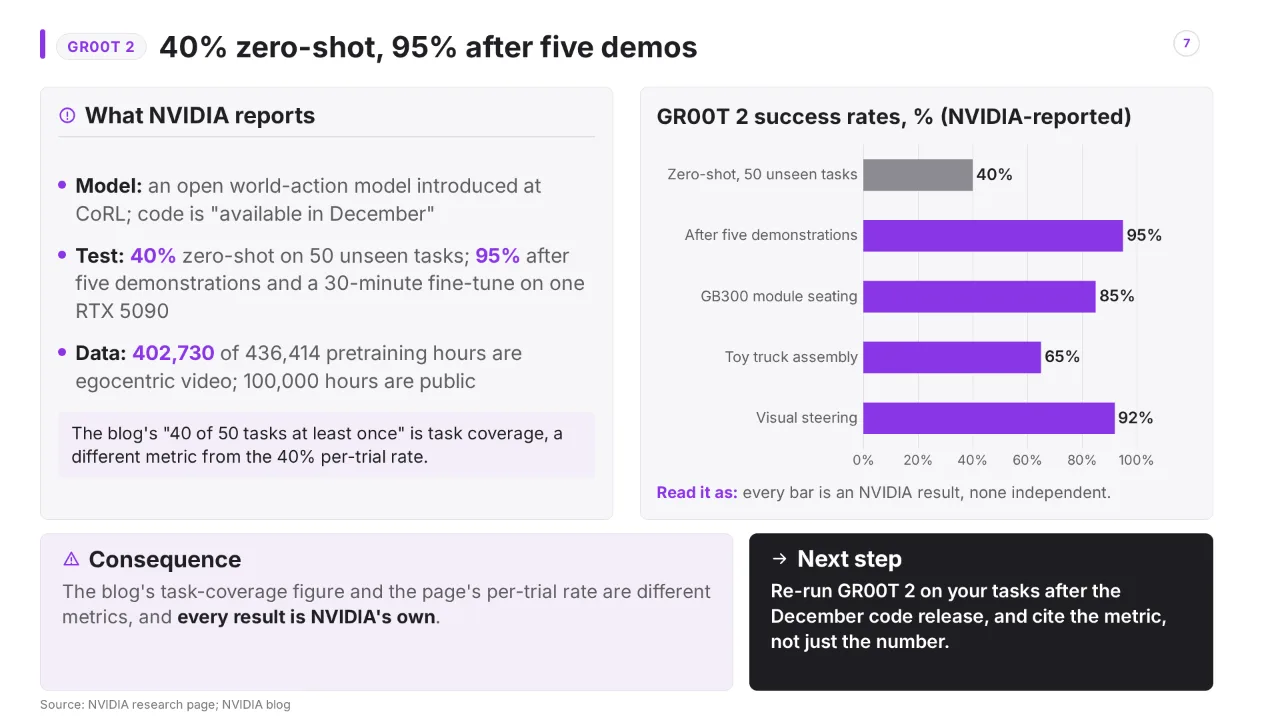
At CoRL in Austin (blog dated Nov 9, 2026) NVIDIA introduced GR00T 2, "an open frontier world action model built on NVIDIA Cosmos", plus Isaac Lab 3.0. The NVIDIA research page (November 2026) says it predicts future video and robot actions together and that code is "available in December" (upcoming); weights and licence terms are not stated. The research-page results, all NVIDIA-reported:
| GR00T 2 test (NVIDIA research page) | Result |
|---|---|
| Zero-shot, 50 tasks unseen on the target robot | 40% |
| After five demonstrations per task (under 3 minutes of robot data) and a 30-minute fine-tune on one RTX 5090 | 95% |
| Seating GB300 memory modules, two 22-DoF Sharpa hands | 85% |
| Toy truck assembly, same hands | 65% |
| Following "what and where" instructions with visual steering (40% with task instruction alone) | 92% |
Two differences between the NVIDIA blog and research page matter:
- Zero-shot: the blog says GR00T 2 "completed 40 of 50 evaluated tasks at least once" without task-specific demonstrations. That is task coverage (40 ÷ 50 = 80% of tasks), whereas the research page's 40% is per-trial success. They are not the same metric. The blog adds 71% average success with one demonstration per task, which the research page does not list.
- Human data: the blog cites "100,000 hours" of open human egocentric data. The research page gives 402,730 hours of egocentric video, 10,184 hours of handheld-gripper demonstrations and 23,500 hours of robot teleoperation, 436,414 hours in total, of which 100,000 hours are public. So the blog's figure is the open 24.8% subset (100,000 ÷ 402,730), and egocentric video is about 92.3% of the mix (402,730 ÷ 436,414). We follow the research page for totals. In NVIDIA's scaling test, adding human video from none to 100% lifted real-robot task progress from 50% to 70%.
For Isaac Lab 3.0 with Newton, NVIDIA reports up to 2.5x the training throughput of Isaac Lab 2.3 with PhysX on one vision-based dexterous benchmark. NVIDIA also says GR00T 2 ranks "among the top three" on four benchmarks (RoboCasa365, RoboLab, RoboDojo, MolmoSpaces); the leaderboards are not in the material. Foxconn "applying", Siemens "evaluating" and Nexuni "testing" it describes trials, not deployments.
3.4 AGIBOT GO-3 Preview, Skild AI and what remains unverified
AGIBOT GO-3 Preview (preview). AGIBOT's PR Newswire release is dated Nov 3, 2026, Shanghai; trade coverage ran Nov 5 and Nov 6. TechTimes says it was first shown on Oct 29 (context). The release claims first place on RoboDojo, RoboTwin and RoboColiseum and a full open-source release "by the end of 2026". TechTimes reports no date or licence, no public weights or code, and no technical report, and says the RoboDojo result rests on a lighter "Nano Preview" variant (average score 61.90, success 56.42%, per PingWest). TechTimes could not find GO-3 on the RoboDojo leaderboard, so the rankings stay self-reported.
Skild AI. According to AI Magazine (Nov 4), Skild Brain passed US$100M in annual recurring revenue ten months after its first commercial deployment, with more than 60 paying customers; US$50M has been recognised since deployments began, and the figures are dated September 2026. ARR is a run rate, not booked revenue: US$50M recognised is half of US$100M ARR. New Market Pitch labels the figure company-disclosed on Sep 10.
Not confirmed. A LinkedIn post says Physical Intelligence is "reportedly raising" at about US$20B; AI Magazine attributes talks at that level to Bloomberg, which is not a company statement (see Chapter 5). No source in this material shows a Figure Helix 3.0 release.
4. Production and deliveries
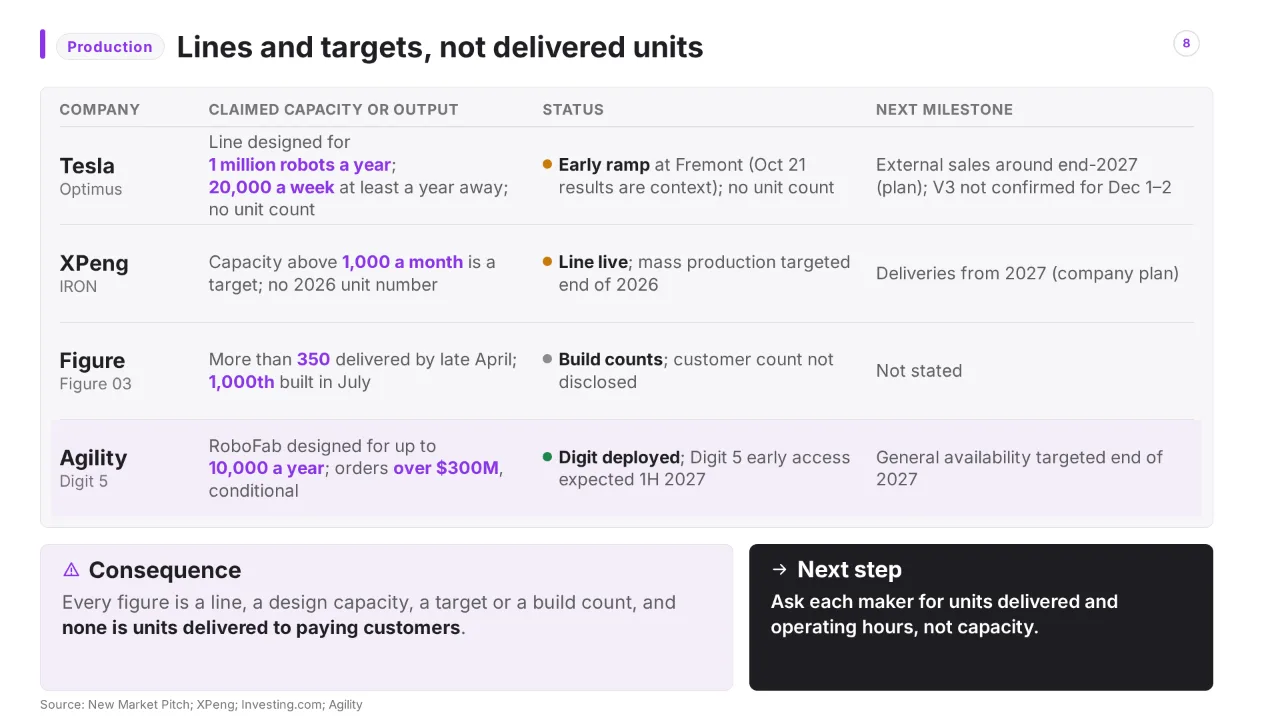
Chapter 3's models matter only if robots are built and delivered, and the window's production evidence is thinner than its claims: three vendors state lines or targets, one research house estimates shipments, and nobody publishes delivered units to paying customers.
4.1 Production and delivery status table
Every figure in this table is a line, a design capacity, a target or a build count. The only delivery-like numbers are third-party shipment estimates, and they are dominated by Chinese vendors.
| Company · product | Claimed capacity or output | Status (as stated) | Next milestone | Source |
|---|---|---|---|---|
| Tesla · Optimus (V3 not shown) | Fremont line designed for 1 million robots a year; about 20,000 a week is a goal at least a year away; no unit count | Early ramp / early production (Q3 update of Oct 21 is context) | External sales around end of 2027 (plan); Humanoids Summit Dec 1–2 | New Market Pitch; video summary |
| XPeng · IRON | Monthly capacity above 1,000 units is a stated target; no 2026 unit number | Automated line live since Sep 2026; mass production targeted end of 2026 | Deliveries from 2027 (company plan) | XPeng; optimusk.blog |
| Figure · Figure 03 | More than 350 delivered by late April (company); 1,000th built Jul 23; about one robot an hour | Production count; customer count not disclosed | Not stated | New Market Pitch |
| Agility · Digit / Digit 5 | RoboFab designed for up to 10,000 robots a year; more than 65,000 operating hours; more than US$300M committed Digit 5 orders, conditional | Digit deployed; Digit 5 early customer access expected 1H 2027 | General availability targeted end of 2027 | Agility |
| Agile Robots · humanoids | Factory can build up to 10,000 a year; about 2,000 targeted for 2026 | Target (Bloomberg, via Quartz) | 2027 output two to three times higher (target) | Quartz |
Status words follow the sources: "designed for", "targeted" and "committed orders subject to milestones" are not units built, and units built are not units delivered.
4.2 Tesla Optimus: a line, not a count
The material's Tesla primary documents (the Q3 2026 update deck and 8-K of Oct 21) did not yield Optimus text in extraction, so the Tesla status below is secondary and dated to the Oct 21 results, which are context for this window. According to New Market Pitch, the Fremont line, built in the old Model S and X area, is listed as "early ramp", the Texas plant as under construction, and Tesla gave no count of robots built. The same source reports Musk tying the line to about 1 million robots a year as a design goal, and the 20,000 a week target as at least a year away. A video summary adds that Tesla's Optimus V3 reveal has slipped repeatedly, that Tesla has not confirmed a V3 reveal at the Dec 1–2 summit or at its Dec 3 shareholder meeting, and that US$30,000 to US$20,000 figures are build-cost estimates, not prices.
Inside the window the news is a denial rather than a delivery. Motor1 reports that Musk replied "No" on X (Nov 1) to a question about December consumer orders, that Tesla has said nothing officially on a waitlist, fee or price, and that Musk has described late 2027 for deliveries to outside companies. Reading these together: Tesla has the largest stated capacity in the field and the least disclosed output. Capacity-to-output gaps are normal at an early ramp, but nothing in the window lets a buyer estimate when an order could be filled.
4.3 XPeng and Figure: the same gap, different evidence
XPeng published Q3 2026 results on Nov 16. The call transcript reports revenue of 24.28 billion yuan and 118,390 vehicle deliveries; on robotics, the only statement the material carries is CEO He Xiaopeng saying that "advanced intelligence is XPeng IRON's greatest competitive advantage" and that the robot could eventually surpass premium vehicle models in sales potential and gross profit. That is an ambition, not a production figure. XPeng's own page describes IRON as walking off an automated Guangzhou line in September 2026 (over 80% of core processes automated), with 76 degrees of freedom, and says volume production is scheduled for the end of 2026 with deliveries beginning in 2027; these are company-stated plans subject to change. An aggregator notes that XPeng has given no 2026 unit number and that robots earn no reported revenue yet. Status: mass production targeted, not reached; deliveries zero until 2027 by XPeng's own timeline.
Figure has the strongest public count of any US maker, but only as builds. New Market Pitch reports that BotQ had delivered more than 350 Figure 03 robots by late April 2026 and that the CEO announced the 1,000th Figure 03 built in July; Figure does not say how many work for customers. Adcock's Nov 2 video of new Figure 03 robots walking out of BotQ is context for the window and a demonstration of output, not a delivery. Applying Interesting Engineering's account of "one robot an hour", a line running flat out for a year would build about 8,760 (24 × 365); that is arithmetic on a rate, not a reported figure.
4.4 Third-party shipment estimates
Smart Analytics Global (SAG) published on Nov 8–9 its estimate that global humanoid shipments reached 16,500 units in Q3 2026, up 347% year over year. By vendor (SAG estimates, shipments rather than customer deliveries): AgiBot 4,900 (30%), UBTech 4,500 (27%), Unitree about 4,400 (27%), Leju and Galbot about 3% each.
Arithmetic: 4,900 + 4,500 + 4,400 = 13,800, or 83.6% of 16,500, which leaves 2,700 units (16,500 − 13,800) for all other vendors; adding Leju and Galbot at about 3% each brings the named five to about 90%. A 347% rise implies Q3 2025 at about 3,700 units (16,500 / 4.47); UBTech's 1,603% rise to 4,500 implies about 260 a year earlier (4,500 / 17.03), both derived, not published. Chinese vendors are about 97% of shipments, and full-size bipedal robots rose to 47% of units from 38% a year earlier. SAG forecasts 54,000 units for 2026 and 86,000 for 2027; with SAG's first-half figure of about 19,100 (reported by New Market Pitch from the South China Morning Post), H1 plus Q3 is about 35,600, leaving roughly 18,400 for Q4 to meet the forecast (derived).
Two cautions. Shipments are not deliveries to paying industrial customers: SAG says Unitree's volume remains concentrated in research, education, entertainment and developer use. And vendor rankings depend on definitions, for example New Market Pitch notes that AgiBot's roughly 8,400 first-half shipments include compact and wheeled machines while Unitree's roughly 5,900 are mostly pure humanoids. No US or European vendor appears in SAG's top five, which squares with Agility, Figure and Tesla being measured in lines and orders rather than shipments.
5. Funding and partnerships
Chapter 4 separated lines and targets from delivered robots; the money side of the window is easier to count, because three events carry company statements: Agility's listing, Agile Robots' round and a GXO–Apptronik letter of intent.
5.1 Deal table
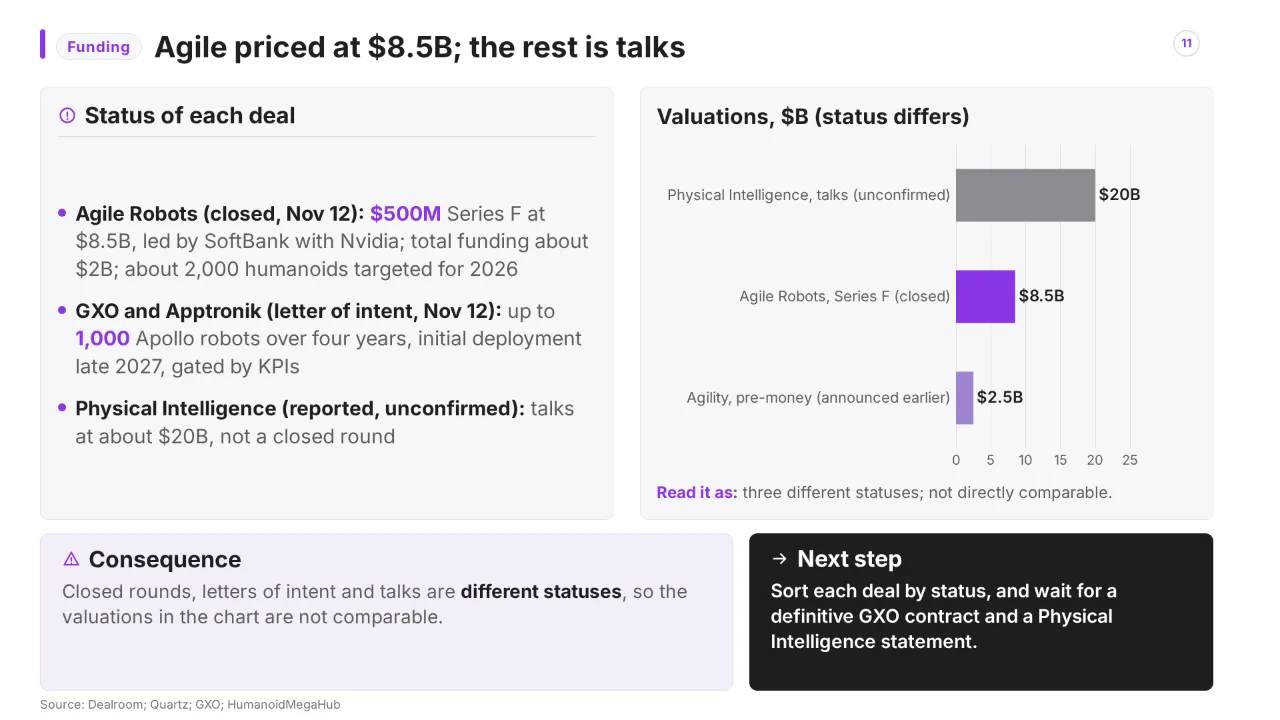
Two deals closed inside the window (Agility's US$465 million merger financing and Agile Robots' US$500 million Series F), and one partnership is only a letter of intent (GXO–Apptronik).
| Date | Company · event | Amount | Valuation | Status | Source |
|---|---|---|---|---|---|
| Nov 4–5 | Agility Robotics · merger with Churchill Capital Corp XI; Nasdaq trading as AGLT from Nov 5 | About US$465M gross, before expenses | US$2.5B pre-money (announced earlier; context, per HumanoidMegaHub) | Closed (company release) | Agility |
| Nov 12 | Agile Robots · Series F, led by SoftBank, with Nvidia and Hitachi | US$500M | US$8.5B | Closed (company statement, via Dealroom and Quartz) | Dealroom; Quartz |
| Nov 12 | GXO · Apptronik · letter of intent on Apollo | No amount stated | n/a | LOI, not a definitive contract | GXO |
| Oct 29 (context) | Physical Intelligence · talks at about US$20B, at least US$1B | At least US$1B | US$20B | In talks (media headline; unconfirmed) | HumanoidMegaHub |
| Jul 2026 start | AgiBot · Hong Kong IPO process; no listing date as of Nov 10 | n/a | n/a | Process started, not listed | optimusk.blog |
A report or a talks headline is not a round: only the first two rows add up to anything, and they are not additive in kind (one is a listing financing, one a private round). Closed rows total US$965 million (465 + 500) of announced gross capital, which is a sum of two unlike events and not an industry funding figure. None of this is investment advice.
5.2 Agility: how the gross raise is built
Agility's own releases give the mechanics, and they are the backbone here. Churchill XI shareholders approved the business combination on Nov 2 with more than 84% of votes cast in favour (context: last issue's open item). The company then announced completion on Nov 4, with common stock and warrants expected to trade on Nasdaq from Nov 5 as AGLT and AGLTW. The Nov 5 release says the business combination and related financings raised about US$465 million gross before transaction expenses, including a PIPE led by Foxconn and US$100 million of equity received before closing.
The pre-close release breaks the number down, and the parts add up exactly:
| Component | Amount | Source |
|---|---|---|
| Churchill XI trust account | About US$164M | Agility |
| Common-stock PIPE at US$10 per share, led by Foxconn | About US$201M | Agility |
| Equity funding already received after announcement | US$100M | Agility |
| Total gross capital | About US$465M | 164 + 201 + 100 = 465 |
Two readings follow. First, the trust contributed only 35% of the total (164 / 465), so most of the money came from the PIPE and pre-closing equity rather than the SPAC cash pile; redemptions explain why. Second, the company says existing Agility shareholders rolled 100% of their equity and, with the Churchill sponsor, are under a 180-day lock-up from closing, subject to early release on stock-price measures. Counting 180 days from Nov 4 puts the lock-up end in early May 2027 (derived, secondary arithmetic in one outlet). These are listing mechanics, not a view on the shares, and not investment advice.
The same releases are the best evidence on what the money funds. Agility says it has more than 65,000 hours of operation, more than US$300 million in committed multi-year Digit 5 orders subject to contractual milestones, product features and specifications, and RoboFab in Salem, Oregon, designed for up to 10,000 robots a year. Capacity and conditional orders are not delivered units; Early customer access to Digit 5 is expected in the first half of 2027 and general availability is targeted for the end of 2027. Proceeds are to support order fulfilment, deployments and Digit production.
5.3 Agile Robots, GXO–Apptronik and reported talks
Agile Robots announced a US$500 million Series F on Nov 12 at an US$8.5 billion valuation, led by SoftBank Group with Nvidia, Hitachi Group (including Hitachi Ventures) and T.Capital participating, taking total funding to about US$2 billion. Funds are for US expansion, more production capacity including in Germany, and new markets. Dealroom adds that the company says it has more than 20,000 systems installed, and that its Fürstenfeldbruck factory can build up to 10,000 legged and wheeled humanoids a year (capacity, not output); The Next Web, cited by Dealroom, reports an expectation of about 2,000 units in 2026. Quartz, citing Bloomberg, puts the 2026 target at roughly 2,000 humanoids and says 2027 could run two to three times higher; both are targets. Dealroom notes the round is smaller than the roughly US$800 million reportedly discussed in June (reported). The valuation is a company figure, and the round is a platform and industrial-robotics round rather than a pure humanoid one, so it should not be benchmarked directly against Agility's listing.
GXO and Apptronik signed a letter of intent on Nov 12 to expand Apollo trials in live GXO operations and develop a Robotics-as-a-Service framework. From 2027 the trials are to validate safety, security and technical requirements against jointly agreed KPIs; subject to success, the companies intend to progress toward a global rollout of up to 1,000 Apollo robots over four years, with initial North America deployment in late 2027. The release names no price, order value or definitive contract, so the 1,000 figure is an intention, not an order. It also says the partnership began in 2024, that Apollo completed a US pilot earlier this year on small consumer goods picking, and that more than 50 logistics tasks were evaluated in Apptronik's training facility.
Reported talks stay out of the table sum. Physical Intelligence was reported on Oct 29 (before the window) to be in talks to raise at least US$1 billion at a US$20 billion valuation; this rests on a media headline and a social-media post, not a company statement, so it is unconfirmed. AgiBot started a Hong Kong IPO process in July 2026 and had no listing date as of Nov 10 (secondary source).
Judgement. The window shows two routes to capital with different evidence. Agility's route (public listing) exposes order, hours and capacity claims to disclosure rules; Agile Robots' route (private round) rests on investor conviction in a broader industrial base. For a buyer, the GXO LOI is the more telling signal: even a large logistics operator moves from trial to scale only against KPIs, with initial deployment in late 2027.
6. Technical-route comparison
Chapter 5 showed who is paying for which strategy; this chapter compares the engineering routes behind the window's robots and models, using only specifications that companies have published and marking everything else "not disclosed".
6.1 Comparison table
The routes differ most in hands, data and dependencies, not in the legged body: nearly all robots below are bipedal or fixed-base humanoids, and every one that discloses its compute except XPeng IRON runs a Thor-class NVIDIA computer.
| Company · robot | Body form | Hands / DoF | Power | Brain and data | Evidence level | Source |
|---|---|---|---|---|---|---|
| Agility · Digit 5 | Bipedal; 1.81 m, 129 kg, reach 2.2 m | Swappable end-effectors; repeated lifts up to 50 lb (22.7 kg) | 90-minute battery, 9-minute charge | Agility physical AI; NVIDIA IGX Thor and Halos | Company-reported (unveiled Sept 2026); Digit 4 has 65,000+ hours | Agility |
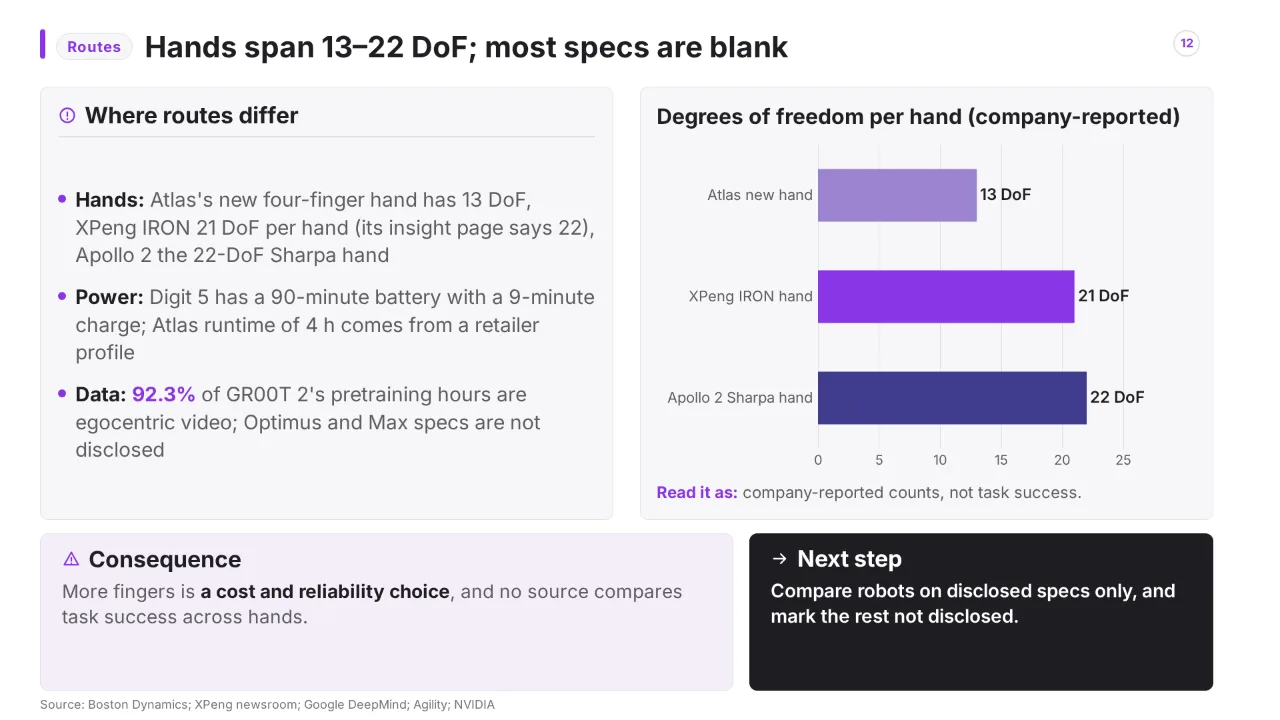
| XPeng · IRON | Bipedal | 76 DoF body, 21 per hand; "all-solid-state" battery claimed | Chemistry not confirmed in the Sept 2026 release | Three Turing AI chips, 2,250 TOPS; own physical-AI model | Company-reported; no output rate | XPeng; Humanoids Daily |
| Boston Dynamics · Atlas | Bipedal (wheeled variant is a research rig) | New four-finger hand, 13 DoF; payload 100 lb+ | Runtime 4 h and body 56 DoF per a retailer profile (secondary) | Jetson Thor onboard; Isaac Lab simulation and RL | Company hand blog; body specs secondary | Boston Dynamics; FIRGELLI |
| ASUS · Gallop | Fixed base, two arms (wheels next) | In-house touch-sensing hand; DoF not disclosed | Not disclosed | Open models; worker head-camera data, simulation, VR teleoperation; one Jetson AGX Thor | In-house factory test; target only | ASUS |
| Meta · Max (with Fourier) | Humanoid, 1.5 m, 48 kg | Five-fingered hands; DoF not disclosed | Not disclosed | Jetson Thor; Meta's models per reports | Report | TechNode |
| Apptronik · Apollo 2 with Gemini Robotics 2.5 | Humanoid | Five-finger, 22-DoF SharpaWave hand | Not disclosed | Gemini Robotics 2.5 (partners) | Company pilot, 96% (Mercedes-Benz) | DeepMind |
| Tesla · Optimus | Humanoid | Not disclosed | Not disclosed | Not disclosed | No public spec sheet | — |
All specifications are company-reported and dated to the cited pages; Atlas's 56 DoF and 4-hour runtime come from a retailer profile, not Boston Dynamics.
6.2 Route trade-offs
Hands are the contested component. ASUS calls the hand the hardest part of any humanoid and says it is still scarce worldwide, which is why it builds its own with touch sensing. Boston Dynamics describes hand design as a "ruthless tradeoff" among dexterity, strength, ruggedness, cost, repairability and sensing, and went from a 7-DoF hand to a 13-DoF, four-finger design. XPeng publishes 21 DoF per hand; Gemini Robotics 2.5 and GR00T 2 both run on Sharpa's 22-DoF hand in the cited tests. XPeng's own pages disagree: its newsroom says 21 per hand, its insight page says 22, and Humanoids Daily explains that the Nov 2025 reveal was 82 DoF with 22 per hand while the Sept 2026 production release is 76 DoF with 21. This report follows the newsroom's 21 and the production revision. More fingers is not "better": it is a cost and reliability choice, and no source here compares task success across hands.
Wheels versus legs is a tool, not yet a verdict. Boston Dynamics fitted wheels to Atlas to stress motors and whole-body control, calls it a research platform, and says the lessons feed the walking Atlas. In SAG's Q3 estimates, wheeled and half-size designs from AgiBot and Galbot sit alongside full-size bipeds, whose share of shipments rose to 47% from 38%. Agility's Digit 5 trades legs for payload and runtime: 40% more payload, a 10:1 run-to-charge ratio against 2:1 for Digit 4, and 20+ productive hours in a 24-hour day (company-reported).
Data strategy is where the models diverge. NVIDIA's GR00T 2 mixes 402,730 hours of egocentric human video, 10,184 hours of handheld-gripper demonstrations and 23,500 hours of robot teleoperation, so egocentric video is about 92.3% of 436,414 hours. ASUS learns from head-camera footage of its own workers, simulation variations and a VR-guided operator, and says its edge "isn't more data. It is the right data". 1X argues a video-pretrained world model can generalise without large-scale robot data or teleoperated demonstrations. An independent arXiv study finds world action models (WAMs) robust under perturbation (LingBot-VA 74.2% on RoboTwin 2.0-Plus, Cosmos-Policy 82.2% on LIBERO-Plus) while VLAs such as pi0.5 can match them on some tasks. GR00T 2 is a WAM and Gemini Robotics 2.5 is a VLA, so the window itself carries both bets, but neither vendor published a head-to-head.
6.3 Who depends on whom
| Layer | Supplier or route | Who relies on it (window evidence) | Source |
|---|---|---|---|
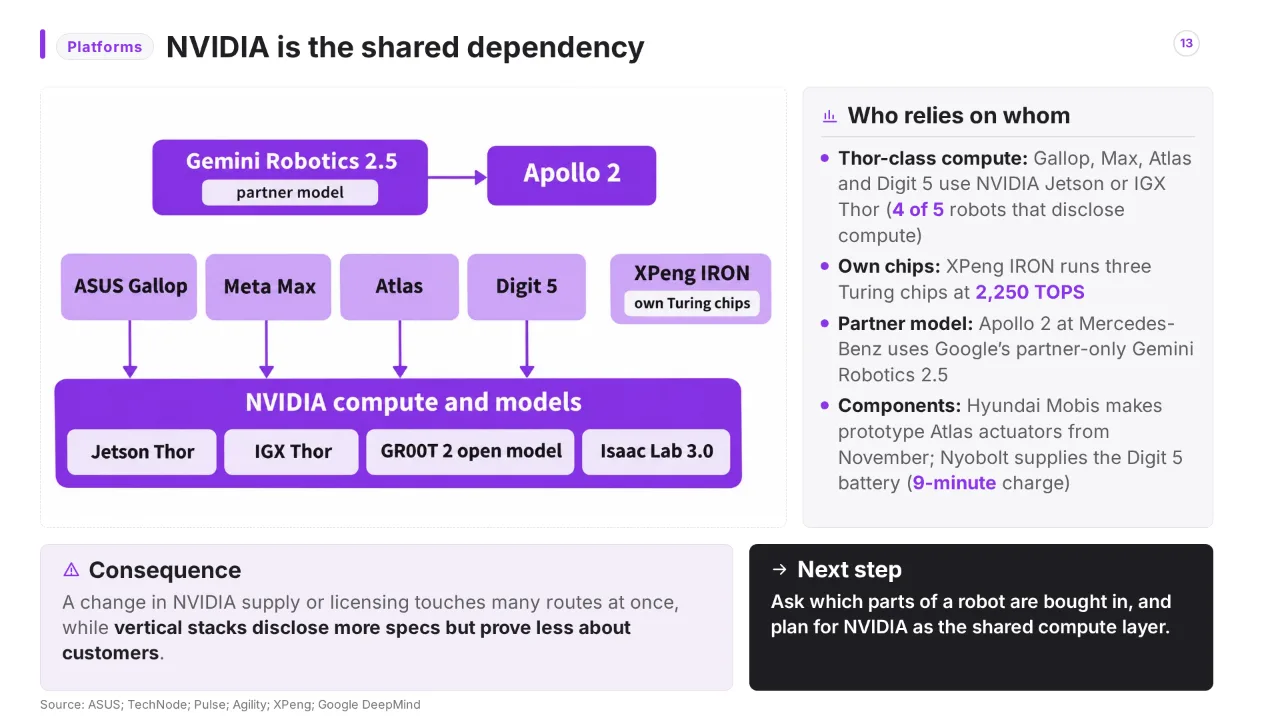
| Compute | NVIDIA Jetson Thor / IGX Thor | Gallop, Max, Atlas, Digit 5 | ASUS; TechNode; Pulse; Agility |
| Open model and simulation | NVIDIA GR00T 2, Isaac Lab 3.0 | Foxconn, Siemens, Nexuni (trials, not deployments) | NVIDIA |
| Partner-only model | Google DeepMind Gemini Robotics 2.5 | Apptronik Apollo 2 at Mercedes-Benz | DeepMind |
| Hardware platform | Fourier builds, Meta directs AI | Max prototype | TechNode |
| Actuators | Hyundai Mobis (prototype, from November) | Atlas | Pulse |
| Battery | Nyobolt fast-charging | Digit 5 | Agility |
| Vertical stack | Own chips, model, line | XPeng IRON (Turing chips), ASUS (hand, body) | XPeng; ASUS |
Judgement. The comparison supports three evidence-based conclusions, not a ranking. First, NVIDIA is the shared dependency: four of the five robots in 6.1 that disclose compute (Digit 5, Atlas, Gallop, Max) use a Thor-class computer, and XPeng is the exception with its own chips, and GR00T 2 is the one open model, so a change in NVIDIA's licensing or supply touches many routes at once. Second, vertical integration (XPeng, ASUS) discloses the most specifications but proves the least about customers; partner stacks (Apptronik with Google, Agility with NVIDIA) disclose pilots with named sites. Third, the brain choice is still open: a world action model and a VLA coexist, and the evidence for either is vendor-reported. Where a spec is "not disclosed", a buyer should treat it as unknown, not as equal.

7. Outlook and what to watch next
Chapters 2 to 6 show an industry that closed one financing and shipped no new product to buyers, so the useful outlook is what each reader should verify and which dates will settle the open claims.
7.1 What the window means for each reader
For every reader the rule is the same: act on delivered units, filed documents and named sites, and treat capacity, targets and benchmarks as claims until a second party confirms them.
| Reader | What the window shows | Implication |
|---|---|---|
| Builders and buyers of robots | Agility's more than US$300M orders are conditional, GXO–Apptronik is an LOI with KPIs, Gallop pilots start in 2027 | Ask for pilot KPIs, site names and hours, not capacity; plan for 2027 pilots and later volume |
| Investors and strategists | A listing route exists (Agility, AGLT from Nov 5); Agile Robots was priced at US$8.5B; reported talks are unconfirmed | Compare disclosures, not valuations; treat private-round and talks headlines as reported. Not investment advice |
| Developers of robot models | Three release levels: partner-only (Gemini Robotics 2.5), open with code due (GR00T 2), preview with promise (GO-3) | Pick on access and licence terms; wait for reproducible evaluations before treating success rates as comparable |
7.2 What would change the reading
Three observations would change the conclusions of this brief. First, a count of Optimus units built or delivered would turn Tesla's "early ramp" from a line into output; none was disclosed by Nov 16. Second, a named paying customer and fleet size for XPeng IRON would test the end-2026 mass-production target and the 2027 delivery plan. Third, a GR00T 2 code release and an outside re-run of its numbers would show whether the 40% zero-shot and 95% few-shot results hold. Conversely, a Gallop miss against its 99.5% target, or a KPI failure in the GXO trials, would put the 2027 and 2028 volume dates at risk.
7.3 Key dates
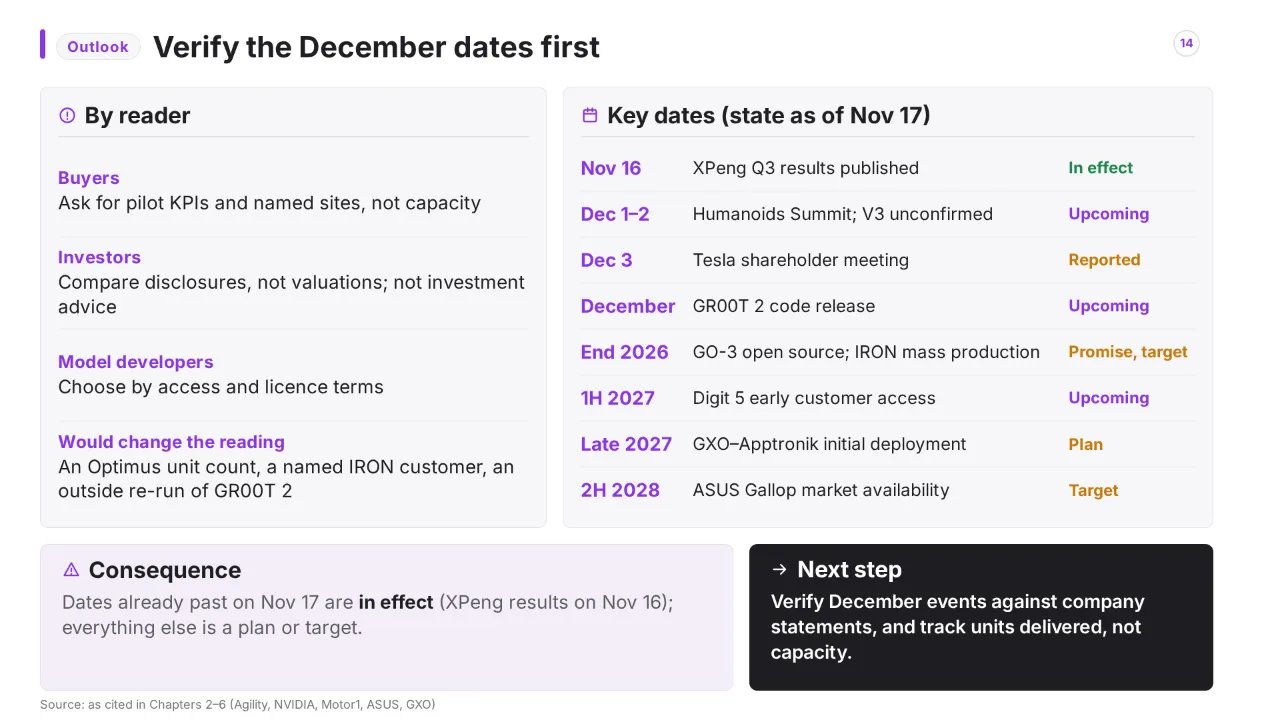
Dates are sorted; the state column compares each with the run date of Nov 17, 2026.
| Date | Event | State | Source |
|---|---|---|---|
| Nov 16 | XPeng Q3 2026 results published (IRON remarks) | In effect (past) | — |
| Dec 1–2 | Humanoids Summit; Optimus V3 appearance expected by press, unconfirmed by Tesla | Upcoming | — |
| Dec 3 | Tesla annual shareholder meeting (reported date; V3 reveal there unconfirmed) | Upcoming (reported) | — |
| December | NVIDIA GR00T 2 code "available in December" | Upcoming | — |
| End of 2026 | AGIBOT GO-3 open-source release promised (no date or licence) | Upcoming (promise) | — |
| End of 2026 | XPeng IRON mass production target | Upcoming (target) | — |
| About early May 2027 | End of Agility's 180-day lock-up (derived from Nov 4 close; secondary) | Upcoming (derived) | — |
| 1H 2027 | Digit 5 early customer access expected | Upcoming | — |
| 2027 | XPeng IRON deliveries; ASUS customer pilots and Computex 2027 showing; GXO–Apptronik trials begin | Upcoming | — |
| Late 2027 | GXO–Apptronik initial North America deployment; Tesla external deliveries (Musk, plan) | Upcoming (plan) | — |
| End of 2027 | Digit 5 general availability targeted | Upcoming (target) | — |
| 2028 | Hyundai targets Atlas deployment at its US plant; ASUS market availability targeted 2H 2028 | Upcoming (plan) | — |
Items marked "Upcoming (promise)" or "(target)" carry no commitment beyond the company's statement, and none is a to-do already past on Nov 17.
8. References
This document draws on the following 48 sources, listed in the order they are first cited.
- Agility Robotics and Churchill Capital Corp XI Complete Business Combination | Agility — agilityrobotics.com
- Churchill Capital Corp XI Shareholders Approve Business Combination with Agility Robotics | Agility — agilityrobotics.com
- Agility Becomes First U.S. Publicly Listed Pure-Play Humanoid Robotics Company, Begins Trading Today on Nasdaq as AGLT | Agility — agilityrobotics.com
- Gemini Robotics 2.5: Accelerating Physical Intelligence — Google DeepMind — deepmind.google
- GR00T 2: Scaling Robot Foundation Models for Generalization, Dexterity, and Adaptation — research.nvidia.com
- AGIBOT Unveils GO-3 Preview, Takes Top Spot on Three Embodied AI Benchmarks — prnewswire.com
- AGIBOT Unveils GO-3 Preview Robot Model: Predicts Outcomes Before Acting, Rankings Self-Reported — techtimes.com
- SoftBank and Nvidia back Munich's Agile Robots at an $8.5B valuation in a $500M Series F | Dealroom News — dealroom.co
- SoftBank-led round values Agile Robots at $8.5 billion — qz.com
- GXO and Apptronik Expand Partnership to Scale Humanoid Deployment | GXO Logistics, Inc. — investors.gxo.com
- Skild AI: Omni-Bodied Robot Brain Passes US$100m ARR | AI Magazine — aimagazine.com
- Humanoid Robot Industry Trends & Market Analysis | HumanoidMegaHub — humanoidmegahub.com
- Who is Tesla’s biggest humanoid rival? – New Market Pitch — newmarketpitch.com
- Tesla Optimus Reservation Confusion Explained — motor1.com
- XPENG L03: The AI SUV Backed by the Industry, Built for an Ecosystem — xpeng.com
- Earnings call transcript: XPeng Q3 2026 revenue beats, loss widens sharply By Investing.com — investing.com
- SAG: Global Humanoid Robot Shipments Surge 347% YoY in Q3 2026; AGIBOT Leads While UBTech Overtakes Unitree for No. 2 - Smart Analytics Global — smartanalyticsglobal.com
- Factory-Proven Physical AI: Why ASUS Is Building a Humanoid Robot | ASUS Pressroom - Official Global News & Updates — press.asus.com
- Why Meta Turned to China’s Fourier for Its Humanoid Robot · TechNode — technode.com
- Xinhua Unveils Bionic Humanoid Robot News Anchors with UBTECH – Unite.AI — unite.ai
- Hyundai Motor Group's Atlas Robot Executes 360-Degree Jump on Wheels - Businesskorea — businesskorea.co.kr
- Practice Makes Precise: At CoRL, NVIDIA and Partners Reveal How Robots Rehearse Delicate Work in Simulation | NVIDIA Blog — blogs.nvidia.com
- ASUS Sets Human-Pace Packing Target for Gallop Humanoid Robot – Unite.AI — unite.ai
- ASUS Unveils Gallop, Its First Humanoid Robot, Already Packing Parts on Its Own Production Line | Humanoids Daily — humanoidsdaily.com
- Meta confirms Max, a humanoid robot built with China's Fourier — pasqualepillitteri.it
- Boston Dynamics Shows Wheeled Atlas Doing a 360-Degree Midair Spin, Eyes 2028 Factory Deployment — BigGo Finance — finance.biggo.com
- Boston Dynamics’ Atlas takes on complex factory tasks with AI - 매일경제 영문뉴스 펄스(Pulse) — pulse.mk.co.kr
- 제미나이 로보틱스 2.5: 현실 세계의 물리적 지능을 가속화하다 — blog.google
- AGIBOT unveils GO-3 embodied AI model, tops three benchmarks — roboticsandautomationnews.com
- Top Robot Foundation Models Startups by Revenue – New Market Pitch — newmarketpitch.com
- Physical Intelligence: What are Robot Foundation Models? | AI Magazine — aimagazine.com
- Physical Intelligence is reportedly raising at a $20B valuation. Four months ago it was $10B. Nobody's talking about the hiring problem that comes next. Here's the pattern I watch every single… | Sonny Sarna — linkedin.com
- Tesla's Optimus Robot Is FINALLY in Production?! (V3 Reveal Coming in December) — youtube.com
- XPeng Robot Stock: IRON Humanoid, XPEV Price & Outlook — optimusk.blog
- Who has the most advanced humanoid robot? – New Market Pitch — newmarketpitch.com
- Figure's new humanoid robots take first steps outside US factory — interestingengineering.com
- Humanoid robots: which company is ahead? – New Market Pitch — newmarketpitch.com
- AgiBot Stock: Swancor (688585), Hong Kong IPO & Exposure — optimusk.blog
- Press Releases | Agility Robotics, Inc — investors.agilityrobotics.com
- Agility is public: the short list of humanoid robot stocks, and who's next | HumanoidMegaHub — humanoidmegahub.com
- Agile Robots: $500 Million Series F Led By SoftBank With Nvidia Participation At $8.5 Billion Valuation — pulse2.com
- Agility Unveils Digit 5 Humanoid Robot Built for Cooperatively Safe Work at Scale | Agility — agilityrobotics.com
- XPENG IRON Humanoid Robot Now Walks Off the Production Line — xpeng.com
- XPENG IRON: generations, specs and latest news | Humanoids Daily — humanoidsdaily.com
- Robot Hands for Modern AI and Real Work | Boston Dynamics — bostondynamics.com
- Atlas specs, price & images | FIRGELLI Robots — firgellirobots.com
- 1X World Model | From Video to Action: A New Way Robots Learn — 1x.tech
- Do World Action Models Generalize Better than VLAs? A Robustness Study — arxiv.org