A conclusion title (consultants call it an action title) is a full sentence that states the one thing the slide proves. “Market overview” is a topic. “US$7.75B in four loans slowed” is a conclusion: it names what happened, puts the number in, and fits on one line. The reader gets the point before looking at the chart, and the chart’s only job is to prove it.
Two checks tell you whether your titles work. First, read only the titles, in order: they should tell the whole story without the slides. Second, look at each slide body and ask whether everything on it supports the title above it. If a title fails the first check, the storyline has a gap. If it fails the second, the slide is arguing about something else.
The examples below are real slides: twelve decks Gamma and Divrite made from the same six analyst briefs, and a ten-slide deck on the US remote-access rule for advanced chips, published Nov 26, 2026.
What separates a topic title from a conclusion title?
A topic title tells the reader what the slide is about. A conclusion title tells them what to think about it. The difference shows up in four places:
| Topic title | Conclusion title | |
|---|---|---|
| Form | Noun phrase | Sentence with a verb |
| Claim | None | Exactly one |
| Number | Rarely | The one the slide proves |
| Date | Rarely | Whenever the fact can change |
“Data protection compared”, “Pricing at a glance” and “What to watch in Q4” are all topic titles from the Gamma decks in our Gamma vs Divrite test. Each sits on a useful slide, but a reader who skims the titles learns nothing from them.
To be fair to Gamma, many of its titles are conclusions: “Share is shifting toward Lilly”, “Models already on the market have until 2 August 2027”. Titles were the closest of the six scores in the test, 13.7 to 11.0 out of 15. Its topic titles sit on tables and comparisons, where a reader most needs the result.
Keep a title to one line, two at most. The method we use puts a short label (“Loans · Bloomberg”) before each title to carry the section and subject, so the title can spend its 40 or so characters on the claim.
Run the title test: read only the titles
Here are the titles of the export-controls deck, copied from its outline. The brief asked for six sections, from highlights to upcoming dates, on the rule the Bureau of Industry and Security released on Nov 16 and put into effect on Nov 19, 2026. Read the right-hand column on its own:
 3  The rule · Nov 19        License follows the user of the compute
 4  The rule · Dates         30, 61 and 90 days from Nov 19
 5  Responses · Nov 16–24    China objects; five governments split
 6  Loans · Bloomberg        US$7.75B in four loans slowed
 7  Markets · Nov 17         Malaysian data-center stocks fell up to 20%
 8  Next dates · To Feb 17   Dec 19, Jan 19 and Feb 17 are fixed
 9  Who acts · By Feb 17     Operators, exporters, lenders
10  Closing                  From Nov 19 the license follows who uses the compute
That is the issue in eight lines: the rule, its dates, the reactions, the money, the markets, the deadlines, who acts. The closing line repeats the first title on purpose. The report behind the deck opens the same way, with the rule tying a license “to the user of the compute, not only to the place a chip ships”.
The test also finds the weak link. Slide 9, “Operators, exporters, lenders”, is a list with no verb. It names three groups and says nothing about them.
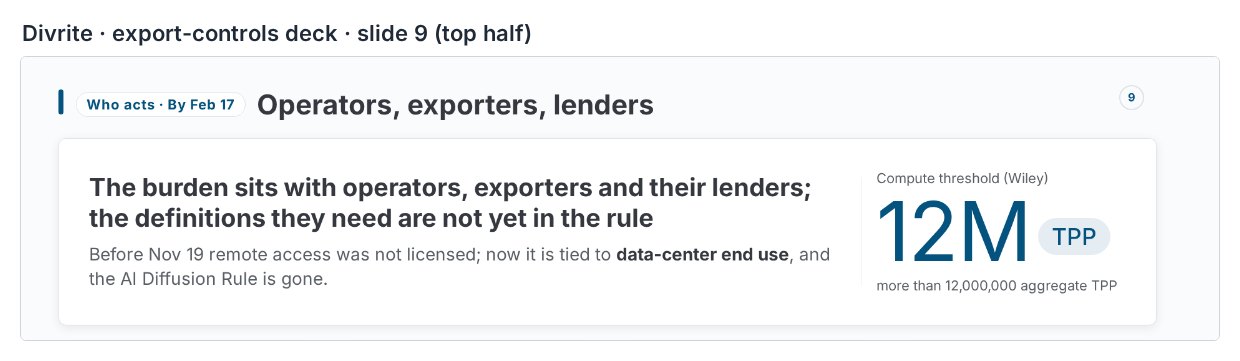
Notice that the slide’s own lead sentence is the better title: “The burden sits with operators, exporters and their lenders; the definitions they need are not yet in the rule”. That sentence carries two claims, so take the first: “Operators, exporters and lenders carry the burden”. The point about missing definitions belongs in the body, where the slide already lists them. When the strongest sentence on a slide sits below the title, promote it.
To run the test on your own deck, paste the titles into a blank page and read them aloud as one paragraph. Mark every pause where you had to guess what comes next, and every title without a verb. Check that the last title answers the brief. Then fix the titles before you touch a chart; it is far cheaper at the outline stage, which is why a research deck should start from its outline.
How do you write a conclusion title?
Start from the “so what”
Finish this sentence: “This slide proves that…”. Whatever follows “that” is your draft title. If you can’t finish the sentence, the slide has no point yet, and wording won’t fix that.
Put the number in, and make it the right number
A number makes a claim checkable. It has to be the number the slide proves.
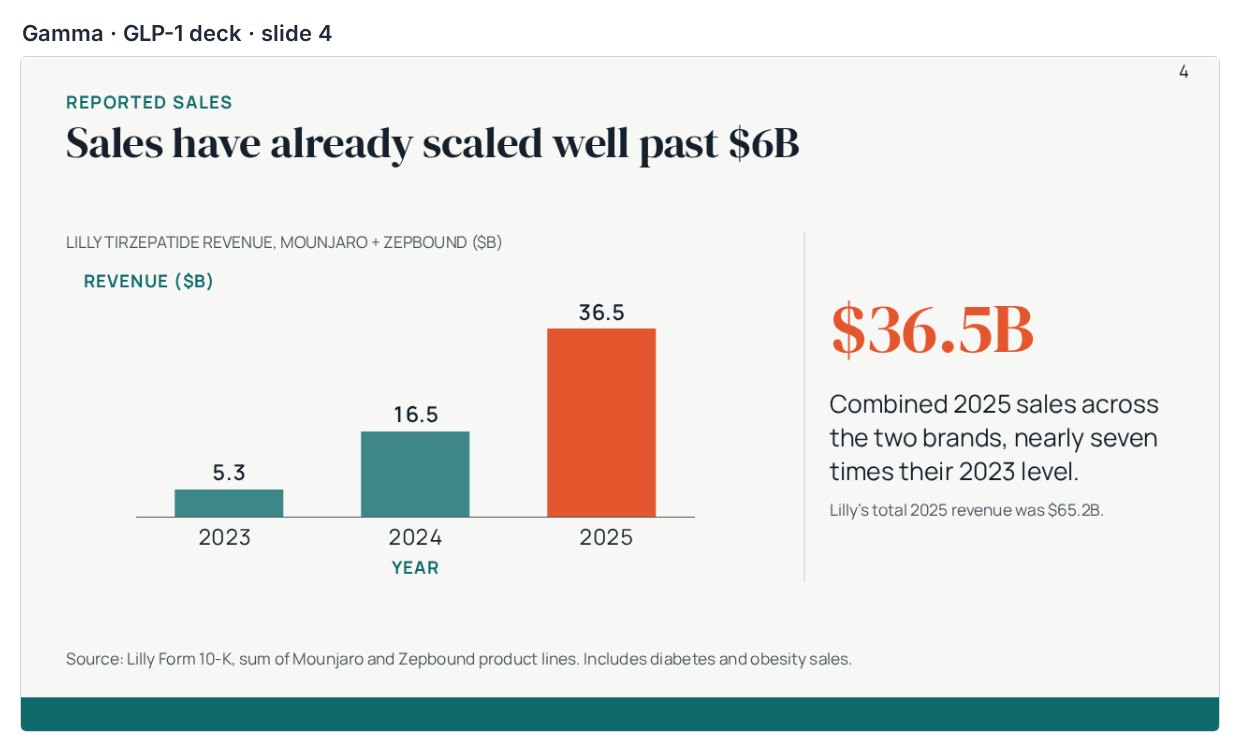
The title says sales are “well past $6B”. The chart and the big figure on the right say $36.5B in 2025, “nearly seven times their 2023 level”. The $6B is a 2023 benchmark from another slide. Nothing here is false, but the title undersells its own evidence. A title built from the chart, as an illustration: “Tirzepatide sales reached $36.5B in 2025, nearly 7x 2023”.
Name the subject
“Shares fell 2.9% on Nov 18” works in an Nvidia earnings deck because the label and the deck make the subject obvious. In a market-wide deck it would need “Nvidia” in front. Ask whether the slide, forwarded on its own, still says who the claim is about.
Keep the verb
Verbs carry the claim: follows, slowed, fell, runs, split. Strip the verb and you are back to a topic. “Data protection compared” becomes a conclusion only when it says what the comparison found.
Date anything that can change
Prices, rules, forecasts and job titles change. “Duties Aug 2, 2025; fines Aug 2, 2026” (Divrite’s EU AI Act deck) tells the reader which obligations already apply. A title without a date leaves them to guess whether it is still true.
Cut to one or two lines
Delete adjectives first (“significant”, “notable”), then hedges (“appears to”), then anything the label already says. If it still runs past two lines, it usually holds two claims.
Make the body prove the title, and nothing else
Everything below the title either proves it, says what it means, or says what to do about it. Anything else goes on another slide or in the appendix.
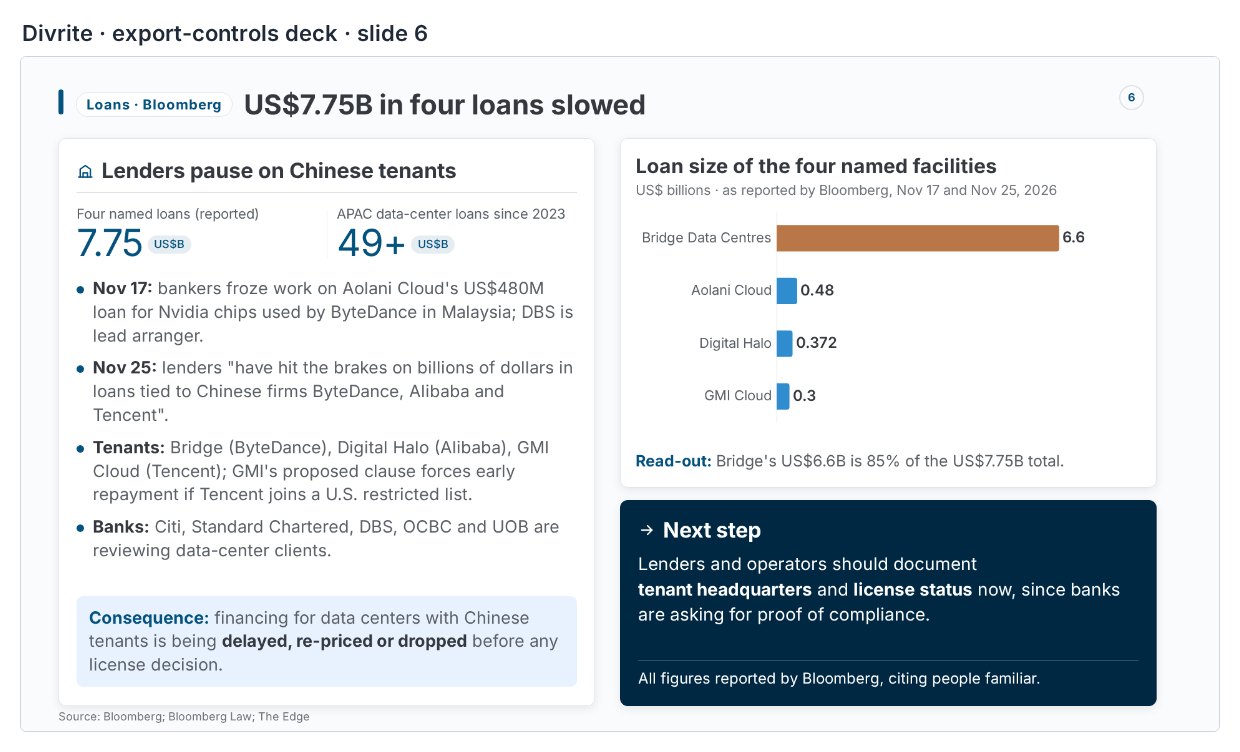
Here the title is “US$7.75B in four loans slowed”. The chart shows the four loans that make up the total, and its read-out says Bridge’s US$6.6B is 85% of it. The left column gives the dated reporting (Nov 17 and Nov 25, 2026). The consequence and the next step follow from the same claim, and a line under the next step says all figures are Bloomberg’s, citing people familiar with the deals.
The method we use makes this a rule: each content slide answers fact, numbers, consequence, action and source, and every number on it must appear in the report behind it. In practice:
- Every number in the title appears in the body, with its source and date.
- The chart shows what the title says. If the title says “slowed” and the chart shows loan sizes with no sign of what slowed, change the chart or the title.
- Interesting extras leave. A good fact that doesn’t support this title weakens it.
Before and after: ten real titles on the same question
Each row is the same sub-question of the same brief, answered by Gamma and by Divrite. The titles are copied word for word from the slides. Divrite’s sit after a short label, left out here.
| Brief | Gamma’s title | Divrite’s title | What changes |
|---|---|---|---|
| Sales-team tool choice | What 20 seats really cost per year | Annual list runs $4,320 to $9,600 | Gives the answer instead of asking the question |
| Remote work | Where the evidence conflicts | BLS +0.08 pp; SF Fed finds little link | Names both sides of the conflict |
| EU AI Act | Three dates frame the regime | Duties Aug 2, 2025; fines Aug 2, 2026 | Says which dates already apply |
| Market entry | Moving customer data from the EU to the US | In force 1,234 days; SCCs as backup | Status of the framework plus the fallback |
| Market entry | Japan’s APPI is lighter, but cross-border transfers need care | Surcharge by Jul 2028; 30-day reports | A deadline in place of “need care” |
| GLP-1 market | Four levers explain why analysts diverge | Price and persistence: $61B to $164B | Which levers matter, and by how much |
| GLP-1 market | 2030 forecasts span roughly $95B to $144B | Three banks span $114B to $200B | Current forecasts instead of superseded ones |
| Nvidia earnings | Gross margin slipped only 0.2 points despite the Rubin ramp | Q4 guide 71.5%, 3.3 pts below Q3 | Points to the margin that moves next |
| Nvidia earnings | What to watch in Q4 | 10-Q pending; $69B due by Jan 2027 | What is still open, and its size |
| Nvidia earnings | A first report without Jensen Huang as CEO | Shares fell 2.9% on Nov 18 | The market’s verdict, not a claim Nvidia’s Nov 23 announcement reversed |
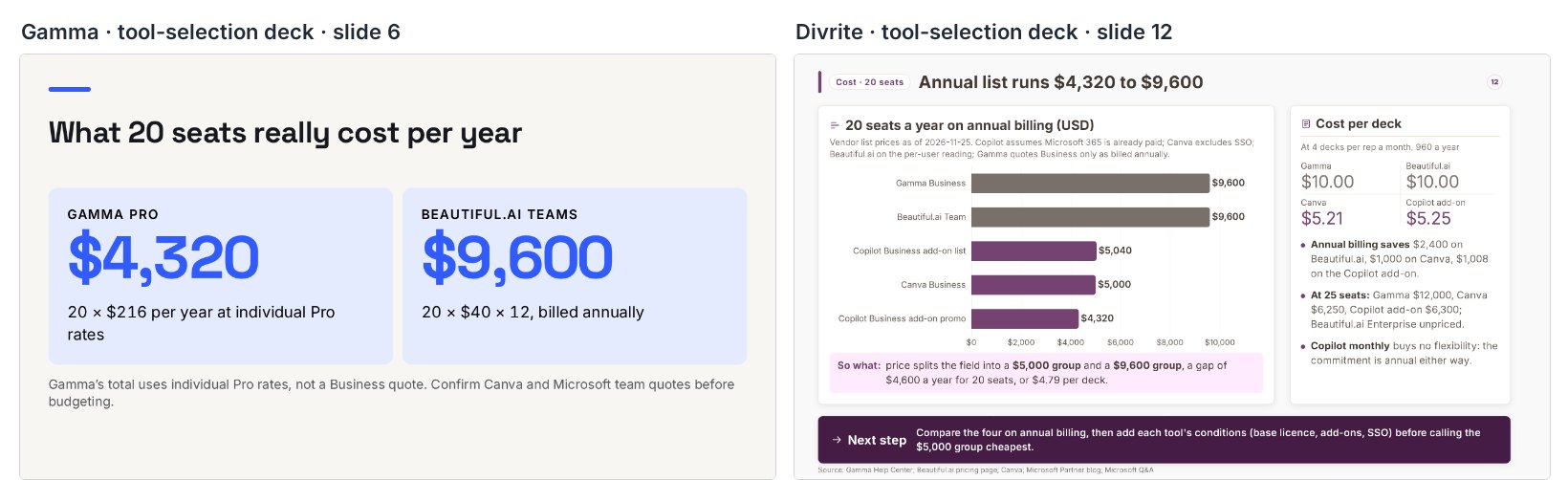
Gamma’s slide on the left already holds the answer, $4,320 and $9,600, in large type. Only the title is still asking.
Two notes. Gamma’s margin title is a sound conclusion; Divrite’s looks ahead to the next quarter, which is what an investor asks. And Divrite’s titles can be this short only because the label carries the subject.
What are the common mistakes?
Two claims in one title. Our own GLP-1 deck has “Net price −43%; Novo list to $675 in 2027”. That is two facts, and the reader can’t tell which is the point. Compare “Lilly guides +40%; Novo −2% to +2%”, which is one claim: a contrast between two companies on the same measure. The rule of thumb: if the two halves would need two different charts, split the slide.
Vague verbs. “Need care”, “frame”, “shape”, “impact” and “drive” sound like claims but don’t commit to one. “Japan’s APPI is lighter, but cross-border transfers need care” also shows the cost of vagueness: Japan amended the law on Jul 10, 2026, adding administrative surcharges, and a vague title made the gap easy to miss.
A title the chart doesn’t support. This runs both ways. A title can undersell its chart, as with “well past $6B” above. Or it can claim more than the chart shows, as in this illustration: “Remote work raises productivity” over a chart of correlations across industries. Divrite’s remote-work title states the conflict instead, because its evidence is correlational and the two sources disagree.
Stale numbers. The title is the line everyone reads, so an out-of-date title does the most damage. “2030 forecasts span roughly $95B to $144B” uses a Goldman Sachs figure that Goldman raised to $114B in mid-2026. “A first report without Jensen Huang as CEO” was overtaken when Nvidia announced his return on Nov 23, 2026. Check the date behind every number in every title on the day you send the deck.
Questions as titles. A question can work on a section divider. On a content slide, answer it.
The checklist
Copy this into your notes and run it on the outline, then again on the finished deck:
[ ] Read the titles alone, in order: the story holds without the slides
[ ] Every content title is a sentence with a verb
[ ] One claim per title; a second claim gets its own slide
[ ] The title carries the number the slide proves
[ ] Anything that can change has a date
[ ] The subject is clear if the slide is forwarded on its own
[ ] One line, two at most
[ ] Every number in the title appears in the body, with a source
[ ] The chart shows what the title says
[ ] Nothing on the slide is off the title's point
[ ] The last title answers the question in the brief
[ ] Every title number checked against its source on the day you send
Frequently asked questions
What is an action title?
An action title is a slide title written as a sentence that states the slide’s conclusion, such as “Malaysian data-center stocks fell up to 20%”, rather than its topic, such as “Market reaction”. The term comes from consulting, where decks are often read without a presenter.
How long should a slide title be?
One line, two at most. In practice that is roughly 6 to 15 words. If a title needs a third line, it usually holds two claims or a caveat that belongs in the body.
Does every slide need a conclusion title?
Every content slide does. The cover, the contents page, section dividers and appendix tables can use plain labels. Even the contents page can do more: the export-controls deck lists each part with its conclusion, such as “US$7.75B in loans slowed, per Bloomberg”.
Do conclusion titles work in a deck I present live?
Yes, and they matter even more, because the audience reads the title while you talk. In a speech deck, keep a one-line conclusion and one chart on the slide and move the detail into your script. More in reading deck vs presentation deck.
What if the data doesn’t support a clear conclusion?
Then say that, specifically. “BLS +0.08 pp; SF Fed finds little link” is a conclusion: the evidence conflicts, and the title names both sides. What fails is a title that hides the uncertainty (“Mixed evidence on productivity”) or one that picks a side the data doesn’t back.
Divrite writes every deck from a research run, with conclusion titles and a source line on each slide: AI presentation maker.