To write a research report with AI, don’t ask for the report in one prompt. Split the job into five steps: write a precise brief, research the question in depth, write the report chapter by chapter from that research, check the numbers and dates against the sources, and only then turn the report into a deck or a document. AI can do most of the work in each step; you decide what the report covers and check what it says.
If you have asked ChatGPT for “a report on X”, you know what comes back: a long, fluent reply with headings, general claims and numbers you can’t trace. A research report needs a scope, a time window, sources you can open, and facts that carry their dates.
Below, each step uses a real example: a published report on U.S. semiconductor export controls, covering Nov 16 to 26, 2026. For report structure in general, see how to write a research report.
What separates a research report from a chat reply?
| Chat reply | Research report | |
|---|---|---|
| Question | A line typed in a chat box | A brief with scope, dates, sections and sources |
| Research | One quick search, or none | Many pages read in full, primary sources first |
| Structure | A few paragraphs, as long as one reply allows | Chapters, a contents list, a summary first |
| Facts | General statements, numbers in prose | Dated facts with a status: done, scheduled, reported |
| Evidence | Claims without page-level sources | A source for each number, and conflicts shown |
| Output | Text to copy out of a chat window | An editable document or deck |
You can get every row on the right from AI, but not from a single prompt.
Step 1: Write a brief a researcher could act on
A vague ask gets a vague report: the model has to guess the scope, the period and the standard of evidence, and it guesses toward the general. Here is a vague version of the export-controls question, written by us as an illustration:
Write a report on the new US chip export rules and what they mean for Asia.
And here is the brief the published report was actually written from, word for word:
Write the “Semiconductor Export Controls” hot-topic report covering 2026-11-16 to 2026-11-26, centred on the U.S. Bureau of Industry and Security’s interim final rule “Addressing Remote Access to Advanced Semiconductors” (released Nov 16, published and effective Nov 19, 2026): new license requirements for advanced computing items going to data centers that serve companies headquartered in countries of concern, a license requirement for shipments to Singapore, Malaysia, Thailand, Indonesia and Brazil, and the formal rescission of the AI Diffusion Rule; plus China’s response and the reported pause in data-center and GPU financing tied to ByteDance, Alibaba and Tencent in Southeast Asia. Sections: 1. Highlights 2. The rule and what changed 3. Responses: China and the five countries 4. Affected companies, data centers and financing 5. Supply-chain and market adjustments 6. Upcoming dates. Length 3,000–4,500 words, for a 10-page slide deck. Key sources: the Federal Register and BIS, government statements, company announcements, direct Bloomberg/Reuters reporting; law-firm notes only attributed. Facts and attributed statements only; no predictions. Answer in English.
Every part of it removes a guess:
| Part of the brief | What it settles |
|---|---|
| Time window (Nov 16 to 26, 2026) | Which events count, and the date the report is “as of” |
| The rule named in full, with its dates | What the report is about, so it doesn’t drift into chip policy in general |
| The five countries and three companies | Which parties need their own coverage |
| Six numbered sections | The chapters, in order |
| Length and use (a 10-page deck) | How much detail each chapter carries |
| Sources and their weight | Rule text first; law-firm readings only with their name attached |
| “Facts and attributed statements only; no predictions” | No forecasts dressed as findings |
The last line matters most. A model asked “what does this mean” will forecast, and its forecasts read exactly like its facts.
What AI does well here: turning your rough question into a draft brief. Ask it to list the sub-questions, the parties, the dates and the likely sources, then edit.
What you must check: that the scope is the one your reader needs, and that the time window and sections are yours, not the model’s defaults.
A template you can copy:
Topic: <one line, with the event, rule, company or market named in full>
Period: <start date> to <end date>; facts as of <end date>
Must cover: <parties, countries, products, figures the reader will ask about>
Sections: 1. Highlights  2. ...  3. ...  N. Upcoming dates / open questions
Length and use: <word range>, for <a deck of N slides / a memo / a pre-read>
Sources: <primary sources first>; <secondary sources only attributed>
Evidence rule: facts and attributed statements only; no predictions
Language: <language of the report>; search local-language sources for <countries>
Step 2: Research in depth before anything is written
The export-controls report cites 69 different sources, from the rule text in the Federal Register to government statements, law-firm notes and Bloomberg reporting. You can’t fit that into one reply.
Four habits make the research usable.
Go to primary sources first. For a rule, that is the rule text; for a company, its filing; for a price, the vendor’s price page. The method we use takes numbers, dates and status from primary sources and lets news and commentary supply interpretation. When a fact exists only in a secondary source, the report says so: “Wiley puts the threshold at more than 12,000,000 aggregate TPP” names the law firm instead of presenting its reading as the rule.
Count sources, not outlets. The frozen US$480M loan tied to ByteDance appears in the export-controls material through Bloomberg Law, TradingView and The Edge Singapore. That is one Bloomberg story, not three sources. The report says as much: “All loan figures and statuses are reported by Bloomberg, citing people familiar with the matter; none has been confirmed by the borrowers’ filings.”
Search in the local language for country questions. A country’s rules and statements are published first by its own government, in its own language. English summaries come later and lose detail. In the Divrite vs Gamma test, Gamma described Japan’s privacy law as it stood after 2022 and missed the amendment passed on Jul 10, 2026. See researching across languages for how to search in a language you don’t speak.
Attach a date and a status to every fact. “Comments due Jan 19, 2027” is a fact. So is “China said on Nov 17 that it would take countermeasures; as of Nov 26 no measure had been named.” The second one carries two dates and a status, which is what keeps it true after Nov 26.
What AI does well here: breadth. It can search by sub-topic and by country in parallel, write queries in each local language, read pages in full and go back for thin points. That is what a deep research tool is for.
What you must check: whether the primary source is in the pile at all, whether three “sources” are really one, and whether the newest facts in your window made it in.
Step 3: Write chapter by chapter, from the material
Write one chapter at a time, each from the material collected for it, not from what the model already knows. A model’s memory stops at its training date and blends sources together. The material is dated and checkable.
The method we use for each chapter:
- One scope per chapter. Each chapter knows what the others cover. A fact that belongs elsewhere gets one sentence and a pointer (“see Chapter 4”).
- Open with the link to the last chapter. Chapter 2 of the export-controls report opens: “Behind the highlights sits one Federal Register document; this chapter sets out what its text requires, from which date, and what it replaces.”
- A source on every sentence that carries a number, date, quote or name. Tables get a source column.
- Status labels. In effect, scheduled, reported, announced, estimate. A deadline that has passed is never written as upcoming.
- Conflicts shown both ways. China’s foreign ministry pledge appears in three English translations, and the report gives all three with their outlets rather than picking one.
- A key-data table at the end of each chapter, listing the facts a checker will want to look at first.
Write the highlights chapter last, even though it comes first: it can only summarize what the other chapters establish. In a market-sizing report, give disagreement its own chapter (“Where estimates disagree and why”), with each forecast’s scope and date side by side.
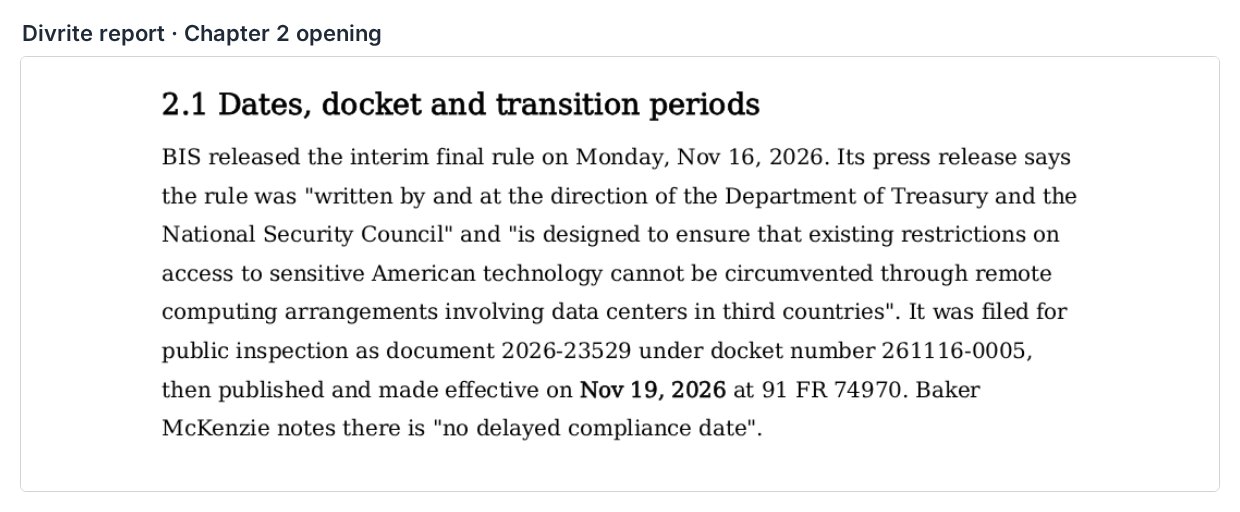
Notice what the paragraph is made of: the agency’s own words in quotation marks, the document and docket numbers, the publication date, and a law firm’s reading credited to the firm by name.
What AI does well here: drafting fast from a stack of material, keeping citations attached, building tables.
What you must check: that each chapter answers its section of the brief, that the highlights match the chapters, and that nothing in the text is missing from the material.
A rewrite: the same point, weak and strong
The weak version below is our illustration of a typical answer from memory; the strong version is from the published report.
| Weak (illustration) | Strong (from the report) |
|---|---|
| The new rules are likely to have a major impact on Southeast Asia’s booming data-center industry, and China is expected to retaliate. | China said on Nov 17 that it has “strong dissatisfaction and firm opposition” and would take countermeasures “if the US persists”; as of Nov 26 no measure had been named. |
What changed:
- “Likely” and “expected” are predictions. The strong version states what was said, by whom and when.
- “Major impact” and “booming” can’t be checked. A quote and a date can.
- “As of Nov 26” tells the reader when the statement was last checked.
Step 4: Check numbers and dates against the sources
Every AI-written report needs a check before it goes out. The full method is in our guide on fact-checking numbers in AI reports. In short: mark the numbers that carry weight, open the cited page for each, check the date, the definition and the units, and recompute anything derived.
Dates deserve the same care as numbers. The export-controls rule says comments are due “60 days after date of publication”. Sixty days from Nov 19, 2026 lands on Jan 18, 2027, and two secondary summaries print Jan 18. The Federal Register page gives Jan 19. The report shows the count, states both dates and says it follows the Federal Register. The 30-day savings clause has the same problem: Nov 19 plus 30 days is Dec 19, while GHY gives Dec 21. The report gives both, because the clause text wasn’t in the material.
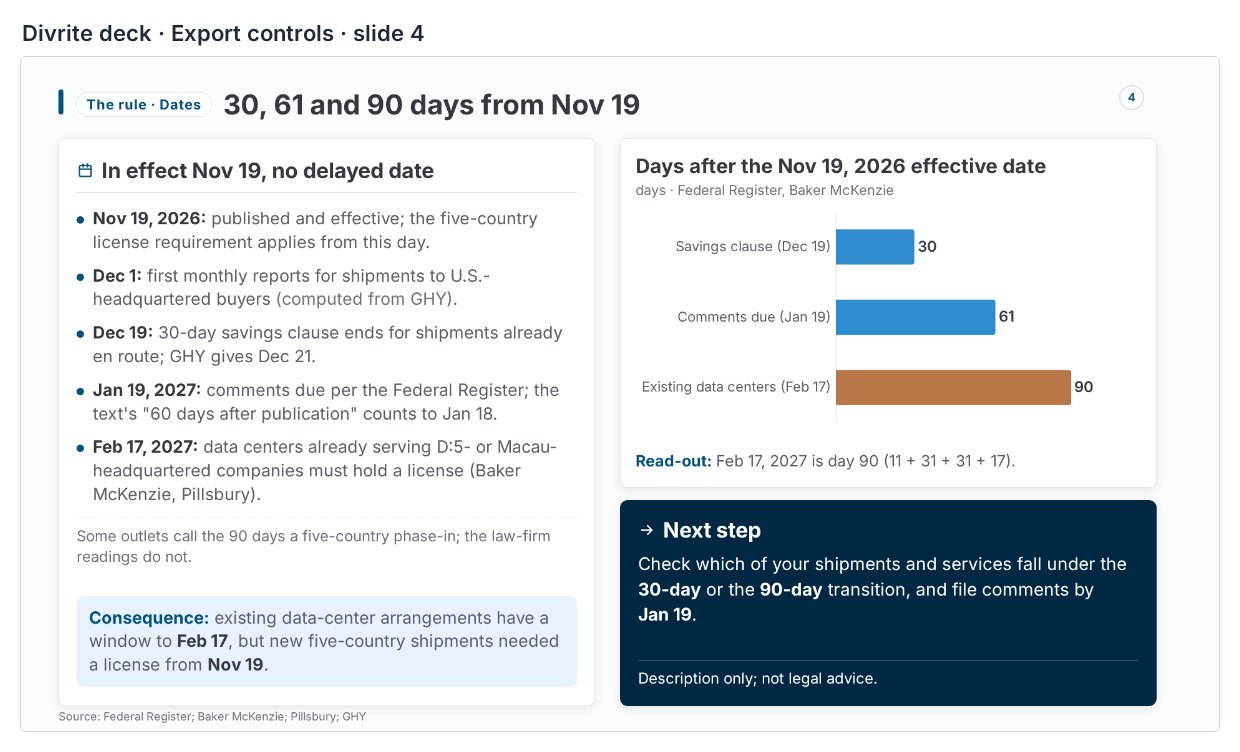
Notice that the disagreements stay on the slide (“GHY gives Dec 21”, “counts to Jan 18”) instead of being quietly resolved.
What AI does well here: date arithmetic with the formula shown, matching each figure to the page it came from, flagging figures it couldn’t find.
What you must check: the load-bearing numbers yourself, on the source page. In the Divrite vs Gamma test, Divrite’s decks had four small errors in the sampled numbers. One example: the GLP-1 deck says it is not confirmed whether the $245 Medicare price also applies to Medicaid, while the White House fact sheet says it does. None changed a conclusion, and this step is how such errors get caught.
Step 5: Turn the report into a deck or a document
Only now make the deliverable. Slides built from a finished report already have every number and source. See how to make a research deck for the full process; the rules we use are short:
- A cover, a contents slide and a closing slide.
- Each content slide has a one-line title that states a conclusion, not a topic.
- Each content slide answers five things: the fact, the numbers, the consequence, the action and the source.
- At most one visual per slide, and charts are built from the report’s own data.
- Every number on a slide must be in the report.
The six-chapter export-controls report became a 10-slide deck and a document version with a contents page.
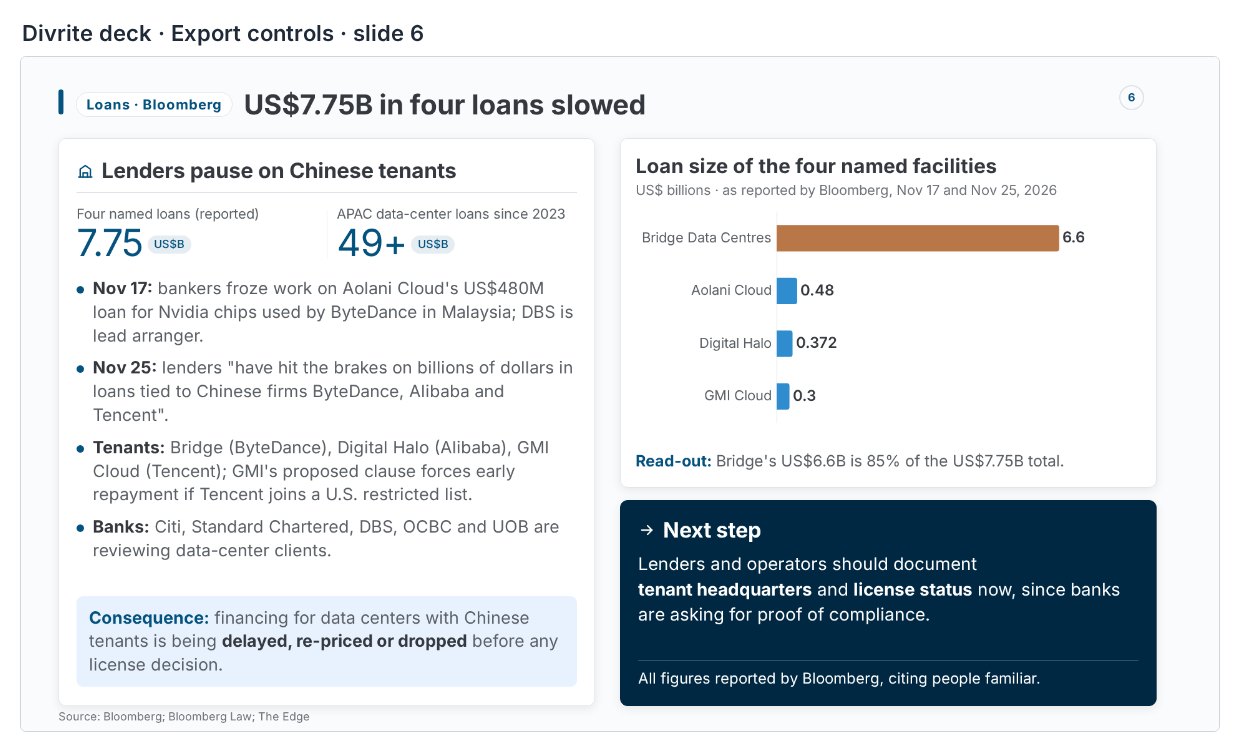
The chart uses only the four loan figures from Chapter 4, and the slide repeats the attribution: “All figures reported by Bloomberg, citing people familiar.”
What AI does well here: layout, charts from the data, speaker notes, and versions of the same research for reading, presenting or a spoken script.
What you must check: that the titles say what the report says, no stronger, and that every number on a slide can be found in the report.
What a deck without current research looks like
Skipping steps 2 to 4 doesn’t produce an ugly deck. It produces a clean one that is out of date in ways you won’t see until a client asks.
In our Divrite vs Gamma test, both tools got the same six analyst briefs. Gamma’s slides are clean and easy to read, and its numbers were mostly right. But on the GLP-1 brief, its closing slide reads “Plan for about $100B in 2030, and stress-test the range”, built on Goldman Sachs at $95B and Morgan Stanley at $105B. Both figures were out of date: Goldman raised its 2030 estimate to $114B in mid-2026, above Gamma’s whole planning range.
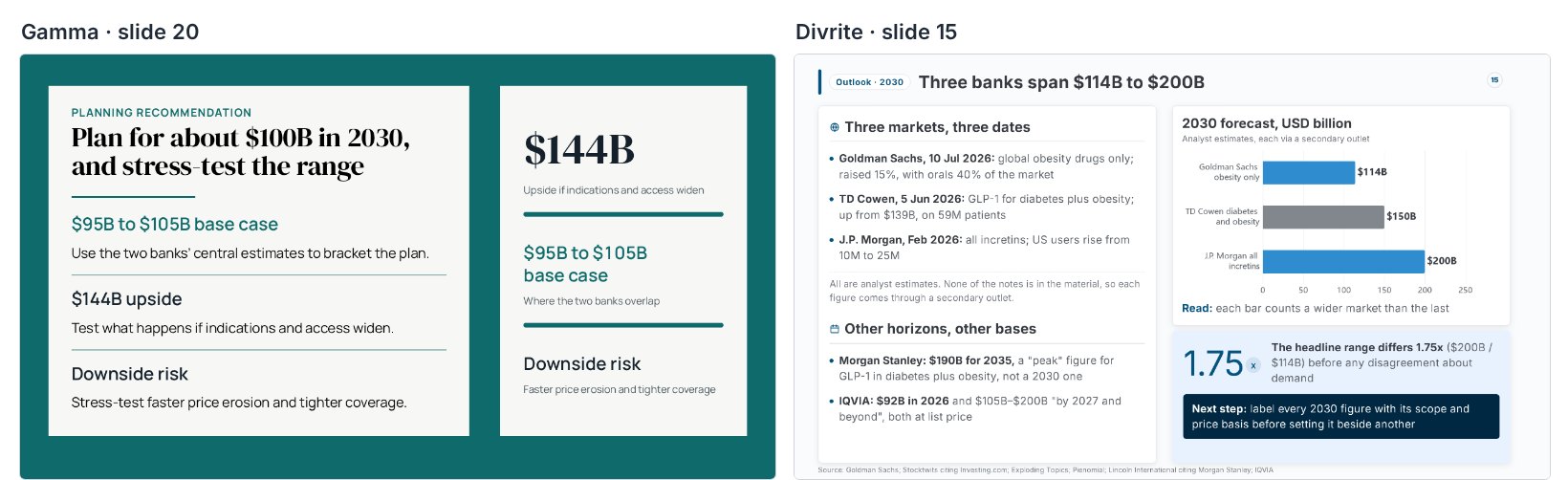
The right-hand slide dates each forecast and names the market it measures.
The same pattern ran through the test:
- Out-of-date facts. Gamma’s Nvidia deck says Jensen Huang is out as CEO. Nvidia announced his return on Nov 23, 2026.
- Missing items a client will ask about. The GLP-1 deck leaves out that the FDA ended the shortages in 2024 and 2025, that compounded versions still compete for cash-paying patients, and that semaglutide generics begin in Canada and other markets in 2026.
- Few source lines. Four of Gamma’s six decks have no source line on any slide.
Gamma Agent can pull in cited research when you ask; the test used standard generation. The lesson isn’t about one tool: a deck made straight from a prompt inherits the model’s memory, and that is where out-of-date forecasts come from.
Be honest about the limits
An AI-written report is research you still have to verify. This workflow reduces errors and makes the rest easy to find, because every fact arrives with a date and a source. It doesn’t remove them. A report is only as current as its research window, and it can’t know what its sources got wrong. If your name goes on it, read the sources for the numbers that carry the argument.
Frequently asked questions
Can ChatGPT write a research report?
It can draft one, and it can help with each step. Asked in a single prompt, it usually returns a long reply from memory or a quick search, without page-level sources. You get closer to a report by giving it a precise brief, feeding it the research, and having it write one chapter at a time from that material.
How do I stop AI from making up numbers or sources?
Have it write only from material you collected, with a source on every sentence that carries a number or date, and with “facts only, no predictions” in the brief. Then check the load-bearing numbers on the source pages. Figures it can’t trace should be removed or flagged, not smoothed over.
How long should the brief be?
As long as it takes to settle scope, time window, sections, length, sources and the evidence rule. The export-controls brief is about 170 words. A one-line request leaves all of those to the model.
Should I let the AI make predictions in a research report?
Keep predictions out of the main chapters. Forecasts written by a model read just like facts, and readers can’t tell them apart. If you need an outlook, cite named forecasts with their date and scope, or write your own view in a separate, labeled section.
Divrite does this research and writing for you: AI report generator.