The executive summary is the part of a research report that many readers read instead of the report. So write it to stand alone. Open with the answer in one or two sentences. Follow with four to eight findings, each a short bold lead plus the fact with its number, date and status. Then say what changed, what comes next and on which dates, and what is still unknown.
Leave out three things people usually put there: background history, the story of how the research was done, and any fact the body of the report doesn’t back up. The test is simple. A reader who stops after the summary should make the same decision as a reader who reads every chapter.
This guide gives the structure, a worked example from a published report on U.S. chip export controls, a rewrite of a weak summary, a fill-in template and a 10-point checklist. For the chapters that come after the summary, see how to write a research report.
Who reads the summary, and what do they need?
The partner who forwards the report, the client deciding whether to open chapter 2 and the board member reading on a phone all ask four questions, in this order:
- What is the answer?
- Which facts is it built on, and are they current?
- What do I have to do, and by when?
- What don’t we know yet?
None of them asks how many sources you read. A summary that answers the four questions stands alone, can be traced line by line to the chapters, and is placed in time with one “as of” date.
The five parts, in order
| Part | What goes in it | Length |
|---|---|---|
| 1. The answer | One or two sentences that answer the question in the brief | 1–2 sentences |
| 2. Findings | 4–8 bullets: a bold lead of a few words, then the fact with its number, date, status and source | 1–3 lines each |
| 3. What changed | Before and after, with the date of the change | A sentence or a small table |
| 4. What comes next | Deadlines and scheduled events with exact dates | 2–4 dates |
| 5. Still unknown | Undefined terms, missing dates, sources that disagree | 1–3 items |
The answer is a claim someone could disagree with. “This report examines the new export rule” is a table of contents, not an answer. If your first sentence could also be the title of the first slide, it is probably right.
Findings carry the evidence. The bold lead names the point in a few words (“Five countries.”); the rest of the line gives the number with its unit, the date, and a status: in effect, announced, scheduled, estimate, or “reported by” a named outlet. Order them by what the reader needs first.
What changed and what comes next need exact dates. “In the coming months” gives the reader nothing to put in a calendar. If you count days (“90 days, to Feb 17”), count them again yourself.
Still unknown is the part most summaries skip. Say it plainly: a term is not defined, no date has been set, two sources give different dates and here is the one you follow.
What to leave out
- Background history. The reader who needs it will find it in chapter 2. One clause of context is enough.
- The method story. “We reviewed more than 150 sources” belongs in a method note, not in the first page.
- New facts. Every number in the summary must appear in the body with the same value and the same source. Write the summary last, from the finished chapters.
- Adjectives instead of numbers. “Significant”, “sharp”, “notable” and “major” are placeholders for a figure you didn’t write down.
- Forecasts the brief didn’t ask for. If the brief says facts only, the summary doesn’t predict.
A worked example: the export-controls report
On Nov 26, 2026, Divrite published a research issue on U.S. semiconductor export controls, Nov 16 to 26. The brief centred on one rule from the Bureau of Industry and Security (BIS) and said: “Facts and attributed statements only; no predictions.” The first chapter, Highlights, opens like this.
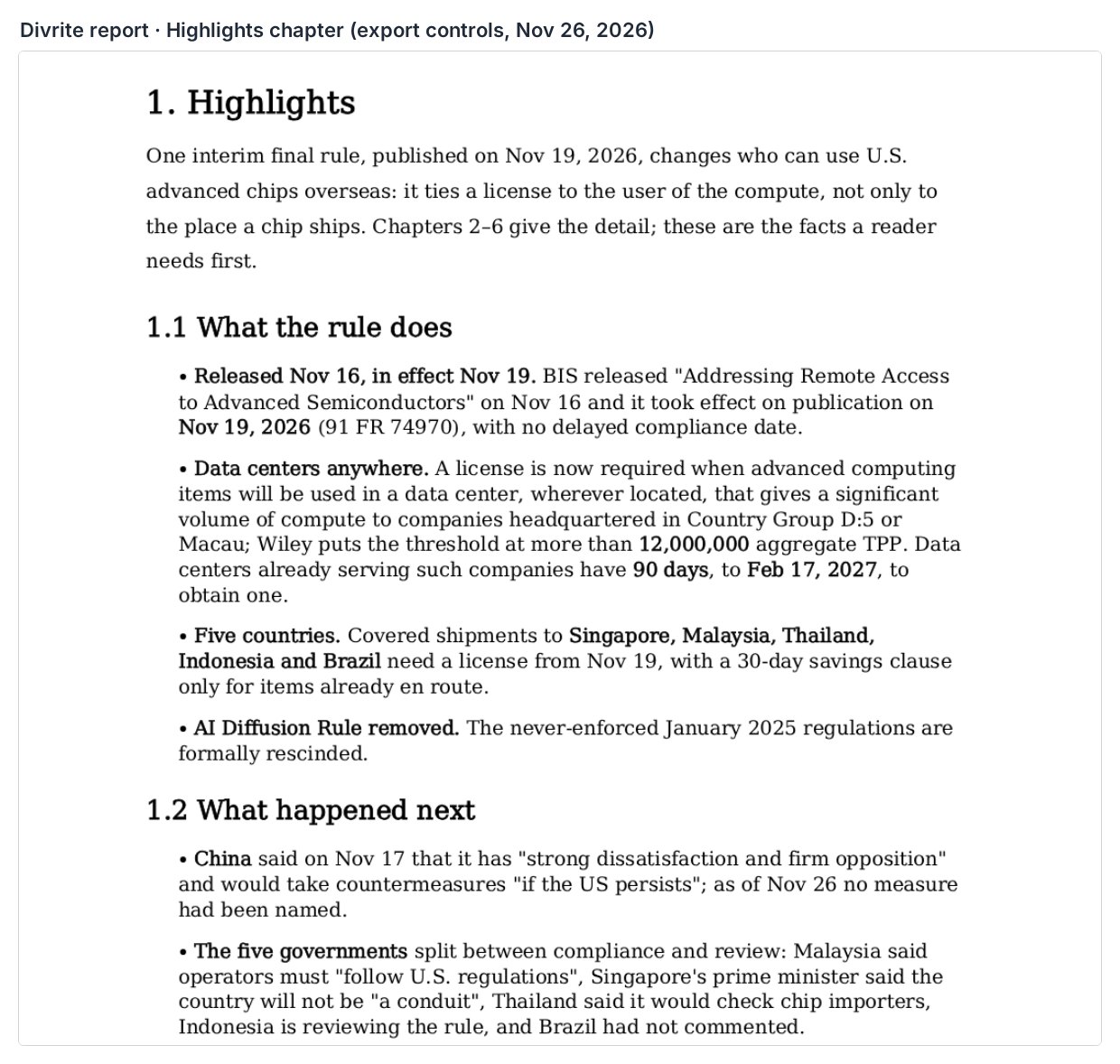
Notice that the first sentence is the answer, and the next sentence tells the reader where the detail lives. The facts below are as they stood on Nov 26, 2026.
The answer, in one sentence. “One interim final rule, published on Nov 19, 2026, changes who can use U.S. advanced chips overseas: it ties a license to the user of the compute, not only to the place a chip ships.” It names the instrument, the date and the mechanism.
Eight findings in two groups. “What the rule does” has four bullets and “What happened next” has four. Each starts with a bold lead: “Released Nov 16, in effect Nov 19.”, “Data centers anywhere.”, “Five countries.”, “AI Diffusion Rule removed.” You can read only the bold words and still get the outline.
Numbers with their source attached. The data-center threshold is written as “Wiley puts the threshold at more than 12,000,000 aggregate TPP”. It is a law firm’s reading, and the sentence says so. The loan figures say who reported them and when: “Bloomberg reported a frozen US$480M loan for chips used by ByteDance (Nov 17)”.
Status in plain words. China “would take countermeasures ‘if the US persists’; as of Nov 26 no measure had been named.” Indonesia “is reviewing the rule, and Brazil had not commented.” Silence is recorded as a fact with a date, rather than left out.
The chapter ends with what comes next and what changed:
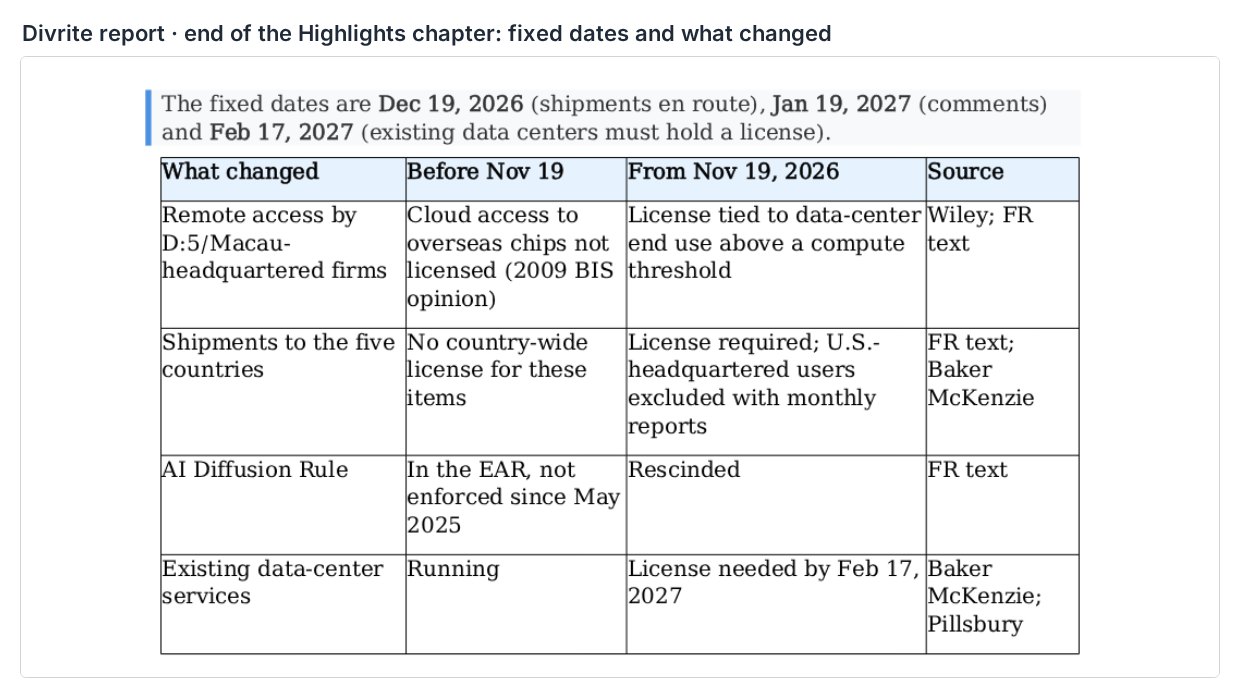
The three dates sit in one line a reader can copy into a calendar, and the table shows each change as “before Nov 19” against “from Nov 19, 2026”, with a source column. Just as useful is what is missing: no history of U.S. chip controls, no account of the research, and one line for the rescinded AI Diffusion Rule.
One thing we would add. Most of the unknowns sit in later chapters, not in the Highlights. A ninth line would bring them forward: Still open (as of Nov 26). The rule does not define “headquartered” or “ultimate parent company”; BIS has set no date for guidance; China has named no countermeasure. Every part of that line is already in the body; it only moves to where the reader will see it.
Weak versus strong: a rewrite
Here is the kind of summary written before the research is done. This is an illustration we wrote, not text from any report:
The U.S. government has recently introduced significant new export restrictions on advanced semiconductors, marking a major escalation in the ongoing tech rivalry with China. The rule is expected to have far-reaching implications for data centers across Southeast Asia and beyond. China has reacted strongly, and several countries are assessing the impact. Financial markets saw notable volatility, and lenders are reportedly becoming more cautious. Companies should closely monitor developments in the coming months.
Every sentence in it could have been written before the rule came out. Set it against the real Highlights:
| Weak version | Real summary | What changed |
|---|---|---|
| “recently introduced significant new export restrictions” | “published on Nov 19, 2026 … it ties a license to the user of the compute, not only to the place a chip ships” | A date and the mechanism replace an adjective |
| “a major escalation in the ongoing tech rivalry” | Nothing | Background and opinion cut; the brief asked for facts |
| “far-reaching implications for data centers across Southeast Asia and beyond” | “Covered shipments to Singapore, Malaysia, Thailand, Indonesia and Brazil need a license from Nov 19” | Five named countries and an effective date |
| “China has reacted strongly” | Said on Nov 17 it has “strong dissatisfaction and firm opposition”; “as of Nov 26 no measure had been named” | A quote, a date and the status of the threat |
| “several countries are assessing the impact” | Malaysia said operators must “follow U.S. regulations”, Thailand said it would check chip importers, “Indonesia is reviewing the rule, and Brazil had not commented” | Each government’s position, including silence |
| “notable volatility” | “Malaysian data-center stocks fell up to about 20% on Nov 17” | A number and a day |
| “lenders are reportedly becoming more cautious” | “Bloomberg reported a frozen US$480M loan for chips used by ByteDance (Nov 17)” | Who reported it, how much, when |
| “closely monitor developments in the coming months” | Dec 19, 2026; Jan 19, 2027; Feb 17, 2027 | Three dates instead of a season |
It is shorter than the real one, but length isn’t the problem. With no checkable fact, a reader can’t act on it or tell whether it is still true.
A longer example: the GLP-1 market report
The second example is a ten-chapter report sizing the global GLP-1 weight-loss drug market. Its summary chapter, “Key takeaways”, runs to about 550 words. Look at its structure:
- One framing sentence with an “as of” date: seven findings answer the client question, “status as of 2026-11-25”.
- Seven numbered findings, each led by a bold sentence that is itself a conclusion: “Two companies, and Lilly now leads.” “List price no longer describes what people pay.” “Generics reach outside the US first.”
- Roughly one finding per question in the brief: sales, players, pricing, coverage, supply, and a last finding on where the 2030 estimates disagree.
- A “Bottom line” paragraph and a one-sentence blockquote that says what the reader should do with any forecast.
- A key-data table with three columns (Key data, Status, Source), where the status column says things like “Approved”, “In effect” or “Estimates, 2026; scopes differ”.
A wider brief gets more findings, but each still fits in one short paragraph. One change we would make: move the bottom line up. Here it comes after the seven findings, so a reader who stops after two lines gets the framing but not the answer.
Fill-in template
EXECUTIVE SUMMARY · <topic> · as of <Mon D, YYYY>

<Answer in one or two sentences: what is true now, since when,
and what it changes.> Chapters <N–M> give the detail.

What <the main subject> does / is
- <Bold lead, 2–5 words.> <Fact with number + unit>, <date>, <status:
  in effect / announced / scheduled / estimate / reported by X>. (<source>)
- <Bold lead.> <Fact, number, date, status.> (<source>)
- <Bold lead.> <Fact, number, date, status.> (<source>)

What happened next / what it means
- <Bold lead.> <Who said or did what, on which date; quote if exact
  wording matters.> (<source>)
- <Bold lead.> <Market, price or behavior change, number, date.> (<source>)

What changed
| Item | Before <date> | From <date> | Source |

Next dates
<Date 1> (<what>), <Date 2> (<what>), <Date 3> (<what>).

Still open (as of <date>)
<Term not defined>; <decision with no date>; <Source A says X, Source B
says Y; we follow A because ...>.
How the summary maps to the first slides of a deck
If the report also becomes a deck, the summary supplies its first pages. In the export-controls deck:
- The answer becomes the title of the first content slide, “License follows the user of the compute”, and returns as the closing line: “From Nov 19 the license follows who uses the compute”.
- The findings become the contents slide. Each part carries its conclusion, not just a topic name: the card “The rule” reads “License follows the user of the compute, from Nov 19”, and “Next dates” reads “Dec 19, Jan 19 and Feb 17”.
- What comes next and what is unknown become a “who acts” slide, whose headline reads “The burden sits with operators, exporters and their lenders; the definitions they need are not yet in the rule”.
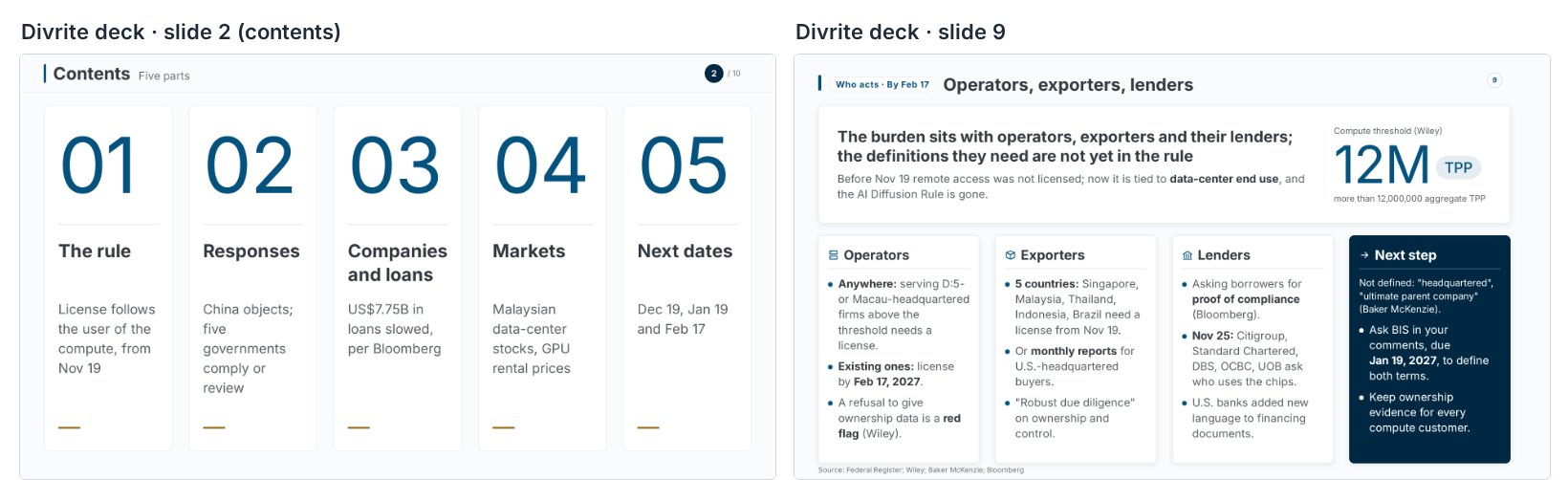
Notice that the contents slide is the summary’s findings in five lines, and that the open question (“Not defined”) sits in the Next step box on slide 9. If your summary lines are already conclusions, the slide titles are mostly written; see how to write slide titles.
The 10-point checklist
- The first sentence answers the question in the brief, as a claim someone could disagree with.
- A reader who reads only the summary would make the same decision as one who reads the whole report.
- There are 4 to 8 findings, each a bold lead of a few words plus one fact.
- Every number has its unit, its date and its status (in effect, announced, scheduled, estimate, reported).
- Figures from news reports, law firms or forecasters say who they come from.
- What changed is shown as before and after, with the date of the change.
- Next steps are exact dates, and any day counts have been recomputed.
- Unknowns are named: undefined terms, missing dates, sources that disagree and which one you follow.
- Every number matches the body, with the same value and source. Check them the way you would fact-check numbers in an AI report.
- No background history, no method story, no adjectives standing in for numbers, and one “as of” date at the top.
Frequently asked questions
How long should an executive summary be?
One page for most research reports, two at most. Size it by the questions in the brief: four to eight findings, each one to three lines. The export-controls Highlights runs to about 400 words plus a table, for a report of about 4,400 words.
Should the executive summary include recommendations?
Only if the body argues for them, and then after the findings, one line each with a date. If the brief asks for facts only, as the export-controls brief did, leave predictions and advice out and let the dates and open questions tell the reader what to watch.
What is the difference between an executive summary and an introduction?
An introduction tells the reader what the report will cover. An executive summary gives the answer and the evidence for it, so the reader can stop there. A summary that starts “This report examines…” is an introduction under the wrong heading.
Should I write the executive summary first or last?
Write a one-line draft answer first, to keep the research pointed at the question. Write the summary itself last, from the finished chapters, so it holds no fact the body doesn’t support and no number that changed during the edit.
Divrite writes research reports that open with a summary chapter built this way: AI report generator.