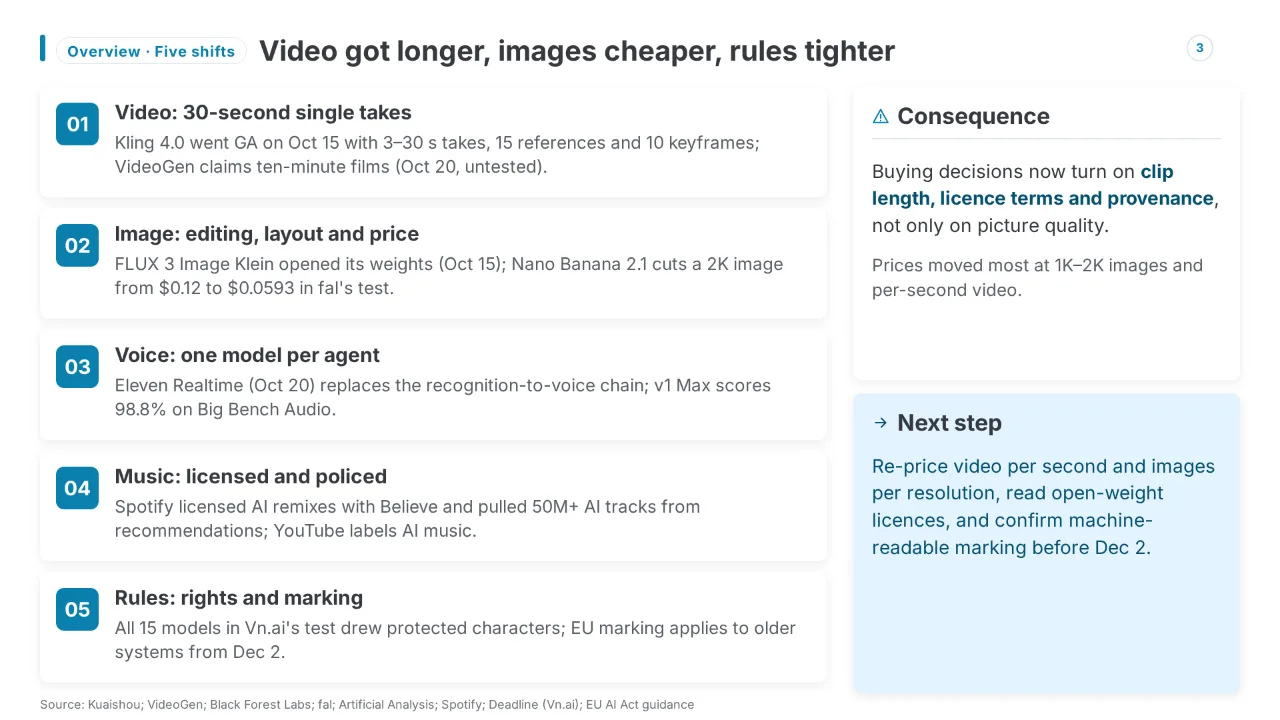
Two weeks, five threads. Kuaishou made 30-second single takes the new ceiling for video, and a start-up promised ten-minute films. Image models competed on editing, layout and price rather than on prettier pictures, and Black Forest Labs released a frontier-class open model that runs on an 8 GB graphics card. ElevenLabs folded the voice-agent stack into one model. Underneath it all, the rules tightened: a stress test found every popular model would draw protected characters, YouTube began labelling AI music, and the EU's machine-readable marking duty for older generative systems takes effect on December 2. This brief covers releases between October 9 and October 22, 2026, compared against the run date of October 23, 2026.
1. Key takeaways from the two weeks
This chapter condenses chapters 2–7 into five conclusions and one table.
1.1 Five conclusions
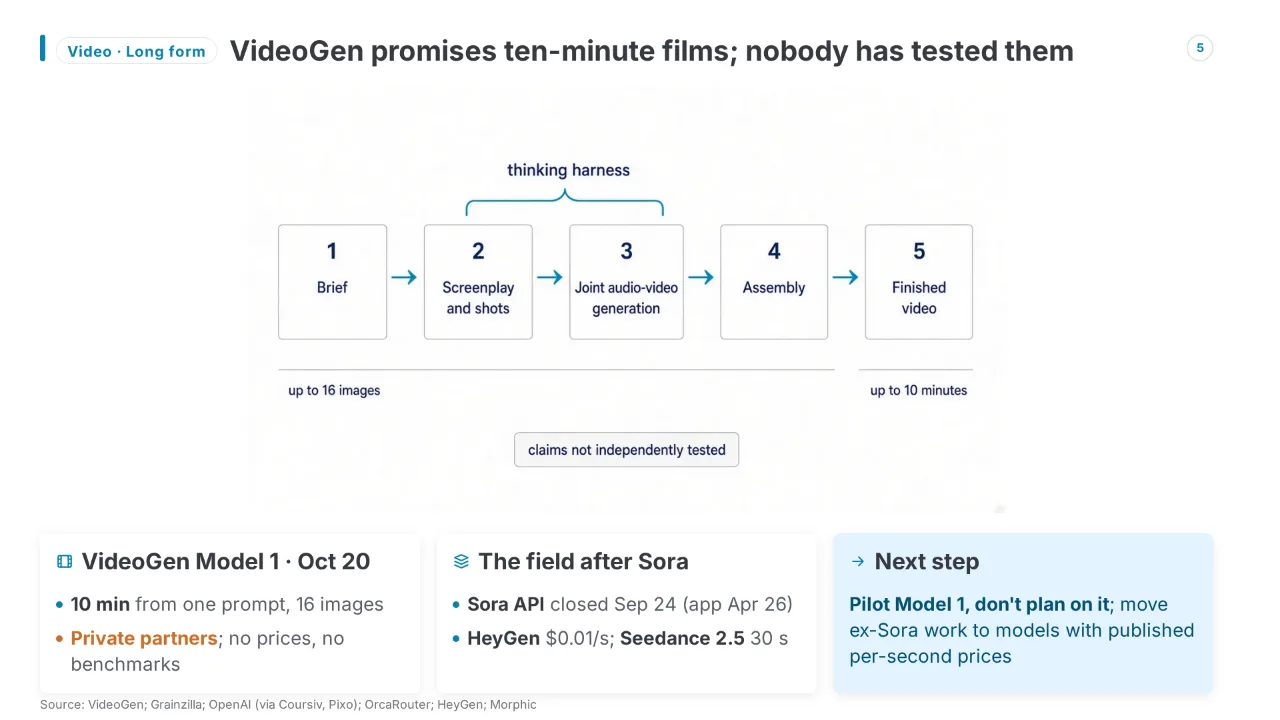
1. Clip length is the new battleground in video, and 30 seconds is the new ceiling. Kuaishou made Kling 4.0 generally available on October 15 with native single takes of up to 30 seconds, up to 15 reference assets and up to 10 keyframes. That doubles Kling 3.0's cap and matches ByteDance's Seedance 2.5. Five days later VideoGen announced Model 1, which it says assembles multi-shot films of up to ten minutes from one prompt; it is in private-partner rollout and nothing about it has been independently tested.
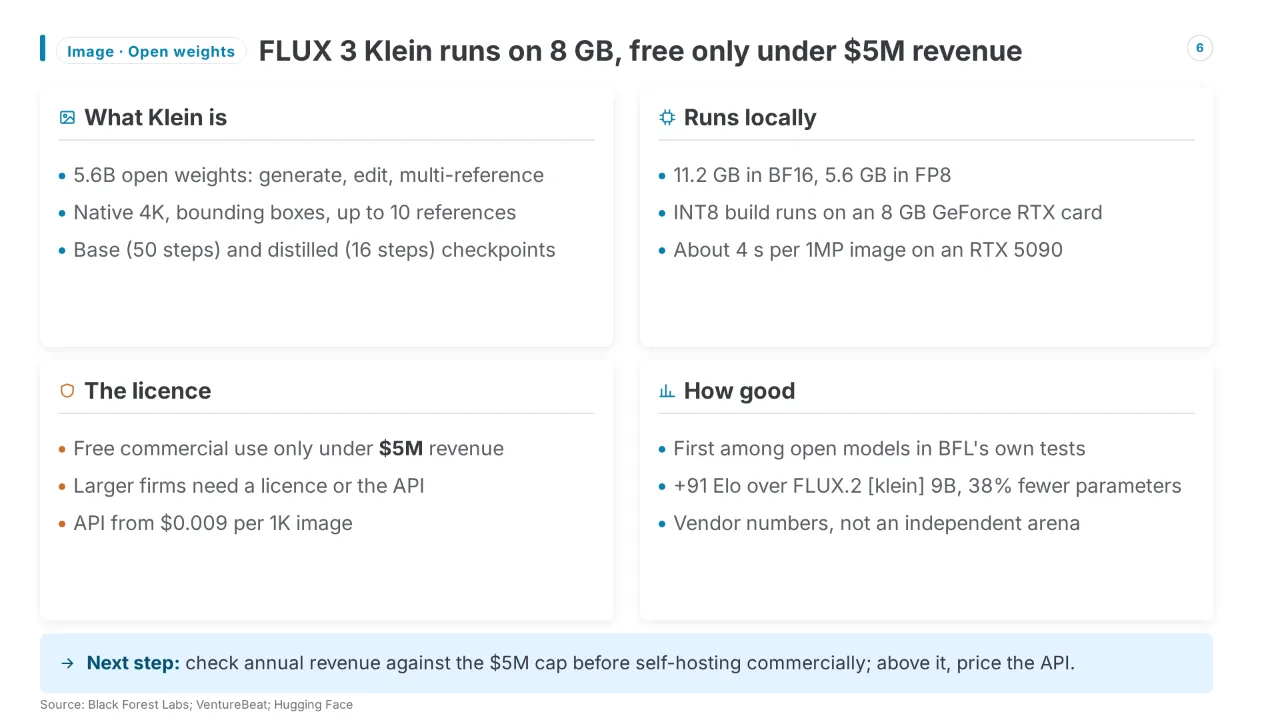
2. Image models now compete on editing, layout and price. Black Forest Labs opened the weights of FLUX 3 Image Klein (5.6B parameters) on October 15, with bounding-box layout control and native 4K output. Google's Nano Banana 2.1, generally available since October 6, roughly halves the price of a 2K image against Nano Banana 2. The OpenMOSS team's MOSS-Image report (October 16) targets dense text and layout in an Apache-2.0 model. On the Artificial Analysis image arena the top three runnable models sit within 20 Elo of each other.
3. Voice agents are collapsing into single models. ElevenLabs launched Eleven Realtime on October 20: two speech-to-speech models that replace the usual chain of speech recognition, language model, turn-taking logic and text-to-speech. The larger model answered 98.8% of Big Bench Audio questions in Artificial Analysis's independent test.
4. Music is being licensed and policed at the same time. Spotify signed Believe for its AI covers and remixes tool on October 20 and the same day said it had pulled more than 50 million AI-spam tracks from recommendations. YouTube Music started labelling songs made mainly with generative AI on October 14. America's largest musicians' union launched "Human Made, Human Paid" to demand consent, credit and compensation before label talks resume on November 3.
5. Rights exposure is now measurable, and the EU marking deadline is close. A stress test of 15 popular models found that every one generated at least one copyright-protected character, and Midjourney v8.1 produced brand-unsafe character images in 37% of prompts. Article 50 of the EU AI Act has applied since August 2, 2026; generative systems already on the market before that date must add machine-readable marking by December 2, 2026.
1.2 What changed at a glance
| Area | What happened | Date | Status on Oct 23 |
|---|---|---|---|
| Video | Kling 4.0: 3–30 s single takes, Omni Reference with 15 assets, 10 keyframes | Oct 15 | GA in Kling; official API "coming soon" |
| Video | VideoGen Model 1: multi-shot videos up to 10 minutes | Oct 20 | Announced; private partners only |
| Video | Sora API shut down after the app closed on Apr 26 | Sep 24 | Retired |
| Image | FLUX 3 Image Klein open weights, 5.6B, free commercial use under $5M revenue | Oct 15 | Released |
| Image | Nano Banana 2.1 replaces Nano Banana 2 | Oct 6 | GA; Nano Banana 2 deprecated, no shutdown date |
| Image | MOSS-Image technical report, 5B, Apache-2.0 | Oct 16 | Weights published |
| Voice | Eleven Realtime v1 Mini and Max speech-to-speech models | Oct 20 | Available |
| Music | Spotify licenses Believe for AI remixes; 50M AI tracks out of recommendations | Oct 20 | Tool announced, no launch date |
| Music | YouTube Music labels mainly AI-made songs | Oct 14 | Rolling out; main app later |
| 3D | Artificial Analysis launches the AA-3D benchmark | Oct 12 | Live leaderboard |
| Rights | Vn.ai report: all 15 models drew protected characters | Oct 14 | Published |
| Rules | EU AI Act Article 50 marking grace period for existing systems ends | Dec 2 | In effect from Dec 2, 2026 |
2. Video generation: 30-second takes and the post-Sora field
The fortnight's video news was about duration and control. Kling 4.0 shipped, VideoGen announced a long-form model, and the market kept reorganising around the gap OpenAI left when it shut Sora down.
2.1 Kling 4.0: 30-second single takes and Omni Reference
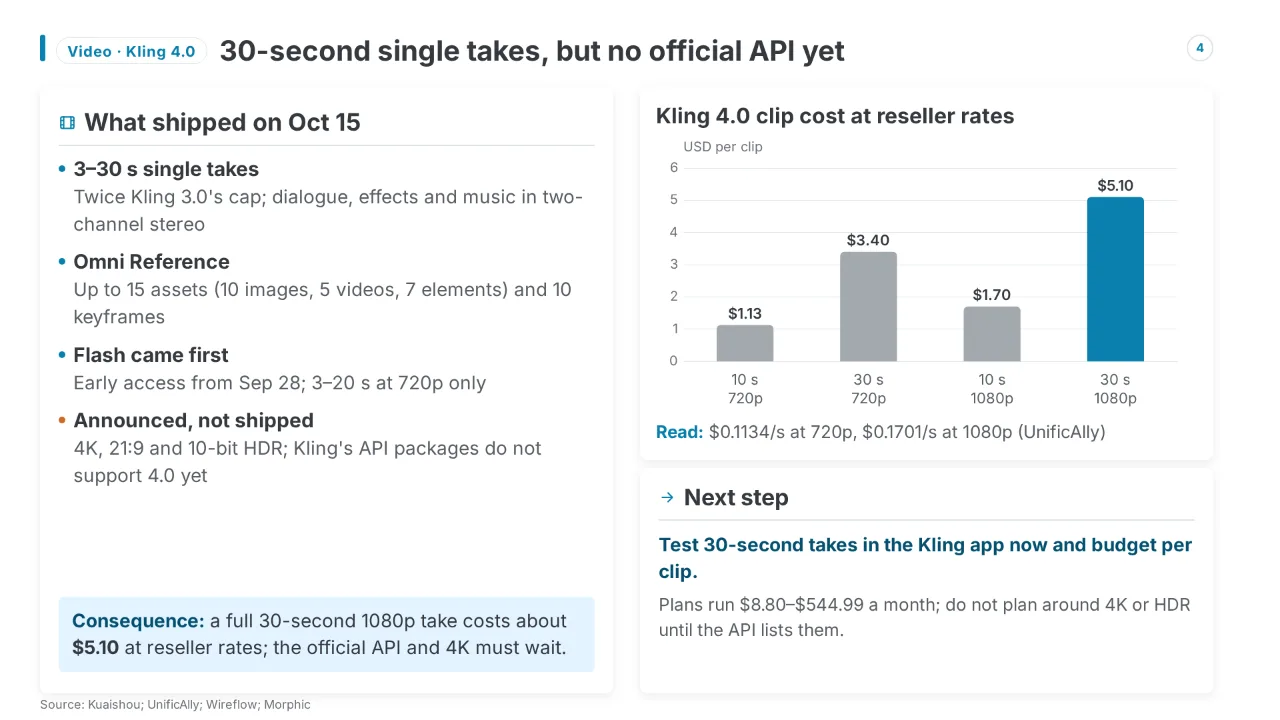
Kuaishou announced on October 16 that Kling 4.0 "officially launched on October 15". The company frames the upgrade around three priorities: steadier large-scale motion and complex camera work such as tracking and orbit shots, native generation of up to 30 seconds in a single pass, and Omni Reference, which combines up to 15 reference assets with up to 10 keyframe inputs. Kling's user guide, as summarised by Wireflow, splits the 15 assets into 10 images, 5 videos (30 seconds in total) and 7 saved elements; the model also edits existing video, takes prompts of up to 8,000 tokens and renders on-screen text in nine or more languages.
The rollout came in two steps. A faster Kling 4.0 Flash opened to a limited group in the Kling app on September 28, and the full model became available to everyone on October 15 under the tagline "You call the shots". Flash is limited to 3–20 seconds at 720p. The full model outputs two-channel stereo audio with dialogue, effects and music rendered in the same pass.
Two capabilities are announced rather than shipped. Kuaishou's release says Kling 4.0 "supports output of up to 10-bit HDR" and "will also support 4K, 1080p and the 21:9 ultrawide format", while resellers list 4K and 10-bit HDR as "coming soon" and not yet callable. Treat 4K and HDR as announced until they appear in the API.
2.2 What Kling 4.0 costs and where to get it
Kling sells credits. Its plans ran from $8.80 a month (Standard) to $544.99 (Ultra+) after the first month when Wireflow checked them on October 19, with 10% off Kling 4.0 for Pro and above; the public pages did not yet say how many credits a Kling 4.0 video uses. Kling's own API packages "currently don't support Kling 4.0" and mark it "coming soon".
At least one reseller already sells access. UnificAlly lists Kling 4.0 since October 16 at $0.1134 per second for 720p (Standard) and $0.1701 per second for 1080p (Pro). At those rates a 10-second 720p clip costs about $1.13 and a full 30-second 1080p take about $5.10. Because the official API is not open, these are third-party prices, not Kuaishou list prices.
Kling's business is also heading to the market: on October 6 MarketScreener reported that Kuaishou's Kling AI had picked three banks for a proposed IPO.
2.3 VideoGen Model 1: ten-minute films, claims not yet tested
On October 20 VideoGen, a Y Combinator-backed company in San Francisco, unveiled Model 1, which it says turns a text prompt and up to 16 reference images into a finished, multi-shot video up to ten minutes long. The pitch is a pipeline rather than a clip generator: a "thinking harness" writes the screenplay, dialogue, shots and pacing, carries context across scenes for consistent characters and locations, and generates audio and video together with joint audio-video attention before assembling the cut. VideoGen shows a 4-minute-33-second claymation film it says came from a single prompt with no editing.

The caveats are large. Access is a limited private-partner rollout that began on October 20. VideoGen expects Model 1 to cost more than 50% less than comparable models "based on internal validation", but final pricing, official benchmarks and third-party validation are still under way. An independent review found no public demo footage beyond the company's own, no benchmarks and no price list. Output carries invisible synthetic watermarks and the model blocks adult and illegal content. VideoGen also opened a $1 million pool of free credits for creators and studios, to be distributed through the end of 2026.
2.4 The field after Sora
OpenAI's exit is now complete. According to OpenAI's discontinuation notice, the Sora web and app experiences closed on April 26, 2026, and the Sora API closed on September 24, 2026; an archive note dated October 17 confirms the API date and says endpoints return "410 Gone". Teams that built on Sora are migrating, and rivals are courting them with price and length.
Three reference points frame the field. HeyGen Video, a post-trained version of MiniMax H3, went live on September 30 at $0.01 per second through October, so a 10-second clip costs a dime. ByteDance's Seedance 2.5 produces 30 continuous seconds per take and accepts up to 50 reference inputs on Morphic. MiniMax's H3, sold as Hailuo, ranked first on the LMArena image-to-video board in August 2026.
The direction is consistent: longer single takes, more references for consistency, and audio generated with the picture. Quality alone no longer separates the leaders; length, control and price do.
3. Image generation: editing, layout and price
Every notable image release in the window led with control — editing one element without disturbing the rest, placing elements with boxes, rendering dense text — and with cost.
3.1 FLUX 3 Image Klein: open weights with a revenue cap
Black Forest Labs (BFL) released open weights for FLUX 3 Image Klein on October 15. It is a 5.6-billion-parameter model for text-to-image generation, image editing and multi-reference generation with up to 10 reference images, and it keeps the larger FLUX 3 Image model's native 4K generation, pixel-precise editing and bounding boxes that place elements or confine edits to an area. The package includes an undistilled base checkpoint for fine-tuning (50 steps) and a distilled checkpoint for low-latency generation (16 steps), which is also the checkpoint behind BFL's API.
It is built to run locally. The generator weights take 11.2 GB in BF16 and 5.6 GB in FP8; with the INT8 build the model runs on GeForce RTX cards with as little as 8 GB of video memory, and NVIDIA measured about 4 seconds per 1-megapixel image on an RTX 5090 and under 9 seconds on an RTX 4070. In BFL's internal evaluations Klein ranks first among the open models it compared on text-to-image, multi-reference generation and editing, and gains 91 Elo in text-to-image over FLUX.2 [klein] 9B with 38% fewer parameters. These are vendor numbers.
The licence matters more than the benchmark for most buyers. BFL permits free commercial use only for individuals and businesses with annual revenue below $5 million; larger organisations need a separate agreement for commercial self-hosting or can use the API, where Klein starts at $0.009 for a 1K image. Downloadable weights do not mean unrestricted commercial rights. BFL, valued at $3.25 billion, says further open releases from the FLUX 3 family will follow.
3.2 Nano Banana 2.1: Flash-tier price, per-token billing
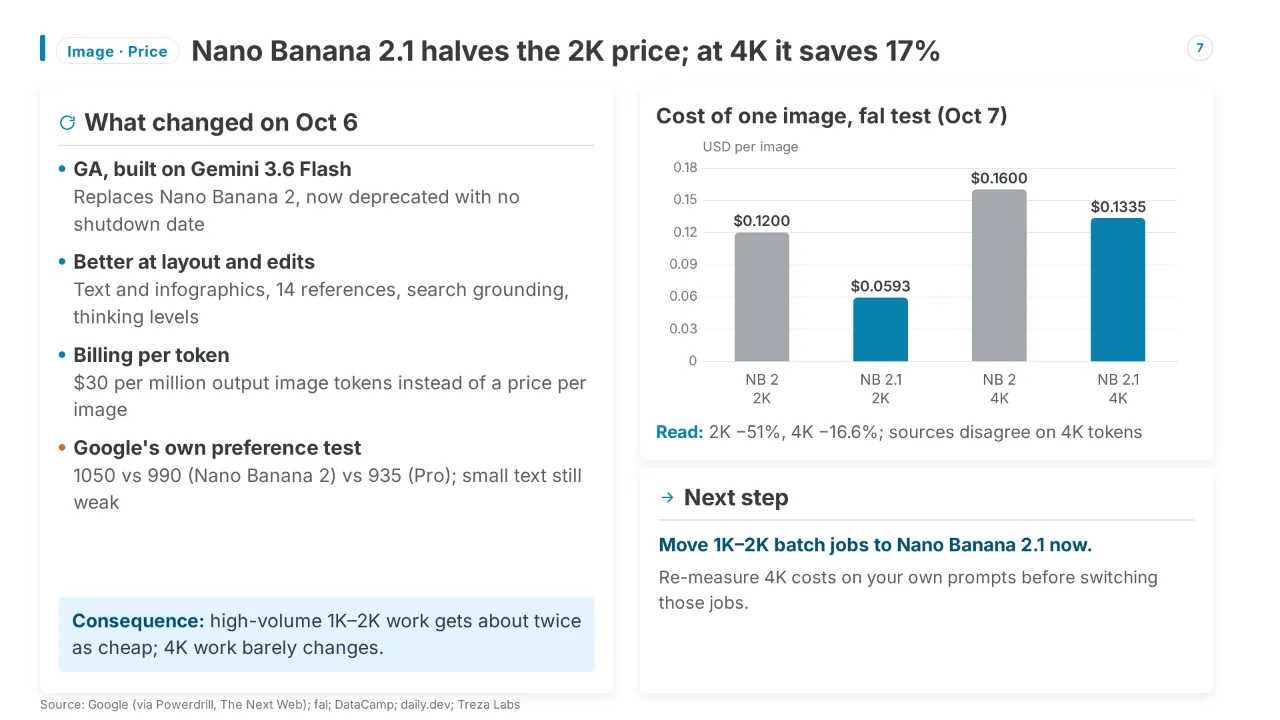
Google made Nano Banana 2.1 (gemini-nano-banana-2.1) generally available on October 6 as "the latest high-efficiency image generation and conversational editing model". It is built on Gemini 3.6 Flash. Google's listed gains are visual quality at 1K, 2K and 4K, fixed tiling artefacts on extreme aspect ratios, better text rendering and infographic layout, up to 14 reference images with consistency for up to 4 characters and 10 objects, grounding in Google Web and Image Search, and configurable thinking. In Google's own human-preference tests, Nano Banana 2.1 with thinking scored 1050 for overall text-to-image preference, against 990 for Nano Banana 2 and 935 for Nano Banana Pro. The release deprecates Nano Banana 2 (gemini-3.1-flash-image) with no shutdown date.
The price story is real but uneven. Output is billed at $30 per million image tokens rather than per image. fal measured one 2K image at $0.0593 on Nano Banana 2.1 against $0.12 on Nano Banana 2, about half, but at 4K the gap narrows to 16.6% ($0.1335 against $0.16). DataCamp's summary agrees: roughly half the output price at 1K and 2K and about 25% less at 4K, with higher input and reasoning rates. Sources disagree on 4K token counts (2,520 tokens per daily.dev, 3,780 measured by Treza Labs); this brief uses fal's side-by-side measurement because it priced both models the same way. Google's model card still lists blurry small text and left-right errors as weak spots.
Community reaction was mixed: of the comments daily.dev classified, 20% were positive, 35% mixed and 45% sceptical, with some users unsure whether requests were really routed to a new model.
3.3 Leaderboards and the layout race
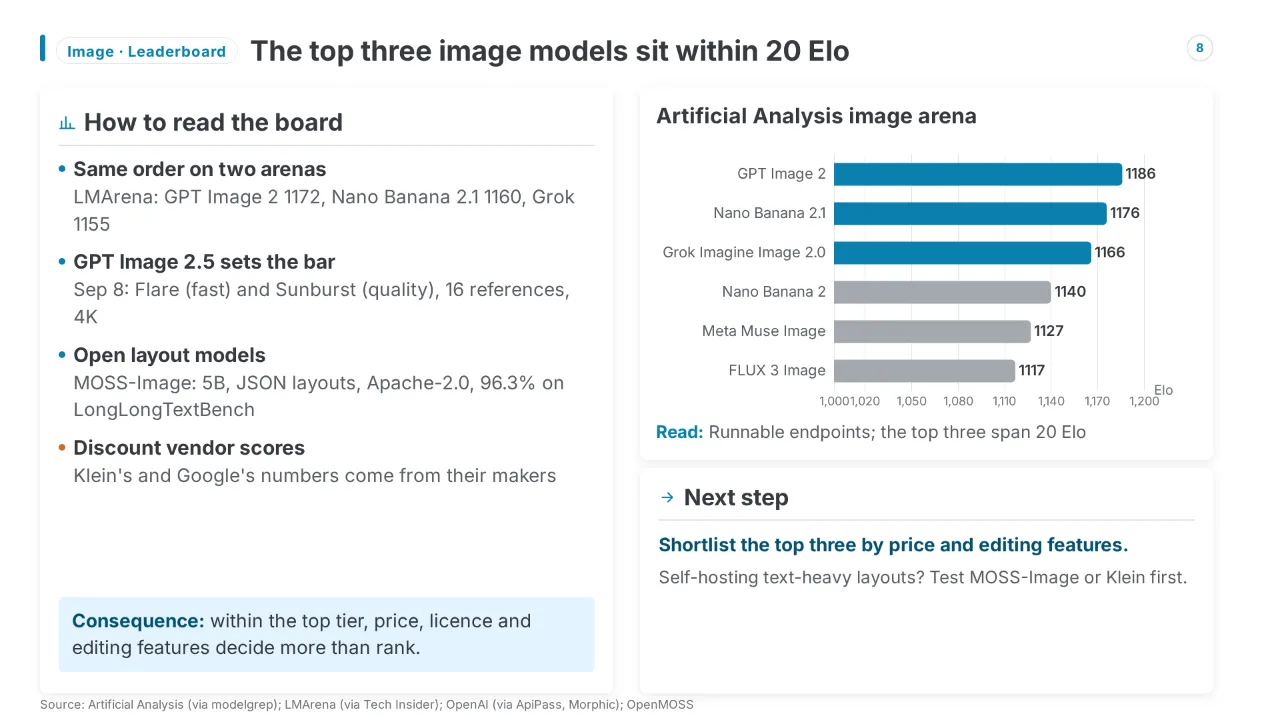
On the Artificial Analysis image arena, as tracked by modelgrep for runnable endpoints in October, GPT Image 2 leads at 1186 Elo, followed by Nano Banana 2.1 at 1176, Grok Imagine Image 2.0 at 1166, Nano Banana 2 at 1140, Meta's Muse Image at 1127 and FLUX 3 Image at 1117. The LMArena text-to-image board shows the same top three in the same order, with GPT Image 2 at 1172 and Nano Banana 2.1 at 1160. A 10-point gap is within the noise of human-preference voting, so the top three are best read as a tier.
OpenAI's newer GPT Image 2.5, released on September 8 in a fast Flare variant and a quality-focused Sunburst variant, is the reference point the others chase: a 20,000-character prompt window, up to 16 reference images and output up to 3840 pixels on the long edge, with Flare at up to half the latency of Images 2.0. A review claims it took first place in text-to-image, single-image edit and multi-image edit arenas.
Open models are closing the layout gap. MOSS-Image, a 5B diffusion transformer from the OpenMOSS team described in a report published on October 16, accepts layouts as JSON prompts with bounding boxes and prompts of up to 4K tokens. It reaches 96.3% average text coverage on the team's LongLongTextBench, the best among open-weight models, and ranks second in the end-to-end RealLayoutArena comparison; its weights are licensed under Apache-2.0.
4. Voice, music and 3D
Beyond pictures, the window brought a structural change in voice agents, more money and more rules in music, and a new benchmark for 3D scenes built by language models.
4.1 Eleven Realtime: the voice agent as one model
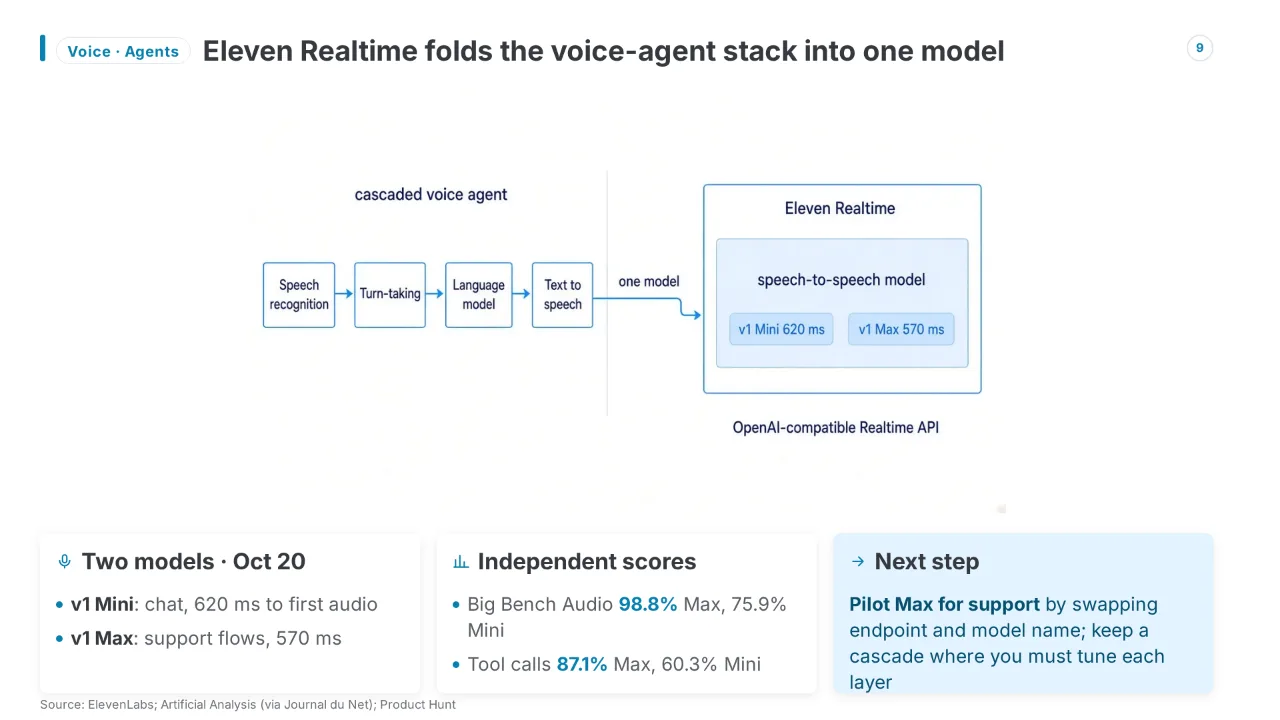
ElevenLabs launched Eleven Realtime on October 20, a family of speech-to-speech models in which "each model is a complete voice agent". Until now a voice agent meant choosing and tuning separate parts: speech recognition, voice-activity detection, turn-taking, a language model and text-to-speech. Eleven Realtime tunes them end to end. v1 Mini targets natural, low-cost conversation for assistants, tutors and characters; v1 Max targets customer support, lead qualification and multi-step workflows. Both support more than 90 languages and the 17,000-plus voices in ElevenLabs' library.

Artificial Analysis evaluated both models independently. On Big Bench Audio, 1,000 spoken reasoning questions, Max answered 98.8% correctly and Mini 75.9%; that puts Max ahead of Grok Voice 3.0 (98.5%) and Gemini 3.8 Live with extended thinking (97.7%). On Full-Duplex-Bench for conversational dynamics, Mini scored 95.8% and Max 94.1%; on tasks with tool calls, Max succeeded 87.1% of the time and Mini 60.3%. ElevenLabs gives time to first audio as 620 ms for Mini and 570 ms for Max.
Adoption friction is low: the API is compatible with OpenAI's Realtime API, so existing apps change only the endpoint and model name. The trade-off is control. Developers no longer pick or inspect the individual components, which suits teams that want a working agent and frustrates those who tune each layer.
4.2 Music: scale at Suno, licensed remixing at Spotify
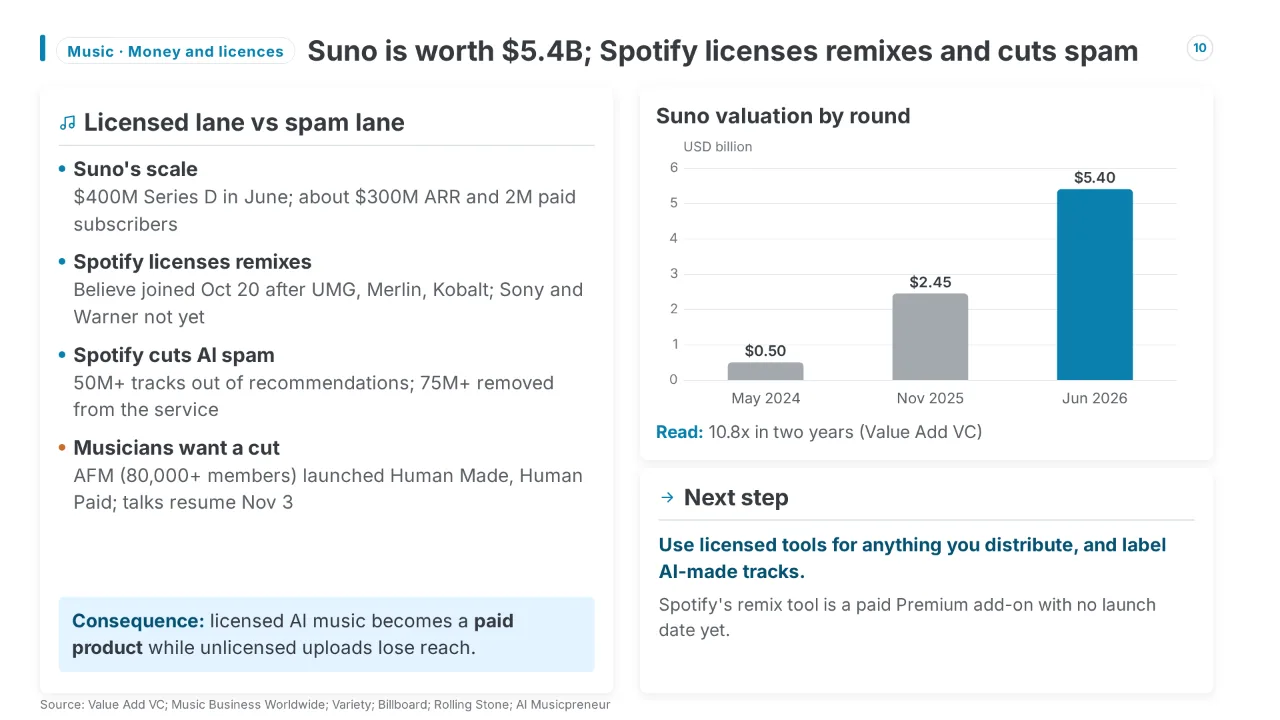
Suno is the category's scale player. It raised a $400 million Series D led by Bond Capital in June 2026 at a $5.4 billion valuation, up from $2.45 billion in November 2025 and $500 million in May 2024, and reported roughly $300 million in annualised revenue and 2 million paid subscribers by early 2026. On October 7 Elon Musk wrote that Grok will route tasks to "the best back end model", naming Suno among them, but no date was given and Suno has no public API.
Spotify is building a licensed lane. On October 20 Believe signed a licence for Spotify's upcoming AI covers and remixes tool, covering participating artists and labels at Believe and TuneCore. It follows Universal Music Group in May, Merlin on August 4 and Kobalt on August 13; Sony and Warner have not announced deals. The tool, still unnamed and without a release date, is designed as a paid add-on to Spotify Premium, pays the rights holders of the original tracks, and is limited to remixes and covers rather than new works.
Spotify is policing the unlicensed lane at the same time. On October 20 it said it had removed more than 50 million "AI-spam" songs from recommendations, on top of more than 75 million tracks removed from the service altogether, using upload patterns, metadata, third-party detection and listener feedback. More than 300,000 artists now carry its "Verified by Spotify" badge, 70% of them independent, and profiles labelled "AI Persona" are excluded from personalised recommendations.
4.3 3D: AA-3D measures scenes that language models build
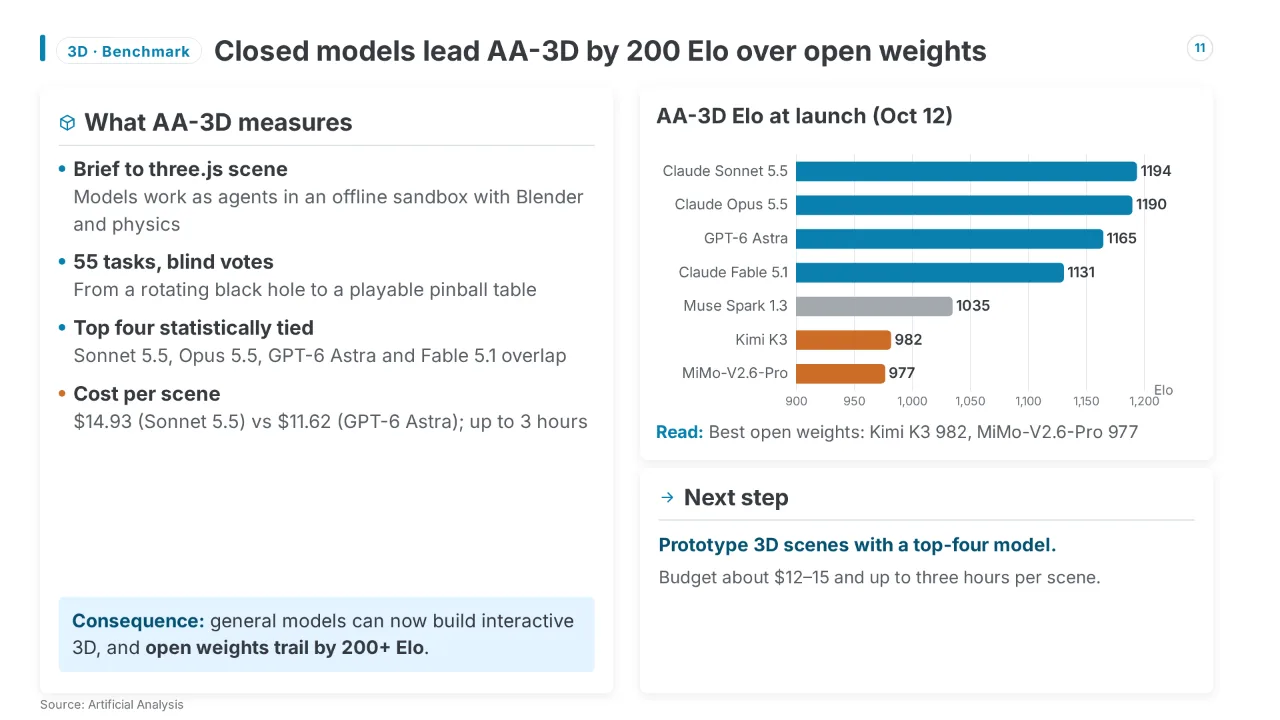
The fortnight's 3D news came from evaluation rather than a new generator. On October 12 Artificial Analysis launched AA-3D, which measures how well models build interactive 3D experiences. Each model works as an agent in an offline sandbox with Blender, Rapier physics, a headless browser and CC0 assets, and turns a written brief into a three.js page within three hours or 250 turns; a recruited panel then compares scenes from the same brief blind. Version 1.0 has 55 tasks, from a rotating black hole to a playable pinball table.
At launch Claude Sonnet 5.5 led with 1194 Elo, but the top four — Sonnet 5.5, Claude Opus 5.5 (1190), GPT-6 Astra (1165) and Claude Fable 5.1 (1131) — were statistically tied. Meta's Muse Spark 1.3 placed seventh at 1035, and the best open-weight models, Kimi K3 (982) and MiMo-V2.6-Pro (977), sat more than 200 points behind. Cost and time differ widely: Sonnet 5.5 wrote 6.2 times as many output tokens as GPT-6 Astra but cost only 1.3 times as much ($14.93 against $11.62).
5. Quality and price
Leaderboards and price sheets moved in the window, but both need careful reading.
5.1 Reading the leaderboards
Human-preference arenas are the main public yardstick for media models. For still images the top tier is tight: on the Artificial Analysis image arena GPT Image 2, Nano Banana 2.1 and Grok Imagine Image 2.0 span 20 Elo, and LMArena's board puts the same three in the same order. For video, VideoGen's October ranking says Google's Gemini Omni Flash tops the Artificial Analysis text-to-video arena, with an Elo of 1,243 on the with-audio board, while capping clips at 10 seconds and 720p. VideoGen sells access to many of these models and now has its own, so its rankings are informative but not neutral.
Vendor-run evaluations need a discount. BFL's Klein results, Google's 1050-versus-990 preference scores and VideoGen's cost claim are all first-party. Independent numbers in this window came from Artificial Analysis (Eleven Realtime, AA-3D) and from third parties that priced models side by side (fal).
5.2 What a clip and an image cost
Video prices are converging on per-second billing. HeyGen's launch price of $0.01 per second sits at the low end. On UnificAlly, a reseller, starting prices run from $0.036 per second for Vidu Q4 and $0.0756 for Kling 3.0 Omni to $0.1134 for Kling 4.0 at 720p. Consumer plans bundle credits instead: Kling's run from $8.80 to $544.99 a month, and Adobe's Firefly Standard costs $9.99 a month for 2,000 generative credits.
Image prices are falling at the low and middle resolutions. Nano Banana 2.1 costs about $0.034 for a 1K image at list rates and Klein starts at $0.009 for a 1K image on BFL's API; UnificAlly lists FLUX.2 Pro and Seedream 5.0 Pro from $0.03 per image and Qwen Image 2.0 at $0.0245. At 4K, savings shrink: Nano Banana 2.1 is only 16.6% cheaper than its predecessor in fal's test.
6. Copyright, labelling and platform policy
Rights and rules produced more concrete news than any model launch: a measurable infringement rate, an appellate ruling on training data, platform labels and a fixed EU deadline.
6.1 Character reproduction: the Vn.ai report
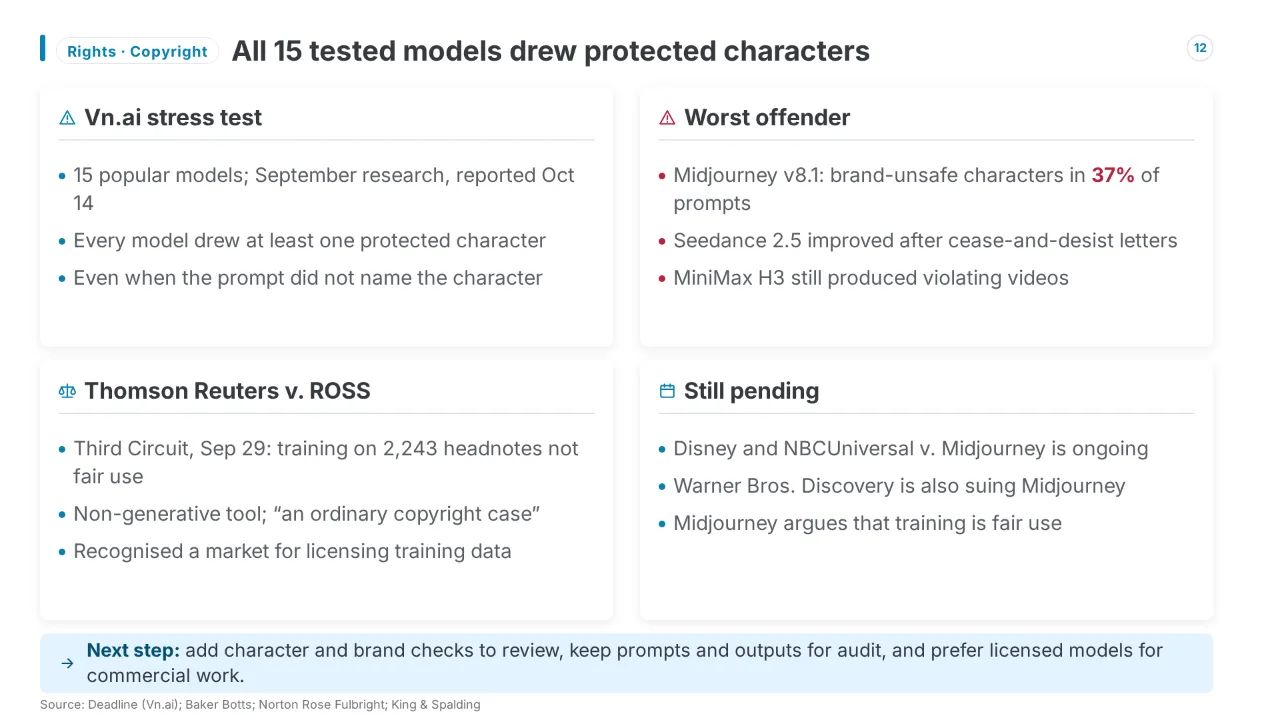
On October 14 Deadline reported the first quarterly report from Vn.ai, a start-up that stress-tests generative tools for copyright infringement. Its September research covered 15 popular models. Midjourney v8.1 was the worst offender: it reproduced copyrighted characters in brand-unsafe contexts, such as violence or drug use, in one of every three text prompts, or 37% of the time. Every model generated at least one copyright-protected character, even when the prompt did not name the character, including Google's Nano Banana and ByteDance's Seedance 2.5; Seedance has improved markedly after cease-and-desist letters from Hollywood studios, while MiniMax H3 still generated violating videos.
Midjourney did not comment. The lawsuit Disney and NBCUniversal filed against it in 2025 is ongoing, Warner Bros. Discovery has also sued, and Midjourney argues that training on copyrighted images is fair use. For buyers, the finding means output filters are not enough: any model in the test could produce a protected character without being asked for it by name.
6.2 Courts: Thomson Reuters v. ROSS
On September 29, 2026 the US Court of Appeals for the Third Circuit issued what commentators describe as the first federal appellate decision on whether training AI on copyrighted material is fair use. It affirmed that Westlaw headnotes are copyrightable and that ROSS Intelligence's use of 2,243 of them to train a competing legal-research tool was not fair use. The court also found that "the market for licensing headnotes as text to train AI is rapidly developing".
The ruling's reach into media generation is limited. ROSS's system was not generative, the court called the appeal "no more than an ordinary copyright case", and a footnote distinguishes AI that "cannot generate original expression" from generative models. Law-firm analyses published in the window agree it leaves generative training questions open. What it does add is appellate support for the idea that a licensing market for training data can count as market harm.
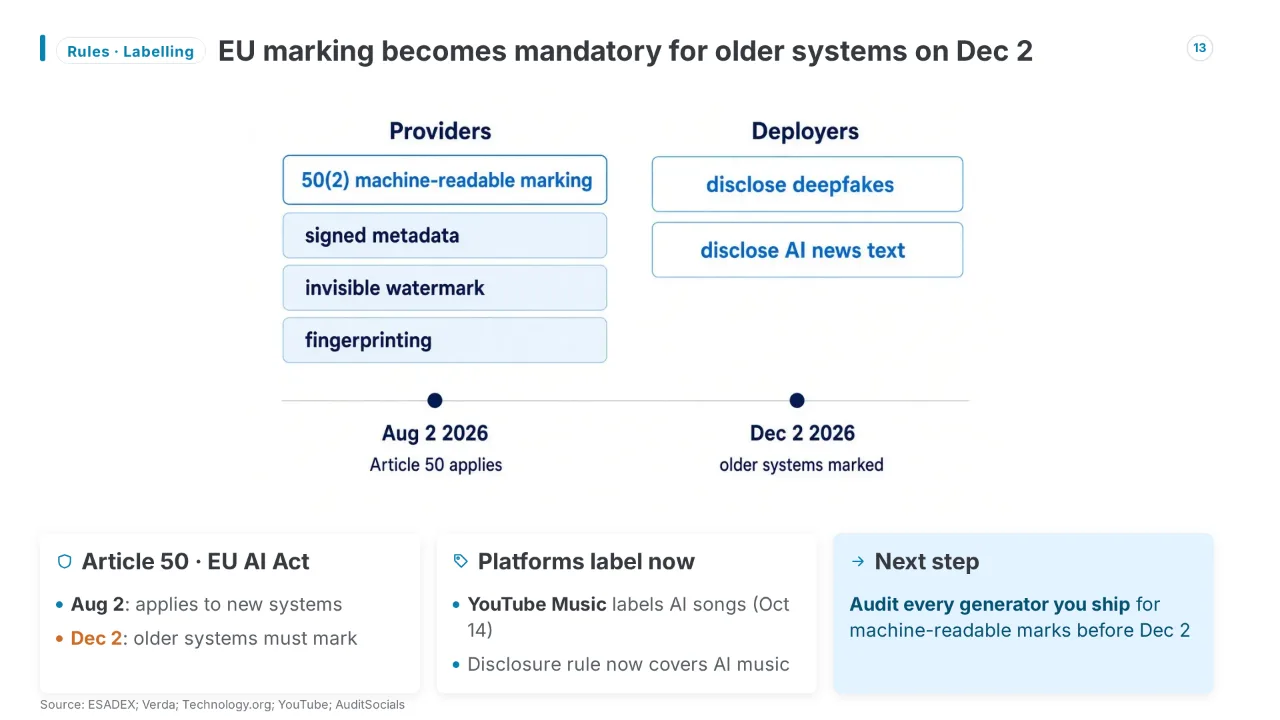
6.3 EU AI Act Article 50: marking by December 2
Article 50 of the EU AI Act has applied since August 2, 2026. Its paragraph 2 requires providers of generative systems to mark audio, image, video and text outputs in a machine-readable format so they can be detected as AI-generated; paragraph 4 requires deployers to disclose deepfakes and AI-written text published to inform the public on matters of public interest. Systems placed on the market from August 2 had to comply at launch; older generative systems get until December 2, 2026 to add the marking.

The Commission's voluntary Code of Practice on marking and labelling has been confirmed as an adequate way to show compliance. It describes a layered approach — signed metadata, an imperceptible watermark and fingerprinting — because no single layer survives every transformation. Article 50 asks whether content is synthetic, not who made it. Separately, the Digital Omnibus (Regulation (EU) 2026/1744), in force since July 27, 2026, moved obligations for stand-alone high-risk systems to December 2, 2027 and added bans on AI built to produce child sexual abuse material and non-consensual intimate imagery.
6.4 Platform labels and spam controls
YouTube moved first among video platforms on music. Its GenAI disclosure policy gained a fourth item, AI content that "creates music that's the main focus of the video", first seen on October 3. On October 14 YouTube Music began showing labels on songs created primarily with generative AI, such as a track whose composition and vocals came from a model, using partner disclosures and its own detection; the labels will expand to the main YouTube app, with no date given. Spotify's 50 million recommendation removals and "AI Persona" labels (chapter 4.2) push in the same direction.
7. Business and the creator ecosystem
Money kept flowing to scale players and tool builders, platforms turned into model marketplaces, and musicians organised for a share.
7.1 Funding and valuations
The largest numbers belong to companies that already have revenue. Suno's $5.4 billion valuation more than doubled in seven months on roughly $300 million in annualised revenue. BFL is valued at $3.25 billion with a team of about 100. Kuaishou's Kling AI picked three banks for a proposed IPO on October 6.
Smaller rounds target workflow. Korean start-up NationA closed an 8.5 billion won ($5.9 million) Series A on October 22, bringing its total to 11.7 billion won; Hana Securities followed on, and Korea Development Bank, Hyundai Investment Partners and Ilshin Investment joined. NationA will merge its AI video tool and interactive drama platform into one product that links image, sound and voice generation with video generation and editing. VideoGen's $1 million credit pool is a customer-acquisition tool of the same kind.
7.2 Platforms become model marketplaces
Creative suites now sell other labs' models. Adobe Firefly offers partner image models including Nano Banana 2, GPT Image and FLUX, and partner video models including Veo 3.1, Kling 3.0, Runway Gen-4.5 and Luma Ray3; Google's Gemini Omni Flash is available in Firefly Boards. Aggregators route each prompt to whichever model fits, as VideoGen does across its quality tiers. For model makers, distribution through these suites matters as much as leaderboard rank; for creators, switching models no longer means switching tools.
7.3 Musicians push for consent and pay
On October 20 the American Federation of Musicians, which represents more than 80,000 professional musicians, launched "Human Made, Human Paid". It demands consent before musicians' work is used to train AI, credit when it is, and compensation, including a share when labels license catalogues to AI companies. The campaign is timed to Sound Recording Labor Agreement talks with Universal, Sony, Warner and Disney's Hollywood Records, which resume on November 3. The union has already sued Universal and Warner over whether the existing agreement's "new use" clause covers AI deals.
The licensed deals of chapter 4.2 and this campaign are two sides of one negotiation: labels and platforms are monetising catalogues for AI, and the performers on those recordings want their cut.
8. Trends and what to watch
This chapter draws judgements from chapters 2–7 and lists the dates that come next.
8.1 Five trend judgements
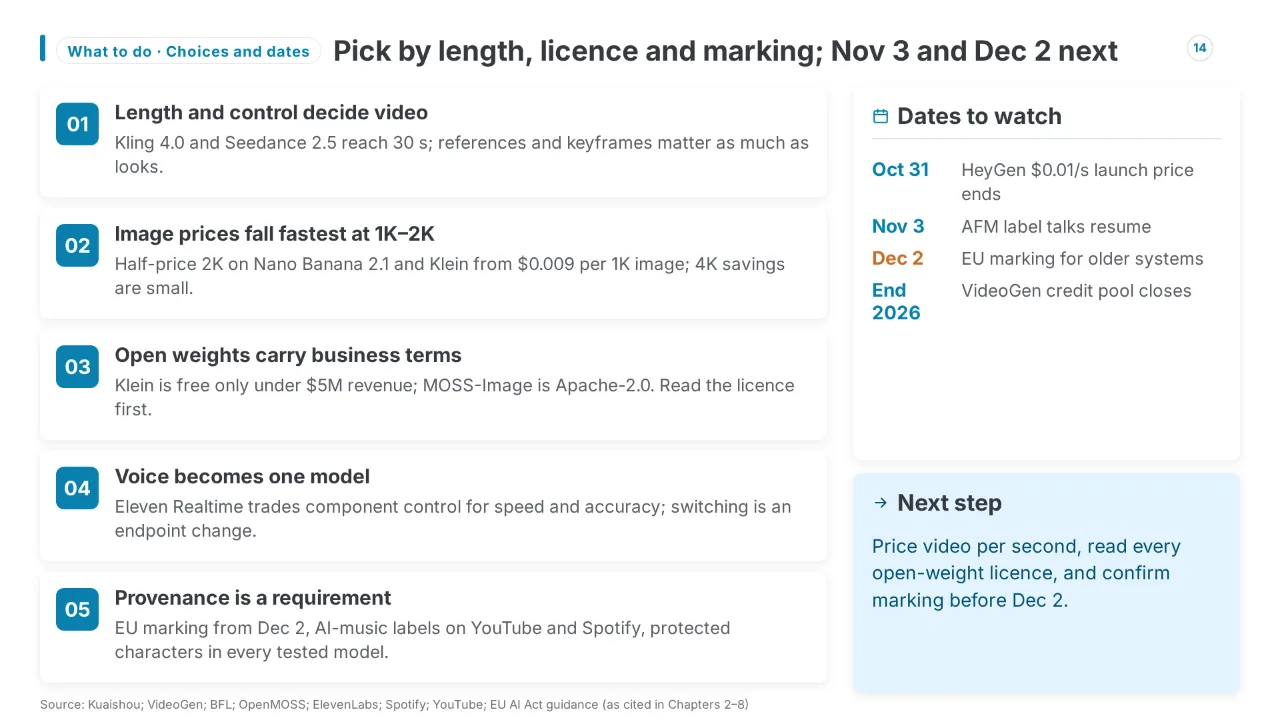
1. Length and control, not raw quality, decide video purchases. Kling 4.0 and Seedance 2.5 both reach 30-second takes, and references and keyframes now matter as much as aesthetics. Long-form assembly, as VideoGen promises, is the next step but remains unproven.
2. Image prices fall fastest where volume is. Halved 2K prices and $0.009 1K images make high-volume catalogue and ad work cheap, while 4K savings are small.
3. Open weights come with business terms. Klein's $5 million revenue cap and MOSS-Image's Apache-2.0 licence sit at opposite ends; teams need to read the licence before the benchmark.
4. Voice moves from stacks to single models. Eleven Realtime trades component control for latency and accuracy, and its OpenAI-compatible API lowers switching costs.
5. Provenance becomes a product requirement. Machine-readable marking is mandatory in the EU from December 2 for older systems, YouTube and Spotify label AI music, and every model in the Vn.ai test could produce protected characters.
8.2 What to do now
- Video buyers: pick by clip length, reference count and per-second price, and treat Kling 4.0's 4K and HDR as announced until the API supports them.
- Image teams: re-price high-volume work on Nano Banana 2.1 or Klein, and check Klein's revenue cap before self-hosting commercially.
- Anyone shipping generated media into the EU: confirm that outputs carry machine-readable marks before December 2.
- Music users: expect labels on mainly AI-made tracks on YouTube Music and loss of recommendations for AI-spam on Spotify.
8.3 Dates to watch
| Date | Event | Source |
|---|---|---|
| Oct 31, 2026 | HeyGen Video's $0.01-per-second launch price runs "through October" | — |
| Nov 3, 2026 | AFM resumes label talks with Universal, Sony, Warner and Hollywood Records | — |
| Dec 2, 2026 | EU AI Act marking duty applies to generative systems on the market before Aug 2 | — |
| End of 2026 | VideoGen distributes its $1M credit pool | — |
| Not dated | Kling 4.0 official API, 4K and 10-bit HDR; YouTube AI music labels in the main app; Spotify remix tool launch | — |