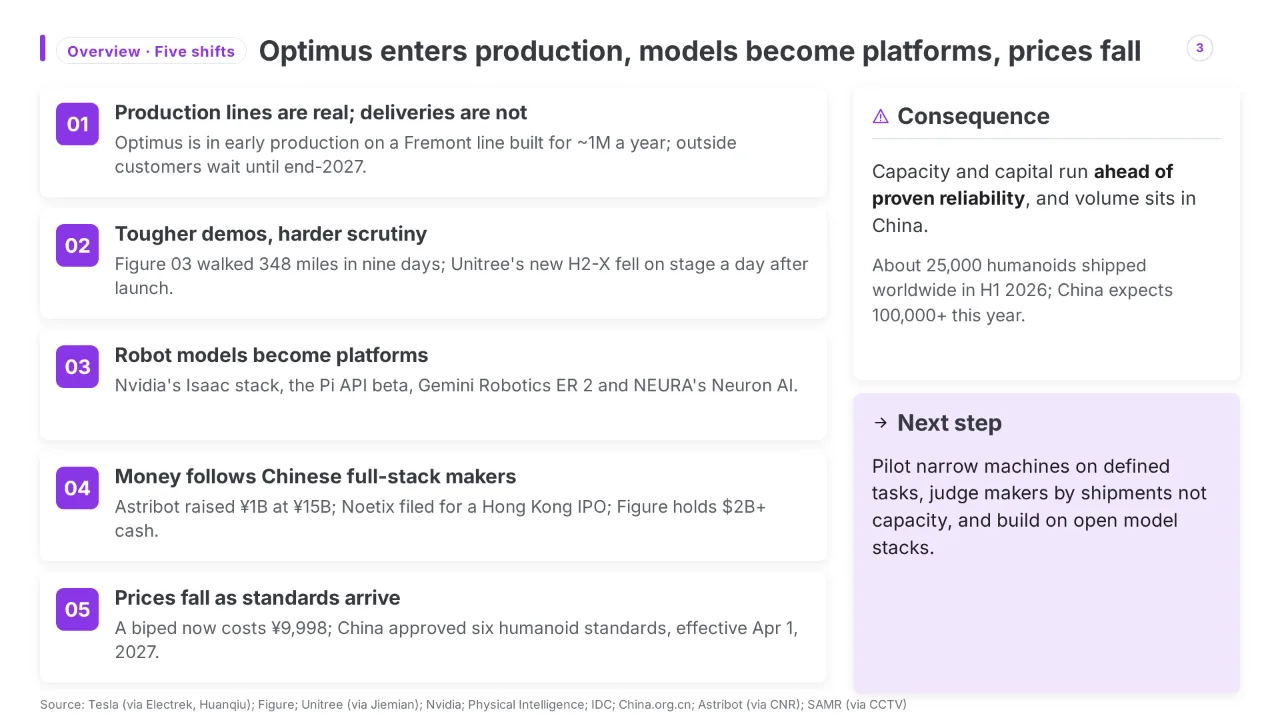
Two weeks, five threads. Tesla said Optimus is now coming off a Fremont line built for a million robots a year, while pushing customer deliveries to the end of 2027. Demonstrations got harder and so did scrutiny: Figure's robot walked 348 miles in nine days, and Unitree's new security humanoid lost a leg on stage a day after launch. Robot models turned into platforms, from Nvidia's open Isaac stack to Physical Intelligence's paid API. Money kept flowing to Chinese full-stack makers, led by Astribot's ¥15 billion valuation. And the price floor fell below ¥10,000 just as China published its first national standards for humanoids. This brief covers October 9–22, 2026.
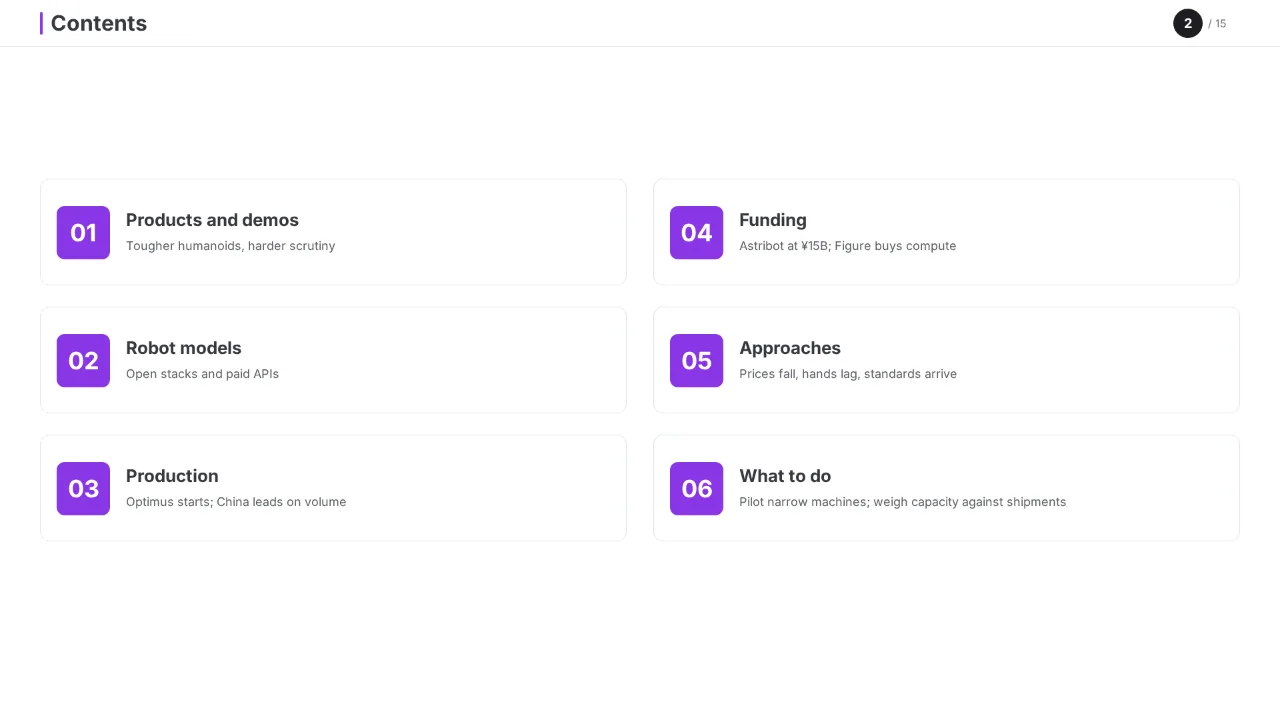
1. Key takeaways from the two weeks
This chapter condenses chapters 2–6 into five conclusions and one table.
1.1 Five conclusions
1. Production lines are real; customer deliveries are not yet. Tesla's third-quarter update said Optimus is in early production on a high-volume Fremont line, in space converted from the Model S and X line in 46 days. The line is designed for about a million robots a year, but Elon Musk said reaching roughly 20,000 a week will take at least a year and outside customers will get robots around the end of 2027. China expects to produce more than 100,000 humanoids this year, after IDC counted about 25,000 shipped worldwide in the first half.
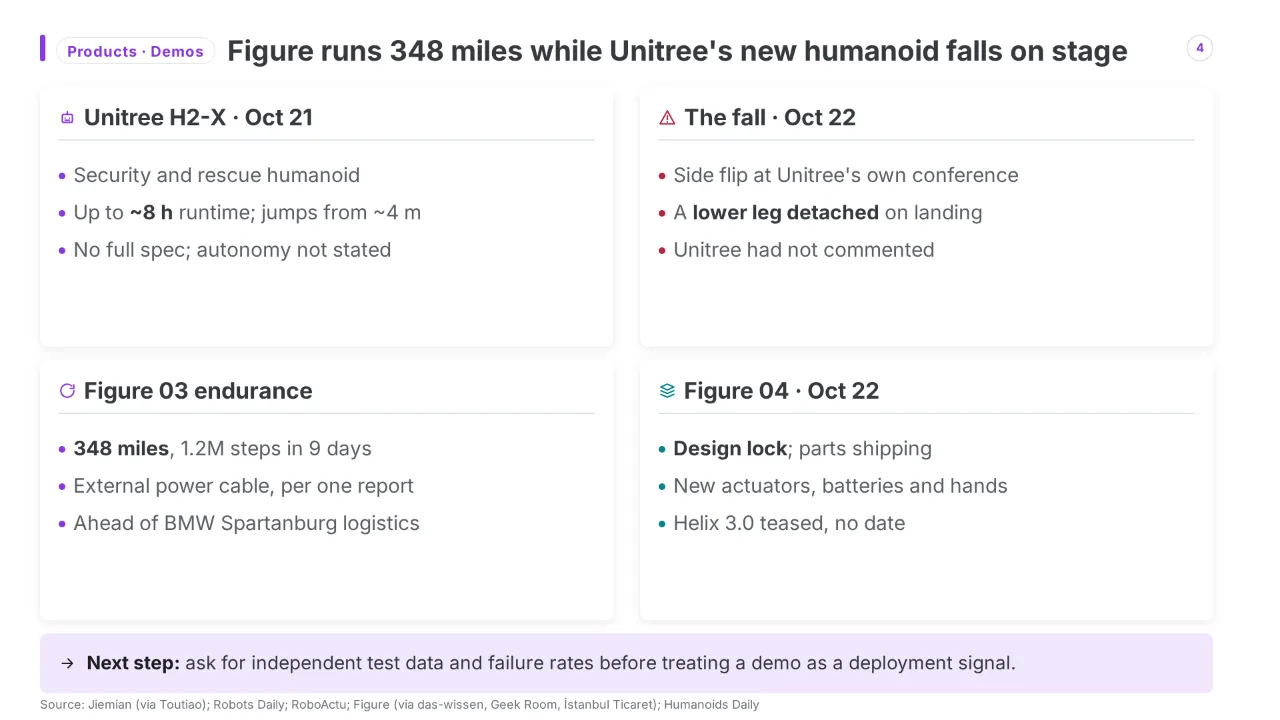
2. Demos are getting tougher, and so is scrutiny. Figure 03 walked 348 miles and 1.2 million steps on a treadmill over nine days. Unitree launched the H2-X security humanoid on October 21; the next day one fell during a side flip at Unitree's own conference and a lower leg came off. Neither company published independent test data.
3. Robot models are becoming platforms. Nvidia added an Isaac OS runtime, Isaac Lab 3.0 and a reference humanoid built with Agile Robots to its open Isaac stack. Physical Intelligence opened its latest models through a paid API beta for fine-tuning and hosted inference, Google previewed Gemini Robotics ER 2, and NEURA released a model that adds touch, sound and memory but no benchmarks.
4. Money follows full-stack Chinese makers. Astribot closed a ¥1 billion round at a ¥15 billion valuation, its fourth round in about six months. Noetix reportedly filed confidentially for a Hong Kong listing. In the US, Figure said it holds more than $2 billion in cash and has committed $3.5 billion to compute with Nscale.
5. The price floor fell as standards arrived. Noetix's Bumi sells for ¥9,998, the first biped under ¥10,000, and Unitree cut its R1 from ¥39,900 to ¥29,900; Faraday Future launched a $2,490 developer humanoid. China approved its first six national standards for humanoid robots, effective April 1, 2027.
1.2 What changed at a glance
| Area | What happened | Date | Status on Oct 23 |
|---|---|---|---|
| Products | Unitree H2-X security humanoid, about 8 h runtime | Oct 21 | Launched; one fell on stage Oct 22 |
| Products | Figure 03 nine-day endurance run; Figure 04 design lock | Oct 19–22 | Test reported by CEO; Figure 04 parts shipping |
| Products | Agile ONE SN reference humanoid on Nvidia Isaac | Oct 21 | Available early 2027 |
| Products | Faraday Future FF Nova at $2,490 | Oct 15 | 100 units in phase one |
| Models | Physical Intelligence models via Pi API beta | Oct 13 | Beta |
| Models | NEURA Neuron AI, a perception-language-action model | Oct 14 | Released, no benchmarks |
| Production | Tesla Optimus early production in Fremont | Oct 21 | Customer deliveries around end-2027 |
| Funding | Astribot ¥1B at ¥15B valuation | Oct 13 | Closed |
| Funding | Noetix confidential Hong Kong IPO filing | Oct 22 (reported) | Listing as early as 2027 |
| Standards | China's first six national humanoid standards | Oct 15 | Effective Apr 1, 2027 |
2. New products and demos
Launches split into two camps: tougher full-size humanoids shown in dramatic videos, and cheap or industrial machines aimed at labs and factories.
2.1 Unitree H2-X: a security humanoid, and a fall on stage
Unitree released a video of the H2-X "Kung Fu Legend Guardian" on October 21, a version of its H2 aimed at security and rescue work. The video shows it denting a car door with a kick, lifting a car and jumping from a platform about 4 metres high; Unitree says it runs for up to about eight hours. Unitree did not publish a full hardware specification or say whether any of the actions in the video were autonomous.
The next day, at Unitree's 2026 World Physical AI Conference, an H2-X lost its balance on a side flip, fell, and a lower leg detached at the joint; Unitree had not commented when the clip spread. The episode is a reminder that a launch video is a best take, not a reliability test.
2.2 Figure: an endurance run and Figure 04 design lock
Figure CEO Brett Adcock said Figure 03 walked for nine straight days on a treadmill, covering 348 miles (about 560 km) and 1.2 million steps, to surface hardware weaknesses before deployment; one report says the robot ran on an external power cable, and Figure did not say whether a single unit completed the whole run. BMW plans to use Figure 03 for logistics at its Spartanburg plant.
In a recorded all-hands meeting published October 22, Adcock said Figure 04 has reached design lock, with parts shipping and new actuators, batteries and hands in testing. He teased Helix 3.0, the next version of Figure's robot model, without a release date or capability breakdown.
2.3 Agile ONE SN: a reference humanoid for labs
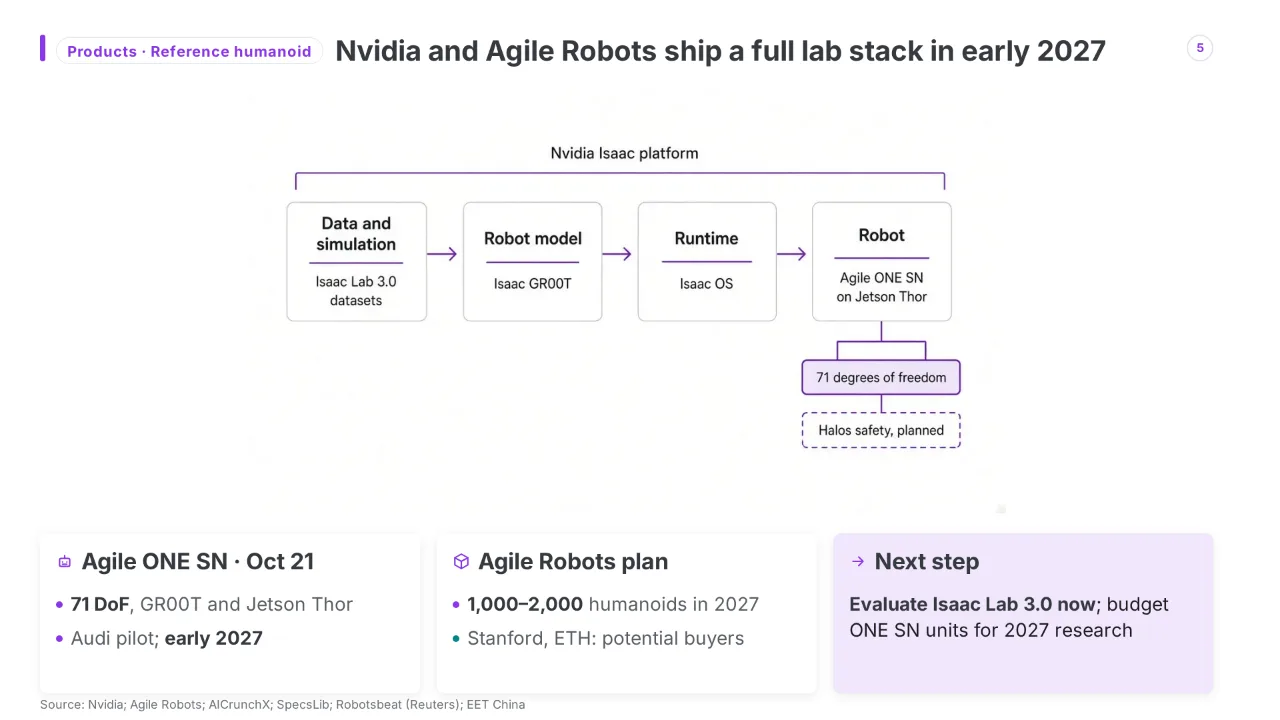
At Nvidia's GTC in Berlin on October 21, Munich-based Agile Robots unveiled Agile ONE SN, a compact humanoid built on Nvidia's Isaac GR00T software and Jetson Thor computer, with Nvidia's Halos safety stack to follow. It has 71 degrees of freedom and is due in early 2027. Agile Robots says the platform was validated in a logistics-sequencing pilot at Audi in Ingolstadt. Its chief executive told Reuters the company expects to build 1,000–2,000 compact humanoids in 2027 for universities and corporate labs, naming Stanford and ETH Zurich as potential customers rather than confirmed buyers.

2.4 Cheap and industrial: FF Nova, HD Hyundai, Inovance
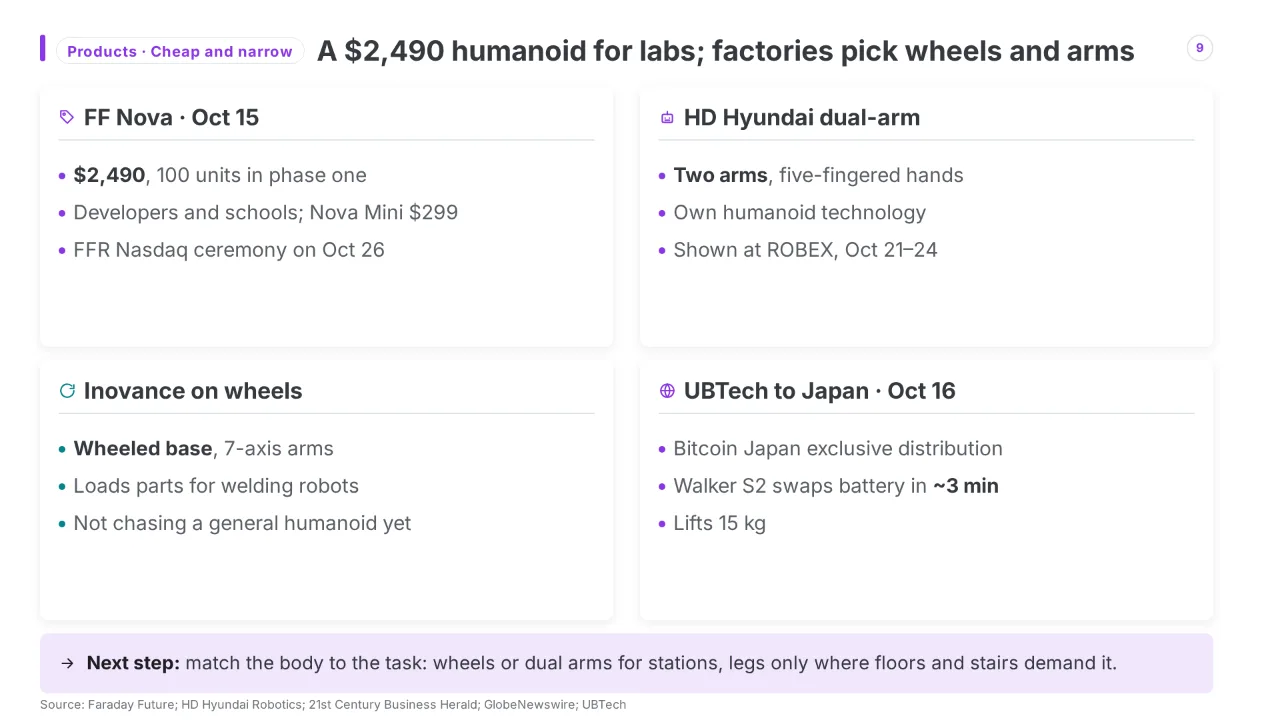
Faraday Future and its robotics arm FFR launched FF Nova on October 15 at $2,490, billing it as the first US humanoid under $2,500; it is a backpack-sized developer and education robot limited to 100 units in phase one, alongside a $299 Nova Mini. FFR plans a listing ceremony and first investor day at the Nasdaq tower on October 26.
Industrial makers showed narrower machines. HD Hyundai Robotics brought an "intelligent dual-arm robot" with five-fingered hands and a human-like upper body, built on its own humanoid technology, to the ROBEX show in Daegu (October 21–24). China's Inovance showed its first humanoid on a wheeled base with seven-axis arms and force control, loading parts for welding robots rather than replacing them; its robotics head said the company is not chasing a fully general humanoid for now.
3. Robot foundation models
The model layer moved from research releases towards products that others build on: open toolkits, paid APIs and on-robot models.
3.1 Nvidia's open stack: Isaac OS, Isaac Lab 3.0, GR00T
Nvidia's October 21 announcement expanded its Isaac robotics platform with a new Isaac OS runtime, Isaac Lab 3.0 for robot learning, simulation pipelines and datasets, plus the Agile ONE SN reference humanoid. Isaac Lab 3.0 is released as open source. The pitch is a single path from data generation through training to deployment on Jetson Thor, so labs can start from an integrated system instead of assembling one. Humanoids took about five minutes of the 94-minute keynote, which was dominated by AI factories and agents.
3.2 Models as a service: Physical Intelligence and Gemini Robotics
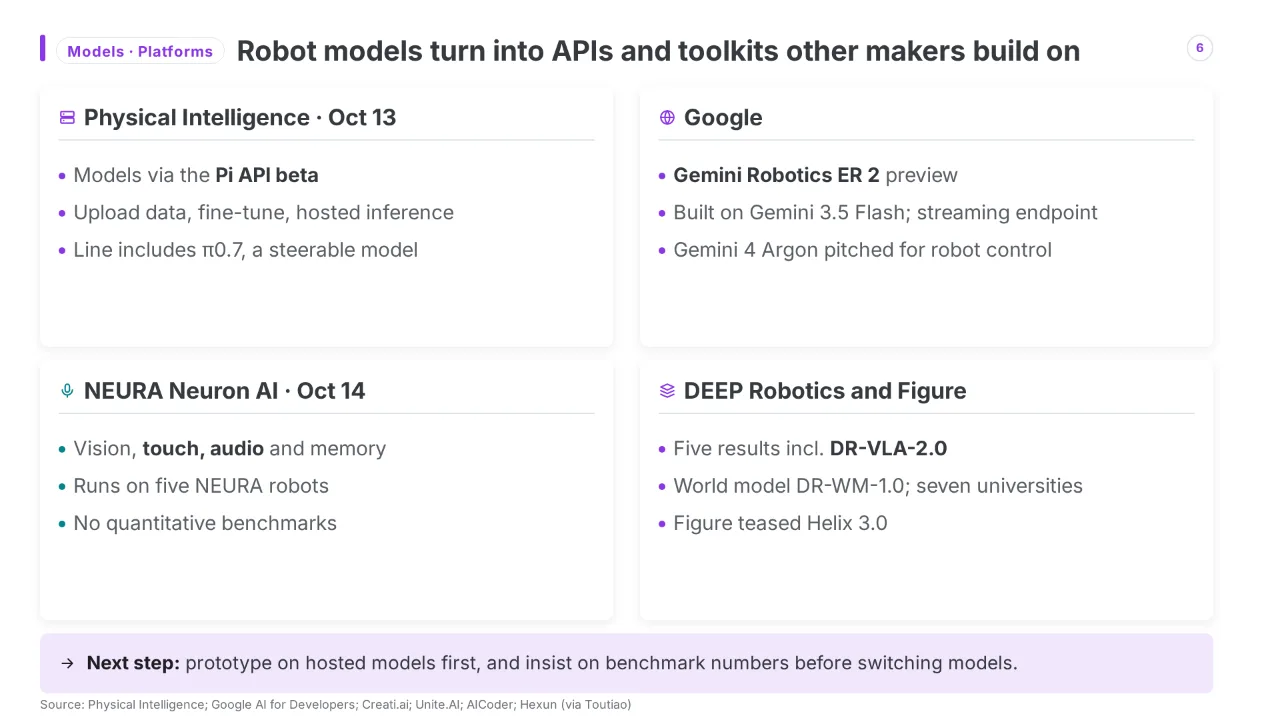
Physical Intelligence said on October 13 that its latest robotics models are available through a Pi API beta: customers upload data, fine-tune models and run cloud-hosted inference on their own robots; its current line includes π0.7, described as a steerable model. Google's Gemini Robotics ER 2, an embodied-reasoning model in preview, is built on Gemini 3.5 Flash and improves spatial reasoning, video progress tracking, multi-robot orchestration and multi-step tool use, with a streaming endpoint for real-time control loops. Google also pitched its new Gemini 4 Argon as one model for controlling robots, generating simulations and reviewing training data, though early demonstrations relied on detailed instructions and vendor tests.
3.3 Beyond vision: touch, world models and Helix 3.0
NEURA Robotics launched Neuron AI on October 14, a perception-language-action model that aligns 3D vision, touch and force, audio, robot state and language, adds memory and runs on the robot across five NEURA machines; it published no quantitative benchmarks. China's DEEP Robotics released five research results around its robot "brain", including a world model (DR-WM-1.0) and an embodied foundation model (DR-VLA-2.0), with seven universities including MIT and Tsinghua. Figure previewed Helix 3.0 but gave no details.
4. Production and deliveries
Volume is now the headline metric, and China is far ahead on it. The US leader is building capacity before it has a product it is willing to sell.
4.1 Tesla Optimus: a line for a million, deliveries in late 2027
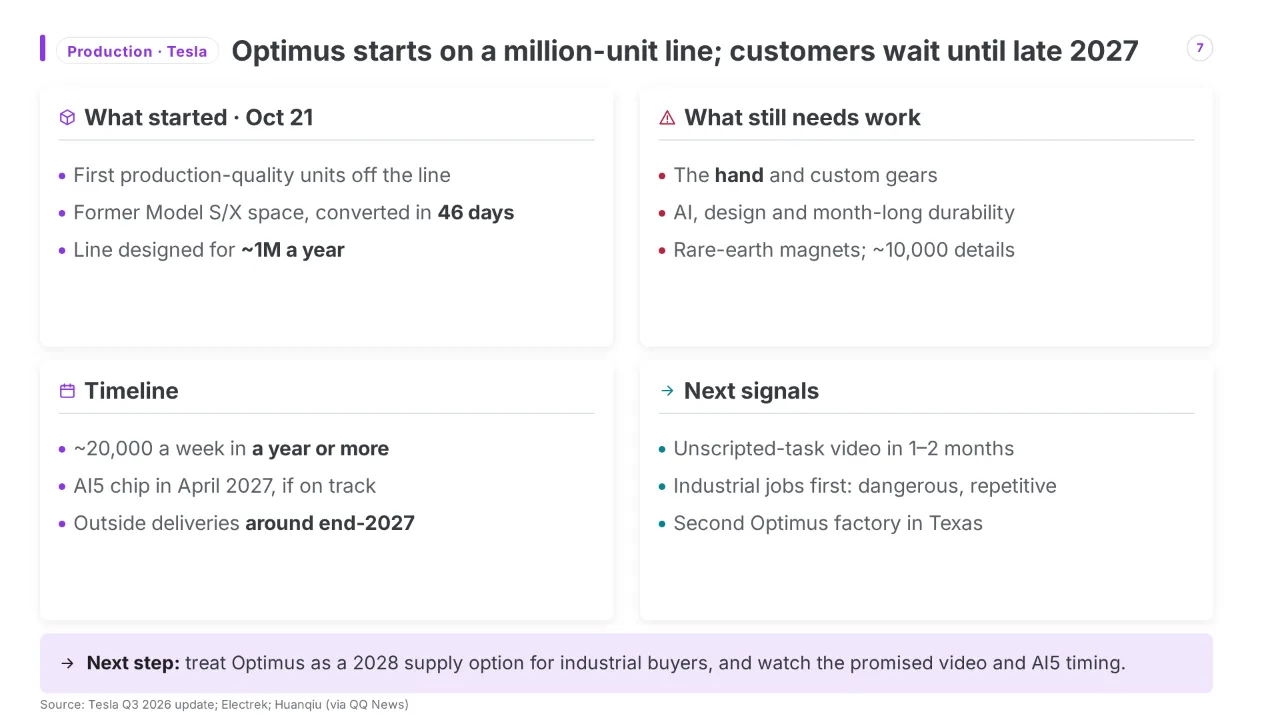
Tesla said in its October 21 update that Optimus is in early production on a high-volume line in Fremont and that the first production-quality robots have come off it. Tesla cleared the former Model S and Model X line in 46 days to make room. Most of a line designed for about a million robots a year is installed, but Musk said reaching about 20,000 a week will take at least a year, possibly longer, because parts of the design are still changing.
The open problems are the ones every humanoid maker faces. Musk named the AI, the electromechanical design and reliability, including making sure the robot does not wear out after a month; an engineer pointed to the hand and custom gears as the hardest hardware areas. Chinese coverage adds about 10,000 details still to debug and rare-earth magnet supply as a constraint. Tesla expects to fit its AI5 chip by April 2027 if integration goes well, to release a video of unscripted tasks within one or two months, and to deliver to outside customers around the end of 2027, starting with dangerous, repetitive industrial work; a second Optimus factory is being built in Texas.
4.2 China's volume lead
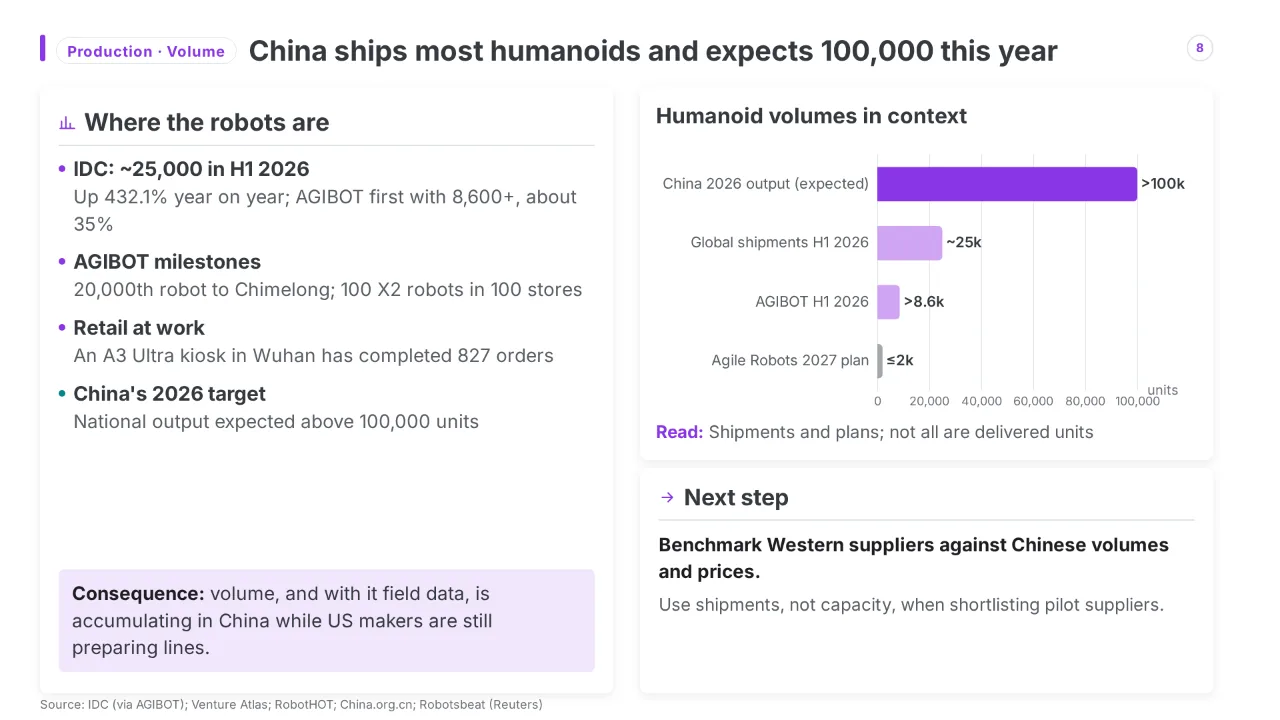
IDC counted nearly 25,000 humanoid robots shipped worldwide in the first half of 2026, up 432.1% year on year, with AGIBOT first at more than 8,600 units, about 35% of the total. AGIBOT says its 20,000th production robot went to theme-park operator Chimelong and that it deployed 100 X2 robots across 100 stores; in Wuhan its A3 Ultra robots run a retail kiosk that has completed 827 orders. China expects national humanoid output to exceed 100,000 units this year.
4.3 Partnerships move robots into new markets
Distribution deals are spreading the leaders' machines. Bitcoin Japan signed an exclusive agreement on October 16 to bring UBTech's robots, including the Walker S2 industrial humanoid, to Japan; the Walker S2 swaps its own battery in about three minutes and lifts 15 kg. In Europe, Agile Robots plans to start producing its ONE S and ONE SN before the end of 2026.
5. Funding and partnerships
The largest rounds went to Chinese companies that make their own models, software and hardware. In the US, the money is going into compute and data.
5.1 Astribot's ¥15 billion valuation
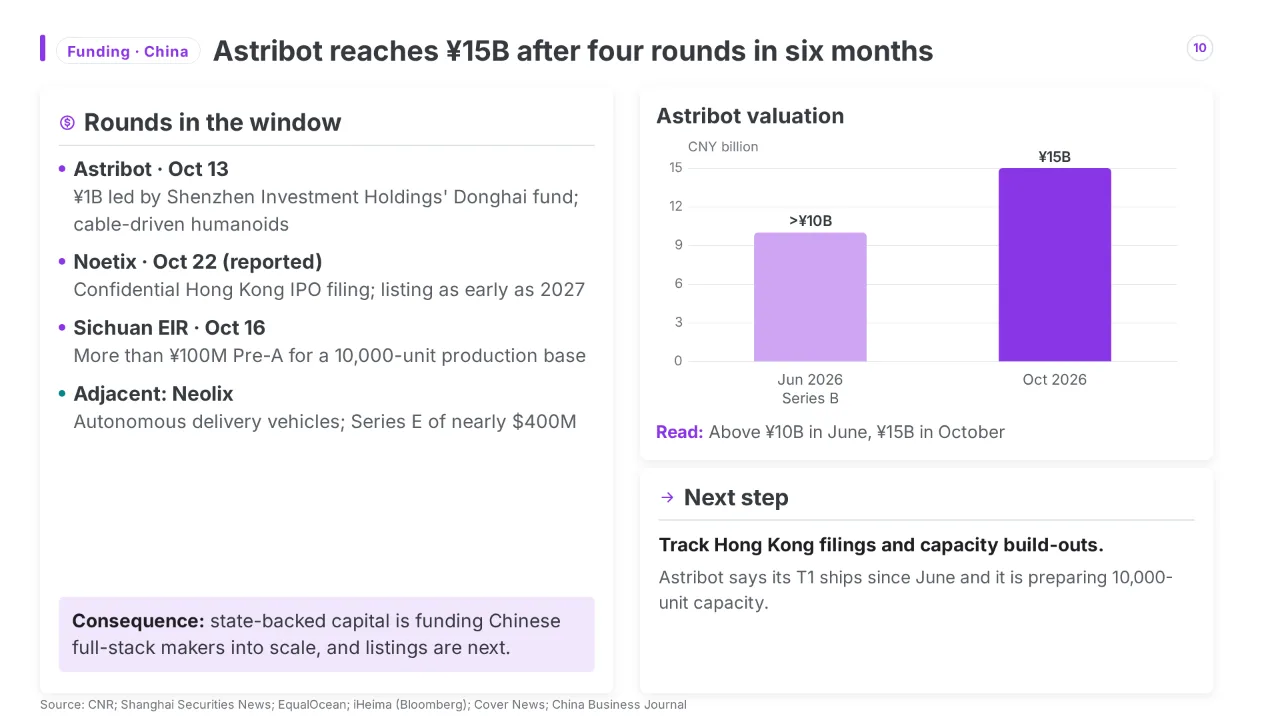
Astribot (Stardust Intelligence), the Shenzhen maker of cable-driven humanoids, closed a ¥1 billion round at a ¥15 billion valuation, led by Shenzhen Investment Holdings' Donghai fund with Hongtai and other state and financial investors. It is the company's fourth round in about six months: its Series B in June totalled more than ¥1 billion and took the valuation above ¥10 billion for the first time. The money goes to models, hiring, commercial deployment and capacity; Astribot says its new T1 humanoid began shipping in June and it is preparing capacity on the order of 10,000 units.
5.2 IPO pipeline and regional rounds
Bloomberg reported on October 22 that Beijing-based Noetix Robotics has filed confidentially for a Hong Kong IPO that could raise several hundred million dollars, with a listing as early as 2027; Noetix raised nearly ¥1 billion in March in a round led by CATL-linked Chendao Capital. Sichuan Embodied Intelligent Robot raised more than ¥100 million in a Pre-A round on October 16 to build a 10,000-unit production base. In adjacent robotics, autonomous-delivery maker Neolix announced a Series E of nearly $400 million. Before the window, simulation-first Sudo Tech raised more than ¥1 billion on September 30 at a valuation above ¥20 billion.
5.3 Figure buys compute and data
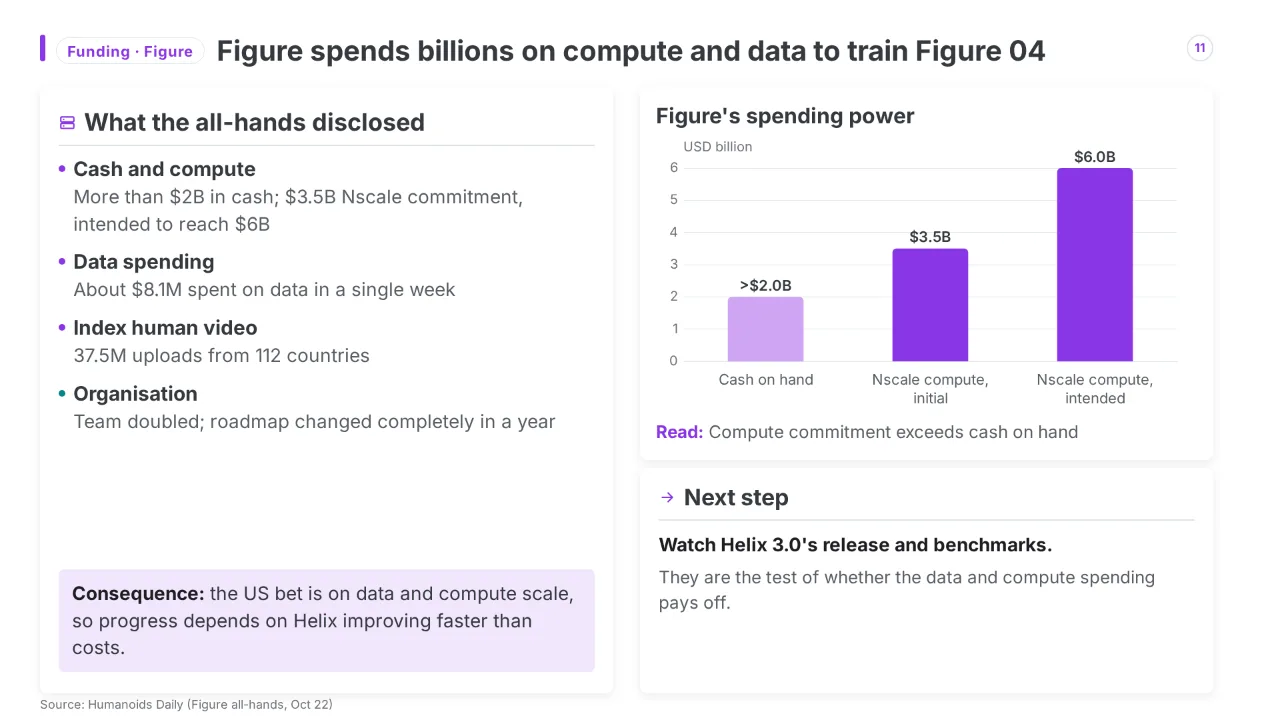
Figure's all-hands meeting put numbers on its spending: more than $2 billion in cash, an initial $3.5 billion compute commitment with Nscale that it intends to raise to $6 billion, and an estimated $8.1 million spent on data in a single week. Its Index program, which collects videos of people doing tasks, has received 37.5 million uploads from 112 countries.
6. Comparing technical approaches
Companies are making different bets on bodies, hands, training data and price. The fortnight added evidence on each.
6.1 Legs, wheels or arms
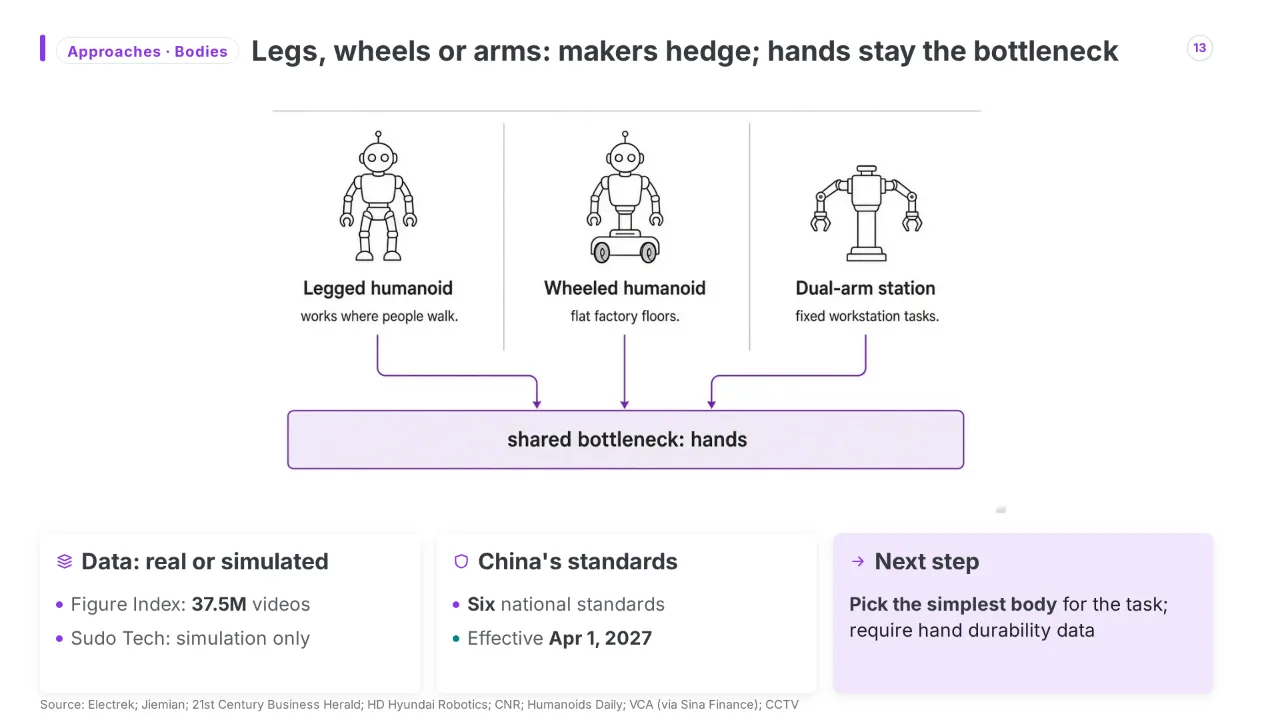
Full-size legged humanoids such as Optimus and the H2-X promise to work anywhere people do, but carry the hardest balance and durability problems, as the H2-X fall showed. Industrial makers are hedging: Inovance put its humanoid on wheels for flat factory floors, and HD Hyundai's dual-arm robot keeps only the upper body. Astribot's cable-driven bodies are a third route, trading conventional joint actuators for tendon-like drives.

6.2 Hands are the bottleneck
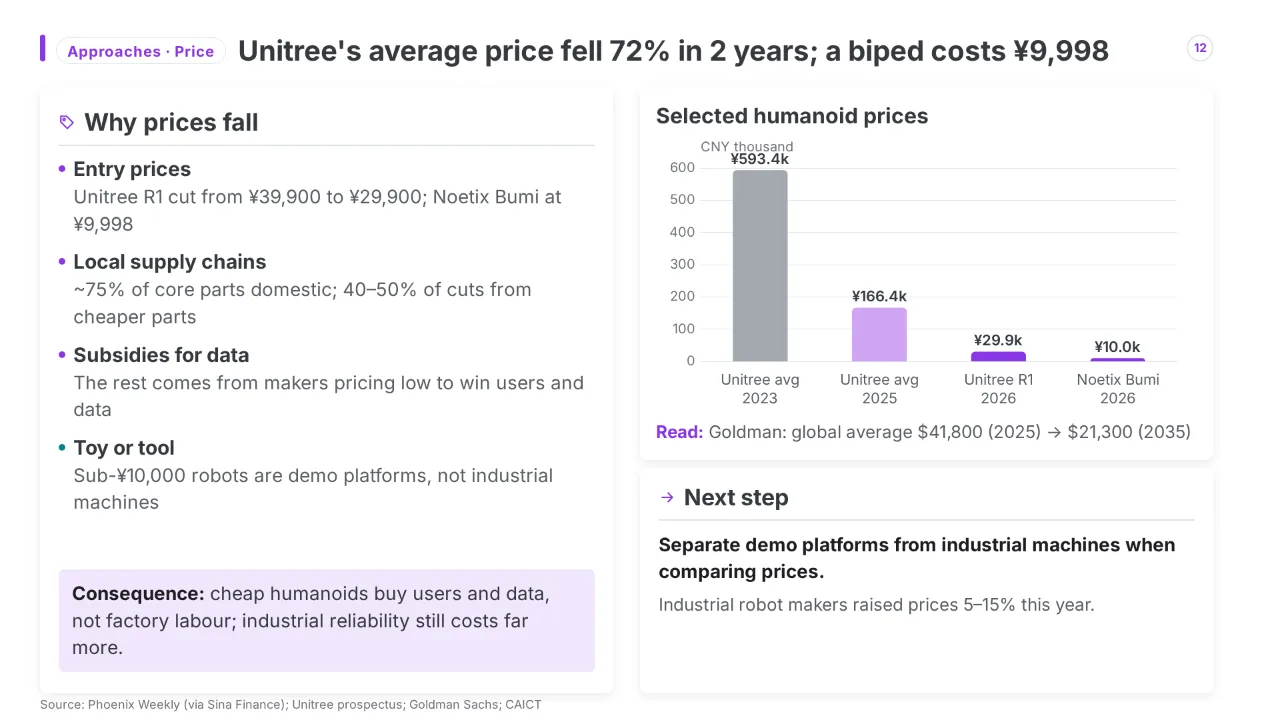
Tesla's engineers named the hand as the hardest hardware area, and Musk said fingers must be soft enough for delicate objects yet durable. Figure is testing new hands for Figure 04. Consumer-grade machines skip the problem: an industry adviser describes sub-¥10,000 humanoids as motion-demonstration platforms, "basically the difference between a toy and a tool" against industrial machines.
6.3 Real-world data or simulation
The data race splits into two camps. Figure collects human video at scale through Index, and X Square Robot built what it calls China's first large-scale data-collection factory for real-scene data. Sudo Tech bets on simulation, saying its Sudo R1 system was trained without any real-robot data. Nvidia's Isaac Lab 3.0 and simulation pipelines serve the second camp and blend into the first.
6.4 Price against capability
Chinese prices are falling fastest. Unitree's average humanoid price fell from ¥593,400 in 2023 to ¥166,400 in 2025, about 72% in two years, according to its prospectus; it cut the R1 to ¥29,900, and Noetix's Bumi lists at ¥9,998. Goldman Sachs expects the global average humanoid price to fall from $41,800 in 2025 to $21,300 in 2035. Domestic parts now make up about 75% of core components, and an insider estimates that 40–50% of recent cuts came from cheaper supply chains and the rest from makers subsidising prices to win users and data.
6.5 Standards arrive
China's market regulator approved the country's first six national standards for humanoid robots on October 15: five technical-requirement standards covering body structure, system architecture, perception and decision-making, plus a specification for simulation test platforms; they take effect on April 1, 2027. They were part of a batch of 515 national standards that included 16 on AI, humanoid and industrial-environment robots.
7. Trends and what to watch
7.1 Five trend judgements
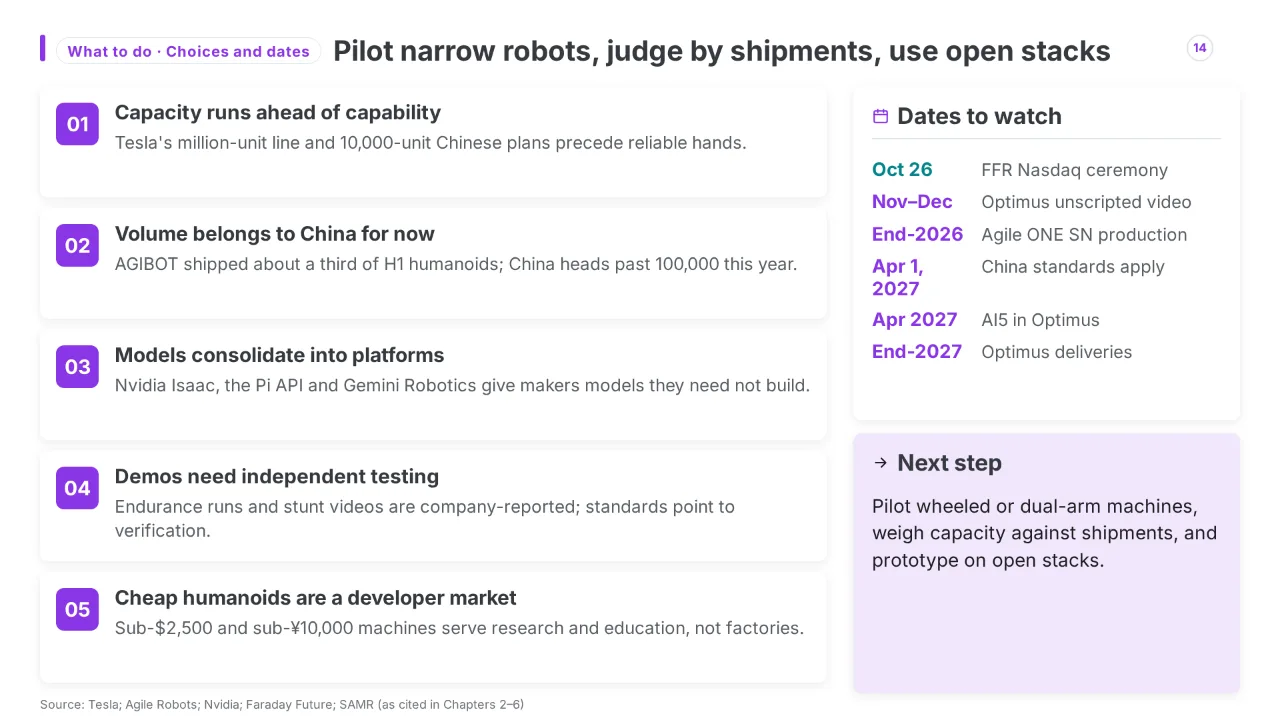
1. Capacity runs ahead of capability. Tesla is installing a million-unit line before the hand and reliability are solved, and Chinese makers such as Astribot are preparing 10,000-unit capacity. Expect utilisation, not capacity, to be the 2027 story.
2. Volume belongs to China for now. AGIBOT alone shipped about a third of the world's humanoids in the first half, and national output is heading past 100,000 this year.
3. The model layer is consolidating into platforms. Nvidia's open stack, Physical Intelligence's API and Google's Gemini Robotics give smaller makers a model they do not have to build.
4. Demos need independent testing. Endurance runs and stunt videos are company-reported; the H2-X fall shows how far a video can be from field reliability. China's new standards and simulation test platforms point to where verification will come from.
5. Cheap humanoids are a developer market. Sub-$2,500 and sub-¥10,000 machines expand research and education, not factory labour.
7.2 What to do now
- Buyers in manufacturing: pilot narrow machines (wheeled or dual-arm) on defined tasks before committing to general-purpose humanoids.
- Investors: weigh capacity announcements against shipments and contracted orders; Agile Robots' 2027 plan and Tesla's line are forecasts.
- Developers: test the open stack (Isaac Lab 3.0) and hosted models (Pi API) before training from scratch.
7.3 Dates to watch
| Date | Event | Source |
|---|---|---|
| Oct 26, 2026 | FFR listing ceremony and first investor day at Nasdaq | — |
| Nov–Dec 2026 | Tesla video of Optimus doing unscripted tasks | — |
| End of 2026 | Agile ONE S and ONE SN production starts | — |
| Early 2027 | Agile ONE SN availability | — |
| Apr 1, 2027 | China's humanoid national standards take effect | — |
| Apr 2027 | AI5 chip in Optimus, if on track | — |
| End of 2027 | Optimus deliveries to outside customers | — |