
AI Chips & Compute Brief, Oct 9–22, 2026: Rubin Ramps, Inference Silicon Splits and Power Sets the Pace
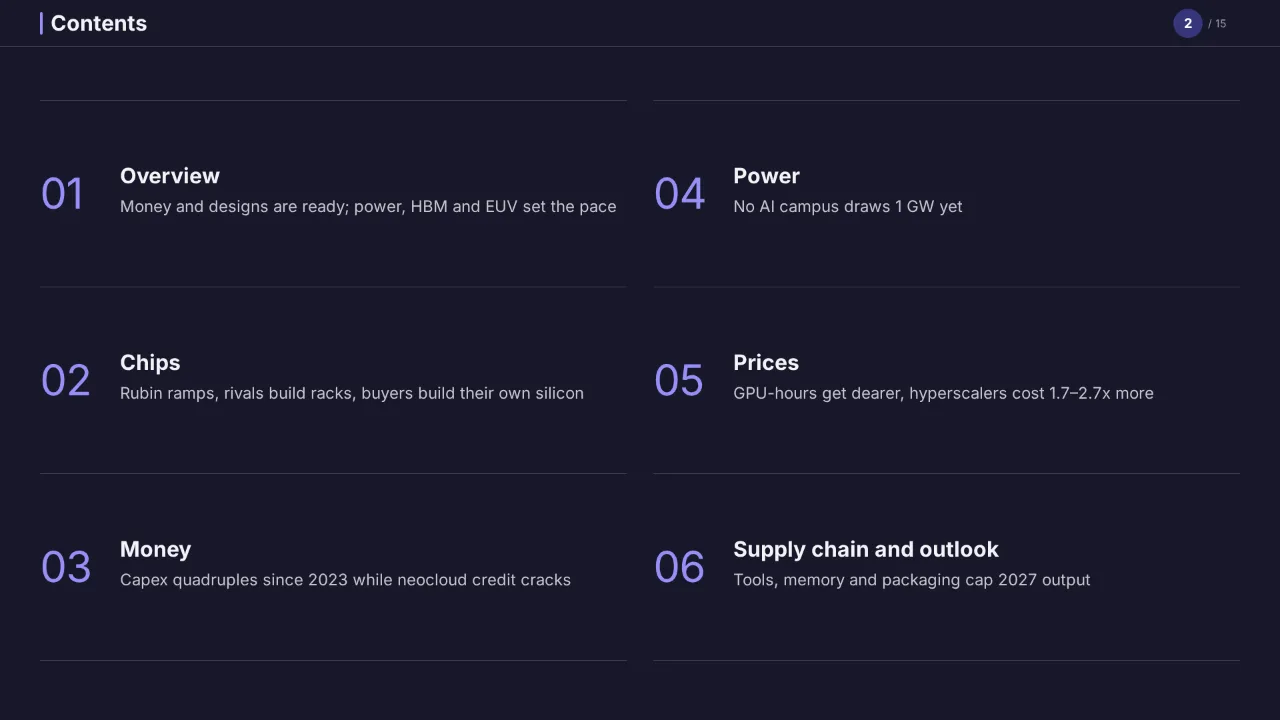
Contents
- Key takeaways from the two weeks
- Nvidia — Vera Rubin from roadmap to racks
- AMD and Intel — open racks and inference cards
- Custom silicon — Maia 300, Jalapeño, TPU and Trainium
- Cloud capex and compute contracts
- Data centers and power
- Compute rental prices
- Supply chain — foundry, HBM and packaging
- Outlook and what to watch next
1. Key takeaways from the two weeks
Between October 9 and October 22, 2026 the AI compute market packed a year's worth of signals into two conferences (the OCP Global Summit on Oct 12–15 and GTC Berlin on Oct 21) and three results releases (ASML, TSMC and Meta). Read together, Chapters 2–8 point one way: demand and budgets are still rising, but the pace of the build-out is now set by power, memory and lithography, not by chip designs. Five conclusions follow.
1.1 Five conclusions
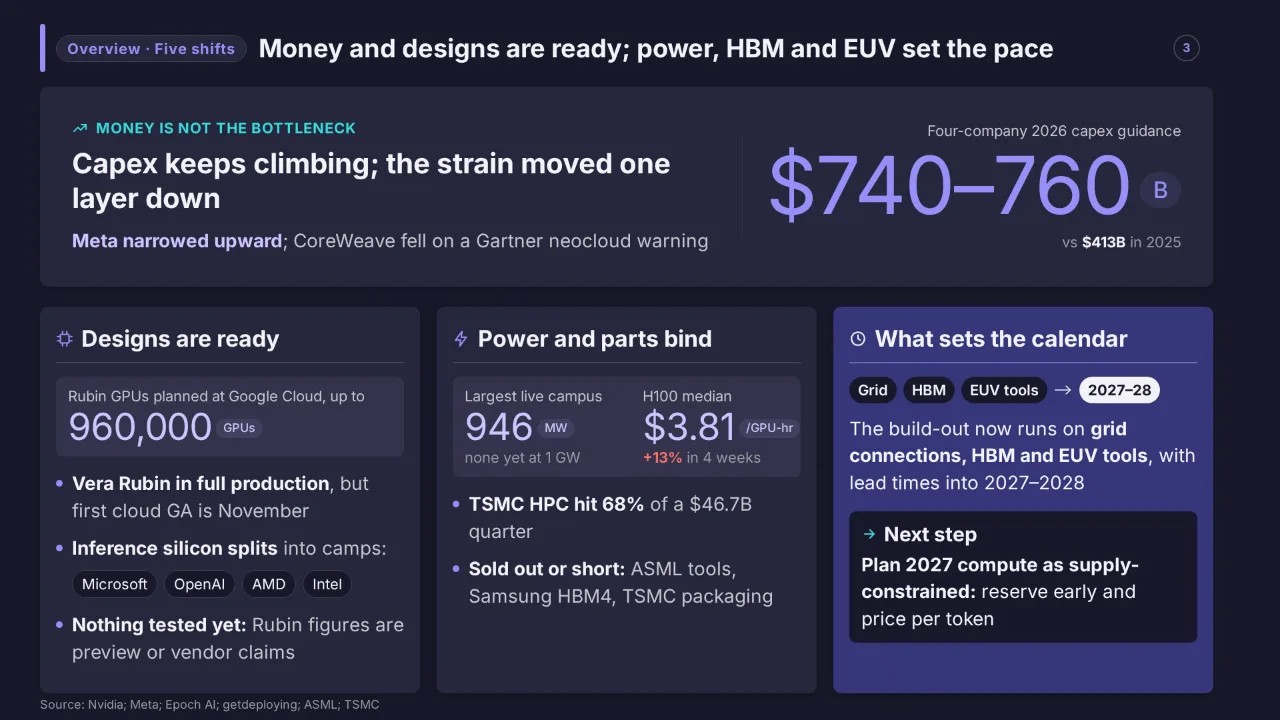
1. Vera Rubin is in production, but nobody can rent it yet. Jensen Huang said at GTC Berlin on Oct 21 that Vera Rubin is "in full production". The first cloud instances, Google Cloud's A5X, are announced with general availability due in November, against a target of up to 960,000 Rubin GPUs. Nvidia's factory-built DSX POD cuts site deployment to as little as 14 days but ships only from early 2027. Every Rubin performance figure in the window, including MLPerf results of up to 3.74x over GB300 NVL72, is a preview submission or a vendor claim.
2. Inference silicon is splitting into four camps. Microsoft announced Maia 300 on Oct 12 (288 GB HBM4, 18 TB/s) and committed to multi-gigawatt Maia deployments from 2027 as its primary inference system. OpenAI's Jalapeño moves to small-volume deployment in late 2026. AMD put rack blueprints on both sides of the agentic data center: Helios is shipping, and Helion's partner systems are due in November. Intel's GPU D270 targets air-cooled enterprise racks at 350 W and is sampling. Broadcom, the design partner behind much of this, targets about $115B of AI revenue in fiscal 2027. None of the efficiency claims has been measured independently yet.
3. Capex keeps rising; the stress moved to the neoclouds. Meta narrowed its 2026 capex range upward to $135–145B on Oct 21, putting four-company 2026 guidance at $740–760B against $413B in 2025. Meta's Q3 free cash flow turned negative. One layer down, CoreWeave fell 15.46% on Oct 14 after Gartner warned that most neoclouds may lose independence by 2030. Microsoft dropped Nscale's Loughton site over grid delays, even as Anthropic and Nscale were reported to be negotiating a second ~$45B deal.
4. Power, not chips, sets the build-out calendar. By Epoch AI's Oct 15 estimate no tracked AI campus has yet crossed 1 GW of operating IT power; the largest, Colossus 2, draws about 946 MW. Of the 92 GW of data-center load seeking ERCOT access, 54 GW is still only proposed. Builders are reserving gas turbines through 2034, as in Venture Global's framework for up to 16 × 720 MW power islands, while Texas has paused data-center permits pending power and water audits.
5. Prices are rising and supply is sold out. The H100 on-demand median reached $3.81 per GPU-hour, up 13% in four weeks; the B200 list median stood at $8.19. ASML said its planned 2027–28 supply "will not fully meet the demand of our customers". Samsung calls its 2026 HBM4 volume effectively sold out, CoWoS is reported sold out through 2026, and TSMC's HPC platform reached 68% of a $46.7B quarter.
The fortnight's message: money and designs are no longer the bottleneck for AI compute. Grid connections, HBM and EUV tools are, and their lead times run into 2027–2028.
1.2 What changed at a glance
| Item | Change | Date | Status (as of Oct 23, 2026) |
|---|---|---|---|
| Nvidia Vera Rubin | "Full production" statement; DSX POD reference design | Oct 21 | Vendor statement; DSX POD deliveries early 2027 |
| Google Cloud A5X (Vera Rubin NVL72) | Announced, up to 960,000 Rubin GPUs planned | Oct 21 | Announced; GA due November 2026 |
| Microsoft Maia 300 | Third-generation inference ASIC, 18 TB/s | Oct 12 | Announced; production deployment 2027 |
| AMD Helion | Open agentic-AI rack blueprint, up to 32,768 cores | Oct 12 | Announced; partner systems November 2026 |
| Intel GPU D270 | Crescent Island named; 1.3 PFLOPS FP8, 350 W | Oct 12 | Sampling |
| OpenAI Jalapeño | Named a TIME Best Invention | Oct 15 | Small-volume deployment planned late 2026 |
| Meta capex | 2026 range narrowed to $135–145B | Oct 21 | Official guidance |
| Microsoft–Nscale | Loughton anchor-tenant role ended | By Oct 19 | In effect |
| Anthropic–Nscale | Second ~$45B, 460 MW deal | Oct 19 | In talks (reported) |
| Venture Global | Up to 16 × 720 MW gas power islands | Oct 15 | Framework; first order by end-2026 |
| GPU rental prices | H100 median $3.81, +13% in 4 weeks | Week of Oct 19 | In effect |
| ASML | Q3 sales €11.7B; 2027–28 supply short of demand | Oct 14 | Reported |
| TSMC | Q3 revenue $46.7B; Q4 guide $52.3–54.3B | Oct 15 | Reported / guidance |
| GlobalFoundries–TSMC | ~$2B CoWoS interposer deal | Oct 8 | Announced; volume H1 2028 |
2. Nvidia — Vera Rubin from roadmap to racks
Chapter 1 called Vera Rubin's move into production the first theme of the fortnight. This chapter checks what Nvidia actually announced and measured between Oct 9 and Oct 22, and what can be bought today.
2.1 Dated timeline
| Date | Event | Status (as of Oct 23, 2026) | Source |
|---|---|---|---|
| Sep 16, 2026 (background) | MLPerf Inference v6.1 published; Vera Rubin NVL72 debuts in the preview category | Preview result | shattered.io |
| Oct 9, 2026 | vLLM support for Vera Rubin NVL72 in nightly containers (CUDA 13.4, PyTorch 2.15) | Preview (nightly builds) | vLLM blog; Spheron, Cherry AI |
| Oct 21, 2026 | GTC Berlin keynote: Huang says Vera Rubin is "in full production" | Vendor statement | NVIDIA Blog |
| Oct 21, 2026 | DSX POD reference design for containerised Vera Rubin AI factories | Announced; partner deliveries early 2027 | NVIDIA Newsroom |
| Oct 21, 2026 | Google Cloud A5X instances on Vera Rubin NVL72 | Announced; GA "next month" (November 2026) | NVIDIA Blog; TradingView |
| Oct 21, 2026 | Three DSX OS components (Config Manager, Rack Management Service, Cluster Readiness Engine) | Developer preview | StorageReview, TechTimes |
Our material has no primary record of Nvidia's OCP Global Summit contributions (Oct 12) or of dedicated Lenovo and Bull Vera Rubin Ultra systems; both firms appear only as DSX POD partners. AMD's OCP news is in Chapter 3.
2.2 Vera Rubin NVL72: specs and benchmark claims
A Vera Rubin NVL72 rack pairs 36 Vera CPUs with 72 Rubin GPUs and is one of five rack-scale systems in the platform, alongside Groq 3 LPX and BlueField-4 STX Storage. The GPU moves from HBM3e to HBM4. It carries 212 streaming multiprocessors, of which 200 are used in the default locality-domain mode. The infrastructure supports 100% liquid cooling at coolant temperatures up to 45°C.
Per-GPU ratios against GB200 NVL72, all from one source: the vLLM blog post co-authored with NVIDIA, which cites NVIDIA spec pages:
| Metric (Vera Rubin NVL72 vs GB200 NVL72) | Ratio | Source |
|---|---|---|
| NVFP4 inference FLOPS | 5x | vLLM blog |
| HBM bandwidth (HBM4 vs HBM3e) | 2.4x | vLLM blog |
| NVLink bandwidth (6th gen) | up to 1.7x | vLLM blog |
| Exponential throughput, FP32 / BF16-FP16 | 2x / 4x | vLLM blog |
Vendor claims. Per TradingView, Huang claimed 30x Blackwell's performance in LLM processing. Nvidia's own blog headline describes it as "up to 30x more work per watt" for AI agents. We follow the per-watt version. Neither figure has been measured independently.
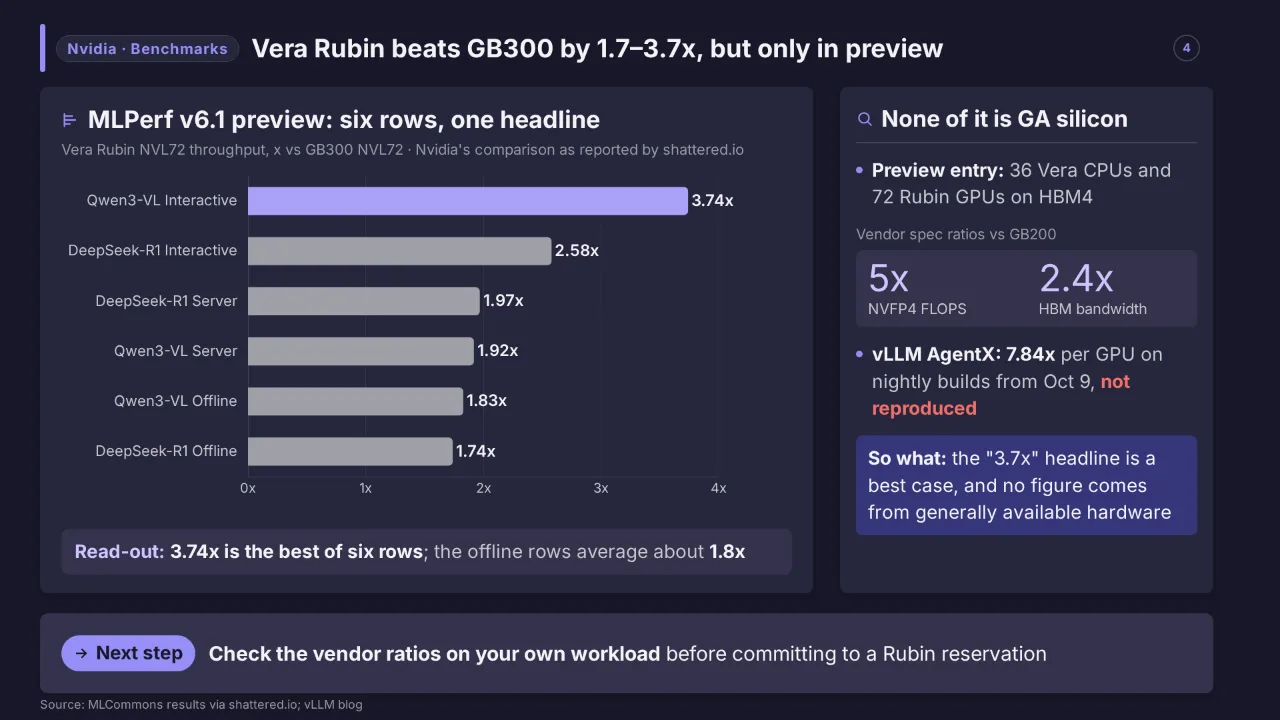
Benchmark results, which are only partly independent. MLPerf is peer-reviewed, but Vera Rubin entered as a preview submission: neither the hardware nor the software is the generally available configuration. The round drew 30 organisations, 120 systems and 486 results. Shattered.io reproduces Nvidia's comparison against GB300 NVL72 from the release, and the Qwen3-VL ratios match Spheron's account:
| Workload · scenario | Vera Rubin NVL72 | GB300 NVL72 | Ratio |
|---|---|---|---|
| DeepSeek-R1 · Interactive (tokens/s) | 652,750 | 253,506 | 2.58x |
| DeepSeek-R1 · Offline (tokens/s) | 1,183,327 | 679,740 | 1.74x |
| DeepSeek-R1 · Server (tokens/s) | 1,175,890 | 596,944 | 1.97x |
| Qwen3-VL-235B · Interactive (queries/s) | 1,306.6 | 349.3 | 3.74x |
| Qwen3-VL-235B · Offline (samples/s) | 2,392.7 | 1,305.0 | 1.83x |
| Qwen3-VL-235B · Server (queries/s) | 2,323.3 | 1,210.5 | 1.92x |
Source: Nvidia's figures as reported by shattered.io. The headline "3.7x" is the best of the six rows. The offline rows average about 1.8x ((1.74 + 1.83) ÷ 2 ≈ 1.79). Nvidia also reported 99% scaling efficiency for 288 GPUs across four racks. Nebius, on a separate configuration, posted 591,368 DeepSeek-R1 tokens/s in server mode, so a second organisation has working silicon.
vLLM day-0 (Oct 9). Rubin can run Blackwell kernels compiled for the sm100f target, so DeepSeek, Kimi, GLM and MiniMax models worked from the first nightly build. Dedicated sm107 kernels are still being written. On the AgentX agentic-coding benchmark with MiniMax M3, vLLM reports 7.84x GB200's per-GPU throughput at matched interactivity, and 5.18x under a 150 tokens/s-per-user cap. Ideal scaling would cut the GPU count to 1 ÷ 7.84 ≈ 13%, or 1 ÷ 5.18 ≈ 19%, of a GB200 fleet. The collaborators published these figures themselves, on early hardware, and nobody has reproduced them yet.
2.3 DSX POD and factory-built deployment
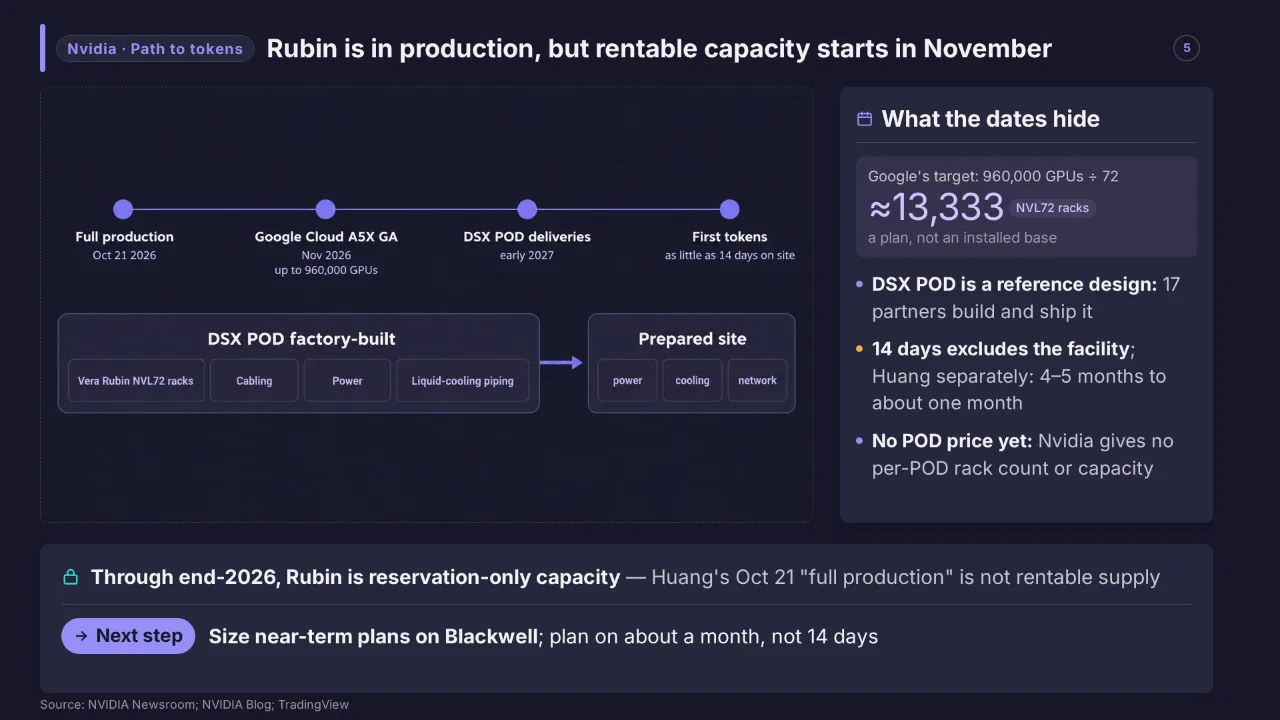
DSX POD is a reference design, not a product Nvidia sells. Partners build complete Vera Rubin AI factories inside modular containers and finish rack-to-rack cabling, power, liquid-cooling piping and validation before shipment. Nvidia says this cuts deployment at a prepared site from six months to as little as 14 days. Seventeen partners, including Bull, Dell, HPE, Lenovo, Schneider Electric and Vertiv, will deliver worldwide in early 2027. Dell announced its own Dell Modular Data Center with NVIDIA DSX POD the same morning. Nvidia has published no per-POD rack count, capacity or price.
There are two caveats. First, the 14 days exclude building the facility, which remains the customer's job and is usually the longer task. Second, in a separate interview Huang gave a more modest figure: equipment arrival to token production falls from four to five months to about one month. We treat 14 days as the best case for site connection, and roughly a month as the realistic planning number.
Nvidia says DSX can deliver the same output with up to 30% less power. A Lambda proof of concept on HGX B200 reported 24% higher throughput, and an Nscale test on four GB300 NVL72 racks within a 264 kW budget reported 49% higher inference throughput. Vertiv models up to 30% more cumulative tokens in the first 12 months; Polar is applying the approach to a 41 MW phase in Norway. Nvidia also expanded its substrate, test and optics supply in Berlin (see Chapter 8), and DSX cooling and power design is covered in Chapter 6.
Vera Rubin is in production but cannot be rented yet. The first cloud GA (Google A5X) is due in November 2026, and factory-built DSX PODs ship from early 2027. Every Vera Rubin performance number in this window is a preview result or a vendor claim.

2.4 Who is buying
Google Cloud is the anchor buyer for the window. A5X combines Vera Rubin NVL72, ConnectX-9 SuperNICs, the Virgo Network and fourth-generation liquid cooling. GA is due "next month", followed by expansion to Europe. Google plans to scale to as many as 960,000 Rubin GPUs across multiple sites. That target is 960,000 ÷ 72 ≈ 13,333 NVL72 racks, and it is a plan, not an installed base. StreetInsider's wording implies A5X is already GA. We follow Nvidia's own blog, which says GA is coming next month: announced / upcoming. The first customer is Ineffable Intelligence, David Silver's reinforcement-learning lab. WPP ran workloads on a single A5X instance that previously needed a multi-node cluster.
Other demand signals are weaker or come from secondary sources:
- Before the window, Nscale agreed to deliver 66,000+ Rubin GPUs to Microsoft in Portugal (Aug 7 brief). Microsoft and Nscale contract changes are covered in Chapter 5.
- Spheron lists Vera Rubin only as a reservation or pre-order.
- Dell says its AI Factory with Nvidia has 6,500+ customers, up from 5,000 the quarter before.
- According to 24/7 Wall St., ByteDance, Alibaba and Tencent are reportedly lining up $35 billion of Nvidia orders, depending on export rules. The report does not specify Vera Rubin.
Our judgement: Google's 960,000-GPU plan locks in demand, but buyers should treat Vera Rubin as reservation-only capacity through the end of 2026. Size near-term plans on Blackwell, and check the 5–8x vendor ratios on your own workload before committing to a reservation.
3. AMD and Intel — open racks and inference cards
Chapter 2 followed Nvidia's Vera Rubin from roadmap into production. AMD and Intel used the OCP Global Summit, which drew 15,000 attendees to San Jose on Oct 12–15, to fight on different ground: AMD pitched open rack blueprints, and Intel pitched an inference card that needs no new data hall.
3.1 AMD Helion and Helios: two racks, two jobs
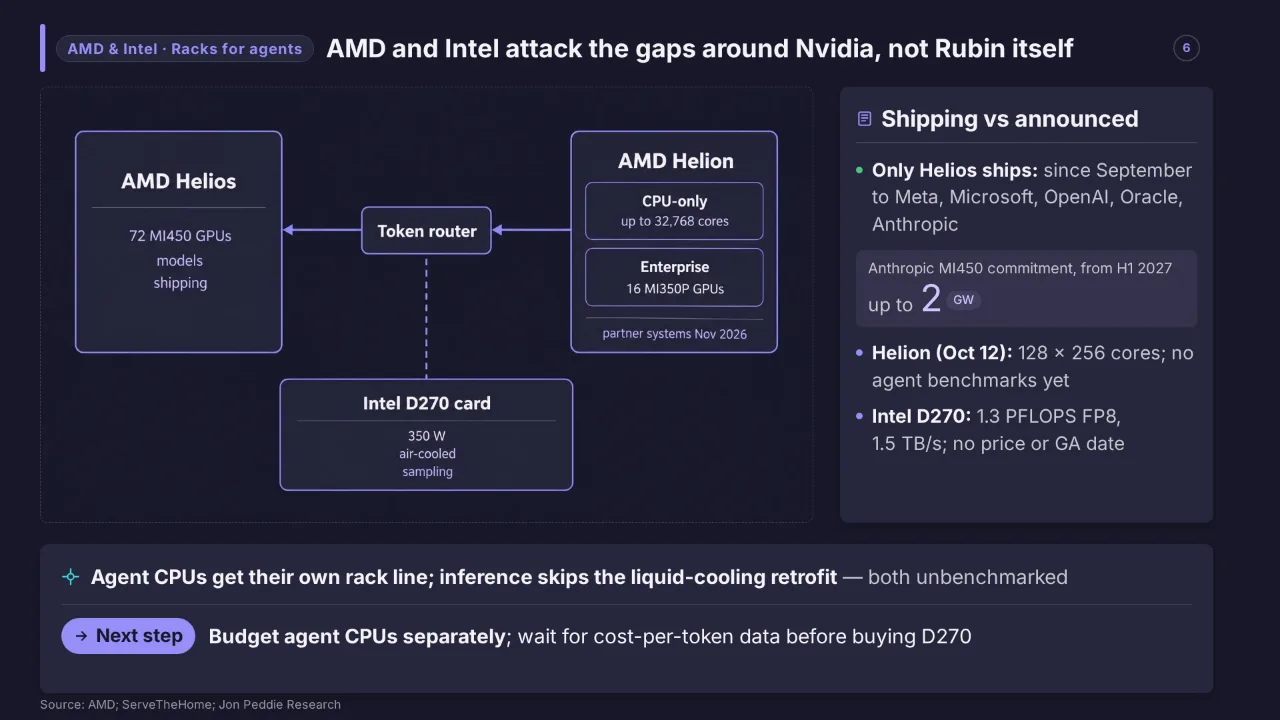
AMD announced Helion on Oct 12, 2026 as "an open blueprint for agentic AI infrastructure" based on an OCP spec design. It is a reference design, not an AMD-branded box. AMD plans to contribute the spec to OCP, and partner configurations are "planned to be available in November 2026" (status: announced). Eight launch partners are named: Cisco, Dell, Hon Hai, HPE, Lenovo, QCT, Supermicro and Wiwynn.
The press release describes two example configurations:
- a CPU-only rack of 6th Gen EPYC processors with up to 32,768 cores, for hyperscalers that want agent-execution capacity separate from their inference clusters;
- an all-in-one rack that mixes EPYC CPU nodes, Instinct MI350P GPU nodes and general-purpose compute, aimed at enterprises.
Both come in liquid- and air-cooled versions, and both include an integrated token router that sends agents' model calls to frontier or open-source models. AMD's product page, as quoted by MLQ, adds the details below. NAND Research reads the core count as up to 128 EPYC 9996 parts, and the arithmetic checks out: 128 × 256 cores = 32,768.
| Helion element (AMD product page) | Value | Source |
|---|---|---|
| Dense CPU blade | 256 cores, 400 W | AMD (via MLQ) |
| Balanced CPU blade | 256 cores, 600 W | AMD (via MLQ) |
| High-frequency CPU blade | 96 cores, up to 5.0 GHz | AMD (via MLQ) |
| GPUs (enterprise config) | 2 servers × 8 MI350P = 16 GPUs, no scale-up fabric between them | AMD (via MLQ) |
| Networking | Up to 102 Tbps | AMD (via MLQ) |
| Rack | 21-inch ORv3, 44 units | AMD (via MLQ) |
There is one conflict. According to a Yahoo Finance report of Lisa Su's summit remarks, Helion supports "up to 32 Instinct MI350P GPUs". We follow the product page figure of 16, which MLQ and NAND Research both report. AMD has not published pricing or a per-rack power figure.
Helios is the other rack. It is AMD's 72-GPU, OCP-standard system built with Meta, combining MI450 GPUs, EPYC Venice CPUs and Pensando networking. Su described it as having more than 18,000 GPU compute units and 4,600 Zen 6 CPU cores, and AMD estimates 30% more tokens per dollar (vendor estimate). Helion is not a smaller Helios. Helios is one unified GPU domain for training and large-scale inference, while Helion handles agent execution and enterprise inference.
3.2 AMD customer commitments and ramp schedule
Separate what has shipped from what is still a contract.
| Item | What was said | Status (as of Oct 23, 2026) | Source |
|---|---|---|---|
| Helios production | Introduced in July; production shipments began in September; ramp "through the fourth quarter and into the first half of 2027" | Shipping, ramping | Lisa Su (via Yahoo Finance) |
| Helios first recipients | Initial systems at Meta, Microsoft, OpenAI, Oracle and Anthropic | Shipping (initial systems) | Lisa Su (via Yahoo Finance) |
| Anthropic MI450 | Up to 2 GW; first deployment expected H1 2027 | Announced | Zacks (via TradingView) |
| OpenAI + Meta + Anthropic | Up to 14 GW of planned AMD deployments, "most of which is still future capacity" | Announced (secondary tally) | New Market Pitch |
| HPE | "Recent customer agreement to deploy AMD Helios" | Announced | HPE in AMD release |
| Helion partner systems | Available from November 2026 | Announced | AMD |
These two sources do not contradict each other. Initial Helios racks have reached Anthropic, while the gigawatt-scale MI450 build is a 2027 event. The 14 GW total is a secondary tally, so treat it as an order of magnitude, not a booked number.
In Q2 2026 revenue rose 50% year on year to $11.54 billion, and Data Center revenue rose 107% to $6.72 billion. That makes Data Center 6.72 ÷ 11.54 ≈ 58% of the total, which matches the 58% Zacks cites. AMD guided Q3 revenue to about $13 billion ± $300 million. It also expects server CPU revenue to grow more than 80% year on year in H2 2026, and the Data Center business to more than double in 2027 (company outlook, via Zacks). On CPUs, Su said AMD has "raised the TAM on this three times in the last nine months". She now sees CPU demand growing about 50% a year to more than $200 billion by 2030, and the data-center AI accelerator market approaching $1.5 trillion by 2030 (both estimates). The constraint is supply: management says wafers, HBM, advanced packaging and substrates are all tight (see Chapter 8).
AMD is no longer selling chips into Nvidia-designed racks. It now has rack blueprints for both halves of the agentic data center: Helios for models, Helion for agents. Only Helios is shipping.

3.3 Intel GPU D-Series: an inference card for ordinary racks
On Oct 12, 2026, Intel gave Crescent Island a product name: the Intel GPU D-Series, led by the D270. Tech-insider.org dates the news to Oct 13 and calls the D270 name unconfirmed. We follow Oct 12 and D270, which VideoCardz says appears on Intel's product site. Status: sampling. Customer sampling is underway, with no pricing, GA date or independent benchmarks yet.
| Intel GPU D270 spec | Value | Source |
|---|---|---|
| Architecture / cores | Xe3P, 32 Xe cores, 256 XMX engines, ~2.5 GHz | ServeTheHome |
| Peak FP8 (matrix) | 1.3 PFLOPS | ServeTheHome |
| Peak FP64 (vector) | 10.2 TFLOPS | ServeTheHome |
| Memory | 160 GB LPDDR5X (Intel card); up to 480 GB (ODM cards) | ServeTheHome |
| Memory bandwidth | 1.5 TB/s | ServeTheHome |
| L2 cache / I/O | 32 MB / PCIe Gen5 x16 | ServeTheHome |
| TDP / cooling | 350 W, air-cooled PCIe CEM | ServeTheHome |
Intel claims that one card can serve models of about 300 billion parameters and that an eight-GPU server can run models above 1 trillion. Jon Peddie Research checks that claim. At FP8, a 300B model needs about 300 GB for weights alone, so the claim holds only on a 480 GB partner card, or with FP4 weights on the 160 GB card. On a dense model, 1.5 TB/s ÷ 300 GB ≈ 5 tokens/s per stream. Efficiency works out to 1,300 TFLOPS ÷ 350 W ≈ 3.7 TFLOPS/W, and eight cards draw 8 × 350 W = 2.8 kW, a load ordinary enterprise rooms can handle. ServeTheHome puts AMD's MI350P PCIe card at 2.3 PFLOPS dense FP8, which leaves the D270 (2.3 − 1.3) ÷ 2.3 ≈ 43% lower on paper. Intel lists vLLM, SGLang, llm-d and Nvidia Dynamo support.
3.4 Judgement: where these fit against Nvidia
Neither company is attacking Vera Rubin head-on (Chapter 2). Each is attacking a gap around it.
- AMD Helios is the only direct rack-for-rack rival, and it is now shipping. Whether it has real share will show in the H1 2027 ramp and the Anthropic 2 GW deployment, not in October announcements.
- AMD Helion competes with Nvidia's Vera CPU Rack. According to NAND Research, the Vera rack has over 22,500 Arm cores against Helion's 32,768 x86 cores. Nvidia reached the market first and has named customers, while Helion has "no published agent benchmarks yet". Helion's real edge is x86 compatibility and a large OEM bench, which matter more in enterprise sales than core counts.
- Intel D270 goes after the enterprise rack that cannot take liquid cooling. JPR puts a Rubin GPU at 17.5 PFLOPS FP8, about 13× the D270, so this is a different market, not a slower competitor. Its 1.5 TB/s bandwidth will cap decode speed on dense models, and Intel's record (Rialto Bridge was cancelled in 2023 and Falcon Shores in 2025) means buyers should wait for cost-per-token numbers.
For buyers, agent execution can now be planned as a separate CPU rack line item, and inference no longer has to wait for a liquid-cooling retrofit, though neither option has independent performance data yet.
4. Custom silicon — Maia 300, Jalapeño, TPU and Trainium
Chapter 3 looked at AMD and Intel as merchant alternatives to Nvidia; the sharper change this fortnight came from the buyers themselves, as Microsoft and OpenAI put dates and volumes on their own inference chips.
4.1 Microsoft Maia 300: bandwidth first, for internal use
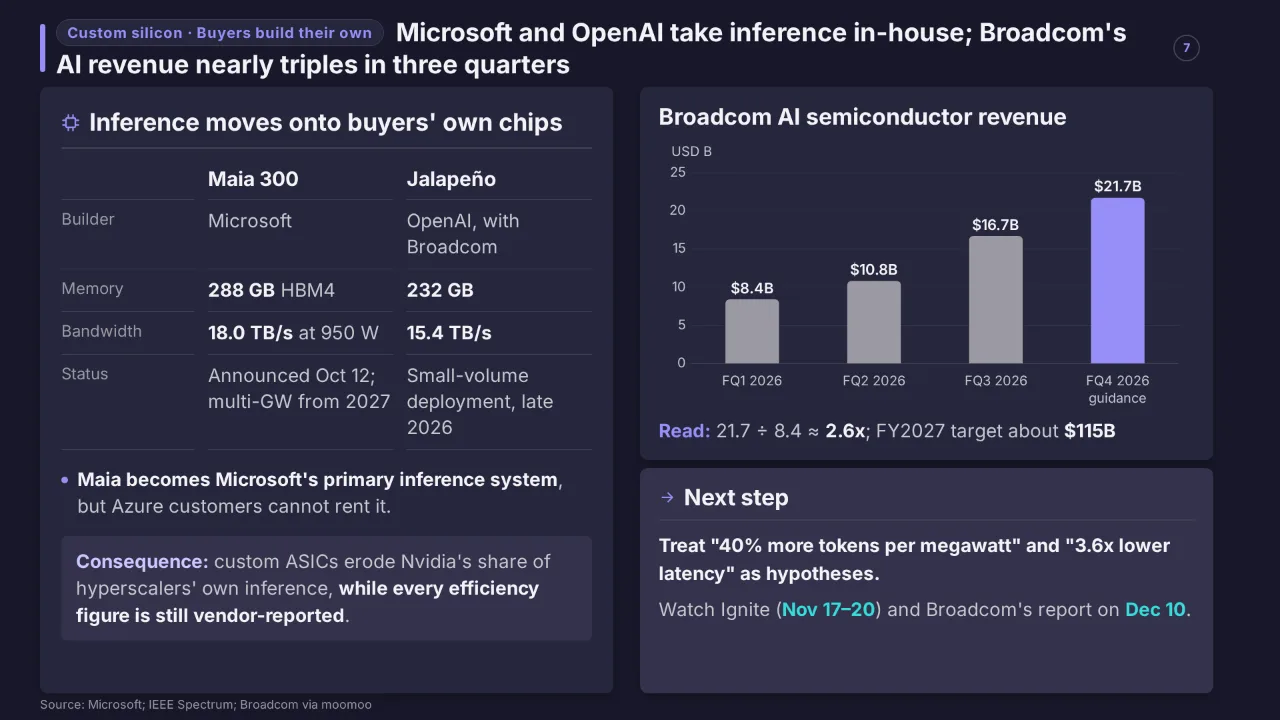
On Oct 12, 2026, Microsoft's Scott Guthrie said the Azure Maia family will scale to "multi-gigawatt deployments starting in 2027", making Maia "the primary inference system for Microsoft products and services". Maia 300, the third generation, is announced, with production deployment to begin in 2027. Maia 200 is in production, serving Microsoft Copilot, with GitHub Copilot and Microsoft Foundry due by end-2026.
The design spends its budget on memory. Eight HBM4 stacks deliver 18.0 TB/s within a 950 W TDP, and the compute chiplets are built on TSMC N2P. Against Maia 200, Microsoft cites 2.5x the memory bandwidth, 33% more capacity and about 2x the HBM bandwidth per watt; launch coverage gives the capacity as 288 GB (216 GB × 1.33 ≈ 288 GB). Compute rises only 36% (Microsoft via Futurum), a ratio built for memory-bound decode. A rack holds 96 accelerators at 167 kW, so 167 kW ÷ 96 ≈ 1.74 kW per accelerator all-in, and 96 × 288 GB ≈ 27.6 TB of HBM per rack. Up to 128 racks form a 12,288-accelerator superpod on Microsoft's Ethernet-based transport.
The performance numbers are vendor claims: up to 7x Maia 200's rack-scale token throughput and more than 2.5x the performance per watt, plus an expected 40% more tokens per megawatt than "leading GPU-based systems". Jon Peddie Research notes that, with twice the accelerators per rack, the per-chip gain is nearer 3.5x, and that Microsoft gave no test conditions for the GPU comparison. The only production evidence is Maia 200's up to 1.7x more tokens per watt than leading GPU infrastructure on some Microsoft 365 features.
Volume is less clear. Reuters, via BusinessKorea, reports that Microsoft plans to deploy more than 1 million Maia 300 chips next year; GPTS24 says Microsoft is negotiating for 300,000+ units from TSMC, with 1 million as an aspiration. We treat these as floor and ceiling. At the ceiling, 1,000,000 ÷ 96 ≈ 10,400 racks × 167 kW ≈ 1.74 GW. Maia cannot be rented by Azure customers, and Evercore ISI estimates it will be only about 10% of Microsoft's AI-chip spending by Q1 2027 (estimate). Microsoft promises more detail at Ignite, Nov 17–20, 2026 (upcoming).
4.2 Jalapeño and Broadcom: the outsourced-design path
OpenAI took the other route: it designed the system, and Broadcom did "physical design from the gates onward". OpenAI and Broadcom announced Jalapeño on June 24, 2026; OpenAI fully detailed it, with first benchmarks, on Aug 25, and TIME named it a 2026 Best Invention on Oct 15. The chip offers 13.4 PFLOPS of FP4, 232 GB of memory at 15.4 TB/s, and draws 550 W sustained, 700 W max; it is built for pods of 2,048 chips. OpenAI-cited benchmarks show up to 3.6x lower end-to-end latency than Nvidia GB300 at lower power. According to TorontoStarts, SemiAnalysis supervised the InferenceX runs. Status: small-volume deployment is planned for late 2026, ramping in 2027, so Jalapeño is not yet in service at scale.
Broadcom is where the money shows. Fiscal Q3 2026, reported Sept 2 (before the window), brought AI semiconductor revenue of $16.7B (+221% YoY), 56% of total revenue (Broadcom via FinanceFeeds).
| Fiscal 2026 quarter | AI semiconductor revenue | Status | Source |
|---|---|---|---|
| Q1 | $8.4B | Reported | Broadcom (via moomoo) |
| Q2 | $10.8B | Reported | Broadcom (via moomoo) |
| Q3 | $16.7B | Reported Sept 2, 2026 | Broadcom (via moomoo) |
| Q4 | $21.7B | Guidance | Broadcom (via moomoo) |
The four quarters add up to 8.4 + 10.8 + 16.7 + 21.7 = $57.6B, in line with the ~$58B FY2026 guide. CEO Hock Tan says Broadcom has secured supply for about $115B of AI revenue in FY2027 and has line of sight to $230B in FY2028 (company targets). In the window, the stock fell from $360.14 on Oct 8 to about $338 on Oct 21 as financing reports landed: up to $42B for Anthropic and more than $50B tied to OpenAI's chip. That is 42 + 50 ≈ $92B for two of Broadcom's six XPU customers. Broadcom next reports Q4 on Dec 10, 2026 (upcoming).
4.3 The hyperscaler ASIC comparison set
| Chip | Process | HBM | Memory bandwidth | Power | Status (Oct 23, 2026) | Source |
|---|---|---|---|---|---|---|
| Microsoft Maia 300 | TSMC N2P (compute) | 288 GB HBM4 | 18.0 TB/s | 950 W TDP | Announced Oct 12; production 2027 | Microsoft; Igor's Lab |
| Microsoft Maia 200 | TSMC 3nm | 216 GB HBM3e | 7 TB/s | 750 W | In production | Microsoft; GPTS24 |
| OpenAI Jalapeño | TSMC N3P (per TorontoStarts) | 232 GB | 15.4 TB/s | 550 W sustained / 700 W max | Small-volume deployment late 2026 (planned) | IEEE Spectrum; Wisevoter; TorontoStarts |
| Google TPU v7 Ironwood | Not in material | 192 GB | Not in material | Not in material | GA on Google Cloud | BusinessKorea; GPTS24 |
| Google TPU 8i | Not in material | 288 GB | Not in material | Not in material | Next generation; TPU 8 expected late 2027 | BusinessKorea; GPTS24 |
| AWS Trainium3 | 3nm | 144 GB HBM3e | 4.9 TB/s | Not in material | GA (Trn3 UltraServers) since Dec 2, 2025 | AWS (via The Model Press) |
| AWS Trainium4 | Not in material | Not in material | 4x Trainium3 (≈ 19.6 TB/s, our estimate) | Not in material | In development, target 2027 | AWS (via The Model Press); BusinessKorea |
The Trainium4 figure applies AWS's "4x more memory bandwidth" to Trainium3: 4 × 4.9 = 19.6 TB/s.
Google and AWS hold one advantage that Microsoft and OpenAI lack: outside customers can rent their chips. Ironwood is generally available on Google Cloud; according to Winzheng it is priced at $12 per chip-hour in Iowa. AWS sells Trn2 and Trn3 capacity, and Anthropic's Apr 20, 2026 agreement covers up to 5 GW across Trainium generations. In the window, AWS moved TorchNeuron, a native PyTorch backend for Trainium2 and Trainium3, to public beta on Oct 19 and open-sourced it under Apache 2.0 on Oct 20 (in effect). Our judgement: Maia 300 leads the announced field on bandwidth per chip, but nobody outside Microsoft can use it; TPU and Trainium remain the custom silicon a buyer can actually rent.
4.4 What the wave means for Nvidia and for buyers
Custom inference silicon is now a deployment plan, not an experiment: Microsoft commits multi-gigawatt Maia capacity from 2027, Jalapeño enters small-volume service in late 2026, and Broadcom targets ~$115B of AI revenue in FY2027. Almost every efficiency number behind it, though, is still vendor-reported.
For Nvidia, this is erosion at the margin, not displacement. Microsoft is keeping a mixed fleet with Nvidia and AMD GPUs alongside Maia, and still trains on Nvidia and AMD hardware. According to kie.ai, a third-party analysis finds Maia 300 matches Rubin's 288 GB but has roughly 20% less bandwidth (Rubin is covered in Chapter 2). The exposure is inference for hyperscalers' own products. Futurum estimates about $15.4B of accelerator spending per gigawatt. As an illustration only, Microsoft's 1.74 GW ceiling × $15.4B ≈ $27B of accelerator spend would go to first-party silicon instead of merchant GPUs (estimate). Gartner sees custom ASICs growing from $67.7B in 2025 to $203.6B in 2030 (estimate), and 1 million Maia 300s × 8 stacks would need about 8 million HBM4 stacks; HBM supply is covered in Chapter 8.
For buyers, Maia and Jalapeño reach you only through the prices of Copilot, Foundry and OpenAI services. TorchNeuron lowers the cost of porting PyTorch code to Trainium; benchmark your own models there before committing. Treat "40% more tokens per megawatt" and "3.6x lower latency" as hypotheses until independent results appear; Ignite in November and Broadcom's Dec 10 report are the next checkpoints.
5. Cloud capex and compute contracts
Chapter 4 followed the hyperscalers into their own silicon; this chapter follows the money that pays for it, and for everything else in the data center. In the window, Meta was the only one of the four big spenders to update its guidance, and the stress showed up one layer down, among the neoclouds and their lenders.
5.1 Where 2026 guidance stands
Meta reported Q3 on Oct 21, inside the window. Microsoft and Alphabet report on Oct 28 and Amazon later, so their latest official guidance dates from the late-July Q2 calls.
| Company | Latest quarter capex | 2026 capex guidance | Date of statement | Source |
|---|---|---|---|---|
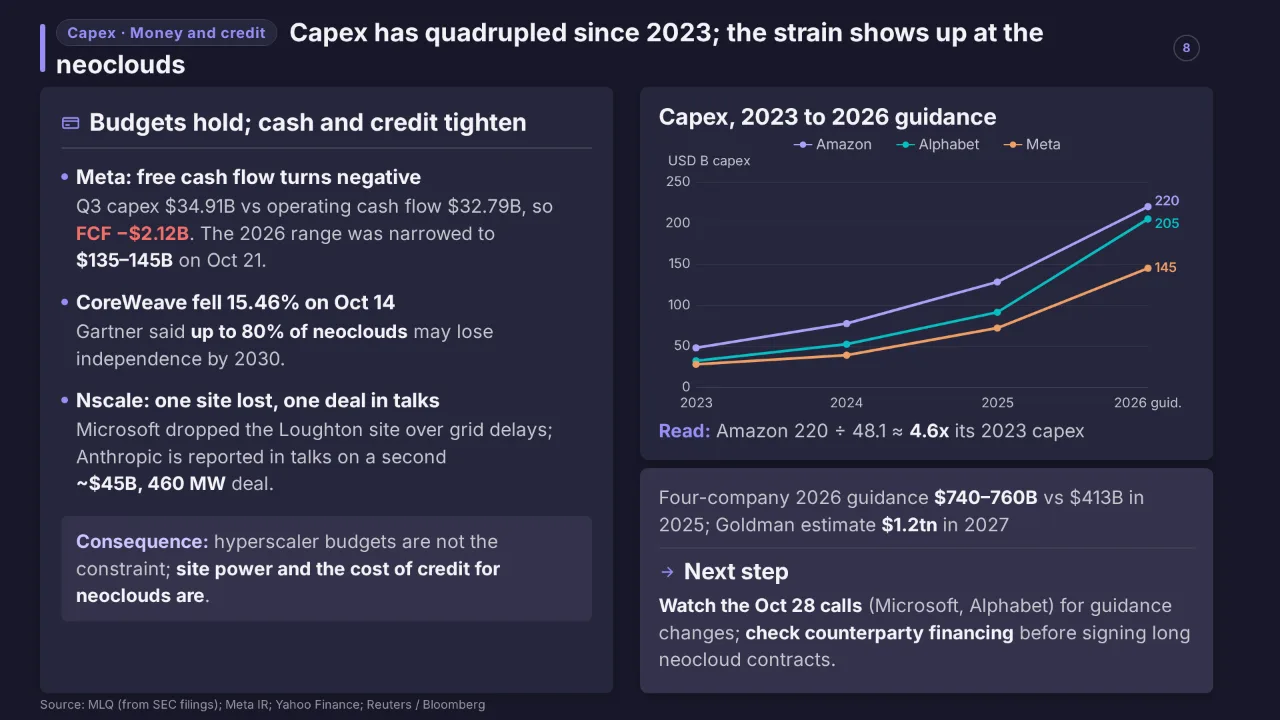
| Meta | Q3 2026: $34.91B (incl. finance-lease principal) | $135–145B, narrowed from $130–145B | Oct 21, 2026 (Q3 release) | Meta IR |
| Alphabet | Q2 2026: $44.9B | $195–205B, raised from $175–185B | Jul 22, 2026 (Q2 call); Q3 due Oct 28 | S&P Global via MLQ; FutureSearch; Admirals |
| Amazon | Not in our sources | ~$220B, raised from ~$200B (Feb guide) | Late Jul 2026 (Q2 call; Jul 30 per CNBC's schedule) | AP via MLQ; CNBC |
| Microsoft | Not in our sources | ~$190B incl. finance leases, set in April and held in July | Apr 2026, maintained on the Jul 29 call | CNBC; Statista |
All four are official guidance, in effect until the next calls. On Microsoft the sources disagree: CNBC and Statista report $190 billion of capex and finance leases, including $25 billion from higher component prices, while MLQ uses an "accounting-adjusted" ~$175 billion. We follow the company-stated $190 billion.
Combined arithmetic, with Meta's new range:
- Low end: 220 + 195 + 135 + 190 = $740B
- High end: 220 + 205 + 145 + 190 = $760B
The step-up is steepest when set against the filings. MLQ's compilation from SEC filings shows the three calendar-year reporters' capex since 2023:
| Capex, $B (MLQ, from filings and guidance) | 2023 | 2024 | 2025 | 2026 guidance (top of range) | Source |
|---|---|---|---|---|---|
| Amazon (cash capex) | 48.1 | 77.7 | 128.3 | ~220 | MLQ |
| Alphabet (purchases of property and equipment) | 32.3 | 52.5 | 91.4 | 205 | MLQ |
| Meta (incl. finance-lease principal) | 28.1 | 39.2 | 72.2 | 145 | MLQ |
Amazon's 2026 plan is 220 ÷ 48.1 ≈ 4.6x its 2023 spend; Alphabet's top of range is 205 ÷ 32.3 ≈ 6.3x and Meta's 145 ÷ 28.1 ≈ 5.2x. MLQ reconstructs about $1.05 trillion of cumulative four-company capex since January 2023 and labels it an estimate.
Statista's $760 billion for 2026, against $413 billion in 2025, equals that high end. With MLQ's Microsoft figure the sum is 725–745, so Meta's narrowing lifts MLQ's $720–745 billion floor by $5 billion. Either way, four-company capex grows by about 80% this year: 740 ÷ 413 ≈ 1.79 and 760 ÷ 413 ≈ 1.84.
Demand backs the spending: on Jul 22 Alphabet reported Cloud revenue up 82%, a $514 billion Cloud backlog and continued supply constraints. Investors were less forgiving: Alphabet shares fell 7% after the raise, and it turned cash-flow negative in Q2.
5.2 Meta's Q3: spending through a litigation charge
A one-off legal hit sits on top of a continuing capex ramp:
| Meta, three months to Sep 30 | Q3 2026 | Q3 2025 | Change | Source |
|---|---|---|---|---|
| Revenue | $64,601M | $51,242M | +26% | Meta IR |
| Costs and expenses | $51,613M | $30,707M | +68% | Meta IR |
| Income from operations | $12,988M | $20,535M | −37% | Meta IR |
| Operating margin | 20% | 40% | −20 pts | Meta IR |
Costs include a $9.89 billion charge for the August settlement with 52 attorneys general. Without it, operating income would have been $22.88 billion. Operating cash flow was $32.79 billion against $34.91 billion of capex, so free cash flow was 32.79 − 34.91 = −$2.12 billion. Cash and securities stood at $82.45 billion.
The 2026 capex range moved for the second time this year. It started at $125–145 billion in April, rose to $130–145 billion in July and is now $135–145 billion. Meta's quarterly capex per its releases, as compiled by MLQ, was $19.84 billion in Q1 and $31.08 billion in Q2. The year to date is therefore 19.84 + 31.08 + 34.91 = $85.83 billion. That implies Q4 capex of $49.2–59.2 billion (135 − 85.83 to 145 − 85.83), or 41–69% above Q3.
For 2027 Meta gives no number, only that it will "continue investing aggressively", while cutting Reality Labs losses from $18–19 billion to about $15 billion and shifting the money "primarily" to AI. CNBC reports Meta is also looking to sell compute to third parties.
Meta has now raised its capex floor twice in 2026 while holding the ceiling at $145 billion. Q3 free cash flow turned negative. The other three hyperscalers report after the window, and nothing in Meta's numbers points to a slowdown.
5.3 Analyst projections (all estimates)
| Projection | Figure | Date | Source |
|---|---|---|---|
| Goldman Sachs: US hyperscaler capex (AMZN, GOOGL, META, MSFT, ORCL, SPCX) | $1.2tn 2027, $1.4tn 2028; growth ~100% (2026), 54% (2027), 12% (2028) | Not shown in material | Goldman via Edward Conard |
| FactSet consensus, 2027 capex (Amazon, Alphabet, Meta, Microsoft, Oracle) | $495bn (Sep 2025) → $1,131bn (current) | Oct 2026 | Apollo |
| UBS: hyperscaler capex growth | +76% (2026) → +25% (2027) | Cited Aug 15, 2026 | UBS via FutureSearch |
All three are estimates. Goldman's figures are $130 billion and $100 billion above consensus, which puts 2027 consensus at roughly 1,200 − 130 ≈ $1.07tn. That is close to Apollo's FactSet figure of $1,131 billion for a slightly different company set, itself 1,131 ÷ 495 ≈ 2.3x the Sep 2025 consensus, hence Apollo's line that expectations "have doubled".
Goldman also estimates that hyperscalers need $308 billion a year in AI revenue to break even on average 2026–27 capex, and $417–526 billion for a 10–20% return. Realized ROIC has fallen from 40% to 25%. Neuberger (Oct 13) warns that rising rates could slow AI capex. Our sources contain no BofA or Citi capex projection. The street and the companies broadly agree: growth slows after 2026, but the dollar amounts keep rising.
5.4 Contracts and neocloud financing
Anthropic–Nscale (talks, not signed). On Oct 19, Reuters relayed a Bloomberg report that Nscale is in talks to sell Anthropic compute worth about $45 billion, for a second facility at its Monarch campus in West Virginia. The reported terms are 460 MW of Nvidia Vera Rubin capacity and a right of first refusal on a third building. Anthropic already holds agreements worth up to $44.6 billion from an August deal, per Nscale's IPO filings, so the new deal would take its Nscale commitments to about $90 billion. Microsoft and Anthropic account for about 85% of Nscale's contract value, and investors are pushing Nscale's hoped-for ~$30 billion IPO valuation down to $16–19 billion.
Microsoft drops Loughton (in effect). Microsoft confirmed, by the time of Reuters' Oct 19 report, that it has ended its anchor-tenant role at Nscale's Loughton, Essex site (50 MW, scalable to 90 MW, 23,040 GB300s planned for Q1 2027) because grid power is not expected until the 2030s. It says the decision "relates to a single site". The rest of the October 2025 contract for about 200,000 GB300s stands: ~104,000 in Texas, ~52,000 in Narvik and ~12,600 in Sines; with Loughton, 104,000 + 52,000 + 12,600 + 23,040 = 191,640, consistent with "about 200,000". Grid delays are covered in Chapter 6.
CoreWeave and Gartner (Oct 14). On Oct 14, Gartner forecast that up to 80% of neoclouds may stop operating independently by 2030. CoreWeave closed down 15.46% at $65.78 the same day, on a hotter-than-expected CPI print. Nebius fell 10.08% and Oracle 8.83%. Reports of Gartner's value-at-risk differ: "over $3.5 trillion" exposed to impairment in 2030 versus more than $4 trillion of write-downs by 2032; we treat both as secondary and anchor on Gartner's direct comment to Fierce that AI revenue will not catch up with data-center capex before 2032–33.
CoreWeave's fact sheet answers with a $104 billion backlog at end-Q2 plus $25 billion of early-Q3 commitments, against $35.6 billion of debt principal, with $14.9 billion of principal due in 2031 and beyond. Its 9.625% 2032 bonds yielded about 15%. According to 36kr, citing the FT, AI-related debt issuance fell to about $23 billion in September, under half of August's. The stock reversed upward on the following Thursday as analysts defended its funding model.
Our judgement: hyperscaler budgets are not the constraint on compute supply; site power and the cost of credit for neoclouds are. Labs keep signing take-or-pay capacity, and lenders are now pricing the gap between short contracts and long debt.
6. Data centers and power
Chapter 5 followed the money; this chapter follows where it has to land, in megawatts that are either already drawing power or still only on a plan, a distinction the fortnight's headlines kept blurring.
6.1 The biggest campuses: operating vs planned
Epoch AI's tracker (updated Oct 15, 2026) separates "current" IT power a site can draw today from "projected" end-state capacity. Every figure is an estimate from satellite imagery and permits; about 80% fall within a factor of 1.4 of the true value.
| Campus | Owner | Current IT power | Planned end-state | Status (Oct 2026) | Source |
|---|---|---|---|---|---|
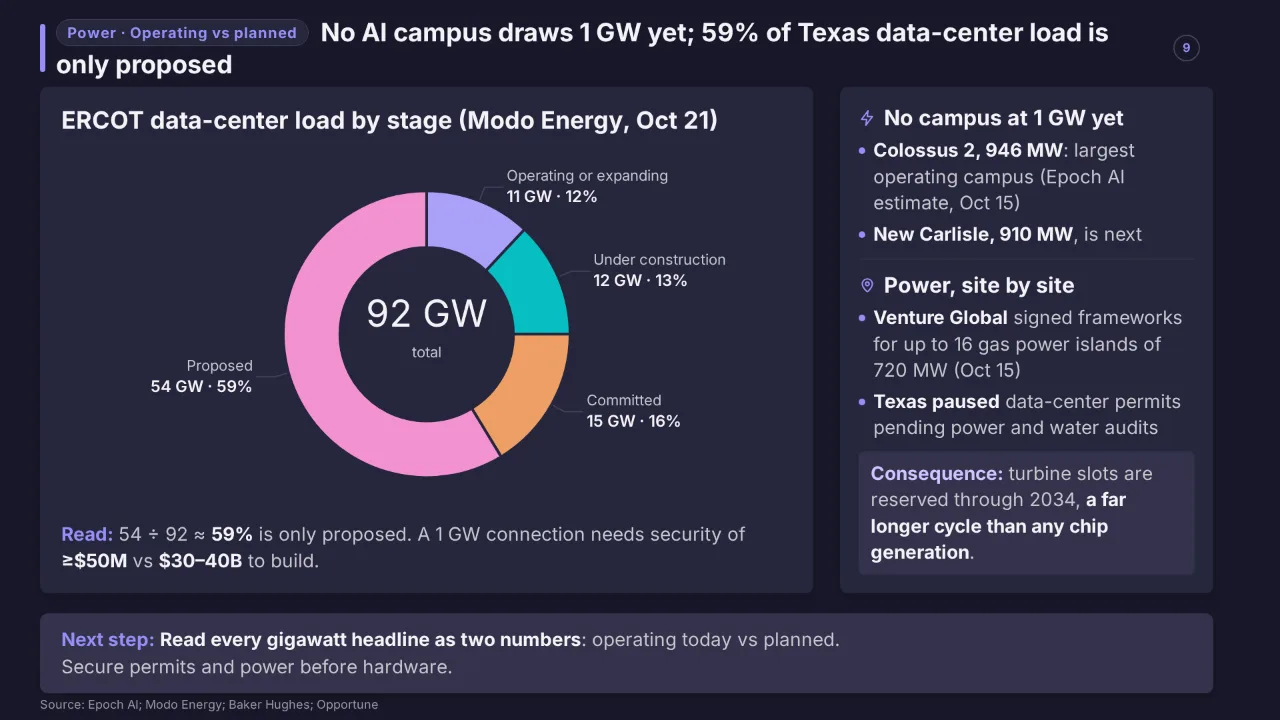
| Colossus 2 (Memphis, TN) | SpaceXAI | 946 MW | 1,531 MW (2027) | Operating, expanding | Epoch AI |
| Anthropic-Amazon New Carlisle (IN) | Amazon | 910 MW | 1,925 MW (2028) | Operating, expanding | Epoch AI |
| Microsoft Fairwater Atlanta (Fayetteville, GA) | Microsoft | 636 MW | not in top five | Operating | Epoch AI |
| DayOne Nusajaya (Johor, Malaysia) | not stated | 473 MW | not in top five | Operating | Epoch AI |
| Meta Prometheus (OH) | Meta | 471 MW | not in top five | Operating | Epoch AI |
| Microsoft Fairwater Wisconsin | Microsoft | not in top five | 2,263 MW (Q2 2028) | Under construction | Epoch AI |
| OpenAI Stargate New Mexico | not stated | not in top five | 1,750 MW (2028) | Under construction | Epoch AI |
| Meta Hyperion | Meta | not in top five | 1,632 MW (2028) | Under construction | Epoch AI |
Epoch lists planned sites only once construction has started. Two gaps stand out. The largest operating site runs at about 62% of its own plan (946 ÷ 1,531) and New Carlisle at 47% (910 ÷ 1,925). And operating capacity has lagged the quoted calendar: an earlier Epoch analysis, reported by The Data Center Engineer, put five campuses on track for 1 GW in 2026: New Carlisle (January), Colossus 2 (February), Microsoft Fayetteville (March), Meta Prometheus (May) and Stargate Abilene (July). In the Oct 15 ranking none exceeds 946 MW. Epoch projects New Carlisle at 1,037 MW on Oct 19, 2026, a forecast, not an observation.
Epoch's pages disagree on Meta Prometheus (562 MW on Sep 17, 471 MW on Oct 15); we follow the newer figure.
Still, Epoch finds the single-site power record has doubled every 10 months since mid-2024. Check: 237 MW (Aug 2024) to 946 MW (Jun 2026) is 4x, two doublings in about 22 months, roughly 11 months each. Across 86 tracked sites Epoch counts 13.1 GW of IT capacity and about 17.0 GW including cooling overhead, with average draw typically 60–80% of capacity (Sep 17 data).
Read every "gigawatt campus" headline as two numbers: what draws power today and what is planned. By Epoch's Oct 15 estimate, no tracked AI campus has yet crossed 1 GW of operating IT power.
6.2 Grid queues and where the power comes from
In Texas, requested load far outruns buildable load. Modo Energy tracks 92 GW of advanced-planning data-center load requesting or holding ERCOT grid access as of Oct 21, 2026:
| ERCOT stage (Modo Energy, Oct 21) | GW | Share of 92 GW |
|---|---|---|
| Operating / expanding | 11 | 12% |
| Under construction | 12 | 13% |
| Committed | 15 | 16% |
| Proposed | 54 | 59% |
According to Opportune, ERCOT's raw large-load queue was roughly 474 GW in August, about 90% data centers; we follow Modo's narrower definition for buildable load. Modo argues security deposits cannot screen out speculation: a 1 GW connection needs at least $50 million at the interconnection-agreement stage against $30–40 billion to build the campus, i.e. 50 ÷ 40,000 to 50 ÷ 30,000, or 0.13–0.17% of build cost.
The workaround is private gas. In ERCOT, Pecos and Longhorn plan dedicated gas generation of 2.7 GW and 1.3 GW, with Microsoft holding a 20-year Pecos agreement. Two deals in the window extend the model:
- Venture Global (announced Oct 15). Frame agreements with GE Vernova and Baker Hughes cover up to 16 gas power-island units of 720 MW each: 16 × 720 MW = 11,520 MW, matching the Houston Business Journal's "over 11 GW". Venture Global says this could support up to 10 GW of compute at its sites by end-2034. Status: framework, not firm orders; the first purchase order is expected by end-2026, deliveries run 2028–2034, and nothing commits it to all 16 units. Its six existing islands total about 4.5 GW operating, building or ordered.
- Google, Cheyenne (Wyoming). Black Hills' agreements (effective Sept 30, announced Oct 6, just before the window) add $1.8 billion and 564 MW of new gas in 2027–2029 plus about 2.1 GW of third-party resources via a private microgrid, roughly 2.7 GW with reserves; service starts late 2027. On Oct 14 AEP announced a $4 billion, 702 MW Bloom fuel-cell plant under a 20-year Google PPA, with full operation by end-2028. A December 2026 offtake milestone remains, and neither company says whether it sits inside the 2.1 GW.
Our judgement: firm power is now procured site by site, with turbine slots reserved through 2034, a far longer cycle than any chip generation.
6.3 Policy friction
According to Opportune, Texas Governor Greg Abbott directed TCEQ on Sept 21 to pause data-center permits until ERCOT and the Texas Water Development Board finish power and water audits. Bracewell and Troutman Pepper Locke read it as also covering islanded generation, so going behind the meter does not bypass it. ERCOT's information request to sites of 25 MW or more (due Oct 12) and TCEQ's report to the Governor (due Oct 19) have passed, with no outcome in our material; ERCOT's audit is due on or before Dec 10 (upcoming). Already in effect: a PUCT rule from September requiring $50,000 per MW of security before an interconnection study, $5 million for 100 MW.
Elsewhere the fight is over who pays. NV Energy's plan has data centers rising from about 5% of Nevada electricity sales to 64% by 2046, and eight data-center companies including Microsoft and Amazon have intervened (reported Oct 6). In Wyoming, Google bears all serving costs and has advanced $399 million for long-lead equipment, yet Princeton's Jesse Jenkins faulted the new gas, contrasting it with Google's 890 MW Constellation nuclear-uprate deal. The consequence: permits in hand and a clear cost-allocation answer now matter more than queue position.
6.4 Rack power and cooling architecture
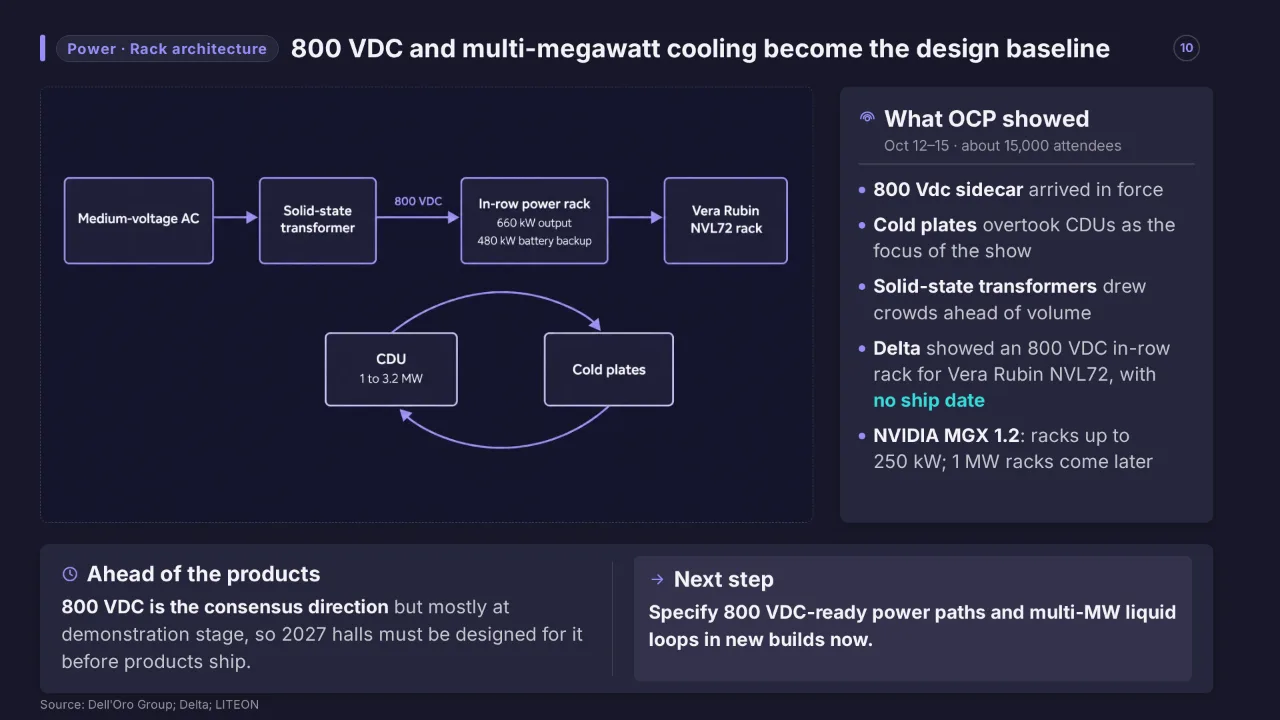
The OCP Global Summit (San Jose, Oct 12–15) drew about 15,000 attendees, up from under 11,000 a year earlier, according to Dell'Oro. Dell'Oro saw three shifts: the cold plate overtook the CDU as the focus, the 800 Vdc power sidecar "arrived in force", and solid-state transformers drew crowds well ahead of volume deployment. NVIDIA's MGX 1.2 supports racks up to 250 kW; 1 MW racks are on the path but later and rarer than roadmaps implied, partly because optics can stretch the scale-up domain across racks.
| Vendor | Cooling distribution unit | Capacity | Stage |
|---|---|---|---|
| Nidec | In-row unit | 3.2 MW | Prototype |
| CoolIT | CHx3000 | 3 MW | Previewed |
| Cooler Master | Floor-mount unit | 2.5 MW | Unveiled |
| Delta | 800 Vdc unit | 2.5 MW | Shown |
| Rittal | In-house CDU (RiMatrix HPC) | >1 MW | Introduced |
All rows from Dell'Oro; "multi-megawatt is now table stakes."
Delta's 800 VDC in-row power rack for Vera Rubin NVL72 combines six modules of 110 kW plus 80 kW battery backup: 6 × 110 = 660 kW output and 6 × 80 = 480 kW backup; its solid-state transformer converts medium-voltage AC directly to 800 VDC (showcased Oct 14–15, no ship date). LITEON showed a 95 kW DC/DC shelf with a 280 kW in-rack CDU for NVL72. Rittal and Bosch's 800 VDC sidecar, scalable to 2 MW, is still a development demonstrator. 800 VDC is the consensus direction, but mostly at demonstration stage; factory-built pod deployment is covered in Chapter 2.

7. Compute rental prices
Chapter 6 showed how power and sites limit new capacity. The rental market is where those limits show up as prices, and in this fortnight they were still rising, fastest for the newest, memory-heavy GPUs.
7.1 Price snapshot
This chapter's backbone is two price indices that measure different things. Uvik publishes the median of public on-demand list prices across 19 providers (prices captured Oct 7, 2026; spot, marketplace and reserved prices excluded; 8-GPU instances divided by 8). getdeploying publishes a weekly median that covers more providers (40 for the H100) and also tracks spot and reservation prices. Because the provider sets differ, the two are not mixed in any column below.
| GPU | Median $/GPU-hr | Low–high | Providers | Hyperscaler vs GPU-cloud median | Source |
|---|---|---|---|---|---|
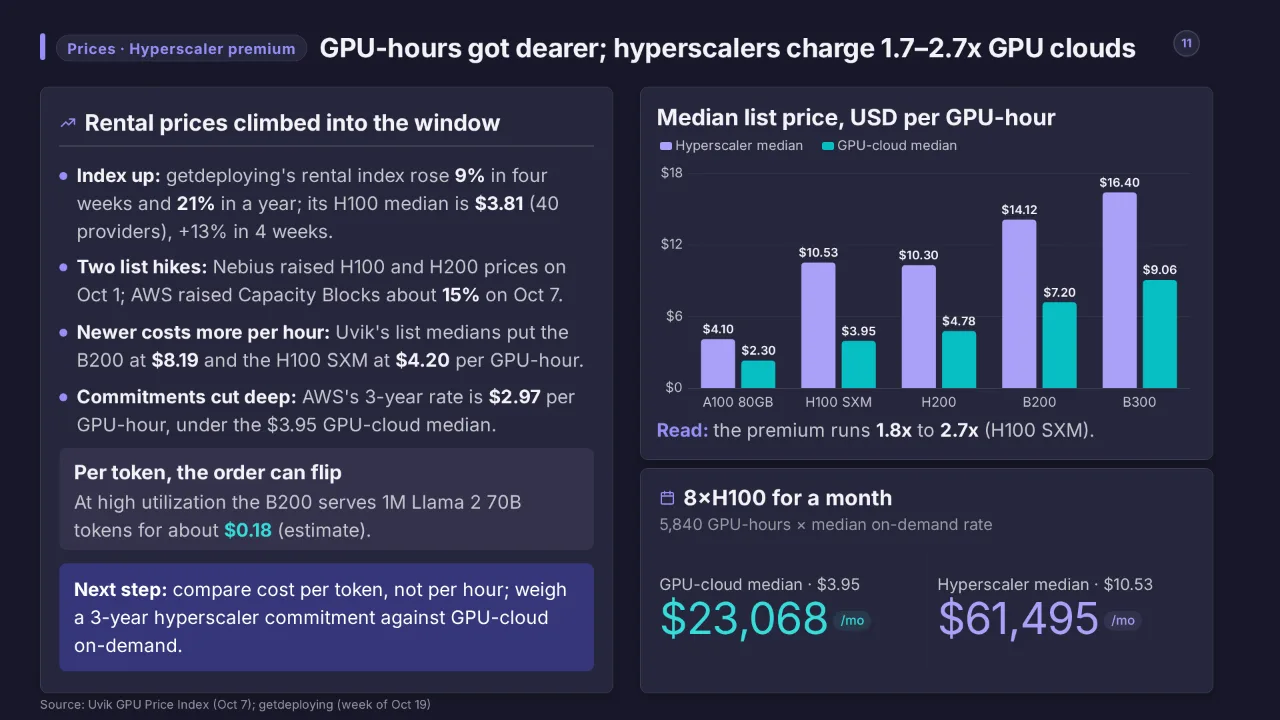
| A100 80GB | $2.75 | $1.09–$5.07 | 14 | $4.10 vs $2.30 (1.8x) | Uvik |
| AMD MI300X | $3.45 | $2.59–$6.00 | 5 | $6.00 vs $2.99 (2.0x) | Uvik |
| H100 SXM | $4.20 | $3.20–$12.29 | 16 | $10.53 vs $3.95 (2.7x) | Uvik |
| H200 | $5.70 | $3.99–$10.60 | 14 | $10.30 vs $4.78 (2.2x) | Uvik |
| B200 | $8.19 | $6.00–$14.24 | 9 | $14.12 vs $7.20 (2.0x) | Uvik |
| B300 | $9.50 | $7.40–$17.80 | 7 | $16.40 vs $9.06 (1.8x) | Uvik |
| GB200 (small sample) | $16.00 | $10.50–$27.04 | 3 | n/a | Uvik |
All rows: list prices in effect as of Oct 7, 2026.
For the H100 SXM, Uvik's provider list runs from $3.20 (Hyperstack, Thunder Compute) through Lambda $3.99 plus tax, Nebius $4.50 and CoreWeave $6.16, up to AWS $6.88, Google Cloud $11.06 and Azure $12.29, a 3.8x spread. Newer provider quotes come from a Runpod comparison page. Runpod is a direct competitor of the providers it lists, so treat its figures as leads. It lists Crusoe (verified Oct 16, 2026) at H100 $4.50, H200 $5.40, B200 $8.50 and B300 $9.60, and gives no published rate for GB200 or MI355X. Runpod's own undated rates are H100 SXM $3.49, H200 $4.59 and B200 $6.79. Runpod's $3.49 H100 rate matches Uvik's Oct 7 capture.
getdeploying measures the hyperscaler gap at a smaller +75% for H100 ($4.50 vs $7.89) and +101% for H200 ($5.40 vs $10.85). Uvik puts the H100 gap at 2.7x. Both indices agree on the direction: on-demand capacity at a hyperscaler costs roughly 1.7x–2.7x what it costs at a specialized GPU cloud.
7.2 What moved in the window
As of the week of Oct 19, 2026, getdeploying's index was up +9% over four weeks (25 models) and +21% over the past year (17 of 21 models rose, 4 fell). Its H100 on-demand median stood at $3.81 (+13% over four weeks, +28% over 12 months). Week-over-week moves were mixed and mostly on older cards: V100 rose 36% to $2.14, while A4000 fell 72% to $0.21.
Two price actions came just before the window and fed into it. Nebius raised H100 from $3.85 to $4.50 (+17%) and H200 from $4.50 to $5.40 (+20%), in effect Oct 1, 2026. AWS raised EC2 Capacity Blocks by about 15% on Oct 7, 2026, and left on-demand prices unchanged. Contract prices had already moved: SemiAnalysis's one-year H100 contract index rose from $1.70 to $2.35 between October 2025 and March 2026, a 38% increase.
The B200 rose the most. According to shattered.io, which cites a SemiAnalysis index dated Sept 25, 2026, the average B200 rental rate reached $8.01/GPU-hour, up 79% in three months. That figure is close to Uvik's $8.19 list median. This chapter uses Uvik's figure and treats the 79% rise as a secondary-source figure.
Market indices that track prices beyond published list rates sit far lower. Silicon Data's H100 index was $2.81 (Oct 7), Ornn's was $2.86 (Oct 6 settlement) and SemiAnalysis's composite was $2.82 (April 2026). The material does not describe their methods, so the gap of roughly $1 to the list medians should be read as list price vs market rate, not as a measurement error.
7.3 Why prices diverge by generation
Per hour, each newer generation costs more. Per GB of memory or per token served, the newer chips are often cheaper, and memory now sets the price.
Uvik's medians put the H200 at +36% per hour over the H100 for +76% more memory, making it 23% cheaper per GB. The B200 costs +95% per hour over the H100, and the B300 +16% over the B200. According to shattered.io, SemiAnalysis found that in September 2026 a B200 cost 21% more per unit of compute than an H100, after being 18% cheaper in June. SemiAnalysis's explanation is that long-context inference needs key-value-cache memory, which buyers now pay for. In that reading, memory capacity (192 GB HBM3e on the B200 vs 80 GB on the H100) has replaced compute as the driver of rental prices. Tight HBM supply passes through to hourly rates. The supply side is covered in Chapter 8.
Uvik's token arithmetic points the other way for throughput-bound work. Using MLPerf v6.1 Offline throughput at median prices, 1M output tokens of Llama 2 70B cost $0.18 on B200, $0.19 on B300 and $0.36 on GB200 (estimate; doubles at 50% utilization). Our judgement: rent the newest generation for high-utilization serving, where cost per token decides. Keep memory-light or bursty work on H100s, which have the most providers and the steepest discounts.
7.4 Cost arithmetic: 8×H100 for a month
Assume 730 hours, so 8 × 730 = 5,840 GPU-hours. Uvik prices, Oct 7, 2026:
| Option | $/GPU-hr | Monthly cost |
|---|---|---|
| Cheapest GPU cloud (Hyperstack) | $3.20 | 5,840 × 3.20 = $18,688 |
| GPU-cloud median | $3.95 | 5,840 × 3.95 = $23,068 |
| AWS p5.48xlarge on-demand | $6.88 | $55.04 × 730 = $40,179 |
| Hyperscaler median | $10.53 | 5,840 × 10.53 = $61,495 |
| AWS three-year commitment | $2.97 | 5,840 × 2.97 = $17,345 |
A three-year commitment at AWS (57% below on-demand) beats the GPU-cloud on-demand median by 25%. getdeploying's median discounts apply to its own $3.81 H100 median: 1 year −28% (about $2.74), 3 years −49% (about $1.94) and spot at 58% of on-demand (about $2.21). For buyers who would rather own than rent, Uvik puts B200 break-even at $30,000–40,000 ÷ $8.19 = 3,663–4,884 GPU-hours, or 5.0–6.7 months at full use. That is a lower bound, since it counts only the GPU.
8. Supply chain — foundry, HBM and packaging
Chapter 7 tracked what a GPU-hour costs to rent. This chapter looks at the inputs that cap how many accelerators can be built in the first place: wafers, lithography tools, packaging and memory.
8.1 Foundry: TSMC's quarter is an AI quarter
TSMC reported Q3 2026 on its October 15 call. The figures come from MarketBeat's call highlights.
| Metric | Q3 2026 (reported) | Q4 2026 (guidance) | Source |
|---|---|---|---|
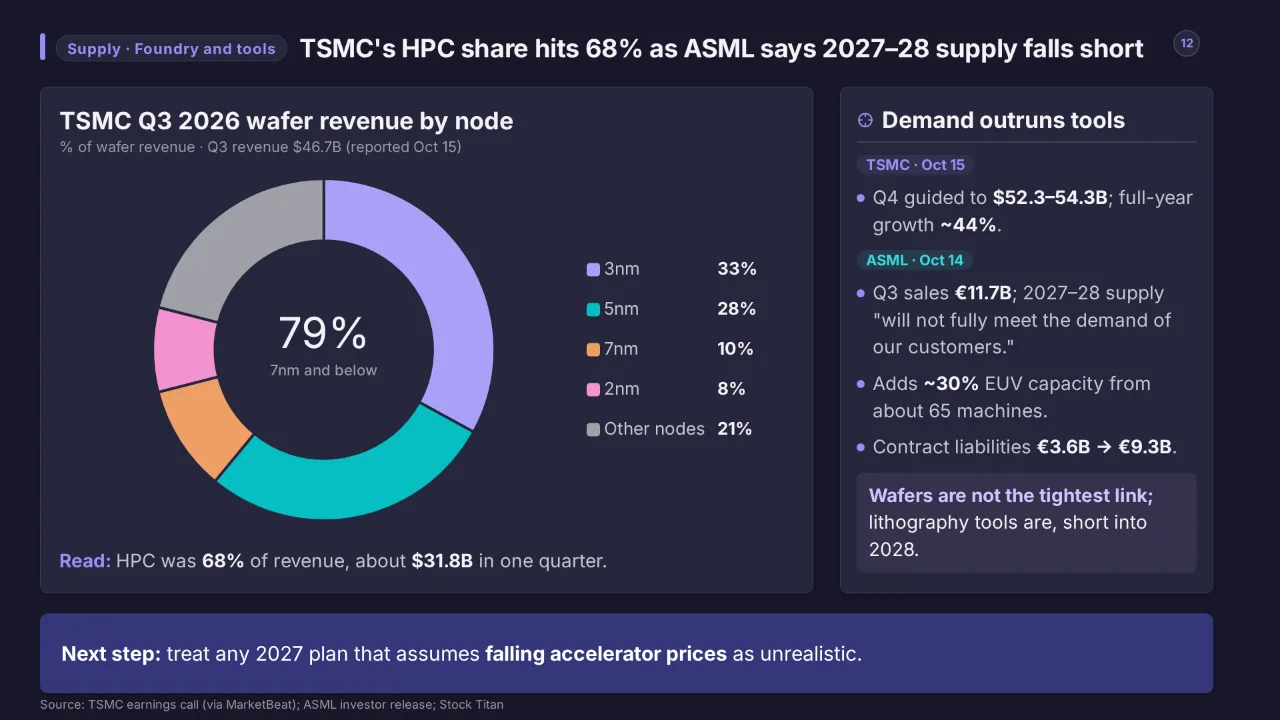
| Revenue | US$46.7B, +16.2% QoQ | US$52.3–54.3B | TSMC call (via MarketBeat) |
| Gross margin | 66.4% | 65–67% | TSMC call (via MarketBeat) |
| HPC share of revenue | 68% | — | TSMC call (via MarketBeat) |
| Capex | US$13.8B | 2026: US$60–64B | TSMC call (via MarketBeat) |
By node, 3nm accounted for 33% of wafer revenue, 5nm 28%, 7nm 10% and 2nm 8%, so 79% came from 7nm and below. HPC made up 68% of $46.7B, about $31.8B in one quarter (46.7 × 0.68). The Q4 midpoint is (52.3 + 54.3) ÷ 2 = $53.3B, and 53.3 ÷ 46.7 ≈ 1.14 matches the 14% sequential growth TSMC cites. TSMC expects full-year growth of about 44%. CEO C.C. Wei called leading-edge demand "extremely robust", driven by agentic AI, accelerators and networking chips.
TSMC is adding supply. N2-family capacity should more than double in 2027, and A14 reaches volume in 2028. Arizona's second fab has been pulled forward to Q3 2027. TSMC expects 2026–2028 capex to be "significantly higher" than in the previous three years. Overseas fabs already dilute gross margin by about 2%, and TSMC expects that to widen to 3–4%. Our judgement: wafers are not the tightest link.
8.2 Lithography: ASML says it cannot meet 2027–28 demand
ASML's October 14 investor release reports Q3 2026 net sales of €11.7B, a 57.5% gross margin and €5.0B of net income. It guides Q4 to €14.2–15.2B and full-year 2026 to €44–45B. Stock Titan supplies the detail. Sales rose 55.2% year over year. Net income includes a €509.7M gain on ASML's Mistral AI stake, leaving about €4.45B without it (4,960.4 − 509.7 = 4,450.7M). ASML sold 121 lithography systems, 17 of them EUV, and raised full-year guidance from €43–45B. The Q4 midpoint is about 26% above Q3 (14.7 ÷ 11.66 ≈ 1.26).
The key line was this: "our supply as currently planned for both 2027 and 2028 will not fully meet the demand of our customers." ASML plans to add 30% to low-NA EUV capacity from about 65 machines (65 × 1.3 ≈ 85), and the same to DUV immersion capacity from about 130. CEO Christophe Fouquet added that "30% in 2027, 30% in 2028 will not allow us to meet our customer demand." ASML no longer reports bookings. Its closest proxy is long-term contract liabilities, which rose from €3.6B to €9.3B year over year. China's share of system sales fell to 23% from 42%.
ASML says planned supply will not meet 2027–28 demand, Samsung and SK hynix call 2026 memory output sold out, and CoWoS is reported sold out through 2026. The ceiling on AI compute is set by tools, packaging and memory, not wafers.
8.3 Packaging: CoWoS, interposers and OSATs
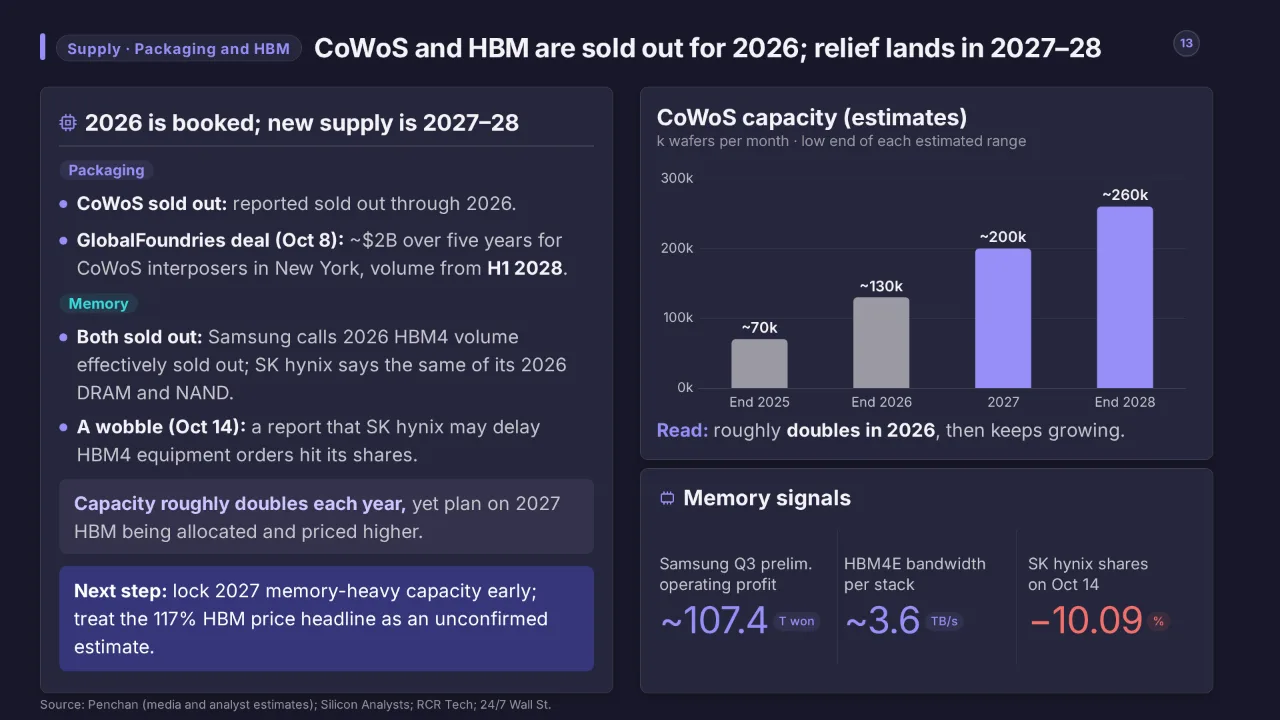
TSMC is in production with 5x reticle-size packages and working toward 9x and 14x. It says CoWoS remains customers' leading choice and that it is working with GlobalFoundries on backend capacity. GlobalFoundries announced the deal on October 8, one day before the window. It is a roughly $2B, five-year agreement to make CoWoS silicon interposers at GF's Malta, New York fab, with volume ramping in H1 2028. It is described as the first U.S. interposer source. Silicon Analysts estimates about $400M a year ($2B ÷ 5), roughly 6% of GF's 2025 revenue of $6.79B. Because the extra capacity only arrives in 2028, it expects TSMC to keep control of 2027 allocation and pricing.
TSMC does not publish CoWoS capacity, so the figures below are media and analyst estimates.
| CoWoS capacity | Wafers / month | Status | Source |
|---|---|---|---|
| End 2025 | ~70k | Estimate | Penchan |
| End 2026 | ~130–140k | Estimate | Penchan |
| 2027 | ~200–220k | Estimate | Penchan |
| End 2028 | ~260k | Estimate | Penchan |
On these estimates, capacity roughly doubles in 2026 (135 ÷ 70 ≈ 1.9x). Penchan cites TSMC guidance that 10–20% of 2026 capex goes to packaging, test and masks. That works out to $6.0–12.8B (60 × 0.10 to 64 × 0.20). Other packaging houses are expanding, but mostly on 2027–28 timelines:
- Amkor raised its Arizona plan to about $12B in September 2026.
- ASE's panel line targets volume in Q1 2027.
- SPIL's Douliu CoWoS plant starts Phase 1 in 2028.
- TSMC's CoPoS reaches volume in 2H 2028 (media).
8.4 HBM: sold out, repricing, and a wobble
Samsung's preliminary Q3, released October 8, shows about 107.4 trillion won of operating profit on about 195 trillion won of revenue, a margin of about 55% (107.4 ÷ 195). It gave no segment breakdown, and full results are due in late October. According to TechTimes, HBM takes three times the DRAM wafer capacity of DDR5.
| Generation | Interface | Pin speed | Bandwidth / stack | Source |
|---|---|---|---|---|
| HBM3E | 1,024-bit | — | ~1.2 TB/s | RCR Tech |
| HBM4 | 2,048-bit | 8 Gbps (JEDEC) | ~2.0 TB/s | RCR Tech |
| HBM4E | 2,048-bit | 14–16 Gbps | ~3.6 TB/s (Samsung) | RCR Tech |
There is no JEDEC standard for HBM4E yet. Samsung measured its HBM4 at 11.7 Gbps, which gives 2,048 × 11.7 ÷ 8 ≈ 3.0 TB/s.
Supply status:
- Samsung has shipped HBM4 since February 2026 and calls its 2026 volume effectively sold out. A report that its HBM4E passed Nvidia qualification is unconfirmed.
- SK hynix says its 2026 DRAM and NAND output is sold out and targets HBM4E mass production in 2027.
- Micron has made HBM4 in volume since March 2026. Much of its 2027 supply is reportedly locked in at higher prices.
On October 7, AMD's Lisa Su visited Samsung and SK hynix in Seoul to secure HBM4. According to tech-insider.org, AMD and Samsung signed a three-year memorandum. TechTimes reports that Samsung used its HBM4 position as leverage in talks to make AMD chips on its SF2P process. No foundry contract has been announced. For the platforms, see Chapter 3.
Pricing. By its own admission, tech-insider.org's 117% headline is not confirmed by any official source. Its body cites a Korea Economic Daily projection of a 121% rise in 2027 HBM4 contract prices. It also cites a 36 GB stack going from about $600 to about $1,300, and 1,300 ÷ 600 ≈ 2.17, so that is likely where the headline comes from. Treat it as an estimate.
The wobble. On October 14 a Korean outlet reported that some SK hynix HBM4 back-end equipment orders may slip into 2027. The company has not commented. SK hynix shares fell 10.09% in one session, about 23% below their early-October close. The explanations on offer point to general DRAM competing for capacity, not weaker HBM demand. Our judgement: plan on 2027 HBM being allocated and priced higher.
9. Outlook and what to watch next
Chapters 2–8 described a market where budgets and designs run ahead of the physical inputs: power, HBM, packaging and lithography. This chapter turns that into implications for three kinds of reader and a dated watch-list for the next weeks.
9.1 What the fortnight means, by reader
The common thread is timing. The chips announced in the window (Vera Rubin, Maia 300, Jalapeño, Helion, D270) mostly reach volume in 2027, while the inputs that limit them are booked or sold out over the same horizon. For anyone planning compute, the question has shifted from "which chip" to "which capacity can actually be delivered, powered and paid for, and when".
| Reader | What changed | Implication | Evidence |
|---|---|---|---|
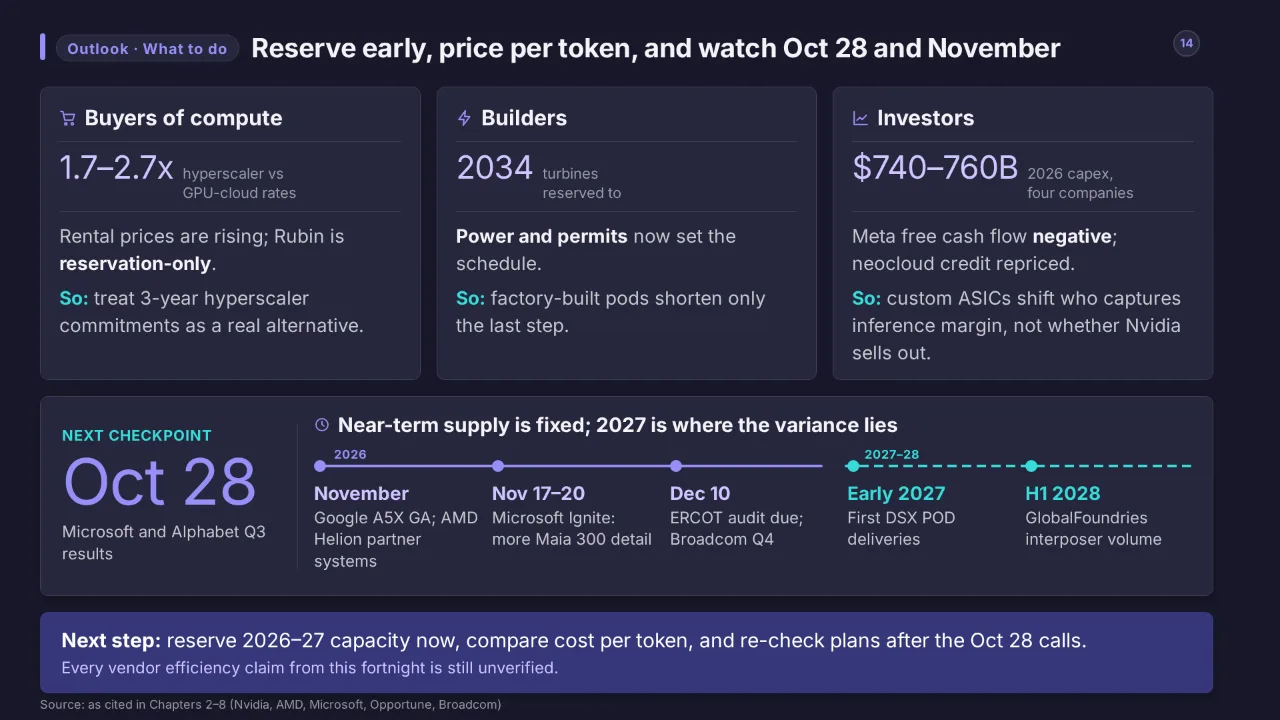
| Buyers of compute (AI teams, enterprises renting GPUs) | Rental prices rose for four straight weeks; Rubin is reservation-only until A5X GA; hyperscalers charge 1.7–2.7x GPU-cloud rates | Lock in Blackwell or H100 capacity for 2026–27 needs now; compare cost per token, not per hour; treat 3-year hyperscaler commitments as a real alternative to GPU-cloud on-demand | — |
| Builders (data-center developers, utilities, operators) | No campus has crossed 1 GW of operating power; turbines are reserved to 2034; permits paused in Texas; 800 VDC and multi-MW CDUs are the new design baseline | Power procurement and permits decide the schedule; factory-built pods shorten only the last step | — |
| Investors and strategists | Four-company capex of $740–760B for 2026; Meta's free cash flow negative in Q3; neocloud credit repriced; custom ASICs take inference share at the margin | Watch the gap between long debt and short contracts at neoclouds; expect merchant-GPU exposure to shift from hyperscaler inference toward training and enterprise | — |
Three judgements follow from the earlier chapters.
First, near-term supply is fixed; 2027 is where the variance lies. ASML plans about 30% more EUV and DUV immersion capacity in each of 2027 and 2028 and says even that falls short. CoWoS capacity is estimated to roughly double in 2026 and keep growing through 2028, but these are media estimates. HBM4 for 2026 is sold out and 2027 supply is being priced higher. Any 2027 plan that assumes falling GPU prices conflicts with all three.
Second, the memory-heavy generation costs more per hour but can cost less per token. The B200's list median is 95% above the H100's per hour, yet at high utilization its cost per million tokens on Llama 2 70B is an estimated $0.18. Buyers who can keep newer GPUs busy gain; bursty or memory-light work still belongs on H100-class capacity. Utilization, not list price, decides which side of that line a team is on.
Third, custom silicon changes who captures inference margin, not whether Nvidia sells out. Microsoft keeps a mixed fleet and still trains on GPUs, and Maia is not rentable by Azure customers. The silicon outsiders can rent remains TPU and Trainium, where AWS's TorchNeuron lowers the PyTorch porting cost. For most readers, custom ASICs will show up as lower prices for Copilot or OpenAI services rather than as a hardware choice.
Plan 2027 compute as a supply-constrained market: reserve early, price per token, and treat every vendor efficiency claim from this fortnight as unverified until independent results arrive.
9.2 Signals that would change the picture
- Hyperscaler Q3 calls (Oct 28 onward). If Microsoft, Alphabet or Amazon cut 2026–27 guidance, the analyst path of $1.2tn in 2027 loses its anchor; a further raise would confirm Meta's direction.
- Independent Rubin and Maia numbers. The first GA A5X benchmarks and Microsoft's Ignite detail will show whether the 5–8x vendor ratios hold.
- Neocloud funding. Whether Anthropic–Nscale signs, and whether AI-related debt issuance recovers from September's ~$23B.
- HBM allocation. Whether SK hynix's reported equipment delay is confirmed, and how 2027 HBM4 contract prices settle.
9.3 Key dates
| Date | Event | State on Oct 23, 2026 | Source |
|---|---|---|---|
| Oct 1, 2026 | Nebius H100 and H200 price increases | In effect | Uvik |
| Oct 14, 2026 | ASML Q3 results; 2027–28 supply statement | In effect (reported) | ASML |
| Oct 15, 2026 | TSMC Q3 results and Q4 guidance | In effect (reported) | TSMC call (via MarketBeat) |
| Oct 21, 2026 | Meta Q3 results; 2026 capex $135–145B | In effect | Meta IR |
| Oct 28, 2026 | Microsoft and Alphabet Q3 results | Upcoming | Admirals |
| Late Oct 2026 | Samsung full Q3 results (segment detail) | Upcoming | TechTimes |
| Nov 2026 | Google Cloud A5X (Vera Rubin) general availability | Upcoming | NVIDIA Blog |
| Nov 2026 | AMD Helion partner configurations available | Upcoming | AMD |
| Nov 17–20, 2026 | Microsoft Ignite: more Maia 300 detail | Upcoming | Microsoft |
| By Dec 10, 2026 | ERCOT power audit under the Texas permit pause | Upcoming | Opportune |
| Dec 10, 2026 | Broadcom fiscal Q4 results | Upcoming | Tickeron |
| End-2026 | Venture Global first firm turbine order expected | Upcoming | Baker Hughes |
| Late 2026 | OpenAI Jalapeño small-volume deployment | Upcoming (planned) | Wisevoter |
| Early 2027 | First DSX POD deliveries by partners | Upcoming | NVIDIA Newsroom |
| H1 2027 | First Anthropic MI450 gigawatt begins | Upcoming (announced) | Zacks (via TradingView) |
| 2027 | Maia 300 production deployment; HBM4E volume (SK hynix, Micron targets) | Upcoming | Microsoft; RCR Tech |
| H1 2028 | GlobalFoundries CoWoS interposer volume | Upcoming | Silicon Analysts |
10. References
This document draws on the following 98 sources, listed in the order they are first cited.
- GTC Berlin 2026: Live Updates From NVIDIA CEO Jensen Huang’s Keynote | NVIDIA Blog — blogs.nvidia.com
- Google Cloud and NVIDIA Announce General Availability of NVIDIA Vera Rubin Infrastructure | NVIDIA Blog — blogs.nvidia.com
- NVIDIA Introduces DSX POD AI Factories to Accelerate Europe’s Infrastructure Deployment | NVIDIA Newsroom — nvidianews.nvidia.com
- Vera Rubin NVL72 MLPerf Results: 3.7x Over GB300 — shattered.io
- Microsoft to expand Azure Maia system to multi-gigawatt deployments - The Official Microsoft Blog — blogs.microsoft.com
- Microsoft Maia 300: HBM4 and 18 TB/s for AI Inference — igorslab.de
- TIME Names OpenAI Jalapeño Chip a Top Invention | Wisevoter — wisevoter.com
- AMD CEO Lisa Su Sees AI Inference Boom Fueling $1.5T Demand By 2030: 'About 60% Of The Market Going Forward' — finance.yahoo.com
- Introducing AMD Helion, Agentic AI Compute at Rack Scale — ir.amd.com
- Intel's Crescent Island AI Server GPU Gets a Name and Specs: Meet the Intel GPU D-Series - ServeTheHome — servethehome.com
- Broadcom’s AI Revenue Is Set to Quadruple. Why Is the Stock Well Off Its High? | TOPONE Markets — top1markets.com
- Meta Reports Third Quarter 2026 Results — investor.atmeta.com
- Chart: Big Tech's AI Spending to Reach $760 Billion in 2026 | Statista — statista.com
- Stock Market Today, Oct. 14: CoreWeave Plummets on Gartner Neocloud Warning and Bond Yield Surge — finance.yahoo.com
- Microsoft drops Nscale’s Loughton AI data center over interconnection delay — finance.yahoo.com
- Nscale, Anthropic in talks for $45 billion cloud computing deal, Bloomberg News reports - AOL — aol.com
- Largest AI data centers ranked by power capacity, 2026 | Epoch AI — epoch.ai
- ERCOT data center buildout forecast, October 2026 - Research | Modo Energy — modoenergy.com
- Venture Global Taps GE Vernova, Baker Hughes to Fuel Its AI Infrastructure Ambitions - Venture Global (NY - Benzinga — benzinga.com
- Texas Data Center Permit Pause: Strategic Implications… | Opportune — opportune.com
- GPU Rental Price Trends (2026) — getdeploying.com · 2026-10-19
- GPU Price Index 2026: NVIDIA H100, H200 and B200 Prices | Uvik Software — uvik.net · 2026-10-11
- ASML Q3 2026 Earnings: Orders, 2027 Supply and China — stocktitan.net · 2026-10-14
- HBM4E: what Samsung and SK hynix's new AI memory does — rcrtech.com · 2026-10
- GlobalFoundries Lands $2B TSMC Deal to Add First U.S. CoWoS Interposer Source — Silicon Analysts — siliconanalysts.com · 2026-10-11
- Taiwan Semiconductor Manufacturing Q3 Earnings Call Highlights — marketbeat.com · 2026-10-15
- Baker Hughes and Venture Global Expand Strategic Long-Term Power Generation Partnership | Baker Hughes — investors.bakerhughes.com
- ASML reports €11.7 billion total net sales and €5.0 billion net income in Q3 2026 | ASML — investor.asml.com · 2026-10-14
- vLLM Support for NVIDIA Vera Rubin NVL72: 7.8x Throughput over GB200 NVL72 | vLLM Blog — vllm.ai
- vLLM Vera Rubin NVL72: Day-0 Support, 7.8x Throughput (2026) | Spheron Blog — spheron.network
- vLLM Runs MiniMax M3 at 7.84x Faster on NVIDIA's Vera Rubin | Cherry AI — cherryai.in
- NVDA Logs Best Day In Over A Month: Burry Spotlights Partnership Blitz — Analyst Calls Full-Stack Strategy ‘Underappreciated’ — TradingView News — tradingview.com
- NVIDIA GTC Berlin: 14-Day DSX POD AI Factories, a 2.5x Substrate Buildout, and the OpenShell Reference Architecture - StorageReview.com — storagereview.com
- NVIDIA Cuts AI Factory Deployment to 14 Days With DSX POD at GTC Berlin — techtimes.com
- - Archives Page 1 | NVIDIA Blog — blogs.nvidia.com
- Google Cloud and Nvidia announce Vera Rubin-based A5X instances — streetinsider.com
- AI Compute Market Brief: GPU Pricing & Capacity — computecollege.com
- Google Cloud and Nvidia target 960,000 Vera Rubin GPUs as A5X instances near launch | 24/7 Wall St. — 247wallst.com
- 2026 OCP Global Summit By the Numbers - Open Compute Project — opencompute.org
- AMD’s Helion rack targets agentic AI with up to 32,768 Zen 6 cores | MLQ News — mlq.ai
- AMD Helion Brings Rack-Scale Design to Agentic AI - NAND Research — nand-research.com
- Advanced Micro Devices Stock Surges 183% YTD: Time to Hold or Exit? - The Globe and Mail — theglobeandmail.com
- NVIDIA Begins Vera Rubin Production: Can It Extend NVDA's AI Lead? — Noticias de TradingView — es.tradingview.com
- Who is the next Nvidia? – New Market Pitch — newmarketpitch.com
- Intel’s D270 puts inference in ordinary racks – Jon Peddie Research — jonpeddie.com
- Intel GPU D270 is Xe3p "Crescent Island" card with 480GB LPDDR5X memory - VideoCardz.com — videocardz.com
- Intel GPU D-Series Debuts: 1.3 PFLOPS, 480GB 2026 — tech-insider.org
- Intel "Crescent Island" GPU Gets D-Series Name, Supports Up to 480 GB of LPDDR5X | TechPowerUp — techpowerup.com
- マイクロソフト、Azure Maia AI システムをマルチギガワット規模へ拡大 - Source Asia — news.microsoft.com
- Deep dive into Azure Maia 300 architecture | Microsoft Azure Blog — azure.microsoft.com
- Microsoft Maia 300 Unveiled: TSMC N2P Chiplet Design Claims Up to 7× Token Throughput · GPTS24 — gpts24.com
- Microsoft Maia 300 Bets Gigawatts on Dataflow Inference — futurumgroup.com
- Microsoft builds Maia 300 for inference – Jon Peddie Research — jonpeddie.com
- Big Tech Moves Away from Nvidia: Chance for Samsung, SK hynix? - Businesskorea — businesskorea.co.kr
- Microsoft Maia 300: 288GB HBM4, 40% More Compute per Megawatt, but Not Until 2027 and Not for External Rental | Winzheng — winzheng.com
- What Is Maia 300? Microsoft's Inference Chip — kie.ai
- Microsoft AI Chips: Maia 300 vs. Maia 200 — gadgetsalvation.com
- Jalapeño Shows Power of LLMs for Chip Design - IEEE Spectrum — spectrum.ieee.org
- Broadcom drops to $346: AI chip revenue surges 221%, another... - moomoo Community — moomoo.com
- OpenAI’s Jalapeño Chip Stakes a Claim Against Nvidia Blackwell in Real-World AI Inference | TorontoStarts — torontostarts.com
- Broadcom Q3: AI Revenue $16.7B, Stock Falls on Guidance — financefeeds.com
- Broadcom AVGO Extends AI Lead With Massive Financing Wave — timothysykes.com
- Broadcom (AVGO) Analyst Targets Point to +48% Upside – Can the Stock Get There? — tickeron.com
- AWS Trainium explained: Trainium2, Trainium3 and who uses it — themodelpress.com
- The Impact of Amazon's "TorchNeuron": Running PyTorch on Trainium in One Line—Will NVIDIA's CUDA Monopoly Crumble?|香川友志 — note.com
- Tesla and Meta Earnings Preview: Q3 2026 and Nasdaq 100 — admiralmarkets.com · 2026-10-20
- Big Tech’s 2026 Capex Range Reaches $720 Billion to $745 Billion | MLQ News — mlq.ai
- Will there be a significant pullback in AI… — FutureSearch — futuresearch.ai
- Hyperscalers face higher capex scrutiny after Alphabet report panned — cnbc.com
- Alphabet Investor Relations - 2026 Q2 Earnings Call — abc.xyz
- AI Capex, Required Revenues, And What's Priced In The AI Trade - Edward Conard — edwardconard.com
- The macro implications of the AI investment boom — apollo.com
- Equity Outlook 4Q 2026: Rising Rates Shift the Balance of Risks | Neuberger — nb.com
- Anthropic is seeking an additional $45 billion in funding. The deal could support its partner Nvidia's IPO – Oninvest — en.oninvest.com
- Anthropic Is in Talks for Another $45 Billion AI Deal. Nvidia Could Be a Big Winner. - AOL — aol.co.uk
- US Stock AI Infrastructure Credit Crisis: Institutions Warn CRWV Default Risk, NBIS & AMD Sharp Plunge — eu.36kr.com
- Wall Street’s anxiety catches up to neocloud CoreWeave — fierce-network.com
- CoreWeave Stock Reverses Up As Wall Street Analysts Rush To Defend Funding Strategy | Investor's Business Daily — investors.com
- Data on AI Data Centers | Epoch AI — epoch.ai
- Five AI data centers to reach 1 GW power capacity in 2026, new analysis shows - The Data Center Engineer — thedatacenterengineer.com
- Largest AI data center power: doubling every 10 months | Epoch AI — epoch.ai
- Baker Hughes, GE Vernova supply power islands to Venture Global - Houston Business Journal — bizjournals.com
- Venture Global signs GE Vernova, Baker Hughes deals for up to 16 gas power islands for AI — credenceresearch.com
- Venture Global, GE Vernova, Baker Hughes sign power deals — pgjonline.com
- AEP Plans $4 Billion Fuel Cell Power Plant for Google, Signs Up to 1.6 GW Mainspring Generator Deal — powermag.com
- The Current — October 9, 2026 | Lookout West — lookoutwest.us
- Black Hills to build 564 MW of new gas, manage 2.1 GW microgrid for Google data center in Wyoming — power-eng.com
- Inside OCP Global Summit 2026: Cold Plates, 800 Vdc Sidecars, and a Buildout at Full Steam - Dell'Oro Group — delloro.com
- Delta Highlights Collaboration with NVIDIA in Advancing Energy-efficient 800 VDC Power and Cooling Solutions for AI Data Centers at OCP Global Summit 2026 — prnewswire.com
- LITEON Showcases NVIDIA 800 VDC Architecture and Thermal Management Portfolio at OCP Global Summit 2026 — finance.yahoo.com
- Rittal at the 2026 OCP Global Summit — rittal.com
- 6 Best Crusoe Alternatives for AI and GPU Workloads (2026) — runpod.io · 2026-10-16
- Nvidia B200 Price Hits $8.01/Hr as GPU Costs Diverge — shattered.io · 2026-10-19
- What Is Advanced Packaging? CoWoS, SoIC, and Taiwan's Packaging-and-Test Supply Chain Explained | Penchan — penchan.co
- Global Semiconductor Market Closing In on $2 Trillion as Samsung Sets Earnings Record — techtimes.com · 2026-10-09
- Samsung Used HBM4 Memory Supply Monopoly to Force AMD Into Foundry Talks — techtimes.com · 2026-10-09
- HBM4 Shortage: Price Jumps 117% as AMD Chases Supply — tech-insider.org · 2026-10-14
- SK Hynix Delays HBM4 Equipment Orders as Its Stock Falls 5 Days Straight - 24/7 Wall St. — 247wallst.com · 2026-10-14