1. Key takeaways from the window
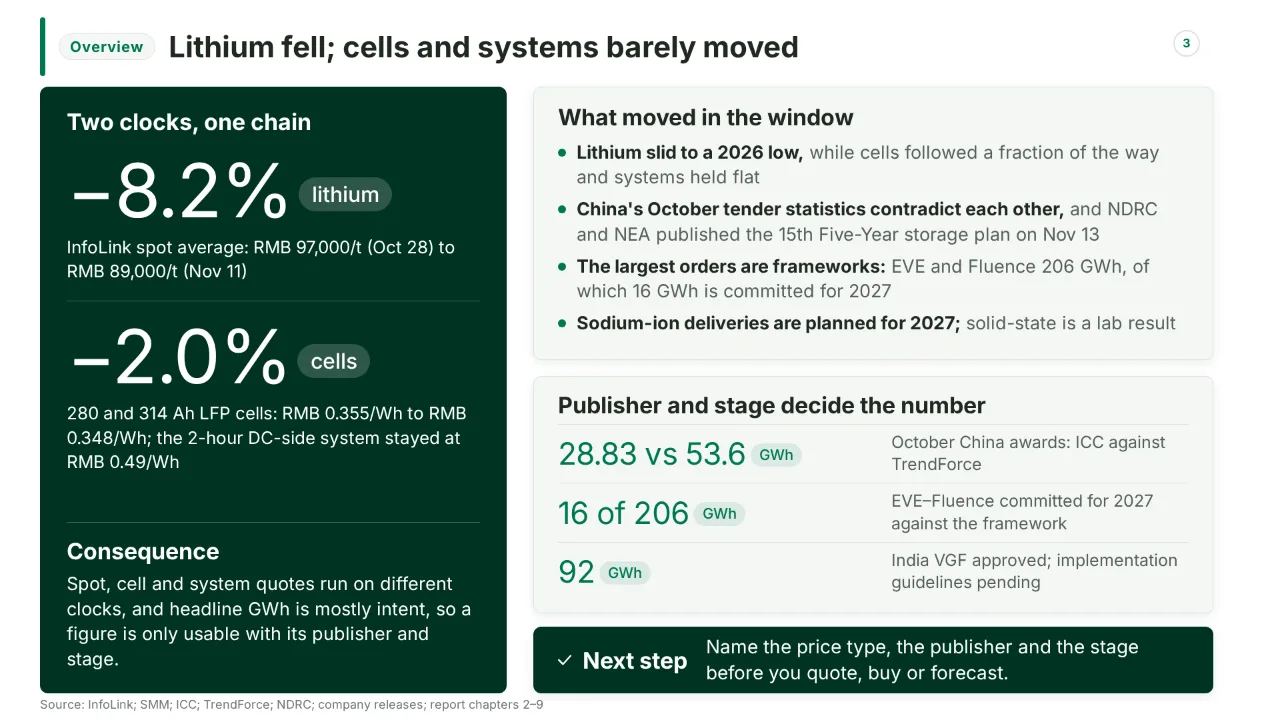
Between 3 and 16 November 2026, lithium carbonate slid to a 2026 low, cells followed only a fraction of the way, and the largest numbers in the news were policy goals, frameworks and forecasts rather than operating capacity. The five conclusions below summarise Chapters 2 to 9. Events dated before 3 November are labelled context and dates after 16 November are labelled upcoming.

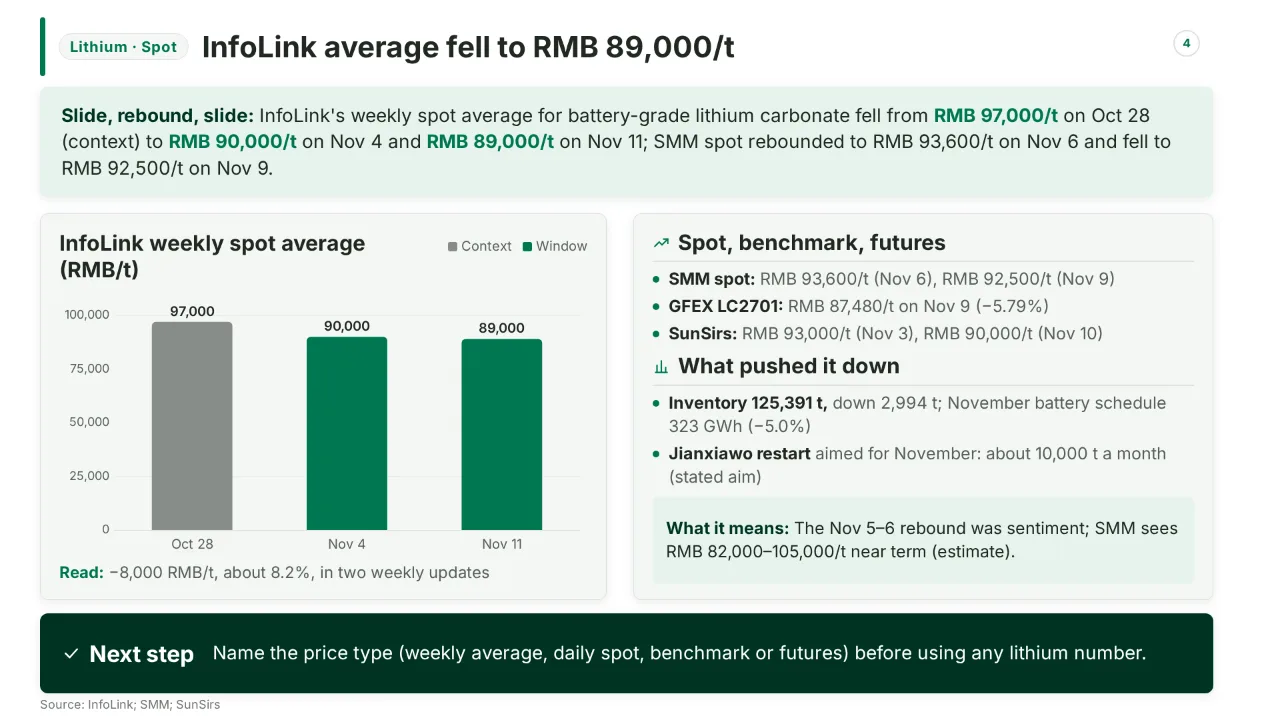
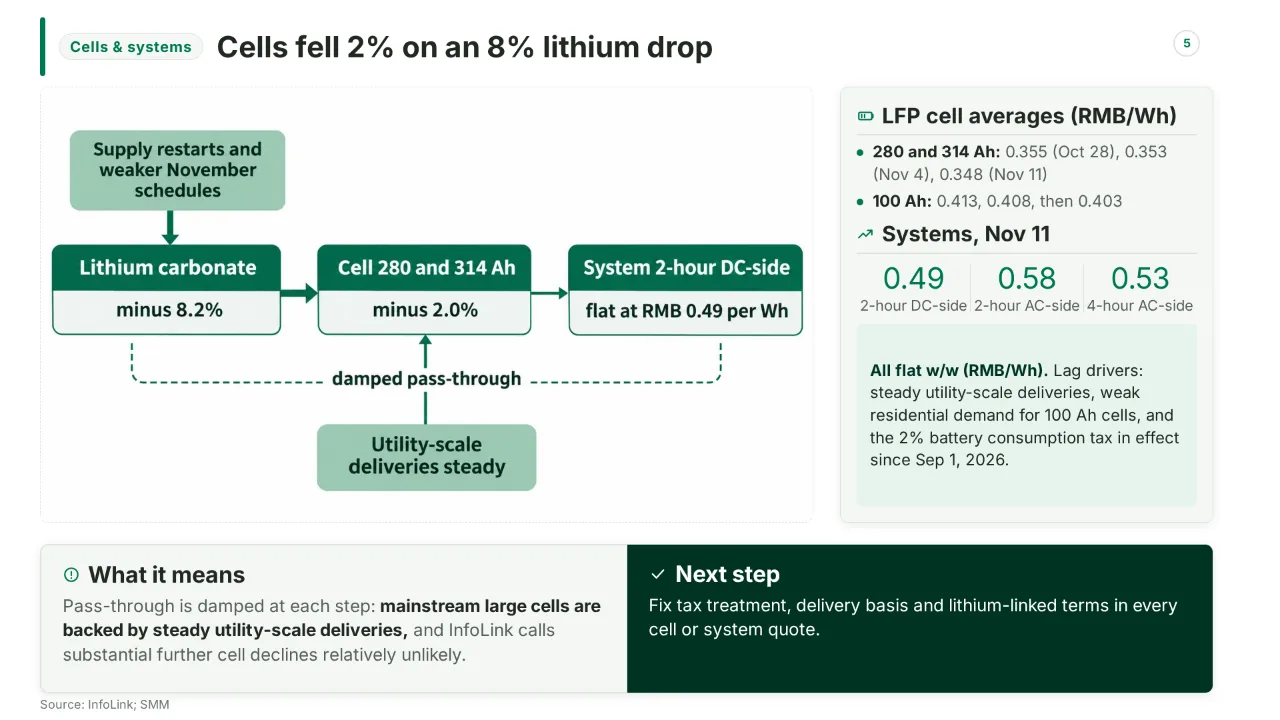
1. Lithium fell to about RMB 89,000–90,000/t, but cells and systems barely moved. InfoLink's weekly spot average was RMB 90,000/t on Nov 4 (-7.2%) and RMB 89,000/t on Nov 11 (-0.8%), while SMM's spot ranged from RMB 91,700/t to 93,800/t and GFEX futures closed at RMB 87,480/t on Nov 9. Over the same two updates, 280 and 314 Ah cells fell from RMB 0.355/Wh to RMB 0.348/Wh, about 2%, and the 2-hour DC-side system average stayed at RMB 0.49/Wh. Supply restarts such as CATL's Jianxiawo mine and a first November fall in battery production schedules explain the pressure.
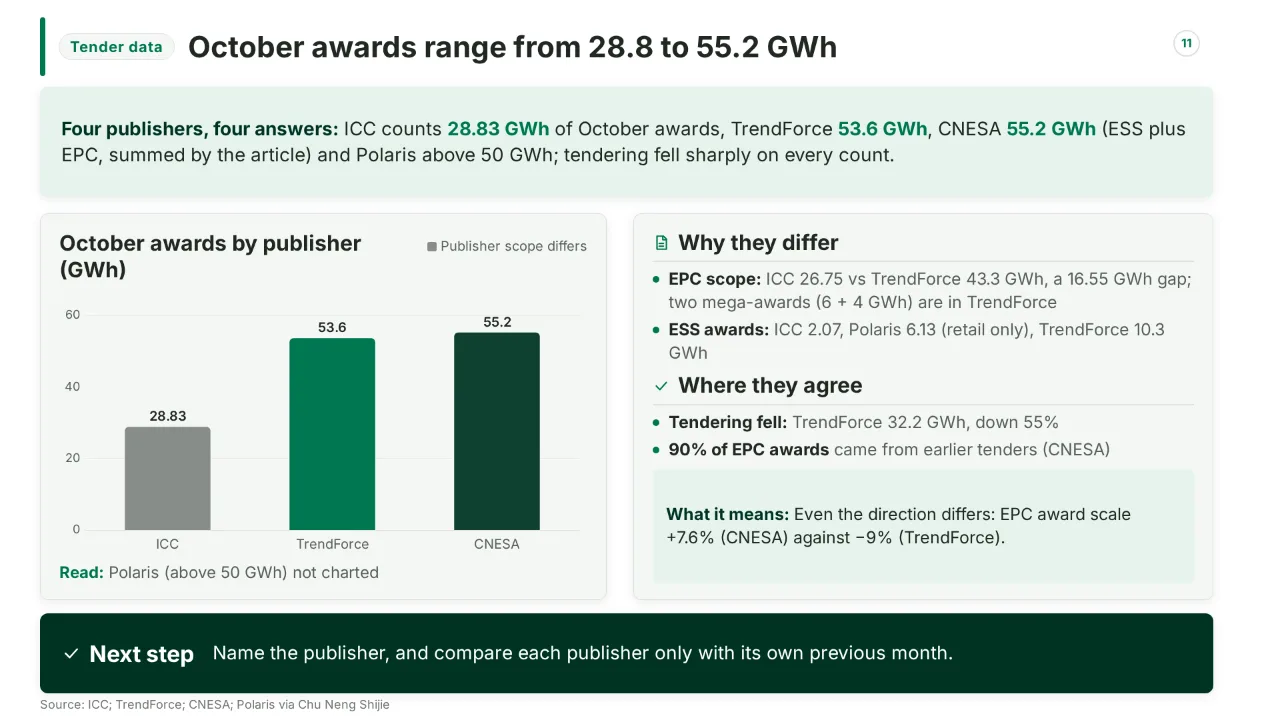
2. China's tender data is contradictory, so any single October figure is a choice of publisher. October awards were 28.83 GWh per ICC and 53.6 GWh per TrendForce, and 4-hour system prices rose on small samples while 2-hour prices were flat to lower. The NDRC and NEA published their 15th Five-Year plan on Nov 13 with a goal of 300 GW, 133 GW above the 167 GW installed at end-September.
3. Volume is growing and concentration is falling, but the biggest orders are frameworks. InfoLink counts 747.63 GWh of storage cells shipped in nine months and SNE Research 779.9 GWh, with CATL first in both. LG Energy Solution reported ESS shipments up more than 60% quarter on quarter and a 160 GWh backlog. EVE's 206 GWh framework with Fluence has only 16 GWh committed for 2027.
4. Sodium-ion advanced on paper, solid-state in the lab. CATL's Tener Sodium block (30+ MWh) is due to be delivered internationally from summer 2027 (company data), Wood Mackenzie counts more than 70 GWh of sodium-ion supply agreements, and QuantumScape's Osprey is a lab-cell result.
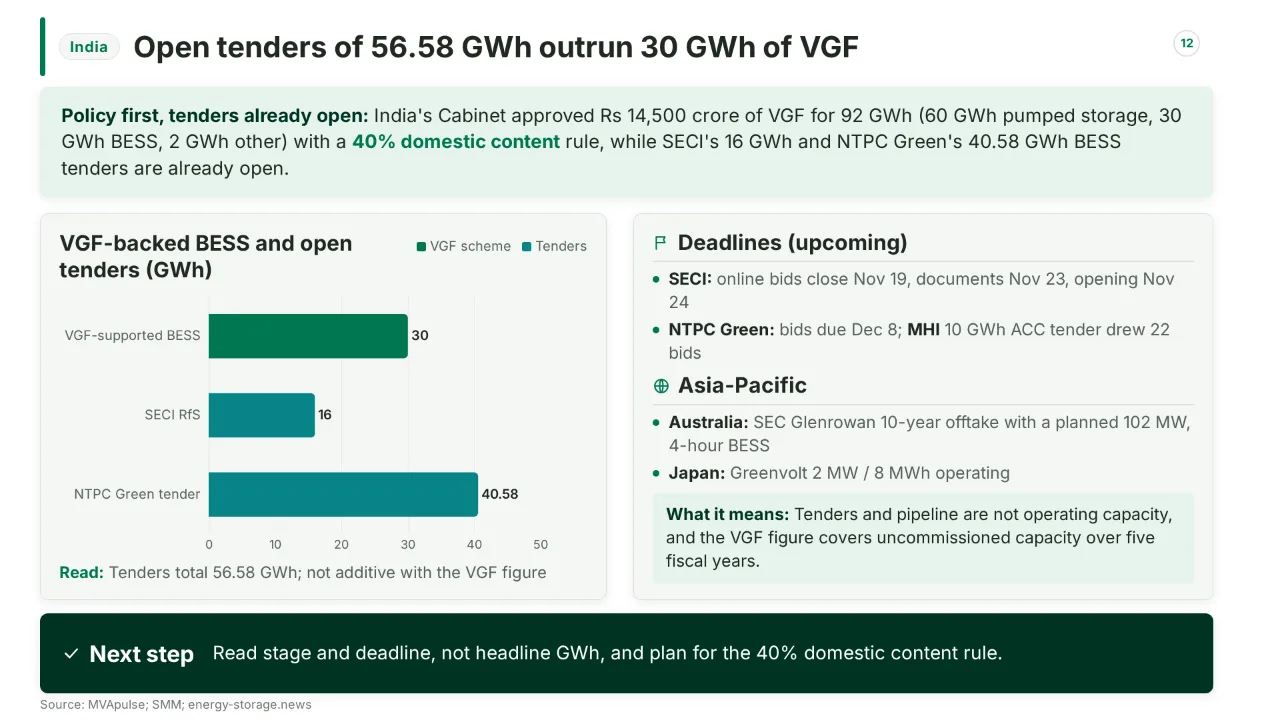
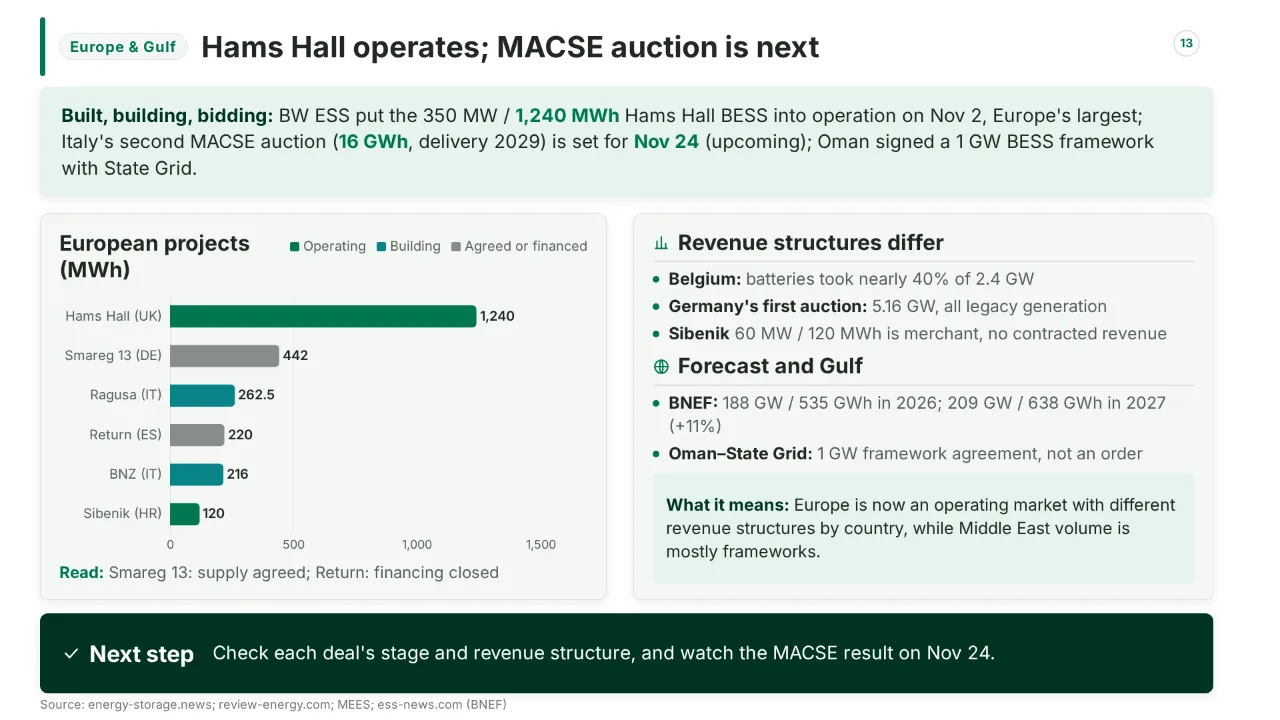
5. Overseas, policy and tenders led the news; Europe and the Middle East showed finished and framework projects. India approved Rs 14,500 crore of VGF for 92 GWh and had a 40.58 GWh NTPC Green tender open. In Europe, Hams Hall (1,240 MWh) is operating and Italy's second MACSE auction (16 GWh) is set for Nov 24, while Oman's 1 GW deal is a framework agreement. BNEF forecasts 188 GW / 535 GWh of new installations in 2026.
1.1 What moved at a glance
| Item | Value | Date | Source |
|---|---|---|---|
| InfoLink battery-grade lithium carbonate, weekly average | RMB 90,000/t (-7.2%); RMB 89,000/t (-0.8%) | Nov 4; Nov 11 | InfoLink |
| SMM spot battery-grade lithium carbonate, daily average | RMB 93,800/t; RMB 92,500/t | Nov 3; Nov 9 | SMM |
| GFEX LC2701 close | RMB 87,480/t (-5.79% vs prior close) | Nov 9 | SMM |
| LFP 280 / 314 Ah cell, weekly average | RMB 0.353/Wh; RMB 0.348/Wh | Nov 4; Nov 11 | InfoLink |
| 2-hour DC-side ESS, weekly average | RMB 0.49/Wh (-1.0%, then flat) | Nov 4; Nov 11 | InfoLink |
| October China awards | 28.83 GWh (ICC); 53.6 GWh (TrendForce) | Published Nov 9 to 12 | ICC; TrendForce |
| NDRC/NEA 15th Five-Year new-type storage plan | 300 GW goal, about 3 h duration | Nov 13 | NDRC |
| LG Energy Solution Q3 | Revenue KRW 9.6 tn; operating profit KRW 756 bn; ESS backlog 160 GWh | Nov 3 | Company; energy-storage.news |
| Global storage shipments, Jan to Sep | 747.63 GWh (InfoLink cells); 779.9 GWh (SNE) | Nov 11; reported Nov 5 to 15 | InfoLink; SNE via Businesskorea |
| EVE and Fluence framework | 206 GWh over five years; 16 GWh committed for 2027 | Signed Sep (context) | 36kr; CN Solar Sources |
| CATL Tener Sodium | 30+ MWh block; international deliveries from summer 2027 | Reported Nov 14 | pv magazine |
| India VGF | Rs 14,500 crore for 92 GWh | Window (date not stated) | MVApulse |
| Italy MACSE round two | 16 GWh, delivery 2029 | Nov 24 (upcoming) | review-energy.com |
| BNEF forecast | 188 GW / 535 GWh (2026); 209 GW / 638 GWh (2027) | Nov 12 | ess-news.com |
2. Lithium and storage-cell prices
The two weeks from 2026-11-03 to 2026-11-16 opened with lithium carbonate already well below the previous issue's levels, and the question for the window was how much of that fall would reach cells and systems.
Battery-grade lithium carbonate spot fell to about RMB 89,000–90,000/t in InfoLink's weekly series, a 2026 low, while LFP storage cells moved only 0.7–1.4% per week.
2.1 Lithium carbonate: spot, benchmark and futures side by side
Four different measures describe the same market, and they should not be read as one series. InfoLink publishes a weekly average of spot quotes, SMM publishes a daily spot average and the GFEX most-traded futures contract (LC2701), SunSirs publishes a benchmark price, and each differs in timing and method.
| Date | Measure | Publisher | Value (RMB/t) | Type | Ref |
|---|---|---|---|---|---|
| Oct 28 (context) | Battery-grade spot, weekly average | InfoLink | 97,000 (-4.9%) | weekly average | — |
| Nov 3 | Battery-grade spot, daily average | SMM | 93,800 (+300 d/d) | spot | — |
| Nov 3 | LC2701 settlement | GFEX via SMM | 89,980 | futures | — |
| Nov 3 | Battery-grade benchmark | SunSirs | 93,000 | benchmark | — |
| Nov 4 | Battery-grade spot, weekly average | InfoLink | 90,000 (-7.2%) | weekly average | — |
| Nov 5 | Battery-grade spot, Thursday average | SMM | 91,700 (-4.6% w/w) | spot | — |
| Nov 5 | LC2701 close | GFEX via SMM | 91,580 (+3.64% w/w) | futures | — |
| Nov 6 | Battery-grade spot, daily average | SMM | 93,600 (+1,900 d/d) | spot | — |
| Nov 6 | LC2701 close | GFEX via SMM | 92,860 (+1.40%) | futures | — |
| Nov 9 | Battery-grade spot, daily average | SMM | 92,500 (-1,100 d/d) | spot | — |
| Nov 9 | LC2701 close | GFEX via SMM | 87,480 (-5.79% vs prior close) | futures | — |
| Nov 10 | Battery-grade benchmark | SunSirs | 90,000 (-25.6% vs a month earlier) | benchmark | — |
| Nov 11 | Battery-grade spot, weekly average | InfoLink | 89,000 (-0.8%) | weekly average | — |
The picture is a drop to the high RMB 80,000s to low 90,000s with a short rebound on Nov 5–6. SMM reports spot rising for two sessions to RMB 93,600/t on Nov 6, then falling back on Nov 9 as "trade basis weakened". SunSirs describes the Nov 6 uptick (benchmark RMB 94,500/t, +4.4% on the day) as "driven by market sentiment rather than a fundamental shift in supply and demand". Futures were the most volatile measure: the Nov 9 close of RMB 87,480/t was 5.79% below the previous close, while spot fell only RMB 1,100/t that day.
2.2 What drove the move
Supply expectations dominate. According to SunSirs, September salt-lake output rose more than 80% year on year to about 22,000 t and spodumene-based output has stabilised at about 63,000 t a month; Zimbabwe concentrate arrivals ramped up after export restrictions were lifted. SunSirs also reports that a meeting on Nov 9 aimed to restart CATL's Jianxiawo mine within November, which at full rate would add about 10,000 t of lithium carbonate a month, equal to 12.5% of domestic monthly output (a stated aim, not a restart). InfoLink notes that the mine's environmental assessment entered public notice on Oct 22 and that time lags separate approval from output.
Demand signals softened. SunSirs reports scheduled lithium-battery production for November of 323 GWh, down 5.0% month on month and the first monthly fall this year, with energy-storage production schedules up only about 5.3% in October. SMM's weekly review adds that precursor schedules for November fell notably, and that lithium carbonate inventory was 125,391 t, down 2,994 t week on week, so the whole chain is destocking. SMM's own range for the near term is RMB 82,000–105,000/t.
Two outside voices frame the uncertainty. According to carboncredits.com, citing Bloomberg, spot was about RMB 91,500/t, roughly 23% lower this year, and Ganfeng's Roy Zhang told a Shanghai conference on Nov 11 that nobody has a clear view of the next six to 12 months; the same article reports Benchmark Mineral Intelligence expects the global market to stay in deficit through 2027. That is a secondary report, so read the deficit view as Benchmark's expectation, not a measured balance.
2.3 Cells follow lithium, but slowly
InfoLink's weekly transaction prices for LFP storage cells fell in each of the three weeks shown, but by far less than lithium carbonate.

| Cell | Oct 28 (context) | Nov 4 | Nov 11 | Change Nov 4 to Nov 11 |
|---|---|---|---|---|
| 100 Ah (RMB/Wh) | 0.413 (-0.6%) | 0.408 (-1.2%) | 0.403 (-1.2%) | -0.005 |
| 280 Ah (RMB/Wh) | 0.355 (-0.7%) | 0.353 (-0.7%) | 0.348 (-1.4%) | -0.005 |
| 314 Ah (RMB/Wh) | 0.355 (-0.7%) | 0.353 (-0.7%) | 0.348 (-1.4%) | -0.005 |
Source: InfoLink weekly spot price articles, averages of transaction ranges. The Nov 11 ranges are RMB 0.320–0.375/Wh for 280 and 314 Ah and RMB 0.370–0.435/Wh for 100 Ah. Over the two window updates, 280 and 314 Ah cells moved from the Oct 28 average of RMB 0.355/Wh to RMB 0.348/Wh, a fall of RMB 0.007/Wh or 2.0% (0.007 / 0.355), while spot lithium carbonate fell from RMB 97,000/t to RMB 89,000/t, 8.2% (8,000 / 97,000).
InfoLink's explanation is that mainstream large cells are supported by steady utility-scale deliveries, whereas 100 Ah cells face weak residential demand, inventory pressure and a shrinking premium as small systems adopt larger cells. Its Oct 28 analysis also says the lithium cost decline "continues to outweigh additional costs, including the consumption tax", and that substantial further declines for mainstream high-capacity cells are "relatively unlikely". The Nov 11 headline says falling material costs are intensifying cell price competition.
2.4 GFEX lithium hydroxide futures: a new hedging tool
On Nov 6 the CSRC registered lithium hydroxide futures and options on GFEX. On Nov 13 GFEX announced that the futures will start trading on Nov 26, 2026 (status: upcoming), with initial contracts LI2706 to LI2711 and a first-day margin of 11% and price limit of 18% of the benchmark listing price. GFEX also issued fee and position-limit rules for the LC2711 lithium carbonate contract on Nov 11 (fee 0.008% of turnover, opening limit 800 lots a day for non-futures-company clients).
2.5 What it means for buyers
For buyers of cells the window shows a low pass-through rather than a collapse: a roughly 8% lithium fall produced a roughly 2% fall in 280 and 314 Ah cell prices over the two InfoLink updates. Because futures swing harder than spot, a futures-linked contract would have moved much more than the physical quotes above. The next reference points are the weekly InfoLink updates (Thursdays), SMM's Thursday weekly review, and the Nov 26 hydroxide launch.
3. System, EPC and tender prices
Cells are only part of the bill: this chapter follows what the lower cell and lithium prices of Chapter 2 did to ESS quotes, to October tender prices published in the window, and to the export-side policy clock.
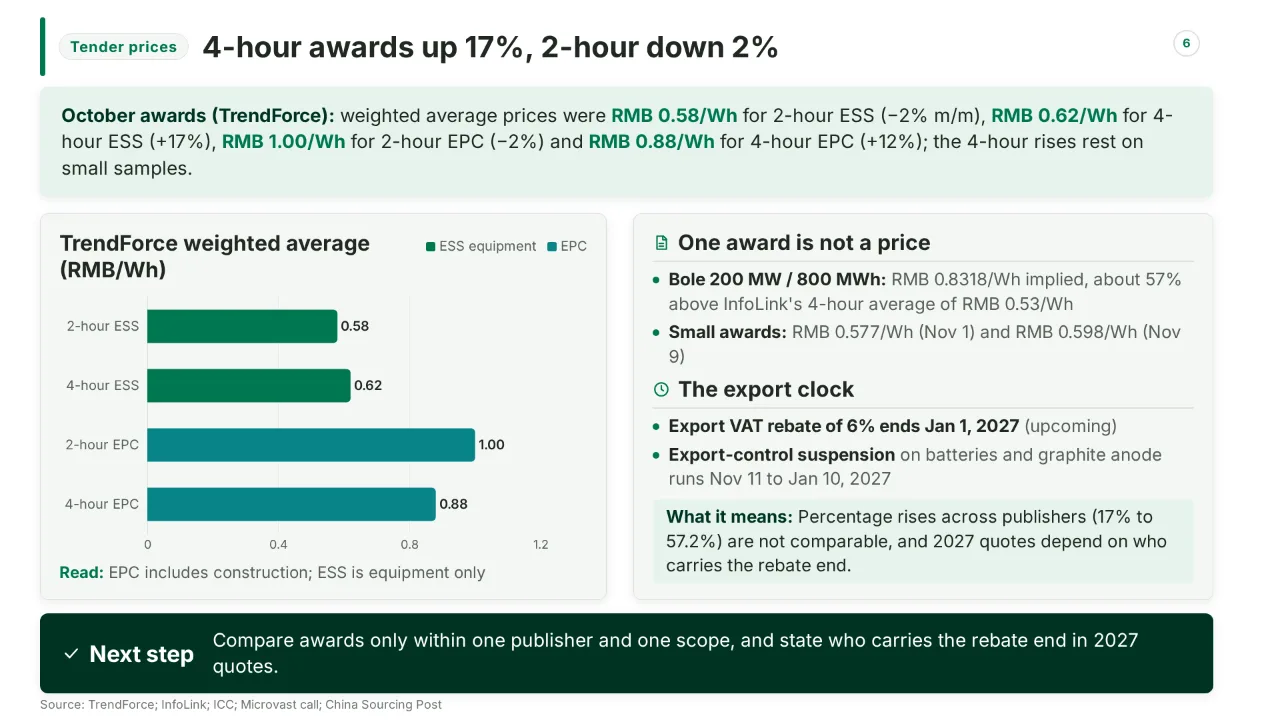
InfoLink's 2-hour DC-side system average slipped 1.0% to RMB 0.49/Wh on Nov 4 and then held flat on Nov 11, while TrendForce's October award data show 4-hour systems up 17% to RMB 0.62/Wh and 2-hour systems down 2% to RMB 0.58/Wh.
3.1 System price snapshot (InfoLink weekly transaction prices)
| System (China, liquid-cooled container) | Oct 28 (context) | Nov 4 | Nov 11 |
|---|---|---|---|
| 2-hour DC-side, RMB/Wh | 0.49 (flat) | 0.49 (-1.0%) | 0.49 (flat) |
| 1-hour AC-side, RMB/Wh | 0.84 (flat) | 0.84 (flat) | 0.84 (flat) |
| 2-hour AC-side, RMB/Wh | 0.58 (flat) | 0.58 (flat) | 0.58 (flat) |
| 4-hour AC-side, RMB/Wh | 0.53 (flat) | 0.53 (flat) | 0.53 (flat) |
Source: InfoLink weekly spot price articles, average of the quoted range in each cell. The one visible change is the 2-hour DC-side average on Nov 4, down 1.0% (range RMB 0.44–0.53/Wh, with the low end lower than the RMB 0.45 of Oct 28). InfoLink's Oct 28 analysis says that as cell prices fall, "the cost basis for newly signed projects is falling" and system quotes "may still face downward pressure" if cells weaken further. That has not yet happened in the average: cells fell about RMB 0.007/Wh over the window (Chapter 2), and the system averages are rounded to the cent.
InfoLink also lists small award datapoints, which it says should not be compared directly with utility-scale standalone projects because of differences in scale, scope and configuration:
| Award (date) | Size | Price | Note |
|---|---|---|---|
| Qinglong Liangshuihe wind project, equipment (Nov 1) | 20 MW / 40 MWh | RMB 23.08 million, about RMB 0.577/Wh | Winner Zhongtian Energy Storage |
| Weihai Carbon Fiber park, Shandong, equipment under EPC (Oct 29, context) | 18.75 MW / 75 MWh | first-ranked about RMB 0.534/Wh; second about RMB 0.500/Wh | Bids, not an award |
| Min County, Dingxi, Gansu, GD Power wind Phase II ESS (Nov 9) | 10 MW / 20 MWh | first-ranked RMB 11.96 million, about RMB 0.598/Wh | 2-hour |
Arithmetic check: RMB 23.08 million / 40 MWh = RMB 0.577/Wh; RMB 11.96 million / 20 MWh = RMB 0.598/Wh.
3.2 October tender and award prices
TrendForce's October statistics, syndicated in Chinese media, split the picture by duration (weighted average of winning prices, the month-on-month change as TrendForce reports it).
| Item (October 2026) | Price range (RMB/Wh) | Weighted average (RMB/Wh) | Change m/m |
|---|---|---|---|
| 2-hour ESS | 0.57–1.06 | 0.58 | -2% |
| 4-hour ESS | 0.51–0.83 | 0.62 | +17% |
| 2-hour EPC | 0.74–1.25 | 1.00 | -2% |
| 4-hour EPC | 0.67–1.22 | 0.88 | +12% |
Source: TrendForce, via Sohu. The same figures are discussed in an article by the media account Chu Neng Shijie (published Nov 13 on Sina and NetEase), which compares four publishers' October statistics: 2-hour ESS averages across publishers were RMB 0.58–0.64/Wh, 2-hour EPC RMB 0.99–1.05/Wh, 4-hour EPC RMB 0.88–0.94/Wh, and 4-hour ESS ranged from RMB 0.62/Wh (TrendForce) to RMB 0.6831/Wh (Polaris) to RMB 0.8318/Wh (CNESA, one project). The article warns that the 4-hour ESS rise "is reported by three publishers but on small samples" and that the percentage rises (17% to 57.2%) are not comparable. The scope of the four statistics, and the direction disagreements, are covered in Chapter 7; this chapter only uses prices.
One checkable datapoint: the Bole, Xinjiang 200 MW / 800 MWh ESS project was won by Paibattery at RMB 665.4544 million, equal to RMB 0.8318/Wh (665.4544 / 800), recorded consistently by CNESA, ICC and Polaris according to the same article. This implied price is about 57% above InfoLink's 4-hour AC-side average of RMB 0.53/Wh, so a single 4-hour award should not be read as a market price.
According to a SunLith Energy blog (secondary, not used for numbers), Chinese tenders increasingly mix 0.5C and 0.25C systems; no price conclusion is drawn from it.
3.3 The export-side clock: VAT rebate and export controls
Two policy items affect how overseas buyers price 2027 orders.
First, the export VAT rebate on lithium batteries. According to Microvast's Q3 call on Nov 10 (company statement), China cut the VAT export rebate on specified lithium battery products from 9% to 6% on Apr 1, 2026 and will eliminate it on Jan 1, 2027; the same call notes a 2% battery consumption tax effective Sep 1, 2026, scheduled to rise to 4% on Sep 1, 2027. The rebate end date is therefore upcoming as of the run date. The material has no official Ministry of Finance text for it; a retailer page and a social post repeat the dates and are not used as a source.
Second, export controls. According to China Sourcing Post (secondary summary of an official notice), MOFCOM and Customs Announcement No. 58 of 2026, dated Nov 9, keeps the October 2025 export-control measures covering lithium batteries and artificial graphite anode materials suspended from Nov 11, 2026 to Jan 10, 2027. The previous suspension was due to end on Nov 10, 2026, so the Nov 9 notice leaves no gap, and the date tracks the US-China arrangement. The controls are suspended, not repealed; the next decision point is Jan 10, 2027 (upcoming).
3.4 What it means
System prices are stickier than cell prices: with cells down about 2% (Chapter 2) and system averages flat, the pass-through into systems is so far almost nil, and the material has no cost data to say more. Buyers comparing quotes should note three points. Averages from InfoLink, TrendForce and the media comparison differ because of weighting and scope. Small awards (10–40 MWh) price RMB 0.58–0.60/Wh, above the 4-hour utility-scale range of RMB 0.50–0.55/Wh in InfoLink's series. Exporters face a rebate cliff on Jan 1, 2027, so quotes for 2027 delivery should state which side carries it.
4. Manufacturers: results and shipments
With prices drifting lower (Chapters 2 and 3), the volume side of the window came from one results release, two nine-month shipment rankings and a handful of company stress signals.
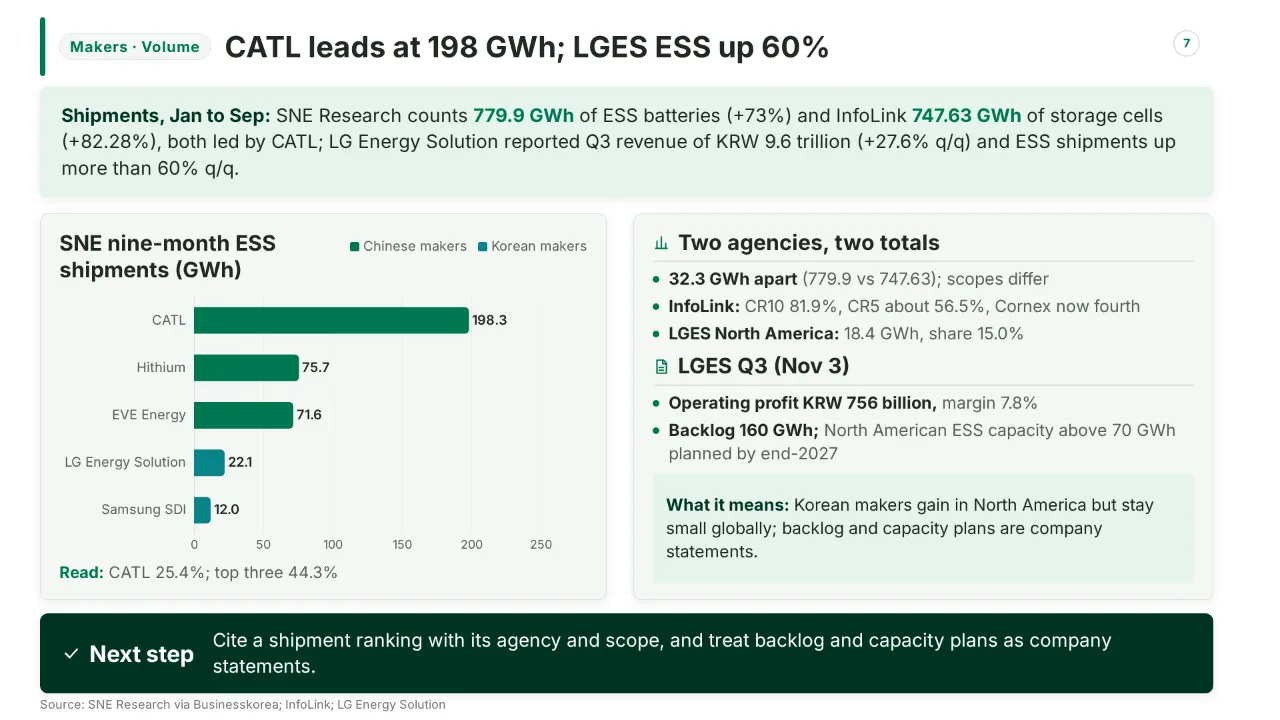
Two agencies put global storage shipments for January to September at 747.63 GWh (InfoLink, cells) and 779.9 GWh (SNE Research, ESS batteries); both put CATL first and both show Korean makers recovering, while LG Energy Solution said its ESS shipments rose more than 60% quarter on quarter.
4.1 Company results in the window
Few storage-relevant companies reported inside the window: Samsung SDI, Sungrow and CATL reported earlier and are context from the previous issue. The window's results were:
| Company | Metric (Q3 2026) | Value | Change | Date | Source |
|---|---|---|---|---|---|
| LG Energy Solution | Consolidated revenue | KRW 9.6 trillion (includes KRW 416.9 billion North America production incentive) | +27.6% q/q | Nov 3 | Company release |
| LG Energy Solution | Operating profit | KRW 756 billion, margin 7.8% | margin 1.5% in Q2, per energy-storage.news | Nov 3 | Company release; energy-storage.news |
| LG Energy Solution | Net loss | KRW 296.9 billion, after a KRW 987.2 billion non-operating loss | n/a | Nov 3 | energy-storage.news |
| LG Energy Solution | ESS shipments | "more than 60%" higher | q/q | Nov 3 | energy-storage.news |
| LG Energy Solution | ESS order backlog | 160 GWh at end of period | n/a | Nov 3 | energy-storage.news |
| Microvast | Revenue | US$45.8 million | -62.8% y/y | window (Nov 10 call) | Press release summary |
The LG Energy Solution release (a company statement) attributes the revenue rise to "a significant increase in ESS shipments" and says it secured its first direct-supply behind-the-meter BESS project for a big-tech customer and qualified as an NVIDIA DSX Ready BESS partner. According to energy-storage.news, management expects ESS shipments to grow about 40% in Q4 2026, a "slight decline" in profitability in Q4 because Q3 included one-off revenue, and North American ESS capacity above 70 GWh by end-2027 (a plan, not installed capacity). The outlet converts KRW 9.6 trillion to US$7.2 billion, an implied rate of about KRW 1,333/US$ (9.6 / 7.2). LG Energy Solution does not split cells from complete systems in its ESS figures.
Two supply-chain points in the release matter for buyers: the company says it is expanding its North American non-PFE (prohibited foreign entity) LFP cathode supplier base to four or more suppliers, and aims to produce sodium-ion battery samples this year for proof-of-concept testing with a key ESS customer (sample stage, company says).
Microvast is a smaller, non-storage-specific signal, reported by a press-release summary site: revenue fell to US$45.8 million, gross margin to 5.2% from 37.6%, net loss widened to US$76.8 million, and cash of US$124.4 million compares with US$177.0 million of debt, with the company saying substantial doubt about its ability to continue operating remains. Separately, energy-storage.news carried a headline on Nov 3 that Fluence's CEO and CFO left with immediate effect; the material holds the headline only and no details. Fluence's next results are expected on Nov 23 (upcoming; source: MarketBeat, secondary).
4.2 Two shipment rankings, not one
Both rankings cover January to September 2026 but measure different things, so they are shown separately.
| Measure | InfoLink (storage cells) | SNE Research (ESS batteries) |
|---|---|---|
| Nine-month global total | 747.63 GWh, +82.28% y/y | 779.9 GWh, +73% y/y (451.5 GWh a year earlier) |
| Third quarter | +8.59% q/q | 286.8 GWh, +58% y/y, +7% q/q (record) |
| Top names | CATL, Hithium, EVE Energy, Cornex, CALB (CR5 about 56.5%; CR10 81.9%) | CATL 198.3 GWh (25.4%), Hithium 75.7 GWh, EVE 71.6 GWh |
| Utility / grid-scale | 650.30 GWh, +74.79% | 575.9 GWh, 73.8% of total |
| Residential | 91.22 GWh, +189.62% | 97.5 GWh, +152% |
| Published | Nov 11 | reported Nov 5 to Nov 15 |
Sources: InfoLink; SNE Research as reported by Businesskorea and Battery-Tech Network. The gap of 32.3 GWh (779.9 - 747.63) between the totals reflects different scopes and shipment definitions; neither source explains it, so the table does not reconcile them. SNE's top-three share is 44.3% ((198.3 + 75.7 + 71.6) / 779.9), and its CATL share of 25.4% equals 198.3 / 779.9.
What the two rankings agree on:
- A consumption-tax pull-forward. InfoLink says news that China's consumption-tax exemption for lithium-ion batteries would expire on Sep 1 triggered a rush to ship in August, then shipments fell more than 5% m/m in September, and it expects growth to resume in Q4.
- Concentration is falling. InfoLink's CR10 of 81.9% is a record low; Cornex moved into the global top five (fourth) for the first time and Sunwoda returned to the top ten after five quarters.
- Korean makers are recovering, mainly in North America. According to SNE, LG Energy Solution shipped 22.1 GWh globally in nine months (+355% y/y), with North America 18.4 GWh (+431%) and a regional share of 15.0%, and in Q3 its 8.1 GWh in North America beat Hithium's 7.1 GWh. Samsung SDI shipped 12.0 GWh (+46%), 7.1 GWh of it to North America, and its regional share fell from 8.6% to 5.8%. Their combined North American share rose from 13.4% to 20.9%, yet together they were only about 4.4% of the global total ((22.1 + 12.0) / 779.9). InfoLink separately has LGES ninth in utility-scale cells in Q3.
- Regional mix is shifting. SNE reports China at 313.1 GWh (40.1% of the total, from 48.9%), North America 122.3 GWh (+71%) and Europe 131.2 GWh (+87%).
4.3 Format race and what is missing
InfoLink notes that leading Chinese makers already mass-produce 310-format 648 Ah cells, that LGES introduced a similar-sized cell one quarter later, and that mid-tier makers may not see significant 500+ Ah volume until 2Q27. In residential storage, Great Power topped the Q3 ranking for the first time, ahead of REPT BATTERO and EVE Energy, and Q3 residential shipments fell more than 15% q/q.
Absences matter as well. The window has no new results from CATL, Hithium, EVE, Sungrow or Tesla in the collected material; their figures come from earlier issues and are not repeated here. Shipment statistics are third-party estimates (InfoLink, SNE), not company disclosures, and SNE's report reaches us through trade press rather than the agency's own release.
5. Orders, capacity and supply chain
Chapter 4 showed who shipped what; this chapter looks at what was signed or announced in the window and how much of it is firm.
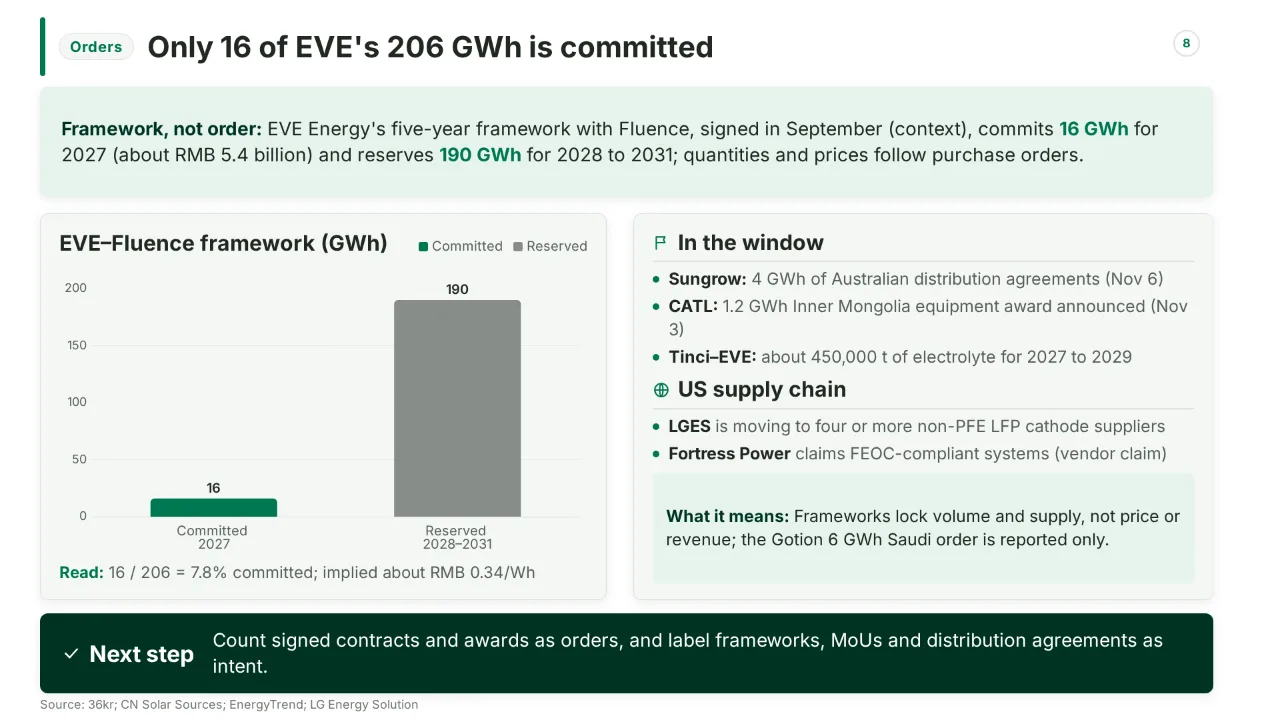
Headline order sizes in the window ranged from 4 GWh of Australian distribution agreements to a 206 GWh cell framework, but only a small share is binding: of the EVE Energy and Fluence framework, 16 GWh (7.8%) is committed for 2027 and the other 190 GWh is reserved capacity, according to a 36kr analysis.
5.1 Orders, frameworks and MoUs
The status column follows the topic rules: a framework, MoU or distribution agreement is not an order.
| Company | Counterparty / project | Size | Type | Date | Source |
|---|---|---|---|---|---|
| EVE Energy | Fluence (North America) | 206 GWh over five years | Framework agreement, signed in September (context, cited again in window) | Sep (context) | CN Solar Sources; 36kr |
| EVE Energy | CleanPeak (Australia) | 1 GWh | MoU | Oct 29 (context) | Gasgoo |
| Sungrow | Solar Juice, Supply Partners, Raystech (Australia, NZ) | 4 GWh BESS with 1.5 GW PV | Distribution agreements | Nov 6 | EnergyTrend; PR Newswire release |
| CATL | POWERCHINA Hubei, Mengning Times Shajing, Inner Mongolia | 300 MW / 1,200 MWh equipment | Award announced | Nov 3 | EnergyTrend |
| CATL | Central Puerto, Argentina (Nuevo Puerto and Central Costanera) | 205 MW / 1,025 MWh | Supply for projects won in the AlmaGBA tender; commissioning end-2026 and Jan 2027 (reported) | announced week of Nov 4 | EnergyTrend, citing ESS News |
| Zhiguang Electric (subsidiary) | A county shared storage station | RMB 114.4 million | Signed contract | Nov 7 | EnergyTrend |
| Tinci Materials | EVE Energy | about 450,000 t electrolyte, 2027 to 2029, plus or minus 20% | Long-term supply agreement; quantities subject to purchase orders | Nov 6 | EnergyTrend |
| Ampace, CATL, Octopus Energy | Home storage | not stated | MoU | Nov 3 | EnergyTrend |
| Gotion High-Tech | Saudi Arabia first-batch large BESS projects | 6 GWh | Reported order, date not stated | early Nov | 36kr |
| BYD / Sungrow | Masdar RTC project, UAE | 11.275 GWh / 7.5 GWh | Reported supply, date not stated | early Nov | 36kr |
Arithmetic checks: Sungrow's three agreements total 2.5 + 1.0 + 0.5 = 4.0 GWh and 500 MW x 3 = 1.5 GW of PV, matching the release. BYD plus Sungrow at Masdar is 11.275 + 7.5 = 18.775 GWh, which 36kr rounds to "close to 19 GWh".
The 36kr piece (secondary, a repost, so every figure in it is "reported") makes three useful distinctions. First, for the EVE and Fluence framework, product specifications, quantities, prices and delivery cycles are "subject to the formal purchase orders", and the 2027 committed volume of 16 GWh corresponds to estimated revenue of about RMB 5.4 billion. That implies about RMB 0.34/Wh (5.4 billion / 16 billion Wh), an implied figure from reported inputs that sits close to InfoLink's RMB 0.348–0.353/Wh cell averages in Chapter 2, not a disclosed price. Second, such agreements typically "lock volume without locking price", with prices adjusted quarterly or monthly. Third, projects in Saudi Arabia and the UAE are project-based deliveries with explicit operating-condition clauses (for example 55 degrees C ambient), so they test delivery record rather than quote level.
CN Solar Sources adds that EVE signed the Fluence framework in September and that the volume equals 1.7 times EVE's 2025 power and storage battery shipments. The collected material has no primary announcement for Gotion's Saudi order or the Masdar award dates, which is why they stay "reported".
5.2 Sungrow's Australian channel deals
At All-Energy Australia on Nov 6, Sungrow signed distribution agreements with Solar Juice (500 MW PV and 2.5 GWh storage), Supply Partners (500 MW and 1 GWh) and Raystech Group (500 MW and 500 MWh, residential), covering Australia and New Zealand household and C&I channels. These are channel agreements, not project orders; they set a ceiling for what distributors may place, and no delivery dates or prices are given. The same news roundup lists two small C&I deployments by Hoymiles, 1,375 kW / 2,871 kWh in Haikou and 750 kW / 1,566 kWh in Guangzhou (delivered, Nov 6).
5.3 Upstream agreements
Tinci Materials told the exchange on Nov 6 that its subsidiary signed a long-term electrolyte agreement with EVE for 2027 to 2029 with estimated demand of 450,000 t, executed at the forecast plus or minus 20%; actual volume and prices depend on purchase orders, and Tinci itself notes "certain uncertainty in the execution". This is a long-dated supply-security move more than a price signal. The 36kr analysis adds that 314 Ah cell lines were running above 95% utilisation and delivery times had lengthened from 2 to 3 weeks to 4 to 5 weeks in the first half of 2026 (reported), which is why integrators pay for certainty.
5.4 US supply chain: FEOC and domestic cells
According to LG Energy Solution's Nov 3 release, a US executive order on grid security and designated foreign entities "continues to support demand for locally produced ESS", and the company is building a North American non-PFE LFP cathode supplier base of four or more suppliers. On the tax side, an investment-site summary (secondary) says storage projects that start construction after Dec 31, 2025 can lose federal credit eligibility if they rely on significant assistance from a disqualified foreign entity, and that Treasury Notice 2026-15 of Feb 12, 2026 gave operating guidance, "though compliance remains complex". Product claims follow the rule: on Nov 3 Fortress Power announced FEOC-compliant commercial and residential systems that it says qualify for the 30% federal investment tax credit (vendor claim). The material contains no Section 301 tariff rate for the window, so none is stated.
5.5 What the pattern means
Volume-locked frameworks are a response to tight 314 Ah supply and low prices, not evidence of new demand on their own. Binding orders in the window were small by comparison (RMB 114.4 million, 1.2 GWh, 1.025 GWh), while the largest numbers are frameworks, distribution agreements or reports. Readers should track the conversion from framework to purchase order, and which supplier lists are forming in the Middle East and North America, rather than add headline GWh together.
6. Technology: sodium-ion, solid-state and system formats
With orders and shipments still dominated by LFP (Chapters 4 and 5), the technology news of the window was about the next chemistry for stationary storage and a laboratory milestone in solid-state cells.
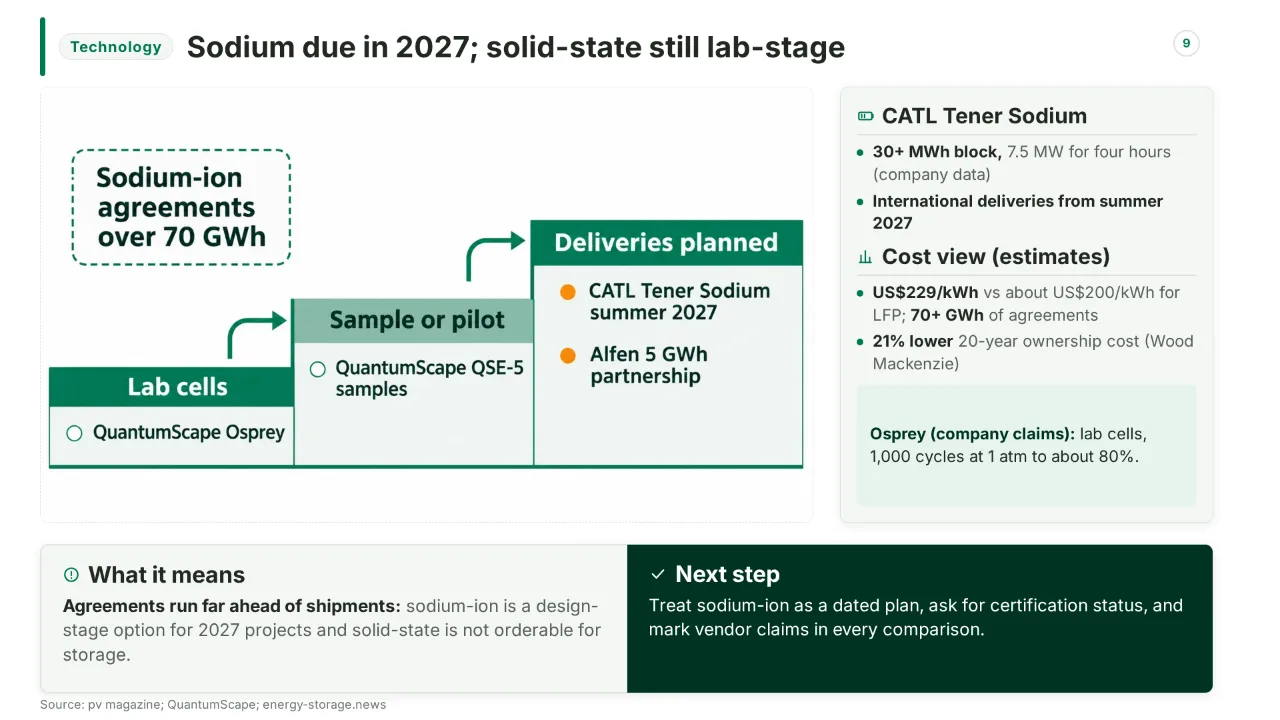
The window's clearest storage milestone is CATL's four-hour Tener Sodium block: international deliveries are due to begin in summer 2027 (company data via pv magazine, Nov 14), so sodium-ion remains a planned product for most buyers, while QuantumScape's Osprey is a lab-cell result.

6.1 Sodium-ion: product details, cost view and early deals
CATL Tener Sodium (company data, product stage: launched June 2026, deliveries planned). pv magazine reported on Nov 14, based on a CATL webinar on Oct 29, that the Tener Sodium block is built from two, four, six or eight cabinets, with the eight-cabinet block rated at more than 30 MWh, 0.25P charge and discharge (7.5 MW for four hours), 95% round-trip efficiency at 25 degrees C and 0.25P, and 70% state of health after 20 years. CATL also says the cell reaches 15,000 cycles at 25 degrees C, retains more than 92% capacity at -20 degrees C, and operates from -35 to +55 degrees C (all vendor claims). Each cabinet weighs 44 to 45 t, about 4 MWh per cabinet in the eight-cabinet version, and an LFP version in the same cabinets is planned at around 50 MWh, with sodium certification prioritised and the LFP version to follow. International deliveries begin in summer 2027. Arithmetic check: 7.5 MW x 4 h = 30 MWh.
Customers and partners. According to energy-storage.news, Alfen, a Dutch integrator, announced a 5 GWh sodium-ion partnership with CATL in July (a partnership, not an order), and its CEO says sodium-ion is currently priced above lithium-ion with lower energy density, needs roughly 20% more footprint for the same energy and power, and that he expects 25 to 30 years of maintained performance (CEO view). In the US, Peak Energy, a sodium-ion BESS start-up, says it has more than US$1 billion of commercial customer agreements and recently announced a US$108 million financing round, according to Battery Tech Online (company statements, not verified in the material). Grepow launched five small sodium-ion pouch cells (2 to 7 Ah) for industrial and cold-climate uses on Nov 12, a niche that does not bear on grid storage.
Cost and parity. A Wood Mackenzie analysis reported by pv magazine on Nov 6 says supply agreements for sodium-ion exceed 70 GWh worldwide, cell-level cost parity with LFP is expected for leading makers by late 2026, but module and system parity not before 2030. It puts the global average sodium-ion cost at US$229/kWh against about US$200/kWh for LFP, and estimates a 21% lower total cost of ownership over 20 years (estimate). The same piece notes China exempts sodium-ion from the battery consumption tax until the end of 2028 while LFP pays 2% from September 2026, rising to 4% in September 2027, and that US tariffs of about 58% on Chinese storage cells encourage domestic sodium-ion manufacturing. A Nov 13 pv magazine interview with a Turin professor puts commercial sodium-ion cells at about 175 Wh/kg against about 205 Wh/kg for advanced LFP and capacity retention above 95% after 5,000 cycles (academic estimate). The difference between 70 GWh of agreements and CATL's aim of more than 1 GWh of sodium-ion shipments by the end of 2026 shows how far agreements run ahead of shipments.
6.2 Solid-state: Osprey is a platform announcement, not a product
On Nov 11, QuantumScape announced Osprey, an all-solid-state platform pairing its ceramic separator and anode-free lithium-metal design with a solid sulfide cathode; the company says cells cycled 1,000 times under one atmosphere of pressure and projects energy densities up to about 1,100 Wh/L (company claims). Electrek notes that the white paper describes small, early lab cells, that the 1,000-cycle result is to about 80% capacity at 1C, 30 degrees C and 1 atm for a two-layer cell, and that the QSE-5 cell, a separate earlier platform with a liquid catholyte, is shipping as samples from its Eagle Line pilot production. Stage: lab cells for Osprey, samples from a pilot line for QSE-5. None of the collected material for the window gives a solid-state stationary-storage deployment. energy-storage.news carried an explainer on semi-solid-state batteries for BESS on Nov 11, but the material holds only the headline, so no claim is drawn from it.
6.3 System formats and design life
CATL launched TENER+ at All Energy Australia on Oct 29, before the window (context): a 9 MWh container that, the company says, reduces the number of containers needed by up to 40%, shown together with TENER Sodium; the same release lists three MoUs with Hitachi Energy, EPEC Group and UNSW Sydney. A LinkedIn post repeats a 25-year design life for TENER+ (vendor claim, social post, not used as a source). Chapter 4 adds InfoLink's note that leading Chinese makers already mass-produce 310-format 648 Ah cells and that LGES followed one quarter later.
6.4 Readiness table
| Technology | Company | Milestone | Stage | Date | Source |
|---|---|---|---|---|---|
| Sodium-ion BESS, 30+ MWh block | CATL | Specifications shown; international deliveries from summer 2027 | Launched; deliveries planned (company data) | Oct 29 webinar, reported Nov 14 | pv magazine |
| Sodium-ion BESS partnership | Alfen with CATL | 5 GWh partnership | Partnership (July, context) | interview in window | energy-storage.news |
| Sodium-ion grid storage | Peak Energy | US$108 million financing; customer agreements above US$1 billion | Company says | reported Nov 13 | Battery Tech Online |
| All-solid-state, sulfide cathode | QuantumScape (Osprey) | 1,000 cycles at 1 atm to about 80% | Lab cells (company claims) | Nov 11 | QuantumScape; Electrek |
| Semi-solid-state for BESS | n/a | Explainer headline only | Not assessed | Nov 11 | energy-storage.news |
| 9 MWh TENER+ container | CATL | Global launch | Launched; vendor claims (context) | Oct 29 | PR Newswire via Yahoo |
6.5 What it means
Sodium-ion is moving from product claims to cost arguments, but the evidence in the window is vendor data, an analyst estimate and one integrator's view; no sodium-ion BESS is reported as operating at utility scale. Buyers planning 2027 projects should treat a sodium option as a choice to be made at design stage, as CATL's identical cabinet layout allows, and should expect certification to arrive first for sodium and later for the LFP version of the same block. Solid-state announcements, including Osprey, do not change stationary-storage procurement in this period.
7. China projects, tenders and policy
Chapter 3 used the October award prices; this chapter covers what China's regulators published in the window and why four October tender statistics tell different stories.
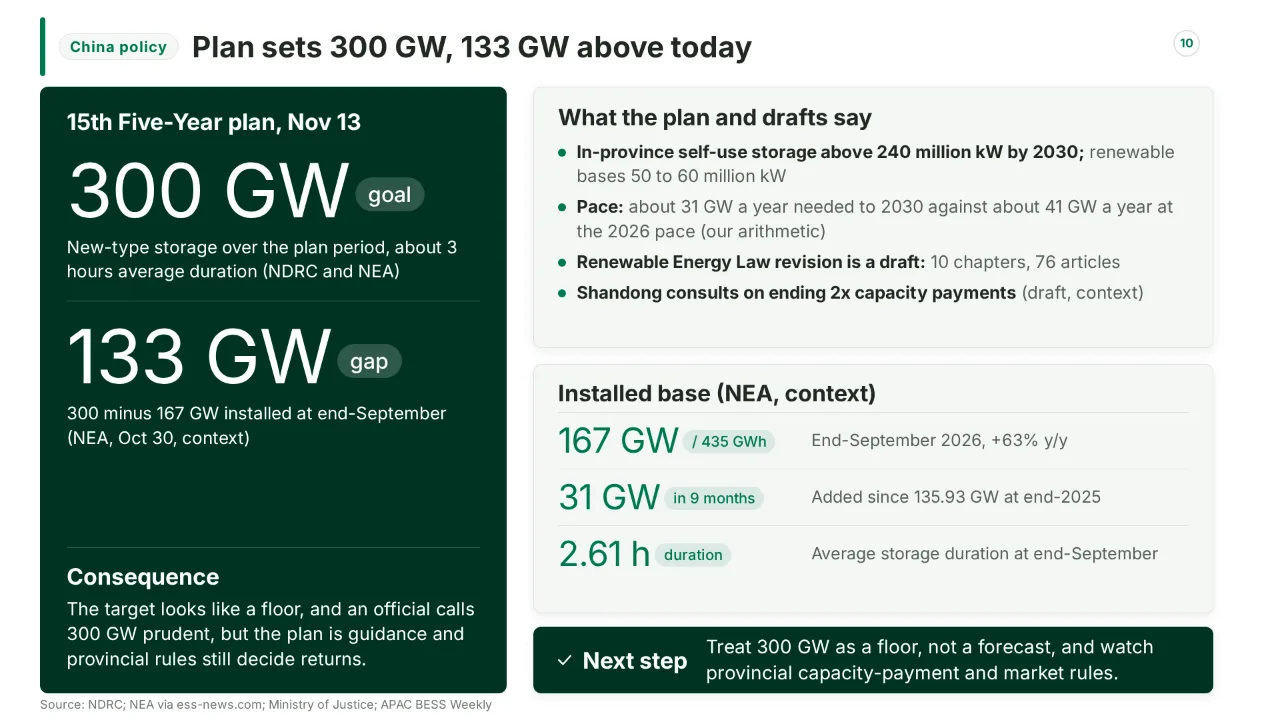
On Nov 13 the NDRC and the NEA published the 15th Five-Year new-type storage plan, setting a goal of 300 million kW (300 GW) of installed capacity with an average duration of about 3 hours, against 167 GW / 435 GWh at the end of September.
7.1 Policy: the 15th Five-Year implementation plan
Status: issued and published (in force as policy guidance), Nov 13. The NDRC's notice, document No. 1565 [2026] of the NDRC Energy Bureau, is signed by the NDRC and NEA with the date Oct 29, 2026 and was published on the NDRC site on Nov 13. According to Chinese coverage of the plan's text, it moves new-type storage from a "scaled development" stage to a "market-based development" stage and sets these goals:
- national new-type storage capacity of 300 million kW over the 15th Five-Year period, with average duration of about 3 hours;
- new in-province self-use storage of about 110 million kW, taking such storage above 240 million kW by 2030;
- storage at renewable bases of 50 to 60 million kW, tied to the number of cross-regional DC transmission channels completed by 2030;
- consolidation of lithium-ion storage, promotion of sodium-ion storage, and engineering of compressed-air and flow-battery routes.
The material does not give the plan's provisions on pricing or market access in detail, so none are described. A power-planning institute official quoted by Fengkou Finance calls 300 GW "a prudent target" and a "floor value" meant to give confidence while avoiding an investment frenzy.
Arithmetic and context. NEA's data of Oct 30 (context, before the window) put operational capacity at 167 GW / 435 GWh at the end of September 2026, up 63% year on year, from 135.93 GW / 351.12 GWh at the end of 2025, an increase of about 31 GW in nine months, with average duration 2.61 hours. The gap to the target is 300 - 167 = 133 GW. Over the roughly 51 months from September 2026 to the end of 2030, that is about 31 GW a year (133 / 4.25), below the 2026 pace of about 41 GW a year (31 GW x 12/9). That supports the "floor" reading, though it is our arithmetic, not an official comparison. The material does not say whether the 300 GW counts from the 2025 base, so the comparison uses installed capacity only.
Renewable Energy Law revision (draft). The Ministry of Justice site reported on Nov 9 that a revised draft law, with 10 chapters and 76 articles, was read at the 25th session of the NPC Standing Committee; it covers market trading and pricing mechanisms, consumption and a green-certificate system. This is a draft; it has no effective date. The same text says more than half of new-energy electricity is now priced through markets and that market-traded volume was 5,853.6 billion kWh from January to September, up 18.9%.
Provincial items. Shandong consulted on capacity compensation on Nov 1 (just before the window), proposing to end 2x capacity payments for standalone storage; the effective date is not disclosed (draft, per APAC BESS Weekly, a secondary source). That weekly also cites a trade-press claim that many standalone plants earn only 3 to 4% returns, which is secondary and unverified. CNESA's information page lists that Xinjiang's grid reached 25.115 GW of new-type storage at the end of September, the nation's largest, with 6.61 GW grid-forming. ess-news.com reported that the Mengxi grid in Inner Mongolia had 20.23 GW / 70.47 GWh operational on Oct 27 (context date; implied duration about 3.5 hours: 70.47 / 20.23).
7.2 Four October statistics, not one
Four Chinese publishers released October tender statistics between Nov 9 and Nov 12. They are shown side by side and must not be blended; the comparison below comes from a Chinese media article (Chu Neng Shijie, Nov 13) and from each publisher's own figures where the material has them.
| Publisher | Awards, October | Of which ESS / EPC | Tenders, October | Note |
|---|---|---|---|---|
| ICC (Xinluo) | 10.97 GW / 28.83 GWh, 62 lots | ESS (incl. collective) 0.83 GW / 2.07 GWh, 9 projects; EPC 10.13 GW / 26.75 GWh, 53 projects | 9.03 GW / 37.46 GWh, 55 lots | Primary |
| TrendForce | 15.6 GW / 53.6 GWh (-7% m/m) | ESS 2.1 GW / 10.3 GWh (incl. collective and framework); EPC 13.5 GW / 43.3 GWh (-9%) | 11.2 GW / 32.2 GWh (-55%) | Via Sohu |
| CNESA | 55.2 GWh (sum of ESS and EPC, computed by the article) | EPC including PC about 50.0 GWh, record; ESS not stated in the material | ESS tenders -30.7%, EPC (incl. PC) -61.5% m/m | Via article and CNESA page |
| Polaris (Beijixing) | above 50 GWh (article) | ESS 6.13 GWh (retail purchases only, excludes collective and framework) | ESS retail tenders down by more than half | Via article |
The article explains four differences:
- EPC is not the same basket. CNESA's EPC includes "PC" (procurement plus construction, no design); TrendForce's EPC of 43.3 GWh is 6.7 GWh below CNESA's 50.0 GWh.
- Mega-awards. TrendForce counts a single 6 GWh award in Inner Mongolia and a 4 GWh award in Ningxia, which lifted those two regions to 9.22 GWh and 6.8 GWh; ICC's largest EPC award was 2 GWh (Xiyuan Group, Hainan prefecture, 500 MW / 2,000 MWh, RMB 1.798 billion, about RMB 0.899/Wh). The gap between ICC's and TrendForce's EPC totals is 43.3 - 26.75 = 16.55 GWh, of which the two mega-awards (10 GWh) account for about 60%.
- Collective purchasing. Polaris counts only retail purchases (6.13 GWh), TrendForce includes collective and framework purchases (10.3 GWh, led by a 2.98 GWh China National Nuclear Corporation LFP framework), and ICC says it includes collective purchases but reports 2.07 GWh.
- Month attribution. CNESA found that 90% of October EPC awards came from earlier tenders, 37.0 GWh from September tenders.
The directions disagree too. EPC award scale rose 7.6% m/m per CNESA and fell 9% per TrendForce; 2-hour EPC prices rose 2.9% per CNESA and fell 2% per TrendForce. What the publishers agree on: tendering fell sharply in October (TrendForce -55%, CNESA EPC -61.5%), 4-hour system prices rose on small samples, and 2-hour system prices were broadly flat to lower at RMB 0.58 to 0.64/Wh (Chapter 3). The article's own advice is to compare each publisher only with its own previous month.
7.3 Projects and named awards in the window
The material for the window is thin on named project awards. From the Nov 3 round-up: CATL won the equipment procurement for the 300 MW / 1,200 MWh Mengning Times Shajing project in Hangjin Banner, Ordos (Chapter 5). CNESA also reports that September filings for new storage projects fell 45.3% y/y in number while energy rose 37.0%, at an average duration of 3.17 hours, a year-to-date high (published before the window, context).
7.4 Implications
The plan raises the long-run ceiling but the window's market data is weak and contradictory: tendering fell by half, award statistics disagree by up to 1.9 times (55.2 / 28.83), and lenders worry about capacity payments. Anyone citing "China tendered X GWh in October" should name the publisher and its scope. The plan's emphasis on market-based operation and long-duration technologies points the same way as the 4-hour price rise and the sodium-ion interest in Chapter 6.
8. India and Asia-Pacific
Having covered China's plan and statistics in Chapter 7, this chapter turns to the overseas markets in Asia-Pacific, where the window's news was dominated by Indian policy and tenders.
India's Cabinet approved Rs 14,500 crore of viability gap funding for 92 GWh of storage, of which 30 GWh is battery storage with a 40% domestic content requirement, while tenders worth far more than that, including a 40.58 GWh NTPC Green solicitation, were already open.
8.1 India: policy and tenders
VGF scheme (approved; implementation guidelines pending). According to MVApulse, the Union Cabinet approved Rs 14,500 crore of VGF for 92 GWh of grid-scale storage for FY 2026-27 to FY 2030-31, split into 60 GWh of pumped storage, 30 GWh of BESS and 2 GWh of alternative technologies, with an estimated investment of Rs 97,600 crore. Capacity is to be allocated through tariff-based competitive bidding to distribution companies, BESS projects must meet a minimum 40% domestic content requirement, and detailed guidelines are still to come. A second MVApulse item converts Rs 14,500 crore to about US$1.53 billion (rate implied by the outlet: about Rs 94.8 per US$). The collected pages do not state the Cabinet's meeting date, so only "reported in the window" can be said. Arithmetic: 60 + 30 + 2 = 92 GWh; the BESS share is 30 / 92 = 33%.
Tenders open or closing.
| Tender | Issuer | Size | Stage (as of Nov 17) | Key date | Source |
|---|---|---|---|---|---|
| Standalone BESS, Rajasthan and Gujarat, 4-hour | SECI | 4 GW / 16 GWh | RfS issued Oct 28 (context); bids open | Online submission closes Nov 19; documents Nov 23; techno-commercial opening Nov 24 (all upcoming) | SMM, Nov 9 |
| BESS programme, LFP containers with grid-forming PCS | NTPC Green Energy | 10 GW / 40.58 GWh in three blocks and phases; 15-year LTSA | Tender issued | Bid deadline Dec 8 (upcoming) | MVApulse |
| ACC cell manufacturing for grid storage (PLI) | Ministry of Heavy Industries | 10 GWh of cell capacity | Bids received: 22 | Closed Nov 10; technical bids opened Nov 11 | MVApulse |
SECI's tender page, according to SMM, names the two states but gives no state-wise allocation and no storage service agreement details; the RfS costs INR 59,000. The NTPC solicitation lists Phase 1 blocks of 4.98, 6.600 and 5.840 GWh, Phase 2 of 4.560 GWh and Phase 3 blocks of 5.800, 6.800 and 6.000 GWh; the sum is 4.98 + 6.6 + 5.84 + 4.56 + 5.8 + 6.8 + 6.0 = 40.58 GWh. The MHI process is a manufacturing incentive, not a storage project tender: bidders include Reliance Industries, Amara Raja, Exide Energy Solutions, Waaree, Avaada and others, selected by a two-stage quality and cost-based method, and MHI says the PLI scheme targets 50 GWh of domestic cell capacity overall.
These are tenders, not installed capacity: the tender pipeline named here (16 + 40.58 GWh) is already more than 1.8 times the 30 GWh of battery storage the VGF scheme supports (56.58 / 30), and the 92 GWh covers uncommissioned capacity over five fiscal years, so the numbers are not additive. The material does not give India's operating BESS capacity for the window.
8.2 Australia and New Zealand
Australian news in the window is about contracted revenue and permitting, not new national policy.
- Victoria's SEC, Glenrowan (announced Nov 2, reported Nov 3): the State Electricity Commission signed a 10-year offtake covering the operating 102 MW Glenrowan Solar Farm and a planned 102 MW, 4-hour BESS at the site (planned, not built).
- Gentari, Maryvale, NSW: the first BESS units arrived at the 172 MW / 409 MWh project, reported Nov 3.
- EnergyAustralia, Hallett, South Australia: the final units for the 50 MW / 250 MWh BESS were delivered; construction continues, up to five hours of storage designed, no commercial operation date given.
- Permitting: the 300 MW / 1,200 MWh Riverland BESS (South Australia) and the 350 MW / 1,400 MWh Little River BESS (Victoria) were referred under the federal EPBC Act, and Pacific Blue referred a 201 MW / 855 MWh Bendigo BESS described as "conceptual capacity". A referral is an early approval step, not a permit.
- Channels: Sungrow's 4 GWh of Australia and New Zealand distribution agreements are in Chapter 5, and CATL's TENER+ and TENER Sodium showings at All-Energy Australia in Chapter 6.
The material for New Zealand is limited to a financing headline in the APAC BESS weekly (Lightyears, NZ$174 million for a 300 MW-plus solar and battery pipeline), which is a secondary report.
8.3 Japan
According to energy-storage.news, Greenvolt Power started commercial operation of its first BESS in Japan, a 2 MW / 8 MWh system in Kyushu, in early November (operating); Sumitomo Corporation began construction of a 16 MW / 70 MWh project in Fukuoka just before the end of October (construction, context) and said its 62 MW / 291 MWh Namie project in Fukushima was under way at the start of October. A BNEF analyst quoted there describes three project types, from large auction-backed projects of about 30 MW and above to dozens of unsubsidised 2 MW / 8 MWh merchant systems, with smaller projects facing shorter grid-interconnection waits.
8.4 Implications
For India, the VGF approval and the 40% domestic-content rule shape procurement before any tender documents under the scheme exist, while open tenders (SECI, NTPC Green) proceed under existing rules. Bidders should read tender stage and deadline rather than headline GWh. For Australia, the shown items are offtake and permitting steps that precede, by months or years, any battery-delivery numbers. The APAC picture is also not a price story: none of the pages gives a tender price for the window.
9. Europe, Middle East and global outlook
After India and Asia-Pacific (Chapter 8), this chapter covers Europe, the Middle East and the global forecast, where the window mixed finished projects, construction starts and capacity-market results.
BNEF forecasts 188 GW / 535 GWh of new storage installations worldwide in 2026 and 209 GW / 638 GWh in 2027 (+11% in power), and in Europe the window shows the gap between contracted revenues and capacity markets: batteries took nearly 40% of Belgium's latest capacity auctions while Germany's first went entirely to gas.
9.1 Europe: operating, building and financing
| Project | Country | Size | Developer / supplier | Stage | Date | Source |
|---|---|---|---|---|---|---|
| Hams Hall | UK | 350 MW / 1,240 MWh (phase 2 to 400 MW / 1,424 MWh) | BW ESS; Sungrow supplied; EDF optimising | Operating, 20 days from energisation | Nov 2 (one day before the window) | energy-storage.news |
| Ragusa, Sicily | Italy | 62.5 MW / 262.5 MWh | RWE | Construction started; commissioning end-2027 | Nov 10 | energy-storage.news |
| Two projects at Rinaldone and Camposcala solar sites, Lazio | Italy | 2 x 27 MW / 108 MWh = 216 MWh | BNZ; Sungrow order | Construction under way; commissioning before year end | Nov 10 | energy-storage.news |
| Smareg 13 (Vohringen II), Bavaria | Germany | 442 MWh, 4-hour, grid-forming | ju:niz Energy (EQT); Envision Gen 8 | Supply agreed; MW, cost, financing and commissioning date not disclosed | Nov 11 | energy-storage.news |
| Three standalone projects, Basque Country | Spain | 55 MW / 220 MWh | Return; EUR 50 million financing | Financing closed; online 2027 | week of Nov 3 (date not stated) | energy-storage.news |
| Sibenik | Croatia | 60 MW / 120 MWh | NGEN with NextGrid; Tesla Megapack XL | Operating; merchant, no contracted revenue; EUR 60 million | Nov 4 | energy-storage.news |
| Calvados and Eastern Pyrenees | France | 2 x 100 MW / 400 MWh | BW ESS buying from Recurrent Energy | Acquired; "advanced development" | context: sale first reported in the previous issue (Oct 29) | energy-storage.news |
Arithmetic checks: RWE 262.5 MWh + BNZ 216 MWh = 478.5 MWh, the "nearly 500 MWh" the outlet cites. RWE's 42 units imply 6.25 MWh each (262.5 / 42), which the outlet says matches Longi's product, though RWE did not name a supplier. Hams Hall is the largest BESS in Europe the outlet knows of to reach commercial operation.
Capacity markets diverge. According to energy-storage.news, Belgium's Elia procured 1.6 GW for 2028-29 (0.5 GW of it BESS, weighted average price EUR 21,643/MW/year) and 0.8 GW for 2030-31 (0.5 GW BESS, EUR 18,143/MW/year), announced on Oct 29 (context), while no new capacity was procured for 2027-28; the outlet puts the battery share of the 2.4 GW at "nearly 40%" (the rounded GW figures give 1.0 / 2.4, or 42%). Germany's first capacity auction, run in September with results published by the Bundesnetzagentur in the window, procured 5.16 GW against a 4.5 GW target across 11 projects, all apparently legacy generation (mainly gas), at a volume-weighted EUR 155,296/MW/year, nearly eight times Belgium's price. The comparison mixes two different products and delivery periods, so it describes market design, not a ranking of technologies.
Italy's MACSE (upcoming). Terna confirmed that the second MACSE auction will be held on Nov 24, 2026 at 10:00, for 16 GWh with delivery in 2029, mainly for lithium-ion and other non-reference technologies (upcoming; not yet allocated). The outlet notes the first auction was in September 2025 and that RWE's Ragusa project was not among the MACSE winners.
9.2 Middle East
Oman's state firm Nama Holding signed a framework agreement with State Grid Corporation of China to develop 1 GW of BESS in Duqm and Ibri, signed during the Omani Sultan's state visit to China on Nov 1 to 2 (context date) and reported by MEES on Nov 6. Stage: framework agreement; MEES notes that Oman plans 1.9 GW / 7.4 GWh of BESS across eight facilities by 2030 (a plan from July). A secondary report puts the framework at US$1 billion, which this chapter does not use. For Saudi Arabia and the UAE, the only window material is the 36kr roundup of Chapter 5 (Gotion 6 GWh, BYD and Sungrow at Masdar), reported, not confirmed by primary announcements.
9.3 Global outlook
According to ess-news.com's report on BNEF's latest forecast, new installations worldwide rise to 188 GW / 535 GWh in 2026, up 45% in capacity from 2025, with China, the US and Australia 62% of the total; 2027 brings 209 GW / 638 GWh, up 11%, with Spain, the UAE, Chile and Japan accelerating; and cumulative capacity could reach 3 TW / 11 TWh by 2036, roughly ten times 2025 levels (forecast). BNEF counts China's target of 300 GW of storage by 2030, which matches Chapter 7, and says India's tender awards will push 2026 installations above 6 GW, up from a few hundred megawatts the previous year. For Latin America, ess-news.com headlines in the window point to a Brazilian battery auction with 1 GW supply targets from YOU.ON (Nov 5) and Canadian Solar (Nov 13) and a 10 GW installed-battery forecast from Voltxs Energia (Nov 12); the material holds the headlines only, so no auction date or rules are stated.
9.4 What it means
European storage is now an operating market (Hams Hall, Sibenik) with revenue structures that differ by country: floors and offtakes in the UK, merchant in Croatia, capacity payments in Belgium, and the MACSE long-term contracts in Italy that will be tested on Nov 24. Middle East volume is real but mostly framework or reported, and BNEF's forecast shows the 2027 increase in power (+11%) is smaller than the 2026 jump (+45%), a signal of a maturing growth rate rather than a reversal.
10. Outlook and what to watch
Chapter 9 showed how much of the window's overseas volume is still framework, tender or forecast. This chapter turns the window into implications by reader and a dated watch-list. It adds no new facts: every figure is cited where Chapters 2 to 9 developed it, and none of it is investment, procurement or legal advice.
10.1 What changed, by reader
| Reader | What changed | Implication | Evidence |
|---|---|---|---|
| Cell buyers | Lithium spot fell about 8% over two InfoLink updates, 280 / 314 Ah cells about 2% | Cell quotes follow lithium with a lag and a damped slope; futures swing harder than spot | InfoLink |
| System buyers and EPC firms | System averages flat; October 4-hour award prices up on small samples | Compare quotes by scope and duration; one award is not a market price | InfoLink; TrendForce via Sohu |
| Cell makers | Shipments up, concentration at a record low (CR10 81.9%), Cornex in the top five | Mid-tier makers are gaining share while frameworks lock volume at the top | InfoLink |
| Korean makers and US-facing suppliers | LGES ESS shipments up more than 60% q/q; North American ESS capacity above 70 GWh planned by end-2027; non-PFE cathode sourcing | Local production is the selling point; US credit eligibility rules still apply | LG Energy Solution; energy-storage.news |
| China developers | New plan with 300 GW goal; four conflicting October statistics; Shandong draft on capacity payments | Name the publisher and its scope; revenue depends on provincial rules still to come | NDRC; Chu Neng Shijie |
| Technology scouts | Sodium-ion deliveries from summer 2027; Osprey at lab stage | Sodium is a design-stage option; solid-state is not orderable for storage | pv magazine; QuantumScape |
| Overseas developers | India VGF and open tenders; MACSE round two upcoming | Stage and deadline matter more than headline GWh | MVApulse; review-energy.com |
Judgement on prices. The lithium fall has begun to reach cells but not systems. InfoLink's own view is that substantial further declines for mainstream large cells are relatively unlikely because utility-scale demand is resilient, while SMM gives a near-term lithium range of RMB 82,000 to 105,000/t (an estimate).
Judgement on orders. The window's largest numbers are conditional. The EVE and Fluence framework has 16 GWh committed against 190 GWh reserved, Sungrow's 4 GWh in Australia are distribution agreements, and Oman's 1 GW is a framework.
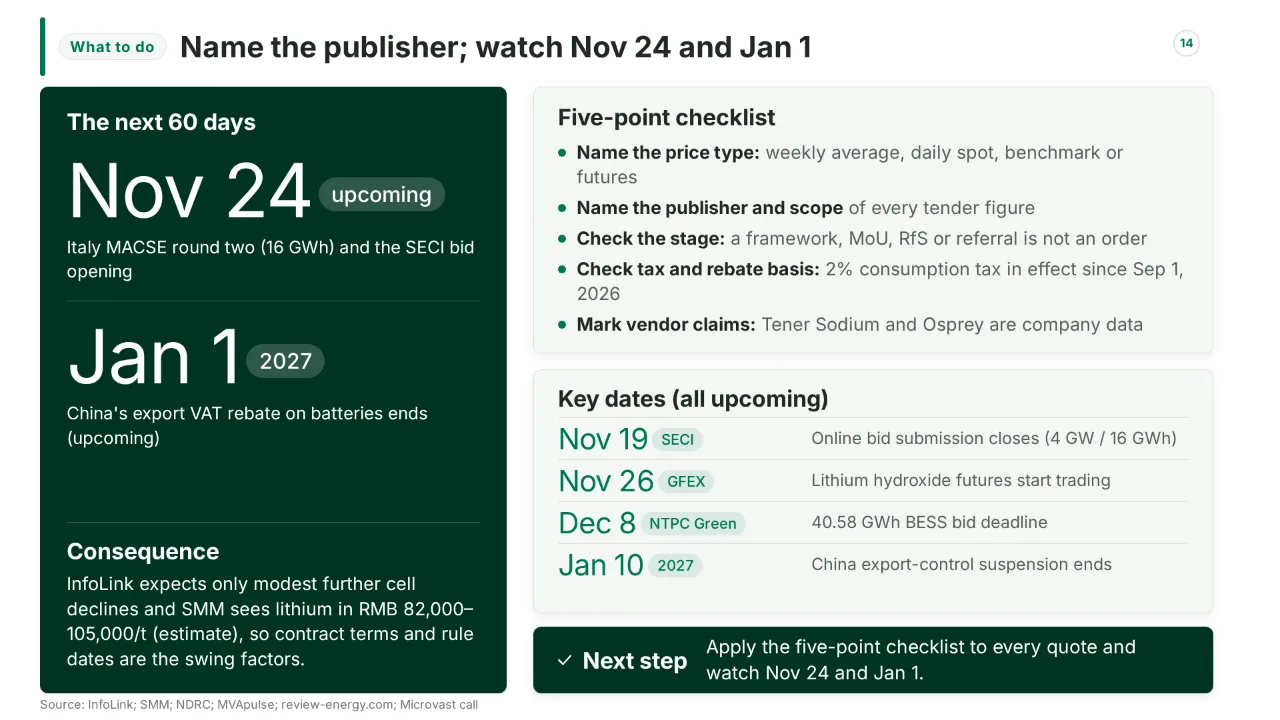
Core claim: The next 60 days will be settled by contract terms and dates, not by chemistry: how far lithium's fall reaches cell and system quotes, whether tender statistics converge, and what happens at the export-rebate cliff on Jan 1, 2027.
10.2 Buyer checklist
- Name the price type. InfoLink weekly averages, SMM daily spot, SunSirs benchmarks and GFEX futures answer different questions (Chapter 2).
- Name the publisher and scope for tender figures. ICC, TrendForce, CNESA and Polaris define EPC, collective purchasing and month attribution differently (Chapter 7).
- Check the stage. A framework, MoU, RfS or referral is not an order or operating capacity.
- Check tax and rebate basis. The 2% consumption tax applies from Sep 1, 2026, and the export VAT rebate of 6% ends on Jan 1, 2027 (upcoming).
- Mark vendor claims. Tener Sodium specifications and Osprey results are company data.
10.3 Key dates
Status is judged against the run date, 17 November 2026.
| Date | Event | State on Nov 17, 2026 | Source |
|---|---|---|---|
| 2026-04-01 | China export VAT rebate cut from 9% to 6% | In effect | Microvast call |
| 2026-09-01 | 2% consumption tax on lithium batteries | In effect | Microvast call; pv magazine |
| 2026-11-10 | MHI 10 GWh ACC tender closed (22 bids) | Closed | MVApulse |
| 2026-11-11 | China export-control suspension (lithium batteries, graphite anode) begins | In effect until Jan 10, 2027 | China Sourcing Post |
| 2026-11-13 | NDRC/NEA 15th Five-Year new-type storage plan published | Issued | NDRC |
| 2026-11-19 | SECI online bid submission closes (4 GW / 16 GWh) | Upcoming | SMM |
| 2026-11-23 and 24 | SECI physical documents due; techno-commercial bids open | Upcoming | SMM |
| 2026-11-24 | Italy MACSE round two (16 GWh, delivery 2029) | Upcoming | review-energy.com |
| 2026-11-26 | GFEX lithium hydroxide futures start trading | Upcoming | SMM |
| 2026-12-08 | NTPC Green 40.58 GWh BESS bid deadline | Upcoming | MVApulse |
| 2027-01-01 | China export VAT rebate on batteries ends | Upcoming | Microvast call |
| 2027-01-10 | China's export-control suspension ends | Upcoming | China Sourcing Post |
| Every Thursday | InfoLink weekly price update | Recurring | InfoLink |
11. References
This document draws on the following 82 sources, listed in the order they are first cited.
- Lithium salt prices decline further as quotes soften across energy storage supply-chain-Industry-InfoLink Consulting — infolink-group.com
- Lithium prices fluctuate at low levels; falling material costs intensify cell price competition-Industry-InfoLink Consulting — infolink-group.com
- SMM Analysis Market Sentiment Marginally Recovers, Lithium Carbonate Destocking Accelerates - Shanghai Metals Market (SMM) — news.metal.com
- SMM Lithium Carbonate Daily Review On November 3, spot lithium carbonate edged up and held steady, while futures retreated after a rapid rise, closing lower on reduced positions. - Shanghai Metals Market (SMM) — news.metal.com
- SMM Lithium Carbonate Daily Review On November 9, spot lithium carbonate stopped rising and pulled back, while futures opened lower, drifted lower with increased open interest, and closed lower. - Shanghai Metals Market (SMM) — news.metal.com
- Lithium salt prices weaken amid fluctuations; cell prices dip; ESS prices steady for now-Industry-InfoLink Consulting — market-report.infolink-group.com
- SunSirs: Following a Brief Rebound, the Decline Continued, and Lithium Carbonate Remained Weak — sunsirs.com
- 2026年10月储能招投标分析-热点|2026年10月储能招投标分析-报告|2026年10月储能招投标分析-内容|CIBF2016|鑫椤锂电网 — icbattery.com
- 10月储能中标53.6GWh,4小时系统均价上涨_招标_项目_中国 — sohu.com
- 同一个10月,四家统计的储能中标规模为什么差了一倍?|招标|epc|gwh|新型储能_网易订阅 — 163.com
- 【关于印发《“十五五”新型储能实施方案》的通知】-国家发展和改革委员会 — ndrc.gov.cn
- 新型储能,实施方案来了!(附方案全文)_大风号_凤凰网 — feng.ifeng.com
- China’s energy storage fleet grows to 167 GW as utilization improves - Energy Storage — ess-news.com
- 1Q26–3Q26 global energy storage cell shipment rankings: Shifts amid stability-Industry-InfoLink Consulting — infolink-group.com
- Global ESS Battery Shipments Surge 73%, With Korean Makers Gaining North American Share - Businesskorea — businesskorea.co.kr
- LG Energy Solution reports 60% growth in ESS shipments, 160GWh order backlog — energy-storage.news
- EVE 206 GWh Mega Order: Gotion & BYD Profit in Middle East, Has Energy Storage Overseas Expansion Formed Solidified Supplier Lists? — eu.36kr.com
- Clarifying the CATL Tener Sodium, with new specifications and availability - pv magazine Global — pv-magazine.com
- Sodium-ion batteries approach cost parity with LFP, with 70 GWh covered by supply agreements - pv magazine Global — pv-magazine.com
- QuantumScape Expands Commercial Roadmap with Osprey, the Open All-Solid-State Platform for Battery Development - QuantumScape — quantumscape.com
- Cabinet Approves Rs. 14,500 Crore VGF for 92 GWh Storage — mvapulse.com
- NTPC Green Issues Tender for 40 GWh BESS Program — mvapulse.com
- BW ESS puts Europe’s largest BESS into commercial operation in the UK — energy-storage.news
- Italy’s MACSE mechanism takes next step as Terna confirms 24 November 2026 auction date — review-energy.com
- Oman-China Sign 1GW Battery Deal | MEES — mees.com
- BNEF forecasts 209 GW of new batteries in 2027 - Energy Storage — ess-news.com
- LG Energy Solution Releases 2026 Third-Quarter Financial Results - BATTERY INSIDE — inside.lgensol.com
- Deye, EVE Energy and Ganfeng report growth in first-nine-month 2026 results | CN Solar Sources — cnsolarsources.com
- SunSirs: Lithium Carbonate Was Nearing the Cost Floor, with Downside Room Gradually Narrowing — sunsirs.com
- SMM Lithium Carbonate Daily Review On November 6, spot lithium carbonate continued to rise, while futures opened lower, moved higher, and closed up on reduced open interest. - Shanghai Metals Market (SMM) — news.metal.com
- Lithium Prices Fall 23% as Supply Risks Keep Market Volatile — carboncredits.com
- China approves lithium-hydroxide futures and options on Guangzhou exchange — chinasourcingpost.com
- GFEX Lithium Hydroxide Futures to List on November 26 - Shanghai Metals Market (SMM) — news.metal.com
- GFEX Issues Announcement on Adjusting Matters Related to Polysilicon Futures PS2711 Contract and Lithium Carbonate Futures LC2711 Contract - Shanghai Metals Market (SMM) — news.metal.com
- 同一个10月,四家统计的储能中标规模为什么差了一倍?_新浪财经_新浪网 — finance.sina.com.cn
- 0.25C Battery Storage vs 0.5C: Why Some Favor 4 Hours | SunLith — sunlithenergy.com
- Microvast (MVST) Q3 2026 Earnings Call Transcript | The Motley Fool — fool.com
- Onsolar Coron — facebook.com
- ESS-Energy Storage System | Johnson Lee.UPS Product Specialist — linkedin.com
- China formalises suspension of rare earth and lithium battery export controls until 10 January 2027 — chinasourcingpost.com
- Global ESS Battery Shipments Rise 73% to 779.9 GWh - Battery-Tech Network — battery-tech.net
- Microvast Q3 Earnings: Revenue Drops 62.8% to $45.8M | MVST Stock News — stocktitan.net
- Energy-Storage.News — energy-storage.news
- EVE Energy, CleanPeak sign 1-GWh energy storage framework for Australia | Gasgoo — autonews.gasgoo.com
- Sungrow and Two Other Companies Announce Energy Storage Partnerships and Orders Totaling over 4 GWh - EnergyTrend — energytrend.com
- Sungrow Joins Forces with Three Strategic Partners to Accelerate Australia's Clean Energy Transition at All-Energy Australia 2026 — tmcnet.com
- EVE Energy, Ampace, and Four Other Companies Sign Major Energy Storage Order Partnerships - EnergyTrend — energytrend.com
- CATL Establishes an Office in Argentina to Supply a 1,025 MWh Energy Storage System- EnergyTrend — m.energytrend.com
- Seven Companies, Including CATL and EVE Energy, Finalize Energy Storage Orders - EnergyTrend — energytrend.com
- Battery Energy Storage Systems (BESS) Investment & Regulations — iebrain.com
- Fortress Power Announces FEOC-Compliant Storage Solutions — fortresspower.com
- QuantumScape unveils Osprey all-solid-state cell: 1,000 cycles at 1 atm | Electrek — electrek.co
- ‘It’s a no-brainer’: Alfen CEO on sodium-ion BESS plans with CATL — energy-storage.news
- How Peak Energy Chose Sodium-Ion for Grid Storage — batterytechonline.com
- Sodium-ion pouch cells target cold-climate industrial niche - pv magazine Global — pv-magazine.com
- Sodium-ion batteries close gap with lithium-ion as utility-scale storage opportunities grow - pv magazine Global — pv-magazine.com
- Europe Archives — energy-storage.news
- CATL globally launches ultra-high capacity energy storage system at All Energy 2026 and signs three Australian partnership MoUs — au.finance.yahoo.com
- #energystorage #batterytechnology #renewableenergy #innovation #technology | NAMICS Corporation — linkedin.com
- 国家发展改革委 国家能源局联合印发《“十五五”新型储能实施方案》 - 风口财经 — fengkouapp.com
- China mulls amendment to Law on Renewable Energy — en.moj.gov.cn
- APAC BESS Weekly Research W45 · Contracted revenue carries the debt, while Shandong's capacity-payment draft tests standalone storage cash flows — apacbess.com
- 行业资讯_-中关村储能产业技术联盟(CNESA) — cnesa.org
- China’s Mengxi grid tops 20 GW of storage as renewables approach 60% of capacity - Energy Storage — ess-news.com
- India Approves ₹145 Billion VGF for 92 GWh Energy Storage — mvapulse.com
- SECI Seeks Bids for 4 GW/16 GWh Standalone BESS in Rajasthan and Gujarat - Shanghai Metals Market (SMM) — news.metal.com
- MHI Receives 22 Bids for 10 GWh ACC Battery Storage Tender — mvapulse.com
- Australia: Victoria’s SEC secures 4-hour Glenrowan BESS offtake, first BESS units arrive at Gentari’s Maryvale — energy-storage.news
- EnergyAustralia takes delivery of final units for 250MWh Hallett battery storage system — energy-storage.news
- 1.2GWh BESS in South Australia and ACEnergy’s Little River project referred to Australia’s EPBC Act — energy-storage.news
- Pacific Blue refers 855MWh BESS to Australia's EPBC Act - Energy-Storage.News — energy-storage.news
- Sumitomo Corporation, Greenvolt deploy BESS at both ends of scale in Japan’s layered market — energy-storage.news
- Vastly different fortunes for BESS in Belgium and Germany’s capacity market auctions — energy-storage.news
- Italy: RWE and BNZ launch construction on large-scale battery projects — energy-storage.news
- ju:niz Energy enlists Envision for 442MWh grid-forming BESS in Germany — energy-storage.news
- Return finances 220MWh in Spain, BW ESS buys 800MWh in France — energy-storage.news
- NGEN puts Croatia’s first standalone, transmission-connected BESS online, with 60MW/120MWh capacity — energy-storage.news
- Batteries to dominate Belgium’s capacity remuneration mechanism - Energy Storage — ess-news.com
- Oman and China sign $1 bn framework for 1 GW Duqm‑Ibri battery storage project — kenya-today.com
- YOU.ON targets 1 GW of locally compliant BESS for Brazil auction - Energy Storage — ess-news.com
- Voltxs Energia forecasts 10 GW of installed batteries in Brazil - Energy Storage — ess-news.com
- Canadian Solar targets 1 GW of BESS supply for Brazil battery auction - Energy Storage — ess-news.com