1. Key takeaways from the two weeks
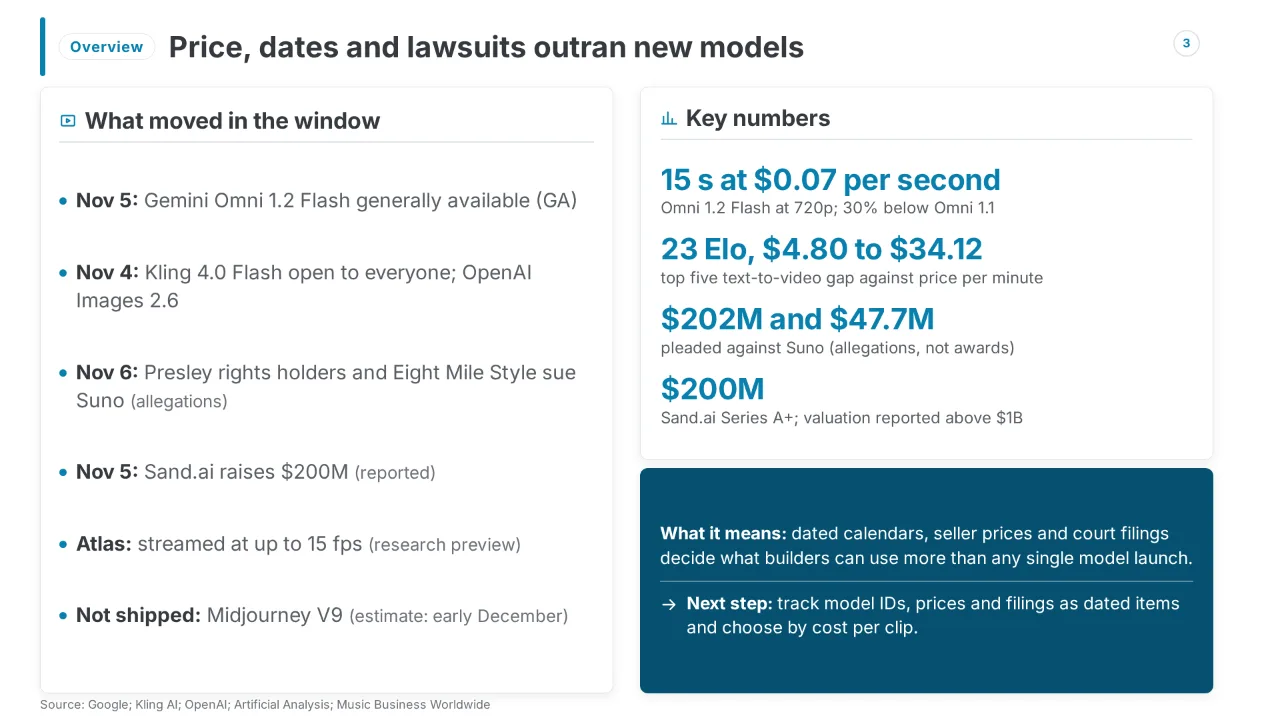
Between Nov 3 and Nov 16, 2026 the multimodal market shipped one flagship video release, one major image release and a lot of distribution news, while the dated risks sit in Google's model calendar and in two new music lawsuits. Five conclusions follow from Chapters 2 to 7.

1.1 Five conclusions
1. At the production tier the contest is length and price: Google made 15-second clips GA at $0.07 per second, and the research frontier moved to real-time worlds. Gemini Omni 1.2 Flash became generally available on Nov 5 with native clips of up to 15 seconds (from 10) and a 30% price cut to $0.07 per second of 720p video. Kling AI said on Nov 4 that Kling 4.0 Flash was open to everyone on its website and API, and World Labs streamed its Atlas world model at up to 15 frames per second in a browser demo (research preview). On images, OpenAI's Images 2.6 (Nov 4) is 50% faster and adds GIFs; Midjourney V9 did not ship and is a reported estimate for around early December. [Chapter 2] [Chapter 3]
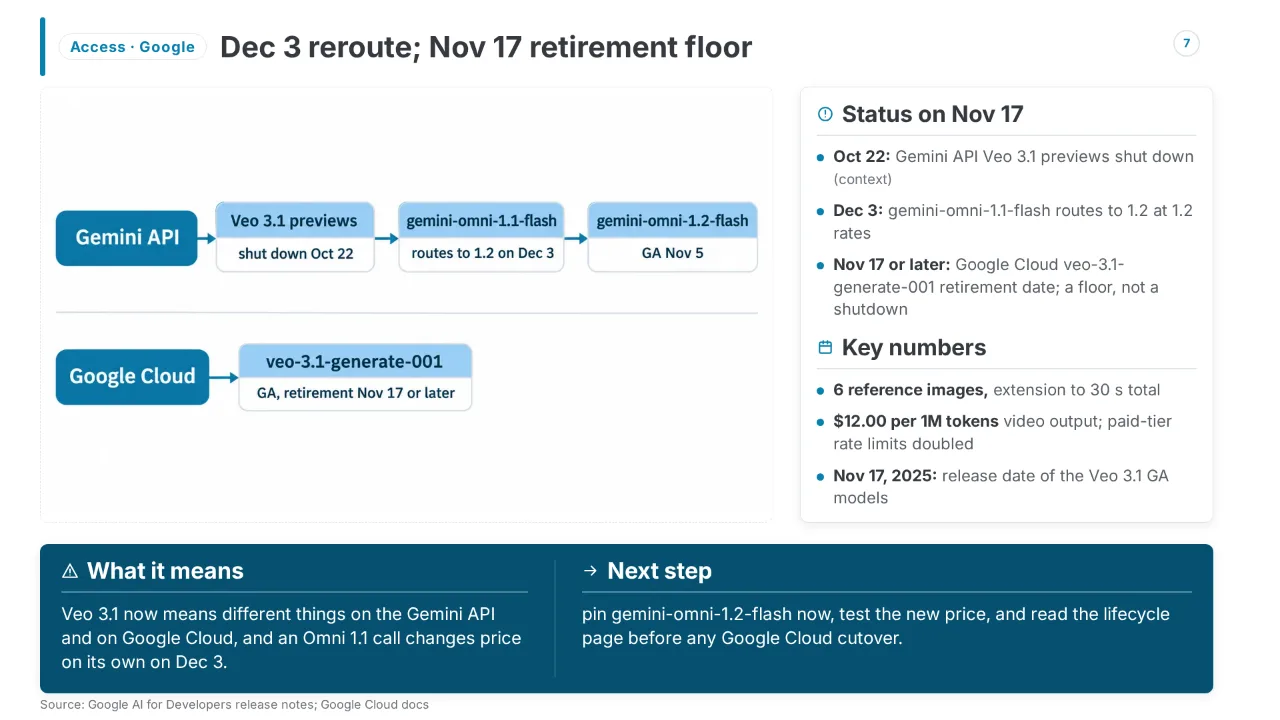
2. For builders, the calendar matters more than the model list. Gemini API requests to gemini-omni-1.1-flash will be rerouted to Omni 1.2 Flash on Dec 3, 2026; the Vertex veo-3.1-generate-001 models list a retirement date of "November 17, 2026 or later", which is a floor, not an announced shutdown; and the one in-window open-weight release, MiniMax's H3-Image, carries a licence that excludes the US, EU, UK and South Korea. [Chapter 4]
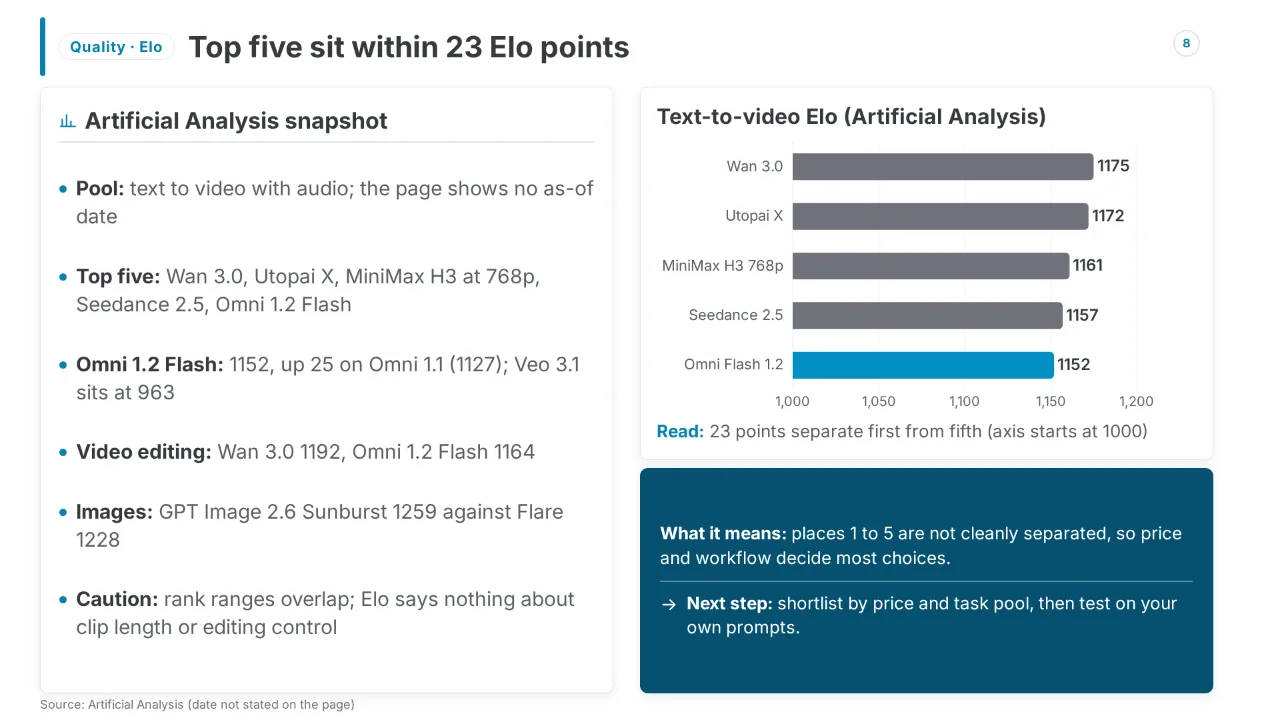
3. Quality is bunched, so price separates the leaders. On Artificial Analysis' text-to-video board (no as-of date on the page) the top five sit within 23 Elo points (1175 to 1152) while normalized prices run from $4.80 to $34.12 per minute; GPT Image 2.6 Sunburst leads the next image model by 31 points (1259 against 1228). Resellers disagree even on one model: Kling 4.0 Flash is $0.094 per second at Runway and "from $0.1174" at Venice. [Chapter 5]
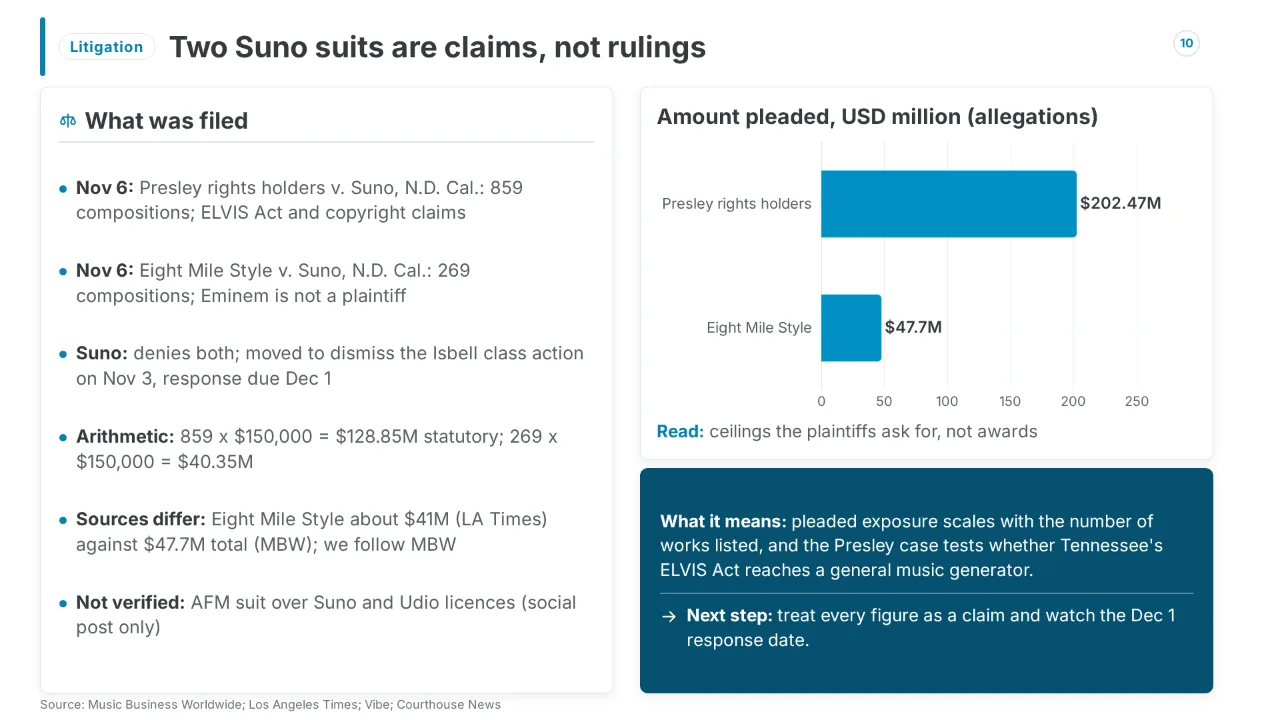
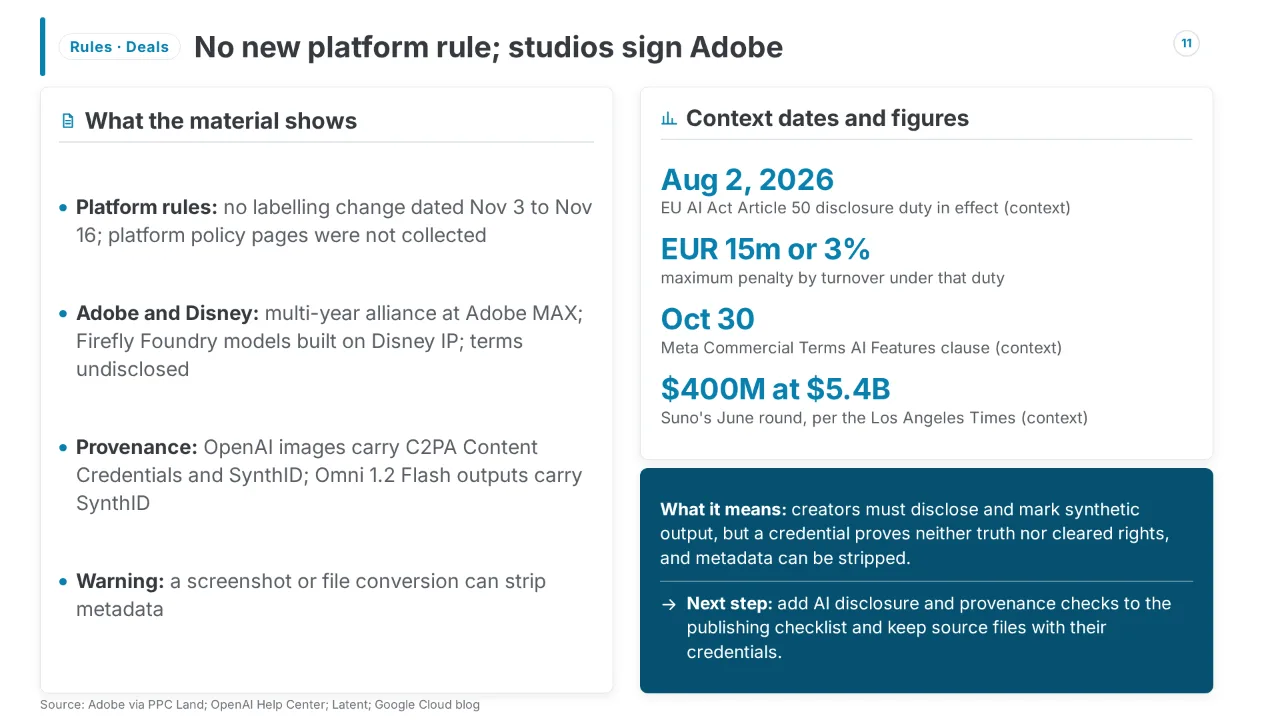
4. Rights holders keep litigating; the window's cases are allegations against one music generator, and no platform rule changed. On Nov 6 the Elvis Presley rights holders and Eight Mile Style (Eminem's publisher) each sued Suno in the Northern District of California, pleading just over $202 million and about $47.7 million respectively; Suno denies both. Suno's Nov 3 motion to dismiss a separate class action has a response due Dec 1. No platform-labelling change dated Nov 3 to Nov 16 appears in the material. [Chapter 6]
5. Money and distribution are concentrating on the layer that owns the creator's workflow. Sand.ai, a Beijing video-model startup, raised $200 million at a reported valuation above $1 billion; at Adobe MAX (Nov 10) Premiere's Generative Media tool offers models from Google, Kling, Runway and Luma; and ElevenMusic output can be published directly to SoundCloud. [Chapter 7]
The window moved less on raw capability than on access, price and rules: a 15-second clip at $0.07 per second, a dated Google migration calendar, and two lawsuits that test voice and likeness law. Distribution surfaces, not single models, are where creators now choose.
1.2 What changed at a glance
| Model / product | Change | Date | Status | Source |
|---|---|---|---|---|
| Premiere mobile | Licensed UMG and WMG music added | Nov 3 | Announced | Adobe |
| Images 2.6 (OpenAI) | 50% faster, GIFs, API Flare and Sunburst | Nov 4 | GA | OpenAI |
| Kling 4.0 Flash | Opened to all on website and API | Nov 4 (Kling post) or Nov 5 (Venice docs) | API available | Kling AI; Venice |
| Gemini Omni 1.2 Flash | 15-second clips, $0.07 per second at 720p | Nov 5 | GA | |
| Atlas "Frameboy" (World Labs) | Real-time demo at up to 15 fps | Nov 5 | Research preview | World Labs |
| ElevenMusic and SoundCloud | Direct publishing | Nov 5 | Announced | TechCrunch via Yahoo |
| Sand.ai | $200M Series A+ | Nov 5 (toflow.ai) | Reported | Grishin Robotics post; toflow.ai |
| Presley rights holders and Eight Mile Style v. Suno | Two copyright complaints | Nov 6 | Allegations; pending | MBW |
| Adobe MAX | Generative Media tool; Google partnership | Nov 10 | Announced | Adobe |
| MiniMax H3-Image | Open weights, 4K claim | Nov 10 (CellCog) or Nov 11 (AI-0) | Open weights; vendor claims | CellCog; AI-0 |
| ElevenLabs and NVIDIA | Voice-agent expansion, 15MW added compute | Nov 11 | Announced | ElevenLabs |
| Grok Imagine team | About 60 people cut, product still live | Reported Nov 13 | Reported | ScreenWeaver citing The Information |
Vertex veo-3.1-generate-001 |
Retirement date listed | Nov 17, 2026 or later | Upcoming | Google Cloud docs |
2. New video and world models
Chapter 1 summarises the window; on the video side the two weeks from Nov 3 to Nov 16 hold one flagship release, one price-led sibling and one real-time research demo, and everything else below is context.
2.1 Release timeline
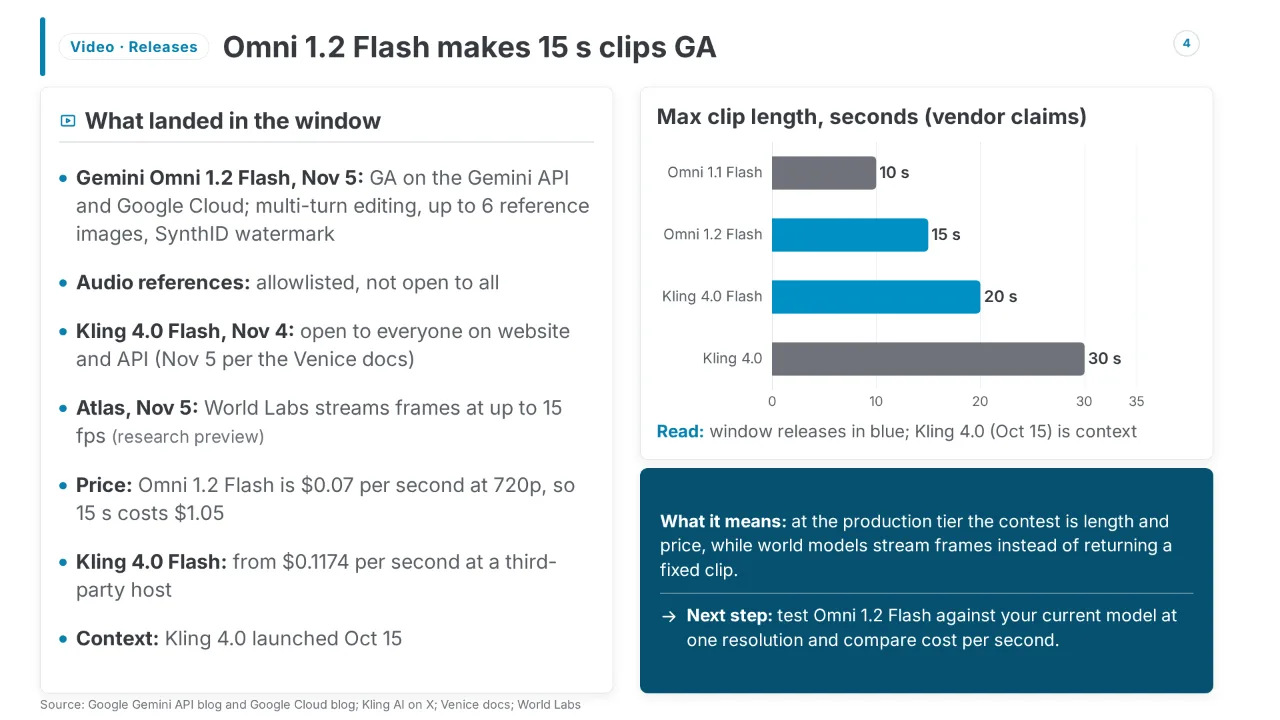
One production release, one cheaper sibling: Google made Gemini Omni 1.2 Flash generally available on Nov 5 with native clips of up to 15 seconds and a 30% price cut to $0.07 per second of 720p video, and Kling AI said on Nov 4 that Kling 4.0 Flash was "available to everyone" on its website and API.
Specs below are vendor claims unless stated; arena ratings and per-second prices are in Chapter 5.
| Model | Maker | Date | Access | Max clip | Resolution | Native audio | Status |
|---|---|---|---|---|---|---|---|
| Gemini Omni 1.2 Flash | Google DeepMind / Google Cloud | Nov 5 (window) | Gemini API, Google Cloud, Gemini for business, Google Vids | 15 s (3 to 15 s in 1 s steps) | Drafts at 360p or 720p, upscale to 1080p or 4K | Dialogue, lip-sync, multi-speaker; audio references allowlisted | GA |
| Kling 4.0 Flash | Kuaishou (Kling AI) | Nov 4 per Kling's X post; Nov 5 per the Venice API docs (window) | Kling website, API, MCP, CLI, plug-ins | 20 s (3 to 20 s) | 720p | Always generated | API available |
| Kling 4.0 | Kuaishou (Kling AI) | Oct 15 (context) | App; API via Runway Dev and others | 30 s | 720p, 1080p | Stereo | Context |
| MiniMax H3 (Hailuo 3) | MiniMax | Before the window (context) | Hosted by third parties, for example OCMaker | 5 to 15 s on that host | 480p, 720p, 2K on that host | Yes | Context; host figures |
| Atlas "Frameboy" demo | World Labs | Nov 5 (window) | Browser demo, research preview | Streamed, not clips | Up to 15 frames per second | Not applicable | Research preview |
According to the AI-0 roundup (Nov 14), no dated new release from Veo, Sora, Seedance, Wan, Runway, Grok Imagine, Midjourney or Luma fell in the Oct 15 to Nov 14 stretch beyond the items above; this is a secondary source and a negative finding, so we treat it as "none found" rather than "none happened". Pika H3 Flex (Oct 29, app Nov 2) is context.
2.2 What is genuinely new
Gemini Omni 1.2 Flash is the substantive release. Google's own post lists five changes from Omni 1.1: clips up to 15 seconds (from 10), a price 30% lower, stronger adherence to reference images and short motion clips of up to three seconds, multi-turn conversational editing of a finished clip, and more natural dialogue with clearer lip-sync. The Google Cloud post adds that it is "production-ready" with Provisioned Throughput, that outputs carry an imperceptible SynthID watermark, and that audio references are gated behind allowlisting. Named launch customers (Artlist, FLORA, invideo, Krea, Picsart, Photoroom and Runway) are vendor-quoted testimonials, not independent tests. The cut is the story for builders: $0.07 per second at 720p means a 15-second clip costs $1.05 (15 x $0.07), before any upscale to 1080p or 4K.
Kling 4.0 Flash is a lower-cost variant of Kling 4.0, not a new generation. The Venice API docs, a third-party host, list it as released Nov 5, 720p only, 3 to 20 seconds, audio always generated, from $0.1174 per second (a 10-second clip is $1.17). Kling's own post is dated Nov 4 and also lists plug-ins for Photoshop, Premiere Pro and After Effects. The one-day gap between the two sources is probably a time-zone effect, but the material does not say; we follow the vendor's Nov 4 post for the announcement and the host's Nov 5 for the API listing. The full Kling 4.0 (up to 30 seconds, 720p or 1080p, stereo audio) predates the window. Runway Dev now sells the Kling 4.0 API self-serve, an example of a competitor reselling a model (see Chapter 7).
2.3 World models versus clip generators
World Labs' Nov 5 research preview shows the other direction of travel. Atlas, which the company introduced about two months earlier, is an autoregressive world model that generates frames one at a time with camera control; "Frameboy" streams frames from cloud GPUs to a browser at up to 15 frames per second while the user steers the camera, and a streaming overlay was added to the Viewfinder scene-building app. The Atlas page lists a developer API, Blender integration and splat-to-mesh conversion, and the docs list an MCP server that runs Atlas tasks from Claude and other MCP clients using the project's developer API credits. This is a research preview and a developer tool for scene exploration, not a clip generator; there is no clip length to compare, and the two categories should not share a ranking.
One negative signal sits at the other end of the market. The Information reported on Nov 13 that about 60 people, more than half of the Grok Imagine team, were let go over one week; the product remains online and no roadmap was announced. We read the report through a secondary summary (it is paywalled), so the number is "reported", and SpaceX had not commented at that time. Read it as a retention risk for creators who build on one model, which is the reason aggregators that route across several models are gaining ground (Chapter 7).
Takeaway: the window rewards price and length at the production tier (15 seconds at $0.07 per second), while the research frontier moves from clips to interactive worlds; neither has an independent quality ranking dated inside the window beyond Chapter 5's arena snapshot.
3. New image, voice, music and 3D models
Chapter 2 covered video and world models; outside video the window is led by one major image release (OpenAI), one open-weight image release (MiniMax), a tool-and-partner push at Adobe MAX, and a run of audio-side distribution news, with no dated 3D model release in this chapter's material.
3.1 Image models
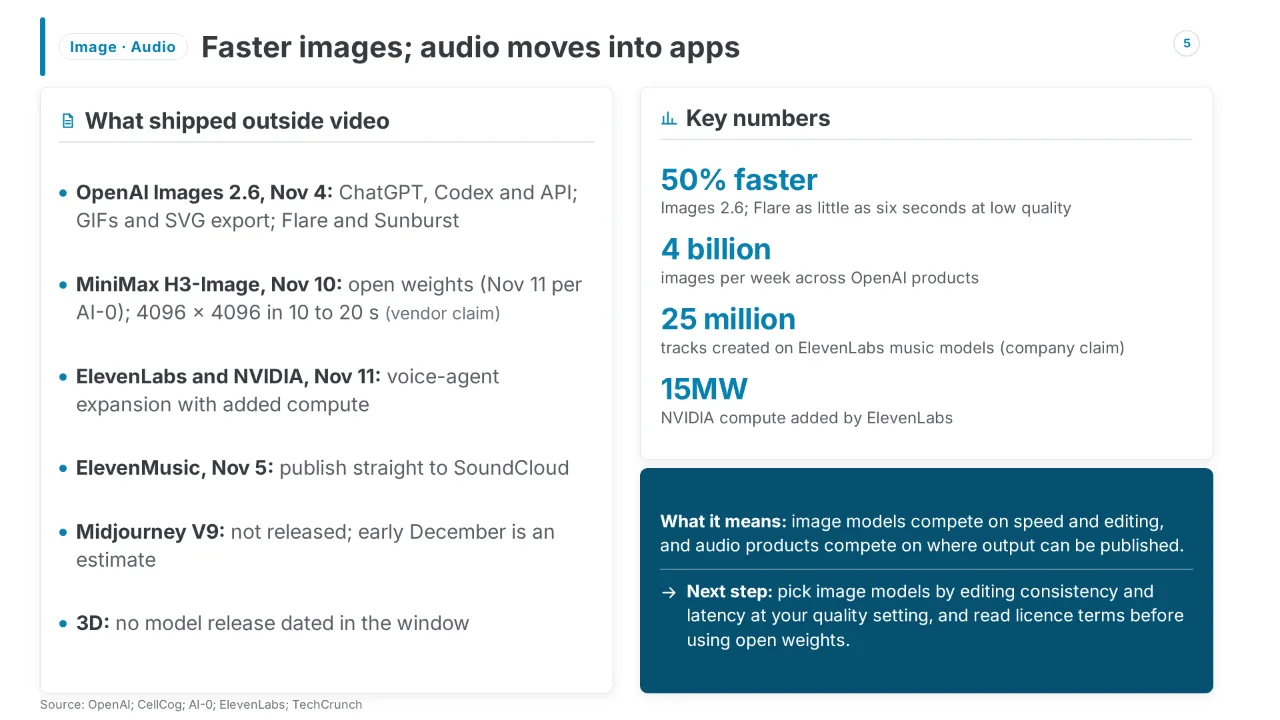
Image models are getting faster and gaining motion: OpenAI's Images 2.6 (Nov 4) generates images 50% faster than before, adds animated GIFs and, in the API, SVG export, markup and a new complexity parameter. The same week MiniMax announced H3-Image with open weights (Nov 10).
| Model | Maker | Date | Access | Licence | Headline capability | Status |
|---|---|---|---|---|---|---|
| Images 2.6 (GPT-Image-2.6 Flare and Sunburst) | OpenAI | Nov 4 (window) | ChatGPT, Codex, API | Closed | 50% faster; Flare "as little as six seconds" at low quality; GIFs; SVG export; image markup in the API | GA |
| H3-Image | MiniMax | Nov 10 per CellCog; Nov 11 per AI-0 (window) | Hailuo AI, MiniMax API, Hugging Face weights | Open weights under MiniMax's own licence (terms in Chapter 4) | 4096 x 4096 (about 16.8 million pixels) in 10 to 20 seconds, up to 16 reference images; vendor claim | Open weights, per secondary sources |
| Seedream 5.5 | ByteDance Seed | Nov 9 per AI-0 (window) | Hosted | Not stated | More natural skin, sharper text, transparent backgrounds | Reported by a secondary roundup |
| Midjourney V9 | Midjourney | Not released | Not available | Closed | Native full-resolution base model plus new upscaler, in internal testing | Upcoming, estimate |
OpenAI's own numbers are the only primary ones here. The company says people now create 4 billion images per week across ChatGPT, Codex and the API, "more than half a billion images created per day". The system card dated 2026-11-04 describes the safety stack as unchanged from Images 2.5 plus extra safeguards for GIF creation. A developer thread on the OpenAI community forum complains that low and medium quality settings bill substantially more output tokens than gpt-image-2.5; that is a user claim, not OpenAI's statement, so cost comparisons are deferred to Chapter 5.
Midjourney V9 did not ship. Secondary summaries of the Nov 4 Midjourney office hours say a functional full-resolution base model exists internally, that the team is deciding between a full launch and an early preview, and that a release "within approximately 30 days of November 4" was the target; Midjourney said V9 images "could cost double". That is a reported estimate, not an announcement, and nothing in the material shows a release by Nov 16. The same sources list native video with sound, real-time generation and 3D camera controls as roadmap items, not shipped features.
3.2 Voice and speech
ElevenLabs' window was about enterprise voice infrastructure rather than a new voice model. On Nov 11 the company and NVIDIA said NVIDIA's Nemotron 3.5 Super VL is now available in ElevenAgents, that ElevenLabs is adding 15MW of NVIDIA Blackwell Ultra and Vera Rubin compute, and that it powers a sovereign voice agent for Poland's national e-Health platform. On Nov 13 TechCrunch reported "ElevenAI", an experimental meeting-notes and dictation app launched at the company's 11/11 Summit, still in preview with early-access sign-up. No new text-to-speech model release dated inside the window appears in the material, so none is claimed.
3.3 Music
| Item | Maker | Date | Access | What changed | Status |
|---|---|---|---|---|---|
| ElevenMusic to SoundCloud publishing | ElevenLabs, SoundCloud | Nov 5 (window) | ElevenMusic users publish directly to SoundCloud; SoundCloud Artist Pro users get three months of ElevenMusic Pro | Distribution, not a new model | Announced, available per TechCrunch |
| Licensed music in Premiere mobile | Adobe with UMG and WMG | Nov 3 (window) | Free Premiere mobile app | Licensed music clips from two major labels | Announced |
TechCrunch notes that ElevenLabs says users have created over 25 million tracks with its models (a company claim) and that streaming platforms "seem more inclined toward labeling and helping users filter out AI-generated music". The pattern is the same in both rows: music generation is moving into distribution and editing surfaces that already have audiences, with licensed catalogue (UMG, WMG) on one side and generated catalogue on the other. No new Suno or Udio model release dated in the window is supported by the material (the Suno news is legal, see Chapter 6).
3.4 Adobe MAX: creative tools with partner models
Adobe MAX 2026 (Nov 10) put generative audio and video into the editing timeline. Premiere's new Generative Media tool offers Generate Video, Generate Sound Effects, Generate Soundscape and Generate Music in the timeline, and the user can choose Adobe Firefly or partner models from Google, Kling, Runway and Luma. Adobe and Google also announced a wider partnership: Google's latest imaging and video models will come to Firefly, Photoshop, Premiere and Express, and Adobe and Google DeepMind will collaborate on image editing starting with Photoshop (a statement of intent, no date given). Pricing and distribution consequences are in Chapter 7. There was no 3D model release in this chapter's material; Atlas, a world model with 3D outputs, is in Chapter 2.
4. Access, retirements and open weights
Chapters 2 and 3 described what shipped; this chapter covers what builders can actually call, what is being switched off, and which weights can be downloaded and under what terms.
4.1 Deprecation and retirement calendar
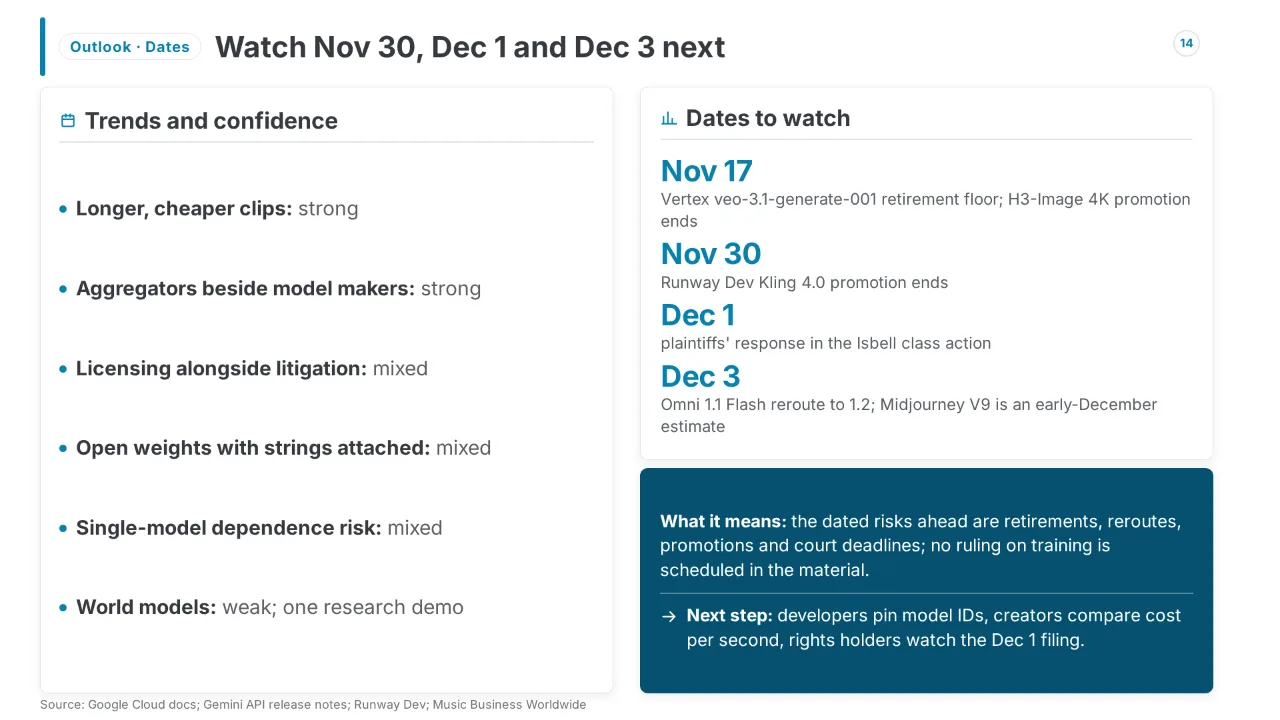
The Google calendar decides who has to move: the Gemini API's Veo 3.1 preview models were shut down on Oct 22, 2026 with Gemini Omni Flash named as the replacement, the Vertex-side Veo 3.1 GA models list a retirement date of "November 17, 2026 or later", and Omni 1.1 Flash traffic will be rerouted to Omni 1.2 Flash on Dec 3, 2026.

| Product | Action | Date | Replacement | Status on 2026-11-17 |
|---|---|---|---|---|
Veo 3.1 Preview (veo-3.1-generate-preview, -fast-, -lite-) in the Gemini API |
Shut down | Oct 22, 2026 | Gemini Omni Flash (gemini-omni-1.2-flash) or the GA models on the Gemini Enterprise Agent Platform |
In effect; context, before the window |
veo-3.1-generate-001, veo-3.1-fast-generate-001 (Gemini Enterprise Agent Platform) |
Retirement date listed | "November 17, 2026 or later"; released Nov 17, 2025 | Not named on the lifecycle page | Listed as GA, retirement date is the run date or later; no earlier date shown |
gemini-omni-1.1-flash (Gemini API) |
Automatic routing to Omni 1.2 Flash at 1.2 rates | Dec 3, 2026 | gemini-omni-1.2-flash |
Upcoming; announced Nov 5 |
| Gemini Omni 1.2 Flash | General availability | Nov 5, 2026 | Not applicable | In effect |
Two readings matter. First, the Vertex footnote says listed retirement dates refer to support in the Gemini Enterprise Agent Platform and that models "may remain accessible through the Gemini API" after those dates; the Gemini API Veo page, however, says its preview models are already shut down, so "Veo 3.1" now means different things on the two surfaces. Second, "November 17, 2026 or later" is a floor, not a promise of removal on that day; the material shows no replacement notice, so the page should be checked directly before any production cutover. The Gemini API video guide now tells developers to use Gemini Omni Flash as the default video model and keeps Veo as the second option. The collected OpenAI changelog and deprecations pages show no image-model retirement dated in the window; the earlier Sora shutdown is context only.
4.2 API versus app availability
The release notes make the Gemini side concrete: Omni 1.2 Flash supports first-and-last-frame interpolation of 3 to 10 seconds, per-turn extension of 3 to 10 seconds up to 30 seconds total, up to 6 reference images and doubled paid-tier rate limits, with the video output price at $12.00 per 1M tokens. That is the API picture behind the consumer-facing 15-second headline in Chapter 2. For Kling 4.0 Flash, World Labs Atlas and OpenAI's Images 2.6 the access routes (API, MCP, plug-ins) are in Chapters 2 and 3; none is gated beyond ordinary account sign-up in the material, except Google's allowlisting of audio references (Chapter 2). Chapter 5 holds the prices.
4.3 Open weights and licences
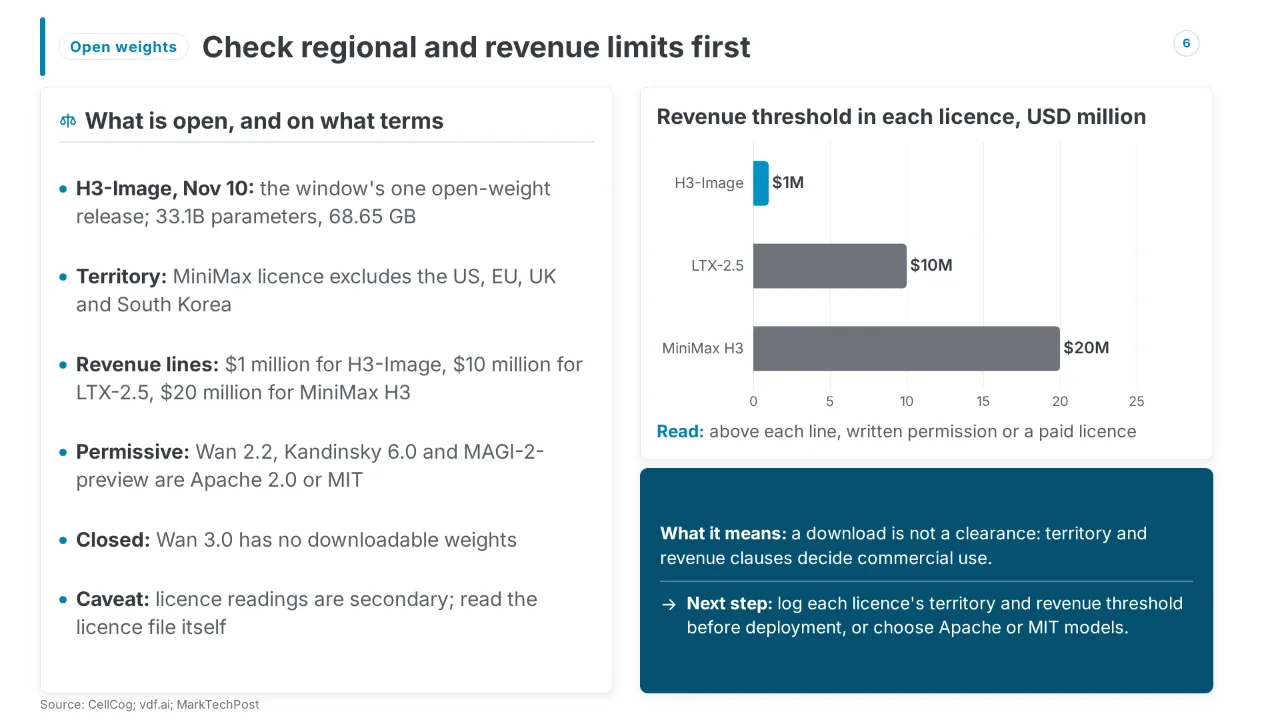
The material gives one open-weight release inside the window and several earlier releases that decide what is usable commercially. All licence descriptions below come from secondary sources that read the licence files; the licence text itself should be read before use.
| Model | Maker | Released | Licence per source | Catch | Status |
|---|---|---|---|---|---|
| H3-Image (image, 33.1B parameters, 68.65 GB) | MiniMax | Nov 10 (window) | MiniMax's own licence | Excludes the US, EU, UK and South Korea; firms above $1 million revenue need written permission | Open weights, CellCog reading |
| MiniMax H3 (video, H3-Base 768p ceiling) | MiniMax | Aug 3 weights (context) | MiniMax H3 Community License | Same four territories excluded; written authorisation above $20 million yearly revenue | Open weights, context |
| LTX-2.5 | Lightricks | Aug 2026 (context) | LTX-2.x Community License (dated Aug 11, amended Oct 29) | Free below $10 million annual revenue; watermark and provenance features must stay | Open weights, context |
| Wan 2.2 family, Kandinsky 6.0, MAGI-2-preview | Alibaba, Kandinsky Lab, Sand AI | 2025 to Sep 2026 (context) | Apache 2.0 or MIT | Commercial use allowed | Open weights, context |
| Wan 3.0 | Alibaba | Aug 24 (context) | None | No downloadable weights; the Wan-AI Hugging Face organisation had none for Wan 2.5 or later on Nov 4 | Hosted only |
The practical split is territory and revenue-capped licences (MiniMax, LTX) versus permissive licences (Wan 2.2, Kandinsky, MAGI-2) that are older or less capable. According to MarkTechPost's Nov 13 ranking, which uses Artificial Analysis Elo, the top-ranked text-to-video model (Wan 3.0) is closed, while the open-weight MiniMax H3 sits in the top three; arena detail is in Chapter 5. For 3D, a secondary guide checked on Nov 4 lists Microsoft's TRELLIS.2 (4B image-to-3D, MIT code and model licence, NVIDIA GPU with at least 24GB VRAM) as the main self-hosted option and notes that Tripo separates its H3.1 and P2 models; no 3D open-weight release dated inside the window appears in the material.
4.4 What to do before the next date
- Gemini API users on Omni 1.1 Flash: rerouting to 1.2 happens on Dec 3 at 1.2 rates, so cost per second changes by itself; pin
gemini-omni-1.2-flashnow if you want to test the new price first. - Teams still on Vertex Veo 3.1 GA models: treat Nov 17, 2026 as the earliest retirement, not the actual one, and read the lifecycle page weekly.
- Anyone using open weights commercially in the US, EU, UK or South Korea: MiniMax's licences exclude those territories; choose Apache or MIT models instead.
5. Quality and price comparison
Chapters 2 to 4 said what shipped and what can be called; this chapter asks what the new models score and cost, using one source per table, and it separates ratings, prices and vendor specs.
5.1 Leaderboard snapshot
Quality is bunched, so price decides: on Artificial Analysis' text-to-video board the top five sit within 23 Elo points (1175 to 1152) while their API prices run from $4.80 to $34.12 per minute; on images, GPT Image 2.6 Sunburst leads the runner-up by 31 points.
Artificial Analysis (AA) ranks by Elo from blind pairwise votes. None of its pages shows an as-of date, so every rating below is "date not stated on the page; crawled for this issue". The Portuguese copy of the video board shows 7,651 votes for Wan 3.0 against 7,787 on the English page, so the pages were captured at different times. arena.ai is not tabulated: the collected pages are a Jan 21, 2026 launch post and a help article with no ratings.
AA-Video-T2V v2.1 (text to video, with audio), source: ref_87
| Rank (range) | Model | Elo | 95% interval | Votes | Released |
|---|---|---|---|---|---|
| 1 (1-2) | Wan 3.0 | 1175 | 1162-1188 | 7,787 | Aug 2026 |
| 2 (1-3) | Utopai X | 1172 | 1158-1186 | 7,171 | Sep 2026 |
| 3 (2-6) | MiniMax H3 (768p) | 1161 | 1148-1174 | 7,948 | Jul 2026 |
| 4 (3-8) | Dreamina Seedance 2.5 | 1157 | 1144-1170 | 7,907 | Jul 2026 |
| 5 (3-9) | Gemini Omni Flash 1.2 | 1152 | 1138-1166 | 5,354 | Nov 2026 |
| 13 (10-14) | Gemini Omni Flash 1.1 | 1127 | 1114-1140 | 8,253 | Aug 2026 |
| 25 (25-26) | Veo 3.1 | 963 | 949-977 | 5,048 | Jan 2026 |
Omni 1.2 Flash, the window's flagship (Chapter 2), enters at rank 5 with the fewest votes of the top five, 25 Elo above its predecessor (1152 - 1127); its rank range of 3 to 9 means the board cannot separate it from FLUX 3 Max or HeyGen Video 1. On AA's video-editing board it is second at 1164, behind Wan 3.0 at 1192. According to MarkTechPost (Nov 13, a secondary ranking built on AA), Seedance 2.5 leads image to video at 1161 and Omni 1.2 Flash scores 1086 there; the same article's text-to-video figures differ from the crawled page by 1 to 2 points (Omni 1154 against 1152), which is ordinary drift.
AA image boards, source: ref_93 (text to image) and ref_94 (editing)
| Model | Text-to-image Elo (rank) | Editing Elo (rank) |
|---|---|---|
| GPT Image 2.6 Sunburst (max) | 1259 (1) | 1210 (1) |
| GPT Image 2.6 Flare (max) | 1228 (2) | 1206 (2) |
| GPT Image 2.5 Sunburst (max) | 1227 (3) | 1201 (3) |
| Nano Banana 2.1 | 1176 (6) | 1152 (9) |
| Grok Imagine Image 2.0 | 1166 (8) | 1117 (23) |
OpenAI's Images 2.6 (Nov 4, Chapter 3) beats Images 2.5 Sunburst by 32 points on text to image (1259 - 1227), outside the 1244-1274 interval, but by only 9 on editing (1210 - 1201), where all three leaders share ranks 1 to 4. MiniMax H3-Image (Chapter 3) is 13th on editing at 1138, and Seedream 5.5 is 7th at 1159.
5.2 Price table
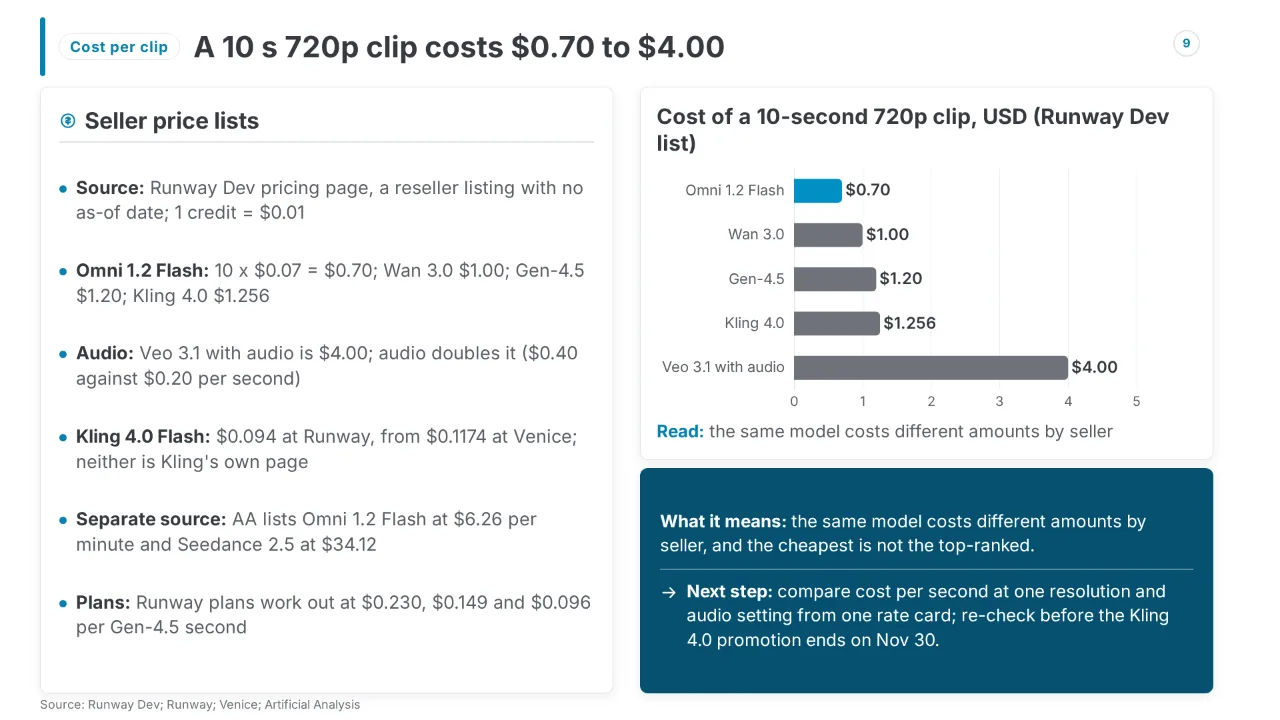
Prices below come from Runway Dev's pricing page, one reseller listing many makers (1 credit = $0.01); the page shows no as-of date, so it is "crawled for this issue", and the Kling 4.0 promotion runs through Nov 30, 2026.
| Model (maker) | Unit | Resolution | Price |
|---|---|---|---|
| Gemini Omni 1.2 Flash (Google) | per second | 720p / 1080p / 4K | $0.07 / $0.10 / $0.21 |
| Gemini Omni 1.1 Flash (Google) | per second | 720p | $0.10 |
| Kling 4.0 Flash (Kling) | per output second, no input video | 720p | $0.094 |
| Kling 4.0 (Kling) | per second, 20% off | 720p / 1080p | $0.1256 (list $0.157) / $0.188 (list $0.235) |
| Gen-4.5 (Runway) | per second | not listed | $0.12 |
| Wan 3.0 (Alibaba) | per second | 720p / 1080p | $0.10 / $0.20 |
| Seedance 2.5 (ByteDance) | per second | 720p / 1080p | $0.30 / $0.68 |
| Veo 3.1 (Google), with audio | per second | 720p and 1080p | $0.40 |
Arithmetic for a 10-second 720p clip on this list: Omni 1.2 Flash 10 x $0.07 = $0.70; Wan 3.0 10 x $0.10 = $1.00; Gen-4.5 10 x $0.12 = $1.20; Kling 4.0 10 x $0.1256 = $1.256; Veo 3.1 with audio 10 x $0.40 = $4.00. Google's own figure agrees with its resale: $0.07 per second at 720p from Nov 5, billed in the Gemini API at $12.00 per 1M video-output tokens; the material does not give tokens per second, so we do not convert. LiteLLM's Nov 13 listing of Kling 4 at $0.1256 matches Runway.
Kling 4.0 Flash disagrees across hosts: Runway lists $0.094 per output second, Venice "from $0.1174" per second at 720p with audio. The Venice figure is 25% higher (0.1174 / 0.094 = 1.249). Neither is Kling's own price page, which the material lacks, so we show both and follow neither as a vendor price.
AA's own normalized video prices (1080p where offered, per minute) are a separate source: Wan 3.0 $12.00 (= $0.20 per second), MiniMax H3 768p $4.80 (= $0.08), Omni 1.2 Flash $6.26 (= $0.1043), Seedance 2.5 $34.12 (= $0.569). So Wan 3.0 costs 1.9 times as much as Omni 1.2 Flash (12.00 / 6.26) for 23 more Elo points. For images AA lists $210.72 per 1,000 for all four OpenAI "max" variants (= $0.2107 per image), against $33.60 for Nano Banana 2.1 (= $0.0336), 6.3 times less for 83 fewer Elo points (1259 - 1176). MiniMax's example 1K H3-Image cost is $0.02179 (= $21.79 per 1,000), under AA's $26.54 per 1,000, and MiniMax says its examples are not fixed prices.
Runway's consumer plans (annual billing) convert as follows at 12 credits per second of Gen-4.5: Standard $12 / 625 credits x 12 = $0.230 per second; Pro $28 / 2,250 x 12 = $0.149; Max $76 / 9,500 x 12 = $0.096, against $0.12 on the API. The page shows no date.
5.3 Clip length and audio
All specs here are vendor or reseller statements, not test results.
| Model | Clip length | Resolution | Audio | Source |
|---|---|---|---|---|
| Gemini Omni 1.2 Flash | 3-15 s; extension to 30 s total | 360p to 4K, 24 FPS | Native | Gemini API docs |
| Kling 4.0 Flash | 3-20 s | 720p | Always generated | Venice docs |
| Gen-4.5 | 2-10 s | 720p, 24 or 25 FPS | Not stated | Runway help |
Audio is also a price lever. Veo 3.1 costs $0.40 per second with audio and $0.20 without (audio doubles it); Kling 3.0 Pro is $0.17 with and $0.12 without, 42% more. AA's text-to-video board scores clips with audio; its silent board has a different leader, HeyGen Video 1 at 1146, with Wan 3.0 fifth at 1136.
5.4 What the comparison does not show
Elo measures blind preference on short prompts, not clip length, consistency or editing control, and a 3-to-9 rank range means ties. AA prices a minute at 1080p, while Google's headline is 720p, so $0.07 and $0.1043 are different products. Credit and token billing hide rounding, minimums and failed generations (per CellCog quoting MiniMax's guide, charges apply to successful images even if the client disconnects). No creator head-to-heads or arena.ai ratings were collected, so editing workflow, prompt adherence in a real project and brand-safe output remain untested here.
6. Copyright and platform policy
Chapter 5 compared quality and price; the legal side of the window is dominated by one defendant, Suno, which was sued twice in one day, while the platform-rule material contains no new rule dated inside the window.
6.1 Litigation and settlements
Two new complaints against Suno, filed Nov 6, are allegations, not findings: the Presley rights holders plead about $202 million across their claims and Eight Mile Style about $47.7 million; nothing has been decided and Suno denies both.
Both complaints were filed on November 6, 2026 in the US District Court for the Northern District of California, by the same legal team led by attorney Richard Busch.
| Case | Court | Plaintiffs | Core claims (allegations) | Amount pleaded | Status on 2026-11-17 |
|---|---|---|---|---|---|
| Presley rights holders v. Suno | N.D. Cal., filed Nov 6 (window) | Elvis Presley Enterprises, ABG EPE IP (both controlled by Authentic Brands Group), Raleigh Music Publishing, Abilene Music and others | Copyright infringement over 859 compositions; Tennessee ELVIS Act; right of publicity; circumvention of access controls; removal of credits | Statutory damages $128.85 million, plus $2.1475 million and $21.475 million, plus "believed to exceed $50 million" for voice and likeness: just over $202 million | Complaint filed; Suno denies; no ruling |
| Eight Mile Style v. Suno | N.D. Cal., filed Nov 6 (window) | Eight Mile Style and Martin Affiliated (Eminem is not a plaintiff) | Copyright infringement over 269 compositions; altered or removed copyright metadata | Just over $47.7 million pleaded in total | Complaint filed; Suno denies; no ruling |
The arithmetic matches MBW's count. 859 works x $150,000 (the statutory maximum for willful infringement) = $128.85 million. Adding $2.1475 million, $21.475 million and one $50 million claim gives $202.47 million, "just over $202 million". For Eight Mile Style, 269 x $150,000 = $40.35 million, which is the figure Vibe reports as "more than $40.35 million"; the Los Angeles Times says "about $41 million"; MBW's $47.7 million is the sum of all pleaded claims. I follow MBW's $47.7 million as the total and $40.35 million as the statutory component, because MBW states how the number is built. Each figure is a ceiling the plaintiffs ask for, not an award.
The Presley complaint is one of the first tests of Tennessee's ELVIS Act (in effect since 2024), which targets unauthorized commercial use of a voice or likeness. The open question, according to MBW, is whether the Act's clause on technology whose "primary purpose or function" is producing a person's voice can reach a general-purpose music generator. Both complaints allege that Suno's filter on artist names is easy to bypass, for example by prompting with style words only.
Suno says it does not "allow prompts for specific artists' names and songs" and screens uploads with third-party providers. On Nov 3 (window) Suno also asked a Boston judge to dismiss a proposed class action by Jason Isbell and three other musicians; the plaintiffs' response is due Dec 1 (upcoming).
Context, not window events: the Presley suit against Anthropic (October), Eight Mile Style v. Meta (filed May 2025, allowed to proceed to discovery) and earlier Suno suits by Round Hill, Reservoir, UMG and Sony. A suit by the American Federation of Musicians against Universal and Warner over their Suno and Udio licences is described, with a motion to dismiss and a union reply, only in an Instagram post by a music commentator; the court, filing date and status are not in the material, so it is listed as unverified. No docket event in the Disney-led studios v. MiniMax case appears in the material.
6.2 Licensing deals and training-data policy
The window's licensing news is one alliance rather than a music-label deal. Adobe and Disney announced a multi-year alliance making Adobe Disney's "Official AI Innovation Partner," which gives Disney teams access to Firefly, Firefly Foundry, Premiere and Photoshop, and was placed at Adobe MAX. The relevant point for copyright is the model design: according to Adobe's post, Firefly Foundry builds private models "customized using Disney intellectual property," and Imagineers are only "experimenting" with a sketch-to-image model. Neither company disclosed value, length in years or exclusivity.
Licensing background for Suno is context: Warner Music Group settled last year and licensed Suno, which also has deals with BMG and Believe; a label-backed model released in September drew a further UMG and Sony suit. Suno raised $400 million in June at a $5.4 billion valuation, per the Los Angeles Times.
6.3 Platform labelling, disclosure and provenance
| Rule | Effective | Who it binds | Source status |
|---|---|---|---|
| EU AI Act disclosure duty for AI-generated "deep fake" content (Article 50), penalties up to EUR 15m or 3% of turnover | Aug 2, 2026 (in effect, context) | Deployers, including advertisers | Per Latent; Sideshift gives the same date |
| Meta Commercial Terms "AI Features" clause: advertisers "solely responsible" for what Meta's AI creates or alters | Oct 30, 2026 (in effect, context) | Advertisers | Per Latent |
| Google "How this ad was made" panel in My Ad Center | Jul 9, 2026 (in effect, context) | Google advertisers | Per Latent |
| India IT Rules amendment: visible AI labels, C2PA metadata, 24-hour takedown for impersonation | Notified Jan 15, 2026 (context) | Intermediaries | Per AIFOD citing IMPRI |
No platform policy change dated Nov 3 to Nov 16 appears in the material. The platforms' own policy pages are not in the material, so everything here is "according to" commentators. Per Latent, YouTube asks creators to disclose realistic altered content and AI music as the main focus, TikTok has a mandatory advertiser disclaimer, and Meta's mandatory ad disclosure applies only to political and social-issue ads.
The one primary provenance source is OpenAI's Help Center: images from ChatGPT or the API carry Content Credentials (C2PA) and SynthID watermarks, audio carries SynthID, and Sora is discontinued. The page is undated and does not mention Images 2.6 (see Chapter 3). OpenAI warns that a screenshot or file conversion can strip metadata. Per Watermark.ws, OpenAI announced SynthID for images on May 19, 2026 and Google made its visible watermark optional in August 2026 (secondary, pre-window).
6.4 What is still unresolved
No court ruling on training-data liability appears in the window. The Suno complaints push the argument toward voice and likeness law, where an output need not copy a song to be challenged. Whether label licences reach session musicians is untested in the material. On platforms the gap is enforcement: provenance metadata is fragile, so a platform may not label what it cannot read. This is description, not legal advice.
7. Commercialization and the creator ecosystem
Chapter 6 showed rights holders pushing back on one music generator; the commercial side of the window shows money and distribution flowing toward companies that sit between models and creators.
7.1 Funding and valuations
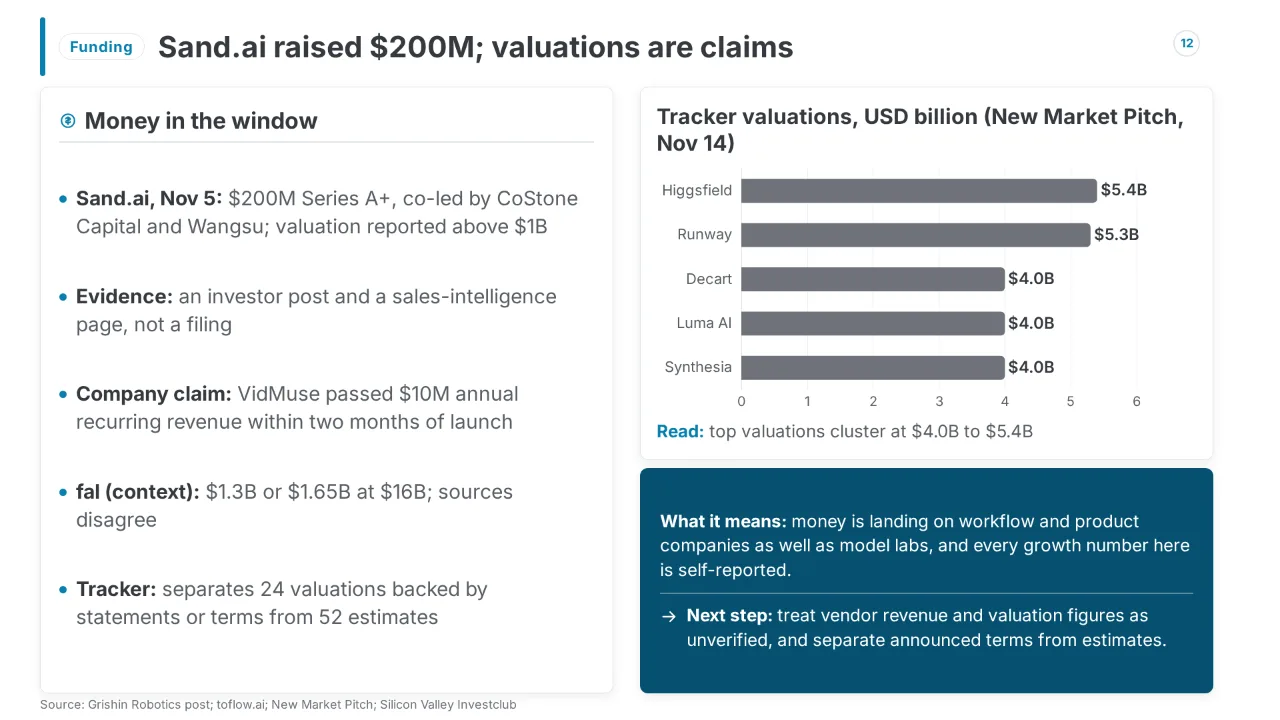
One in-window round, and it is Chinese and open-source: Sand.ai, a Beijing video-generation startup, raised $200 million in a Series A+ co-led by CoStone Capital and Wangsu Science & Technology, with a valuation reported above $1 billion.
| Company | Round | Amount | Valuation | Lead / participants | Date | Status |
|---|---|---|---|---|---|---|
| Sand.ai (MAGI models, VidMuse app) | Series A+ | $200 million | Above $1 billion (reported) | CoStone Capital and Wangsu Science & Technology (co-leads); Times Capital, Pudong Venture Capital, Shanghai Guofang and others | Nov 5 per toflow.ai; reports dated about Nov 7 (window) | Reported; round and investors per an investor post |
| fal (inference platform for image, video, audio models) | Round led by Bessemer | $1.3 billion or $1.65 billion (sources disagree) | $16 billion | Bessemer; Nvidia, Sound Ventures, T. Rowe Price | October (context) | Reported, social posts only |
| Higgsfield | Series B extension | Undisclosed | $5.4 billion (as of Aug 2026) | Not stated in this source | October (context) | Tracker estimate of announced terms |
| Runway | Series E | $315 million | $5.3 billion | Not stated | Feb 2026 (context) | Tracker |
Three cautions apply. The Sand.ai figures come from an investor's social post and a sales-intelligence page, not the company or a filing; Sand.ai itself is quoted saying its VidMuse app passed $10 million in annual recurring revenue within two months of launch, which is a company claim. Wangsu also disclosed a planned 300 million yuan investment tied to inference and deployment cooperation; we do not convert currencies. Where two sources disagree on fal's October round, we follow neither: $1.3 billion and $1.65 billion both appear and the material has no company statement to settle it. The New Market Pitch tracker, updated Nov 14, ranks Higgsfield first at $5.4 billion, Runway at $5.3 billion and Decart, Luma AI and Synthesia at $4.0 billion each; it separates 24 valuations backed by statements or round terms from 52 estimates, which is the right habit to copy.
7.2 Distribution and aggregators
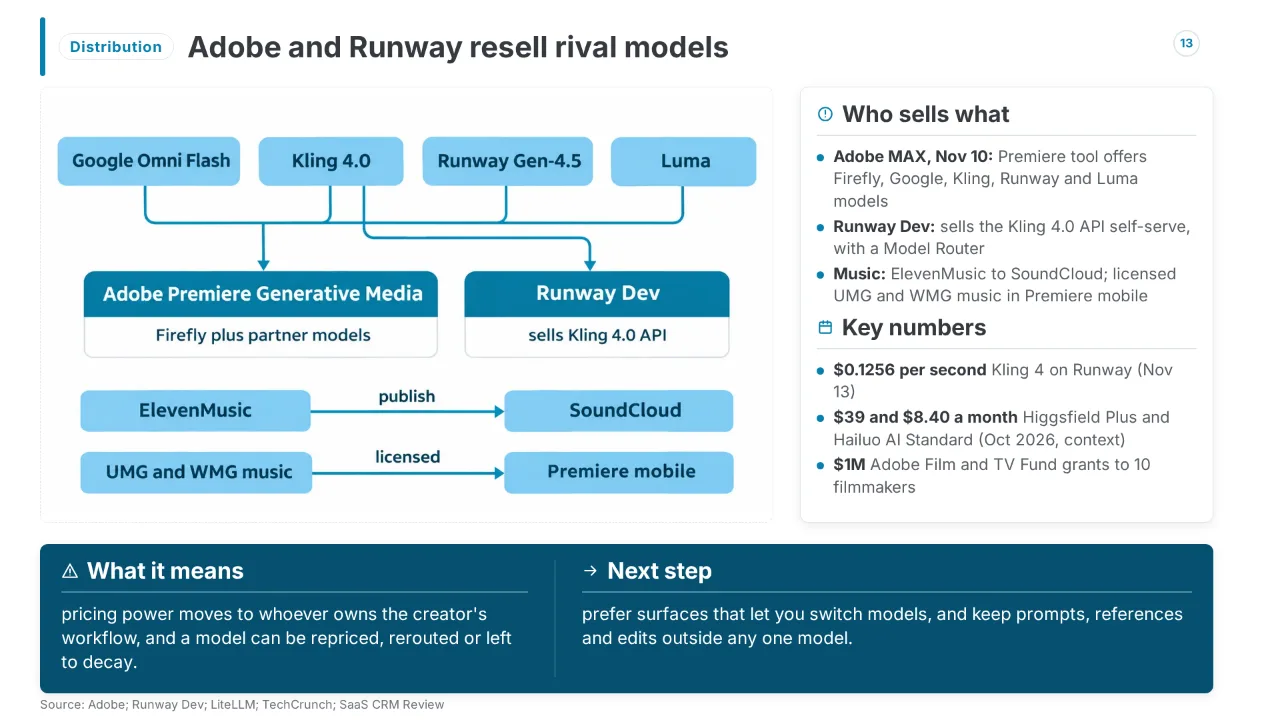
The window's distribution moves share one pattern: the model maker sells through someone else's surface.

- Adobe as an aggregator. At Adobe MAX (Nov 10) Premiere's Generative Media tool lets editors choose Adobe Firefly or partner models from Google, Kling, Runway and Luma, and Google's latest imaging and video models are due to come to Firefly, Photoshop, Premiere and Express (product detail in Chapter 3). The Adobe-Disney alliance is the studio-side counterpart (Chapter 6).
- Developer platforms reselling video models. Runway Dev sells the official Kling 4.0 API self-serve, alongside its own models and a Model Router that picks a model by cost, quality or latency; LiteLLM lists Kling 4 on Runway at $0.1256 per second as of Nov 13 (Chapter 5).
- Google's customer list as distribution. Google's Cloud post names Artlist, FLORA, invideo, Krea, Picsart, Photoroom and Runway as builders on Gemini Omni 1.2 Flash; these are vendor-quoted testimonials.
- Music distribution. ElevenMusic output can be published directly to SoundCloud, and Adobe's free Premiere mobile app adds licensed UMG and WMG music (Chapter 3).
7.3 Creator economics
Consumer plan prices in the material are third-party lists, so they are directional: a comparison captured in Oct 2026 (before the window) puts Higgsfield Plus at $39 per month billed annually with a credit price beside each listed video model, and Hailuo AI's Standard plan at $8.40 per month billed yearly. Adobe also announced $1 million in direct grants to 10 filmmakers through its Film & TV Fund on Nov 9, on top of nearly $10 million committed in grants and donated products for 2026. A Nov 13 social post reports that Disney plans to launch a preschool series made with agentic AI tools in December, with artists reviewing every frame; the source is a social post and is not verified.
7.4 What the money signals
Pricing power is moving to whoever owns the creator's workflow. The cheapest models are now one click away inside tools that already have the audience (Premiere, Firefly, Runway Dev), and valuations at the top of the tracker cluster at $4.0 to $5.4 billion for workflow and product companies, not for model labs alone. The one fresh round, Sand.ai's, pairs an open-source model with a consumer app. For creators the implication is portability: a model can be repriced, rerouted or left to decay (see the Grok Imagine report in Chapter 2), so keep prompts, references and edits outside any single model. Nothing here is investment advice, and tracker valuations marked "estimate" are not company statements.
8. Trend assessment and what to watch next
Chapters 2 to 7 covered models, access, price, rules and money; this chapter reads them together and lists what to watch in the next 30 days.
Capability news in the window was concentrated in two releases (Gemini Omni 1.2 Flash and OpenAI Images 2.6); the larger story is that models are reaching creators through other companies' surfaces, at prices that differ by seller, under licences and lawsuits that decide where they may be used.
8.1 Trends and how strong the evidence is
| Trend | Evidence in this window | Confidence |
|---|---|---|
| Longer, cheaper production clips | Omni 1.2 Flash 15 s at $0.07 per second; Kling 4.0 Flash 3 to 20 s; AA puts the top five within 23 Elo while prices span $4.80 to $34.12 per minute | Strong |
| Clips to interactive world models | Atlas streamed at up to 15 fps as a research preview; no clip length, price or ranking to compare | Weak |
| Aggregators alongside model makers | Premiere offers Google, Kling, Runway and Luma models; Runway Dev sells Kling 4.0; Google's launch customers include Runway, Krea and Picsart | Strong |
| Licensing and litigation in parallel | Two new Suno suits on Nov 6; UMG and WMG music licensed into Premiere mobile; ElevenMusic to SoundCloud | Mixed |
| Open weights with strings attached | H3-Image weights excluded in US, EU, UK, South Korea; LTX-2.5 free below $10M revenue; Wan 3.0 closed | Mixed |
| Single-model dependence is a risk | Grok Imagine team cut, product still live; Veo 3.1 previews gone from the Gemini API | Mixed |
The strongest signal is price dispersion: the same Kling 4.0 Flash costs $0.094 or $0.1174 per second depending on the seller, and the top-ranked model is not the cheapest. The weakest is the world-model story, which rests on one vendor demo.
8.2 What it means by reader
| Reader | What changed | Implication | Evidence |
|---|---|---|---|
| Solo creator | Plans differ by seller: Runway plans work out at $0.096 to $0.230 per Gen-4.5 second; Omni 1.2 Flash is $0.07 per second at 720p | Compare cost per second, not plan price; keep prompts and references outside any one model | — |
| Studio or agency | Adobe puts several makers' models in one timeline; Adobe-Disney alliance uses private models on Disney IP | Pick a surface that lets you switch models; ask vendors for licence and provenance terms in writing | — |
| Developer integrating APIs | Omni 1.1 Flash reroutes to 1.2 on Dec 3; Vertex Veo 3.1 retirement floor is Nov 17 | Pin model IDs, test the new price, and read the lifecycle page before cutover | — |
| Rights holder | Two Suno complaints (Nov 6) test the ELVIS Act and copyright metadata claims; response due Dec 1 in the class action | Dated procedural steps exist, but no ruling on training is scheduled in the material | — |
These are readings of the evidence, not legal or investment advice.
8.3 Key dates
Dates up to Nov 17, 2026 are in effect or the matching status word; later ones are upcoming.
| Date | Event | State on Nov 17, 2026 | Source |
|---|---|---|---|
| Oct 22, 2026 | Gemini API Veo 3.1 preview models shut down (context) | In effect | Google AI for Developers |
| Nov 3, 2026 | Suno motion to dismiss the Isbell class action (Boston) | Filed | MBW |
| Nov 5, 2026 | Gemini Omni 1.2 Flash GA | In effect | |
| Nov 6, 2026 | Presley rights holders and Eight Mile Style file against Suno | Pending | MBW |
| Nov 10, 2026 | Adobe MAX announcements | Announced | Adobe |
| Nov 17, 2026 | Vertex veo-3.1-generate-001 retirement date "or later"; MiniMax H3-Image half-price 4K promotion ends (per CellCog) |
Upcoming or in effect on the run date; check the pages | Google Cloud docs; CellCog |
| Nov 30, 2026 | Runway Dev 20% Kling 4.0 promotion ends | Upcoming | Runway Dev |
| Dec 1, 2026 | Plaintiffs' response due to Suno's motion to dismiss (Isbell class action) | Upcoming | MBW |
| Dec 3, 2026 | gemini-omni-1.1-flash requests route to Omni 1.2 Flash |
Upcoming | Gemini API release notes |
| Early Dec 2026 (estimate) | Midjourney V9, "within about 30 days of Nov 4" per secondary summaries | Upcoming, not confirmed | kie.ai |
9. References
This document draws on the following 67 sources, listed in the order they are first cited.
- Gemini Omni 1.2 Flash: 15-second video and lower pricing — blog.google
- Gemini Omni 1.2 Flash now GA: cost-effective video | Google Cloud Blog — cloud.google.com
- Kling AI on X: "Kling 4.0 Flash Is Now Fully Available! ⚡ Kling 4.0 Flash is now available to everyone on the Kling AI website and via API. You can also access it through MCP, CLI, and AI plugins, bringing greater flexibility to your video creation workflows. With Kling plugins for professional c… / X — x.com
- Frameboy: Atlas in Real-time | World Labs — worldlabs.ai
- Introducing Images 2.6 — openai.com
- What Is Midjourney v9? Specs, Changes, Roadmap — kie.ai
- Google AI Studio — ai.google.dev
- Model versions and lifecycle | Gemini Enterprise Agent Platform | Google Cloud Documentation — docs.cloud.google.com
- Veo 3.1 | Gemini Enterprise Agent Platform | Google Cloud Documentation — docs.cloud.google.com
- MiniMax H3-Image: 16M-Pixel Images, Prices, Open Weights | CellCog — cellcog.ai
- AA-Video-T2V v2.1 Leaderboard - Top AI Video Models | Artificial Analysis — artificialanalysis.ai
- AA-Image-T2I v2.1 Leaderboard - Top AI Image Models | Artificial Analysis — artificialanalysis.ai
- AI Video, Image and Audio API Pricing | Runway Dev — dev.runwayml.com
- Kling 4.0 Flash API: Pricing and Specs | Venice — docs.venice.ai
- Elvis Presley rightsholders sue Suno, alleging its AI imitates the King’s voice. Eight Mile Style has filed a separate suit over 269 Eminem songs. - Music Business Worldwide — musicbusinessworldwide.com
- Elvis rights holders and Eminem’s publisher sue Suno, testing the ELVIS Act — spokesman.com
- Sand.ai raised $200 million in a Series A+ round to build video generation models and tools for creators. CoStone Capital and Wangsu Science & Technology co-led the round. Sand.ai takes two routes… | Grishin Robotics — linkedin.com
- What Funding Has Sand.ai Raised? Full Round History | toflow.ai | toflow.ai — toflow.ai
- Explore new ways to create across Creative Cloud and Adobe Firefly while advancing your craft with more precision, choice and control — blog.adobe.com
- ElevenLabs now lets users publish AI-generated music directly on SoundCloud — tech.yahoo.com
- Premiere mobile adds music from UMG and WMG, helping creators find the perfect track for every story — blog.adobe.com
- Adobe and Google Deepen Partnership to Bring Leading AI Models and Integrated Workflows to Creatives and Enterprises — news.adobe.com
- AI video news November 2026: Kling 4.0, GPT Image 2.6 | AI-0 — ai-0.net
- ElevenLabs and NVIDIA expand voice agents for enterprise — elevenlabs.io
- Grok Imagine Loses Most of Its Video Team: Keep Your Film Portable — screenweaver.ai
- Kling 4.0 API: access, pricing and code | Runway Dev — dev.runway.com
- GitHub - useapi/kling-api: Kling API examples by useapi.net: Kling 4.0, 3.0 and Omni video (text-to-video, image-to-video with keyframes, multi-shot, motion control, native sound), lip-sync avatars, KOLORS images and a hosted MCP server (45 tools), on your Kling AI subscription, with no Kling developer account. · GitHub — github.com
- MiniMax H3 (Hailuo 3) AI Video: 2K Clips with Native Sound — ocmaker.ai
- Atlas | World Labs — worldlabs.ai
- MCP server · Atlas — docs.atlas.worldlabs.ai
- ChatGPT Images 2.6 - OpenAI Deployment Safety Hub — deploymentsafety.openai.com
- 🌹🦋 Timeless Visions AI Art Challenge Alerts 🌹🦋 | 🚀 MIDJOURNEY V9 IS GETTING CLOSER | Facebook — facebook.com
- Images, upgraded—introducing ChatGPT Images 2.6 - Announcements - OpenAI Developer Community — community.openai.com
- ElevenLabs’ new app combines meeting note-taking and dictation for teams — techcrunch.com
- ElevenLabs SoundCloud Deal: What We Know (Nov 2026) — mubert.com
- Google AI Studio — ai.google.dev
- Video generation in the Gemini API | Google AI for Developers — ai.google.dev
- Changelog | OpenAI API — platform.openai.com
- Deprecations | OpenAI API — platform.openai.com
- Best Local Video Generation Models 2026: VRAM and Licence — vdf.ai
- Best AI Video Generation Models in 2026: Elo, Price per Second, Open Weights - MarkTechPost — marktechpost.com
- AI 3D Model Generators for Game Development (2026) | Wavect — wavect.io
- Ranking AA-Video-T2V v2.1 - Principais modelos de vídeo com IA | Artificial Analysis — artificialanalysis.ai
- Video Arena Is Live on Web - Arena.ai — arena.ai
- How to Generate Videos with Video Arena | Arena Help Center — help.arena.ai
- AA-Video-Editing v1.1 Leaderboard - Top AI Video Models | Artificial Analysis — artificialanalysis.ai
- AA-Image-Editing v2.1 Leaderboard - Top AI Image Models | Artificial Analysis — artificialanalysis.ai
- Kling 4 API Pricing (Nov 2026): $0.1256 per Second | LiteLLM — models.litellm.ai
- AI Image and Video Pricing from $12/month | Runway AI — runwayml.com
- Gemini Omni Flash - Gemini API | Google AI Studio — ai.google.dev
- Creating with Gen-4.5 – Runway — help.runwayml.com
- Elvis Presley, Eminem's rights holders sue AI company Suno - Los Angeles Times — latimes.com
- Elvis Presley rights holders sue AI music generator over licensing, copyright violations | Courthouse News Service — courthousenews.com
- Eminem's Publisher Sues AI Music Generator Suno For $40M — vibe.com
- Instagram — instagram.com
- Adobe gains marketing tie-ins with 5 Disney units in multi-year AI alliance — ppc.land
- Is AI-generated advertising allowed? The 2026 rules | Latent — thesillyhumans.com
- AI Labels Explained: What They Mean for UGC and Ad Performance - Sideshift Blog — sideshift.app
- India Mandates 24-Hour Deepfake Takedowns and C2PA Labels | AIFOD — af.net
- Provenance signals in content processed by OpenAI tools | OpenAI Help Center — help.openai.com
- Do AI Images Have Invisible Watermarks? | Watermark.ws — watermark.ws
- [𝐟𝐚𝐥 𝐑𝐚𝐢𝐬𝐞𝐬 $𝟏.𝟑 𝐁𝐢𝐥𝐥𝐢𝐨𝐧 𝐚𝐭 𝐚 $𝟏𝟔 𝐁𝐢𝐥𝐥𝐢𝐨𝐧 𝐕𝐚𝐥𝐮𝐚𝐭𝐢𝐨𝐧
fal is a startup that hosts and runs cutting-edge AI video, image, and audio models. Designed to empower developers and creators with high-performance infrastructure, the company provides scalable APIs and fast tools that eliminate deployment bottlenecks, making it easy to integrate state-of-the-art generative AI into real-time applications.
fal has raised $1.3 billion in its latest funding round, bringing the company’s valuation to $16 billion. The round was led by Bessemer Venture Partners, with participation from Nvidia, Sound Ventures, and T. Rowe Price.
fal, headquartered in San Francisco, California, United States, was founded in 2021 by Burkay Gur and Gorkem Yurtseven. In 2025, the company joined the unicorn club. “This year, we at fal pushed the limits of what’s possible, of what’s imaginable, in generative media. We post-trained already outstanding models to be even better and faster, in order to test what happens when quality converges with speed. We also cemented generative media’s impact in every major industry, expanding the very definition of what a creative layer can enable,” wrote the company in its post. | Silicon Valley Investclub](https://www.facebook.com/siliconvalleyinvestclub/videos/%F0%9D%90%9F%F0%9D%90%9A%F0%9D%90%A5-%F0%9D%90%91%F0%9D%90%9A%F0%9D%90%A2%F0%9D%90%AC%F0%9D%90%9E%F0%9D%90%AC-%F0%9D%9F%8F%F0%9D%9F%91-%F0%9D%90%81%F0%9D%90%A2%F0%9D%90%A5%F0%9D%90%A5%F0%9D%90%A2%F0%9D%90%A8%F0%9D%90%A7-%F0%9D%90%9A%F0%9D%90%AD-%F0%9D%90%9A-%F0%9D%9F%8F%F0%9D%9F%94-%F0%9D%90%81%F0%9D%90%A2%F0%9D%90%A5%F0%9D%90%A5%F0%9D%90%A2%F0%9D%90%A8%F0%9D%90%A7-%F0%9D%90%95%F0%9D%90%9A%F0%9D%90%A5%F0%9D%90%AE%F0%9D%90%9A%F0%9D%90%AD%F0%9D%90%A2%F0%9D%90%A8%F0%9D%90%A7fal-is-a-startup-that-hosts-and-r/1074828878850229) — facebook.com 63. Instagram — instagram.com 64. What are the most valuable AI video generation startups? – New Market Pitch — newmarketpitch.com 65. 10 Google Flow Alternatives in 2026: Veo, Credits & Cost — saascrmreview.com 66. Adobe backs the next generation of filmmakers with $1 million in direct funding and new industry Advisory Board — blog.adobe.com 67. Ventureburn — facebook.com