1. What happened
| Date (ET) | Event | Seat count after | Source |
|---|---|---|---|
| Before Nov 3 (context) | Republicans hold the House (majority since the 2022 election) and the Senate | House 218 R, 214 D, 1 independent, 2 vacant; Senate 53–47 | AP; AP count via YX Insights; AP via PBS |
| Tue Nov 3, 11:36 p.m. | AP calls Democratic control of the Senate | Senate 54 D, 44 R, 2 uncalled (as of 5:15 a.m. Nov 4) | AP; AP count via YX Insights |
| Wed Nov 4, 1:24 a.m. | AP calls Democratic control of the House | House 228 D, 139 R, 68 uncalled (as of 5:17 a.m.) | AP; AP count via YX Insights |
| Wed Nov 11, 5:59 p.m. | AP calls Mississippi Senate for Scott Colom (D), eighth seat flipped | Senate 55 D | AP; AP via PBS |
| Tue Nov 17, 10:19 p.m. | AP calls Alaska Senate for Mary Peltola (D) over Sen. Dan Sullivan (R), the last Senate race and ninth flip | Senate 56–44 from January | AP; Roll Call |
| Wed Nov 18 | House Democrats nominate Hakeem Jeffries for Speaker, 251–11, 262 votes cast | — | AP |
| Sun Nov 22 | AP calls North Carolina 5th for Chuck Hubbard (D) over Rep. Virginia Foxx (R) after a recount | House at least 258 D, 173 R, 4 uncalled | AP; Politico |
| Tue Nov 24 | AP calls Tennessee race for Victoria Broderick (D) over Rep. Scott DesJarlais (R); Sullivan concedes in Alaska | House at least 259 D, 173 R, 3 uncalled | AP; NYT |
Times are US Eastern; statuses are as of Nov 25, 2026.
1.1 The race calls, Nov 3 to Nov 24
Before the vote. Republicans had held the House since the 2022 election. According to YX Insights, citing the AP, the House stood at 218 Republicans, 214 Democrats, one independent and two vacancies. In the Senate, nine flips produced 56 Democratic seats, so Democrats started with 56 − 9 = 47 (including two independents) to Republicans' 53. The same AP count shows 34 Democratic and 31 Republican seats not up, so 35 were contested (100 − 34 − 31); Republicans were defending 53 − 31 = 22 and Democrats 47 − 34 = 13.

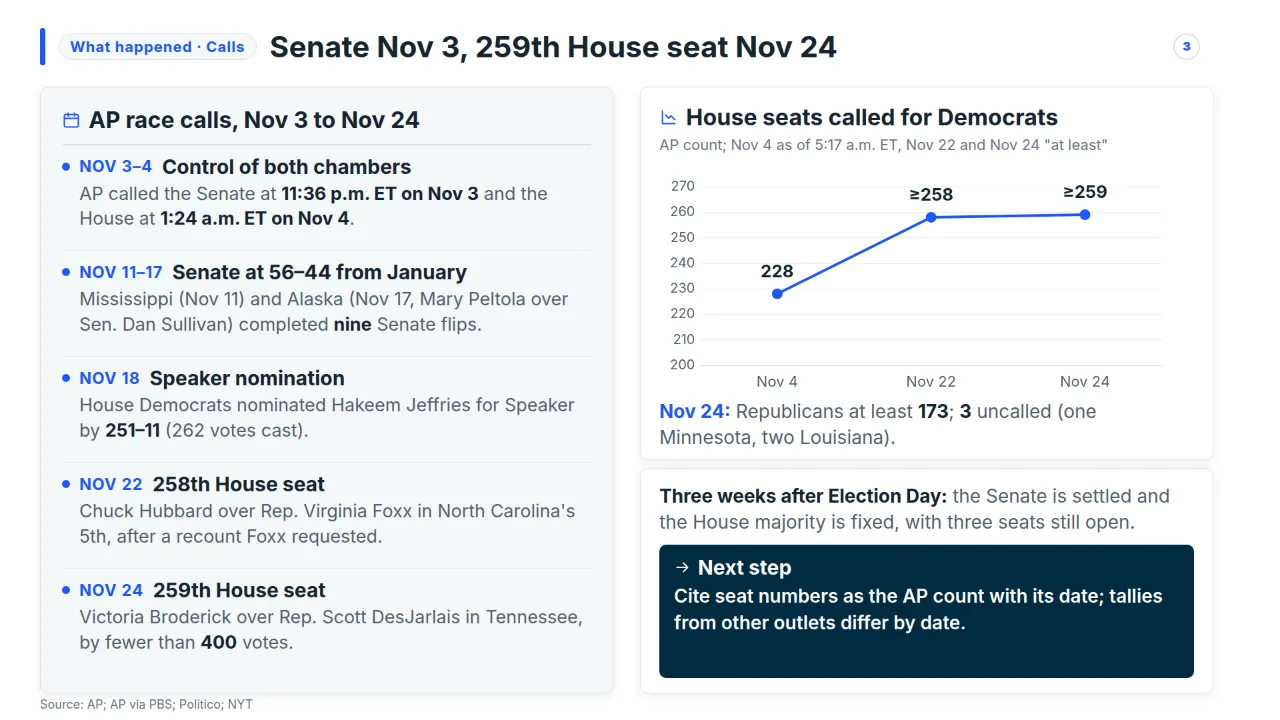
Election night. The AP called Democratic control of the Senate at 11:36 p.m. ET on Nov 3 and of the House at 1:24 a.m. ET on Nov 4. At 5:17 a.m. ET the AP had called 228 House seats for Democrats and 139 for Republicans, with 68 still open (according to YX Insights).
Senate, Nov 11–17. The AP called Mississippi for Scott Colom (D) at 5:59 p.m. on Nov 11, the eighth Republican-held seat to flip. On Nov 17 at 10:19 p.m., two weeks after Election Day, it called Alaska for Mary Peltola (D) over Sen. Dan Sullivan (R). That gave Democrats 56–44 from January, with nine seats flipped, their largest midterm Senate gain since 1958. Sullivan conceded on Nov 24.
House, Nov 22–24. On Nov 22 the AP called North Carolina's 5th District for Chuck Hubbard (D) over Rep. Virginia Foxx (R), after a recount that Foxx requested; this was the 258th seat. On Nov 24 it called Tennessee for Victoria Broderick (D) over Rep. Scott DesJarlais (R), by fewer than 400 votes out of about 196,000 (0.18 points), the 259th seat. Republicans have at least 173 seats. Three races remain: one in Minnesota and two in Louisiana that go to a December runoff. Chapter 4 covers their dates.
The count moved from 228 House seats on the morning of Nov 4 to at least 259 on Nov 24; three weeks after Election Day, three House seats are still open and the Senate is settled at 56–44.
1.2 Statements on the record
President Trump. On election night he posted on Truth Social that if he had been on the ballot, "we would have won IN A LANDSLIDE!" In a call with CBS News the same night he said: "congratulations to the Democrats, and I look forward to working with you for the good of our country" (both via The Hill). At a White House briefing on Nov 20 he said: "If I were on the ballot, it would have been a whole different story" (PBS NewsHour video).
Democratic leaders. Senate Democratic Leader Chuck Schumer said on Nov 17: "56 seats was an unimaginable result even just a few months ago". On Nov 18 he said: "The American people have given us their votes. Now we have to earn their trust". After his nomination, Jeffries said: "Our job is to fight MAGA extremism, not each other, and to get big things done for the American people". The full House votes on the Speakership on Jan 3, 2027; electing him takes 218 votes. Rep. Robert Garcia (D-Calif.), named by The Hill as incoming Oversight Committee chair, posted: "Lawyer up".
Republican leaders and the White House. Rep. Jim Jordan of Ohio, whom House Republicans elected to lead them in the minority, said: "Over the next two years, House Republicans will fight for American families". The White House warned that planned Democratic probes may amount to "blatant criminality". Conceding, Sullivan said: "I accept the results certified by the Division of Elections". Foxx said voters supported her "even if we came up just a few votes short" (via BBC).
1.3 Where reports differ
- Senate call time. State Capital Lobbyist, cited by Admiral Markets, gave 11:39 p.m. ET. This brief uses the AP's own log, 11:36 p.m..
- "Largest since 1990" or "since 1992". The AP's Nov 22 story (258 seats) said "since 1992", when Democrats won 258. Its Nov 24 story (259 seats) says "since 1990", when they won 268. AP's Broderick report still says 1992. Since 259 is more than 258, this brief uses since 1990.
- Jeffries vote. The AP describes "closed-door voting" on a secret ballot. Uprise RI reports that Jeffries asked for a recorded vote rather than acclamation so that a tally would exist. Individual ballots stayed secret.
- Seat gains. AP gives a net gain of 45 at 259 seats and 44 at 258. Chapter 2 reconciles these.
2. Key numbers
Chapter 1 set out the race calls from Nov 3 to Nov 24. This chapter fixes the counts behind them, each with its basis, date and source, as of Nov 25, 2026, with AP as the reference tally.
| Item | Figure | Basis | Date | Source |
|---|---|---|---|---|
| House, Democrats | at least 259 of 435 | AP race calls | Nov 24 | AP |
| House, Republicans | at least 173; 176 if they win all three uncalled seats | AP race calls | Nov 24 | AP |
| House seats uncalled | 3: one Minnesota, two Louisiana (December runoff) | AP | Nov 24 | AP |
| Democratic House gain | 45 from seats held on Election Day | AP | Nov 24 | AP |
| Senate in January 2027 | 56–44 (from 53–47) | All 35 races called | Nov 17 | AP via PBS; CBS via |
| Senate seats flipped to Democrats | 9, none flipped the other way | AP | Nov 17 | AP via PBS |
| Veto override | 290 House / 67 Senate | Two-thirds of members voting, all seats filled | Constitutional rule | Newsweek |
| Senate cloture | 60 | Most legislation | Senate rule | Newsweek |
| House popular vote | 56% D vs 42% R (14 points) | Reported vote, counting not final | Nov 23 | NPR |
2.1 The House: 259 seats and how the gain is counted
AP's figures give a same-source before-and-after view of the 435 seats:
| House, 435 seats | Democrats | Republicans | Other / uncalled |
|---|---|---|---|
| Before Election Day | 214 | 218 | 3 (435 − 218 − 214) |
| AP count, Nov 24 | at least 259 | at least 173 | 3 uncalled |
| Range once the 3 are settled | 259–262 | 173–176 | 0 |
Source: AP; range = current count + 0 to 3 seats.
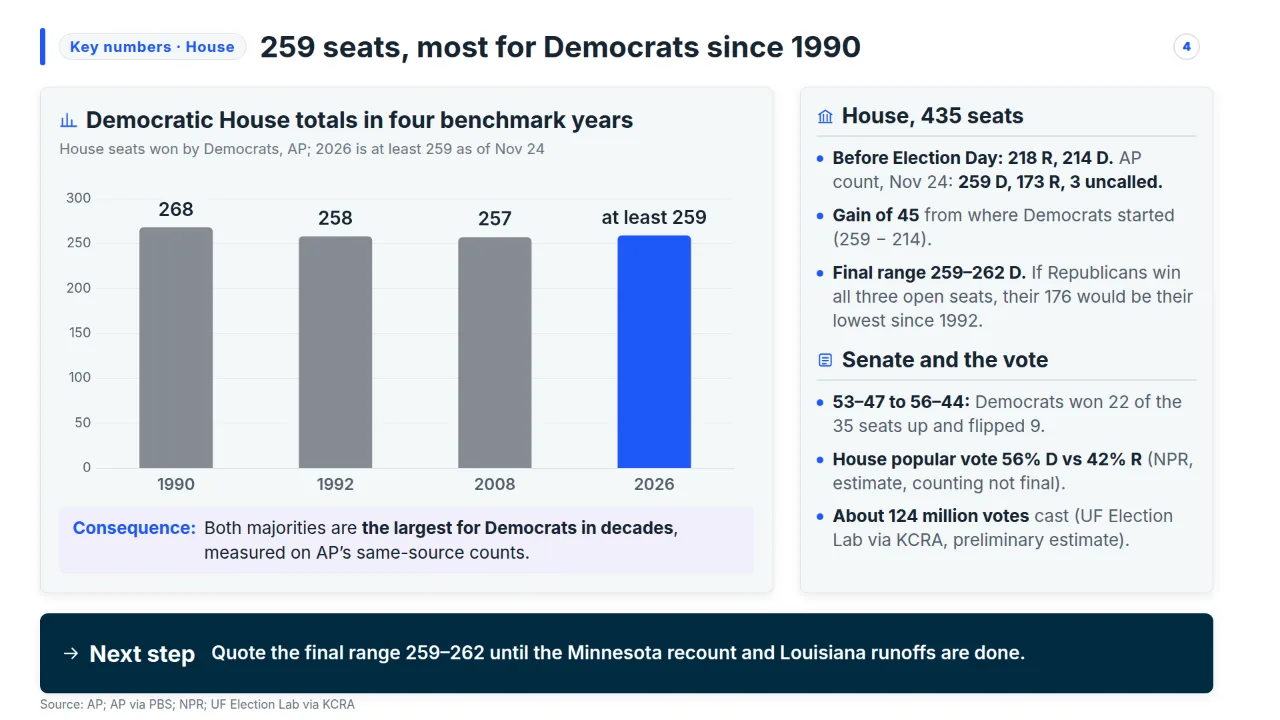
Before the vote Speaker Mike Johnson held what AP called a "narrow 218-214 Republican majority". The 259th seat came on Tuesday, Nov 24, when Democrat Victoria Broderick defeated Republican Rep. Scott DesJarlais in Tennessee. AP says Democrats "have so far gained 45 House seats from where they started on Election Day". The arithmetic checks against the pre-election seats: 259 − 214 = 45.
Other tallies differ because their basis and timing differ. AP's own results analysis counts a gain of 44 over the seats Democrats won in 2024, a different baseline. CBS counts 47 districts shifted to Democrats and three to Republicans, a net of 44 (47 − 3). NBC's results page, at 257 seats, showed 45 flipped and a net gain of 42. This brief follows AP's 45, because AP is the reference tally and its baseline matches 259 − 214.
On historical comparisons, AP says 259 is Democrats' best House result since 1990, when they won 268 seats. It also tops 1992 (258) and 2008 (257). If Republicans win all three remaining contests, their 176 seats would be their lowest House total since 1992. Two other sources give 267 for the comparison year: CFR for 1990 and The Center Square for 1993. The brief uses AP's 268. AP also reports that no Republican defeated an incumbent Democrat this year.
The national House vote has no official total yet. NPR reported 56% for Democrats and 42% for Republicans on Nov 23, a 14-point gap it called the largest for Democrats in 50 years. The New York Times/Siena estimate is D+13 (56% to 43%), and CFR also cites an estimated 13 points. These are estimates until states finish certifying. As of Nov 24, The Center Square reported that 22 states had certified. The material has no official national turnout figure. The University of Florida Election Lab's preliminary estimate, reported by KCRA, is about 124 million votes, compared with 112 million in 2022 and 118.6 million in 2018.
2.2 The Senate: 53–47 to 56–44
Republicans held the Senate 53–47 before the election, according to CBS News. The 47 included two independents who caucus with Democrats. AP's Nov 4 count separates the seats not on the ballot from those won on Nov 3. Adding AP's later calls in Mississippi (Nov 11) and Alaska (Nov 17) gives the final split:
| Senate, 100 seats | Not up in 2026 | Up in 2026 (held before) | Won in 2026 | Total, Jan 2027 |
|---|---|---|---|---|
| Democrats (incl. 2 independents) | 34 | 13 (47 − 34) | 22 (20 + Mississippi + Alaska) | 56 |
| Republicans | 31 | 22 (53 − 31) | 13 | 44 |
Source: AP count via YX Insights; AP race calls. Checks: 34 + 22 = 56; 31 + 13 = 44; 13 + 22 = 35 seats up.
Democrats won 22 of the 35 seats up: they held their 13 and took 9 from Republicans (22 − 13 = 9). Republicans won no Democratic-held seat. AP describes this as the party's biggest midterm Senate gain since 1958. CFR ranks the net gain as tied for third among midterms since 1942. The 56–44 split is Democrats' largest Senate advantage in 16 years; they last held more, 58 seats, at the end of the 111th Congress on Jan 3, 2011. Senate Democratic Leader Chuck Schumer said: "56 seats was an unimaginable result even just a few months ago".
2.3 Seats against the thresholds
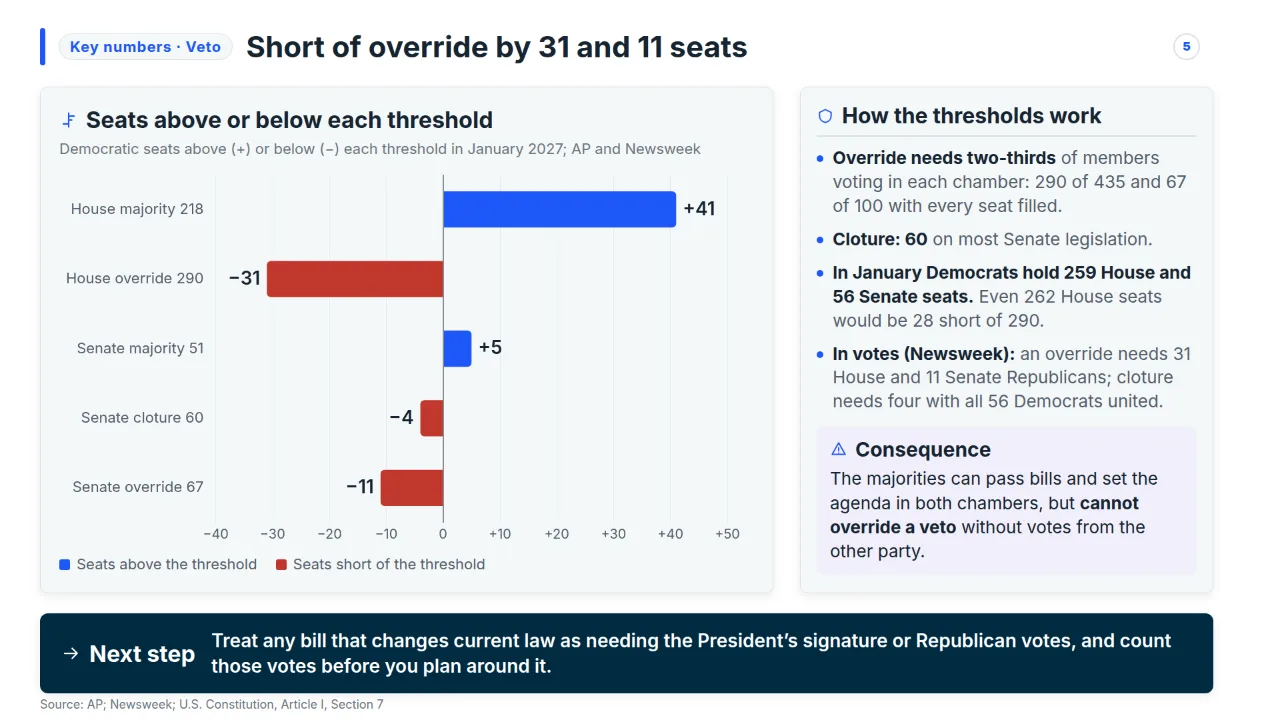
A veto override needs two-thirds of members voting in each chamber. With every seat filled and voting, that is 290 in the House and 67 in the Senate. Cloture on most Senate legislation needs 60 votes.
| Threshold | Basis | Democratic seats, Jan 2027 | Margin |
|---|---|---|---|
| House majority: 218 | More than half of 435 | 259 | +41 (259 − 218) |
| House veto override: 290 | ⅔ × 435 = 290 | 259 | −31 (290 − 259) |
| Senate majority: 51 | More than half of 100 | 56 | +5 (56 − 51) |
| Senate cloture: 60 | Three-fifths of 100 | 56 | −4 (60 − 56) |
| Senate veto override: 67 | ⅔ × 100 = 66.7, rounded up | 56 | −11 (67 − 56) |
Source: seat counts AP; thresholds Newsweek; majority threshold.
Even if Democrats win all three uncalled House seats, 262 seats would leave them 28 short of 290 (290 − 262). Newsweek frames the gaps in votes needed from the other party: 31 House Republicans and 11 Senate Republicans for an override, and four Republicans for cloture with all 56 Democrats united. A 41-seat cushion over 218 means the House majority can pass bills even if dozens of its own members vote no, as AP notes. Chapter 3 covers what this means by sector.
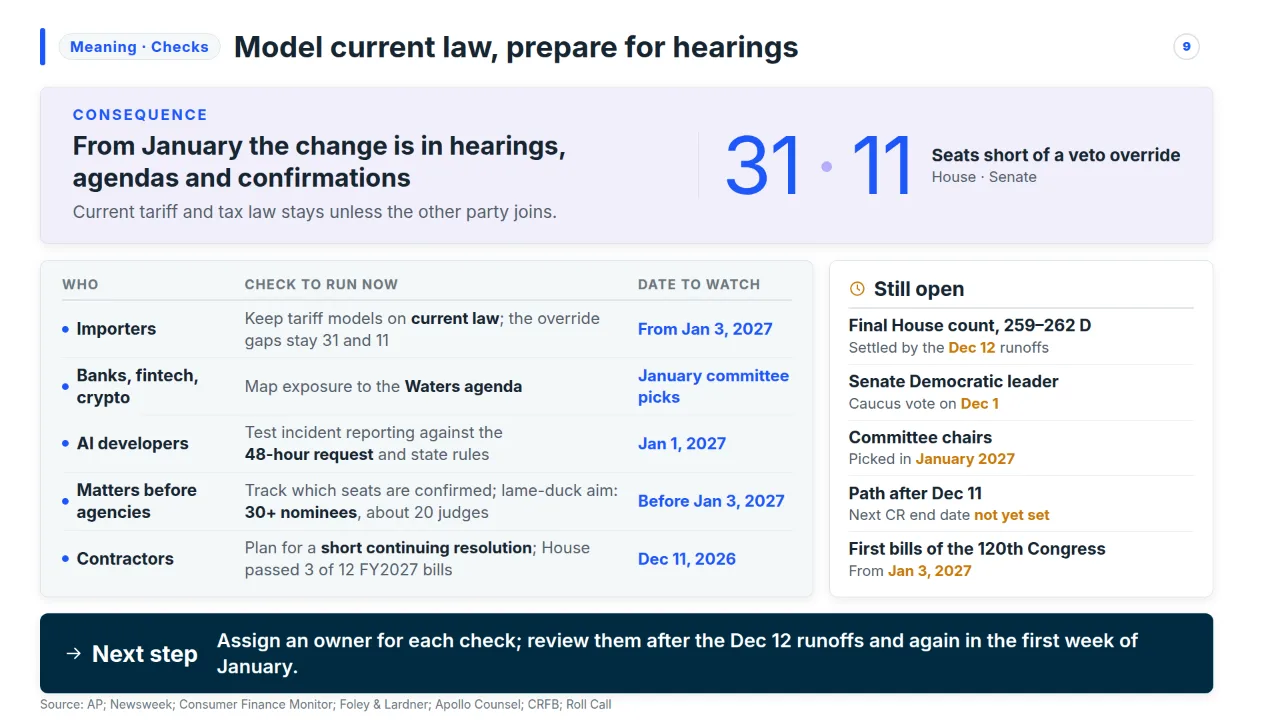
Democrats will hold 259 House seats and 56 Senate seats in January. That is enough to set the agenda, but 31 and 11 seats short of overriding a veto.
3. Who is affected and how
Chapter 2 set the thresholds; this chapter lists what incoming chairs, leaders and the administration say they will do in each business area.
| Area | What changes in January | Who said it / document | Date | Source |
|---|---|---|---|---|
| Trade and tariffs | House vote on tariffs sought within 100 days; Senate bill to repeal Sections 122 and 338 | Hakeem Jeffries letter; Sen. Chuck Schumer, S. 5390 | Nov 2026 | Foley & Lardner; Grant Thornton |
| Tax and budget | Democrats chair Ways and Means and Finance; the 2025 tax law stays in force | Rep. Richard Neal statement; Bilzin Sumberg note | After Nov 4 | Ways and Means Democrats; Bilzin Sumberg |
| Financial services | CFPB funding, junk fees, "housing first" committee | Rep. Maxine Waters letter | Nov 6 | The Hill; Consumer Finance Monitor |
| Tech and AI | Frontier-AI framework; developer-liability draft; possible AI select committee | Sen. Maria Cantwell; Rep. Lori Trahan; House Democrats | Oct 7 (context) to Nov | Foley & Lardner; Jenner & Block |
| Health | Votes to restore ACA tax credits and reverse Medicaid cuts | House Democrats' 100-day agenda | Nov 24 | AP |
| Energy | Data centers; clean-energy tax credits | Rep. Frank Pallone; Democratic campaigns | Nov | Captain Compliance; EUROMETAL |
| Oversight | Chairs hold subpoena power under House Rule XI | Rep. Robert Garcia; Jenner & Block alert | Nov 4 | Jenner & Block |
| Confirmations | Senate majority decides which nominees move | Newsweek interviews | After Nov 17 | Newsweek |
3.1 Trade, tax and the budget
In a letter to colleagues, Hakeem Jeffries urged the House to vote within its first 100 days to "eradicate the Trump tariffs," according to Foley & Lardner. Rep. Richard Neal, the top Democrat on Ways and Means, said voters "are tired of paying for Trump's needless war with Iran and price-hiking tariffs every time they visit the checkout counter or the gas pump". Schumer's End Trump's Tariff Tax Act (S. 5390, introduced) would repeal Section 122 of the Trade Act of 1974 and Section 338 of the Tariff Act of 1930, the basis for 50% tariffs on $20 billion of Canadian imports, according to Grant Thornton. On Nov 12, Neal and Sen. Ron Wyden asked Commerce Secretary Howard Lutnick to preserve records of the Section 232 semiconductor investigation.

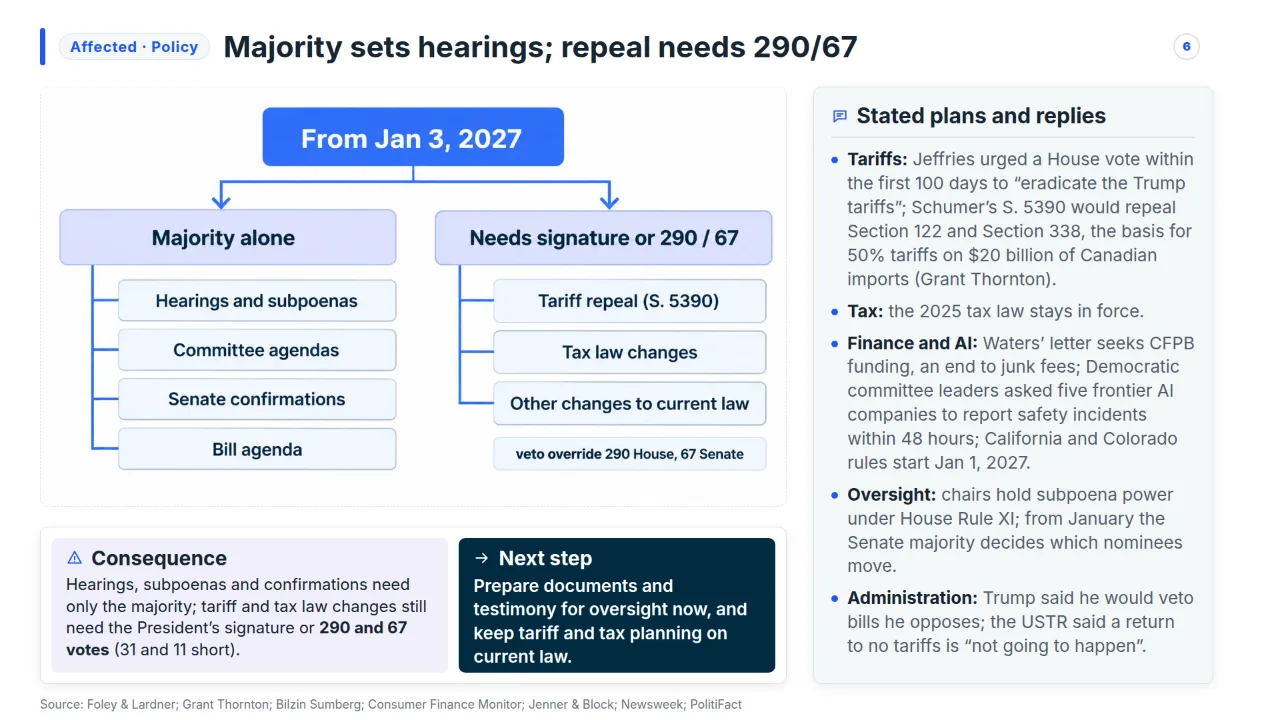
U.S. Trade Representative Jamieson Greer told CNBC on Nov 12 that "with Democrats gaining in the midterms, that has not changed the fact that we have a trillion-dollar trade deficit," and of a return to no tariffs: "That's not going to happen". President Trump told Fox News: "They're in control, but they're really not in control because they can send over, you know, 50 different great bills that they're all excited about, and I send them back with a nice stamp veto" (PolitiFact). A repeal therefore needs his signature or 290 House and 67 Senate votes, 31 and 11 more than Democrats will hold (290 − 259; 67 − 56).
On tax, the One Big Beautiful Bill Act "remains the law, and nothing in it changes because of Tuesday's election," Bilzin Sumberg wrote. What changes is agenda control: revenue bills originate in the House, and reconciliation passes the Senate with 51 votes but can still be vetoed. Current government funding runs to Dec 11 (Quorum); see Chapter 4.
From Jan 3, 2027, incoming chairs control hearings, subpoenas and the Senate confirmation calendar without the President's signature. Changing tariff law or the 2025 tax law still needs his signature or 290 House and 67 Senate votes.
3.2 Financial services, technology, health and energy
On Nov 6, Rep. Maxine Waters sent a five-page letter seeking the Financial Services gavel, built on "affordability, accountability, and accessibility" (Consumer Finance Monitor). It pledges to "permanently and independently fund" the CFPB, end overdraft, late and other fees, rename the panel the "Committee on Housing and Financial Services," and set "tough but fair" rules for "legitimate crypto ventures". Rep. Sean Casten has sought the same gavel since Nov 5.
On AI, Sen. Maria Cantwell, positioned to chair Senate Commerce, released a six-principle framework on Oct 7 (context) calling for NIST safety standards and pre-release audits. According to Foley, Rep. Lori Trahan's CLAIM Act draft would make developers liable for AI harms without preempting state law, and House Democratic committee leaders have asked five frontier AI companies to report safety incidents within 48 hours. Presumptive Energy and Commerce Chair Frank Pallone opposes a proposed AI select committee, saying it would "further delay the legislative process" (Jenner & Block). State automated decision-making rules in California and Colorado take effect Jan 1, 2027.
On health, House Democrats are "planning swift votes" to reverse Medicaid cuts and restore the expired ACA tax credits (AP); no drug-pricing plan from an incoming chair appears in the material. On energy, Pallone has targeted data centers (Captain Compliance), and Democrats campaigned on restoring clean-energy tax credits cut in 2025 (EUROMETAL).
3.3 Oversight, confirmations and the market reaction
House committees hold subpoena power under Rule XI, usually delegated to chairs; committee rules are set in January and February (Jenner & Block). Rep. Robert Garcia, incoming Oversight chair, said on election night: "Lawyer up". Jenner lists his priorities as Trump family business dealings, DHS contracting, HHS vaccine policy and DOGE workforce cuts. White House spokeswoman Lauren Bis told Newsweek that if Democrats pursue "sham investigations and radical left policies," they would be "choosing to work against the American people".
Blocking a nominee needs neither the House nor the President; Casey Burgat of George Washington University called confirmations "the number one thing that is unilaterally in Democrats' control" (Newsweek). In the lame duck, Republicans aim to confirm more than 30 nominees and about 20 judges, including picks for the FDA, FCC, SEC and CFTC; any left unconfirmed must be renominated, according to Apollo Counsel.
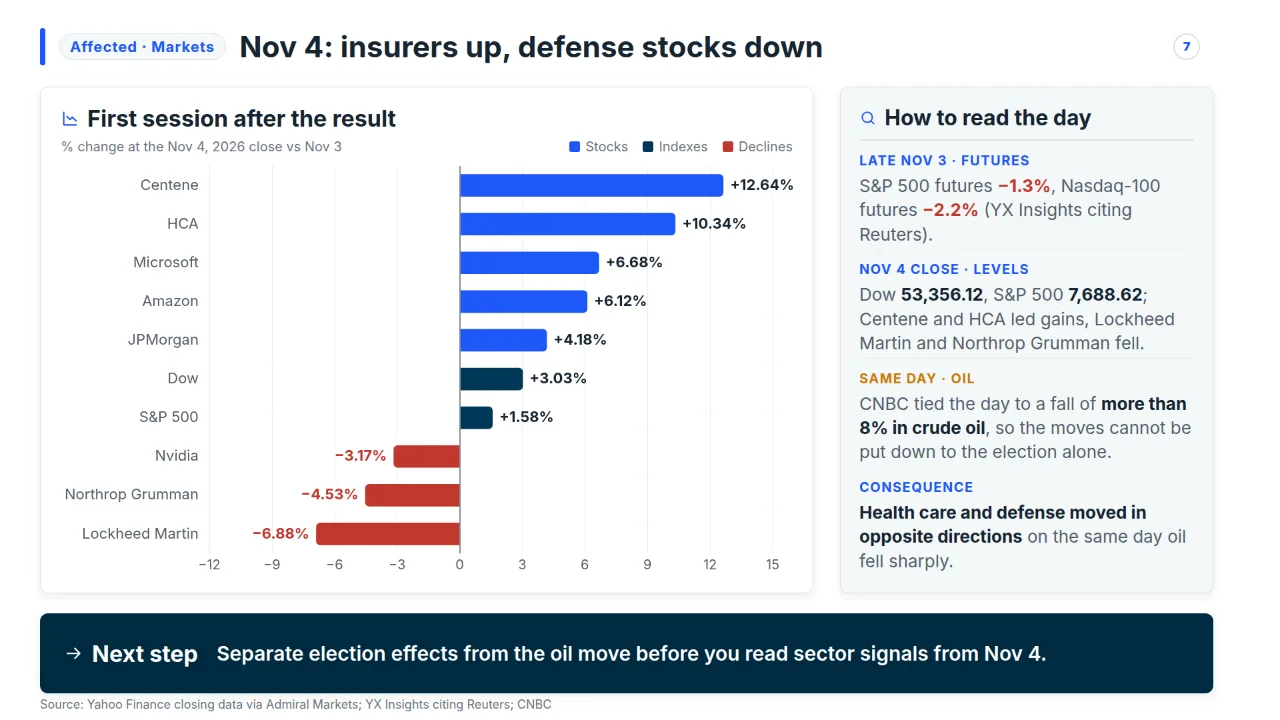
Late on Nov 3, S&P 500 futures fell 1.3% and Nasdaq-100 futures 2.2%, according to YX Insights citing Reuters. Moves at the Nov 4 close are below; CNBC also tied the day to a fall of more than 8% in crude oil, so the move cannot be put down to the election alone.
| Instrument | Nov 4 close vs Nov 3 |
|---|---|
| Centene / HCA Healthcare | +12.64% / +10.34% |
| Microsoft / Amazon | +6.68% / +6.12% |
| JPMorgan / XLF financials fund | +4.18% / +3.51% |
| Dow (53,356.12) / S&P 500 (7,688.62) | +3.03% / +1.58% |
| Nvidia / SOX semiconductor index | −3.17% / −3.13% |
| Lockheed Martin / Northrop Grumman | −6.88% / −4.53% |
Source: Yahoo Finance closing data via Admiral Markets.
4. Timeline and next dates
Chapter 3 set out what the new majorities plan for each business area. This chapter lists the dates already fixed between now and the handover, as of Nov 25, 2026 (US Eastern), and marks those that are not.
| Date | Event | Status | Source |
|---|---|---|---|
| Nov 18–19 | House Democratic leaders elected; Minnesota certifies, MN-1 recount requested | Done | AP; Bring Me The News via Yahoo |
| Nov 30 | MN-1 hand recount begins | Scheduled | ; The Center Square |
| Dec 1 | Senate Democratic leadership elections | Scheduled; time not announced | Roll Call |
| Dec 3 / Dec 8 | MN-1 recount results / certification | Scheduled | — |
| Dec 11, 11:59 p.m. | Continuing resolution and surface transportation authority expire | Set in law | Granted; Quorum |
| Dec 12 | Louisiana runoffs, 5th and 6th districts | Scheduled | Shreveport Times via Yahoo |
| Dec 17 / Dec 18 | House last scheduled day / Senate target adjournment | Planning dates | Quorum |
| Dec 31 | Export-Import Bank and some farm commodity provisions lapse | Set in law | Quorum |
| Jan 3, 2027 | 120th Congress convenes; Speaker roll call | Set | AP |
| January 2027 | House rules package; committees organize | Day not yet set | Jenner & Block |
| Not yet set | Louisiana certification; next CR end date; committee chairs; State of the Union | — | — |
4.1 Closing the House count
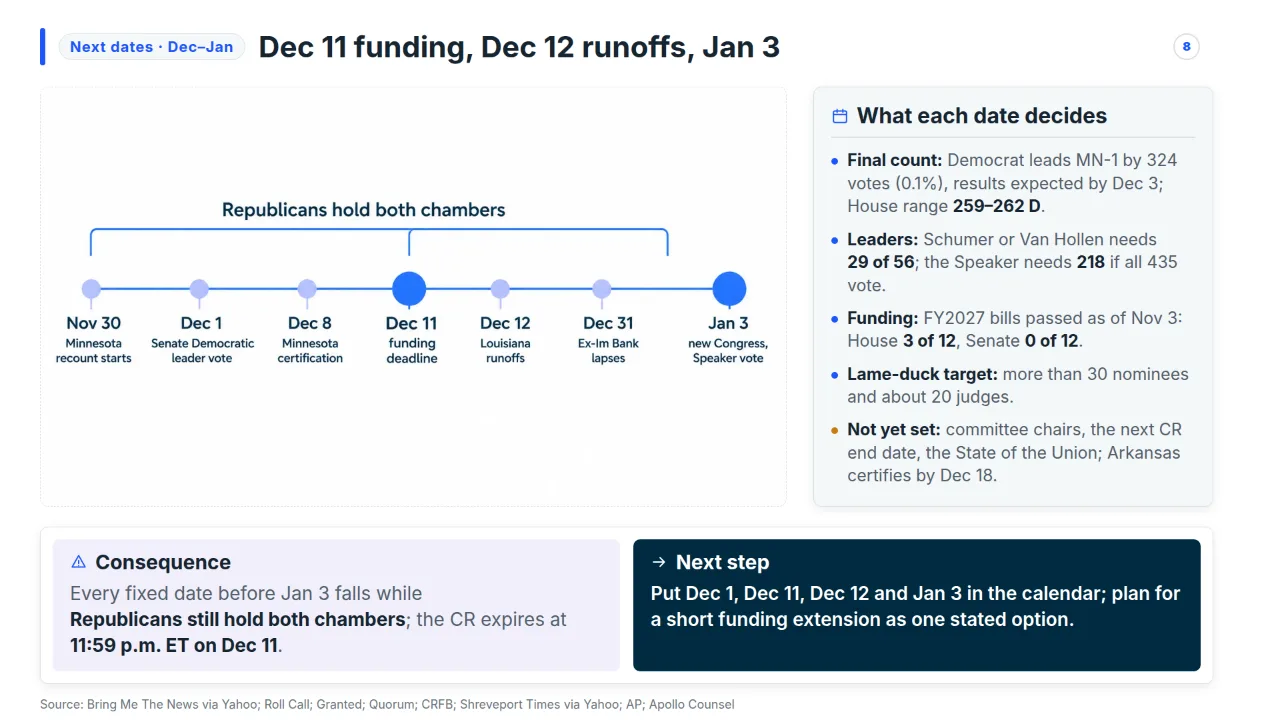
The three House seats AP had not called on Nov 24 (Chapter 2) all have fixed dates. In Minnesota's 1st District, the State Canvassing Board certified on Nov 19 that Democrat Jake Johnson led Rep. Brad Finstad (R) by 324 votes, 0.1% of votes cast. That is within the threshold for a taxpayer-funded recount, and Finstad requested one. The hand count starts on Nov 30 in all 21 counties of the district. Results are expected by Dec 3, and certification of the recount is scheduled for Dec 8.
Louisiana held open primaries on Nov 3, and the top two go to a runoff on Saturday, Dec 12 where no candidate won a majority. Two districts are going to a runoff: in the 5th, Patricia "Pat" Moore (D) faces Gabe Firment (R), and in the 6th, Chauna Banks (D) faces Blake Miguez (R). Official results are expected "before the new year", with no date set, according to The Center Square.
The arithmetic sets a range, not an outcome. Democrats will finish with between 259 and 262 seats (259 + 0 to 3) and Republicans with between 176 and 173 (173 + 3 to 0). Both ends add up to 435. The final count cannot be known before Dec 12. State certification is also still under way. According to The Center Square, 22 states had certified three weeks after Election Day, and Arkansas has the latest deadline, Dec 18.
4.2 The lame duck: Dec 11 and other deadlines
Republicans control both chambers until Jan 3. Funding under the current stopgap, Public Law 119-103, runs out at 11:59 p.m. ET on Friday, Dec 11. When the lame duck began, the House had passed 3 of 12 FY2027 appropriations bills and the Senate 0 of 12 (CRFB, Nov 3). The highway provisions of the 2021 infrastructure law expire the same day.

Every fixed date before Jan 3, 2027 is either part of the count (Nov 30, Dec 8, Dec 12) or part of the budget (Dec 11, 11:59 p.m. ET), and all of them fall while Republicans still hold both chambers.
Members of both parties have stated their positions on the record. House Appropriations Chair Tom Cole (R-Okla.) said: "A lame duck doesn't have to leave full-year bills dead in the water." Sen. Mike Rounds (R-S.D.) said he was not hearing about anything "other than a continuing resolution until sometime in February or March." Ranking member Rosa DeLauro (D-Conn.) favours full-year bills for uncontroversial items and a "short" CR for the rest. The next CR's end date is not yet set.
According to Quorum, Export-Import Bank authorization expires on Dec 31, and some farm commodity provisions revert to older permanent law if Congress does not act by then. Health extenders are on the year-end list, but the material gives no expiry date for them. Quorum, citing No Labels, says the debt limit could be reached as soon as February 2027, which is not a default date. CRFB says the limit must be raised by mid-2027. Both are estimates, and no vote is scheduled. According to Apollo Counsel, Senate Republicans aim to confirm more than 30 nominees and about 20 judges before Jan 3. Nominees still unconfirmed at the end of the session would have to be renominated.
4.3 Leadership votes and Jan 3, 2027
Senate Democrats will elect leaders on Dec 1. Roll Call reported on Nov 17 that they had moved to keep that date after talk of an earlier vote. Chuck Schumer and Chris Van Hollen are running for majority leader, the first contested race for the post since 1994, according to Ballotpedia. In a 56-member caucus, a majority is 29 (56 ÷ 2 + 1), the figure Roll Call gives. On Nov 17, Schumer said: "I'm confident I'll be the next leader. I have the votes." Van Hollen said his bid has "momentum at this point in time, which is why there was an effort to short-circuit the process."
House Democrats finished their leadership elections on Nov 18. Katherine Clark (majority leader), Pete Aguilar (whip) and Ted Lieu (caucus chair) were elected unopposed alongside the Jeffries nomination. On Jan 3, 2027, the full House elects the Speaker by roll call. The winner needs a majority of members voting, which is 218 if all 435 vote. According to Jenner & Block, the January 2027 rules package sets the committees' subpoena rules, and each party's steering committee picks chairs. Committee chairs are not yet set.
5. What it means for decision-makers
Chapters 1–4 give the counts, the stated plans and the dates; this chapter turns them into checks a company can run now. None of it is a forecast of how any vote will go.
5.1 Trade and tax: plan for agenda change, not repeal
Democrats will have the votes to pass bills in both chambers: 259 House seats against a majority of 218 and 56 Senate seats against 51. They will not have the votes to override a veto without the other party: the gaps are 31 seats in the House (290 − 259) and 11 in the Senate (67 − 56), and 4 short of cloture (60 − 56). The President has said he would veto bills he opposes, and the USTR has said a return to no tariffs is "not going to happen". The 2025 tax law stays in force.
- Importers: keep tariff cost models on current law. Track the Jeffries 100-day vote and S. 5390 as signals, and price a repeal only if it gains Republican co-sponsors in numbers that close the 31 and 11 gaps.
- Tax teams: no change to current provisions from the election itself; watch which revenue bills the new Ways and Means chair brings up first.
5.2 Regulated industries: prepare for hearings and document requests
Committee chairs hold subpoena power under House Rule XI, and committee rules are set in January and February. The incoming Oversight chair has named his priorities; Maxine Waters has published a financial-services agenda covering the CFPB, fees and crypto; House Democratic committee leaders have already asked five frontier AI companies to report safety incidents within 48 hours.
- Banks, fintech and crypto firms: map exposure to the Waters letter items before the Financial Services gavel is decided.
- AI developers and deployers: check incident-reporting readiness against the 48-hour request and the California and Colorado rules that take effect Jan 1, 2027.
- Companies with federal contracts or named in oversight lists: review record-keeping now; the Neal–Wyden records-preservation letter on the chips investigation shows the requests have started.
5.3 Agencies and budgets: the lame duck sets the starting point
Until Jan 3, Republicans hold both chambers and aim to confirm more than 30 nominees and about 20 judges, including FDA, FCC, SEC and CFTC picks. From January the Senate majority controls which nominees move. Funding runs out at 11:59 p.m. ET on Dec 11, with 3 of 12 House and 0 of 12 Senate FY2027 bills passed as of Nov 3.
- Companies with matters before those agencies: list which seats are filled by Jan 3 and which would need renomination.
- Federal contractors and grant recipients: plan for a short continuing resolution as one stated option; the next end date is not yet set.
The majorities change who sets the agenda, the hearings and the confirmation calendar from Jan 3, 2027; the veto arithmetic (31 and 11 seats short) is what keeps existing tariff and tax law in place unless the other party joins.
| Check | Why (fact) | Date to watch |
|---|---|---|
| Keep tariff models on current law | Override gaps 31 House / 11 Senate; veto stated | Jan 3, 2027 onward (100-day vote) |
| Map financial-services exposure | Waters agenda; gavel contested | January 2027 committee picks |
| Test AI incident reporting | 48-hour request; state rules | Jan 1, 2027 |
| Review records for oversight | Rule XI subpoenas; preservation letter | Rules package, January 2027 |
| Track agency confirmations | 30+ nominees, ~20 judges in lame duck | Before Jan 3, 2027 |
| Plan for funding gaps | CR ends Dec 11; 3 of 12 bills passed | Dec 11, 2026 |
6. What we don't know yet
The counts and dates in Chapters 1–4 leave several questions open as of Nov 25, 2026. Each one below has a known way to be settled and, where the material gives one, a date.
6.1 The final numbers
- How many House seats will Democrats hold? Between 259 and 262. Minnesota's 1st District, where the Democrat leads by 324 votes, is settled by the recount (results by Dec 3, certification Dec 8); Louisiana's 5th and 6th by the Dec 12 runoffs.
- What is the national House vote? NPR reports 56% to 42% and the NYT/Siena estimate is D+13, but only 22 states had certified as of Nov 24. Final state certifications, the last due Dec 18 in Arkansas, will settle it.
6.2 Who will run what
- Who leads Senate Democrats? Schumer and Van Hollen are both running; the caucus votes on Dec 1 and 29 of 56 votes are needed.
- Who chairs the key House committees? Steering committees pick chairs in January; Financial Services is contested between Waters and Casten, and no chair in the material has been formally chosen.
- Will the Speaker vote on Jan 3 go as nominated? Jeffries was nominated 251–11 by secret ballot; the floor roll call is public.
6.3 What happens first
- How is the Dec 11 funding deadline handled? Members on the record describe both full-year bills and a short continuing resolution; the end date of any new CR is not yet set.
- Which bills come first in January? Stated plans include a House tariff vote within 100 days and health votes on the ACA credits and Medicaid; the order will show in the rules package and the first bills introduced.
- Which nominees are confirmed before Jan 3? Senate Republicans aim for more than 30 nominees and about 20 judges; the Senate's record of votes will settle it.
- When does the debt limit bind? Estimates range from February 2027 to mid-2027; neither is an official date.
The final House count, the Senate Democratic leader and the funding path are all settled by dated events between Nov 30 and Dec 12; committee chairs and the first bills follow in January.
| Question | What would settle it | Expected date or source |
|---|---|---|
| Final House count (259–262 D) | MN-1 recount; Louisiana runoffs | Dec 3 / Dec 8; Dec 12 |
| National House vote | State certifications | By Dec 18 (Arkansas) |
| Senate Democratic leader | Caucus vote, 29 of 56 | Dec 1 |
| House committee chairs | Steering committees; rules package | January 2027 |
| Funding after Dec 11 | New CR or full-year bills | Dec 11, 2026 |
| First bills of the 120th Congress | Introductions and floor schedule | From Jan 3, 2027 |
| Debt-limit date | Treasury notice | Estimates Feb–mid 2027 |
7. References
This document draws on the following 49 sources, listed in the order they are first cited.
- Democrat Hakeem Jeffries is nominated to be House speaker | AP News — apnews.com
- Democrats Win Congress in 2026 Midterms: Market Reaction — yxinsights.com
- Democrats flipped 9 US Senate seats — the most in almost 70 years | PBS News — pbs.org
- Calling control of Congress in the 2026 midterm elections | The Associated Press — ap.org
- Peltola says Alaska voters did not elect her to be partisan | AP News — apnews.com
- Mary Peltola unseats Republican Sen. Dan Sullivan in Alaska | Roll Call — rollcall.com
- Democrats clinch historic House majority, largest since 1992 | AP News — apnews.com
- Rep. Virginia Foxx loses reelection bid after 11 terms - POLITICO — politico.com
- Democrats clinch historic House majority, largest since 1990 | AP News — apnews.com
- Democrat Victoria Broderick wins tight race for Tennessee House seat | AP News — apnews.com
- Sullivan Concedes Alaska Senate Race to Peltola - The New York Times — nytimes.com
- Democrat Mary Peltola flips Alaska Senate seat, defeating GOP Sen. Dan Sullivan — nbcnews.com
- Donald Trump congratulates Democrats after midterm election wins — thehill.com
- PBS NewsHour on Facebook: "President Donald Trump said Friday that the midterm elections would have been a “whole different sto…" — facebook.com
- Democrats win largest House majority since 1992 after flipping North Carolina seat — bbc.com
- Democrats Win 2026 Midterms: What It Means for Markets — admiralmarkets.com
- Measuring Democrats’ House wave | AP News — apnews.com
- Jeffries Wins Democrats' Speaker Nomination, 251–11 — upriseri.com
- No veto-proof majority: what Democrats can and can't do — google.com
- Democrats Have 56 Senate Seats. Is That Enough? - Newsweek — newsweek.com
- Up First briefing: Midterm results; AI; NATO Poland meeting; COP31 : NPR — npr.org
- Democrats have now flipped 47 House seats. Here are all the districts that changed control in the midterms. - CBS News — cbsnews.com
- U.S. House Elections 2026 Live Results: Democrats Win Control — nbcnews.com
- The 2026 Election by the Numbers | Council on Foreign Relations — cfr.org
- Democrats hit 259 seats in U.S. House as states continue to certify results | National | thecentersquare.com — thecentersquare.com
- How Americans Voted in the 2026 Election by Race, Gender, Age and Education - The New York Times — nytimes.com
- 2026 midterm elections: 8charts explain Democratic sweep - KCRA — kcra.com
- What Every Multinational Should Know About … The Impact of the 2026 U.S. Midterm Elections on U.S. Trade Policy | Foley & Lardner — foley.com
- Administration to continue tariff policy post-midterm | Grant Thornton — grantthornton.com
- Neal Statement on Democrats Winning House Majority | Ways and Means - Democrats — democrats-waysandmeans.house.gov
- What a Change in Congressional Majorities Means for Tax and Estate Planning | Bilzin Sumberg - JDSupra — jdsupra.com
- Maxine Waters launches bid for House Financial Services chair — thehill.com
- Maxine Waters’ Blueprint for the House Financial Services Committee: A Preview of the Financial Services Industry’s Congressional Challenges in 2027 — consumerfinancemonitor.com
- Blue Wave, New AI Rules? What Democratic Control of Congress Means for AI Regulation | Foley & Lardner — foley.com
- Democrats Flip the House: Incoming Committee Chairs and Oversight Priorities — jenner.com
- Democrats Win Congress: What It Means for Privacy and AI — captaincompliance.com
- US Midterm Elections: potential effects on steel - EUROMETAL — eurometal.net
- Democrats will soon control Congress. How might Trump use veto power? - KCRA — kcra.com
- The 2026 Lame-Duck Session: What Can Still Pass Before the New Congress | Quorum — quorum.us
- Maxine Waters, Sean Casten battle to lead changing House Financial Services Committee — thehill.com
- Lame Duck Congress 2026: Dec. 11 Deadline and What’s Left | Apollo Counsel — apollocounsel.com
- Finstad requests recount after state certifies Johnson as winner in 1st District — yahoo.com
- Senate Dems dismiss talk of earlier leadership election; Schumer confident — rollcall.com
- Congress Left for Thanksgiving With No Deal for December 11. What Grantees Should Do in the Next 19 Days. | Granted AI — grantedai.com
- Who is running in Louisiana runoff election? See candidates, runoff day — yahoo.com
- Chauna Banks, Blake Miguez advance to runoff for Louisiana’s 6th Congressional District — wafb.com
- Lame Duck Session Shouldn’t Be an Excuse to Borrow More-2026-11-03 — crfb.org
- Lawmakers break for Thanksgiving as year-end agenda looms — thehill.com
- U.S. Senate leadership elections, 120th Congress (2027-2028) - Ballotpedia — ballotpedia.org